engine MERCEDES-BENZ SPRINTER 2010 MY10 Operator’s Manual
[x] Cancel search | Manufacturer: MERCEDES-BENZ, Model Year: 2010, Model line: SPRINTER, Model: MERCEDES-BENZ SPRINTER 2010Pages: 292, PDF Size: 6.75 MB
Page 159 of 292
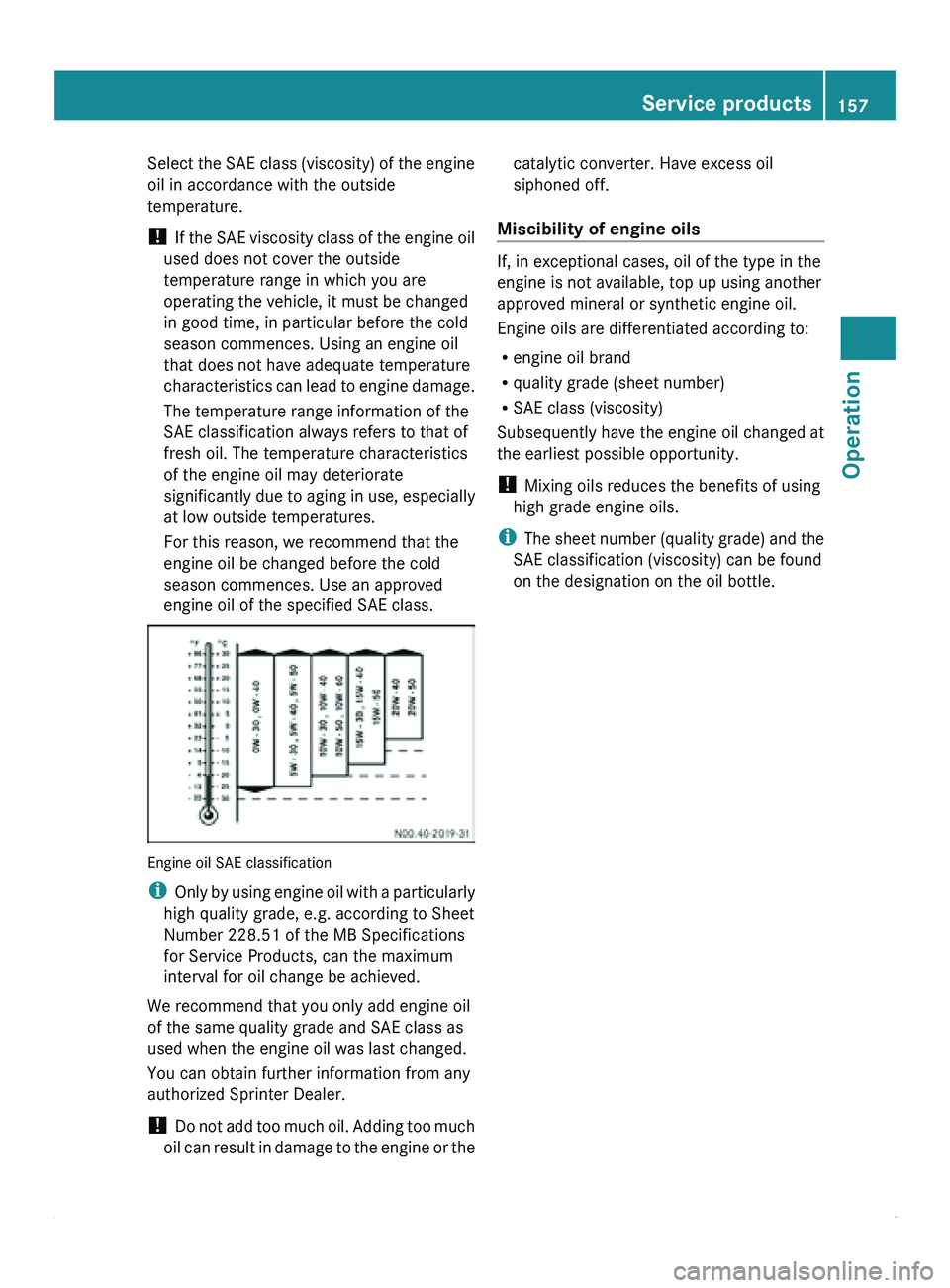
Select the SAE class (viscosity) of the engine
oil in accordance with the outside
temperature.
!
If the SAE
viscosity class of the engine oil
used does not cover the outside
temperature range in which you are
operating the vehicle, it must be changed
in good time, in particular before the cold
season commences. Using an engine oil
that does not have adequate temperature
characteristics can lead to engine damage.
The temperature range information of the
SAE classification always refers to that of
fresh oil. The temperature characteristics
of the engine oil may deteriorate
significantly due to aging in use, especially
at low outside temperatures.
For this reason, we recommend that the
engine oil be changed before the cold
season commences. Use an approved
engine oil of the specified SAE class. Engine oil SAE classification
i
Only by using
engine oil with a particularly
high quality grade, e.g. according to Sheet
Number 228.51 of the MB Specifications
for Service Products, can the maximum
interval for oil change be achieved.
We recommend that you only add engine oil
of the same quality grade and SAE class as
used when the engine oil was last changed.
You can obtain further information from any
authorized Sprinter Dealer.
! Do not add too much oil. Adding too much
oil can result in damage to the engine or the catalytic converter. Have excess oil
siphoned off.
Miscibility of engine oils If, in exceptional cases, oil of the type in the
engine is not available, top up using another
approved mineral or synthetic engine oil.
Engine oils are differentiated according to:
R
engine oil brand
R quality grade (sheet number)
R SAE class (viscosity)
Subsequently have the
engine oil changed at
the earliest possible opportunity.
! Mixing oils reduces the benefits of using
high grade engine oils.
i The sheet number (quality grade) and the
SAE classification (viscosity) can be found
on the designation on the oil bottle. Service products
157
Operation Z
Page 160 of 292
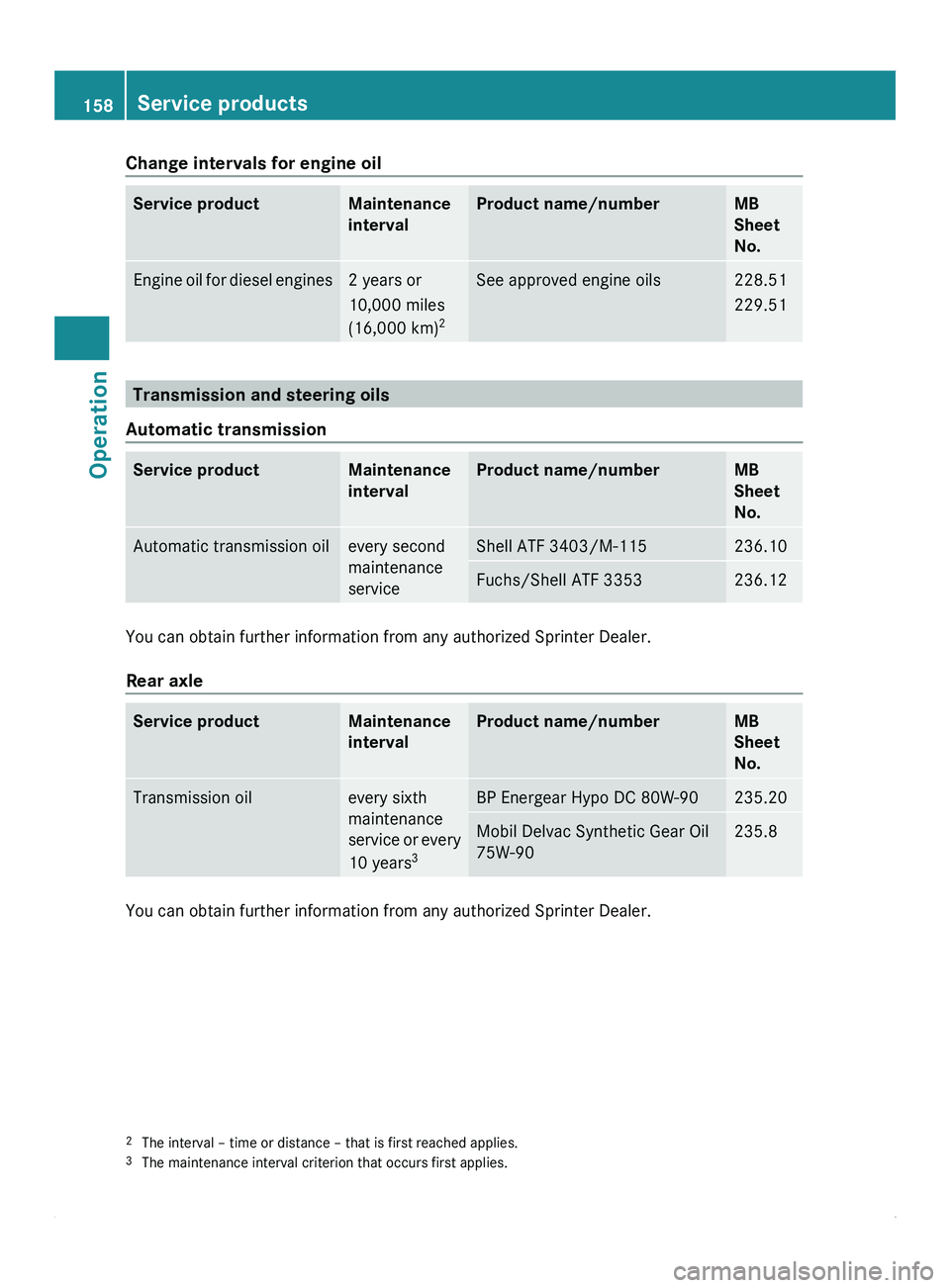
Change intervals for engine oil
Service product Maintenance
interval Product name/number MB
Sheet
No.
Engine oil for diesel engines 2 years or
10,000 miles
(16,000 km)
2 See approved engine oils 228.51
229.51
Transmission and steering oils
Automatic transmission Service product Maintenance
interval Product name/number MB
Sheet
No.
Automatic transmission oil every second
maintenance
service Shell ATF 3403/M-115 236.10
Fuchs/Shell ATF 3353 236.12
You can obtain further information from any authorized Sprinter Dealer.
Rear axle
Service product Maintenance
interval Product name/number MB
Sheet
No.
Transmission oil every sixth
maintenance
service or
every
10 years 3 BP Energear Hypo DC 80W-90 235.20
Mobil Delvac Synthetic Gear Oil
75W-90 235.8
You can obtain further information from any authorized Sprinter Dealer.
2
The interval – time or distance – that is first reached applies.
3 The maintenance interval criterion that occurs first applies.158
Service productsOperation
Page 161 of 292
Steering
Steering, no maintenance required.
Service product Maintenance
interval Product name/number MB
Sheet
No.
Power steering fluid – Mobil ATF-D,
Exxon Mobil Corporation or
equivalent 236.3
You can obtain further information from any authorized Sprinter Dealer.
Brake fluid
G
Warning
Brake fluid is hazardous to health. Do not
swallow brake fluid.
See a doctor immediately
if you swallow brake fluid.
Make sure that brake fluid does not come into
contact with skin, clothing or eyes. Rinse
affected areas with plenty of clean water and
consult a doctor if necessary.
Always wear gloves and eye protection when
topping up brake fluid.
Store brake fluid only in the original closed
container and keep it out of the reach of
children. Comply with safety regulations
when handling brake fluid.
Use only approved brake fluids that comply
with the MB Specification for Service
Products, Sheet No. 331.0. You must observe
the boiling points (DOT 4 plus).
The brake fluid must have the following
characteristics in accordance with the
FMVSS 116 and ISO 4925 standards:
R boiling point (ERBP) of at least
500 ‡(260 †)
R wet boiling point (WERBP) of at least
356 ‡(180 †)
R viscosity of a maximum of 1500 mm²/s
Over a period of time, the brake fluid absorbs
moisture from the air. This reduces its boiling
point. G
Warning
If the boiling point of the brake fluid is too low,
vapor pockets may form in the brake system
when the brakes
are subjected to a heavy load
(e.g. on long downhill stretches). This would
impair braking efficiency. The vehicle's
stopping distance may then be longer. This
increases the risk of an accident.
Have the brake fluid replaced every
two years with brake fluid approved by the
distributor named on the inside of the front
cover and have the replacement confirmed in
the Maintenance Booklet.
i There is usually a notice in the engine
compartment to remind you when the next
brake fluid change is due.
You can obtain further information from any
authorized Sprinter Dealer. Service products
159Operation Z
Page 162 of 292
Change intervals for brake fluid
Service product Maintenance
interval Product name/number MB
Sheet
No.
Brake fluid 2 years Intac B026E
R
Boiling point: 500 ‡(260 †)
R Wet boiling point:
356 ‡ (180 †) 331.0
Coolant
G
Warning
Coolant contains glycol and is therefore toxic.
Do not swallow the coolant. See a doctor
immediately if you swallow coolant.
Make sure that coolant does not come into
contact with skin,
eyes or clothing. In case of
contact with eyes, rinse immediately with
plenty of clean water. Clean affected areas of
skin and clothing with soap and water
immediately. Change any affected clothing
immediately.
Coolant is a mixture of water and antifreeze/
corrosion inhibitor.
In the coolant, the antifreeze/corrosion
inhibitor is responsible for:
R corrosion protection
R antifreeze protection
R raising the boiling point
The coolant must remain in the cooling
system all year round for corrosion protection
purposes and to increase the boiling point –
even in countries with hot climates.
At the factory, the vehicle is filled with a
coolant that ensures protection against frost
and corrosion and which can be mixed with
approved antifreeze/corrosion inhibitors.
! Use only approved antifreeze/corrosion
inhibitors that comply with the MB
Specification for Service Products, Sheet
No. 325. Using other, non-approved
antifreeze/corrosion inhibitors may cause damage to the coolant system and reduce
the engine's service life.
Check the antifreeze/corrosion inhibitor
concentration in the coolant every six
months.
When the coolant is being renewed, the
coolant must contain 50 % by volume of
anticorrosion/antifreeze
agent. This provides
antifreeze protection down to
–34.6 ‡(–37 †).
Do not exceed a proportion of
55 % by volume (antifreeze protection down
to approximately –49.0 ‡ (–45 †)),
otherwise heat dissipation is reduced.
If there is a loss of coolant, do not replenish
with water only, but also add an approved
corrosion inhibitor/antifreeze agent. The
water in the coolant must meet certain
requirements, which are often fulfilled by
drinking water. If the water quality is not
sufficient, you must treat the water.
Observe the MB Specifications for Service
Products, Sheet Number 325.
You can obtain further information from any
authorized Sprinter Dealer. 160
Service products
Operation
Page 163 of 292
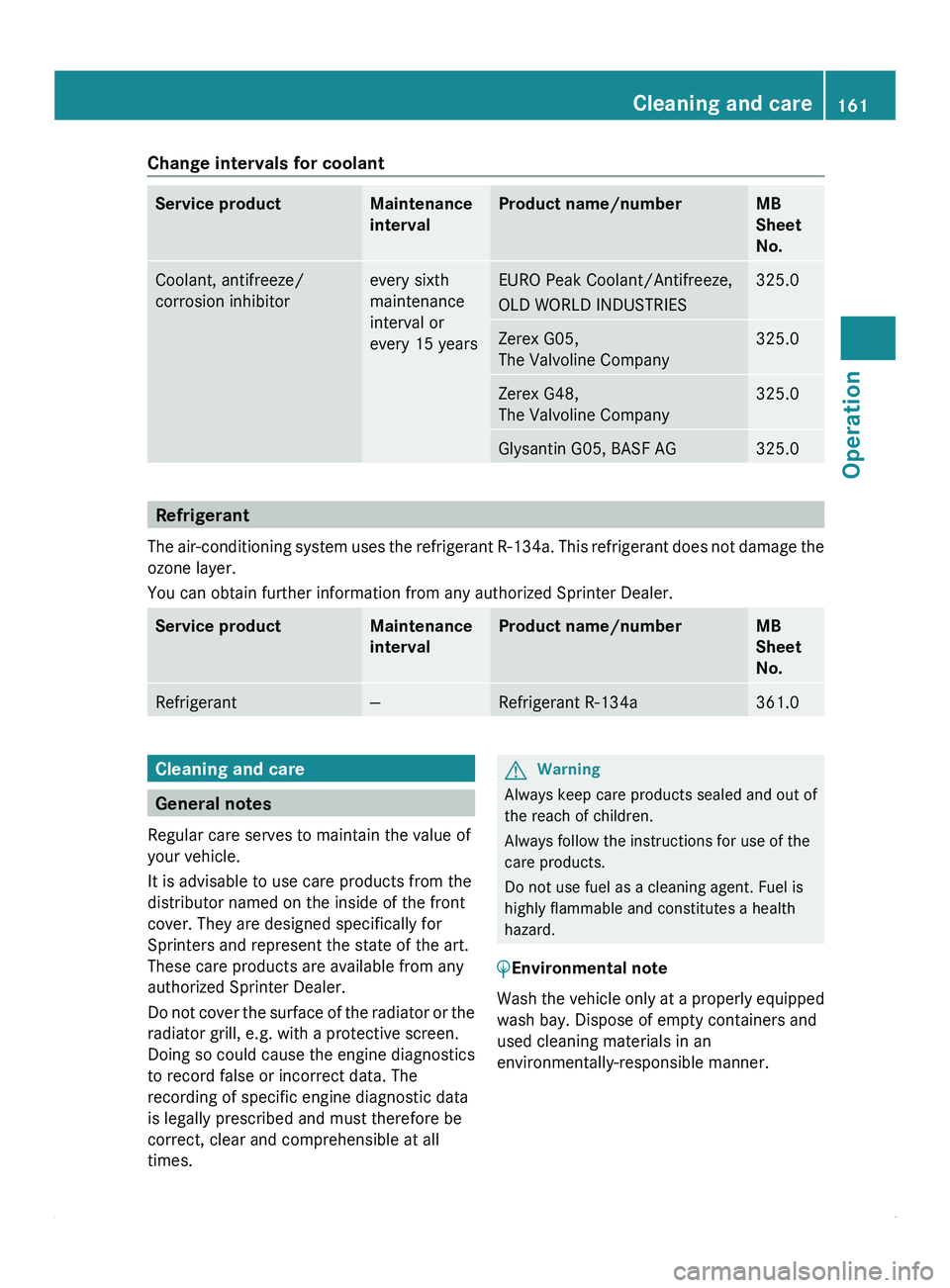
Change intervals for coolant
Service product Maintenance
interval Product name/number MB
Sheet
No.
Coolant, antifreeze/
corrosion inhibitor every sixth
maintenance
interval or
every 15 years EURO Peak Coolant/Antifreeze,
OLD WORLD INDUSTRIES 325.0
Zerex G05,
The Valvoline Company 325.0
Zerex G48,
The Valvoline Company 325.0
Glysantin G05, BASF AG 325.0
Refrigerant
The air-conditioning system
uses the refrigerant R-134a. This refrigerant does not damage the
ozone layer.
You can obtain further information from any authorized Sprinter Dealer. Service product Maintenance
interval Product name/number MB
Sheet
No.
Refrigerant — Refrigerant R-134a 361.0
Cleaning and care
General notes
Regular care serves to maintain the value of
your vehicle.
It is advisable to use care products from the
distributor named on the inside of the front
cover. They are designed specifically for
Sprinters and represent the state of the art.
These care products are available from any
authorized Sprinter Dealer.
Do not cover
the surface of the radiator or the
radiator grill, e.g. with a protective screen.
Doing so could cause the engine diagnostics
to record false or incorrect data. The
recording of specific engine diagnostic data
is legally prescribed and must therefore be
correct, clear and comprehensible at all
times. G
Warning
Always keep care products sealed and out of
the reach of children.
Always follow the instructions for use of the
care products.
Do not use fuel as a cleaning agent. Fuel is
highly flammable and constitutes a health
hazard.
0040Environmental note
Wash the vehicle only at a properly equipped
wash bay. Dispose of empty containers and
used cleaning materials in an
environmentally-responsible manner. Cleaning and care
161
Operation Z
Page 167 of 292
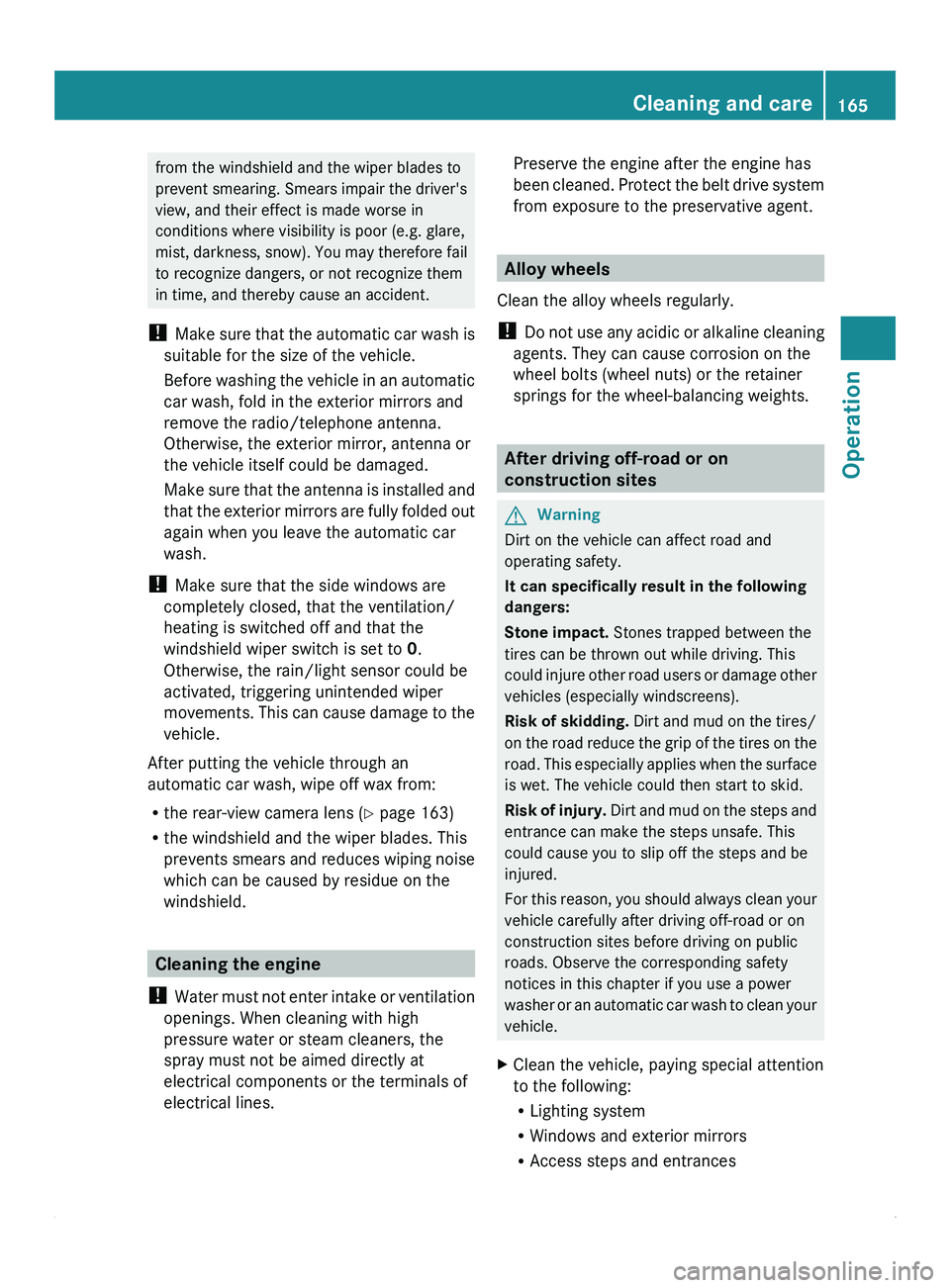
from the windshield and the wiper blades to
prevent smearing.
Smears
impair the driver's
view, and their effect is made worse in
conditions where visibility is poor (e.g. glare,
mist, darkness, snow). You may therefore fail
to recognize dangers, or not recognize them
in time, and thereby cause an accident.
! Make sure that the automatic car wash is
suitable for the size of the vehicle.
Before washing the vehicle in an automatic
car wash, fold in the exterior mirrors and
remove the radio/telephone antenna.
Otherwise, the exterior mirror, antenna or
the vehicle itself could be damaged.
Make sure that the antenna is installed and
that the exterior mirrors are fully folded out
again when you leave the automatic car
wash.
! Make sure that the side windows are
completely closed, that the ventilation/
heating is switched off and that the
windshield wiper switch is set to 0.
Otherwise, the rain/light sensor could be
activated, triggering unintended wiper
movements. This can cause damage to the
vehicle.
After putting the vehicle through an
automatic car wash, wipe off wax from:
R the rear-view camera lens ( Y page 163)
R the windshield and the wiper blades. This
prevents smears and reduces wiping noise
which can be caused by residue on the
windshield. Cleaning the engine
! Water must not
enter intake or ventilation
openings. When cleaning with high
pressure water or steam cleaners, the
spray must not be aimed directly at
electrical components or the terminals of
electrical lines. Preserve the engine after the engine has
been cleaned.
Protect
the belt drive system
from exposure to the preservative agent. Alloy wheels
Clean the alloy wheels regularly.
! Do not use
any acidic or alkaline cleaning
agents. They can cause corrosion on the
wheel bolts (wheel nuts) or the retainer
springs for the wheel-balancing weights. After driving off-road or on
construction sites
G
Warning
Dirt on the vehicle can affect road and
operating safety.
It can specifically result in the following
dangers:
Stone impact. Stones trapped between the
tires can be thrown out while driving. This
could injure other
road users or damage other
vehicles (especially windscreens).
Risk of skidding. Dirt and mud on the tires/
on the road reduce the grip of the tires on the
road. This especially applies when the surface
is wet. The vehicle could then start to skid.
Risk of injury. Dirt and mud on the steps and
entrance can make the steps unsafe. This
could cause you to slip off the steps and be
injured.
For this reason, you should always clean your
vehicle carefully after driving off-road or on
construction sites before driving on public
roads. Observe the corresponding safety
notices in this chapter if you use a power
washer or an automatic car wash to clean your
vehicle.
X Clean the vehicle, paying special attention
to the following:
R
Lighting system
R Windows and exterior mirrors
R Access steps and entrances Cleaning and care
165
Operation Z
Page 169 of 292
authorized Sprinter Dealer. All work relevant
to safety or on safety-related systems must
be carried out at a qualified specialist
workshop.
Observe the notes on parts in the "Technical
data" section ( Y page 276).
0040 Environmental note
Observe measures to protect the
environment when working on the vehicle.
You must observe the legal requirements
when disposing of service products, e.g.
engine oil. This
also includes all components,
e.g. filters, which have come into contact with
service products.
Any qualified specialist workshop, e.g. an
authorized Sprinter Dealer, can provide
information about this.
Dispose of empty containers, cleaning cloths
and care products in an environmentally-
responsible manner. Comply with the
instructions for use of the care products.
Do not run the engine for longer than
necessary when the vehicle is stationary. Active Service System (ASSYST)
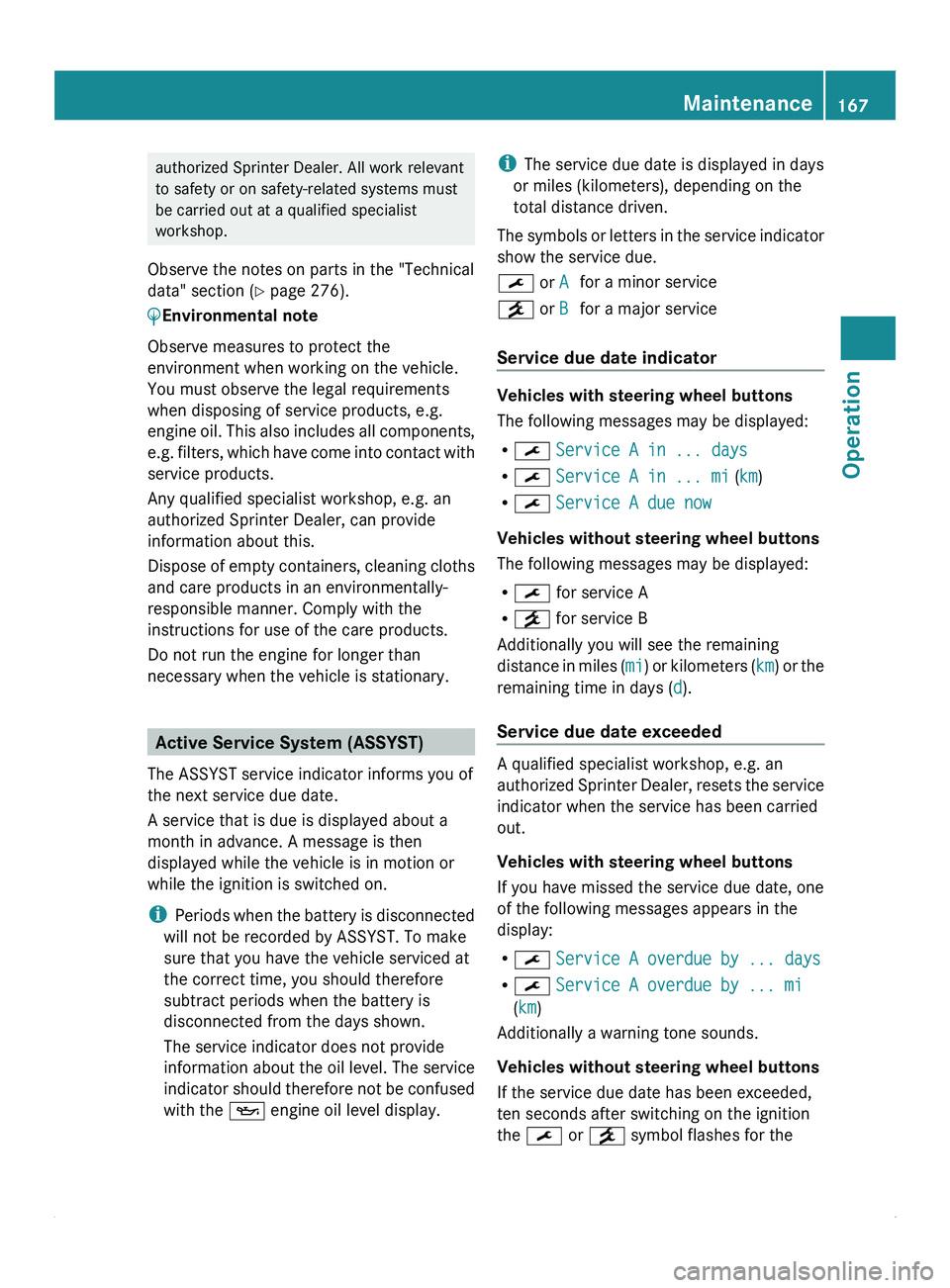
The ASSYST service indicator informs you of
the next service due date.
A service that is due is displayed about a
month in advance. A message is then
displayed while the vehicle is in motion or
while the ignition is switched on.
i Periods when the
battery is disconnected
will not be recorded by ASSYST. To make
sure that you have the vehicle serviced at
the correct time, you should therefore
subtract periods when the battery is
disconnected from the days shown.
The service indicator does not provide
information about the oil level. The service
indicator should therefore not be confused
with the 00B5 engine oil level display. i
The service due date is displayed in days
or miles (kilometers), depending on the
total distance driven.
The symbols or
letters in the service indicator
show the service due.
009B or A for a minor service
009C or B for a major service
Service due date indicator Vehicles with steering wheel buttons
The following messages may be displayed:
R
009B
Service A in ... days
R 009B Service A in ... mi (km)
R 009B Service A due now
Vehicles without steering wheel buttons
The following messages may be displayed:
R 009B for service A
R 009C for service B
Additionally you will see the remaining
distance in
miles
(mi) or kilometers ( km) or the
remaining time in days ( d).
Service due date exceeded A qualified specialist workshop, e.g. an
authorized Sprinter
Dealer,
resets the service
indicator when the service has been carried
out.
Vehicles with steering wheel buttons
If you have missed the service due date, one
of the following messages appears in the
display:
R 009B Service A overdue by ... days
R 009B Service A overdue by ... mi
(km)
Additionally a warning tone sounds.
Vehicles without steering wheel buttons
If the service due date has been exceeded,
ten seconds after switching on the ignition
the 009B or 009C symbol flashes for the Maintenance
167
Operation Z
Page 170 of 292
service. You will also see a minus sign before
the service due date.
Calling up the service due date
X
Turn the key to position 2 in the ignition
lock.
The display is activated.
Vehicles with steering wheel buttons
X Press the 0059 or 0058 button on the
steering wheel repeatedly
until you see the
standard display (Y page 77).
X Press the 0029 or 002D button on the
steering wheel repeatedly
until you see the
following in the display, for example:
R 009B Service A in ... days
R 009B Service A in ... mi (km)
Vehicles without steering wheel buttons
X Press the 007B menu button on the
instrument cluster repeatedly until the
009B or 009C symbol for the service
appears.
Additionally you will see the remaining
distance in miles ( mi) or kilometers ( km) or
the remaining time in days ( d).Hood
Opening the hood G
Warning
Do not pull the release lever while the vehicle
is in motion.
If you do so, the hood may open
up and block your view. G
Warning!
There is a risk of injury if the hood is open,
even if the engine is not running.
Some engine components can become very
hot.
To avoid the risk of burns, only touch those
components described in the Operator's
Manual and observe
the relevant safety notes. G
Warning
The radiator fan between the radiator and the
engine can start
automatically, even if the key
has been removed from the ignition lock.
Keep away from the area of rotation of the fan
blades. You could otherwise be injured.
The electronic injector control operates at
high voltage. For this reason, you must never
touch injection system components while:
R the engine is running.
R the engine is being started.
R the ignition is switched on.
You could otherwise receive an electric shock
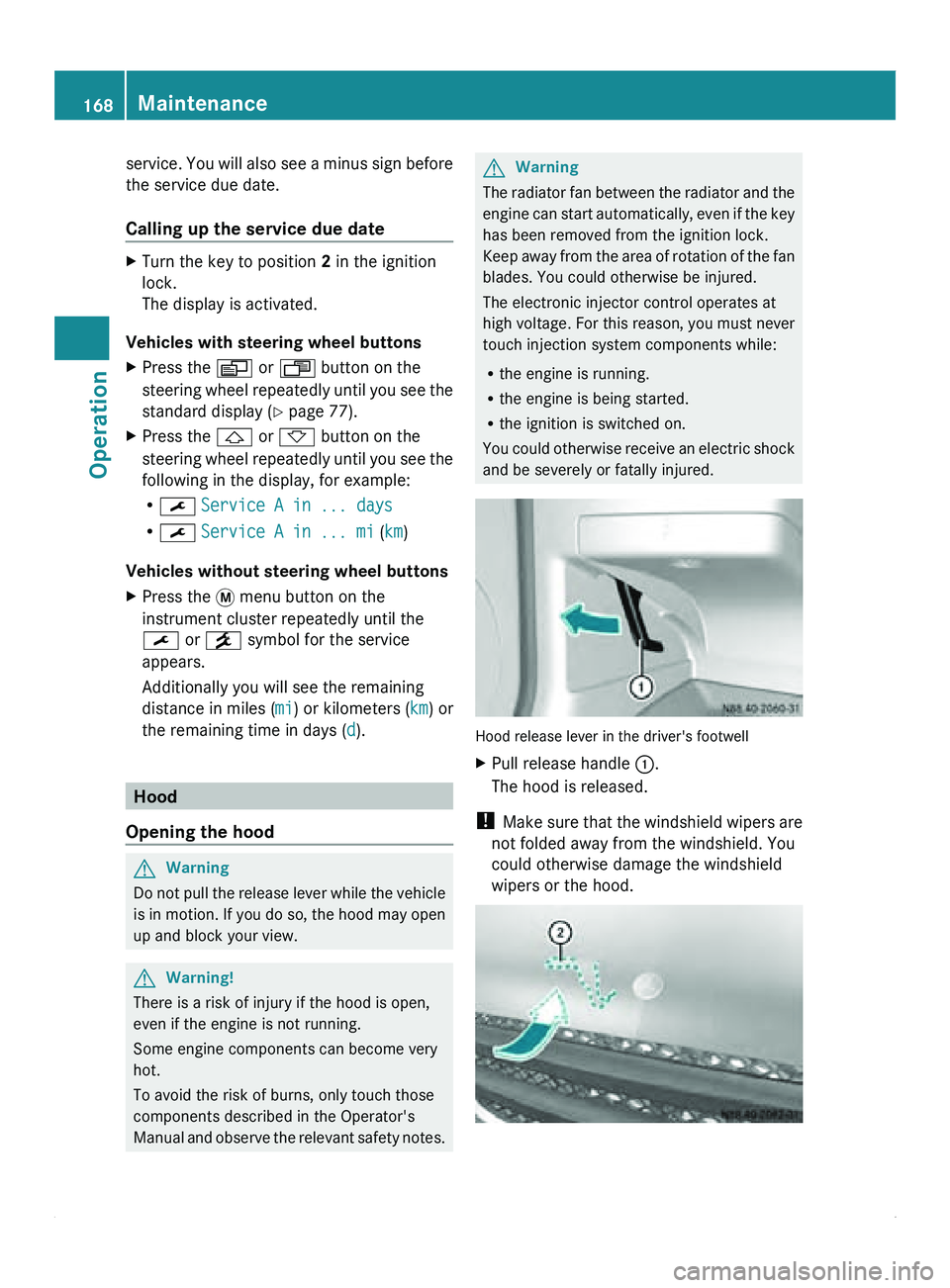
and be severely or fatally injured. Hood release lever in the driver's footwell
X
Pull release handle 0046.
The hood is released.
! Make sure
that
the windshield wipers are
not folded away from the windshield. You
could otherwise damage the windshield
wipers or the hood. 168
Maintenance
Operation
Page 171 of 292
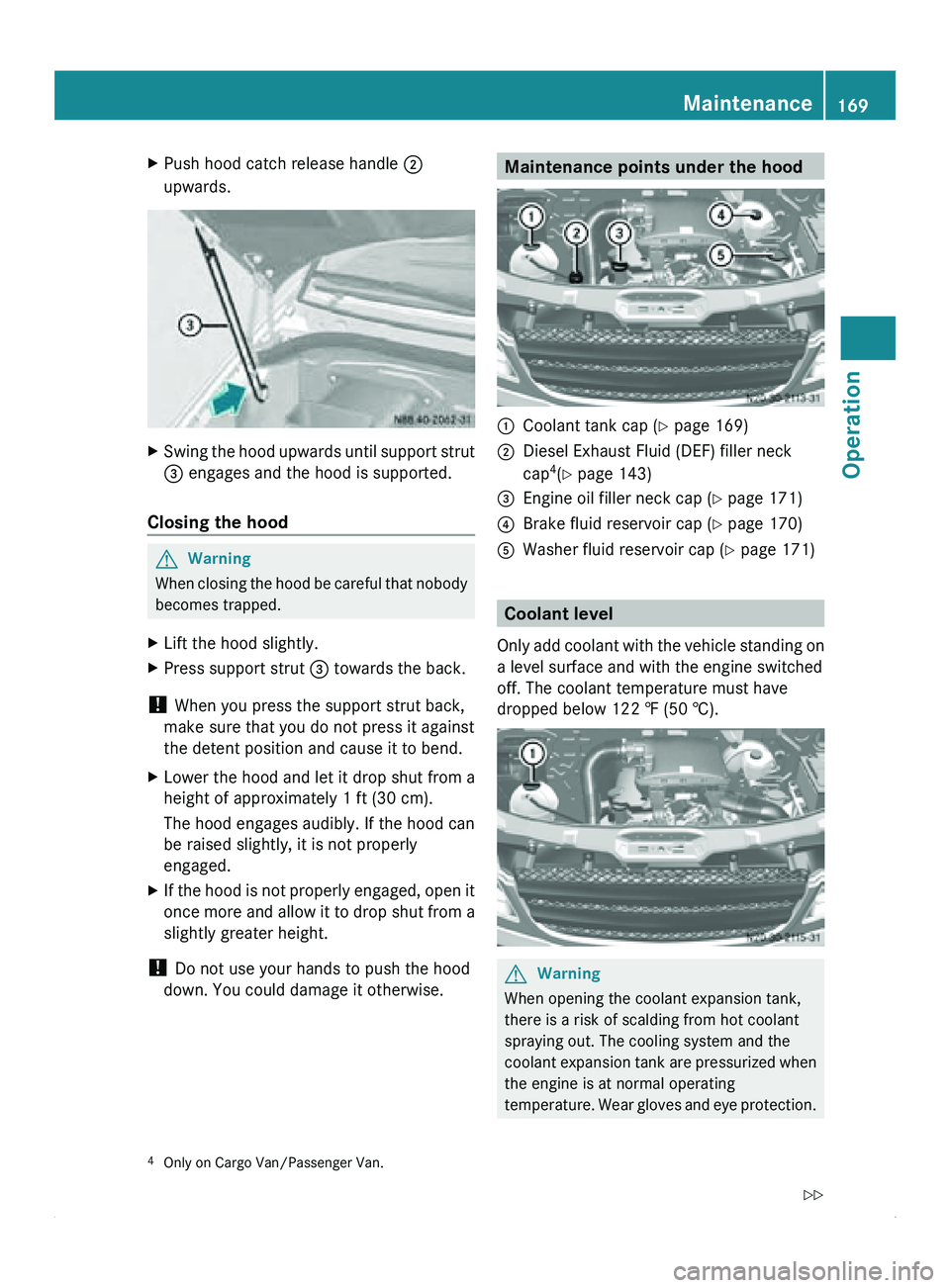
X
Push hood catch release handle 0047
upwards. X
Swing the hood upwards until support strut
008A engages and the hood is supported.
Closing the hood G
Warning
When closing the hood be careful that nobody
becomes trapped.
X Lift the hood slightly.
X Press support strut 008A towards the back.
! When you press the support strut back,
make sure that you do not press it against
the detent position and cause it to bend.
X Lower the hood and let it drop shut from a
height of approximately 1 ft (30 cm).
The hood engages audibly. If the hood can
be raised slightly, it is not properly
engaged.
X If
the hood is not properly engaged, open it
once more and
allow it to drop shut from a
slightly greater height.
! Do not use your hands to push the hood
down. You could damage it otherwise. Maintenance points under the hood
0046
Coolant tank cap (Y page 169)
0047 Diesel Exhaust Fluid (DEF) filler neck
cap 4
(Y page 143)
008A Engine oil filler neck cap (Y page 171)
0088 Brake fluid reservoir cap (Y page 170)
0086 Washer fluid reservoir cap (Y page 171) Coolant level
Only add coolant
with the vehicle standing on
a level surface and with the engine switched
off. The coolant temperature must have
dropped below 122 ‡ (50 †). G
Warning
When opening the coolant expansion tank,
there is a risk of scalding from hot coolant
spraying out. The cooling system and the
coolant expansion tank
are pressurized when
the engine is at normal operating
temperature. Wear gloves and eye protection.
4 Only on Cargo Van/Passenger Van. Maintenance
169
Operation
Z
Page 172 of 292
Only open the coolant expansion tank when
the coolant temperature is below 122 ‡
(50 †).
G
Warning
Coolant contains glycol and is therefore toxic.
Do not swallow the coolant. See a doctor
immediately if you swallow coolant.
Make sure that coolant does not come into
contact with skin,
eyes or clothing. In case of
contact with eyes, rinse immediately with
plenty of clean water. Clean affected areas of
skin and clothing with soap and water
immediately. Change any affected clothing
immediately.
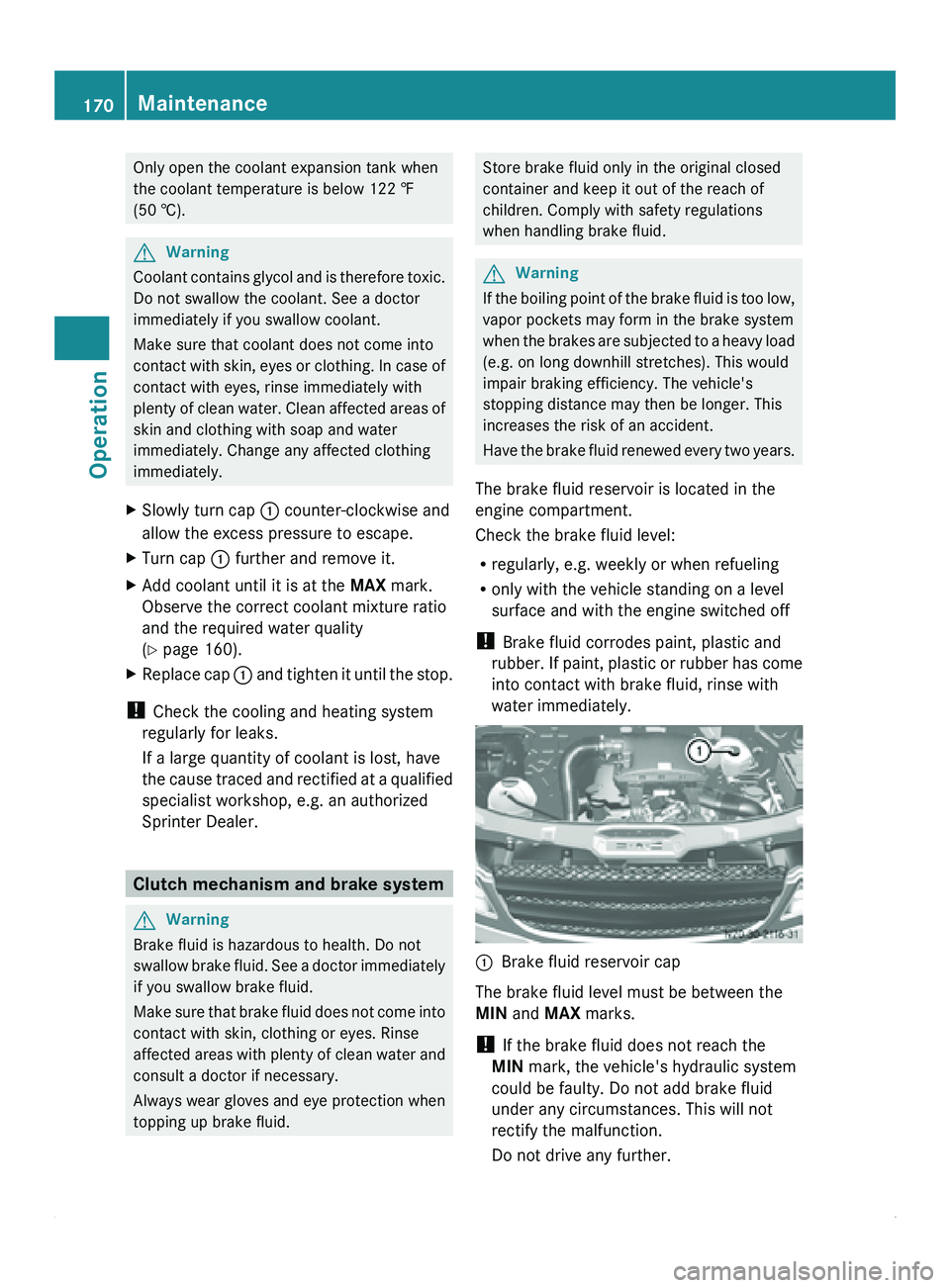
X Slowly turn cap 0046 counter-clockwise and
allow the excess pressure to escape.
X Turn cap 0046 further and remove it.
X Add coolant until it is at the MAX mark.
Observe the correct coolant mixture ratio
and the required water quality
(Y page 160).
X Replace cap 0046 and tighten
it until the stop.
! Check the cooling and heating system
regularly for leaks.
If a large quantity of coolant is lost, have
the cause traced
and rectified at a qualified
specialist workshop, e.g. an authorized
Sprinter Dealer. Clutch mechanism and brake system
G
Warning
Brake fluid is hazardous to health. Do not
swallow brake fluid.
See a doctor immediately
if you swallow brake fluid.
Make sure that brake fluid does not come into
contact with skin, clothing or eyes. Rinse
affected areas with plenty of clean water and
consult a doctor if necessary.
Always wear gloves and eye protection when
topping up brake fluid. Store brake fluid only in the original closed
container and keep it out of the reach of
children. Comply with safety regulations
when handling brake fluid.
G
Warning
If the
boiling point of the brake fluid is too low,
vapor pockets may form in the brake system
when the brakes
are subjected to a heavy load
(e.g. on long downhill stretches). This would
impair braking efficiency. The vehicle's
stopping distance may then be longer. This
increases the risk of an accident.
Have the brake fluid renewed every two years.
The brake fluid reservoir is located in the
engine compartment.
Check the brake fluid level:
R regularly, e.g. weekly or when refueling
R only with the vehicle standing on a level
surface and with the engine switched off
! Brake fluid corrodes paint, plastic and
rubber. If paint, plastic or rubber has come
into contact with brake fluid, rinse with
water immediately. 0046
Brake fluid reservoir cap
The brake fluid level must be between the
MIN and
MAX marks.
! If the brake fluid does not reach the
MIN mark, the vehicle's hydraulic system
could be faulty. Do not add brake fluid
under any circumstances. This will not
rectify the malfunction.
Do not drive any further. 170
Maintenance
Operation