child restraint MERCEDES-BENZ SPRINTER 2014 MY14 Operator’s Manual
[x] Cancel search | Manufacturer: MERCEDES-BENZ, Model Year: 2014, Model line: SPRINTER, Model: MERCEDES-BENZ SPRINTER 2014Pages: 338, PDF Size: 6.78 MB
Page 53 of 338
G
WARNING
Accident statistics show that children
secured in the rear seats are safer than chil-
dren secured in the co-driver's seat. For this
reason, we strongly advise that you always
secure children in the rear seats. Regardless
of the seat position, children under 12 years
must be secured correctly in a suitable infant
or child restraint system or booster seat suit-
able for the size and weight of the child.
Never place anything between the seat cush-
ion and child seat (e.g. pillow). The bottom of
the child seat must make full contact with the
vehicle seat cushion. An incorrectly mounted
child seat could cause injuries to the child in
the event of an accident, instead of protecting
the child.
The infant or child restraint must be properly
secured with the vehicle's seat belt, the seat
belt and Top Tether strap, or lower anchors
and Top Tether strap, fully in accordance with
the child seat manufacturer's instructions.
Always observe the manufacturer's instruc-
tions when installing special child restraint
systems.
Occupants, in particular children, must sit as
upright as possible, fasten the seat belt cor-
rectly and use a suitable infant restraint sys-
tem, child restraint system or booster seat
suitable for the size and weight of the child.
Children can be seriously or even fatally
injured by an air bag deploying. Observe the
following important information if it is abso-
lutely necessary to carry a child on the co-
driver's seat:
R The co-driver's front air bag is not deacti-
vated.
R Never secure your child in a rearward-
facing child restraint system on the co-driv-
er's seat. A child in a rearward-facing child
restraint system on the co-driver's seat can
be seriously injured or even killed if the co-
driver's front air bag deploys. Only install a rearward-facing child restraint system on a
suitable rear seat.
R Where permitted by state law, if you secure
your child in a forward-facing child restraint
system on the co-driver's seat, move the
co-driver's seat as far back to the rear as
possible. You must then use an appropri-
ately sized child restraint system recom-
mended for the age, size and weight of the
child and secure it with the vehicle seat belt
in accordance with the child seat manufac-
turer's instructions. G
WARNING
Infants and small children should never share
a seat belt with another occupant. In the event
of an accident, they could be crushed
between the occupant and seat belt.
A child's risk of serious or fatal injuries is sig-
nificantly increased if the child restraints are
not properly secured in the vehicle and/or the
child is not properly secured in the child
restraint.
Children that are too large for a child restraint
must travel in seats using normal seat belts.
Position the shoulder belt across the chest
and shoulder, not the face or neck. A booster
seat may be necessary to achieve proper seat
belt positioning for children over 41 lbs
(18 kg) until they reach a height where a lap/
shoulder belt fits properly without a booster
seat.
When the child restraint is not in use, remove
it from the vehicle or secure it with the seat
belt to prevent the child restraint from becom-
ing a projectile in the event of an accident. G
WARNING
When extending or retracting, parts of the
body could become trapped within the sweep
of the roller sunblind. There is a risk of injury.
When extending or retracting, make sure that
no one has any parts of the body within the
sweep of the roller sunblind. If someone
becomes trapped, briefly press the button Child restraint systems
51Safety
Z
Page 54 of 338
again. The opening or closing procedure will
be stopped. G
WARNING
If the child restraint system is installed incor-
rectly or is not secured, it can come loose in
the event of an accident, heavy braking or a
sudden change in direction. The child
restraint system could be thrown about, strik-
ing vehicle occupants. There is an increased
risk of injury, possibly even fatal.
Always install child restraint systems prop-
erly, even if they are not being used. Make
sure that you observe the child restraint sys-
tem manufacturer's installation instructions.
Further information on secure stowage of
loads can be found under "Loading guide-
lines".
If an infant or child is traveling in the vehicle:
R secure the child with a child or infant seat
restraint system appropriate to the age and
weight of the child
R make sure that the infant or child is prop-
erly secured at all times while the vehicle
is in motion.
We recommend that you always properly
secure all infants and children in an infant or
child restraint system for the journey.
The use of seat belts and infant and child
restraint systems is required by law in:
R all 50 states
R the U.S. territories
R the District of Columbia
R all Canadian provinces
Infants and children must always be seated in
an appropriate infant or child restraint system
recommended for the size and weight of the
child. This must be properly secured in
accordance with the manufacturer's installa-
tion instructions for the infant or child seat
restraint system. All infant or child restraint systems must meet
the following standards:
R
U.S. Federal Motor Vehicle Safety Stand-
ards 213 and 225
R Canadian Motor Vehicle Safety Standards
213 and 210.2
A statement by the child restraint manufac-
turer of compliance with these standards can
be found on the instruction label on the child
restraint system. You will also find the state-
ment in the instruction manual provided with
the child restraint system.
When using any infant restraint, child
restraint or booster seat, make sure to care-
fully read and follow all manufacturer's
instructions for installation and use.
Observe the warning labels in the vehicle
interior or on the infant or child restraint. LATCH-type (ISOFIX) child seat secur-
ing system
G
WARNING
Children that are too large for a child restraint
must travel in seats using normal seat belts.
Position shoulder belt across the chest and
shoulder, not face or neck.
A booster seat may be necessary to achieve
proper seat belt positioning for children over
41 lb (18 kg) until they reach a height where
a lap/shoulder belt fits properly without a
booster.
Install the child restraint system in accord-
ance with the manufacturer's instructions.
Attach the child restraint system to both
securing rings.
An incorrectly installed child restraint system
could come loose during an accident and ser-
iously or even fatally injure the child.
Child restraint systems or child seat securing
rings that are malfunctioning or damaged as
the result of a collision must be replaced. 52
Child restraint systemsSafety
Page 55 of 338
These include, for example:
R
Top Tether belt
R Seat belts
R LATCH-type (ISOFIX) child seat securing
system
! When installing the child restraint system,
make sure that the seat belt for the middle
seat does not get trapped. 0043
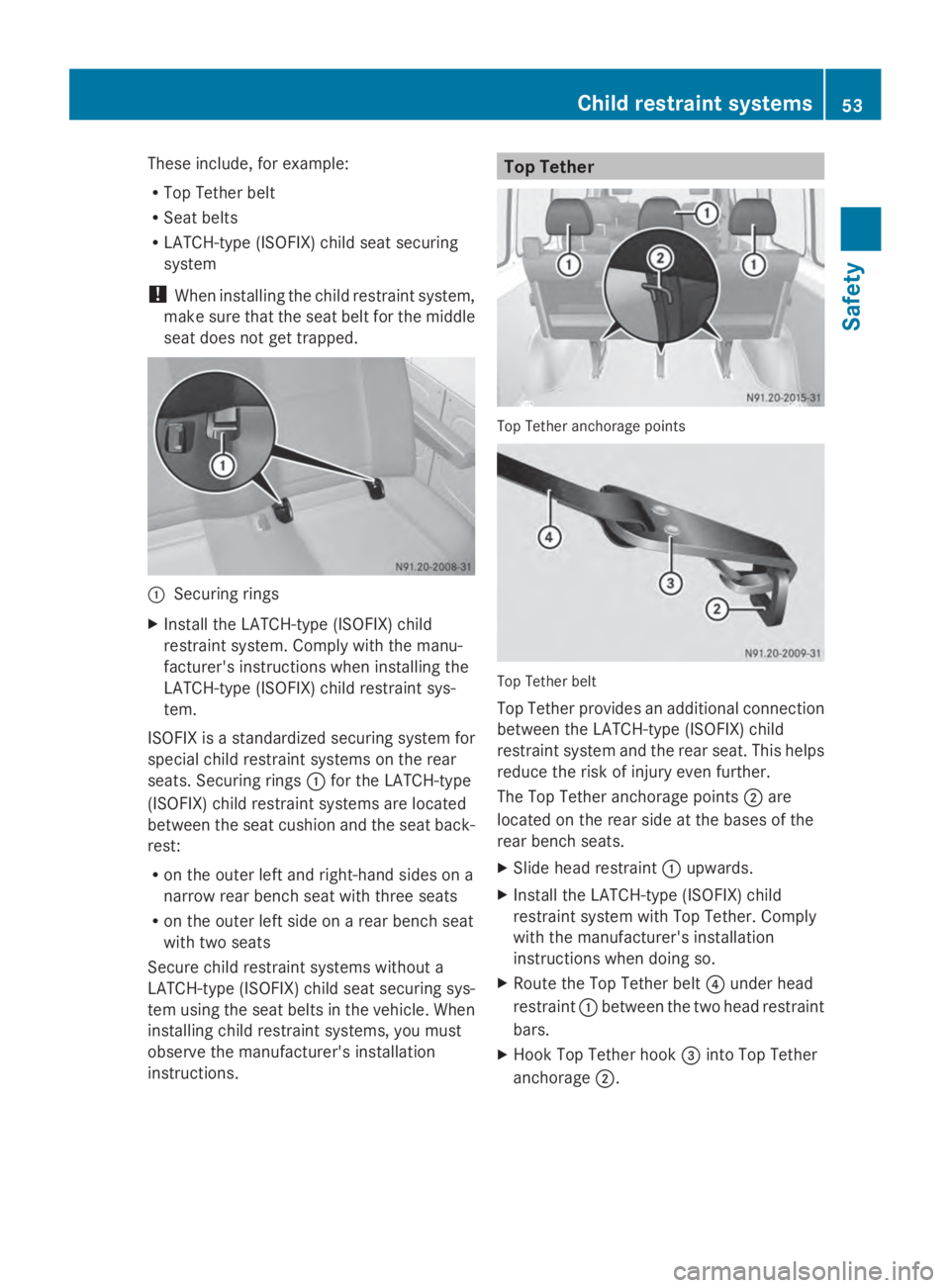
Securing rings
X Install the LATCH-type (ISOFIX) child
restraint system. Comply with the manu-
facturer's instructions when installing the
LATCH-type (ISOFIX) child restraint sys-
tem.
ISOFIX is a standardized securing system for
special child restraint systems on the rear
seats. Securing rings 0043for the LATCH-type
(ISOFIX) child restraint systems are located
between the seat cushion and the seat back-
rest:
R on the outer left and right-hand sides on a
narrow rear bench seat with three seats
R on the outer left side on a rear bench seat
with two seats
Secure child restraint systems without a
LATCH-type (ISOFIX) child seat securing sys-
tem using the seat belts in the vehicle. When
installing child restraint systems, you must
observe the manufacturer's installation
instructions. Top Tether
Top Tether anchorage points
Top Tether belt
Top Tether provides an additional connection
between the LATCH-type (ISOFIX) child
restraint system and the rear seat. This helps
reduce the risk of injury even further.
The Top Tether anchorage points
0044are
located on the rear side at the bases of the
rear bench seats.
X Slide head restraint 0043upwards.
X Install the LATCH-type (ISOFIX) child
restraint system with Top Tether. Comply
with the manufacturer's installation
instructions when doing so.
X Route the Top Tether belt 0085under head
restraint 0043between the two head restraint
bars.
X Hook Top Tether hook 0087into Top Tether
anchorage 0044. Child restraint systems
53Safety Z
Page 56 of 338
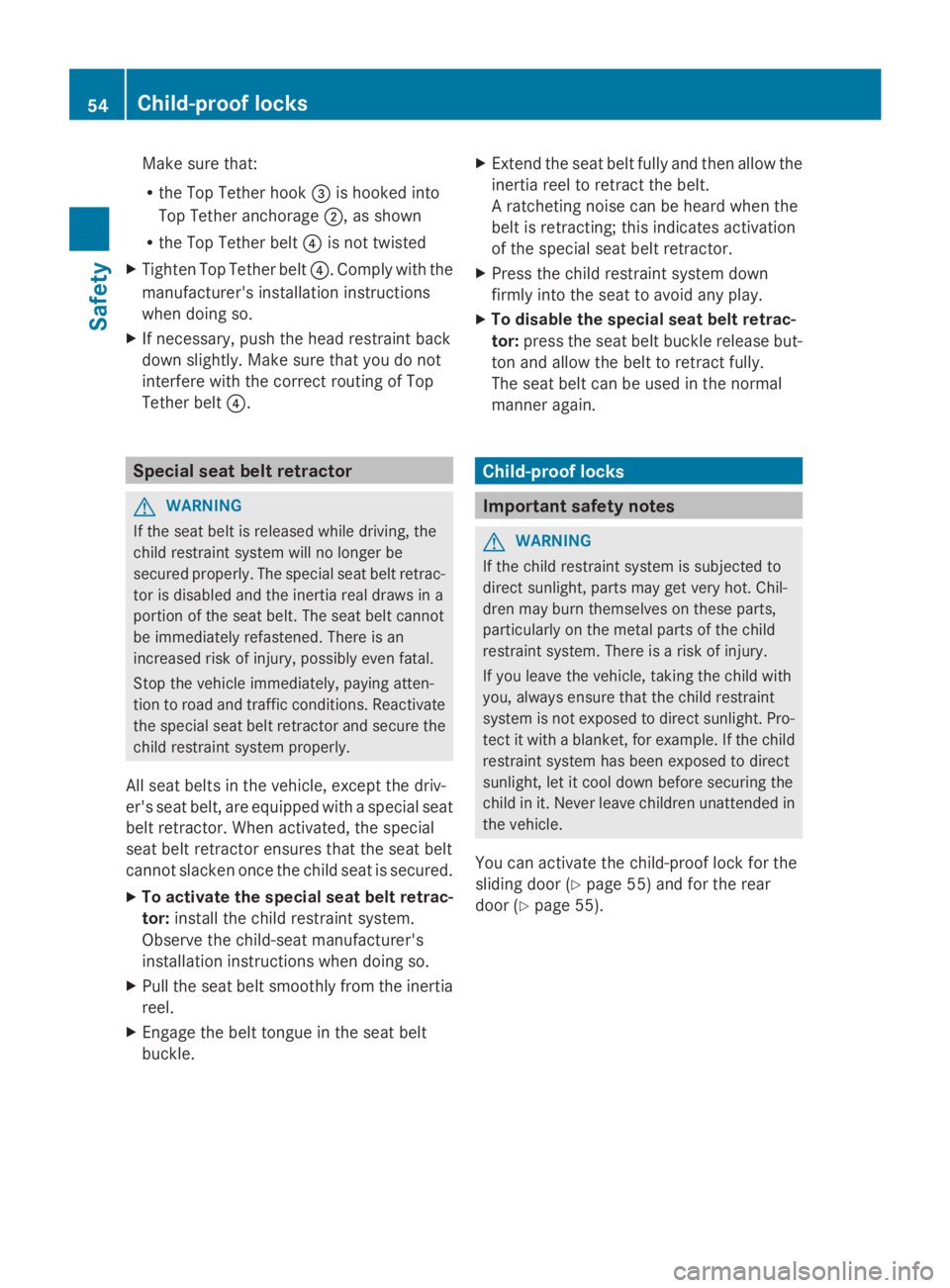
Make sure that:
R
the Top Tether hook 0087is hooked into
Top Tether anchorage 0044, as shown
R the Top Tether belt 0085is not twisted
X Tighten Top Tether belt 0085. Comply with the
manufacturer's installation instructions
when doing so.
X If necessary, push the head restraint back
down slightly. Make sure that you do not
interfere with the correct routing of Top
Tether belt 0085. Special seat belt retractor
G
WARNING
If the seat belt is released while driving, the
child restraint system will no longer be
secured properly. The special seat belt retrac-
tor is disabled and the inertia real draws in a
portion of the seat belt. The seat belt cannot
be immediately refastened. There is an
increased risk of injury, possibly even fatal.
Stop the vehicle immediately, paying atten-
tion to road and traffic conditions. Reactivate
the special seat belt retractor and secure the
child restraint system properly.
All seat belts in the vehicle, except the driv-
er's seat belt, are equipped with a special seat
belt retractor. When activated, the special
seat belt retractor ensures that the seat belt
cannot slacken once the child seat is secured.
X To activate the special seat belt retrac-
tor: install the child restraint system.
Observe the child-seat manufacturer's
installation instructions when doing so.
X Pull the seat belt smoothly from the inertia
reel.
X Engage the belt tongue in the seat belt
buckle. X
Extend the seat belt fully and then allow the
inertia reel to retract the belt.
A ratcheting noise can be heard when the
belt is retracting; this indicates activation
of the special seat belt retractor.
X Press the child restraint system down
firmly into the seat to avoid any play.
X To disable the special seat belt retrac-
tor: press the seat belt buckle release but-
ton and allow the belt to retract fully.
The seat belt can be used in the normal
manner again. Child-proof locks
Important safety notes
G
WARNING
If the child restraint system is subjected to
direct sunlight, parts may get very hot. Chil-
dren may burn themselves on these parts,
particularly on the metal parts of the child
restraint system. There is a risk of injury.
If you leave the vehicle, taking the child with
you, always ensure that the child restraint
system is not exposed to direct sunlight. Pro-
tect it with a blanket, for example. If the child
restraint system has been exposed to direct
sunlight, let it cool down before securing the
child in it. Never leave children unattended in
the vehicle.
You can activate the child-proof lock for the
sliding door (Y page 55) and for the rear
door (Y page 55). 54
Child-proof locksSafety
Page 68 of 338
Useful information
This Operator's Manual describes all models
as well as standard and optional equipment
of your vehicle that were available at the time
of going to print. Country-specific variations
are possible. Note that your vehicle may not
be equipped with all of the described func-
tions. This also applies to systems and func-
tions relevant to safety.
Read the information on qualified specialist
workshops (Y page 26). Key
Important safety notes
G
WARNING
Activate the child-proof door locks if children
are traveling in the vehicle. The children could
otherwise open the doors while the vehicle is
in motion, injuring themselves and others. G
WARNING
Do not leave children unsupervised in the
vehicle, even if they are secured in a child
restraint system. Children could otherwise
injure themselves on parts of the vehicle.
They could be severely or even fatally injured
by prolonged exposure to intense heat or
cold.
If children open a door, they could:
R injure other people
R get out of the vehicle and thereby injure
themselves or be injured by a passing vehi-
cle
R severely injure themselves by falling down,
in particular due to the vehicle height
Always take the key with you when leaving the
vehicle, even if you are only leaving for a short
time. G
WARNING
If you attach heavy or large objects to the
SmartKey, the SmartKey could be uninten- tionally turned in the ignition lock. This could
cause the engine to be switched off. There is
a risk of an accident.
Do not attach any heavy or large objects to
the SmartKey. Remove any bulky key rings
before inserting the SmartKey into the igni-
tion lock.
Do not keep the key with remote control:
R with electronic devices, e.g. a mobile
phone or another key with remote control
R with metallic objects, e.g. coins or metal
foil
R in metallic objects, e.g. metal cases
This can affect the key's functionality. Key functions of the remote control
General notes The vehicle is equipped with either 2 or
4 remote controls with a folding key, or 4
mechanical keys. In this Operator's Manual,
both the mechanical keys and the keys with
remote control are referred to as keys. The
remote control key has a range of up to
32 ft (10 m). Use the remote control of the
key only when in immediate proximity of the
vehicle. This prevents theft.
Remote controls that are not included in the
scope of delivery for the vehicle must be pro-
grammed before use. Further information can
be obtained at any authorized Sprinter
Dealer.
The key's remote control locks/unlocks the
driver's door and/or the following centrally if
the factory settings have not been changed:
R the driver's and the co-driver's door
R the sliding doors
R the rear doors
i If the driver's or co-driver's door is not
closed, the corresponding door is not
locked. If a sliding door or a rear door is not
closed properly, none of the rear doors are
locked. 66
KeyOpening and closing
Page 73 of 338
Central locking
Important safety notes
G
WARNING
Activate the child-proof door locks if children
are traveling in the vehicle. The children could
otherwise open the doors while the vehicle is
in motion, injuring themselves and others. G
WARNING
Do not leave children unsupervised in the
vehicle, even if they are secured in a child
restraint system. Children could otherwise
injure themselves on parts of the vehicle.
They could be severely or even fatally injured
by prolonged exposure to intense heat or
cold.
If children open a door, they could:
R injure other people
R get out of the vehicle and thereby injure
themselves or be injured by a passing vehi-
cle
R severely injure themselves by falling down,
in particular due to the vehicle height
Always take the key with you when leaving the
vehicle, even if you are only leaving for a short
time.
You can open a locked front door from the
inside at any time. You can open a locked
sliding door or rear door from the inside if it
has been previously unlocked from inside. Locking and unlocking manually
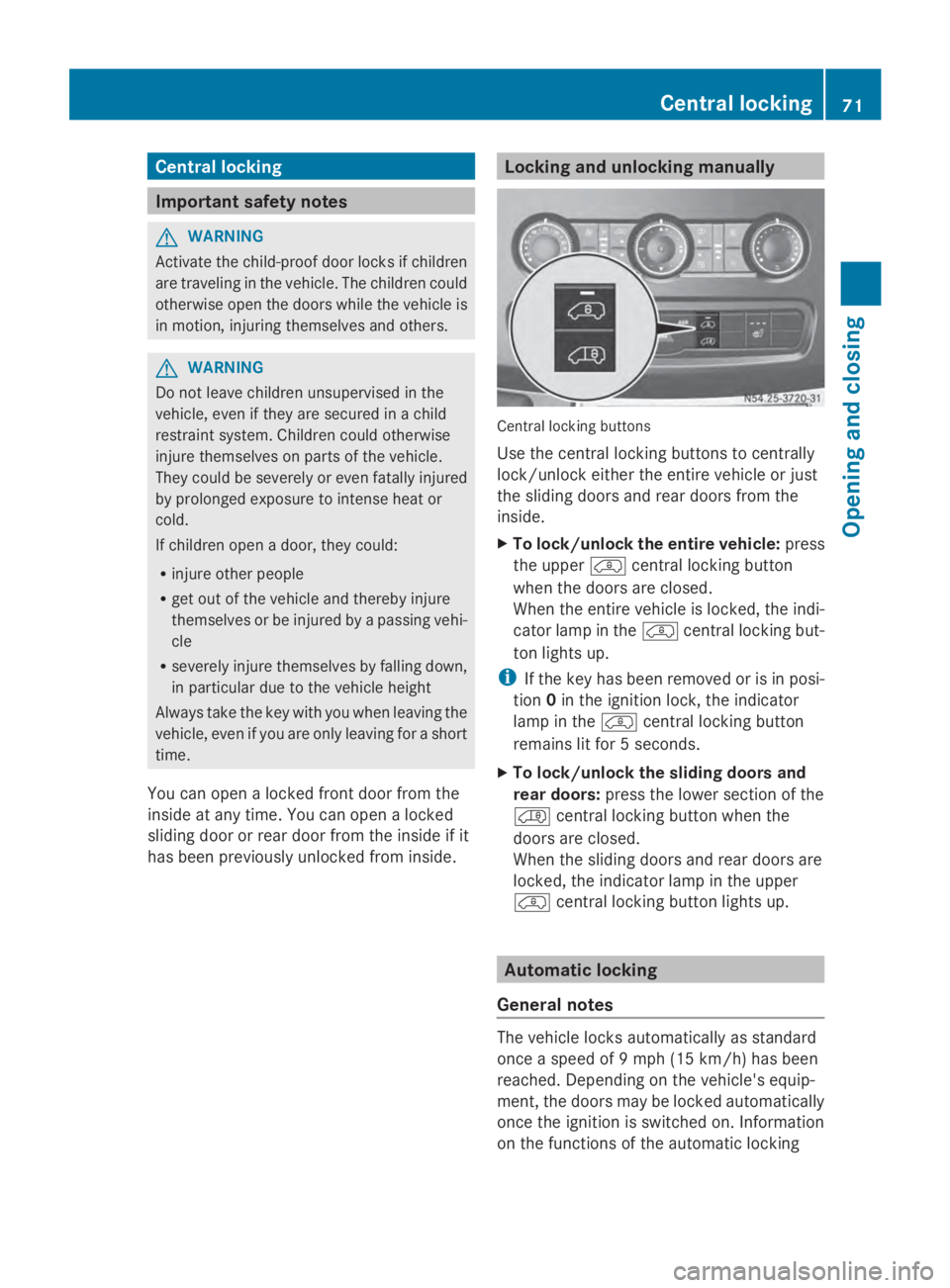
Central locking buttons
Use the central locking buttons to centrally
lock/unlock either the entire vehicle or just
the sliding doors and rear doors from the
inside.
X
To lock/unlock the entire vehicle: press
the upper 00BFcentral locking button
when the doors are closed.
When the entire vehicle is locked, the indi-
cator lamp in the 00BFcentral locking but-
ton lights up.
i If the key has been removed or is in posi-
tion 0in the ignition lock, the indicator
lamp in the 00BFcentral locking button
remains lit for 5 seconds.
X To lock/unlock the sliding doors and
rear doors: press the lower section of the
00C0 central locking button when the
doors are closed.
When the sliding doors and rear doors are
locked, the indicator lamp in the upper
00BF central locking button lights up. Automatic locking
General notes The vehicle locks automatically as standard
once a speed of 9 mph (15 km/h) has been
reached. Depending on the vehicle's equip-
ment, the doors may be locked automatically
once the ignition is switched on. Information
on the functions of the automatic locking Central locking
71Opening and closing Z
Page 80 of 338
X
To unlock: press the catch in the direction
of arrow 0087.
The sliding door is unlocked.
X Slide the sliding door to the stop in the
direction of arrow 0043.
X To close: slide the sliding door in the direc-
tion of arrow 0044until it engages. Side windows
Important safety notes
G
WARNING
While opening the side windows, body parts
could become trapped between the side win-
dow and the door frame as the side window
moves. There is a risk of injury.
Make sure that nobody touches the side win-
dow during the opening procedure. If some-
body becomes trapped, release the switch or
pull the switch to close the side window again. G
WARNING
While opening the side windows, body parts
in the closing area could become trapped.
There is a risk of injury.
Make sure that no body parts are in close
proximity during the closing procedure. If
somebody becomes trapped, release the
switch or press the switch to open the side
window again. G
WARNING
If children operate the side windows they
could become trapped, particularly if they are
left unsupervised. There is a risk of injury.
Activate the override feature for the rear side
windows. When leaving the vehicle, always
take the SmartKey with you and lock the vehi-
cle. Never leave children unsupervised in the
vehicle. G
WARNING
Do not leave children unsupervised in the
vehicle, even if they are secured in a child restraint system. Children could otherwise
injure themselves on parts of the vehicle.
They could be severely or even fatally injured
by prolonged exposure to intense heat or
cold.
If children open a door, they could:
R
injure other people
R get out of the vehicle and thereby injure
themselves or be injured by a passing vehi-
cle
R severely injure themselves by falling down,
in particular due to the vehicle height
Always take the key with you when leaving the
vehicle, even if you are only leaving for a short
time. Opening/closing the side window
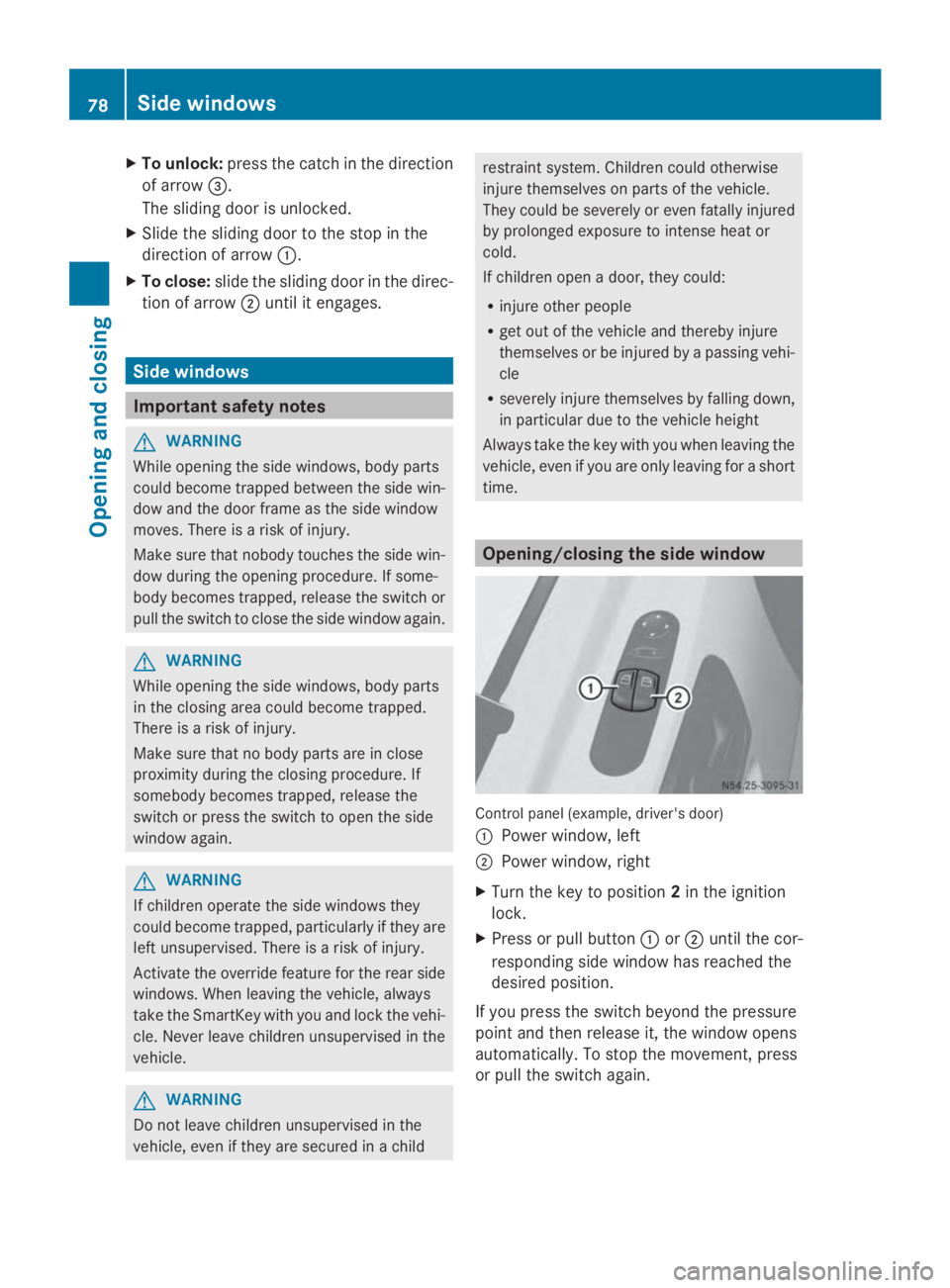
Control panel (example, driver's door)
0043
Power window, left
0044 Power window, right
X Turn the key to position 2in the ignition
lock.
X Press or pull button 0043or0044 until the cor-
responding side window has reached the
desired position.
If you press the switch beyond the pressure
point and then release it, the window opens
automatically. To stop the movement, press
or pull the switch again. 78
Side windowsOpening and closing
Page 84 of 338
Useful information
This Operator's Manual describes all models
as well as standard and optional equipment
of your vehicle that were available at the time
of going to print. Country-specific variations
are possible. Note that your vehicle may not
be equipped with all of the described func-
tions. This also applies to systems and func-
tions relevant to safety.
Read the information on qualified specialist
workshops (Y page 26). Seats
Important safety notes
G
WARNING
If the driver's seat is not engaged, it could
move unexpectedly while the vehicle is in
motion. This could cause you to lose control
of the vehicle. There is a risk of an accident.
Always make sure that the driver's seat is
engaged before starting the engine. G
WARNING
When you adjust a seat, you or other vehicle
occupants could become trapped, e.g. on the
seat guide rail. There is a risk of injury.
Make sure when adjusting a seat that no one
has any body parts in the sweep of the seat. G
WARNING
If head restraints are not installed and
adjusted correctly, they cannot provide pro-
tection as intended. There is an increased risk
of injury in the head and neck area, e.g. in the
event of an accident or when braking.
Always drive with the head restraints instal-
led. Before driving off, make sure for every
vehicle occupant that the center of the head
restraint supports the back of the head at
about eye level.
Your seat must be adjusted in such a way that
you can wear the seat belt correctly. Observe the following points:
R
Position the backrest in an almost vertical
position so that you are sitting virtually
upright. Do not drive with the backrest
reclined too far back.
R Your arms should be slightly bent when you
are holding the steering wheel.
R Avoid seat positions that prevent the seat
belt from being routed correctly. The
shoulder section of the belt must be routed
over the middle of your shoulder and be
pulled tight against your upper body. The
lap belt must always pass across your lap
as low down as possible, i.e. over your hip
joints.
R Adjust the head restraint so that it supports
the back of the head at eye level.
R The distance from the pedals should be
such that you can depress them fully.
Observe also the safety notes in the section
on "Air bags" (Y page 44) and "Children in the
vehicle" ( Ypage 50).
If you swap over the head restraints for the
front and rear seats, you will not be able to
adjust the height and angle of the head
restraints to the correct position.
Use the head restraint pad to adjust the head
restraint so that it is as close as possible to
the back of your head.
Before the journey, make sure the head
restraints have been correctly set for each of
the vehicle's passengers (Y page 86).82
SeatsSeats, steering wheel and mirrors
Page 90 of 338
X
Make sure that the key is in position 1or
2 in the ignition lock.
X To switch on: press the0072button
repeatedly until the desired heating level
has been set.
X To switch off: press the0072button
repeatedly until all indicator lamps go out.
If the indicator lamps of the current heating
level in the 0072button flash, the seat heat-
ing has switched off automatically. In this
case, too many electrical consumers are
switched on or the battery charge is not suf-
ficient. The seat heating will automatically
switch back to the current heating level when
enough on-board voltage is available again. Steering wheel
G
WARNING
You could lose control of your vehicle if you
do the following while driving:
R adjust the driver's seat, head restraint,
steering wheel or mirrors
R fasten the seat belt
There is a risk of an accident.
Adjust the driver's seat, head restraint, steer-
ing wheel and mirror and fasten your seat belt
before starting the engine. G
WARNING
If the steering wheel is unlocked while the
vehicle is in motion, it could change position
unexpectedly. This could cause you to lose
control of the vehicle. There is a risk of an
accident.
Before starting off, make sure the steering
wheel is locked. Never unlock the steering
wheel while the vehicle is in motion. G
WARNING
Children could injure themselves if they
adjust the steering wheel. There is a risk of
injury. When leaving the vehicle, always take the
SmartKey with you and lock the vehicle. Never
leave children unsupervised in the vehicle.
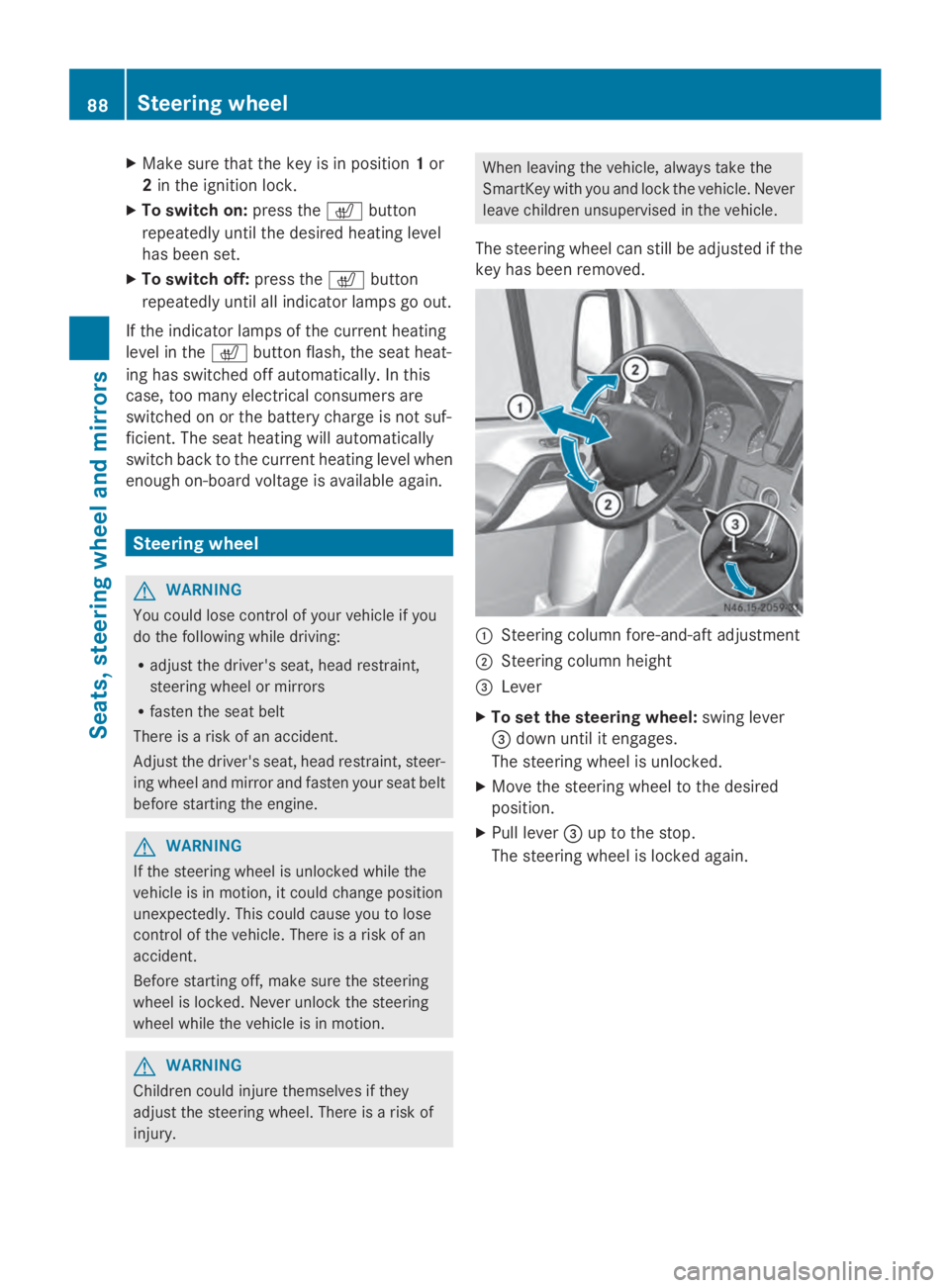
The steering wheel can still be adjusted if the
key has been removed. 0043
Steering column fore-and-aft adjustment
0044 Steering column height
0087 Lever
X To set the steering wheel: swing lever
0087 down until it engages.
The steering wheel is unlocked.
X Move the steering wheel to the desired
position.
X Pull lever 0087up to the stop.
The steering wheel is locked again. 88
Steering wheelSeats, steering wheel and mirrors