window MERCEDES-BENZ SPRINTER 2014 MY14 Operator’s Manual
[x] Cancel search | Manufacturer: MERCEDES-BENZ, Model Year: 2014, Model line: SPRINTER, Model: MERCEDES-BENZ SPRINTER 2014Pages: 338, PDF Size: 6.78 MB
Page 45 of 338
When you switch on the ignition, the
007E
warning lamp in the instrument cluster lights
up for approximately 4 seconds.
A malfunction has occurred if the 007Ewarn-
ing lamp:
R does not light up when you switch on the
ignition, or
R does not go out within a few seconds of
switching on the ignition, or
R lights up again
Safety guidelines for seat belts, Emer-
gency Tensioning Devices (ETDs) and
air bags G
WARNING
R Damaged seat belts or seat belts that have
been subjected to stress in an accident
must be replaced and their anchoring
points must also be checked. Only use seat
belts which have been installed or supplied
by a qualified specialist workshop.
R Air bags and pyrotechnic Emergency Ten-
sioning Devices (ETDs) contain perchlorate
material, which may require special han-
dling and regard for the environment.
Check with your local government's dis-
posal guidelines. California residents, see
www.dtsc.ca.gov/HazardousWaste/
Perchlorate/index.cfm.
R Air bags and ETDs are designed to function
on a one-time-only basis. An air bag or ETD
that has deployed must be replaced.
R Do not pass seat belts over sharp edges.
They could tear.
R Do not make any modification that could
change the effectiveness of the seat belts.
R Do not bleach or dye seat belts as this may
severely weaken them. In a crash they may
not be able to provide adequate protection.
R No modifications of any kind may be made
to any components or wiring of the SRS.
R Do not change or remove any component
or part of the SRS. R
Do not install additional paneling, seat cov-
ers, badges etc. over the steering wheel
hub, co-driver's front air bag cover, out-
board sides of the seat backrests, door trim
panels, or door frame trims.
R Do not install additional electrical/elec-
tronic equipment on or near SRS compo-
nents and wiring.
R Keep the area between air bags and occu-
pants free of objects (e.g. packages,
purses, umbrellas etc.).
R Do not hang items such as coat hangers
from the coat hooks or handles over the
door. These items may be thrown around in
the vehicle and cause head and other inju-
ries when the window curtain air bag is
deployed.
R Air bag system components will be hot after
an air bag has inflated. Do not touch them.
R Never place your feet on the instrument
panel or on the seat. Always keep both feet
on the floor in front of the seat.
R Improper repair work creates a risk of ren-
dering the SRS inoperative or causing unin-
tended air bag deployment. Work on the
SRS must therefore only be performed by
qualified technicians. Please contact a
qualified specialist workshop.
R For your protection and the protection of
others, when scrapping the air bag unit or
ETD, our safety instructions must be fol-
lowed. These instructions are available
from any authorized Sprinter Dealer.
R Given the considerable deployment speed,
required inflation volume, and the material
of the air bags, there is the possibility of
abrasions or other, potentially more serious
injuries resulting from air bag deployment.
If you sell your vehicle, we strongly recom-
mend that you inform the subsequent owner
that the vehicle is equipped with SRS. Also
refer them to the applicable section in the
Operator's Manual. Occupant safety
43Safety Z
Page 47 of 338
The air bag installation locations are identi-
fied by the label SRS/AIRBAG or AIRBAG.
R Front air bags (Y page 45)
R Thoraxbags (Y page 45)
R Window curtain air bags (Y page 46)
The air bags are deployed if the air bag control
unit detects the need for deployment. Only in
the event of such a situation will they provide
their supplemental protection.
If the driver and co-driver do not wear their
seat belts, it is not possible for the air bags to
provide their supplemental protection.
In the event of other types of impacts and
impacts below air bag deployment thresh-
olds, the air bags will not deploy. The driver
and passengers will then be protected to the
extent possible by a properly fastened seat
belt. A properly fastened seat belt is also
needed to provide the best possible protec-
tion in a rollover.
Air bags provide additional protection, but are
not a substitute for the seat belts. All vehicle
occupants must fasten their seat belts
regardless of whether your vehicle is equip-
ped with air bags or not.
If an air bag is deployed, you will hear a bang
and a small amount of powder is released
briefly. Only in rare cases will the bang affect
your hearing. The powder emitted is not gen-
erally hazardous to health. The 007Ewarning
lamp lights up. If it is safe to do so:
X Exit the vehicle immediately.
If you are unable to leave the vehicle:
X Open a window.
You will be able to breathe in fresh air and
avoid respiratory problems.
It is important for your safety and that of any
passengers to have deployed air bags
replaced and to have any malfunctioning air
bags repaired. This will help to make sure the
air bags continue to perform their protective
function for the vehicle occupants in the
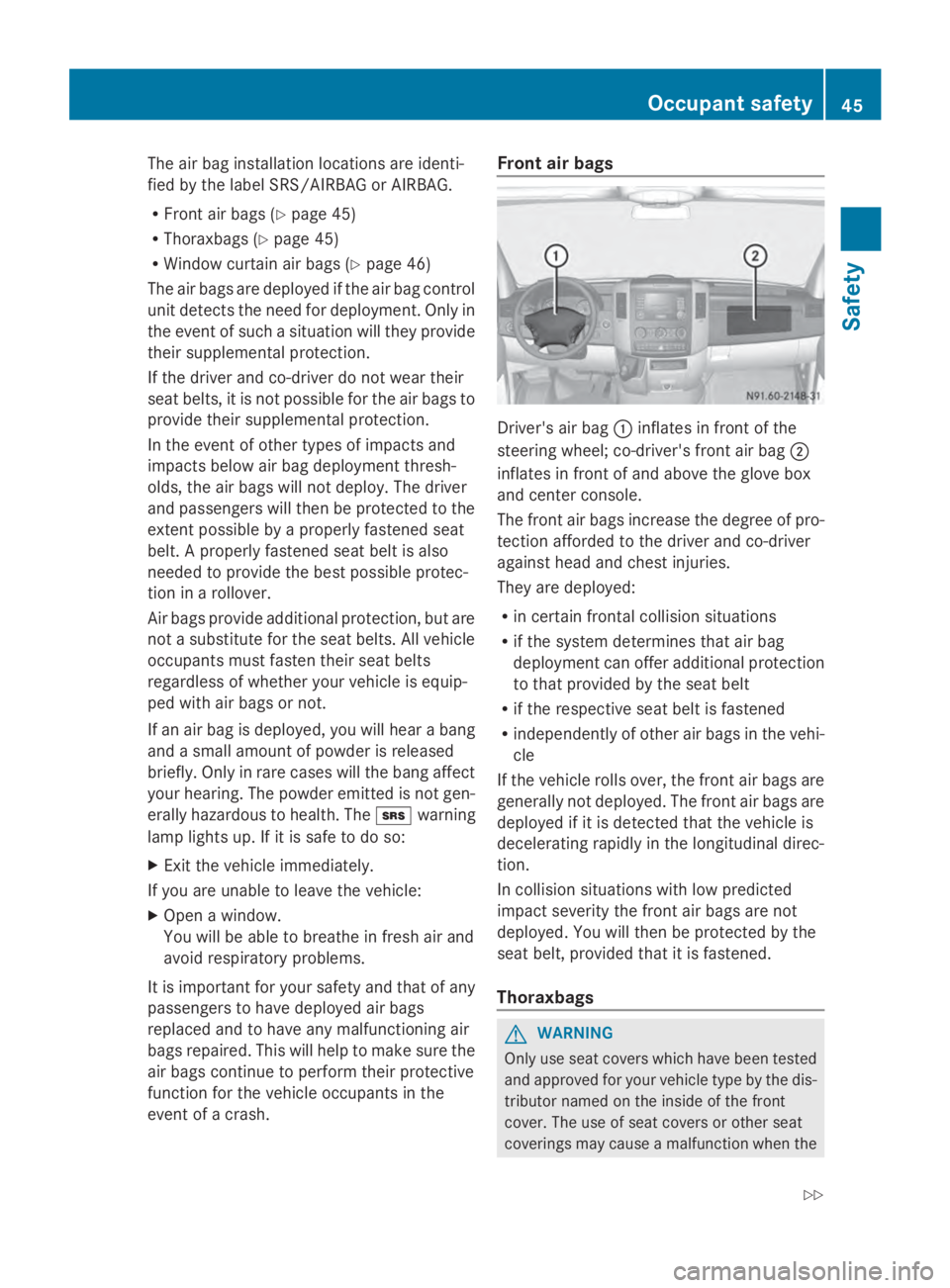
event of a crash. Front air bags
Driver's air bag
0043inflates in front of the
steering wheel; co-driver's front air bag 0044
inflates in front of and above the glove box
and center console.
The front air bags increase the degree of pro-
tection afforded to the driver and co-driver
against head and chest injuries.
They are deployed:
R in certain frontal collision situations
R if the system determines that air bag
deployment can offer additional protection
to that provided by the seat belt
R if the respective seat belt is fastened
R independently of other air bags in the vehi-
cle
If the vehicle rolls over, the front air bags are
generally not deployed. The front air bags are
deployed if it is detected that the vehicle is
decelerating rapidly in the longitudinal direc-
tion.
In collision situations with low predicted
impact severity the front air bags are not
deployed. You will then be protected by the
seat belt, provided that it is fastened.
Thoraxbags G
WARNING
Only use seat covers which have been tested
and approved for your vehicle type by the dis-
tributor named on the inside of the front
cover. The use of seat covers or other seat
coverings may cause a malfunction when the Occupant safety
45Safety
Z
Page 48 of 338
thoraxbag is deployed. Please contact a quali-
fied specialist workshop for availability. G
WARNING
The pressure sensors for controlling the thor-
axbags are located in the doors. Do not mod-
ify any components of the doors or door trim
panels including, for example, the addition of
door speakers.
Improperly performed repairs on the doors,
modifications to the doors or attached parts
can result in the failure or unintentional
deployment of the thoraxbag. Work on the
doors must therefore only be performed by
qualified technicians. Please contact a quali-
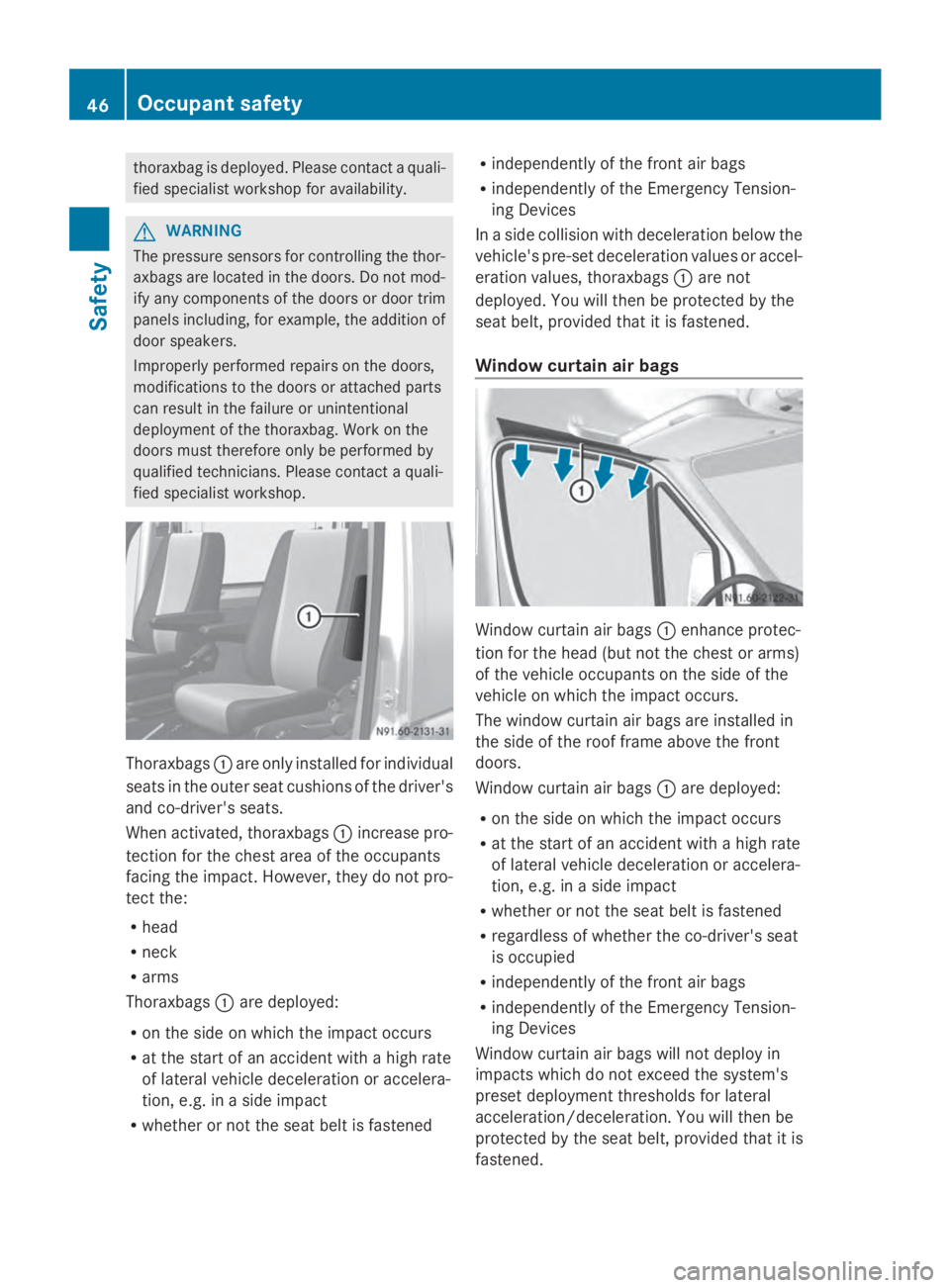
fied specialist workshop. Thoraxbags
0043are only installed for individual
seats in the outer seat cushions of the driver's
and co-driver's seats.
When activated, thoraxbags 0043increase pro-
tection for the chest area of the occupants
facing the impact. However, they do not pro-
tect the:
R head
R neck
R arms
Thoraxbags 0043are deployed:
R on the side on which the impact occurs
R at the start of an accident with a high rate
of lateral vehicle deceleration or accelera-
tion, e.g. in a side impact
R whether or not the seat belt is fastened R
independently of the front air bags
R independently of the Emergency Tension-
ing Devices
In a side collision with deceleration below the
vehicle's pre-set deceleration values or accel-
eration values, thoraxbags 0043are not
deployed. You will then be protected by the
seat belt, provided that it is fastened.
Window curtain air bags Window curtain air bags
0043enhance protec-
tion for the head (but not the chest or arms)
of the vehicle occupants on the side of the
vehicle on which the impact occurs.
The window curtain air bags are installed in
the side of the roof frame above the front
doors.
Window curtain air bags 0043are deployed:
R on the side on which the impact occurs
R at the start of an accident with a high rate
of lateral vehicle deceleration or accelera-
tion, e.g. in a side impact
R whether or not the seat belt is fastened
R regardless of whether the co-driver's seat
is occupied
R independently of the front air bags
R independently of the Emergency Tension-
ing Devices
Window curtain air bags will not deploy in
impacts which do not exceed the system's
preset deployment thresholds for lateral
acceleration/deceleration. You will then be
protected by the seat belt, provided that it is
fastened. 46
Occupant safetySafety
Page 50 of 338
tion, as that could result in serious injuries
in the event of an accident.
R All occupants should wear their seat belt at
all times, because seat belts help reduce
the likelihood of and potential severity of
injuries in accidents, even if the vehicle
rolls over. The integrated restraint system
is equipped with SRS (driver's air bag, front-
passenger air bag, thorax side impact air
bags, window curtain air bags for side win-
dows), Emergency Tensioning Devices and
seat belt force limiters.
The system is designed to enhance the pro-
tection offered to occupants who are prop-
erly secured during certain frontal impacts
(front air bags and Emergency Tensioning
Devices) and side impacts (thorax side
impact air bags, window curtain air bags
and Emergency Tensioning Device) that
exceed preset deployment thresholds, as
well as in certain situations where the vehi-
cle rolls over (window curtain air bags and
Emergency Tensioning Device).
R Never route the shoulder section of the
seat belt under your arm, across your neck
or anywhere other than across your
shoulder. In the event of a frontal impact,
your body would be moved too far forward.
This would increase the risk of head and
neck injuries. The seat belt would then
apply excessive force to the ribs or abdo-
men, which could cause severe internal
injuries to organs such as the liver or
spleen.
Adjust the seat belt so that the upper part
of the belt is as close as possible to the
center of the shoulder. It should not touch
the neck. Never route the belt under the
shoulder. The height of the belt outlet can
be altered to ensure correct usage.
R The lap belt should be routed as low as pos-
sible across the hips, not across the abdo-
men. If the lap belt is routed across the
abdomen, it could cause serious injuries in
the event of an impact. R
Never route the seat belt over rigid or frag-
ile objects in or on your clothing, such as
eyeglasses, pens, keys etc., as this could
cause injuries.
R Always ensure that the seat belt is routed
correctly. This is particularly important if
you are wearing loose clothing.
R Never use a seat belt for more than one
person at a time. Never route a seat belt
around more than one person or additional
objects.
R Never wear seat belts if they are twisted.
Otherwise, in the event of an impact, the
full width of the seat belt is unavailable to
distribute the force of the impact. The
twisted seat belt routed across your body
could cause injuries.
R Pregnant women should also always use a
three-point seat belt. The lap belt must
always pass across your lap as low down as
possible, i.e. across your hips; not across
your abdomen.
R The backrest should be set as close to ver-
tical as possible.
R Check the seat belt during the journey in
order to make sure that it is correctly posi-
tioned.
R Never place your feet on the instrument
panel or on the seat. Always keep both feet
on the floor in front of the seat.
R When using a seat belt to secure an infant
restraint system, child restraint system or
a child on a booster seat, always follow the
child restraint system manufacturer's
instructions.
Fastening/unfastening the seat belts G
WARNING
According to accident statistics, children are
safer when properly restrained on the rear
seats than on the front-passenger seat. Thus,
we strongly recommend that children be
placed in the rear seat whenever possible.
Regardless of seating position, children 12
years old and under must be seated and prop- 48
Occupant safetySafety
Page 52 of 338
Emergency Tensioning Devices, seat
belt force limiters G
WARNING
Pyrotechnic ETDs that were activated must be
replaced.
For your safety, when disposing of the pyro-
technic ETDs always follow our safety instruc-
tions. These instructions are available from
any authorized Sprinter Dealer.
! If the front-passenger seat is not occu-
pied, do not engage the seat belt tongue in
the buckle on the front-passenger seat.
Otherwise, the Emergency Tensioning
Device could be triggered in the event of an
accident.
X In order to ensure that the pyrotechnic
Emergency Tensioning Devices have not
been triggered, always have the seat belts
checked after an accident.
If the Emergency Tensioning Devices have
been triggered, they must be replaced.
If the vehicle is equipped with a driver's air
bag, the seat belts on the driver's and co-
driver's seats have Emergency Tensioning
Devices and seat belt force limiters.
ETDs tighten the seat belts in an accident,
pulling them close against the seat occu-
pant's body.
ETDs do not correct incorrect seat positions
or incorrectly fastened seat belts.
ETDs do not pull vehicle occupants back
towards the backrest.
When activated, the seat belt force limiters
reduce the force exerted by the seat belt on
the driver or co-driver.
The seat belt force limiters are synchronized
with the front air bags, which absorb part of
the deceleration force, resulting in the force
exerted on the occupant being distributed
over a greater area.
The ETDs can only be triggered if the ignition
is switched on and the restraint systems are
operational, see " 007Ewarning lamp"
(Y page 42). The Emergency Tensioning Devices are trig-
gered depending on the type and severity of
an accident:
R
in the event of a head-on or rear-end colli-
sion if the vehicle decelerates or acceler-
ates rapidly in a longitudinal direction dur-
ing the initial stages of the impact
R in the event of a side impact if the vehicle
decelerates or accelerates rapidly in a lat-
eral direction and the vehicle is equipped
with thorax side impact air bags and/or
window curtain air bags
If the ETDs are triggered, you will hear a bang
and powder may also be released. Only in rare
cases will the bang affect your hearing. The
powder emitted is not generally hazardous to
health. The 007Ewarning lamp lights up. Child restraint systems
Important safety notes
G
WARNING
If the child restraint system is not installed
correctly to a suitable seat, the child may not
be secured in the event of an accident or sud-
den braking and may be seriously or even
fatally injured. Therefore, when installing a
child restraint system, you must observe the
manufacturer's installation instructions as
well as the notes on using the child restraint
system.
Child restraint systems should preferably be
installed to the rear seats. Children are gen-
erally better protected there.
Never place objects, e.g. cushions, under the
child restraint system. The entire base of the
child restraint system must always rest on the
seat cushion.
A child restraint system must not be used
without the genuine cover designed for it.
Only replace damaged covers with genuine
covers.
On the rear seats, use only child restraint sys-
tems that have been recommended for use in
the Sprinter. 50
Child restraint systemsSafety
Page 63 of 338
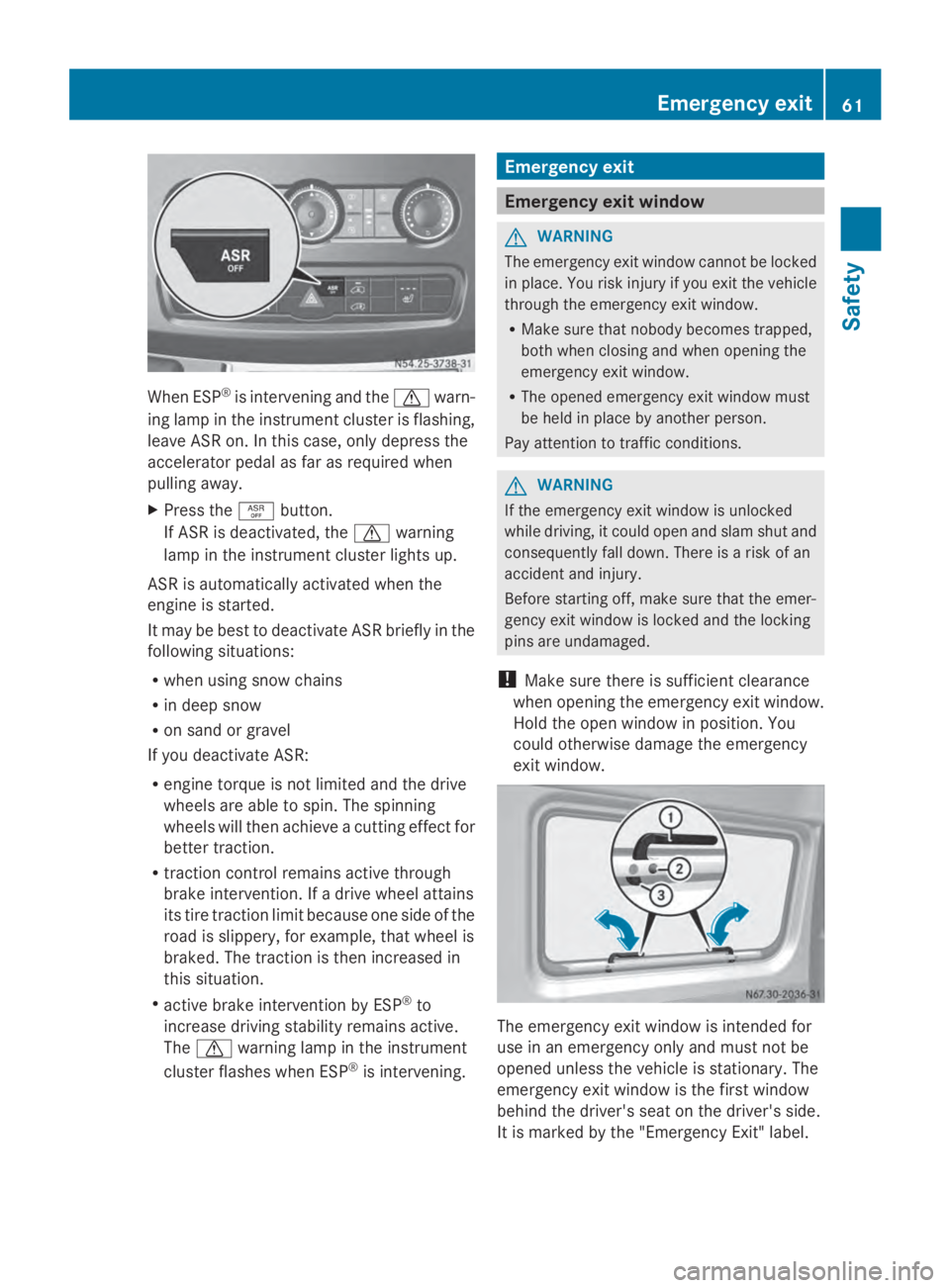
When ESP
®
is intervening and the 0072warn-
ing lamp in the instrument cluster is flashing,
leave ASR on. In this case, only depress the
accelerator pedal as far as required when
pulling away.
X Press the 00E3button.
If ASR is deactivated, the 0072warning
lamp in the instrument cluster lights up.
ASR is automatically activated when the
engine is started.
It may be best to deactivate ASR briefly in the
following situations:
R when using snow chains
R in deep snow
R on sand or gravel
If you deactivate ASR:
R engine torque is not limited and the drive
wheels are able to spin. The spinning
wheels will then achieve a cutting effect for
better traction.
R traction control remains active through
brake intervention. If a drive wheel attains
its tire traction limit because one side of the
road is slippery, for example, that wheel is
braked. The traction is then increased in
this situation.
R active brake intervention by ESP ®
to
increase driving stability remains active.
The 0072 warning lamp in the instrument
cluster flashes when ESP ®
is intervening. Emergency exit
Emergency exit window
G
WARNING
The emergency exit window cannot be locked
in place. You risk injury if you exit the vehicle
through the emergency exit window.
R Make sure that nobody becomes trapped,
both when closing and when opening the
emergency exit window.
R The opened emergency exit window must
be held in place by another person.
Pay attention to traffic conditions. G
WARNING
If the emergency exit window is unlocked
while driving, it could open and slam shut and
consequently fall down. There is a risk of an
accident and injury.
Before starting off, make sure that the emer-
gency exit window is locked and the locking
pins are undamaged.
! Make sure there is sufficient clearance
when opening the emergency exit window.
Hold the open window in position. You
could otherwise damage the emergency
exit window. The emergency exit window is intended for
use in an emergency only and must not be
opened unless the vehicle is stationary. The
emergency exit window is the first window
behind the driver's seat on the driver's side.
It is marked by the "Emergency Exit" label. Emergency exit
61Safety Z
Page 64 of 338
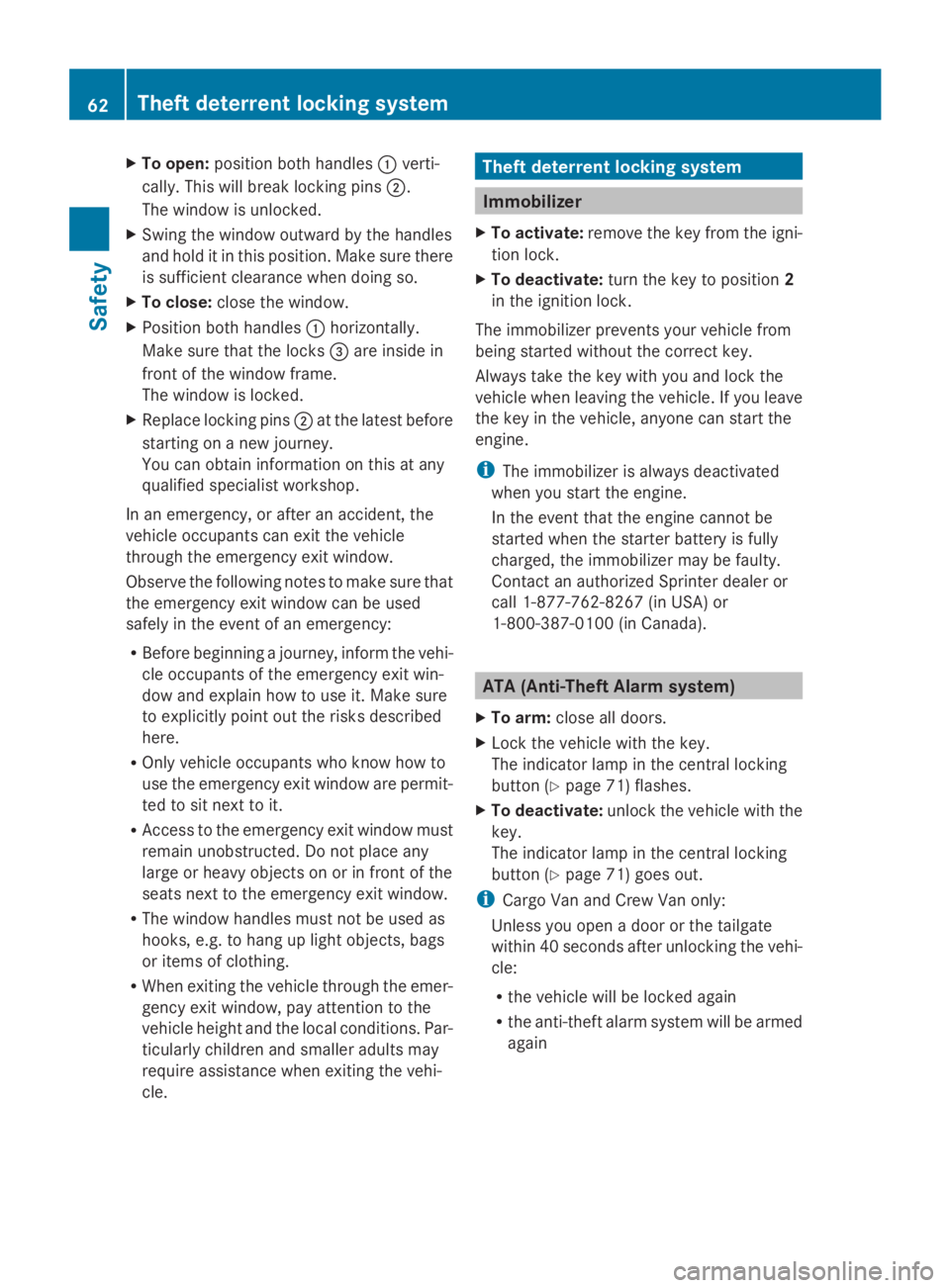
X
To open: position both handles 0043verti-
cally. This will break locking pins 0044.
The window is unlocked.
X Swing the window outward by the handles
and hold it in this position. Make sure there
is sufficient clearance when doing so.
X To close: close the window.
X Position both handles 0043horizontally.
Make sure that the locks 0087are inside in
front of the window frame.
The window is locked.
X Replace locking pins 0044at the latest before
starting on a new journey.
You can obtain information on this at any
qualified specialist workshop.
In an emergency, or after an accident, the
vehicle occupants can exit the vehicle
through the emergency exit window.
Observe the following notes to make sure that
the emergency exit window can be used
safely in the event of an emergency:
R Before beginning a journey, inform the vehi-
cle occupants of the emergency exit win-
dow and explain how to use it. Make sure
to explicitly point out the risks described
here.
R Only vehicle occupants who know how to
use the emergency exit window are permit-
ted to sit next to it.
R Access to the emergency exit window must
remain unobstructed. Do not place any
large or heavy objects on or in front of the
seats next to the emergency exit window.
R The window handles must not be used as
hooks, e.g. to hang up light objects, bags
or items of clothing.
R When exiting the vehicle through the emer-
gency exit window, pay attention to the
vehicle height and the local conditions. Par-
ticularly children and smaller adults may
require assistance when exiting the vehi-
cle. Theft deterrent locking system
Immobilizer
X To activate: remove the key from the igni-
tion lock.
X To deactivate: turn the key to position 2
in the ignition lock.
The immobilizer prevents your vehicle from
being started without the correct key.
Always take the key with you and lock the
vehicle when leaving the vehicle. If you leave
the key in the vehicle, anyone can start the
engine.
i The immobilizer is always deactivated
when you start the engine.
In the event that the engine cannot be
started when the starter battery is fully
charged, the immobilizer may be faulty.
Contact an authorized Sprinter dealer or
call 1-877-762-826 7(in USA) or
1-800-387-010 0(in Canada). ATA (Anti-Theft Alarm system)
X To arm: close all doors.
X Lock the vehicle with the key.
The indicator lamp in the central locking
button (Y page 71) flashes.
X To deactivate: unlock the vehicle with the
key.
The indicator lamp in the central locking
button (Y page 71) goes out.
i Cargo Van and Crew Van only:
Unless you open a door or the tailgate
within 40 seconds after unlocking the vehi-
cle:
R the vehicle will be locked again
R the anti-theft alarm system will be armed
again 62
Theft deterrent locking systemSafety
Page 65 of 338
If the alarm system is armed, a visual and
audible alarm is triggered by the following:
R Unlocking the vehicle from inside
R Opening a door
R Opening the hood
i The alarm is not switched off, even if you
immediately close the open door that has
triggered it, for example.
X To stop the alarm: press the0036button
on the remote control.
Or
X Insert the key into the ignition lock.
The alarm stops. Tow-away alarm
Operation A visual and audible alarm is triggered if the
inclination of the vehicle changes when the
tow-away alarm is armed. This can be the
case if the vehicle is raised on one side, for
example.
Arming/deactivating The tow-away alarm is automatically armed
approximately 20 seconds after you lock the
vehicle.
The tow-away alarm is automatically deacti-
vated when you unlock the vehicle.
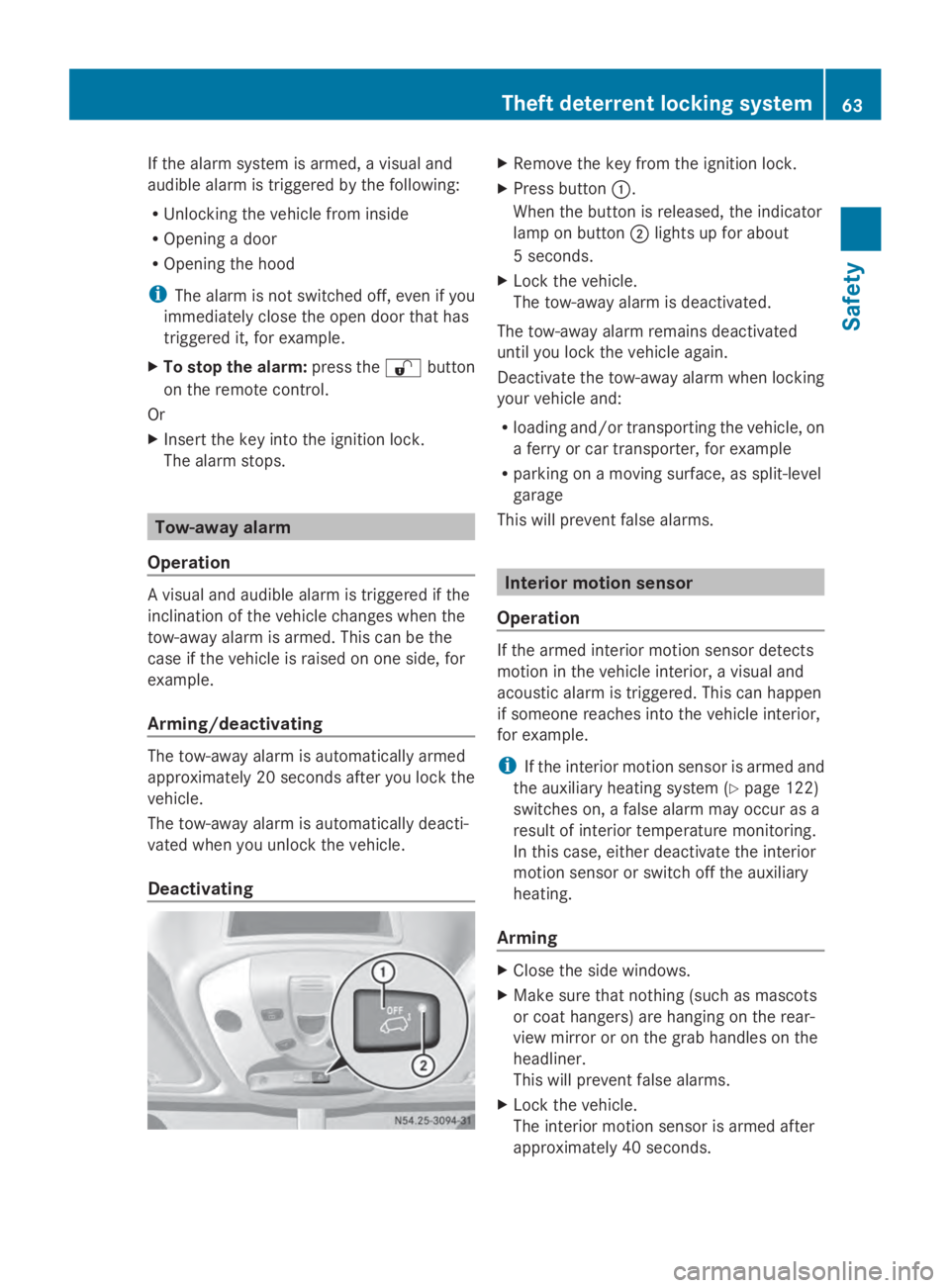
Deactivating X
Remove the key from the ignition lock.
X Press button 0043.
When the button is released, the indicator
lamp on button 0044lights up for about
5 seconds.
X Lock the vehicle.
The tow-away alarm is deactivated.
The tow-away alarm remains deactivated
until you lock the vehicle again.
Deactivate the tow-away alarm when locking
your vehicle and:
R loading and/or transporting the vehicle, on
a ferry or car transporter, for example
R parking on a moving surface, as split-level
garage
This will prevent false alarms. Interior motion sensor
Operation If the armed interior motion sensor detects
motion in the vehicle interior, a visual and
acoustic alarm is triggered. This can happen
if someone reaches into the vehicle interior,
for example.
i
If the interior motion sensor is armed and
the auxiliary heating system (Y page 122)
switches on, a false alarm may occur as a
result of interior temperature monitoring.
In this case, either deactivate the interior
motion sensor or switch off the auxiliary
heating.
Arming X
Close the side windows.
X Make sure that nothing (such as mascots
or coat hangers) are hanging on the rear-
view mirror or on the grab handles on the
headliner.
This will prevent false alarms.
X Lock the vehicle.
The interior motion sensor is armed after
approximately 40 seconds. Theft deterrent locking system
63Safety Z
Page 66 of 338
Switching off
X
Unlock vehicle.
The interior motion sensor automatically
switches off.
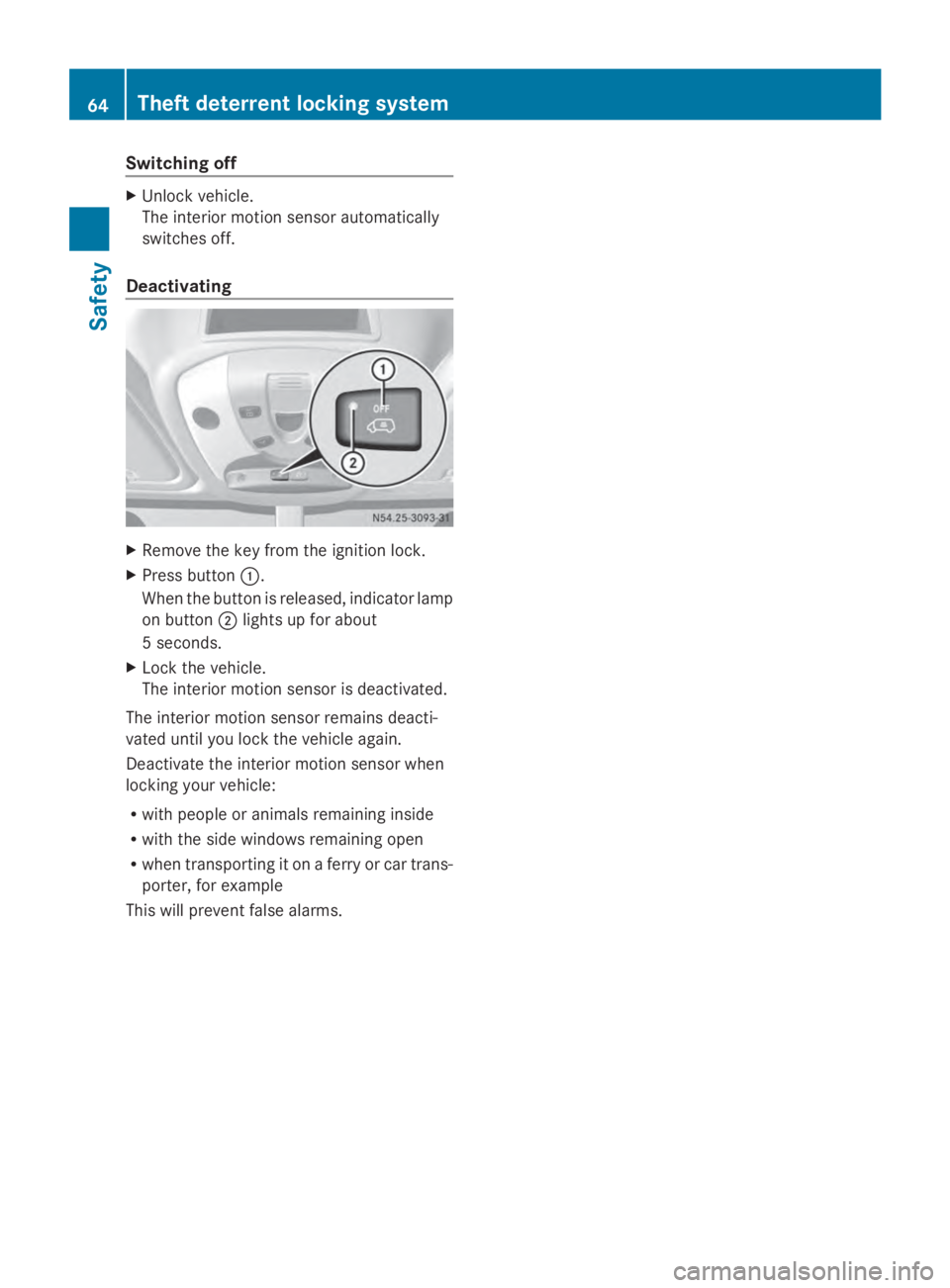
Deactivating X
Remove the key from the ignition lock.
X Press button 0043.
When the button is released, indicator lamp
on button 0044lights up for about
5 seconds.
X Lock the vehicle.
The interior motion sensor is deactivated.
The interior motion sensor remains deacti-
vated until you lock the vehicle again.
Deactivate the interior motion sensor when
locking your vehicle:
R with people or animals remaining inside
R with the side windows remaining open
R when transporting it on a ferry or car trans-
porter, for example
This will prevent false alarms. 64
Theft deterrent locking systemSafety
Page 67 of 338
Useful information
..............................66
Key ....................................................... 66
Central locking .................................... 71
Driver's door and co-driver's door .....72
Sliding door ......................................... 72
Electrical step ..................................... 73
Rear doors ........................................... 75
Partition sliding door ..........................77
Side windows ...................................... 78 65Opening and closing