belt MERCEDES-BENZ SPRINTER 2014 MY14 Operator’s Manual
[x] Cancel search | Manufacturer: MERCEDES-BENZ, Model Year: 2014, Model line: SPRINTER, Model: MERCEDES-BENZ SPRINTER 2014Pages: 338, PDF Size: 6.78 MB
Page 56 of 338
Make sure that:
R
the Top Tether hook 0087is hooked into
Top Tether anchorage 0044, as shown
R the Top Tether belt 0085is not twisted
X Tighten Top Tether belt 0085. Comply with the
manufacturer's installation instructions
when doing so.
X If necessary, push the head restraint back
down slightly. Make sure that you do not
interfere with the correct routing of Top
Tether belt 0085. Special seat belt retractor
G
WARNING
If the seat belt is released while driving, the
child restraint system will no longer be
secured properly. The special seat belt retrac-
tor is disabled and the inertia real draws in a
portion of the seat belt. The seat belt cannot
be immediately refastened. There is an
increased risk of injury, possibly even fatal.
Stop the vehicle immediately, paying atten-
tion to road and traffic conditions. Reactivate
the special seat belt retractor and secure the
child restraint system properly.
All seat belts in the vehicle, except the driv-
er's seat belt, are equipped with a special seat
belt retractor. When activated, the special
seat belt retractor ensures that the seat belt
cannot slacken once the child seat is secured.
X To activate the special seat belt retrac-
tor: install the child restraint system.
Observe the child-seat manufacturer's
installation instructions when doing so.
X Pull the seat belt smoothly from the inertia
reel.
X Engage the belt tongue in the seat belt
buckle. X
Extend the seat belt fully and then allow the
inertia reel to retract the belt.
A ratcheting noise can be heard when the
belt is retracting; this indicates activation
of the special seat belt retractor.
X Press the child restraint system down
firmly into the seat to avoid any play.
X To disable the special seat belt retrac-
tor: press the seat belt buckle release but-
ton and allow the belt to retract fully.
The seat belt can be used in the normal
manner again. Child-proof locks
Important safety notes
G
WARNING
If the child restraint system is subjected to
direct sunlight, parts may get very hot. Chil-
dren may burn themselves on these parts,
particularly on the metal parts of the child
restraint system. There is a risk of injury.
If you leave the vehicle, taking the child with
you, always ensure that the child restraint
system is not exposed to direct sunlight. Pro-
tect it with a blanket, for example. If the child
restraint system has been exposed to direct
sunlight, let it cool down before securing the
child in it. Never leave children unattended in
the vehicle.
You can activate the child-proof lock for the
sliding door (Y page 55) and for the rear
door (Y page 55). 54
Child-proof locksSafety
Page 84 of 338
Useful information
This Operator's Manual describes all models
as well as standard and optional equipment
of your vehicle that were available at the time
of going to print. Country-specific variations
are possible. Note that your vehicle may not
be equipped with all of the described func-
tions. This also applies to systems and func-
tions relevant to safety.
Read the information on qualified specialist
workshops (Y page 26). Seats
Important safety notes
G
WARNING
If the driver's seat is not engaged, it could
move unexpectedly while the vehicle is in
motion. This could cause you to lose control
of the vehicle. There is a risk of an accident.
Always make sure that the driver's seat is
engaged before starting the engine. G
WARNING
When you adjust a seat, you or other vehicle
occupants could become trapped, e.g. on the
seat guide rail. There is a risk of injury.
Make sure when adjusting a seat that no one
has any body parts in the sweep of the seat. G
WARNING
If head restraints are not installed and
adjusted correctly, they cannot provide pro-
tection as intended. There is an increased risk
of injury in the head and neck area, e.g. in the
event of an accident or when braking.
Always drive with the head restraints instal-
led. Before driving off, make sure for every
vehicle occupant that the center of the head
restraint supports the back of the head at
about eye level.
Your seat must be adjusted in such a way that
you can wear the seat belt correctly. Observe the following points:
R
Position the backrest in an almost vertical
position so that you are sitting virtually
upright. Do not drive with the backrest
reclined too far back.
R Your arms should be slightly bent when you
are holding the steering wheel.
R Avoid seat positions that prevent the seat
belt from being routed correctly. The
shoulder section of the belt must be routed
over the middle of your shoulder and be
pulled tight against your upper body. The
lap belt must always pass across your lap
as low down as possible, i.e. over your hip
joints.
R Adjust the head restraint so that it supports
the back of the head at eye level.
R The distance from the pedals should be
such that you can depress them fully.
Observe also the safety notes in the section
on "Air bags" (Y page 44) and "Children in the
vehicle" ( Ypage 50).
If you swap over the head restraints for the
front and rear seats, you will not be able to
adjust the height and angle of the head
restraints to the correct position.
Use the head restraint pad to adjust the head
restraint so that it is as close as possible to
the back of your head.
Before the journey, make sure the head
restraints have been correctly set for each of
the vehicle's passengers (Y page 86).82
SeatsSeats, steering wheel and mirrors
Page 86 of 338
If the seat moves up and down frequently and
to a great extent, you can lock the seat in the
lower movement range.
X To engage the seat suspension lock:
turn lever 006Bupwards.
When it next moves, the seat will lock in
position.
i The seat suspension lock will only engage
if your body weight equals or exceeds the
weight selected for the seat suspension.
X To release the seat suspension lock:
turn lever 006Bto the right.
The seat can now move up and down again. Swiveling front seats
G
WARNING
You could lose control of your vehicle if you
do the following while driving:
R adjust the driver's seat, head restraint,
steering wheel or mirrors
R fasten the seat belt
There is a risk of an accident.
Adjust the driver's seat, head restraint, steer-
ing wheel and mirror and fasten your seat belt
before starting the engine. G
WARNING
If the driver's and co-driver's seats are not
engaged facing the direction of travel while
driving, the restraint systems may not be able
to provide the intended protection. There is
an increased risk of injury, possibly even fatal.
Engage the driver's and co-driver's seats so
they are facing the direction of travel before
starting the engine.
! When rotating the seats, make sure that
there is sufficient space to do so.
Move the seat forward or back first. This
will help to avoid contact with other parts
of the interior.
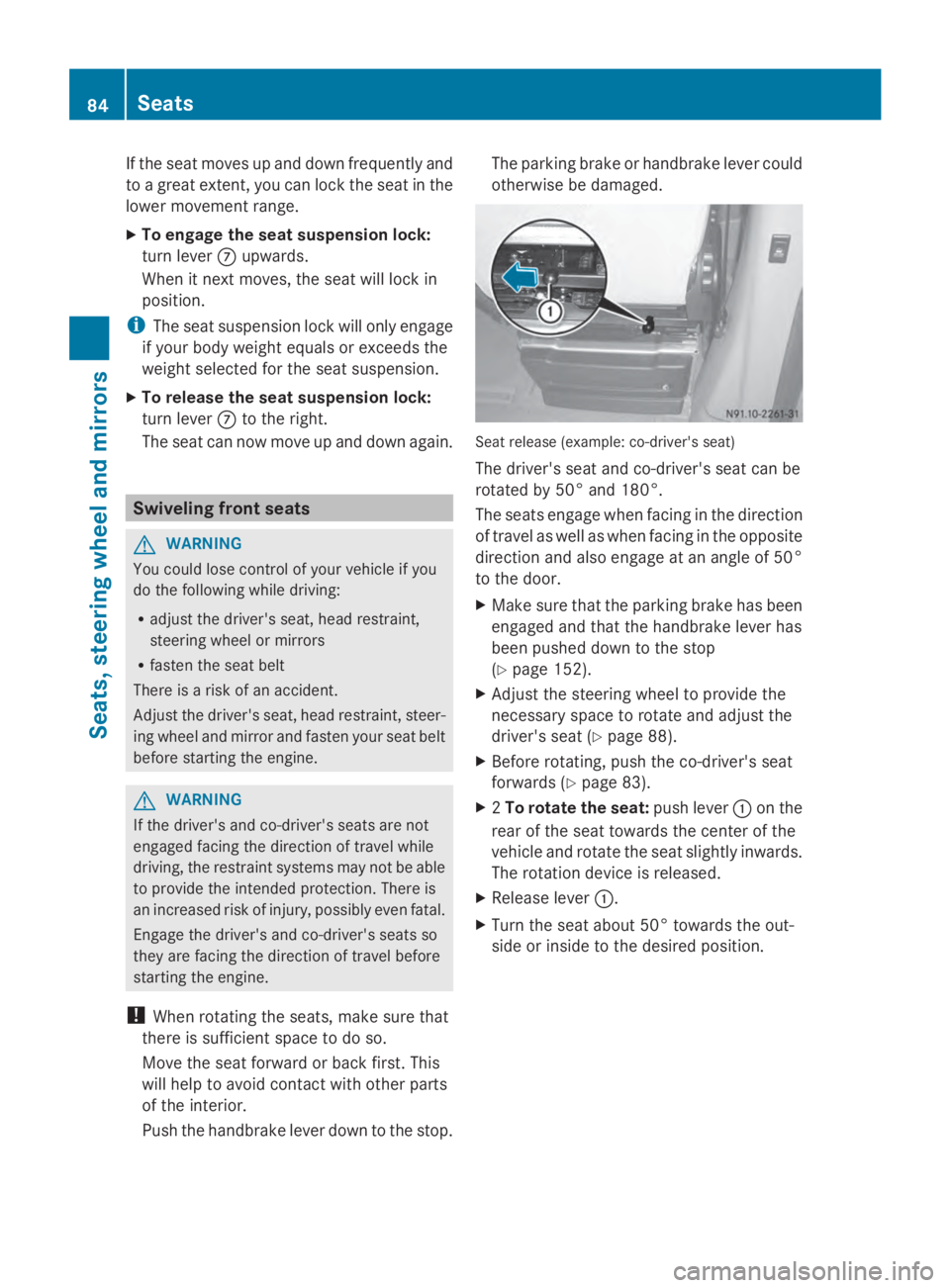
Push the handbrake lever down to the stop. The parking brake or handbrake lever could
otherwise be damaged.
Seat release (example: co-driver's seat)
The driver's seat and co-driver's seat can be
rotated by 50° and 180°.
The seats engage when facing in the direction
of travel as well as when facing in the opposite
direction and also engage at an angle of 50°
to the door.
X Make sure that the parking brake has been
engaged and that the handbrake lever has
been pushed down to the stop
(Y page 152).
X Adjust the steering wheel to provide the
necessary space to rotate and adjust the
driver's seat (Y page 88).
X Before rotating, push the co-driver's seat
forwards (Y page 83).
X 2To rotate the seat: push lever0043on the
rear of the seat towards the center of the
vehicle and rotate the seat slightly inwards.
The rotation device is released.
X Release lever 0043.
X Turn the seat about 50° towards the out-
side or inside to the desired position. 84
SeatsSeats, steering wheel and mirrors
Page 87 of 338
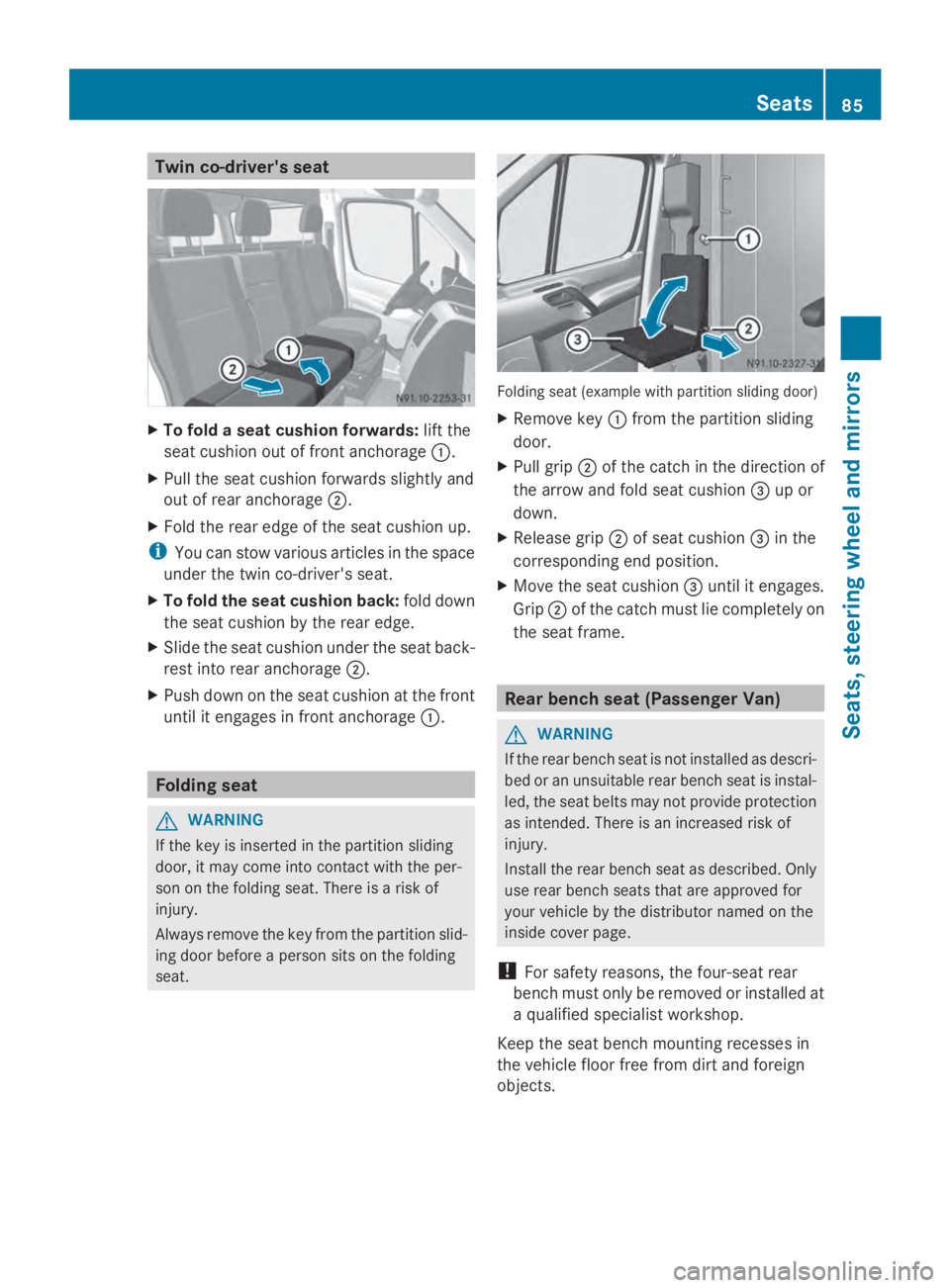
Twin co-driver's seat
X
To fold a seat cushion forwards: lift the
seat cushion out of front anchorage 0043.
X Pull the seat cushion forwards slightly and
out of rear anchorage 0044.
X Fold the rear edge of the seat cushion up.
i You can stow various articles in the space
under the twin co-driver's seat.
X To fold the seat cushion back: fold down
the seat cushion by the rear edge.
X Slide the seat cushion under the seat back-
rest into rear anchorage 0044.
X Push down on the seat cushion at the front
until it engages in front anchorage 0043.Folding seat
G
WARNING
If the key is inserted in the partition sliding
door, it may come into contact with the per-
son on the folding seat. There is a risk of
injury.
Always remove the key from the partition slid-
ing door before a person sits on the folding
seat. Folding seat (example with partition sliding door)
X
Remove key 0043from the partition sliding
door.
X Pull grip 0044of the catch in the direction of
the arrow and fold seat cushion 0087up or
down.
X Release grip 0044of seat cushion 0087in the
corresponding end position.
X Move the seat cushion 0087until it engages.
Grip 0044of the catch must lie completely on
the seat frame. Rear bench seat (Passenger Van)
G
WARNING
If the rear bench seat is not installed as descri-
bed or an unsuitable rear bench seat is instal-
led, the seat belts may not provide protection
as intended. There is an increased risk of
injury.
Install the rear bench seat as described. Only
use rear bench seats that are approved for
your vehicle by the distributor named on the
inside cover page.
! For safety reasons, the four-seat rear
bench must only be removed or installed at
a qualified specialist workshop.
Keep the seat bench mounting recesses in
the vehicle floor free from dirt and foreign
objects. Seats
85Seats, steering wheel and mirrors Z
Page 90 of 338
X
Make sure that the key is in position 1or
2 in the ignition lock.
X To switch on: press the0072button
repeatedly until the desired heating level
has been set.
X To switch off: press the0072button
repeatedly until all indicator lamps go out.
If the indicator lamps of the current heating
level in the 0072button flash, the seat heat-
ing has switched off automatically. In this
case, too many electrical consumers are
switched on or the battery charge is not suf-
ficient. The seat heating will automatically
switch back to the current heating level when
enough on-board voltage is available again. Steering wheel
G
WARNING
You could lose control of your vehicle if you
do the following while driving:
R adjust the driver's seat, head restraint,
steering wheel or mirrors
R fasten the seat belt
There is a risk of an accident.
Adjust the driver's seat, head restraint, steer-
ing wheel and mirror and fasten your seat belt
before starting the engine. G
WARNING
If the steering wheel is unlocked while the
vehicle is in motion, it could change position
unexpectedly. This could cause you to lose
control of the vehicle. There is a risk of an
accident.
Before starting off, make sure the steering
wheel is locked. Never unlock the steering
wheel while the vehicle is in motion. G
WARNING
Children could injure themselves if they
adjust the steering wheel. There is a risk of
injury. When leaving the vehicle, always take the
SmartKey with you and lock the vehicle. Never
leave children unsupervised in the vehicle.
The steering wheel can still be adjusted if the
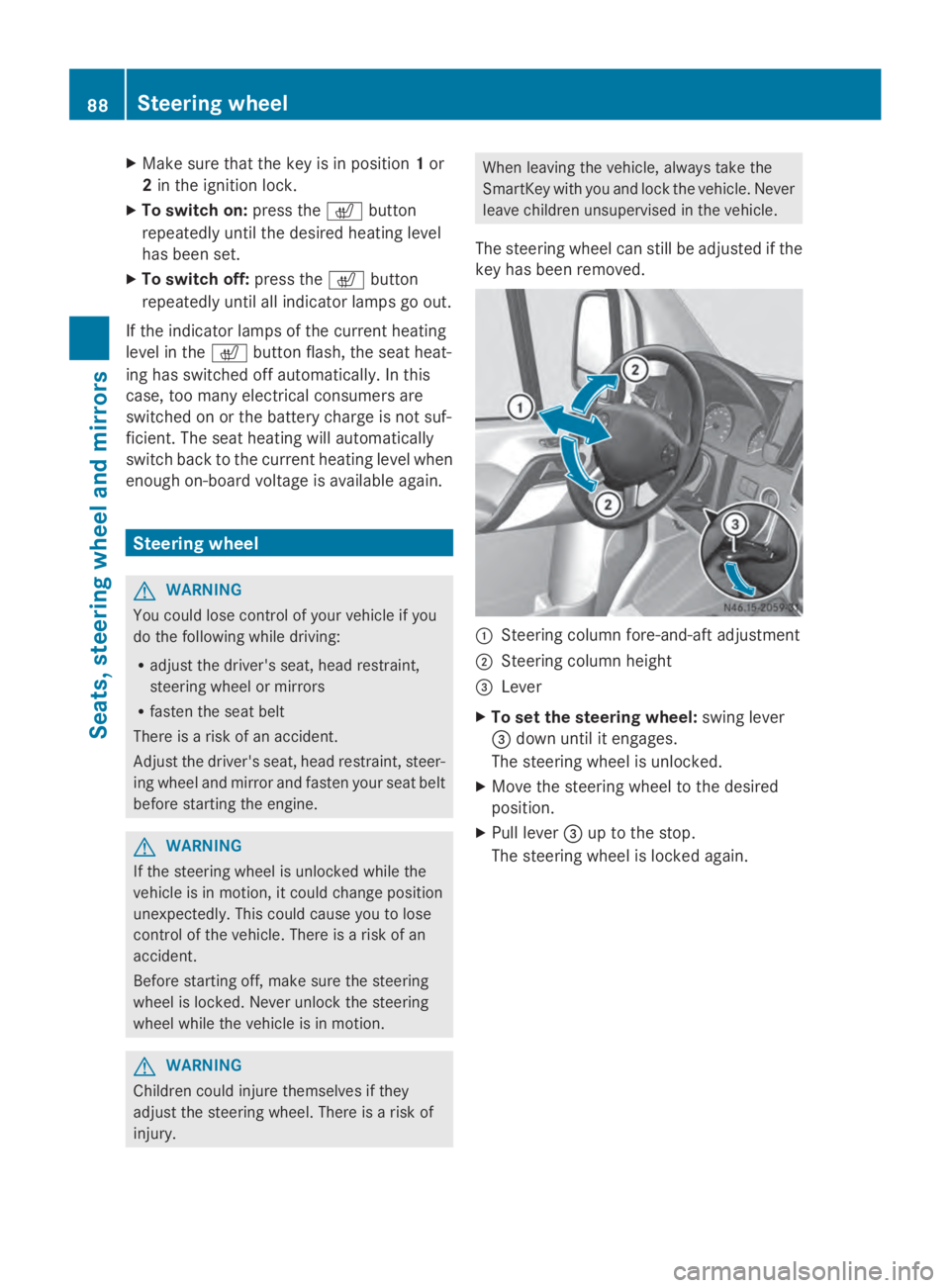
key has been removed. 0043
Steering column fore-and-aft adjustment
0044 Steering column height
0087 Lever
X To set the steering wheel: swing lever
0087 down until it engages.
The steering wheel is unlocked.
X Move the steering wheel to the desired
position.
X Pull lever 0087up to the stop.
The steering wheel is locked again. 88
Steering wheelSeats, steering wheel and mirrors
Page 141 of 338
X
Before starting the engine, make sure that:
R all the doors are closed.
R all the vehicle occupants are wearing
their seat belts correctly.
R the parking brake is applied.
i If you depress the brake pedal before
starting the engine, the pedal travel is short
and pedal resistance is high.
If you depress the brake pedal again after
starting the engine, pedal travel and resist-
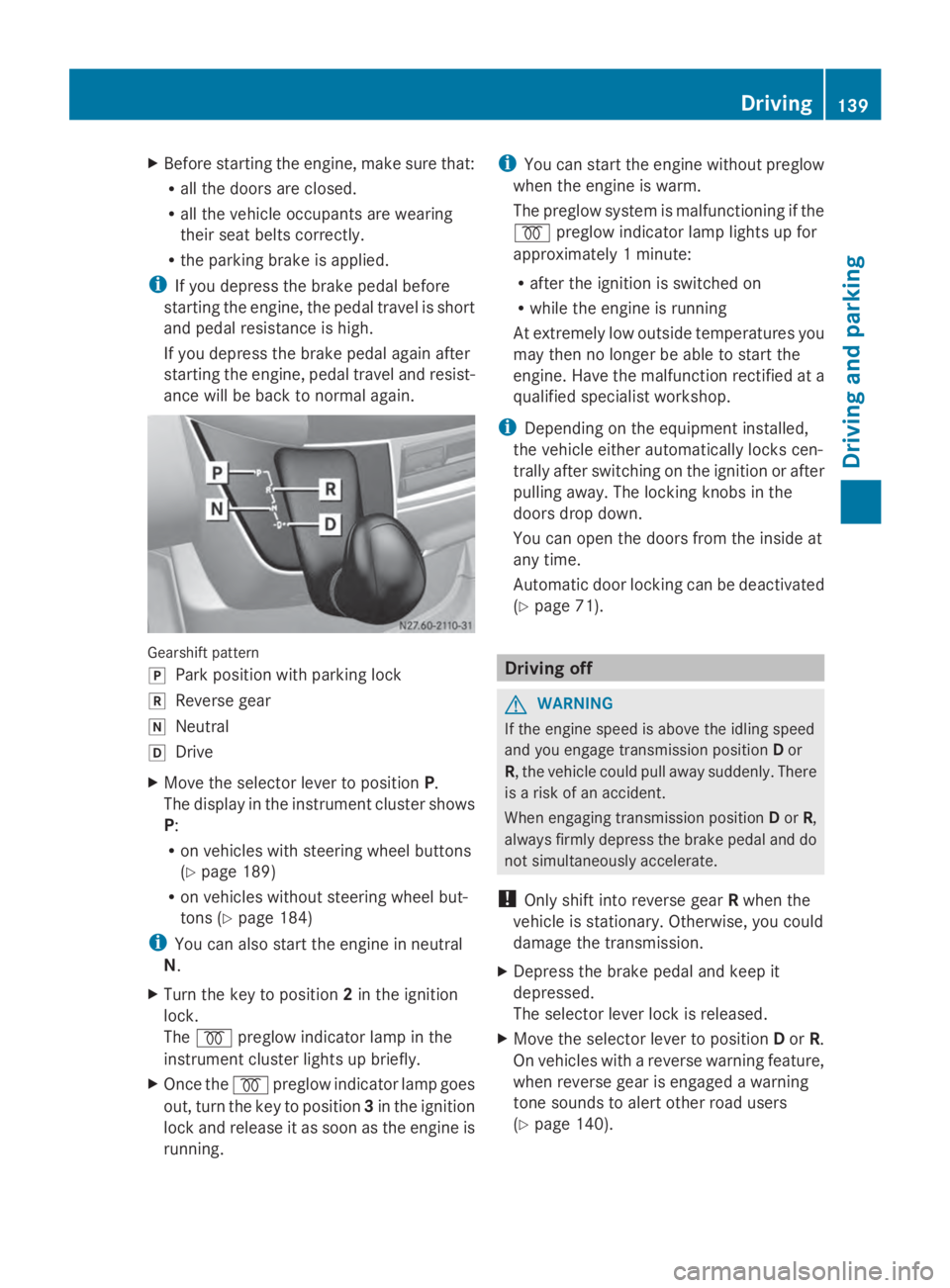
ance will be back to normal again. Gearshift pattern
005D
Park position with parking lock
005E Reverse gear
005C Neutral
005B Drive
X Move the selector lever to position P.
The display in the instrument cluster shows
P:
R on vehicles with steering wheel buttons
(Y page 189)
R on vehicles without steering wheel but-
tons ( Ypage 184)
i You can also start the engine in neutral
N.
X Turn the key to position 2in the ignition
lock.
The 0028 preglow indicator lamp in the
instrument cluster lights up briefly.
X Once the 0028preglow indicator lamp goes
out, turn the key to position 3in the ignition
lock and release it as soon as the engine is
running. i
You can start the engine without preglow
when the engine is warm.
The preglow system is malfunctioning if the
0028 preglow indicator lamp lights up for
approximately 1 minute:
R after the ignition is switched on
R while the engine is running
At extremely low outside temperatures you
may then no longer be able to start the
engine. Have the malfunction rectified at a
qualified specialist workshop.
i Depending on the equipment installed,
the vehicle either automatically locks cen-
trally after switching on the ignition or after
pulling away. The locking knobs in the
doors drop down.
You can open the doors from the inside at
any time.
Automatic door locking can be deactivated
(Y page 71). Driving off
G
WARNING
If the engine speed is above the idling speed
and you engage transmission position Dor
R, the vehicle could pull away suddenly. There
is a risk of an accident.
When engaging transmission position Dor R,
always firmly depress the brake pedal and do
not simultaneously accelerate.
! Only shift into reverse gear Rwhen the
vehicle is stationary. Otherwise, you could
damage the transmission.
X Depress the brake pedal and keep it
depressed.
The selector lever lock is released.
X Move the selector lever to position Dor R.
On vehicles with a reverse warning feature,
when reverse gear is engaged a warning
tone sounds to alert other road users
(Y page 140). Driving
139Driving and parking Z
Page 143 of 338
When pulling away again, the engine starts
automatically. The ECO start/stop function
thereby helps you to reduce the fuel con-
sumption and emissions of your vehicle.
The stop/start function is automatically acti-
vated each time you start the engine with the
ignition key.
If the ECO start/stop function has been man-
ually deactivated or a malfunction has caused
the system to be deactivated, 00A7sym-
bol 0044is not displayed. In addition, the indi-
cator lamp in the ECO button on the center
console does not light up.
Automatic engine switch-off The ECO start/stop function is operational
and the 00A7symbol is displayed in the mul-
tifunction display, if:
R the indicator lamp in the ECO button is lit
green
R the outside temperature is above 0 †
R the vehicle is below 2500 m above sea level
R the hood is closed
R the driver's seat belt is fastened
R on vehicles with a manual transmission, the
doors are closed
R on vehicles with an automatic transmis-
sion, the driver's door is closed
i All of the driving systems remain active
when the engine is switched off automati-
cally.
i The engine can be switched off automat-
ically a maximum of four times (initial stop,
then three subsequent stops) in succes-
sion. The automatic engine switch-off is
then available again after the ECO symbol
appears in the multifunction display.
Vehicles with automatic transmission If the vehicle is braked to a standstill in
Dor
N, the ECO start/stop function switches off
the engine automatically. Automatic engine start The engine is started automatically if:
R
you switch off the ECO start/stop function
by pressing the ECO button
R you engage reverse gear Ror park position
P
R the vehicle begins to roll away
R the battery's condition of charge is too low
R on vehicles with a manual transmission, the
driver's seat belt is not fastened or a door
is opened
R on vehicles with an automatic transmis-
sion, the driver's seat belt is not fastened
or the driver's door is opened
If you open the hood after an automatic
engine switch-off, automatic engine start is
deactivated. Once the hood is closed, you
have to start the engine manually.
Vehicles with automatic transmission The engine is started automatically if you:
R
release the brakes when in transmission
position Dor N
R depress the accelerator pedal
R open the driver's door
R unfasten your seatbelt
i If you shift the transmission from Rto D,
the ECO start/stop function is available
again as soon as the 00A7symbol reap-
pears in the multifunction display.
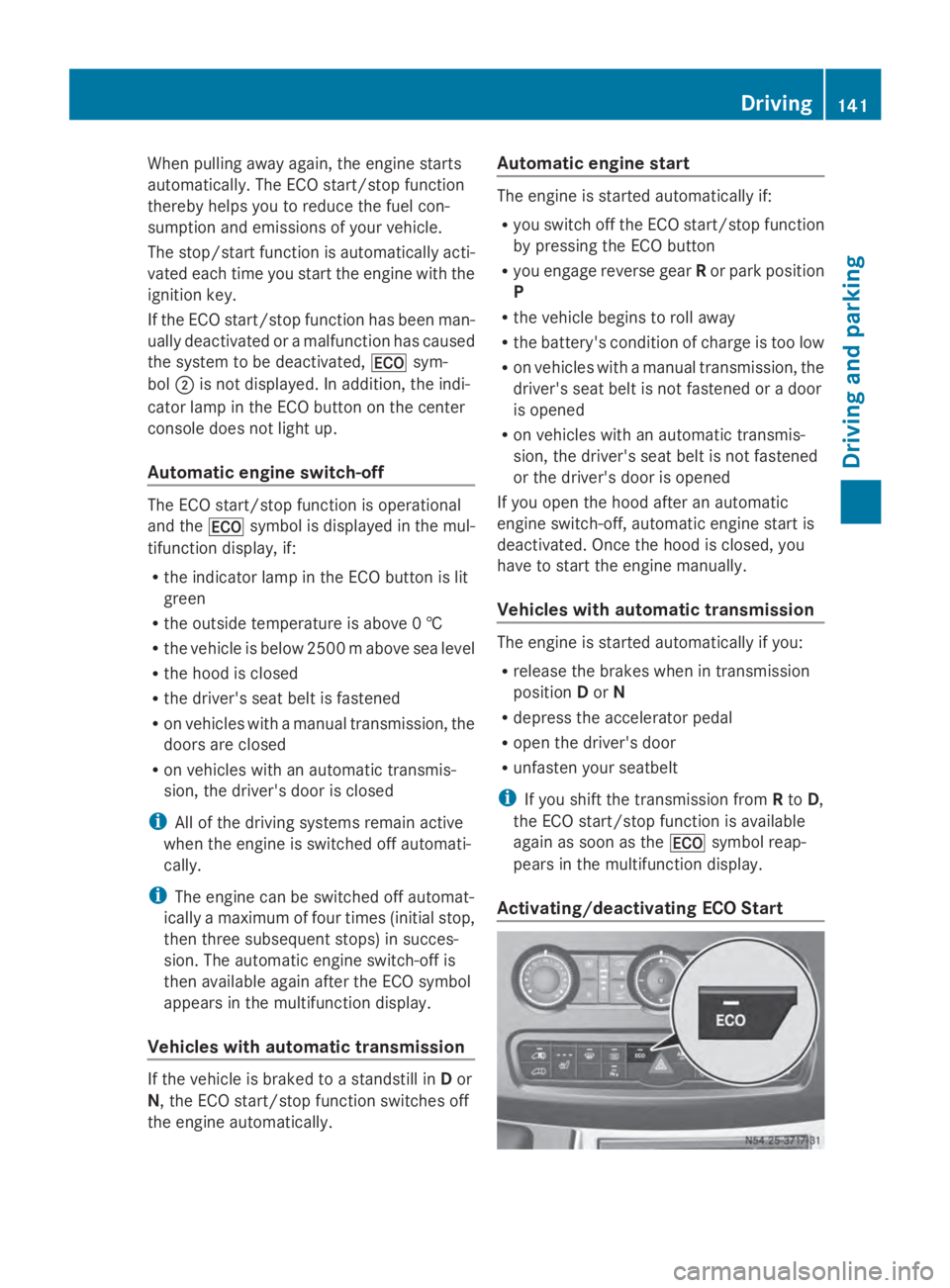
Activating/deactivating ECO Start Driving
141Driving and parking Z
Page 161 of 338
You can find further information on winter
tires and snow chains in the "Wheels and
tires" section (Y page 288). Driving off-road
Important safety notes G
WARNING
If you drive on a steep incline at an angle or
turn when driving on an incline, the vehicle
could slip sideways, tip and rollover. There is
a risk of an accident.
Always drive on a steep incline in the line of
fall (straight up or down) and do not turn the
vehicle. G
WARNING
When driving off-road, your body is subject to
forces from all directions, due to the uneven
surface. You could be thrown from your seat,
for instance. There is a risk of injury.
Always wear a seat belt, even when driving off-
road. G
WARNING
If you drive over obstacles or in ruts, the steer-
ing wheel may jerk out of your grip, causing
injury to your hands.
Always hold the steering wheel firmly with
both hands. When driving over obstacles, you
must expect steering forces to increase
briefly and suddenly. G
WARNING
Flammable material such as leaves, grass or
twigs may ignite if they come into contact with
hot parts of the exhaust system. There is a
risk of fire.
When driving off road or on unpaved roads,
check the vehicle's underside regularly. In
particular, remove parts of plants or other
flammable materials which have become
trapped. In the case of damage, contact a
qualified specialist workshop. !
When driving off-road or on unpaved sur-
faces, check the underside of the vehicle
and the wheels and tires at regular inter-
vals. In particular, remove any trapped for-
eign objects, e.g. stones and branches.
Such foreign objects may:
R damage the chassis, the fuel tank or the
brake system
R cause imbalances and thus vibrations
R be flung out when you continue driving
If there is any damage, inform a qualified
specialist workshop.
! If there are steep gradients while driving
off-road, a sufficient filling level in the DEF
tank must be ensured. Make sure for this
reason that there is a minimum fill level of
ten liters before driving off-road.
When driving off-road and on construction
sites, sand, mud and water mixed with oil, for
example, may get into the brakes. This may
lead to a reduction in braking performance or
total brake failure, also as a result of
increased wear. The braking characteristics
will vary depending on the material that has
got into the system. Clean the brakes after
driving off-road. If you then notice reduced
braking performance or hear scraping noises,
have the brake system checked at a qualified
specialist workshop. Adjust your driving style
to the changed braking characteristics.
Driving off-road or on construction sites
increases the possibility of vehicle damage
which may in turn lead to the failure of certain
assemblies and systems. Adapt your driving
style to the off-road driving conditions. Drive
carefully. Have any vehicle damage rectified
at a qualified specialist workshop as soon as
possible.
When driving on rough terrain, do not shift the
transmission into the neutral position. You
could lose control when attempting to brake
the vehicle with the service brake. If your
vehicle cannot manage an uphill slope, drive
back down the slope in reverse gear. Driving tips
159Driving and parking Z
Page 211 of 338
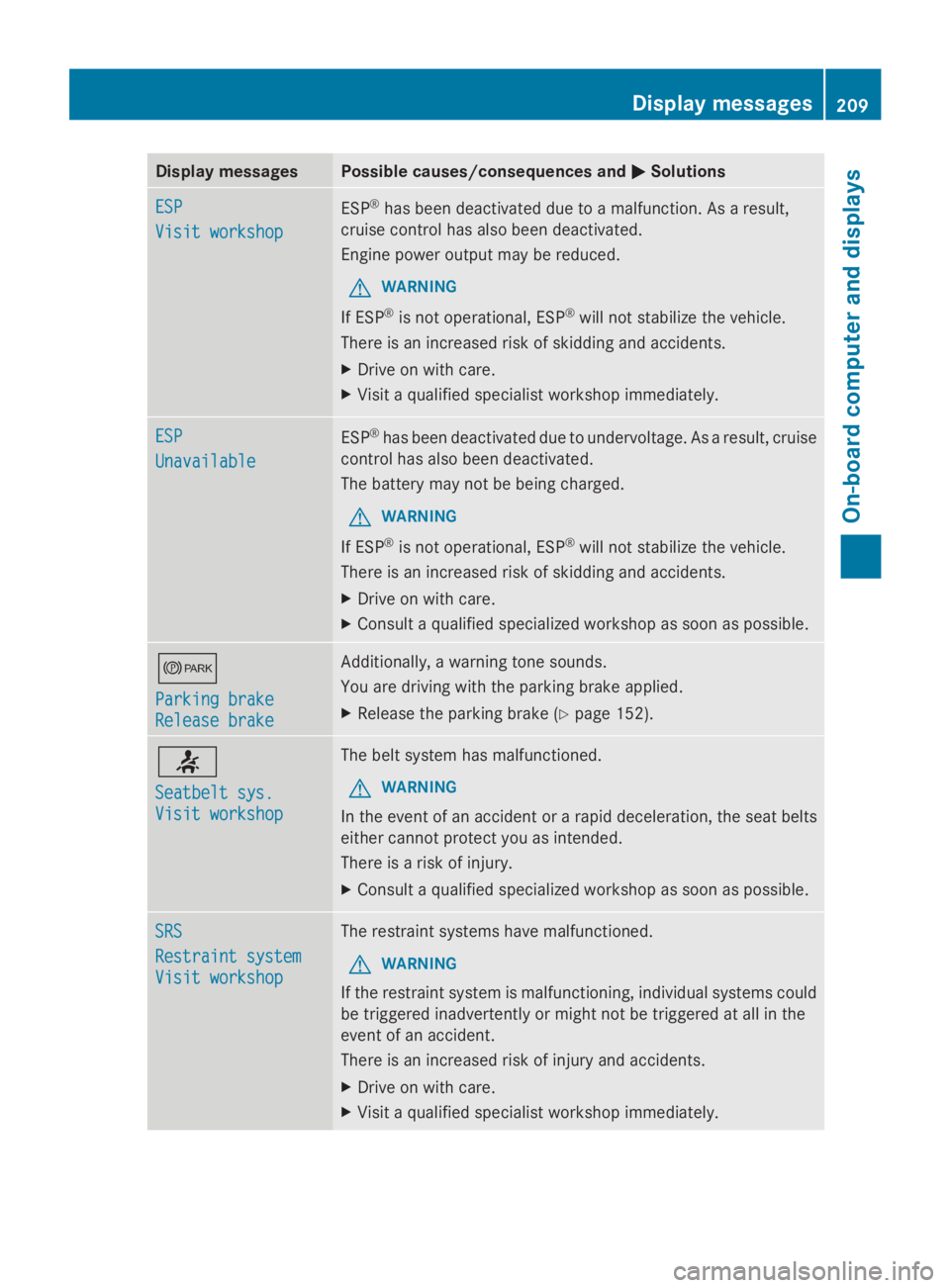
Display messages Possible causes/consequences and
0050
0050Solutions ESP
ESP
Visit workshop Visit workshop
ESP
®
has been deactivated due to a malfunction. As a result,
cruise control has also been deactivated.
Engine power output may be reduced.
G WARNING
If ESP ®
is not operational, ESP ®
will not stabilize the vehicle.
There is an increased risk of skidding and accidents.
X Drive on with care.
X Visit a qualified specialist workshop immediately. ESP ESP
Unavailable Unavailable
ESP
®
has been deactivated due to undervoltage. As a result, cruise
control has also been deactivated.
The battery may not be being charged.
G WARNING
If ESP ®
is not operational, ESP ®
will not stabilize the vehicle.
There is an increased risk of skidding and accidents.
X Drive on with care.
X Consult a qualified specialized workshop as soon as possible. 0066
Parking brake Parking brake
Release brake Release brake Additionally, a warning tone sounds.
You are driving with the parking brake applied.
X
Release the parking brake (Y page 152).0076
Seatbelt sys. Seatbelt sys.
Visit workshop Visit workshop The belt system has malfunctioned.
G WARNING
In the event of an accident or a rapid deceleration, the seat belts
either cannot protect you as intended.
There is a risk of injury.
X Consult a qualified specialized workshop as soon as possible. SRS SRS
Restraint system Restraint system
Visit workshop Visit workshop The restraint systems have malfunctioned.
G WARNING
If the restraint system is malfunctioning, individual systems could
be triggered inadvertently or might not be triggered at all in the
event of an accident.
There is an increased risk of injury and accidents.
X Drive on with care.
X Visit a qualified specialist workshop immediately. Display
messages
209On-board computer and displays Z
Page 221 of 338
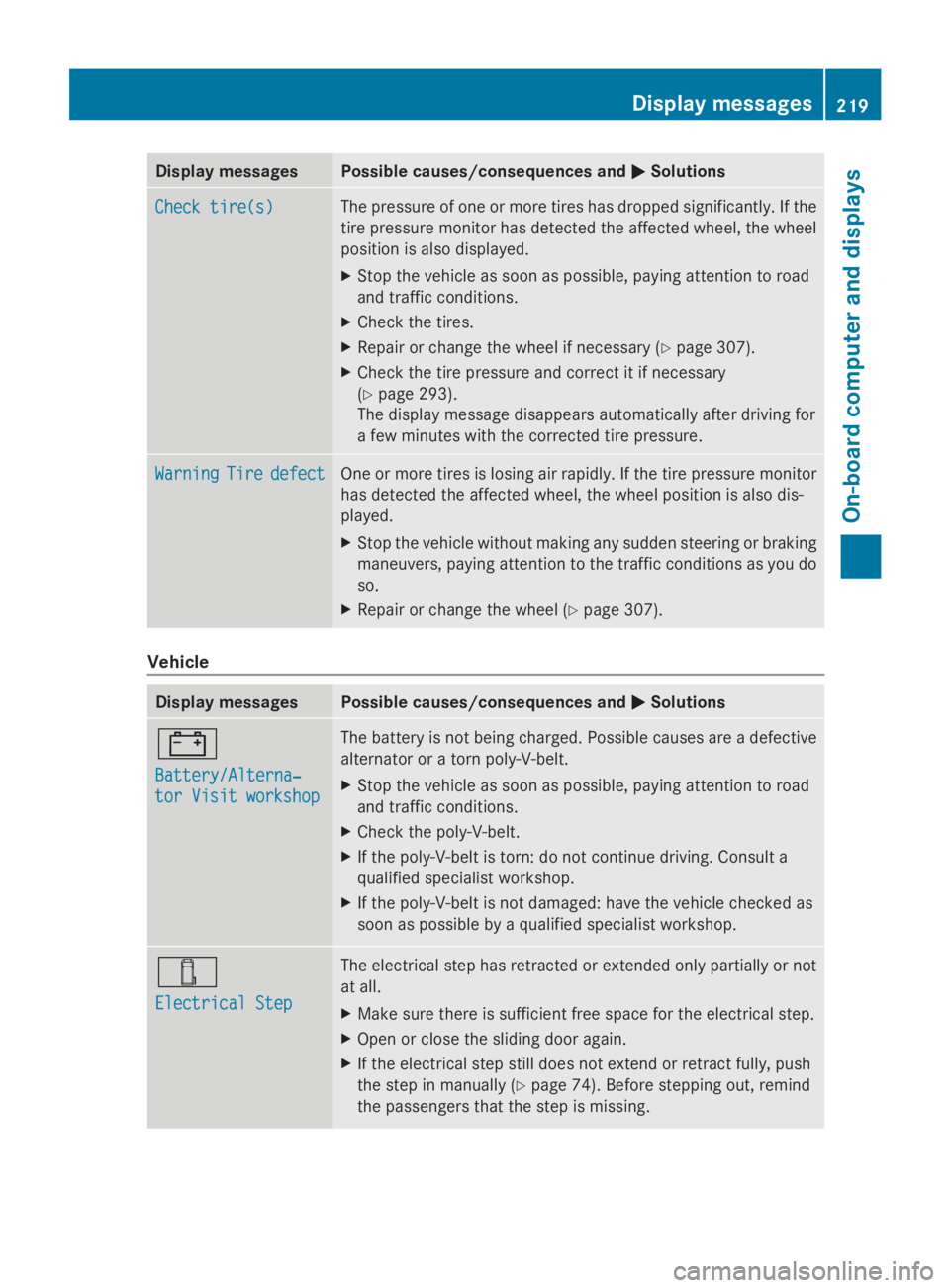
Display messages Possible causes/consequences and
0050
0050Solutions Check tire(s)
Check tire(s)
0054 The pressure of one or more tires has dropped significantly. If the
tire pressure monitor has detected the affected wheel, the wheel
position is also displayed.
X
Stop the vehicle as soon as possible, paying attention to road
and traffic conditions.
X Check the tires.
X Repair or change the wheel if necessary (Y page 307).
X Check the tire pressure and correct it if necessary
(Y page 293).
The display message disappears automatically after driving for
a few minutes with the corrected tire pressure. Warning Warning
Tire
Tiredefect
defect
0054 One or more tires is losing air rapidly. If the tire pressure monitor
has detected the affected wheel, the wheel position is also dis-
played.
X
Stop the vehicle without making any sudden steering or braking
maneuvers, paying attention to the traffic conditions as you do
so.
X Repair or change the wheel (Y page 307).Vehicle
Display messages Possible causes/consequences and
0050 0050Solutions 003D
Battery/Alterna‐ Battery/Alterna‐
tor Visit workshop tor Visit workshop The battery is not being charged. Possible causes are a defective
alternator or a torn poly-V-belt.
X
Stop the vehicle as soon as possible, paying attention to road
and traffic conditions.
X Check the poly-V-belt.
X If the poly-V-belt is torn: do not continue driving. Consult a
qualified specialist workshop.
X If the poly-V-belt is not damaged: have the vehicle checked as
soon as possible by a qualified specialist workshop. 00E6
Electrical Step Electrical Step The electrical step has retracted or extended only partially or not
at all.
X
Make sure there is sufficient free space for the electrical step.
X Open or close the sliding door again.
X If the electrical step still does not extend or retract fully, push
the step in manually (Y page 74). Before stepping out, remind
the passengers that the step is missing. Display
messages
219On-board computer and displays Z