fuel consumption MERCEDES-BENZ SPRINTER 2014 MY14 Operator’s Manual
[x] Cancel search | Manufacturer: MERCEDES-BENZ, Model Year: 2014, Model line: SPRINTER, Model: MERCEDES-BENZ SPRINTER 2014Pages: 338, PDF Size: 6.78 MB
Page 13 of 338
Fog lamps
Switching on/off .............................. 94
Folding seat ......................................... 85
Folding table ...................................... 236
In the twin co-driver's sea t............ 236
Frequencies
Mobile phone ................................. 318
Two-way radio ................................ 318
Front fog lamps
Switching on/off .............................. 94
Front interior light
Replacing bulbs ............................. 106
Front windshield
see Windshield
Fuel
Additives (diesel )........................... 323
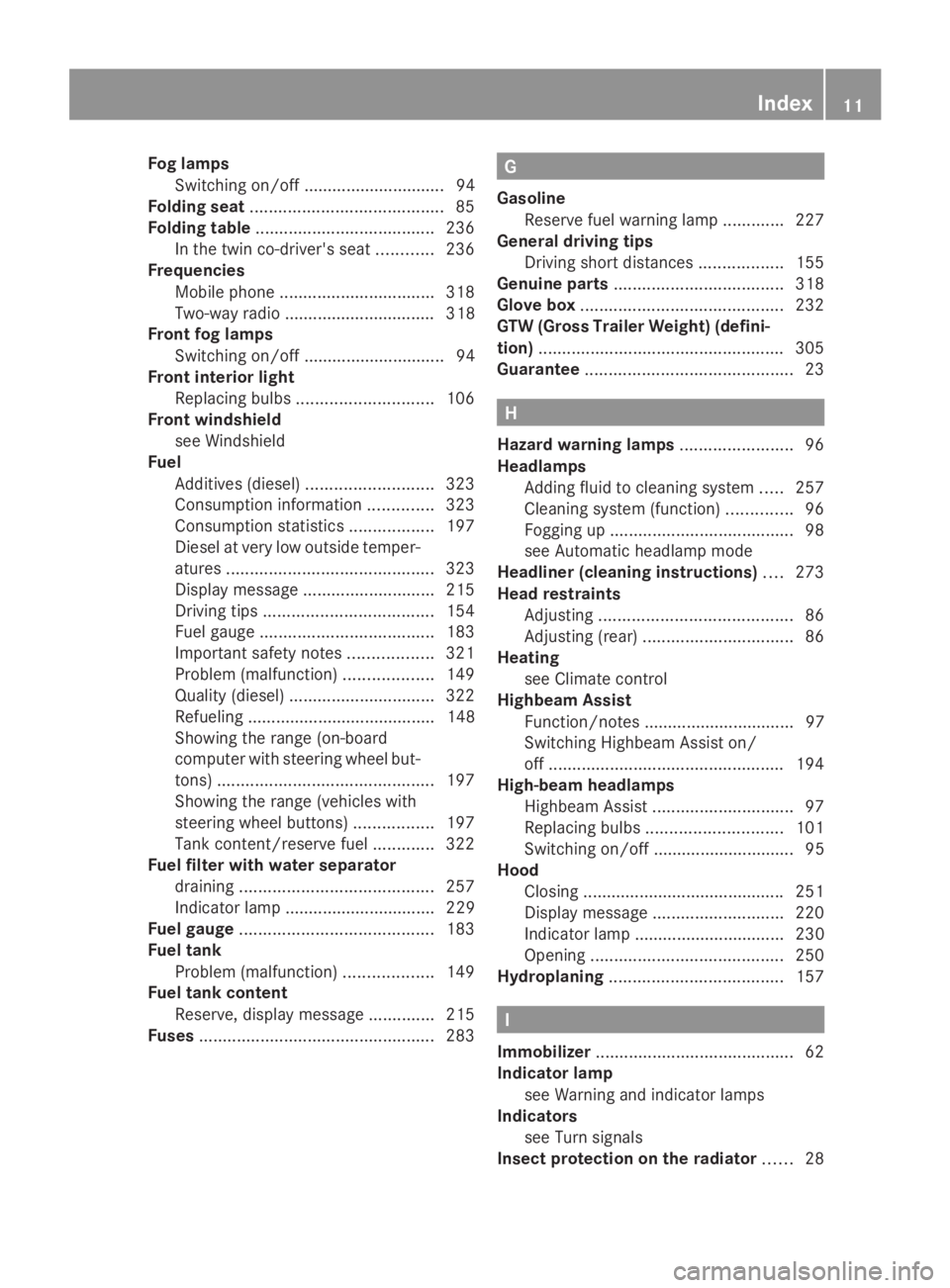
Consumption information ..............323
Consumption statistics ..................197
Diesel at very low outside temper-
atures ............................................ 323
Display message ............................ 215
Driving tips .................................... 154
Fuel gauge ..................................... 183
Important safety notes ..................321
Problem (malfunction) ...................149
Quality (diesel )............................... 322
Refueling ........................................ 148
Showing the range (on-board
computer with steering wheel but-
tons) .............................................. 197
Showing the range (vehicles with
steering wheel buttons) .................197
Tank content/reserve fuel .............322
Fuel filter with water separator
draining ......................................... 257
Indicator lamp ................................ 229
Fuel gauge ......................................... 183
Fuel tank Problem (malfunction) ...................149
Fuel tank content
Reserve, display message ..............215
Fuses .................................................. 283 G
Gasoline Reserve fuel warning lamp .............227
General driving tips
Driving short distances ..................155
Genuine parts .................................... 318
Glove box ........................................... 232
GTW (Gross Trailer Weight) (defini-
tion) .................................................... 305
Guarantee ............................................ 23 H
Hazard warning lamps ........................96
Headlamps Adding fluid to cleaning system .....257
Cleaning system (function) ..............96
Fogging up ....................................... 98
see Automatic headlamp mode
Headliner (cleaning instructions) ....273
Head restraints Adjusting ......................................... 86
Adjusting (rear) ................................ 86
Heating
see Climate control
Highbeam Assist
Function/notes ................................ 97
Switching Highbeam Assist on/
off .................................................. 194
High-beam headlamps
Highbeam Assist .............................. 97
Replacing bulbs ............................. 101
Switching on/off .............................. 95
Hood
Closing .......................................... .251
Display message ............................ 220
Indicator lamp ................................ 230
Opening ......................................... 250
Hydroplaning ..................................... 157 I
Immobilizer .......................................... 62
Indicator lamp see Warning and indicator lamps
Indicators
see Turn signals
Insect protection on the radiator ......28 Index
11
Page 24 of 338
Protection of the environment
General notes
H
Environmental note
Daimler's declared policy is one of compre-
hensive environmental protection.
The objectives are for the natural resources
that form the basis of our existence on this
planet to be used sparingly and in a manner
that takes the requirements of both nature
and humanity into account.
You too can help to protect the environment
by operating your vehicle in an environmen-
tally responsible manner.
Fuel consumption and the rate of engine,
transmission, brake and tire wear are affected
by these factors:
R operating conditions of your vehicle
R your personal driving style
You can influence both factors. You should
bear the following in mind:
Operating conditions:
R avoid short trips as these increase fuel con-
sumption.
R always make sure that the tire pressures
are correct.
R do not carry any unnecessary weight.
R remove roof racks once you no longer need
them.
R a regularly serviced vehicle will contribute
to environmental protection. You should
therefore adhere to the service intervals.
R always have service work carried out at a
qualified specialist workshop.
Personal driving style:
R do not depress the accelerator pedal when
starting the engine.
R do not warm up the engine when the vehicle
is stationary.
R drive carefully and maintain a safe distance
from the vehicle in front.
R avoid frequent, sudden acceleration and
braking. R
change gear in good time and use each gear
only up to 00C3of its maximum engine speed.
R switch off the engine in stationary traffic.
R keep an eye on the vehicle's fuel consump-
tion. Environmental issues and recommen-
dations
When prompted by this Operator's Manual to
dispose of materials, please try to regenerate
and recycle these materials. Observe all rel-
evant environmental guidelines and regula-
tions when disposing of materials. This helps
to protect the environment. Product information
We recommend original Sprinter parts and
conversion parts and accessories that have
been approved expressly for the type of vehi-
cle concerned.
We test genuine Sprinter parts, as well as
conversion parts and accessories that have
been specifically approved for the type of
vehicle, for:
R reliability
R safety
R suitability
Despite ongoing market research, Mercedes-
Benz is unable to assess other parts. We
therefore accept no responsibility for the use
of such parts in a Sprinter, even if they have
been independently or officially approved.
Genuine Sprinter parts, as well as specifically
approved conversion parts and accessories,
can be obtained at an authorized Sprinter
Dealer. Here you will receive advice about
permissible technical modifications, and the
parts will be professionally installed. 22
Introduction
Page 29 of 338
Exhaust gas aftertreatment
The exhaust gas aftertreatment requires a
reducing agent known as Diesel Exhaust Fluid
(DEF) in order to function correctly. Filling up
the DEF tank is usually part of the service
scope. DEF consumption depends on opera-
tional and driving conditions and it is not nec-
essary to wait until the next scheduled
service to replenish the fluid. Fluid should be
added regularly to the DEF supply reservoir
during vehicle operation or, at the latest, after
receiving the first warning message via the
on-board computer.
To conform to emission regulations, you must
operate the vehicle with DEF and refill the
supply regularly. The engine management
recognizes attempts to operate the vehicle
without DEF, with thinned DEF or with
another reducing agent. After previous warn-
ing messages, the engine management then
prevents a further engine start.
If the DEF level drops below 1.5 US gal
(5.5 l), the first warning message is issued
and a warning tone sounds. After the mes-
sage appears for the first time, and under
normal driving conditions, the remaining DEF
reserve will last for approximately
1000 miles (1600 km) before the next mes-
sage.
After that, the 0.8 US gal (3.0 l)reserve mark
is reached. Once the reserve range has been
reached, you will receive the next warning
message and you will hear a series of warning
tones. After the first message, the DEF
reserve will last for approximately
1,200 miles (1,900 km) until the next mes-
sage is shown. However, you will only be able
to start the engine another 16 times.
You should immediately add 2.0 US gal
(7.6 l) of DEF (Y page 150) or have the DEF
supply reservoir filled at a qualified specialist
workshop.
When the number of remaining engine starts
is 0
0 the engine management prevents the
vehicle being driven at a speed exceeding 5 mph (8 km/h). The
Idle Mode Idle Modemessage
appears in the multifunction display:
If the 00B9 Check Engine indicator lamp lights
up, the exhaust gas aftertreatment is faulty or
an emission-related malfunction has occur-
red (Y page 213). You will then only be able
to drive a maximum 50 mi (80 km) before the
engine management restricts the number of
starts remaining.
If the exhaust gas aftertreatment is faulty,
have it checked and repaired at a qualified
specialist workshop.
Further information on DEF can be found in
the "Refueling" (Y page 149) and "Service
products and capacities" (Y page 324) sec-
tions. Attachments, bodies, equipment and
conversions
General notes !
For safety reasons, have add-on equip-
ment manufactured and installed accord-
ing to the Sprinter body/equipment mount-
ing directives in force. These body/equip-
ment mounting directives ensure that the
chassis and the body form one unit and that
maximum operating and road safety is ach-
ieved.
We recommend for safety reasons that:
R you carry out no other modifications to
the vehicle.
R you obtain the agreement of the distrib-
utor named on the inside of the front
cover for any deviations from the
approved body/equipment mounting
directives.
Approval from certified inspection agen-
cies or official approvals cannot rule out
risks to your safety.
We recommend that you use genuine
Mercedes-Benz parts as well as conversion
parts and accessories that have been specif-
ically approved by Mercedes-Benz for the
type of vehicle. Introduction
27 Z
Page 156 of 338
Bear in mind that at a speed of just 30 mph
(approximately 50 km/h), your vehicle covers
a distance of 44 feet (approximately 14 m)
every second. G
WARNING
If you switch off the ignition while driving,
safety-relevant functions are only available
with limitations, or not at all. This could affect,
for example, the power steering and the brake
boosting effect. You will require considerably
more effort to steer and brake. There is a risk
of an accident.
Do not switch off the ignition while driving.
! Always observe the ground clearance of
the vehicle and avoid obstacles. On vehi-
cles with a step, ground clearance is further
restricted. Obstacles can damage the vehi-
cle.
If you must drive over obstacles, drive espe-
cially slowly and carefully. If necessary,
have another person direct you.
Drive sensibly – save fuel In order to save fuel, observe the following
tips:
X
The tires should always be inflated to the
recommended tire pressure.
X Remove unnecessary loads.
X Remove roof carriers when they are not
needed.
X Warm up the engine at low engine speeds.
X Avoid frequent acceleration or braking.
X Have all maintenance work carried out as
indicated by the service intervals in the
Maintenance Booklet or by the service
interval display.
Fuel consumption also increases when driv-
ing in cold weather, in stop-start traffic and in
mountainous terrain. Overrun cutoff If you are in overrun mode and take your foot
off the accelerator pedal, the fuel supply is
cut off when the engine speed is out of the
idle speed control range.
Drinking and driving
G
WARNING
Drinking and driving and/or taking drugs and
driving are very dangerous combinations.
Even a small amount of alcohol or drugs can
affect your reflexes, perceptions and judg-
ment.
The possibility of a serious or even fatal acci-
dent are greatly increased when you drink or
take drugs and drive.
Do not drink or take drugs and drive or allow
anyone to drive who has been drinking or tak-
ing drugs.
Emission control G
WARNING
Combustion engines emit poisonous exhaust
gases such as carbon monoxide. Inhaling
these exhaust gases leads to poisoning. There
is a risk of fatal injury. Therefore never leave
the engine running in enclosed spaces with-
out sufficient ventilation.
Certain engine systems are designed to keep
the level of poisonous substances in exhaust
fumes within legal limits.
These systems only work optimally if they are
maintained exactly in accordance with the
manufacturer's specifications. Any work on
the engine should therefore be carried out by
qualified and authorized technicians at a
Sprinter dealer.
The engine settings must not be changed
under any circumstances. In addition, all spe-
cific maintenance work must be carried out
at regular intervals and in accordance with
the service requirements of the dealer listed 154
Driving tipsDriving and parking
Page 185 of 338
Instrument lighting
When the lights are switched on, you can
adjust the brightness of the instrument clus-
ter lighting using the 0074and 0075buttons.
X To brighten: press the0074button.
X To dim: press the 0075button.
i Vehicles with automatic headlamp mode:
the instrument lighting also adapts to auto-
matic headlamp mode. Tachometer
! Do not drive in the overrevving range, as
this could damage the engine. H
Environmental note
Avoid driving at high engine speeds. This
unnecessarily increases the fuel consumption
of your vehicle and harms the environment as
a result of increased emissions.
The red band in the tachometer indicates the
engine's overrevving range.
To protect the engine, the fuel supply is inter-
rupted when the red band is reached. Outside temperature
You should pay special attention to road con-
ditions when temperatures are around the
freezing point.
On vehicles without steering wheel buttons
(Y page 184) and on vehicles with steering
wheel buttons (Y page 189), the outside tem-
perature display is in the display.
Changes in the outside temperature are dis-
played after a short delay. Speedometer
The speed can also be shown in the display.
You can find information on the digital speed-
ometer for vehicles without steering wheel
buttons under (Y page 184) and for vehicles with steering wheel buttons under
(Y
page 189).
i In some countries, a warning sounds
when the vehicle reaches the maximum
speed limit, e.g. at 75 mph ( 120 km/h). Trip odometer
X To reset: make sure that the display is
showing the trip odometer if you have a
vehicle with steering wheel buttons
(Y page 189).
X Press and hold the 0045reset button until the
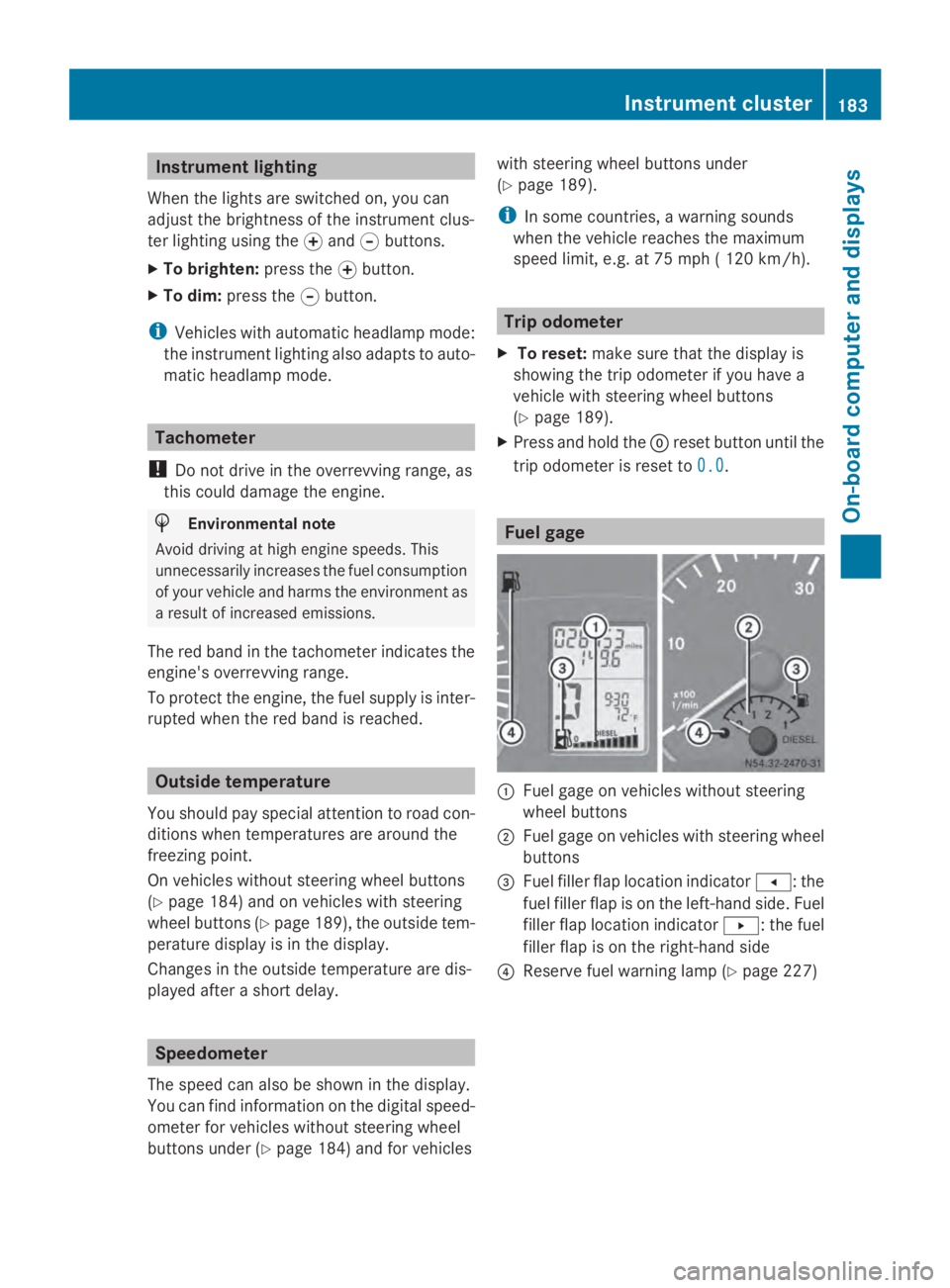
trip odometer is reset to 0.0 0.0. Fuel gage
0043
Fuel gage on vehicles without steering
wheel buttons
0044 Fuel gage on vehicles with steering wheel
buttons
0087 Fuel filler flap location indicator 007F: the
fuel filler flap is on the left-hand side. Fuel
filler flap location indicator 0080: the fuel
filler flap is on the right-hand side
0085 Reserve fuel warning lamp (Y page 227) Instrument cluster
183On-board computer and displays Z
Page 186 of 338
DEF gauge
Vehicles without steering wheel but-
tons If the supply of DEF is less than 1.5 US gal
(5.5 l), the 00E2indicator lamp lights up and
the 0099 dEF Chk
dEF Chk display message appears.
If the supply of DEF falls below the reserve
range of 0.8 US gal (3.0 l), the 00E2indicator
lamp lights up and the 0099StArtS RExx
StArtS RExx
display message appears. In the display, xx
xx
corresponds to the number of possible
remaining engine starts (16 16to0
0).
Further information on DEF consumption can
be found in the "Service products and filling
capacity" section (Y page 324).
Vehicles with steering wheel buttons If the supply of DEF is less than 1.5 US gal
(5.5 l), the Check Diesel Exhaust Fluid
Check Diesel Exhaust Fluid
See
See Operator's
Operator's Manual
Manualmessage is shown
in the display.
If the supply of DEF falls below the reserve
range of 0.8 US gal (3.0 l), the 00E2xx
xx
starts remaining starts remaining message is displayed. In
the display, xx
xxcorresponds to the number of
possible remaining engine starts ( 16
16to0
0).
Further information on DEF consumption can
be found in the "Service products and filling
capacity" section (Y page 324).On-board computer (vehicles without
steering wheel buttons) Operating the on-board computer
General notes The on-board computer is activated as soon
as you turn the key to position 1in the ignition
lock.
The on-board computer shows vehicle infor-
mation and settings in the display. You can control the display and the settings
in the on-board computer using the adjust-
ment buttons on the instrument cluster.
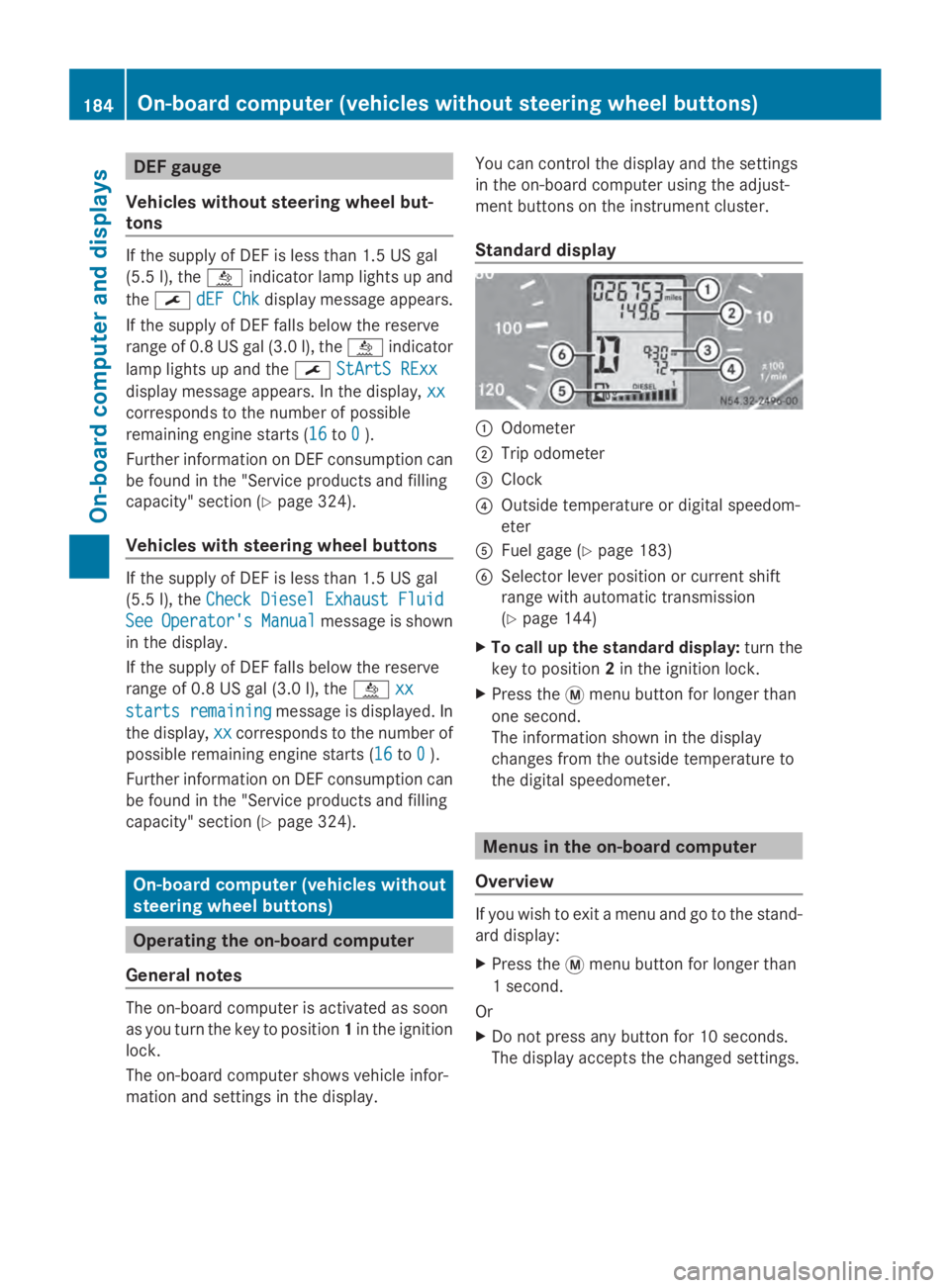
Standard display
0043
Odometer
0044 Trip odometer
0087 Clock
0085 Outside temperature or digital speedom-
eter
0083 Fuel gage (Y page 183)
0084 Selector lever position or current shift
range with automatic transmission
(Ypage 144)
X To call up the standard display: turn the
key to position 2in the ignition lock.
X Press the 0079menu button for longer than
one second.
The information shown in the display
changes from the outside temperature to
the digital speedometer. Menus in the on-board computer
Overview If you wish to exit a menu and go to the stand-
ard display:
X
Press the 0079menu button for longer than
1 second.
Or
X Do not press any button for 10 seconds.
The display accepts the changed settings. 184
On-boa
rdcompu ter (vehicles without steering wheel buttons)On-board computer and displays
Page 199 of 338
X
Press the 0063button to select the Key
Key
function.
The selection marker is on the current set-
ting.
X Press the 0081or0082 button to activate
or deactivate key dependency. Trip computer menu
General notes You can call up or reset statistical data for the
vehicle in the Trip computer menu.
i When you call up the trip computer again,
it displays the last function called up.
The units of the statistical information dis-
played are set permanently for each spe-
cific country, and are therefore independ-
ent of the units selected in the Settings
Settings
menu.
Trip computer "After start" or "After
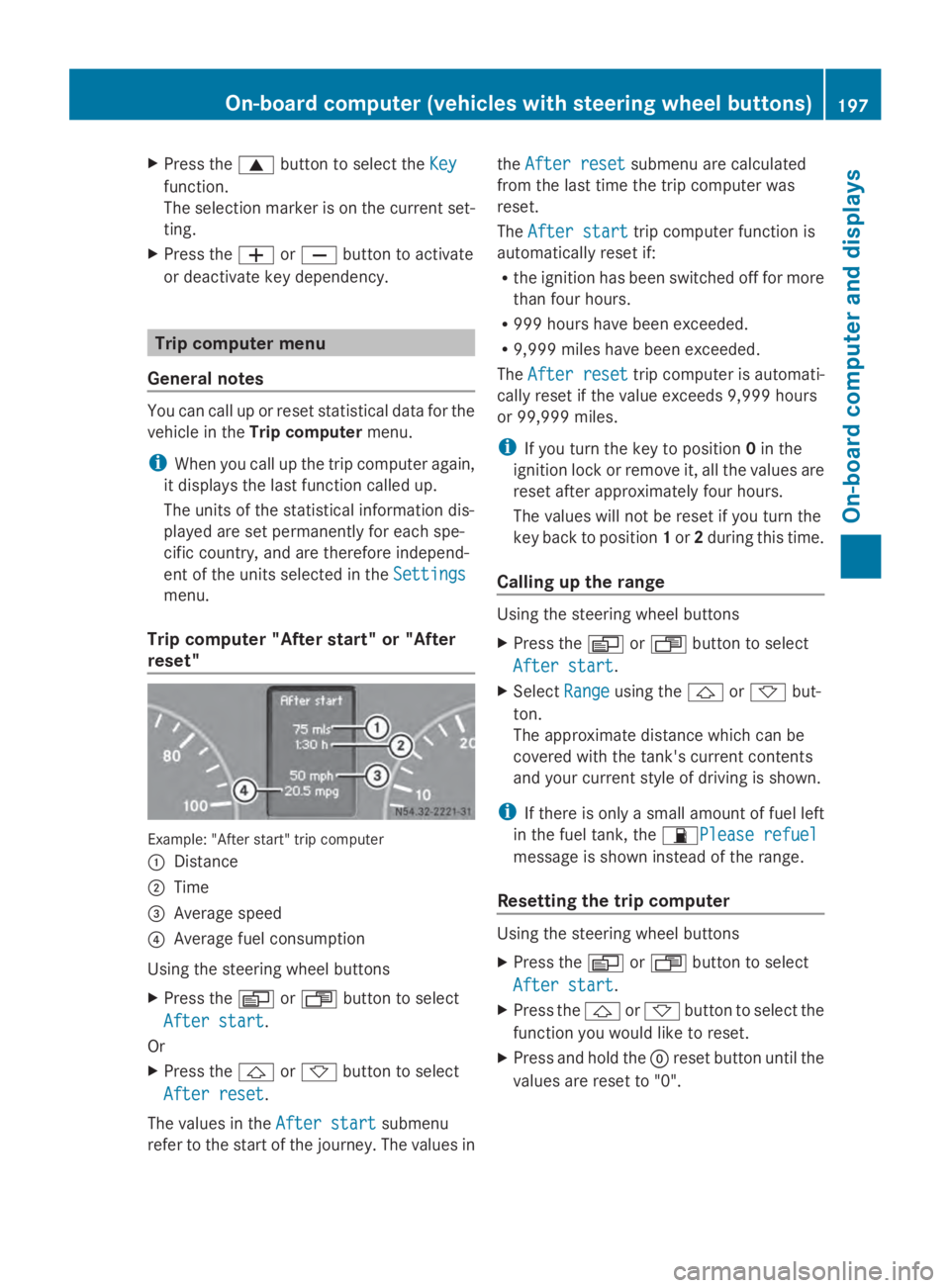
reset" Example: "After start" trip computer
0043
Distance
0044 Time
0087 Average speed
0085 Average fuel consumption
Using the steering wheel buttons
X Press the 0080or007F button to select
After start
After start.
Or
X Press the 0041or0068 button to select
After reset After reset.
The values in the After start
After startsubmenu
refer to the start of the journey. The values in the
After reset
After reset submenu are calculated
from the last time the trip computer was
reset.
The After start After start trip computer function is
automatically reset if:
R the ignition has been switched off for more
than four hours.
R 999 hours have been exceeded.
R 9,999 miles have been exceeded.
The After reset
After reset trip computer is automati-
cally reset if the value exceeds 9,999 hours
or 99,999 miles.
i If you turn the key to position 0in the
ignition lock or remove it, all the values are
reset after approximately four hours.
The values will not be reset if you turn the
key back to position 1or 2during this time.
Calling up the range Using the steering wheel buttons
X
Press the 0080or007F button to select
After start After start.
X Select Range
Rangeusing the 0041or0068 but-
ton.
The approximate distance which can be
covered with the tank's current contents
and your current style of driving is shown.
i If there is only a small amount of fuel left
in the fuel tank, the 00B5Please refuelPlease refuel
message is shown instead of the range.
Resetting the trip computer Using the steering wheel buttons
X
Press the 0080or007F button to select
After start After start.
X Press the 0041or0068 button to select the
function you would like to reset.
X Press and hold the 0045reset button until the
values are reset to "0". On-board computer (vehicles with steering wheel buttons)
197On-board computer and displays Z
Page 294 of 338
ing properties and the driving characteristics.
There is a risk of an accident.
Avoid tire pressures that are too low in all the
tires, including the spare wheel.
Underinflated tires can:
R fail from being overheated
R adversely affect handling
R wear excessively and/or unevenly
R have an adverse effect on fuel consumption
Overinflated tires G
WARNING
Tires with excessively high pressure can burst
because they are damaged more easily by
road debris, potholes etc. In addition, they
also suffer from irregular wear, which can
severely impair the braking properties and the
driving characteristics. There is a risk of an
accident.
Avoid tire pressures that are too high in all the
tires, including the spare wheel.
Overinflated tires can:
R increase the braking distance
R adversely affect handling
R wear excessively and/or unevenly
R adversely affect ride comfort
R be more susceptible to damage
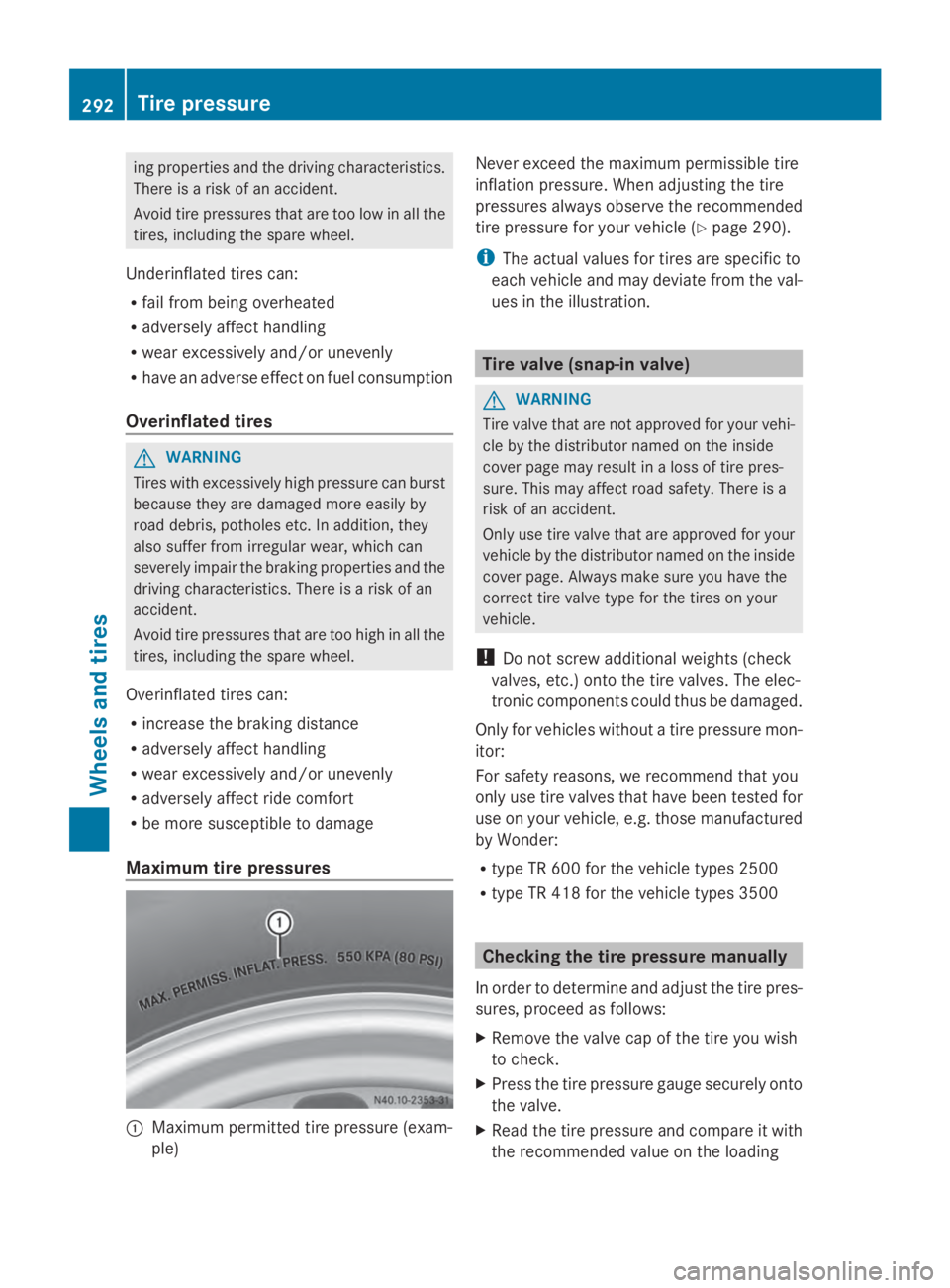
Maximum tire pressures 0043
Maximum permitted tire pressure (exam-
ple) Never exceed the maximum permissible tire
inflation pressure. When adjusting the tire
pressures always observe the recommended
tire pressure for your vehicle (Y
page 290).
i The actual values for tires are specific to
each vehicle and may deviate from the val-
ues in the illustration. Tire valve (snap-in valve)
G
WARNING
Tire valve that are not approved for your vehi-
cle by the distributor named on the inside
cover page may result in a loss of tire pres-
sure. This may affect road safety. There is a
risk of an accident.
Only use tire valve that are approved for your
vehicle by the distributor named on the inside
cover page. Always make sure you have the
correct tire valve type for the tires on your
vehicle.
! Do not screw additional weights (check
valves, etc.) onto the tire valves. The elec-
tronic components could thus be damaged.
Only for vehicles without a tire pressure mon-
itor:
For safety reasons, we recommend that you
only use tire valves that have been tested for
use on your vehicle, e.g. those manufactured
by Wonder:
R type TR 600 for the vehicle types 2500
R type TR 418 for the vehicle types 3500 Checking the tire pressure manually
In order to determine and adjust the tire pres-
sures, proceed as follows:
X Remove the valve cap of the tire you wish
to check.
X Press the tire pressure gauge securely onto
the valve.
X Read the tire pressure and compare it with
the recommended value on the loading 292
Tire pressureWheels and tires
Page 325 of 338
R
diesel fuel with a bio-diesel content of
more than 7%
R diesel fuel with a bio-diesel content of up
to 7%, which does not fulfill the require-
ments stated under "Fuel grade"
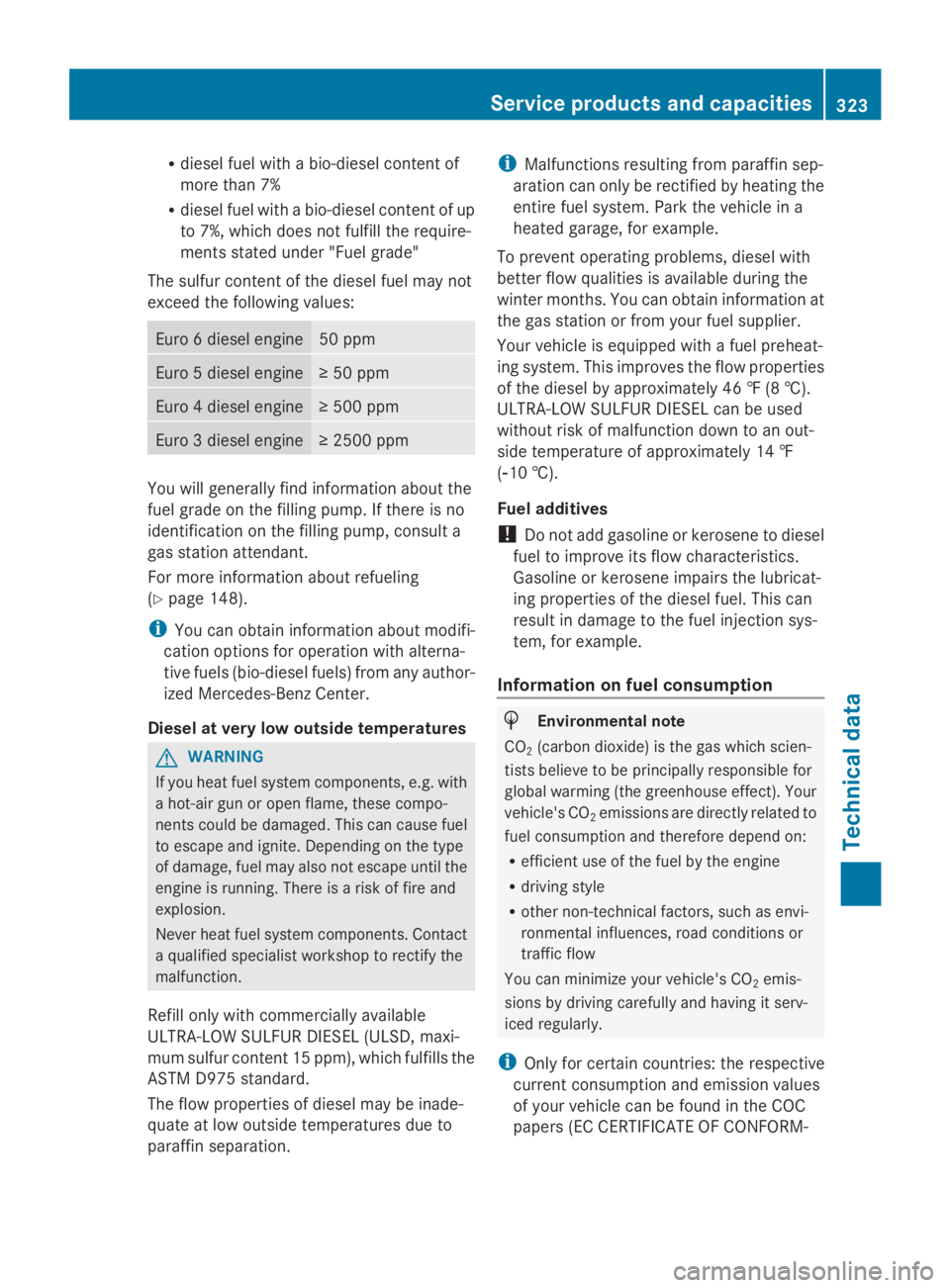
The sulfur content of the diesel fuel may not
exceed the following values: Euro 6 diesel engine 50 ppm
Euro 5 diesel engine ≥ 50 ppm
Euro 4 diesel engine ≥ 500 ppm
Euro 3 diesel engine ≥ 2500 ppm
You will generally find information about the
fuel grade on the filling pump. If there is no
identification on the filling pump, consult a
gas station attendant.
For more information about refueling
(Y
page 148).
i You can obtain information about modifi-
cation options for operation with alterna-
tive fuels (bio-diesel fuels) from any author-
ized Mercedes-Benz Center.
Diesel at very low outside temperatures G
WARNING
If you heat fuel system components, e.g. with
a hot-air gun or open flame, these compo-
nents could be damaged. This can cause fuel
to escape and ignite. Depending on the type
of damage, fuel may also not escape until the
engine is running. There is a risk of fire and
explosion.
Never heat fuel system components. Contact
a qualified specialist workshop to rectify the
malfunction.
Refill only with commercially available
ULTRA-LOW SULFUR DIESEL (ULSD, maxi-
mum sulfur content 15 ppm), which fulfills the
ASTM D975 standard.
The flow properties of diesel may be inade-
quate at low outside temperatures due to
paraffin separation. i
Malfunctions resulting from paraffin sep-
aration can only be rectified by heating the
entire fuel system. Park the vehicle in a
heated garage, for example.
To prevent operating problems, diesel with
better flow qualities is available during the
winter months. You can obtain information at
the gas station or from your fuel supplier.
Your vehicle is equipped with a fuel preheat-
ing system. This improves the flow properties
of the diesel by approximately 46 ‡ (8 †).
ULTRA-LOW SULFUR DIESEL can be used
without risk of malfunction down to an out-
side temperature of approximately 14 ‡
(00F810 †).
Fuel additives
! Do not add gasoline or kerosene to diesel
fuel to improve its flow characteristics.
Gasoline or kerosene impairs the lubricat-
ing properties of the diesel fuel. This can
result in damage to the fuel injection sys-
tem, for example.
Information on fuel consumption H
Environmental note
CO 2(carbon dioxide) is the gas which scien-
tists believe to be principally responsible for
global warming (the greenhouse effect). Your
vehicle's CO 2emissions are directly related to
fuel consumption and therefore depend on:
R efficient use of the fuel by the engine
R driving style
R other non-technical factors, such as envi-
ronmental influences, road conditions or
traffic flow
You can minimize your vehicle's CO 2emis-
sions by driving carefully and having it serv-
iced regularly.
i Only for certain countries: the respective
current consumption and emission values
of your vehicle can be found in the COC
papers (EC CERTIFICATE OF CONFORM- Service products and capacities
323Technical data Z
Page 326 of 338
ITY). These documents are supplied when
the vehicle is delivered.
Consumption figures were found in the cur-
rently valid respective version:
R for vehicles from the Euro 5 standard
according to regulation (EC) no.
715/2007
R for vehicles from the Euro 6 standard
according to regulation (EC) no.
595/2009
Fuel consumption depends on:
R the vehicle version
R the style of driving
R the operating conditions
R the type or quality of the fuel used
The vehicle will use more fuel than usual in
the following situations:
R at very low outside temperatures
R in city traffic
R during short journeys
R on mountainous terrain
R when towing a trailer
To keep fuel consumption low, observe the
advice in the "Protection of the environment"
section (Y page 22).
The following components of the different
vehicle versions influence fuel consumption:
R tire sizes, tire tread, tire pressure, tire con-
dition
R body
R transmission ratios for the drive assem-
blies
R additional equipment (e.g. air-conditioning
system, auxiliary heating system).
For these reasons, the actual consumption
figures for your vehicle may deviate from the
consumption figures determined according
to EU Directive 80/1268/EEC.
Data concerning fuel consumption are
recorded in the on-board computer; use the
steering wheel buttons to call up the Trip
computer menu (Ypage 197). Diesel Exhaust Fluid (DEF) General notes
!
Only use DEF in accordance with
ISO 22241. The exhaust gas aftertreatment
system may otherwise be damaged.
Observe the MB Specifications for Service
Products, Sheet No. 352.0.
Damage caused by the use of other reduc-
ing agents will invalidate the New Vehicle
Limited Warranty.
! If DEF comes into contact with a painted
or aluminum surface, wash the surface off
immediately with plenty of water.
High ambient temperatures
When opening the DEF tank filler cap at high
outside temperatures, ammonia vapors may
escape. Ammonia vapors have a pungent
odor and are particularly irritating for your
skin, respiratory organs and eyes. This may
result in burning eyes, nose and throat, as
well as coughing and watering eyes. Do not
inhale ammonia vapors.
If DEF heats up, e.g. in direct sunlight, in the
DEF supply reservoir for some time to over
122 ‡ (50 †), ammonia vapor will develop.
Low ambient temperatures
DEF freezes at a temperature of approx-
imately 12 ‡(00F811 †). The vehicle is equipped
with a DEF preheating system at the factory.
Winter operation is therefore also guaranteed
at temperatures under 12 ‡ (00F811 †).
Additives and tap water
! Do not mix DEF with any additives and do
not dilute DEF with tap water. Otherwise,
the exhaust gas aftertreatment may be
damaged.
Observe the MB Specifications for Service
Products, Sheet No. 352.0.
Damage that arises through the use of addi-
tives or tap water will invalidate the New
Vehicle Limited Warranty. 324
Service products and capacitiesTechnical data