air condition MERCEDES-BENZ SPRINTER 2016 MY16 Operator’s Manual
[x] Cancel search | Manufacturer: MERCEDES-BENZ, Model Year: 2016, Model line: SPRINTER, Model: MERCEDES-BENZ SPRINTER 2016Pages: 290, PDF Size: 6.44 MB
Page 5 of 290
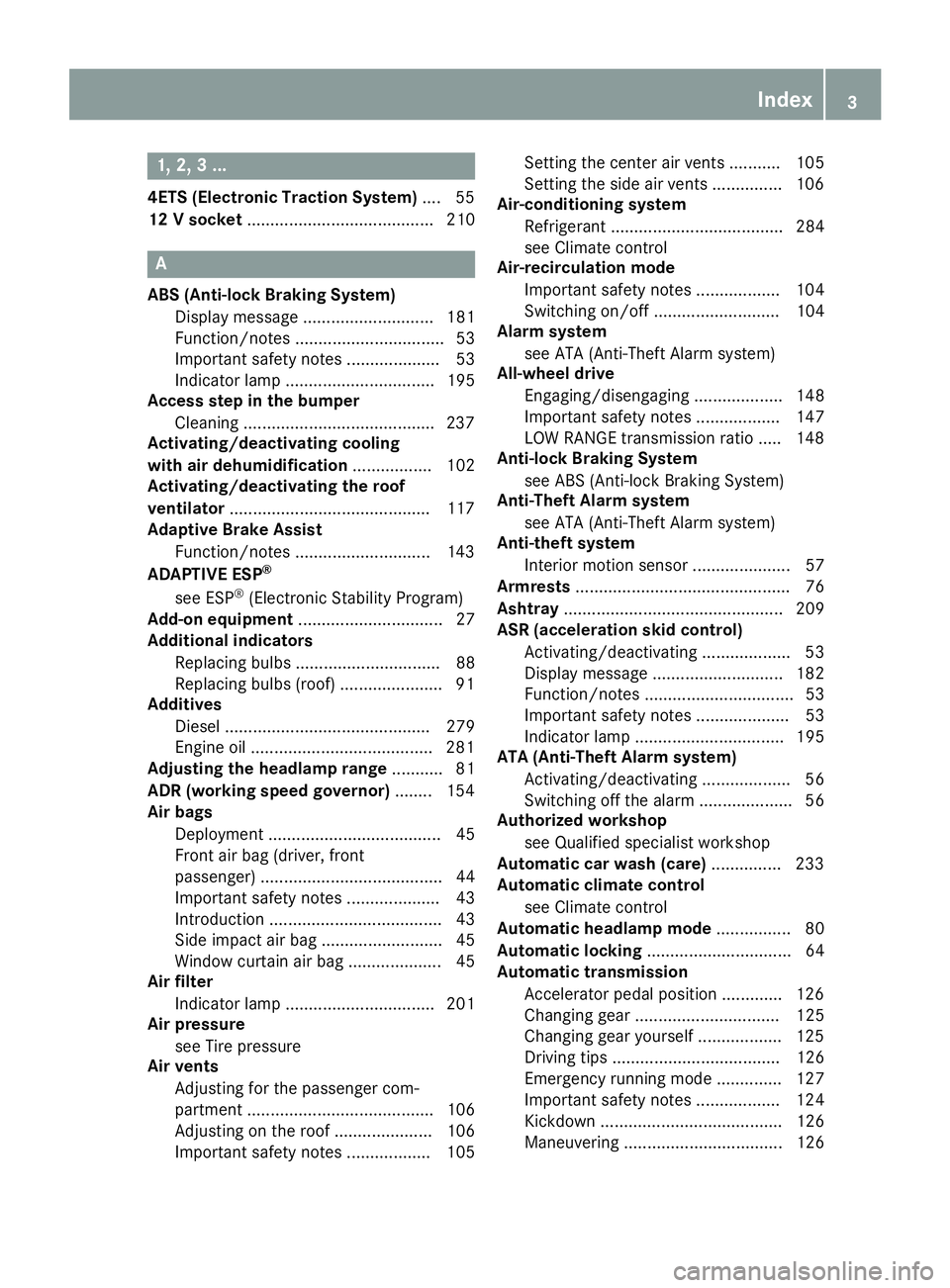
1, 2, 3 ...
4ETS (Electronic Traction System).... 55
12 V socket ........................................ 210
A
ABS (Anti-lock Braking System)
Display message ............................ 181
Function/notes ................................ 53
Important safety notes .................... 53
Indicator lamp ................................ 195
Access step in the bumper
Cleaning .........................................2 37
Activating/deactivating cooling
with air dehumidification ................. 102
Activating/deactivating the roof
ventilator ...........................................1 17
Adaptive Brake Assist
Function/notes .............................1 43
ADAPTIVE ESP
®
see ESP®(Electronic Stability Program)
Add-on equipment ............................... 27
Additional indicators
Replacing bulbs ............................... 88
Replacing bulbs (roof) ......................9 1
Additives
Diesel ............................................ 279
Engine oil ...................................... .281
Adjusting the headlamp range ........... 81
ADR (working speed governor) ........154
Air bags
Deployment ..................................... 45
Front air bag (driver, front
passenger) ....................................... 44
Important safety notes .................... 43
Introduction ..................................... 43
Side impact air bag .......................... 45
Window curtain air bag .................... 45
Air filter
Indicator lamp ................................ 201
Air pressure
see Tire pressure
Air vents
Adjusting for the passenger com-
partment ........................................ 106
Adjusting on the roof ..................... 106
Importa nt sa
fety notes .................. 105 Setting the center air vents ........... 105
Setting the side air vents ...............1
06
Air-conditioning system
Refrigerant ..................................... 284
see Climate control
Air-recirculation mode
Important safety notes .................. 104
Switching on/off ........................... 104
Alarm system
see ATA (Anti-Theft Alarm system)
All-wheel drive
Engaging/disengaging ................... 148
Important safety notes .................. 147
LOW RANGE transmission ratio ..... 148
Anti-lock Braking System
see ABS (Anti-lock Braking System)
Anti-Theft Alarm system
see ATA (Anti-Theft Alarm system)
Anti-theft system
Interior motion sensor ..................... 57
Armrests .............................................. 76
Ashtray ............................................... 209
ASR (acceleration skid control)
Activating/deactivating ................... 53
Display message ............................ 182
Function/notes ................................ 53
Important safety notes .................... 53
Indicator lamp ................................ 195
ATA (Anti-Theft Alarm system)
Activating/deactivating ................... 56
Switching off the alarm .................... 56
Authorized workshop
see Qualified specialist workshop
Automatic car wash (care) ...............233
Automatic climate control
see Climate control
Automatic headlamp mode ................ 80
Automatic locking ............................... 64
Automatic transmission
Accelerator pedal position ............. 126
Changing gear ............................... 125
Changing gear yourself .................. 125
Driving tips .................................... 126
Emergency running mode .............. 127
Important safety notes .................. 124
Kickdown ....................................... 126
Maneuvering .................................. 126
Index3
Page 6 of 290
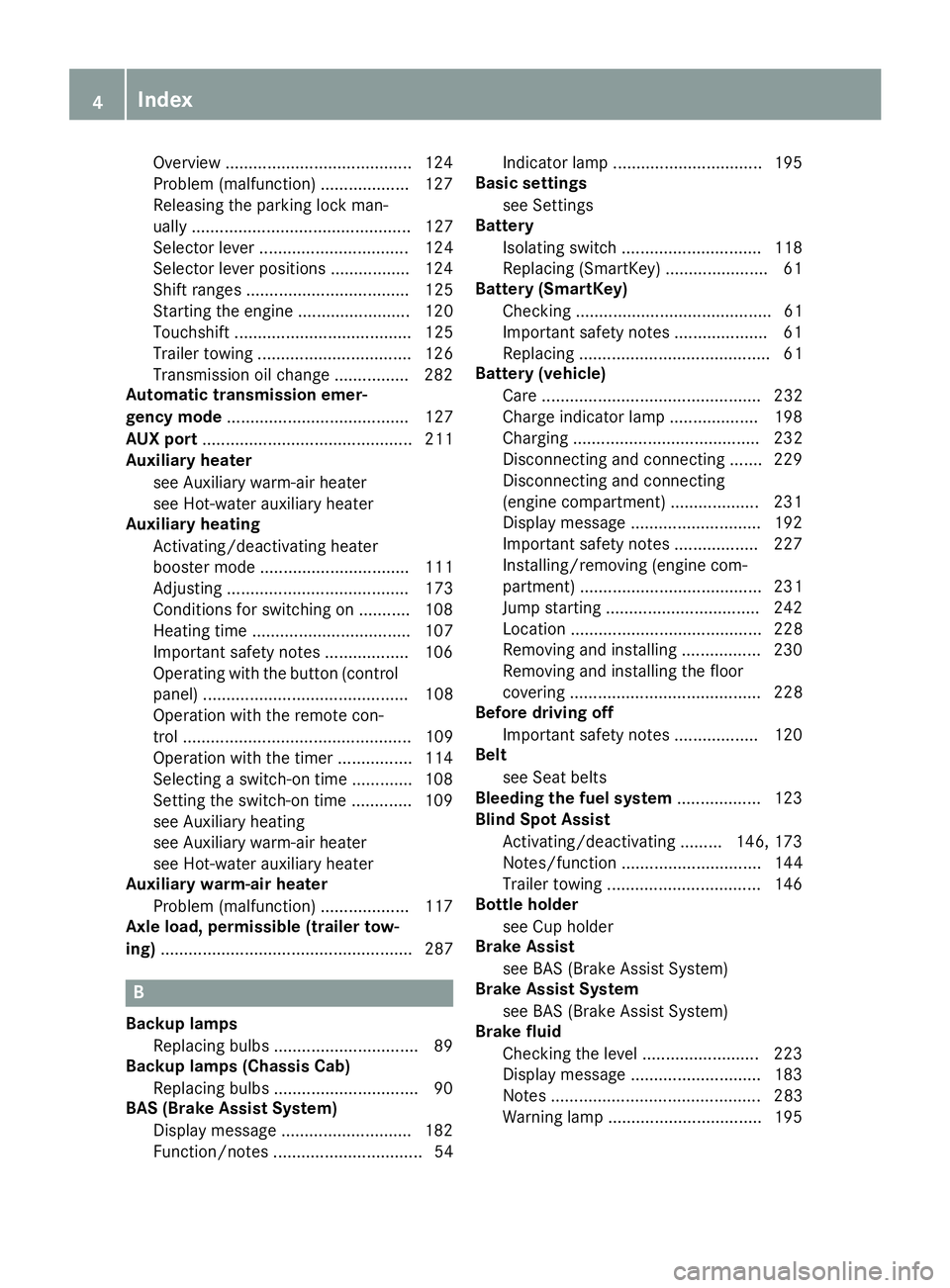
Overview ........................................124
Problem (malfunction) ................... 127
Releasing the parking lock man-
ually ............................................... 127
Selector lever ................................ 124
Selector lever positions ................. 124
Shift ranges ................................... 125
Starting the engine ........................ 120
Touchshift ...................................... 125
Trailer towing ................................. 126
Transmission oil change ................ 282
Automatic transmission emer-
gency mode ....................................... 127
AUX port ............................................. 211
Auxiliary heater
see Auxiliary warm-air heater
see Hot-water auxiliary heater
Auxiliary heating
Activating/deactivating heater
booster mode ................................ 111
Adjusting ....................................... 173
Conditions for switching on ........... 108
Heating time .................................. 107
Important safety notes .................. 106
Operating with the button (control
panel) ............................................ 108
Operation with the remote con-
trol ................................................. 109
Operation with the timer ................ 114
Selecting a switch-on time ............. 108
Setting the switch-on time ............. 109
see Auxiliary heating
see Auxiliary warm-air heater
see Hot-water auxiliary heater
Auxiliary warm-air heater
Problem (malfunction) ................... 117
Axle load, permissible (trailer tow-
ing) ...................................................... 287
B
Backup lamps
Replacing bulbs ............................... 89
Backup lamps (Chassis Cab)
Replacing bulbs ............................... 90
BAS (Brake Assist System)
Display message ............................ 182
Function/notes ................................ 54 Indicator lamp ................................ 195
Basic settings
see Settings
Battery
Isolating switch .............................. 118
Replacing (SmartKey) ......................6 1
Battery (SmartKey)
Checking .......................................... 61
Important safety notes .................... 61
Replacing ......................................... 61
Battery (vehicle)
Care ............................................... 232
Charge indicator lamp ................... 198
Charging ........................................ 232
Disconnecting and connecting ....... 229
Disconnecting and connecting
(engine compartment) ................... 231
Display message ............................ 192
Important safety notes .................. 227
Installing/removing (engine com-
partment) ....................................... 231
Jump starting ................................. 242
Location ......................................... 228
Removing and installing ................. 230
Removing and installing the floor
covering ......................................... 228
Before driving off
Important safety notes .................. 120
Belt
see Seat belts
Bleeding the fuel system .................. 123
Blind Spot Assist
Activating/deactivating ......... 146, 173
Notes/function .............................. 144
Trailer towing ................................. 146
Bottle holder
see Cup holder
Brake Assist
see BAS (Brake Assist System)
Brake Assist System
see BAS (Brake Assist System)
Brake fluid
Checking the level ......................... 223
Display message ............................ 183
Notes ............................................. 283
Warning lamp ................................. 195
4Index
Page 8 of 290
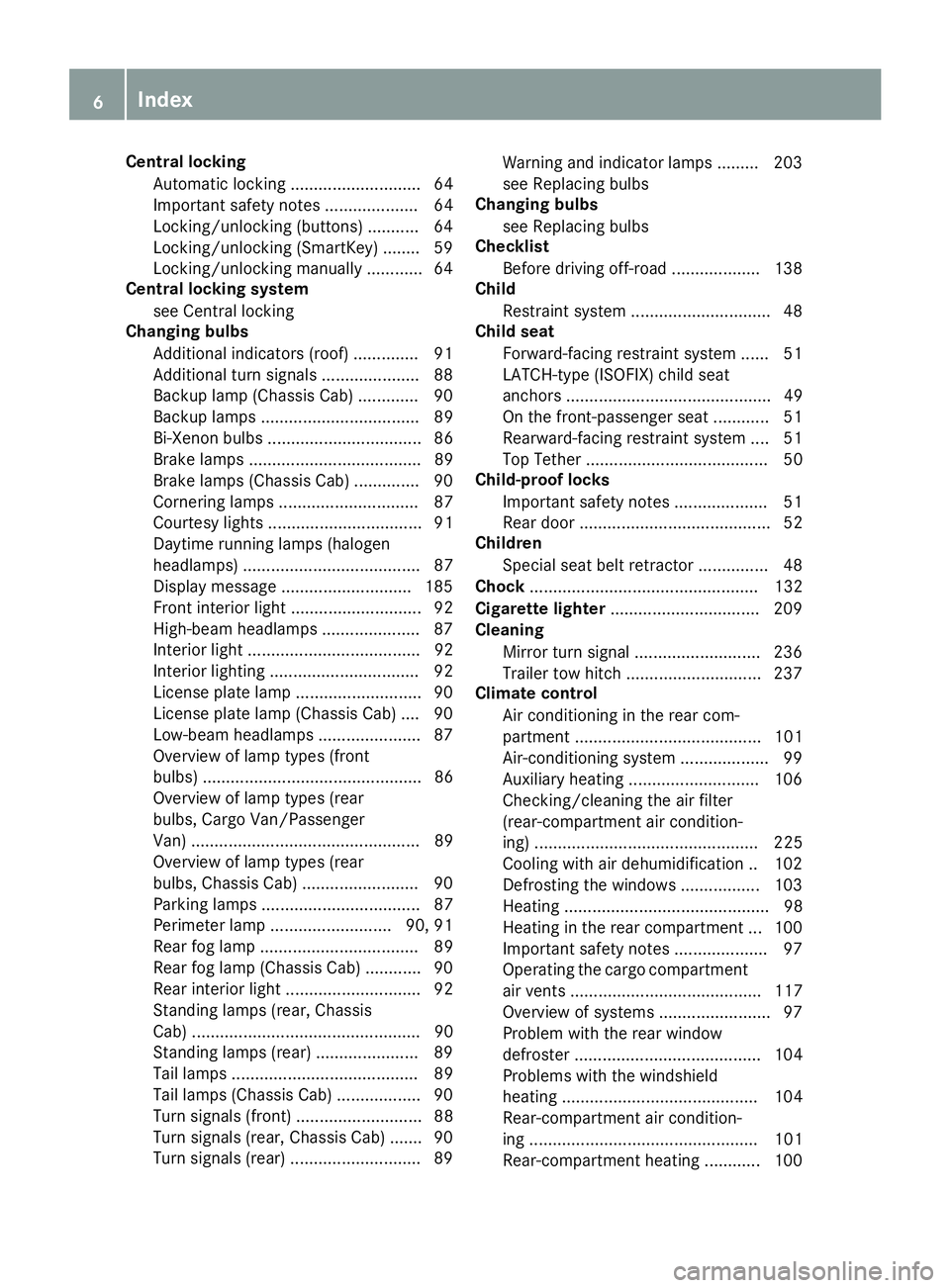
Central lockingAutomatic locking ............................ 64
Important safety notes .................... 64
Locking/unlocking (buttons) ........... 64
Locking/unlocking (SmartKey) ........ 59
Locking/unlocking manually ............ 64
Central locking system
see Central locking
Changing bulbs
Additional indicators (roof) .............. 91
Additional turn signals ..................... 88
Backup lamp (Chassis Cab) ............. 90
Backup lamps .................................. 89
Bi-Xenon bulbs ................................. 86
Brake lamps ..................................... 89
Brake lamps (Chassis Cab) .............. 90
Cornering lamps .............................. 87
Courtesy lights ................................. 91
Daytime running lamps (halogen
headlamps) ...................................... 87
Display message ............................ 185
Front interior light ............................ 92
High-beam headlamps ..................... 87
Interior light ..................................... 92
Interior lighting ................................ 92
License plate lamp ........................... 90
License plate lamp (Chassis Cab) .... 90
Low-beam headlamps ...................... 87
Overview of lamp types (front
bulbs) ............................................... 86
Overview of lamp types (rear
bulbs, Cargo Van/Passenger
Van) ................................................. 89
Overview of lamp types (rear
bulbs, Chassis Cab) ......................... 90
Parking lamps .................................. 87
Perimeter lamp .......................... 90, 91
Rear fog lamp .................................. 89
Rear fog lamp (Chassis Cab) ............ 90
Rear interior light ............................. 92
Standing lamps (rear, Chassis
Cab) ................................................. 90
Standing lamps (rear) ...................... 89
Tail lamps ........................................ 89
Tail lamps (Chassis Cab) .................. 90
Turn signals (front) ........................... 88
T
urn signals (rear, Chassis Cab) ....... 90
Turn signals (rear) ............................ 89 Warning and indicator lamps ......... 203
see Replacing bulbs
Changing bulbs
see Replacing bulbs
Checklist
Before driving off-road ................... 138
Child
Restraint system .............................. 48
Child seat
Forward-facing restraint system ...... 51
LATCH-type (ISOFIX) child seat
anchors ............................................ 49
On the front-passenger seat ............ 51
Rearward-facing restraint system .... 51
Top Tether ....................................... 50
Child-proof locks
Important safety notes .................... 51
Rear door ......................................... 52
Children
Special seat belt retractor ............... 48
Chock ................................................. 132
Cigarette lighter ................................ 209
Cleaning
Mirror turn signal ........................... 236
Trailer tow hitch ............................. 237
Climate control
Air conditioning in the rear com-
partment ........................................ 101
Air-conditioning system ................... 99
Auxiliary heating ............................ 106
Checking/cleaning the air filter
(rear-compartment air condition-
ing) ................................................ 225
Cooling with air dehumidification .. 102
Defrosting the windows ................. 103
Heating ............................................ 98
Heating in the rear compartment ... 100
Important safety notes .................... 97
Operating the cargo compartment
air vents ......................................... 117
Overview of systems ........................ 97
Problem with the rear window
defroster ........................................ 104
Problems with the windshield
heating .......................................... 104
Rear-compartment air condition-
ing ................................................. 101
Rear-compartment heating ............ 100
6Index
Page 9 of 290
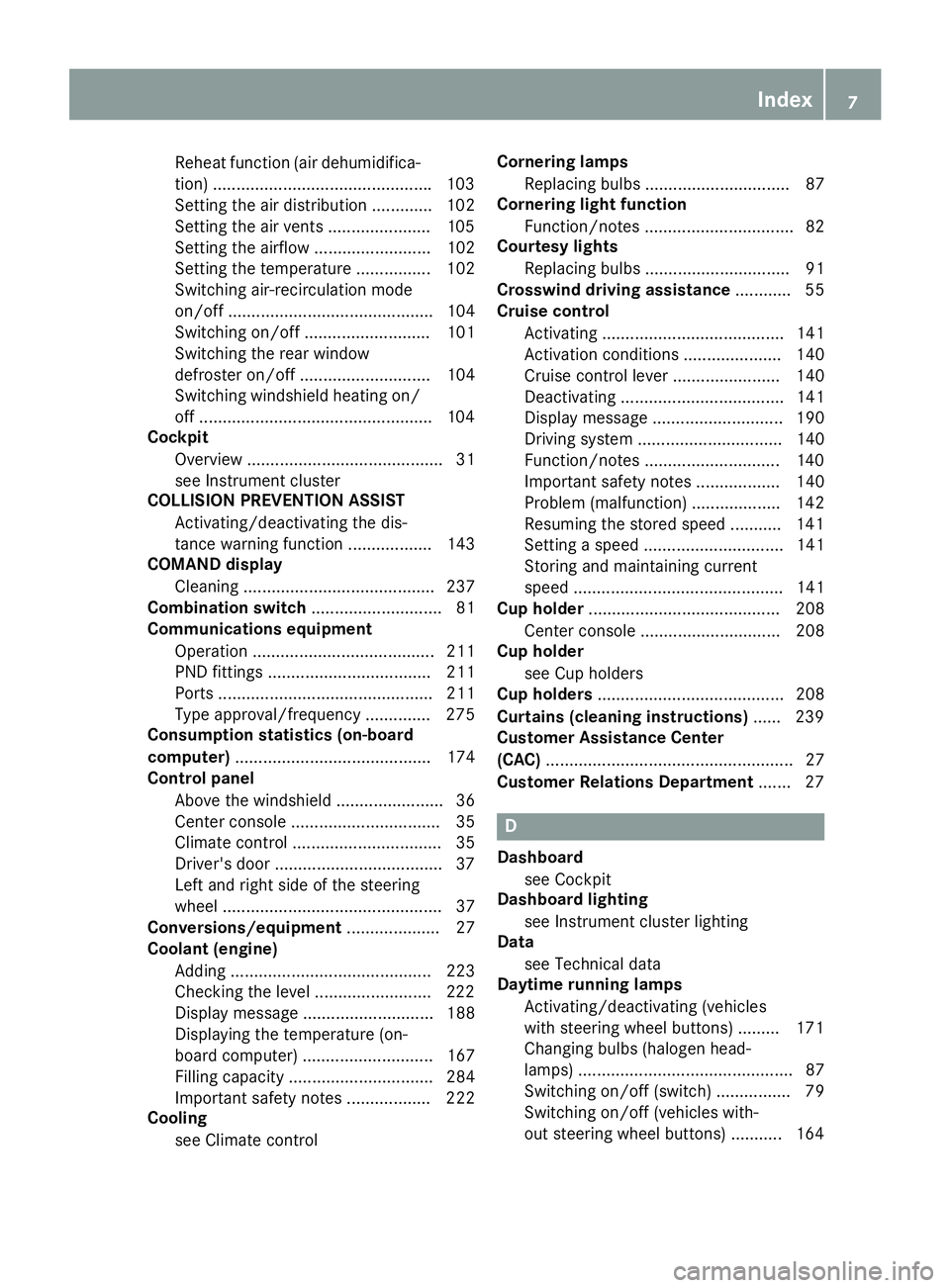
Reheat function (air dehumidifica-
tion).............................................. .103
Setting the air distribution ............. 102
Setting the air vents ......................1 05
Setting the airflow ......................... 102
Setting the temperature ................ 102
Switching air-recirculation mode
on/off ............................................ 104
Switching on/off ........................... 101
Switching the rear window
defroster on/off ............................ 104
Switching windshield heating on/
off ..................................................1 04
Cockpit
Overview .......................................... 31
see Instrument cluster
COLLISION PREVENTION ASSIST
Activating/deactivating the dis-
tance warning function .................. 143
COMAND display
Cleaning ......................................... 237
Combination switch ............................ 81
Communications equipment
Operation ....................................... 211
PND fittings ................................... 211
Ports .............................................. 211
Type approval/frequency .............. 275
Consumption statistics (on-board
computer) .......................................... 174
Control panel
Above the windshield ....................... 36
Center console ................................ 35
Climate control ................................ 35
Driver's door ....................................3 7
Left and right side of the steering
wheel ............................................... 37
Conversions/equipment .................... 27
Coolant (engine)
Adding ........................................... 223
Checking the level .........................2 22
Display message ............................ 188
Displaying the temperature (on-
board computer) ............................ 167
Filling capacity ............................... 284
Important safety notes .................. 222
Cooling
see Climate control C
ornering lamps
Replacing bulbs ............................... 87
Cornering light function
Function/notes ................................ 82
Courtesy lights
Replacing bulbs ............................... 91
Crosswind driving assistance ............ 55
Cruise control
Activating ....................................... 141
Activation conditions ..................... 140
Cruise control lever ....................... 140
Deactivating ................................... 141
Display message ............................ 190
Driving system ............................... 140
Function/notes .............................1 40
Important safety notes .................. 140
Problem (malfunction) ................... 142
Resuming the stored speed ........... 141
Setting a speed .............................. 141
Storing and maintaining current
speed ............................................. 141
Cup holder ......................................... 208
Center console .............................. 208
Cup holder
see Cup holders
Cup holders ........................................ 208
Curtains (cleaning instructions) ...... 239
Customer Assistance Center
(CAC) ..................................................... 27
Customer Relations Department ....... 27
D
Dashboard
see Cockpit
Dashboard lighting
see Instrument cluster lighting
Data
see Technical data
Daytime running lamps
Activating/deactivating (vehicles
with steering wheel buttons) ......... 171
Changing bulbs (halogen head-
lamps) .............................................. 87
Switching on/off (switch) ................ 79
Switching on/off (vehicles with-
out steering wheel buttons) ........... 164
Index7
Page 17 of 290
Rain and light sensorSetting the sensitivity (vehicles
with steering wheel buttons) ......... 173
Windshield wiper .............................. 93
Range (vehicles with steering
wheel buttons) .................................. 174
Rear bench seat
Installing/removing (Passenger
Van) ................................................. 75
Stowage compartment (crewcab) .. 207
Rear compartment
Activating/deactivating climate
control ........................................... 101
Setting the air vents ...................... 106
Rear door
Child-proof locks .............................. 52
Important safety notes .................... 68
Opening/closing .............................. 68
Opening/closing from inside ........... 69
Rear fog lamp
Replacing bulbs ............................... 89
Switching on/off .............................. 80
Rear fog lamp (Chassis Cab)
Replacing bulbs ............................... 90
Rear interior light
Replacing bulbs ............................... 92
Rear lamps
see Lights
Rear rack
Notes ............................................. 216
Rear view camera
Cleaning instructions ..................... 236
Important safety notes .................. 154
Switching on .................................. 154
Rear window defroster
Problem (malfunction) ................... 104
Switching on/off ........................... 104
Rear window wiper ............................. 94
Switching on/off .............................. 94
Rear-compartment air-condition-
ing system
see Climate control
Rear-compartment heating
see Climate control
Rear-view mirror
Anti-glare mode ............................... 78
Refilling
DEF filler neck ............................... 129 Important safety notes (Diesel
Exhaust Fluid – DEF) ...................... 129
Refilling procedure (Diesel
Exhaust Fluid – DEF) ...................... 129
Refrigerant ......................................... 284
Refueling
Fuel filler flap ................................. 128
Fuel gauge ..................................... 162
Important safety notes (fuel) ......... 127
Refueling procedure (fuel) ............. 128
see Fuel
Releasing the parki
ng lock man-
ually (automatic transmission) ........ 127
Remote control
Changing the operating duration
(auxiliary heating) .......................... 110
Replacing the battery (auxiliary
heating ) ........................................ 111
Switching on/off (auxiliary heat-
ing) ................................................ 110
Synchronizing (auxiliary heating) ... 110
Replacing bulbs
Important safety notes .................... 86
Replacing the battery (auxiliary
heating remote control) .................... 111
Replacing the fuel filter .................... 202
Reporting safety defects .................... 27
Rescue card ......................................... 29
Restraint system
Introduction ..................................... 39
Warning lamp (function) .......... 39, 198
Reverse warning feature .................. 122
Roadside Assistance (breakdown) .... 23
Roof carrier
Maximum payload .......................... 286
Notes ............................................. 216
Roof load (roof carrier) ..................... 286
S
Safety
Children in the vehicle ..................... 47
Operating safety .............................. 25
Safety system
see Driving safety systems
Seat belts
Adjusting the height ......................... 42
Cleaning ......................................... 238
Index15
Page 26 of 290
Proper use
Observe the following information when oper-
ating your vehicle:
Rthe safety notes in these operating instruc-
tions
Rthe technical data in these Operating Instruc-
tions
Rtraffic laws and regulations
Rmotor vehicle laws and safety standards
There are various warning stickers affixed to the
vehicle. If you remove warning stickers, you and
others may fail to recognize the dangers. Leave
the warning stickers in their original position.
GWARNING
Modifications to electronic components, their software as well as wiring can impair their
function and/or the function of other net-
worked components. In particular, systems
relevant to safety could also be affected. As a
result, these may no longer function as inten-
ded and/or jeopardize the operating safety of
the vehicle. There is an increased risk of an
accident and injury.
Never tamper with the wiring as well as elec-
tronic components or their software. You
should have all work to electrical and elec-
tronic equipment carried out at a qualified
specialist workshop.
The general operating permit for your vehicle
could be rendered invalid if you carry out mod-
ifications to electronic components, their soft-
ware as well as wiring.
GWARNING
Gases and fluids from substances that con-
stitute a health hazard or react aggressively
can escape even from securely closed con-
tainers. When transporting such substances
in the vehicle interior, your ability to concen-
trate or your health could be affected during
the journey. Malfunctions, short circuits or
electrical component system failures may
also result. There is a risk of an accident and
fire.
Do not store or transport any substances in
the vehicle interior which are hazardous to
health or react aggressively.
These instructions must also be observed for
vehicles where the cargo compartment is not
fully separated from the driver's cab.
Partition with door/window: always keep the
door/window in the partition closed during
transport.
Examples of substances that are hazardous to
health and/or react aggressively:
RSolvents
RFuel
ROil and grease
RCleaning agents
RAcids
Protection of the environment
Economic and environmentally aware
driving
HEnvironmental note
Daimler's declared policy is one of compre-
hensive environmental protection.
The objectives are for the natural resources
that form the basis of our existence on this
planet to be used sparingly and in a manner
that takes the requirements of both nature
and humanity into account.
You too can help to protect the environment
by operating your vehicle in an environmen-
tally responsible manner.
Fuel consumption and the rate of engine,
transmission, brake and tire wear are affected
by these factors:
Roperating conditions of your vehicle
Ryour personal driving style
You can influence both factors. You should
bear the following in mind:
24Introduction
Page 27 of 290
Operating conditions:
Ravoid short trips as these increase fuel con-
sumption.
Ralways make sure that the tire pressures
are correct.
Rdo not carry any unnecessary weight.
Rremove roof racks once you no longer need
them.
Ra regularly serviced vehicle will contribute
to environmental protection. You should
therefore adhere to the service intervals.
Ralways have service work carried out at a
qualified specialist workshop.
Personal driving style:
Rdo not depress the accelerator pedal when
starting the engine.
Rdo not warm up the engine when the vehicle
is stationary.
Rdrive carefully and maintain a safe distance
from the vehicle in front.
Ravoid frequent, sudden acceleration and
braking.
Rchange gear in good time and use each gear
only up to Ôof its maximum engine speed.
Rswitch off the engine in stationary traffic.
Rkeep an eye on the vehicle's fuel consump-
tion.
Environmental issues and recommen-
dations
When prompted by this Operator's Manual to
dispose of materials, please try to regenerate
and recycle these materials. Observe all rele-
vant environmental guidelines and regulations
when disposing of materials. This helps to pro-
tect the environment.
Operating safety and vehicle approval
Important safety notes
GWARNING
If you do not have the prescribed service/
maintenance work or any required repairs
carried out, this can result in malfunctions or system failures. There is a risk of an accident.
Always have the prescribed service/mainte-
nance work as well as any required repairs
carried out at a qualified specialist workshop.
Air bags and pyrotechnic Emergency Tensioning
Devices (ETDs) contain perchlorate material,
which may require special handling and regard
for the environment. The guidelines must be
observed during disposal.
In California, you can find more information on
the Internet at www.dtsc.ca.gov.
Notes on operating the vehicle
There is a risk of damage to the vehicle if:
Rthe vehicle makes contact with the ground,
e.g. on a high curb or a loose road surface
Ryou drive too quickly over an obstacle, e.g. a
curb or a pothole
Ra heavy object hits the underbody or chassis
component
In these or similar situations, the vehicle body/
frame, the underbody, chassis components,
wheels or tires could be damaged even if this is
not visible from the outside. Components that
have been damaged in this way can unexpect-
edly fail or no longer be able to assimilate the
loads occurring in the event of an accident. If the underbody paneling is damaged, flammable
material, such as leaves, grass or twigs, could
collect between the underbody and underbody
paneling. These materials could ignite if they
remain in contact with hot components of the
exhaust system for an extended period.
GWARNING
Flammable material such as leaves, grass or
twigs may ignite if they come into contact with
hot parts of the exhaust system. There is a risk of fire.
Introduction25
Z
Page 28 of 290

When driving off road or on unpaved roads,
check the vehicle's underside regularly. In
particular, remove parts of plants or other
flammable materials which have become
trapped. In the case of damage, contact a
qualified specialist workshop.
Have the vehicle checked and repaired immedi-
ately at a qualified specialist workshop. If you
become aware when continuing the journey that
driving safety has been effected, stop as soon as
possible in accordance with the traffic condi-
tions. In such cases, consult a qualified special- ist workshop.
Declaration of conformity
Radio-based vehicle components
USA: "The wireless devices of this vehicle com-
ply with Part 15 of the FCC Rules. Operation is
subject to the following two conditions: 1) These
devices may not cause harmful interference. 2.
This device must accept any interference
received, including interference that may cause
undesired operation. Changes or modifications
not expressly approved by the party responsible
for compliance could void the user’s authority to
operate the equipment."
Canada: "The wireless devices of this vehicle
comply with Industry Canada license-exempt
RSS standard(s). Operation is subject to the fol-
lowing two conditions: 1) These devices may not
cause interference, and 2) these devices must
accept any interference received, including
interference that may cause undesired opera-
tion of the device".
Diagnostics connection
The diagnostics connection is only intended for the connection of diagnostic equipment at a
qualified specialist workshop.
GWARNING
If you connect equipment to the diagnostics
connection in the vehicle, it may affect the
operation of the vehicle systems. As a result,
the operating safety of the vehicle could be
affected. There is a risk of an accident.
Do not connect any equipment to a diagnos-
tics connection in the vehicle.
Changing the engine power output
!
Increases in engine power can:
Rchange the emission values
Rcause malfunctions
Rcause consequential damage
The operating reliability of the engine is not
guaranteed in all cases.
Any tampering with the engine management
system in order to increase the engine power
output will lead to the loss of the New Vehicle
Limited Warranty and other warranty entitle-
ments.
If you sell the vehicle, inform the purchaser
about the changes to the engine power output of
the vehicle. If you do not inform the buyer, this
may constitute a punishable offense under
national legislation.
Qualified specialist workshops
An authorized Sprinter Dealer is a qualified spe-
cialist workshop.
A qualified specialist workshop has the neces-
sary specialist knowledge, tools and qualifica-
tions to correctly carry out the work required on
the vehicle.
This is especially the case for work relevant to
safety. Observe the notes in the Maintenance or
Service Booklet.
The following work should always be carried out
at qualified specialist workshop:
Rwork relevant to safety
Rservice and maintenance work
Rrepair work
Rmodifications as well as installations and
alterations
Rwork on electronic components
For this reason, we recommend an authorized
Sprinter Dealer.
!Only have work carried out on the engine
electronics and its associated parts, such as
control units, sensors, actuating components
and connector leads, at a qualified specialist
workshop. Vehicle components may other-
26Introduction
Page 30 of 290

Further information can be obtained at any
authorized Sprinter Dealer.
GWARNING
The function of systems or components can
be affected by conversions or modifications
to the vehicle. They might not function prop-
erly anymore and/or jeopardize the opera-
tional safety of the vehicle. There is an
increased risk of an accident and injury.
Conversions or modifications should always
be carried out at qualified specialist work-
shop.
If you intend to make modifications to your vehi-
cle, we strongly recommend that you contact
the distributor named on the inside of the front
cover. There you will receive all the necessary
information and a charge may be levied.
You alone accept the responsibility if body man-
ufacturers or dealers make modifications that
affect the final certification of the engine, the
vehicle or the equipment. This also applies to
the identification and documentation of modifi-
cations to the affected vehicle components.
You are responsible for certification and confir-
mation that:
Rall the applicable standards and regulations
that are affected by the vehicle modification
are met
Rthe modified vehicle fulfills the vehicle safety standards and emissions laws and regula-
tions
Rthe modifications or installation of accesso-
ries does not affect the safety of the vehicle
We are not responsible for the final certification,
product liability or warranty claims which result
from the modifications. This applies to:
Rthe modified components, assemblies or sys-
tems
Rany resulting noncompliance with any of the
emissions laws and regulations or the motor
vehicle safety standards
Rany consequences arising from the changes
that make the vehicle less safe or even render it defective
We do not assume responsibility as the final-
stage manufacturer or for the consequential
product liability.
Notes on the radiator
Even seemingly small changes to the vehicle,
such as attaching a radiator trim for winter driv-
ing, is not permitted. Do not cover up the radi-
ator. Do not use thermal mats, insect protection
covers or anything similar.
Otherwise, the values of the diagnostic system
may be affected. Some of these values are
legally prescribed and must always be correct.
Information on the cargo compartment
floor
!The wooden or plastic cargo area floor fitted
at the factory is an integral component of the
vehicle structure. The vehicle body could be
damaged if you have the load area floor
removed. This then affects the securing of
loads and the maximum loading capacity of
the lashing points is no longer guaranteed.
Therefore, do not have the load area floor
removed.
Genuine Mercedes-Benz parts
!
Air bags and Emergency Tensioning Devi-
ces, as well as control units and sensors for
these restraint systems, may be installed in
the following areas of your vehicle:
Rdoors
Rdoor pillars
Rdoor sills
Rseats
Rcockpit
Rinstrument cluster
Rcenter console
Do not install accessories such as audio sys-
tems in these areas. Do not carry out repairs or welding. You could impair the operating
efficiency of the restraint systems.
Have aftermarket accessories installed at a
qualified specialist workshop.
HEnvironmental note
We supply reconditioned assemblies and
parts which are of the same quality as new
parts. The same New Vehicle Limited War-
ranty applies as for new parts.
28Introduction
Page 31 of 290
The operating safety of the vehicle could be
jeopardized if you use parts, tires and wheels as
well as accessories relevant to safety which
have not been approved by Mercedes-Benz. This
could lead to malfunctions in safety-relevant
systems, e.g. the brake system. Only use genu-
ine Mercedes-Benz parts or parts of equal qual-ity. Only use tires, wheels and accessories that
have been specifically approved for your vehi-
cle.
We test genuine Sprinter parts, as well as con-
version parts and accessories that have been
specifically approved for the type of vehicle, for:
Rreliability
Rsafety
Rsuitability
Despite ongoing market research, Mercedes-
Benz is unable to assess other parts. Therefore,
we accept no responsibility for the use of such
parts in Sprinter vehicles, even if they have been
officially approved or independently approved
by a testing center.
In some countries, certain parts are only offi-
cially approved for installation or modification if
they comply with legal requirements. All genu-
ine Sprinter parts satisfy these requirements.
Make sure that all parts are suitable for your
vehicle.
Always specify the vehicle identification number
(VIN) and engine number when ordering genuine
Sprinter parts (
Ypage 276).
QR code for rescue card
The QR Code stickers are affixed to the B-pillar
on the driver's and front-passenger side.
In the event of an accident the rescue services
use the QR Code to quickly find the rescue card
for your vehicle. The current rescue card con-
tains the most important information on your
vehicle, e.g. the electric cable routes, in a com-
pact form.
Further information can be found under http://
portal.aftersales.i.daimler.com.
Data stored in the vehicle
Data Recording
A wide range of electronic components in your
vehicle contain data memories. These data memories temporarily or perma-
nently store technical information about:
Rthe vehicle's operating state
Revents
Rfaults
In general, this technical information docu-
ments the state of a component, a module, a
system or the surroundings.
These include, for example:
Roperating conditions of system components,
e.g. fluid levels
Rthe vehicle's status messages and those of its
individual components, e.g. number of wheel
revolutions/speed, deceleration in move-
ment, lateral acceleration, accelerator pedal
position
Rmalfunctions and defects in important system
components, e.g. lights, brakes
Rvehicle reactions and operating conditions in
special driving situations, e.g. airbag deploy-
ment, intervention of stability control sys-
tems
Rambient conditions, e.g. outside temperature
This data is of an exclusively technical nature
and can be used to:
Rassist in detecting and rectifying faults and
defects
Ranalyze vehicle functions, e.g. after an acci-
dent
Roptimize vehicle functions
The data cannot be used to trace the vehicle's
movements.
When your vehicle is serviced, technical infor-
mation can be read from the event data memory
and fault data memory.
Services include, for example:
Rrepair services
Rservice processes
Rwarranty events
Rquality assurance
The vehicle is read out by employees of the ser- vice network (including the manufacturer) using
special diagnostic testers. You can obtain more
information there, if required.
After a fault has been rectified, the information
is deleted from the fault memory or is continu-
ally overwritten.
When operating the vehicle, situations are con-
ceivable in which this technical data, in connec-
Introduction29
Z