fuel pressure MERCEDES-BENZ SPRINTER 2016 MY16 Operator’s Manual
[x] Cancel search | Manufacturer: MERCEDES-BENZ, Model Year: 2016, Model line: SPRINTER, Model: MERCEDES-BENZ SPRINTER 2016Pages: 290, PDF Size: 6.44 MB
Page 260 of 290
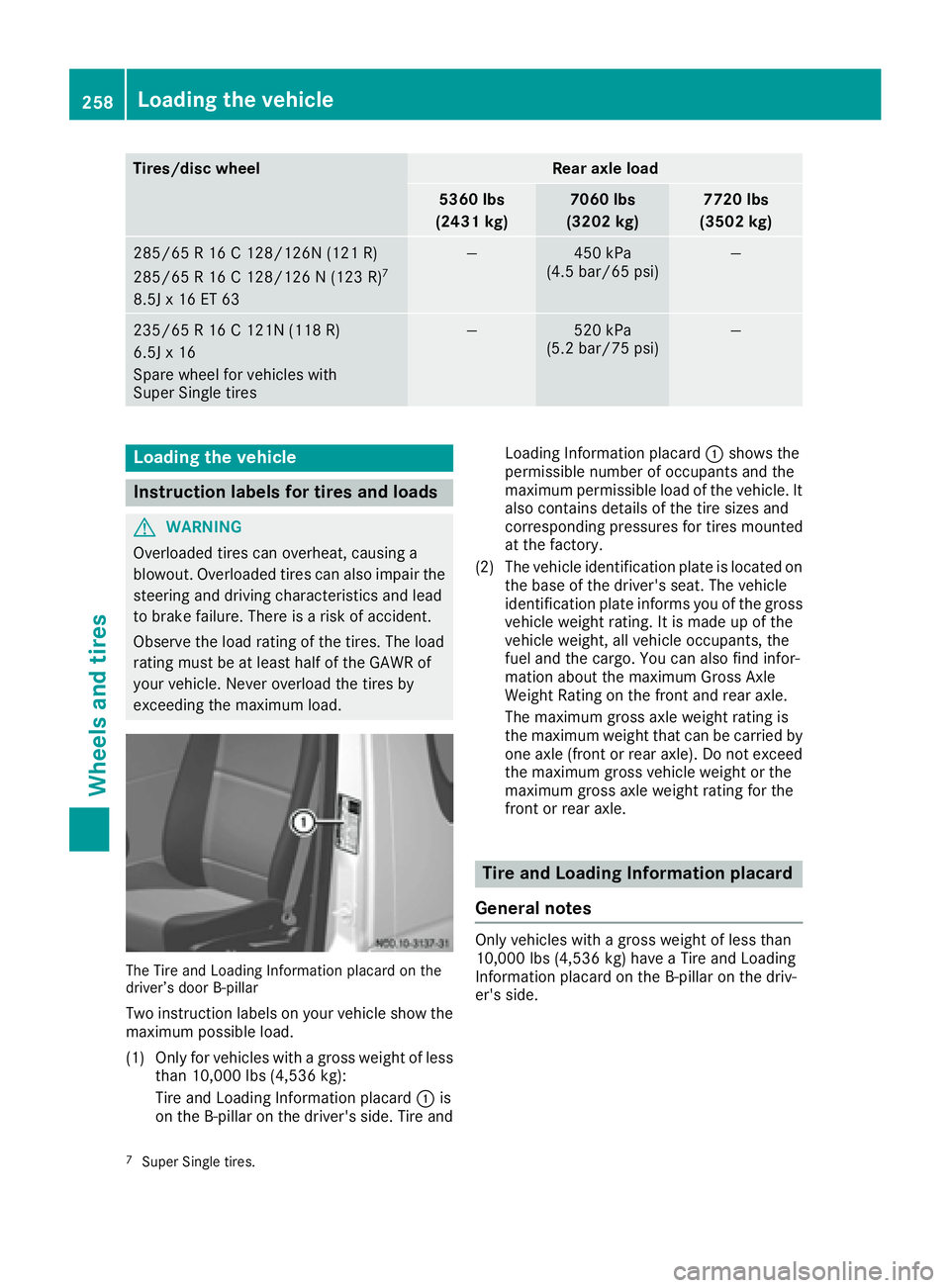
Tires/disc wheelRear axle load
5360 lbs
(2431 kg)7060 lbs
(3202 kg)7720 lbs
(3502 kg)
285/65 R 16 C 128/126N (121 R)
285/65 R 16 C 128/126 N (123 R)7
8.5J x 16 ET 63
—450 kPa
(4.5 bar/65 psi)—
235/65 R 16 C 121N (118 R)
6.5J x 16
Spare wheel for vehicles with
Super Single tires—520 kPa
(5.2 bar/75 psi)—
Loading the vehicle
Instruction labels for tires and loads
GWARNING
Overloaded tires can overheat, causing a
blowout. Overloaded tires can also impair the steering and driving characteristics and lead
to brake failure. There is a risk of accident.
Observe the load rating of the tires. The load
rating must be at least half of the GAWR of
your vehicle. Never overload the tires by
exceeding the maximum load.
The Tire and Loading Information placard on the
driver’s door B-pillar
Two instruction labels on your vehicle show themaximum possible load.
(1) Only for vehicles with a gross weight of less than 10,000 lbs (4,536 kg):
Tire and Loading Information placard :is
on the B-pillar on the driver's side. Tire and Loading Information placard
:shows the
permissible number of occupants and the
maximum permissible load of the vehicle. It
also contains details of the tire sizes and
corresponding pressures for tires mounted
at the factory.
(2) The vehicle identification plate is located on the base of the driver's seat. The vehicle
identification plate informs you of the gross
vehicle weight rating. It is made up of the
vehicle weight, all vehicle occupants, the
fuel and the cargo. You can also find infor-
mation about the maximum Gross Axle
Weight Rating on the front and rear axle.
The maximum gross axle weight rating is
the maximum weight that can be carried by
one axle (front or rear axle). Do not exceed
the maximum gross vehicle weight or the
maximum gross axle weight rating for the
front or rear axle.
Tire and Loading Information placard
General notes
Only vehicles with a gross weight of less than
10,000 lbs (4,536 kg) have a Tire and Loading
Information placard on the B-pillar on the driv-
er's side.
7Super Single tires.
258Loading the vehicle
Wheels and tires
Page 266 of 290
is marked with "3208", was manufactured in
week 32 in 2008.
iTire data is vehicle-specific and may deviate
from the data in the example.
Tire characteristics
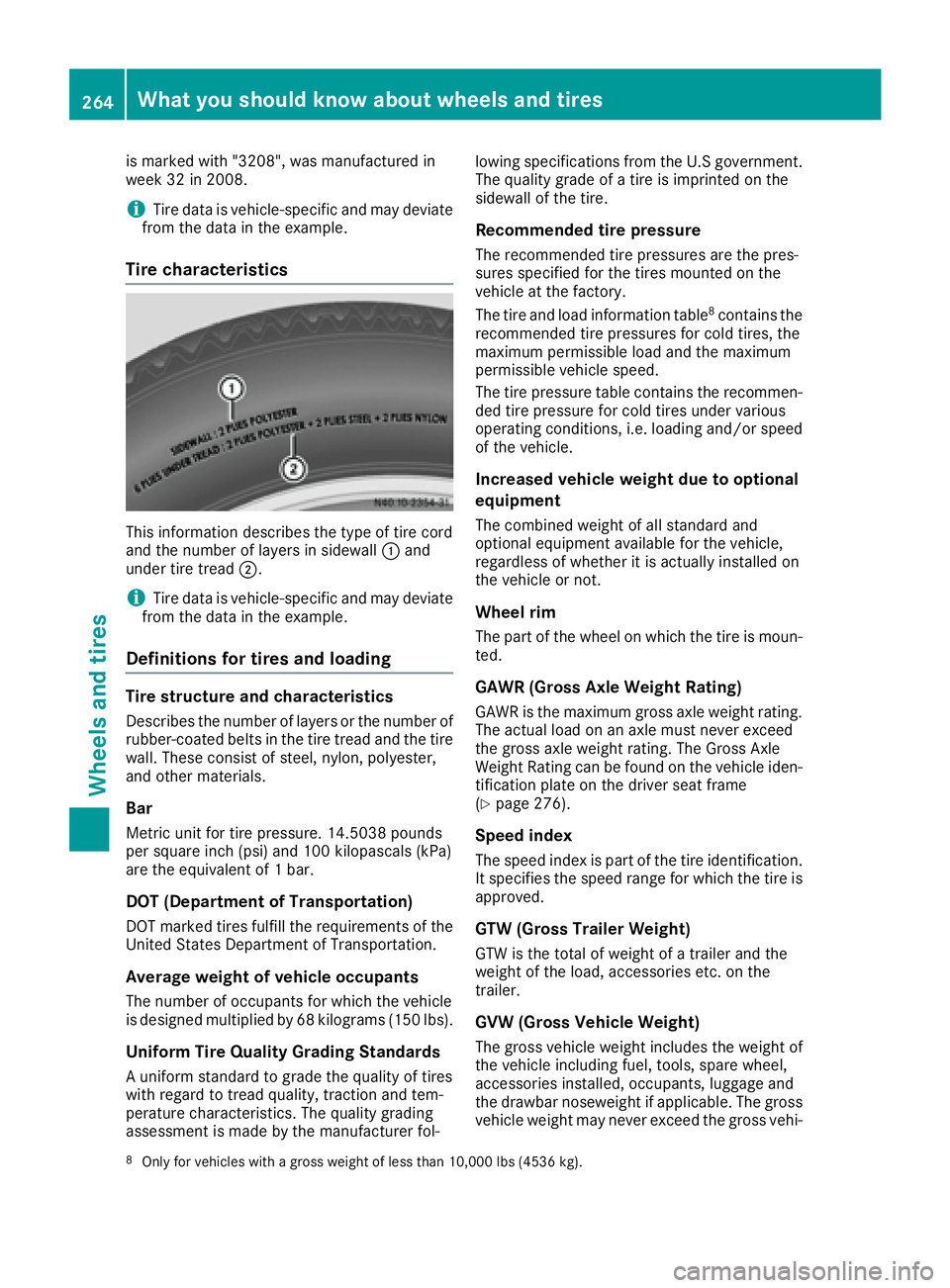
This information describes the type of tire cord
and the number of layers in sidewall :and
under tire tread ;.
iTire data is vehicle-specific and may deviate
from the data in the example.
Definitions for tires and loading
Tire structure and characteristics
Describes the number of layers or the number of
rubber-coated belts in the tire tread and the tire
wall. These consist of steel, nylon, polyester,
and other materials.
Bar
Metric unit for tire pressure. 14.5038 pounds
per square inch (psi) and 100 kilopascals (kPa)
are the equivalent of 1 bar.
DOT (Department of Transportation)
DOT marked tires fulfill the requirements of the
United States Department of Transportation.
Average weight of vehicle occupants
The number of occupants for which the vehicle
is designed multiplied by 68 kilograms (150 lbs).
Uniform Tire Quality Grading Standards
A uniform standard to grade the quality of tires
with regard to tread quality, traction and tem-
perature characteristics. The quality grading
assessment is made by the manufacturer fol- lowing specifications from the U.S government.
The quality grade of a tire is imprinted on the
sidewall of the tire.
Recommended tire pressure
The recommended tire pressures are the pres-
sures specified for the tires mounted on the
vehicle at the factory.
The tire and load information table
8contains the
recommended tire pressures for cold tires, the
maximum permissible load and the maximum
permissible vehicle speed.
The tire pressure table contains the recommen-
ded tire pressure for cold tires under various
operating conditions, i.e. loading and/or speed
of the vehicle.
Increased vehicle weight due to optional
equipment
The combined weight of all standard and
optional equipment available for the vehicle,
regardless of whether it is actually installed on
the vehicle or not.
Wheel rim
The part of the wheel on which the tire is moun-
ted.
GAWR (Gross Axle Weight Rating)
GAWR is the maximum gross axle weight rating.
The actual load on an axle must never exceed
the gross axle weight rating. The Gross Axle
Weight Rating can be found on the vehicle iden-
tification plate on the driver seat frame
(
Ypage 276).
Speed index
The speed index is part of the tire identification.
It specifies the speed range for which the tire is
approved.
GTW (Gross Trailer Weight)
GTW is the total of weight of a trailer and the
weight of the load, accessories etc. on the
trailer.
GVW (Gross Vehicle Weight)
The gross vehicle weight includes the weight of the vehicle including fuel, tools, spare wheel,
accessories installed, occupants, luggage and
the drawbar noseweight if applicable. The gross
vehicle weight may never exceed the gross vehi-
8Only for vehicles with a gross weight of less than 10,000 lbs (4536 kg).
264What you should know about wheels and tires
Wheels and tires
Page 267 of 290
cle weight rating (GVWR) specified on the vehi-
cle identification plate at the base of the driver's
seat (
Ypage 276).
GVWR (Gross Vehicle Weight Rating)
The GVWR is the maximum permitted gross
weight of the fully laden vehicle (weight of the
vehicle including all accessories, occupants,
fuel, luggage and the drawbar noseweight if
applicable). The Gross Vehicle Weight Rating is
specified on the vehicle identification plate on
the driver seat frame (
Ypage 276).
Maximum weight of the laden vehicle
The maximum weight is the sum of:
Rthe curb weight of the vehicle
Rthe weight of the accessories
Rthe load limit
Rthe weight of the factory installed optional
equipment
Kilopascal (kPa)
Metric unit for tire pressure. 6.9 kPa are the
equivalent of 1 psi. Another tire pressure unit is
bar. 100 kilopascals(kPa) are the equivalent of
1 bar.
Load index
In addition to the load bearing index, a load
index can be stamped onto the sidewall of the
tire. It specifies the load-bearing capacity of the
tire more precisely.
Curb weight
The weight of a vehicle with standard equipment
including the maximum filling capacity of fuel,
oil, and coolant. It also includes the air-condi-
tioning system and optional equipme nt i
f these
are installed on the vehicle, but does not include
passengers or luggage.
Maximum tire load
The maximum tire load in kilograms or pounds is
the maximum weight for which a tire is
approved.
Maximum permissible tire pressure
Maximum permissible tire pressure for one tire.
Maximum load on one tire
Maximum load on one tire. This is calculated by
dividing the maximum axle load of one axle by
two.
PSI (Pounds per square inch)
Standard unit of measurement for tire pressure.
Aspect ratio
Relationship between tire height and width in
percent.
tire pressure
Pressure inside the tire applying an outward
force to every square inch of the tire's surface.
Tire pressure is specified in pounds per square
inch (psi), in kilopascal (kPa) or in bar. Tire pres-
sure should only be corrected when the tires are
cold.
Cold tire pressure
The tires are cold:
Rif the vehicle has been parked for at least
three hours without direct sunlight on the
tires, and
Rif the vehicle has not been driven further than
1 mile (1.6 km)
Tire tread
The part of the tire that comes into contact with the road.
Tire bead
The tire bead ensures that the tire sits securely
on the wheel. There are several stee l wires in the
bead to prevent the tire from coming loose from
the wheel rim.
Sidewall
The part of the tire between the tread and the
tire bead.
Weight of optional extras
The combined weight of those optional extras
that weigh more than the replaced standard
parts and more than 2.3 kg (5 lbs). These
optional extras, such as high-performance
brakes, a roof rack or a high-performance bat-
tery, are not included in the curb weight and the
weight of the accessories.
TIN (Tire Identification Number)
A unique identification number which can be
used by a tire manufacturer to identify tires, for
example for a product recall, and thus identify
the purchasers. The TIN is composed of the
manufacturer identification code, tire size, tire
model code and manufacturing date.
What you should know about wheels and tires265
Wheels and tires
Z
Page 281 of 290
Fuel additives
!Do not add gasoline or kerosene todiesel
fuel to improve its flow characteristics. Gas-
olin e or kerosene impairs the lubricating
properties of the diesel fuel. This can result in
damage to the fuel injection system, for
example.
Information on fuel consumption
HEnvironmental note
CO
2(carbon dioxide) is the gaswhich scien-
tists believe to be prin cipally responsible for
global warming (the greenhouse effect). Your veh icle'sCO
2emissions are directly related to
fuel consumption and therefore depend on:
Reff icie nt use of the fuel bythe engine
Rdriv ing style
Rother non-technical factors, such as envi-
ronmental influences, road conditions or
traff icflow
You can min imize your veh icle'sCO
2emis-
sions by driv ing carefully and having itserv-
iced regularly.
Fuel consumption depends on:
Rthe vehicleversion
Rthe style of driving
Rthe operating conditions
Rthe type or quality of the fuel used
The veh icle will use more fuel than usual inthe
fol lowin g situations:
Rat very low outside temperatures
Rincity traff ic
Rduring short journeys
Ron mountainous terrain
Rwhen to winga trailer
To keep fuel consumption low,observe the
advice inthe "Protection of the environment"
section (
Ypage 24).
The fol lowing components of the different veh i-
cle versions influence fuel consumption:
Rtire sizes, tire tread, tire pressure, tire cond i-
tion
Rbody
Rtransmission ratios for the drive assemblies
Radditional equipment (e.g. air-conditioning
system, auxil iary heating system)
For these reasons, the actual consumption fig-
ures for your vehicle may deviate from the con-
sumption figures determined according to EU
Directive 80 /1268/EE C.
Data concerning fuel consumption are recorded
in the on-board computer; use the steering
wheel buttons to call up the Trip computer
menu (
Ypage 174).
Diesel Exhaust Fluid (DEF)
General notes
HEnvironmental note
Dispose of DEF in an environmentally respon-
sible manner.
When opening the DEF tank filler cap at high
outside temperatures, ammonia vapors may
escape.
Ammonia vapors have a pungent smell and pri-
marily cause irritation of the:
Rskin
Rmucous membranes
Reyes
You may experience a burning sensation in your
eyes, nose and throat, as well as coughing and
watering of the eyes.
Do not inhale ammonia vapors. Avoid contact
with DEF.
Do not allow DEF to come into direct contact
with your skin; it is hazardous to your health.
Rinse any affected areas off with plenty of clean water. Consult a doctor if necessary.
If DEF heats up, e.g. in direct sunlight, in the DEF
supply reservoir for some time to over 122 ‡
(50 †), ammonia vapor will develop.
To conform to emission regulations, you must
operate the vehicle with DEF and refill the supply
regularly. The engine management recognizes
attempts to operate the vehicle without DEF,
with thinned DEF or with another reducing
agent. After previous warning messages, the
engine management then prevents a further
engine start.
When the number of remaining engine starts is 0
the engine management prevents the vehicle
from being driven at a speed exceeding 5 mph
Service products and capacities279
Technical data
Z