tow MERCEDES-BENZ SPRINTER 2016 MY16 Operator’s Manual
[x] Cancel search | Manufacturer: MERCEDES-BENZ, Model Year: 2016, Model line: SPRINTER, Model: MERCEDES-BENZ SPRINTER 2016Pages: 290, PDF Size: 6.44 MB
Page 268 of 290
Load bearing index
The load bearing index (also load index) is a code
that contains the maximum load bearing capa-
city of a tire.
Traction
Traction is the result of friction between the tires
and the road surface.
TWR (permissible trailer drawbar load)
The TWR is the maximum permissible weight
that may act on the ball coupling of the trailer
tow hitch.
Wear indicator
Narrow bars (tread wear bars) that are distrib-
uted over the tire tread. If the tire tread is level
with the bars, the wear limit ofáin(1.6 mm )
ha sbeen re ached.
Distribution of the vehicle occupants
The distribution of vehicle occupants over des-
ignated seat positions in a vehicle.
Maximum permissible payload weight
Nominal load and goods/luggage load plus
68 kg (150 lbs) multiplied by the number of
seats in the vehicle.
Flat tire
General notes
If your vehicle is equipped with a spare wheel,
the spare wheel is under the rear of the vehicle
(
Ypage 272).
Information about installing a wheel can be
found in the "Wheel change" section
(
Ypage 267).
Changing wheels
Rotating the wheels
GWARNING
Interchanging the front and rear wheels may
severely impair the driving characteristics if
the wheels or tires have different dimensions. The wheel brakes or suspension components
may also be damaged. There is a risk of acci-
dent.
Rotate front and rear wheels only if the wheels and tires are of the same dimensions.
!On vehicles equipped with a tire pressure
monitor, electronic components are located
in the wheel.
Tire-mounting tools should not be used near
the valve. This could damage the electronic
components.
Only have tires changed at a qualified spe-
cialist workshop.
Always observe the instructions and safety
notes in the "Mounting a wheel" section
(
Ypage 267).
The wear patterns on the front and rear tires
differ, depending on the operating conditions.
Rotate the wheels before a clear wear pattern
has formed on the tires. Front tires typically
wear more on the shoulders and the rear tires in
the center.
If your vehicle's tire configuration allows, you
can rotate the wheels according to the intervals
in the tire manufacturer's warranty book in your
vehicle documents. If no warranty book is avail-
able, the tires should be rotated every 3,000 to
6,000 miles (5,000 to 10,000 km), or earlier if
tire wear requires. Do not change the direction
of rotation.
Clean the contact surfaces of the wheel and the brake disc thoroughly every time a wheel is rota-
ted.
Check the tire pressure and reactivate the tire
pressure monitor if necessary.
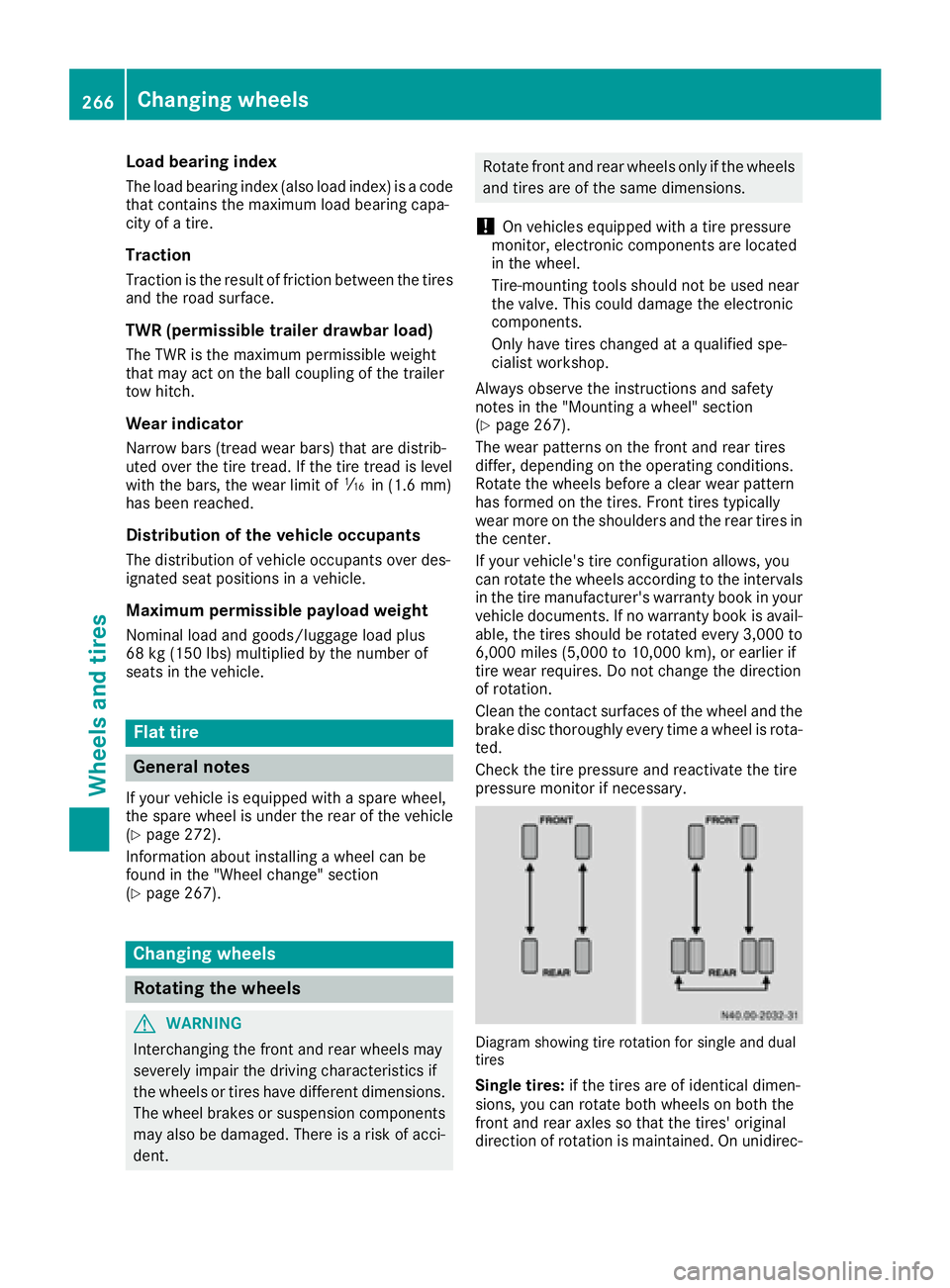
Diagram showing tire rotation for single and dual
tires
Single tires: if the tires are of identical dimen-
sions, you can rotate both wheels on both the
front and rear axles so that the tires' original
direction of rotation is maintained. On unidirec-
266Changing wheels
Wheels and tires
Page 273 of 290
Slide the new wheel onto the wheel hub and
push it on.
Wheels with centering by wheel bolts:
XVehicles with alloy wheels: take the short
wheel bolts that secure the steel spare wheel
out of the vehicle tool kit.
XScrew in the wheel bolts and tighten them
lightly.
For wheels with wheel nuts:
XFront wheels with wheel nut covers: press the
wheel nut covers onto the wheel nuts.
XScrew in the three wheel nuts over the fixing
discs of the wheel nut cover.
XTurn the wheel so that the wheel bolts are in
the middle of the holes.
XScrew on the rest of the wheel nuts.
XSlightly tighten all the wheel nuts.
Lowering the vehicle
GWARNING
The wheels could work loose if the wheel nuts and bolts are not tightened to the specified
tightening torque. There is a risk of accident.
Have the tightening torque immediately
checked at a qualified specialist workshop
after a wheel is changed.
!Only use the jack pump lever middle rod and
the rod with the largest diameter as a lug
wrench extension. Only slide the middle rod
as far as it will go onto the lug wrench. The
rods may otherwise bend and be distorted to
such an extent that they can no longer be
used as a pump lever for the jack.
!Vehicles with Super Single tires: if you
install the spare wheel, do not exceed the
maximum speed of 40 mph (60 km/h) and do
not drive further than 65 miles(100 km).
The transmission could otherwise be dam-
aged by the difference in wheel rotation
speeds.
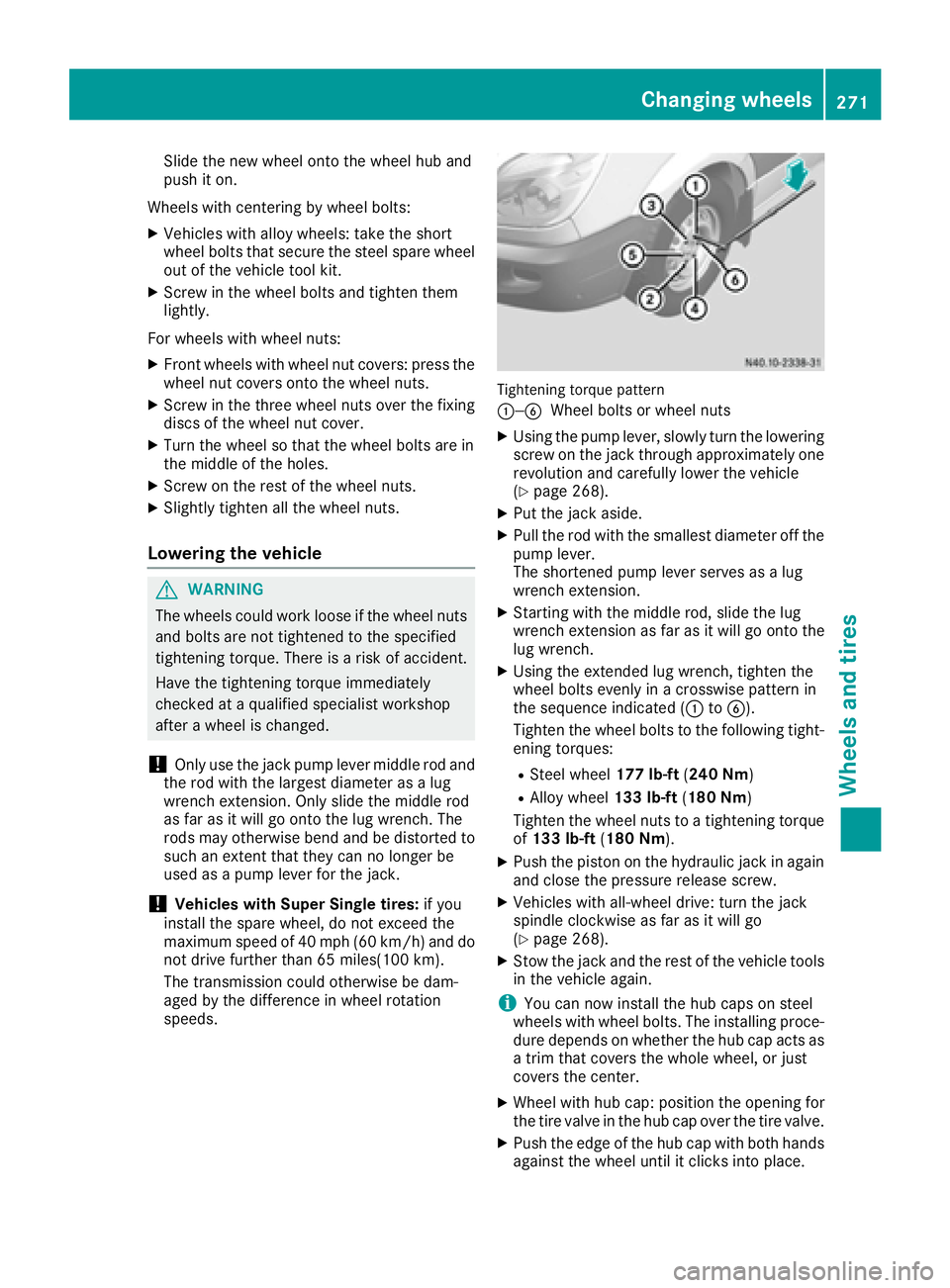
Tightening torque pattern
:—B
Wheel bolts or wheel nuts
XUsing the pump lever, slowly turn the lowering
screw on the jack through approximately one revolution and carefully lower the vehicle
(
Ypage 268).
XPut the jack aside.
XPull the rod with the smallest diameter off the
pump lever.
The shortened pump lever serves as a lug
wrench extension.
XStarting with the middle rod, slide the lug
wrench extension as far as it will go onto the
lug wrench.
XUsing the extended lug wrench, tighten the
wheel bolts evenly in a crosswise pattern in
the sequence indicated ( :toB).
Tighten the wheel bolts to the following tight-
ening torques:
RSteel wheel 177 lb-ft(240 Nm)
RAlloy wheel 133 lb-ft(180 Nm)
Tighten the wheel nuts to a tightening torque
of 133 lb-ft (180 Nm).
XPush the piston on the hydraulic jack in again
and close the pressure release screw.
XVehicles with all-wheel drive: turn the jack
spindle clockwise as far as it will go
(
Ypage 268).
XStow the jack and the rest of the vehicle tools
in the vehicle again.
iYou can now install the hub caps on steel
wheels with wheel bolts. The installing proce-
dure depends on whether the hub cap acts as
a trim that covers the whole wheel, or just
covers the center.
XWheel with hub cap: position the opening for
the tire valve in the hub cap over the tire valve.
XPush the edge of the hub cap with both hands against the wheel until it clicks into place.
Changing wheels271
Wheels and tires
Z
Page 288 of 290
The values specified apply only to loads placed
on the cargo compartment floor if:
Rthe load is secured to 2 cargo tie-down points
on the rail and
Rthe distance to the nearest load-securing
point on the same rail is approximately 3 ft
(1 m).
Roof carrier
GWARNING
When you load the roof, the center of gravity
of the vehicle rises and the driving character-
istics change. If you exceed the maximum roof
load, the driving characteristics, as well as
steering and braking, will be greatly impaired.
There is a risk of an accident.
Never exceed the maximum roof load and
adjust your driving style.
GWARNING
If you distribute the load unevenly in the vehi- cle, the handling as well as the steering and
braking characteristics are severely affected.
There is a risk of an accident.
Distribute the load evenly in the vehicle.
Secure the load to prevent it from slipping.
!The weight of any load carried on the roof,
including the roof carrier, must not exceed
the maximum permissible roof load.
The roof carrier supports must be mounted at
equal distances.
We recommend that you have a stabilizer
installed on the front axle.
!For safety reasons, we recommend that you
only use roof carrier systems that have been
tested and approved for the Sprinter. This will
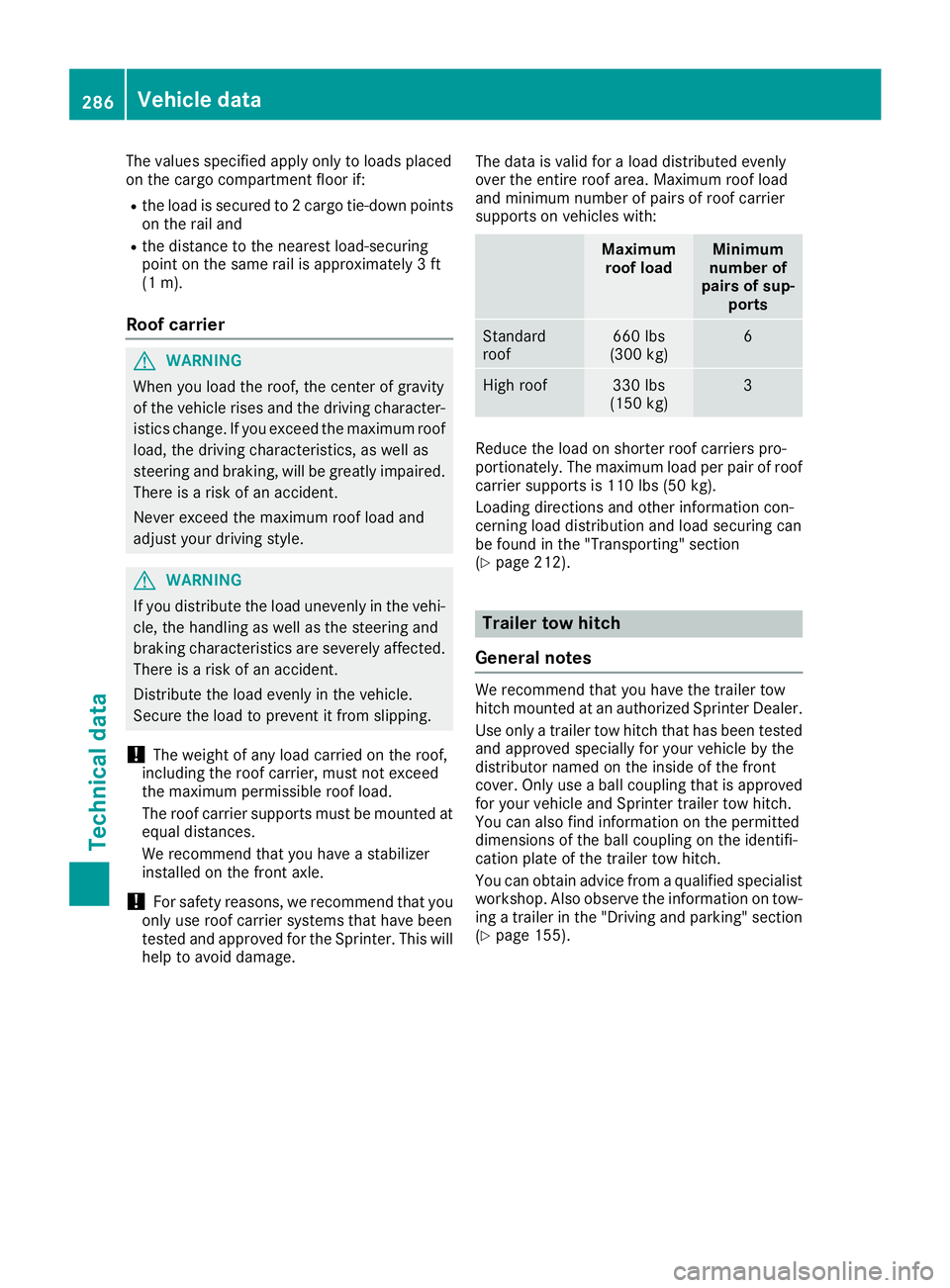
help to avoid damage. The data is valid for a load distributed evenly
over the entire roof area. Maximum roof load
and minimum number of pairs of roof carrier
supports on vehicles with:
Maximum
roof loadMinimum
number of
pairs of sup- ports
Standard
roof660 lbs
(300 kg)6
High roof330 lbs
(150 kg)3
Reduce the load on shorter roof carriers pro-
portionately. The maximum load per pair of roof
carrier supports is 110 lbs (50 kg).
Loading directions and other information con-
cerning load distribution and load securing can
be found in the "Transporting" section
(
Ypage 212).
Trailer tow hitch
General notes
We recommend that you have the trailer tow
hitch mounted at an authorized Sprinter Dealer. Use only a trailer tow hitch that has been tested
and approved specially for your vehicle by the
distributor named on the inside of the front
cover. Only use a ball coupling that is approved for your vehicle and Sprinter trailer tow hitch.
You can also find information on the permitted
dimensions of the ball coupling on the identifi-
cation plate of the trailer tow hitch.
You can obtain advice from a qualified specialist
workshop. Also observe the information on tow-
ing a trailer in the "Driving and parking" section
(
Ypage 155).
286Vehicle data
Technical data
Page 289 of 290
Maximum permitted weights and loads
!On vehicles with a permissible gross vehicle weight of 11030 lbs (5003 kg), the permissible
gross combination weight is less than the total of the permissible gross vehicle weight and the
permissible trailer load. Exceeding the permissible gross combination weight can lead to damage
to the drivetrain, to the transmission or to the trailer tow hitch.
If the vehicle or the trailer is fully laden, the relevant value for the permissible gross vehicle weight
or the permissible trailer load is therefore lower. In this case, the trailer or the vehicle may only
be partially loaded.
The permissible weights and loads which cannot be exceeded can also be found:
Rin your vehicle documents and
Ron the identification plates of the trailer tow hitch, trailer and vehicle (Ypage 276).
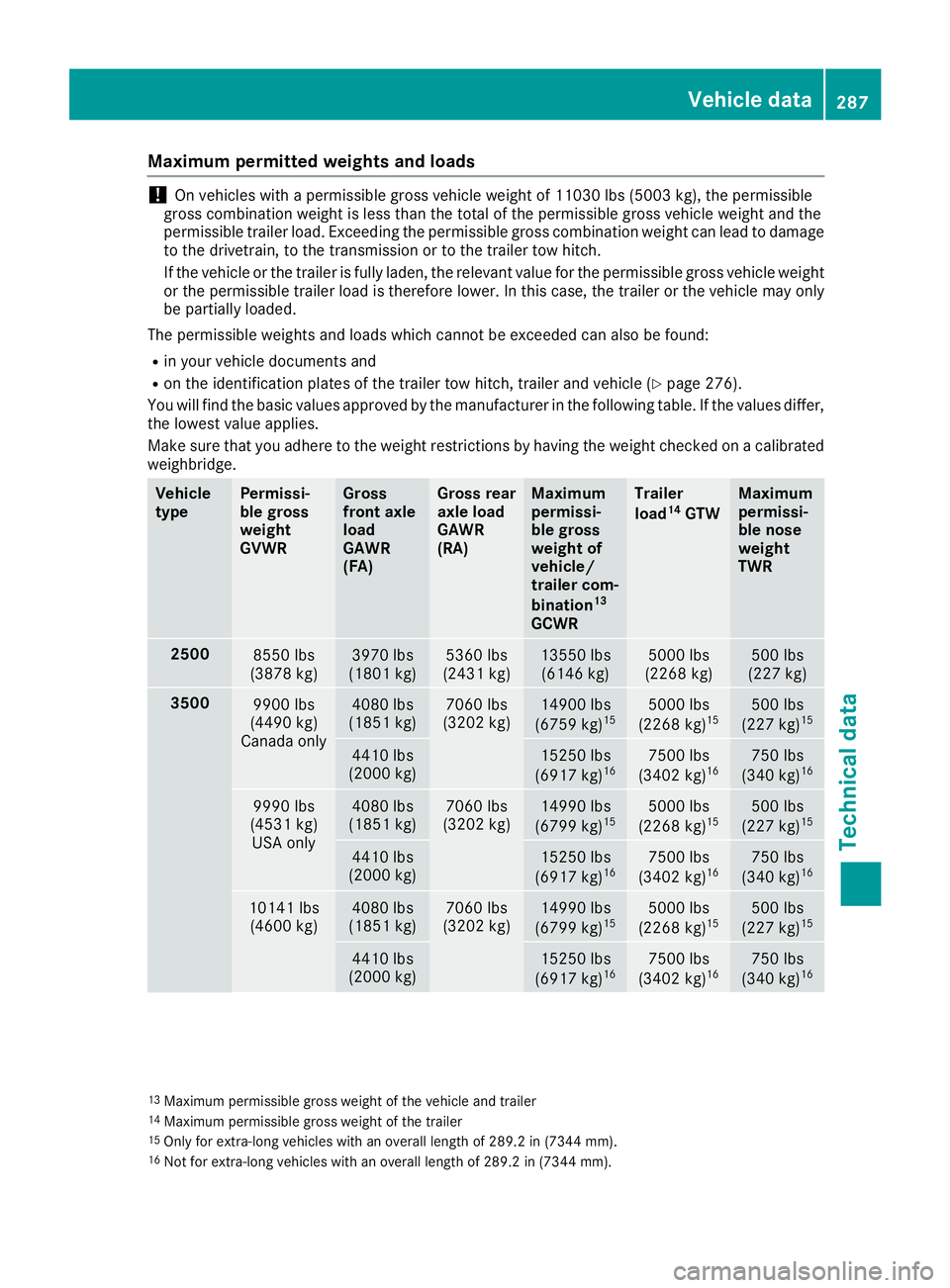
You will find the basic values approved by the manufacturer in the following table. If the values differ,
the lowest value applies.
Make sure that you adhere to the weight restrictions by having the weight checked on a calibrated
weighbridge.
Vehicle
typePermissi-
ble gross
weight
GVWRGross
front axle
load
GAWR
(FA)Gross rear
axle load
GAWR
(RA)Maximum
permissi-
ble gross
weight of
vehicle/
trailer com-
bination
13
GCWR
Trailer
load14GTW
Maximum
permissi-
ble nose
weight
TWR
25008550 lbs
(3878 kg)3970 lbs
(1801 kg)5360 lbs
(2431 kg)13550 lbs (6146 kg)5000 lbs
(2268 kg)500 lbs
(227 kg)
35009900 lbs
(4490 kg)
Canada only4080 lbs
(1851 kg)7060 lbs
(3202 kg)14900 lbs
(6759 kg)155000 lbs
(2268 kg)15500 lbs
(227 kg)15
4410 lbs
(2000 kg)15250 lbs
(6917 kg)167500 lbs
(3402 kg)16750 lbs
(340 kg)16
9990 lbs
(4531 kg) USA only4080 lbs
(1851 kg)7060 lbs
(3202 kg)14990 lbs
(6799 kg)155000 lbs
(2268 kg)15500 lbs
(227 kg)15
4410 lbs
(2000 kg)15250 lbs
(6917 kg)167500 lbs
(3402 kg)16750 lbs
(340 kg)16
10141 lbs (4600 kg)4080 lbs
(1851 kg)7060 lbs
(3202 kg)14990 lbs
(6799 kg)155000 lbs
(2268 kg)15500 lbs
(227 kg)15
4410 lbs
(2000 kg)15250 lbs
(6917 kg)167500 lbs
(3402 kg)16750 lbs
(340 kg)16
13Maximum permissible gross weight of the vehicle and trailer14Maximum permissible gross weight of the trailer15Only for extra-long vehicles with an overall length of 289.2 in (7344 mm).16Not for extra-long vehicles with an overall length of 289.2 in (7344 mm).
Vehicle data287
Technical data
Z