steering wheel MERCEDES-BENZ SPRINTER 2017 MY17 Operator’s Manual
[x] Cancel search | Manufacturer: MERCEDES-BENZ, Model Year: 2017, Model line: SPRINTER, Model: MERCEDES-BENZ SPRINTER 2017Pages: 286, PDF Size: 4.36 MB
Page 254 of 286
Restarting the tire pressure monitor (vehi-
cles with steering wheel buttons):
XTurn the key to position2in the ignition lock.
XPress the VorU button on the steering
wheel until the standard display (Ypage 164)
appears in the display.
XPress the 9or: button on the steering
wheel repeatedly until the current pressure of
the individual tires is displayed or the display
shows the following message:
Tire pres. displayed after driving
for several minutes
XPress the 9reset button on the instrument
cluster.
The display shows the following message: Monitor current tire pressure?
XPress the
Wbutton on the steering wheel.
The display shows the following message:
Tire pres. monitor reactivated
The tire pressure monitor activation process
has begun. The tire pressures measured for
the individual wheels are stored as the new
reference values, provided that the tire pres-
sure monitor considers them to be plausible.
If you wish to cancel the restart:
XPress the Xbutton on the steering wheel.
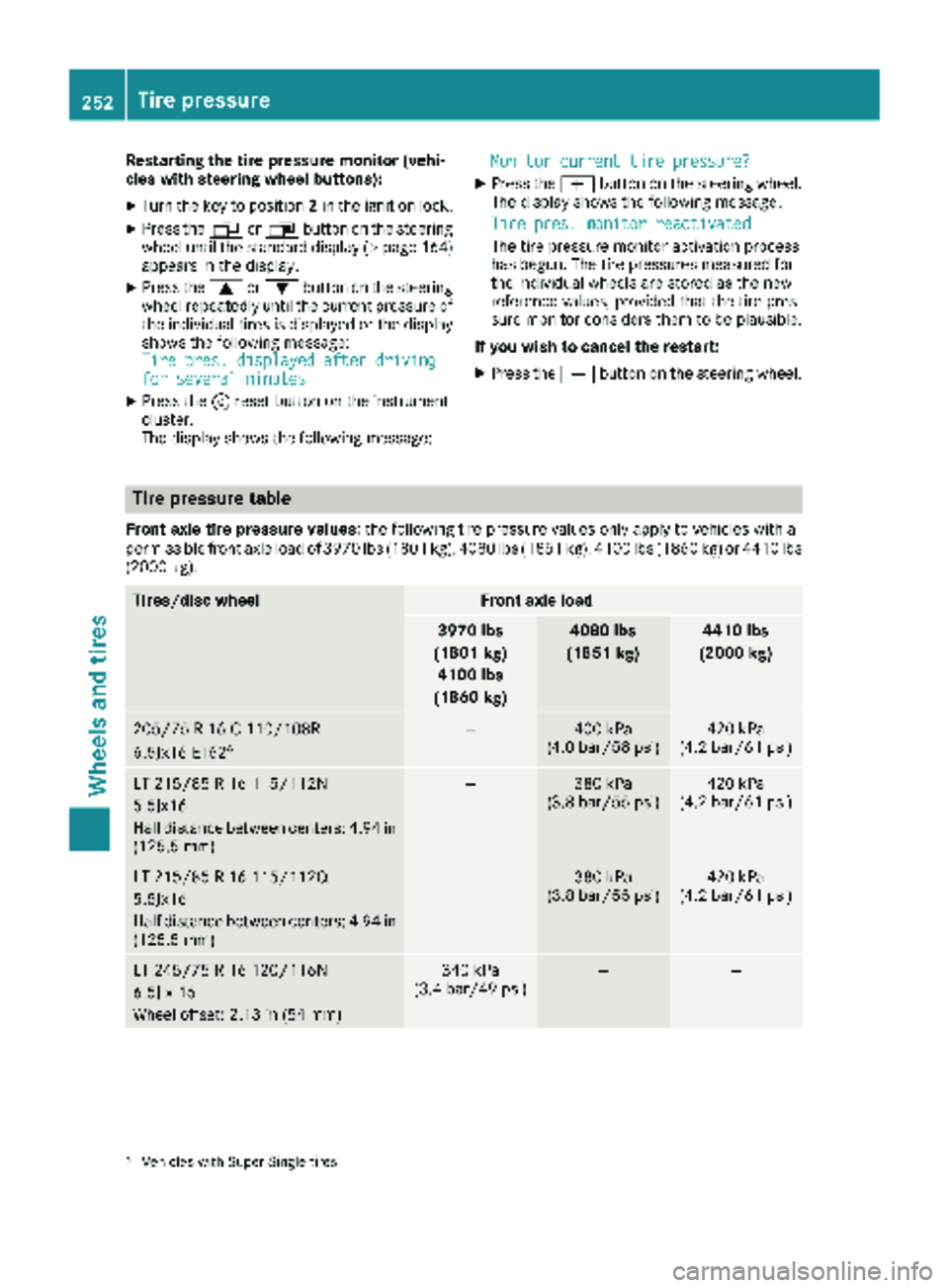
Tire pressure table
Front axle tire pressure values: the following tire pressure values only apply to vehicles with a
permissible front axle load of 3970 lb s(1801 kg), 4080 lbs (1851 kg), 4100 lbs (1860 kg) or 4410 lbs
(2000 kg).
Tires/disc wheelFront axle load
3970 lbs
(1801 kg) 4100 lbs
(1860 kg)4080 lbs
(1851 kg)4410 lbs
(2000 kg)
205/75 R 16 C 110/108R
6.5Jx16 ET626—400 kPa
(4.0 bar/58 psi)420 kPa
(4.2 bar/61 psi)
LT 215/85 R 16 115/112N
5.5Jx16
Half distance between centers: 4.94 in
(125.5 mm)—380 kPa
(3.8 bar/55 psi)420 kPa
(4.2 bar/61 psi)
LT 215/85 R 16 115/112Q
5.5Jx16
Half distance between centers: 4.94 in
(125.5 mm)—380 kPa
(3.8 bar/55 psi)420 kPa
(4.2 bar/61 psi)
LT 245/75 R 16 120/116N
6.5J x 16
Wheel offset: 2.13 in (54 mm)340 kPa
(3.4 bar/49 psi)——
6Vehicles with Super Single tires
252Tire pressure
Wheels and tires
Page 256 of 286
Loading the vehicle
Instruction labels for tires and loads
GWARNING
Overloaded tires can overheat, causing a
blowout. Overloaded tires can also impair the steering and driving characteristics and lead
to brake failure. There is a risk of accident.
Observe the load rating of the tires. The load
rating must be at least half of the GAWR of
your vehicle. Never overload the tires by
exceeding the maximum load.
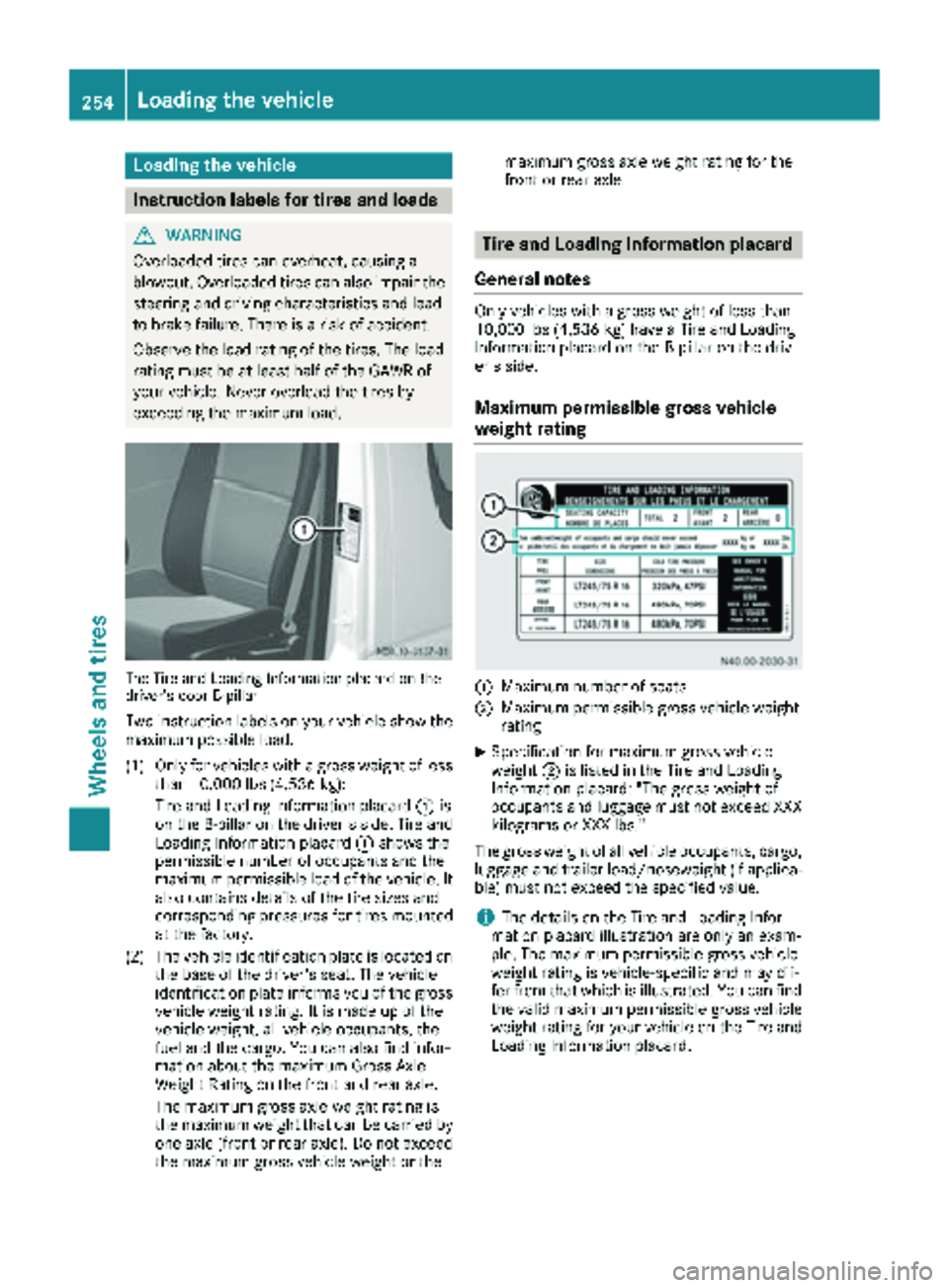
The Tire and Loading Information placard on the
driver’s door B-pillar
Two instruction labels on your vehicle show themaximum possible load.
(1) Only for vehicles with a gross weight of less than 10,000 lbs (4,536 kg):
Tire and Loading Information placard :is
on the B-pillar on the driver's side. Tire and
Loading Information placard :shows the
permissible number of occupants and the
maximum permissible load of the vehicle. It
also contains details of the tire sizes and
corresponding pressures for tires mounted
at the factory.
(2) The vehicle identification plate is located on the base of the driver's seat. The vehicle
identification plate informs you of the gross
vehicle weight rating. It is made up of the
vehicle weight, all vehicle occupants, the
fuel and the cargo. You can also find infor-
mation about the maximum Gross Axle
Weight Rating on the front and rear axle.
The maximum gross axle weight rating is
the maximum weight that can be carried by
one axle (front or rear axle). Do not exceed
the maximum gross vehicle weight or the maximum gross axle weight rating for the
front or rear axle.
Tire and Loading Information placard
General notes
Only vehicles with a gross weight of less than
10,000 lbs (4,536 kg) have a Tire and Loading
Information placard on the B-pillar on the driv-
er's side.
Maximum permissible gross vehicle
weight rating
:Maximum number of seats
;Maximum permissible gross vehicle weight
rating
XSpecification for maximum gross vehicle
weight ;is listed in the Tire and Loading
Information placard: "The gross weight of
occupants and luggage must not exceed XXX
kilograms or XXX lbs."
The gross weight of all vehicle occupants, cargo,
luggage and trailer load/noseweight (if applica-
ble) must not exceed the specified value.
iThe details on the Tire and Loading Infor-
mation placard illustration are only an exam-
ple. The maximum permissible gross vehicle
weight rating is vehicle-specific and may dif-
fer from that which is illustrated. You can find
the valid maximum permissible gross vehicle
weight rating for your vehicle on the Tire and
Loading Information placard.
254Loading the vehicle
Wheels and tires
Page 277 of 286
damage to the fuel injection system, for
example.
B20 fuels with bio-diesel content
!Continuous use of B20 fuel can lead to fuel
filter clogging and injector deposits. This can
cause engine performance degradation.
Injector deposits can cause the engine oil
level to rise due to unburned fuel washing into
the oil pan. This can cause engine mechanical
damage.
To avoid damages and performance degrada-
tion:
RFill up with ULSD (B5 or less) whenever
possible.
RRegularly monitor your engine oil level if
you use B20 fuel on a regular basis.
RStrictly follow the oil change intervals quo-
ted in the instrument cluster and within
your maintenance booklet.
RUse only engine oils and filters approved for
use in your vehicle.
RIf you do not plan to drive your vehicle for
several weeks, fill your vehicle’s fuel tank in
advance with ULSD fuel.
For more information, consult the gas station
staff. The fatty acid methyl ester B5 or B20 label on the fuel pump must clearly state that the
standard for ULSD is complied with. If the mark-
ing does not make this clear, do not refuel from that pump.
Do not refuel with any fuels that have not been
approved for your vehicle.
For more information about refueling
(
Ypage 125).
Information on fuel consumption
HEnvironmental note
CO
2(carbon dioxide) is the gas which scien-
tists believe to be principally responsible for
global warming (the greenhouse effect). Your
vehicle's CO
2emissions are directly related to
fuel consumption and therefore depend on:
Refficient use of the fuel by the engine
Rdriving style
Rother non-technical factors, such as envi-
ronmental influences, road conditions or
traffic flow
You can minimize your vehicle's CO
2emis-
sions by driving carefully and having it serv-
iced regularly.
Fuel consumption depends on:
Rthe vehicle version
Rthe style of driving
Rthe operating conditions
Rthe type or quality of the fuel used
The vehicle will use more fuel than usual in the
following situations:
Rat very low outside temperatures
Rin city traffic
Rduring short journeys
Ron mountainous terrain
Rwhen towing a trailer
To keep fuel consumption low, observe the
advice in the "Protection of the environment"
section (
Ypage 25).
The following components of the different vehi-
cle versions influence fuel consumption:
Rtire sizes, tire tread, tire pressure, tire condi-
tion
Rbody
Rtransmission ratios for the drive assemblies
Radditional equipment (e.g. air-conditioning
system, auxiliary heating system)
For these reasons, the actual consumption fig-
ures for your vehicle may deviate from the con-
sumption figures determined according to EU
Directive 80/1268/EEC.
Data concerning fuel consumption are recorded in the on-board computer; use the steering
wheel buttons to call up the Trip computer
menu (
Ypage 171).
Diesel Exhaust Fluid (DEF)
General notes
HEnvironmental note
Dispose of DEF in an environmentally respon-
sible manner.
Service products and capacities275
Technical data
Z