cooling MERCEDES-BENZ SPRINTER 2017 MY17 Operator’s Manual
[x] Cancel search | Manufacturer: MERCEDES-BENZ, Model Year: 2017, Model line: SPRINTER, Model: MERCEDES-BENZ SPRINTER 2017Pages: 286, PDF Size: 4.36 MB
Page 221 of 286
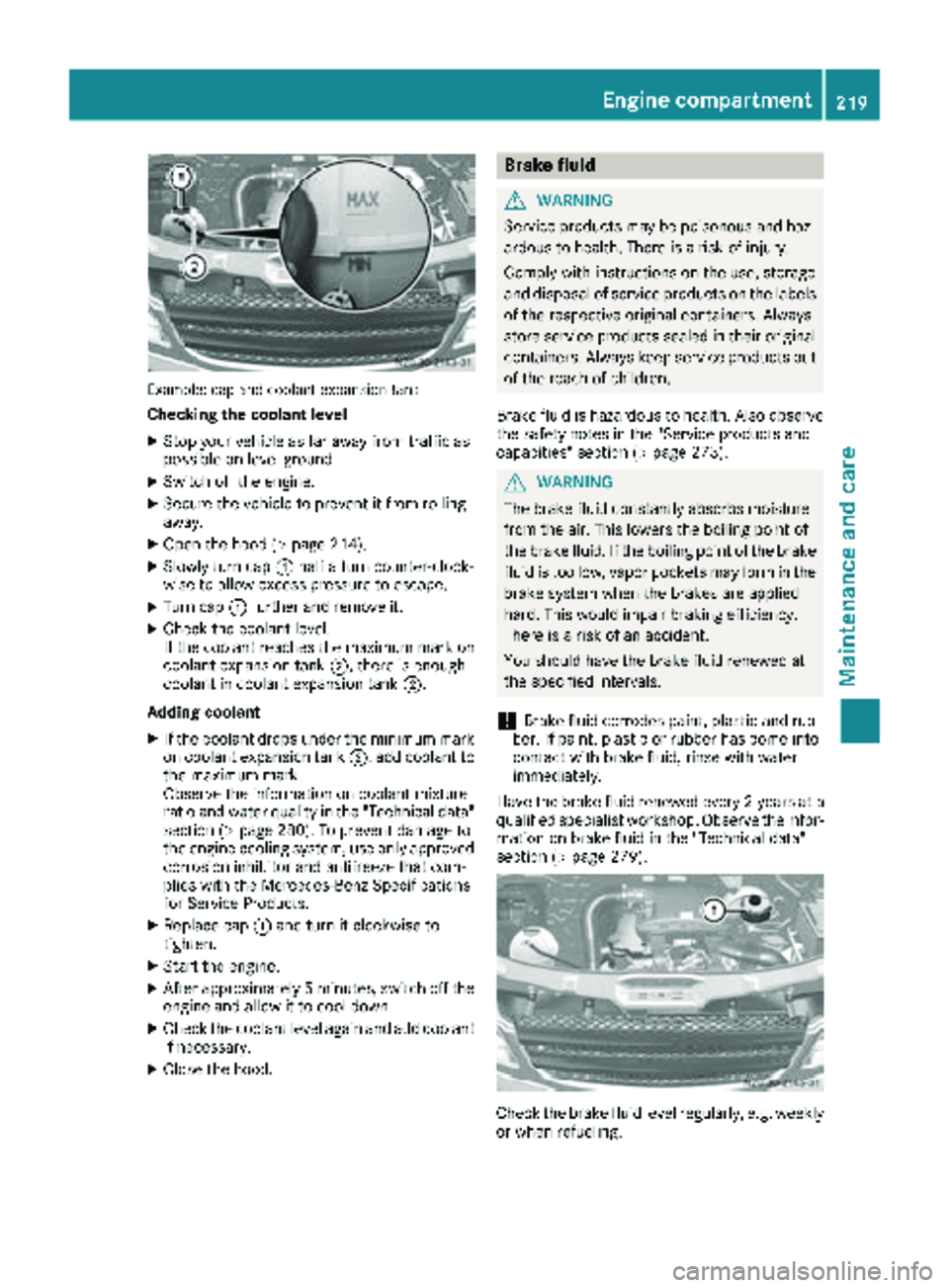
Example: cap and coolant expansion tank
Checking the coolant level
XStop your vehicle as far away from traffic as
possible on level ground.
XSwitch off the engine.
XSecure the vehicle to prevent it from rolling
away.
XOpen the hood (Ypage 214).
XSlowly turn cap:half a turn counter-clock-
wise to allow excess pressure to escape.
XTurn cap :further and remove it.
XCheck the coolant level.
If the coolant reaches the maximum mark on
coolant expansion tank ;, there is enough
coolant in coolant expansion tank ;.
Adding coolant
XIf the coolant drops under the minimum mark
on coolant expansion tank ;, add coolant to
the maximum mark.
Observe the information on coolant mixture
ratio and water quality in the "Technical data"
section (
Ypage 280). To prevent damage to
the engine cooling system, use only approved
corrosion inhibitor and antifreeze that com-
plies with the Mercedes-Benz Specifications
for Service Products.
XReplace cap :and turn it clockwise to
tighten.
XStart the engine.
XAfter approximately 5 minutes, switch off the
engine and allow it to cool down.
XCheck the coolant level again and add coolant
if necessary.
XClose the hood.
Brake fluid
GWARNING
Service products may be poisonous and haz-
ardous to health. There is a risk of injury.
Comply with instructions on the use, storage
and disposal of service products on the labels
of the respective original containers. Always
store service products sealed in their original
containers. Always keep service products out
of the reach of children.
Brake fluid is hazardous to health. Also observe
the safety notes in the "Service products and
capacities" section (
Ypage 273).
GWARNING
The brake fluid constantly absorbs moisture
from the air. This lowers the boiling point of
the brake fluid. If the boiling point of the brake
fluid is too low, vapor pockets may form in the
brake system when the brakes are applied
hard. This would impair braking efficiency.
There is a risk of an accident.
You should have the brake fluid renewed at
the specified intervals.
!Brake fluid corrodes paint, plastic and rub-
ber. If paint, plastic or rubber has come into
contact with brake fluid, rinse with water
immediately.
Have the brake fluid renewed every 2 year sat a
qualified specialist workshop. Observe the infor- mation on brake fluid in the "Technical data"
section (
Ypage 279).
Check the brake fluid level regularly, e.g. weekly
or when refueling.
Engine compartment219
Maintenance and care
Z
Page 282 of 286
Coolant
Important safety notes
GWARNING
If antifreeze comes into contact with hot com- ponents in the engine compartment, it may
ignite. There is a risk of fire and injury.
Let the engine cool down before you add anti-
freeze. Make sure that antifreeze is not spilled
next to the filler neck. Thoroughly clean the
antifreeze from components before starting
the engine.
!Take care not to spill any coolant on painted
surfaces. You could otherwise damage the
paintwork.
When handling coolant, observe the important
safety notes for service products (
Ypage 273).
Coolant additive with antifreeze
requirements
!Use only approved antifreeze/corrosion
inhibitor that complies with MB Specification for Service Products, Sheet Number 325.
Using other, non-approved antifreeze/corro-
sion inhibitors may cause damage to the cool-
ant system and reduce the engine's service
life.
Coolant is a mixture of water and antifreeze/
corrosion inhibitor. It performs the following
tasks:
RAnti-corrosion protection
RAntifreeze protection
RRaises the boiling point
When the vehicle is first delivered, it is filled with
a coolant mixture that ensures adequate anti-
freeze/corrosion protection. Coolant must be
used in the system all year round to ensure anti-
corrosion protection and a raised boiling point –
even in countries with high outside tempera-
tures.
To prevent damage to the engine cooling sys-
tem, use only approved corrosion inhibitor/anti-
freeze that comply with the Mercedes-Benz
Specifications for Service Products.
We recommend corrosion inhibitor/antifreeze
that meets the requirements in MB Specifica-
tions for Service Products Sheet Number 325. Check the antifreeze/corrosion inhibitor con-
centration in the coolant every six months.
The percentage of corrosion inhibitor/anti-
freeze additive in the engine coo
ling system
should:
Rbe at least 50%. This way, the engine cooling
system is protected against freezing down to
approximately -35 ‡ (-37 †).
Rnot exceed 55% (antifreeze protection down
to -49 ‡ [-45 †]). Otherwise, heat will not be
dissipated as effectively.
If there has been coolant loss, do not refill only
with water. If the vehicle has lost coolant, add
equal parts water and corrosion inhibitor/anti-
freeze additive. The water used as part of the
coolant mixture must fulfill certain require-
ments; these are usually fulfilled by drinking
water. If the water quality is not sufficient, you
must treat the water.
Operating fluid: coolant
Product name/number
EURO Peak Coolant/Antifreeze,
OLD WORLD INDUSTRIES
MB Sheet No. 325.0
Zerex G05, The Valvoline Company
MB Sheet No. 325.0
Zerex G48, The Valvoline Company
MB Sheet No. 325.0
Glysantin G05, BASF AG
MB Sheet No. 325.0
Capacities
Engine cooling system
CoolantApprox. 10.75 qt (10.0 l)
280Service products and capacities
Technical data