brakes MERCEDES-BENZ SPRINTER 2017 MY17 Operator’s Manual
[x] Cancel search | Manufacturer: MERCEDES-BENZ, Model Year: 2017, Model line: SPRINTER, Model: MERCEDES-BENZ SPRINTER 2017Pages: 286, PDF Size: 4.36 MB
Page 182 of 286
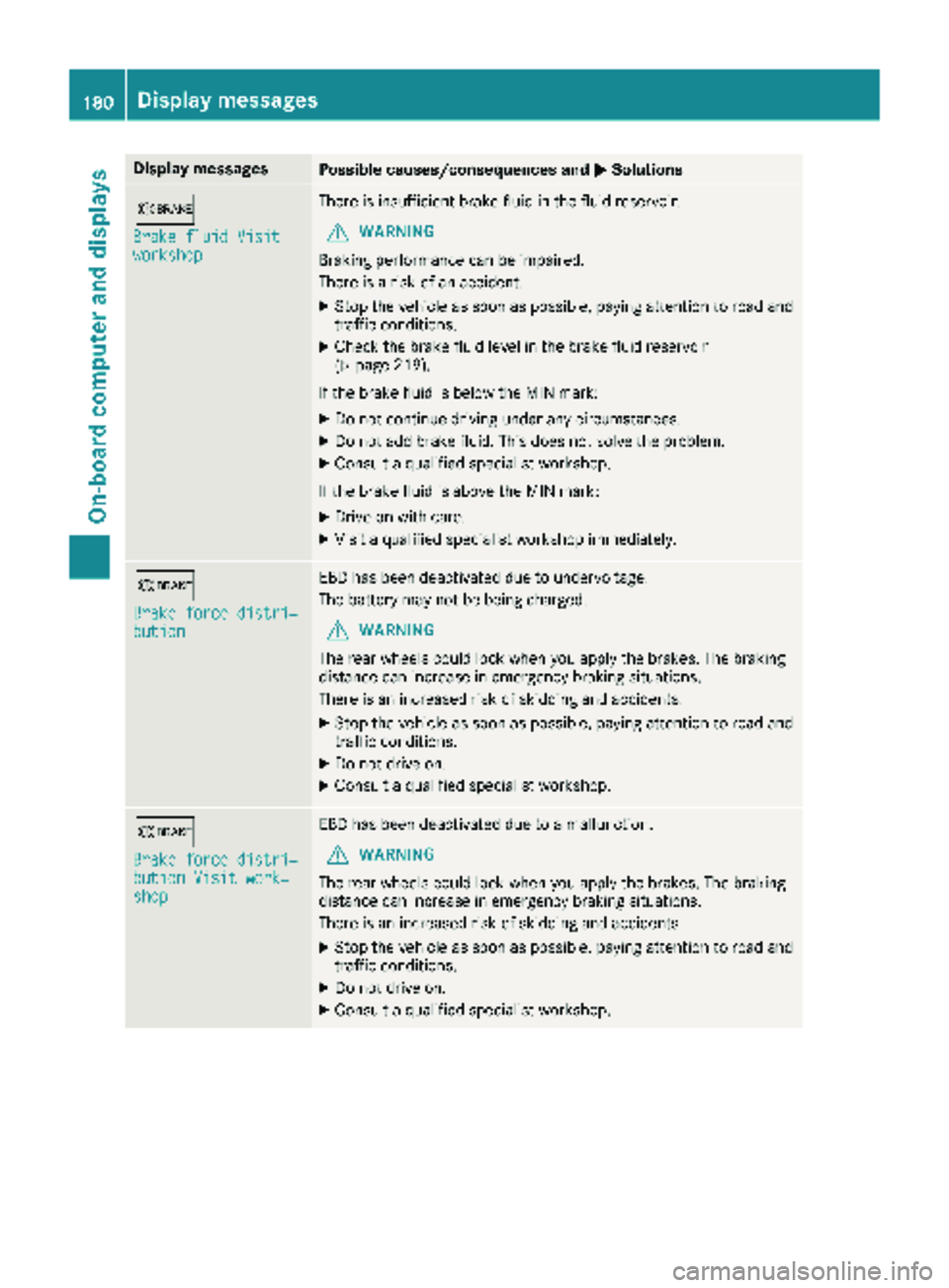
Display messagesPossible causes/consequences andMSolutions
b
Brake fluid Visitworkshop
There is insufficientbrak eflui din th efluid reservoir .
GWARNING
Braking performance can be impaired.
There is aris kof an accident.
XStop th evehicl eas soo nas possible, payin gattention to roa dand
traffic conditions.
XChec kth ebrak efluid level in th ebrak efluid reservoir
(Ypage 219).
If th ebrak eflui dis belo wtheMIN mark:
XDo no tcontinu edrivin gunder any circumstances.
XDo no tadd brak efluid .This does no tsolv eth eproblem .
XConsult aqualified specialist workshop .
If th ebrak eflui dis abov eth eMIN mark:
XDrive on wit hcare.
XVisit aqualified specialist workshop immediately.
b
Brake force distri ‐bution
EBDhas been deactivated due to undervoltage.
The battery may no tbe bein gcharged.
GWARNIN G
The rear wheels could loc kwhen you apply th ebrakes. The braking
distanc ecan increas ein emergenc ybraking situations.
There is an increased ris kof skiddin gand accidents .
XStop thevehicl eas soo nas possible, payin gattention to roa dand
traffic conditions.
XDo no tdrive on .
XConsult aqualified specialist workshop .
b
Brake force distri‐bution Visit work‐shop
EBDhas been deactivated due to amalfunction .
GWARNING
The rear wheels could loc kwhen you apply th ebrakes. The braking
distanc ecan increas ein emergenc ybraking situations.
There is an increased ris kof skiddin gand accidents .
XStop thevehicl eas soo nas possible, payin gattention to roa dand
traffic conditions.
XDo no tdrive on .
XConsult aqualified specialist workshop .
180Display messages
On-board computer and displays
Page 193 of 286
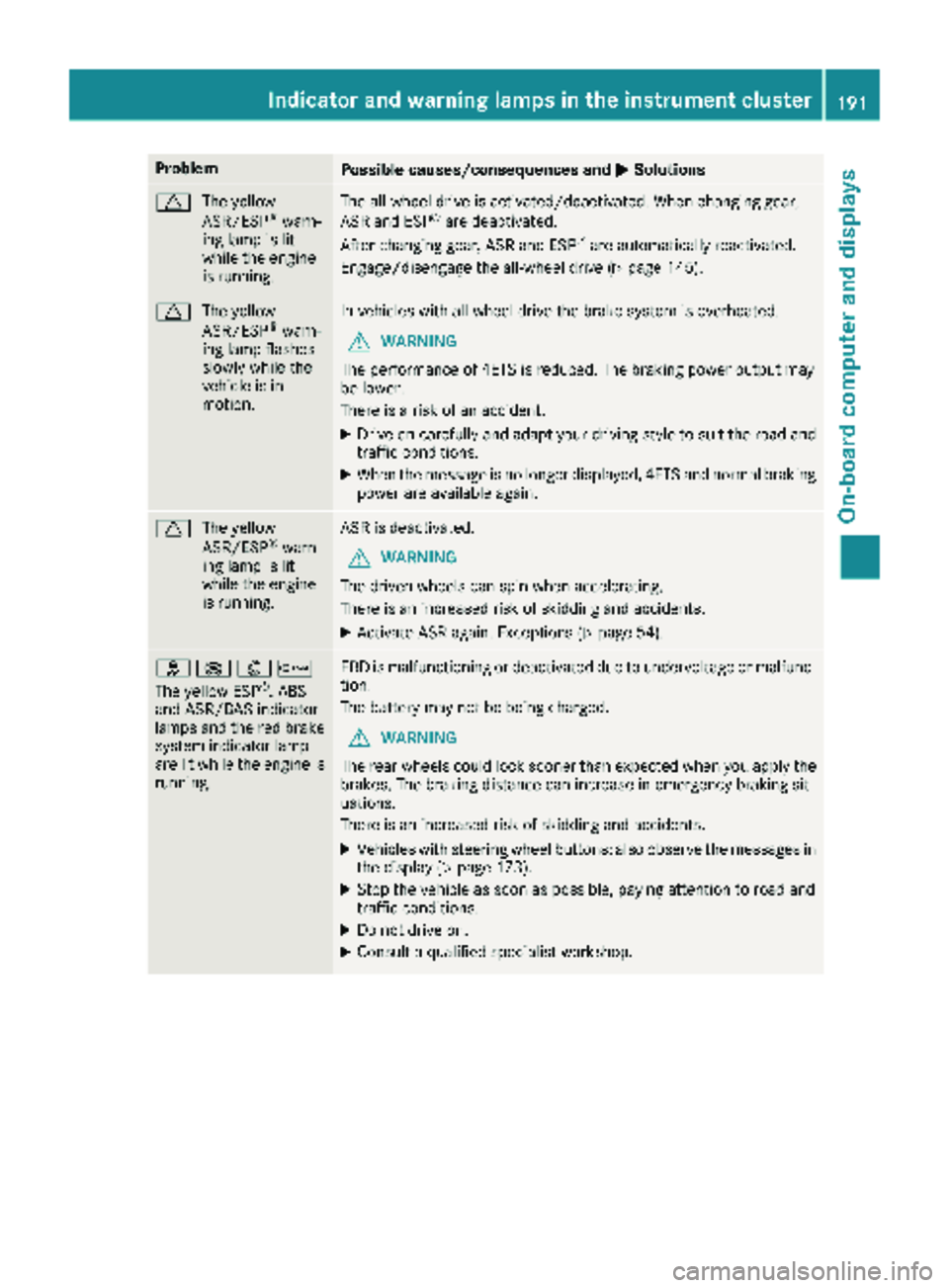
ProblemPossible causes/consequences andMSolutions
d
The yellow
ASR/ESP®warn-
ing lamp is lit
while the engine
is running.
The all-wheel drive is activated/deactivated. When changing gear,
ASR and ESP®are deactivated.
After changing gear, ASR and ESP®are automatically reactivated.
Engage/disengage the all-wheel drive (
Ypage 145).
d The yellow
ASR/ESP®warn-
ing lamp flashes
slowly while the
vehicle is in
motion.
In vehicles with all-wheel drive the brake system is overheated.
GWARNING
The performance of 4ETS is reduced. The braking power output may
be lower.
There is a risk of an accident.
XDrive on carefully and adapt your driving style to suit the road and
traffic conditions.
XWhen the message is no longer displayed, 4ETS and normal braking
power are available again.
d The yellow
ASR/ESP®warn-
ing lamp is lit
while the engine
is running.
ASR is deactivated.
GWARNING
The driven wheels can spin when accelerating.
There is an increased risk of skidding and accidents.
XActivate ASR again. Exceptions (Ypage 54).
h !:b
The yellow ESP®, ABS
and ASR/BAS indicator
lamps and the red brake
system indicator lamp
are lit while the engine is
running.
EBD is malfunctioning or deactivated due to undervoltage or malfunc-
tion.
The battery may not be being charged.
GWARNING
The rear wheels could lock sooner than expected when you apply the
brakes. The braking distance can increase in emergency braking sit-
uations.
There is an increased risk of skidding and accidents.
XVehicles with steering wheel buttons: also observe the messages in
the display (Ypage 173).
XStop the vehicle as soon as possible, paying attention to road and
traffic conditions.
XDo not drive on.
XConsult a qualified specialist workshop.
Indicator and warning lamps in the instrument cluster191
On-board computer and displays
Z
Page 195 of 286
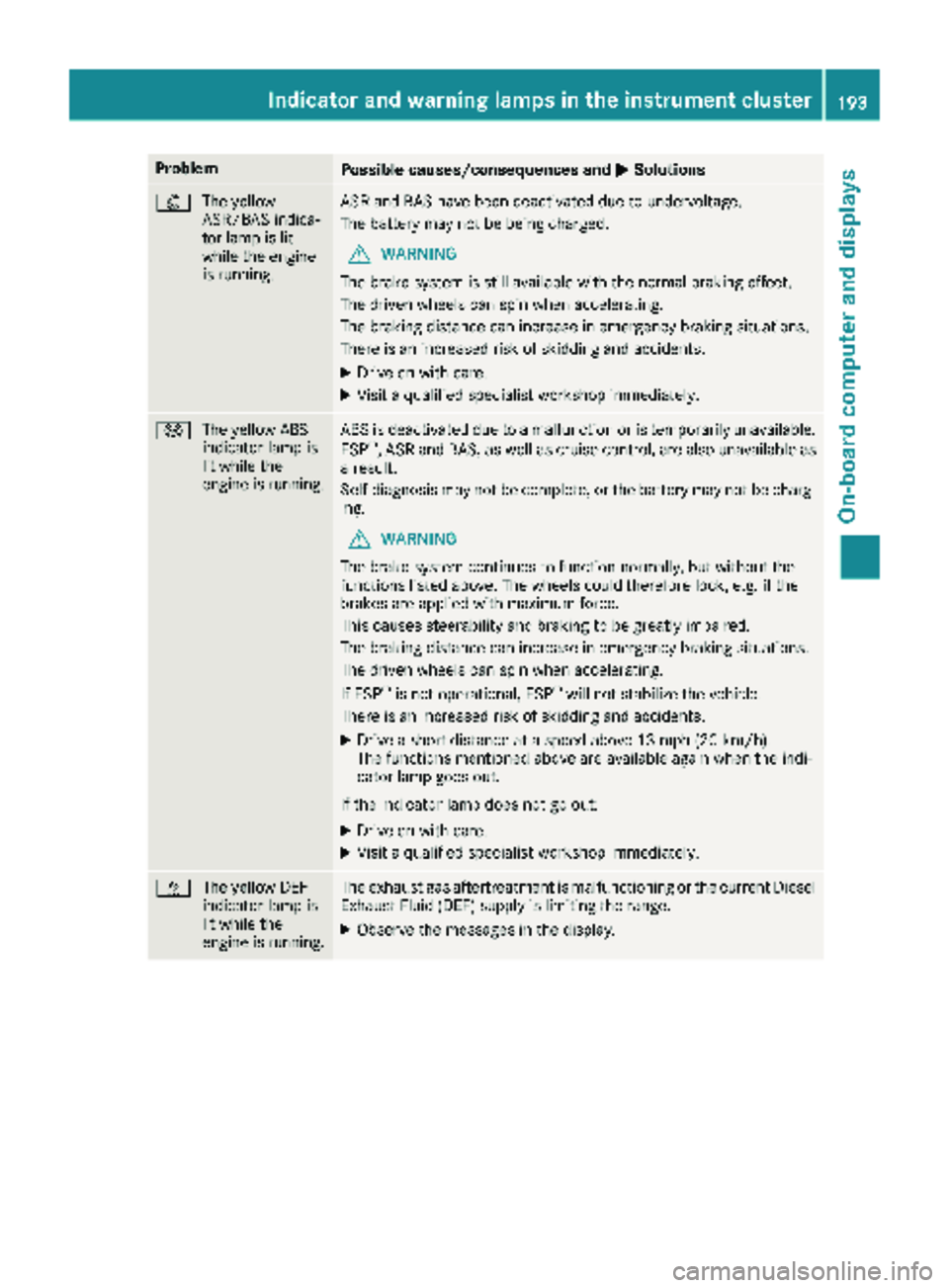
ProblemPossible causes/consequences andMSolutions
:
The yellow
ASR/BAS indica-
tor lamp is lit
while the engine
is running.ASR and BAS have been deactivated due to undervoltage.
The battery may not be being charged.
GWARNING
The brake system is still available with the normal braking effect.
The driven wheels can spin when accelerating.
The braking distance can increase in emergency braking situations.
There is an increased risk of skidding and accidents.
XDrive on with care.
XVisit a qualified specialist workshop immediately.
! The yellow ABS
indicator lamp is
lit while the
engine is running.ABS is deactivated due to a malfunction or is temporarily unavailable.
ESP®, ASR and BAS, as well as cruise control, are also unavailable as
a result.
Self-diagnosis may not be complete, or the battery may not be charg-
ing.
GWARNING
The brake system continues to function normally, but without the
functions listed above. The wheels could therefore lock, e.g. if the
brakes are applied with maximum force.
This causes steerability and braking to be greatly impaired.
The braking distance can increase in emergency braking situations.
The driven wheels can spin when accelerating.
If ESP
®is not operational, ESP®will not stabilize the vehicle.
There is an increased risk of skidding and accidents.
XDrive a short distance at a speed above 13 mph (20 km/h).
The functions mentioned above are available again when the indi-
cator lamp goes out.
If the indicator lamp does not go out:
XDrive on with care.
XVisit a qualified specialist workshop immediately.
å The yellow DEF
indicator lamp is
lit while the
engine is running.The exhaust gas aftertreatment is malfunctioning or the current Diesel
Exhaust Fluid (DEF) supply is limiting the range.
XObserve the messages in the display.
Indicator and warning lamps in the instrument cluster193
On-board computer and displays
Z
Page 221 of 286
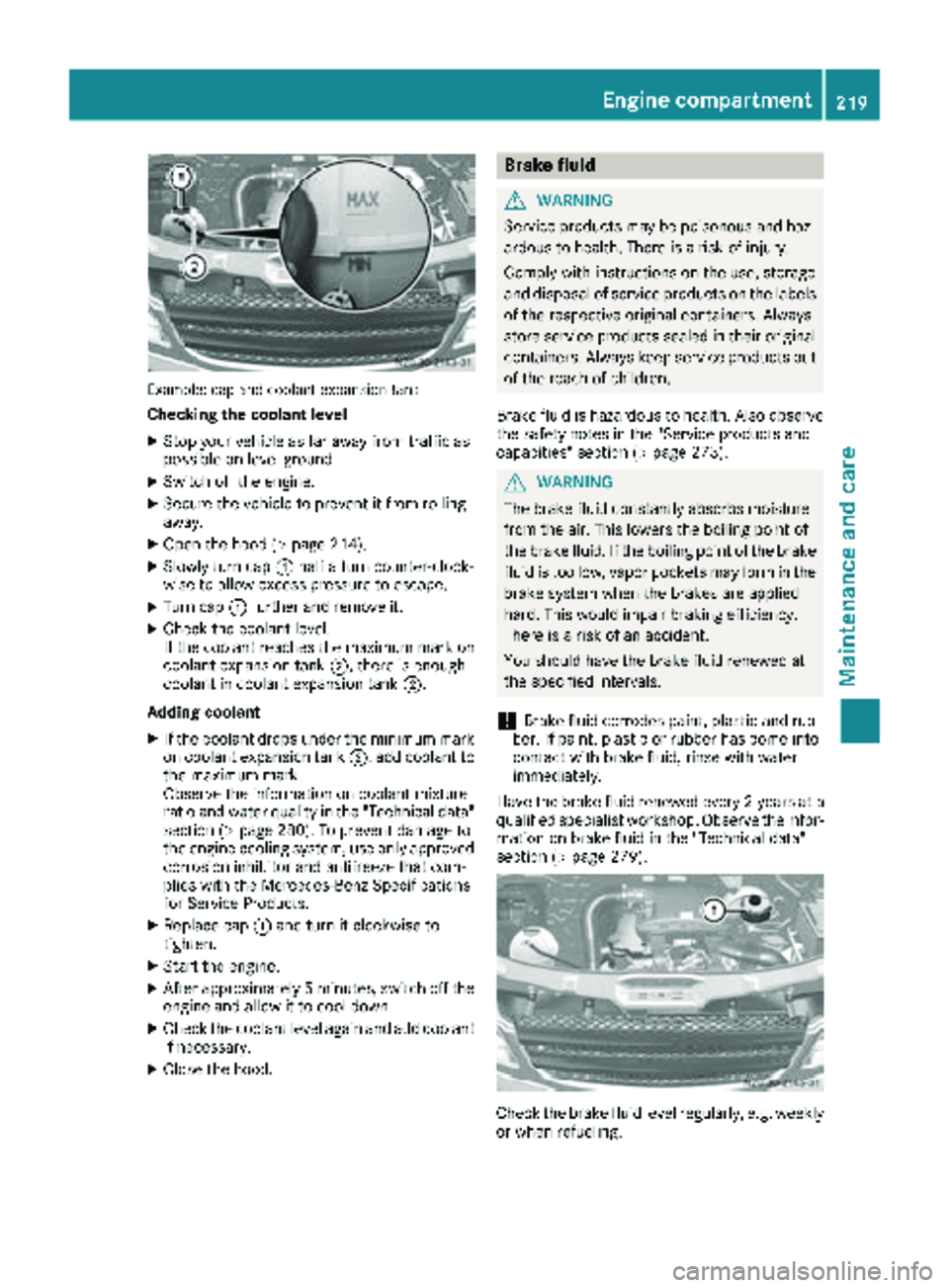
Example: cap and coolant expansion tank
Checking the coolant level
XStop your vehicle as far away from traffic as
possible on level ground.
XSwitch off the engine.
XSecure the vehicle to prevent it from rolling
away.
XOpen the hood (Ypage 214).
XSlowly turn cap:half a turn counter-clock-
wise to allow excess pressure to escape.
XTurn cap :further and remove it.
XCheck the coolant level.
If the coolant reaches the maximum mark on
coolant expansion tank ;, there is enough
coolant in coolant expansion tank ;.
Adding coolant
XIf the coolant drops under the minimum mark
on coolant expansion tank ;, add coolant to
the maximum mark.
Observe the information on coolant mixture
ratio and water quality in the "Technical data"
section (
Ypage 280). To prevent damage to
the engine cooling system, use only approved
corrosion inhibitor and antifreeze that com-
plies with the Mercedes-Benz Specifications
for Service Products.
XReplace cap :and turn it clockwise to
tighten.
XStart the engine.
XAfter approximately 5 minutes, switch off the
engine and allow it to cool down.
XCheck the coolant level again and add coolant
if necessary.
XClose the hood.
Brake fluid
GWARNING
Service products may be poisonous and haz-
ardous to health. There is a risk of injury.
Comply with instructions on the use, storage
and disposal of service products on the labels
of the respective original containers. Always
store service products sealed in their original
containers. Always keep service products out
of the reach of children.
Brake fluid is hazardous to health. Also observe
the safety notes in the "Service products and
capacities" section (
Ypage 273).
GWARNING
The brake fluid constantly absorbs moisture
from the air. This lowers the boiling point of
the brake fluid. If the boiling point of the brake
fluid is too low, vapor pockets may form in the
brake system when the brakes are applied
hard. This would impair braking efficiency.
There is a risk of an accident.
You should have the brake fluid renewed at
the specified intervals.
!Brake fluid corrodes paint, plastic and rub-
ber. If paint, plastic or rubber has come into
contact with brake fluid, rinse with water
immediately.
Have the brake fluid renewed every 2 year sat a
qualified specialist workshop. Observe the infor- mation on brake fluid in the "Technical data"
section (
Ypage 279).
Check the brake fluid level regularly, e.g. weekly
or when refueling.
Engine compartment219
Maintenance and care
Z
Page 231 of 286
!Do not use cleaning agents containing fuel.
Cleaning agents containing fuel corrode the
battery housing.
!If dirt gets into the battery cell, battery self-
discharge will increase and the battery may
be damaged.
The following points on battery care must be
observed:
XRegularly check the battery terminals and the
fastening of the negative cable to the chassis
to ensure that they are firmly seated.
XAlways keep the battery terminals and battery
surfaces clean and dry.
XLightly grease the undersides of the battery
terminals with acid-resistant grease.
XOnly clean the battery casing with a commer-
cially available cleaning product.
Care
Notes on care
GWARNING
If you use openings in the bodywork or
detachable parts as steps, you could:
Rslip and/or fall
Rdamage the vehicle and cause yourself to
fall.
There is a risk of injury.
Always use secure climbing aids, e.g. a suita-
ble ladder.
!For cleaning your vehicle, do not use any of
the following:
Rdry, rough or hard cloths
Rabrasive cleaning agents
Rsolvents
Rcleaning agents containing solvents
Do not scrub.
Do not touch the surfaces or protective films
with hard objects, e.g. a ring or ice scraper.
You could otherwise scratch or damage the
surfaces and protective film.
!Do not park your vehicle for a long period of
time directly after cleaning, particularly after
cleaning the wheel rim with wheel cleaner.
Wheel cleaner can lead to the increased cor- rosion of the brake discs and pads. Therefore,
drive for a few minutes after cleaning. By
heating up the brakes, the brake discs and
pads dry. The vehicle can then be parked for a
long period of time.
HEnvironmental note
Only clean your vehicle at specially designed
wash bays. Dispose of empty containers and
used cleaning products in an environmentally
responsible manner.
HEnvironmental note
Dispose of empty packaging and cleaning
cloths in an environmentally responsible man-
ner.
Regular care of your vehicle is a condition for
retaining the quality in the long term.
Use care products and cleaning agents recom-
mended and approved for Sprinter vehicles.
Washing the vehicle and cleaning the
paintwork
Automatic car wash
GWARNING
Braking efficiency is reduced after washing
the vehicle. There is a risk of an accident.
After the vehicle has been washed, brake
carefully while paying attention to the traffic
conditions until full braking power is restored.
!Never clean your vehicle in a Touchless
Automatic Car Wash as these use special
cleaning agents. These cleaning agents can
damage the paintwork or plastic parts.
!Make sure that the automatic car wash is
suitable for the size of the vehicle.
Before washing the vehicle in an automatic
car wash, fold in the exterior mirrors and
remove any additional antennas. Otherwise,
the exterior mirror, antenna or the vehicle
itself could be damaged.
Make sure that the exterior mirrors are fully
folded out again and that any additional
antennas are re-installed when you leave the
automatic car wash.
Care229
Maintenance and care
Z
Page 245 of 286
Useful information
This Operator's Manual describes all models as
well as standard and optional equipment of your
vehicle that were available at the time of going
to print. Country-specific variations are possi-
ble. Note that your vehicle may not be equipped
with all of the described functions. This also
applies to systems and functions relevant to
safety.
Read the information on qualified specialist
workshops (
Ypage 27).
Important safety notes
GWarning
A flat tire severely impairs the driving, steer-
ing and braking characteristics of the vehicle.
There is a risk of an accident.
do not drive with a flat tire. Immediately
replace the flat tire with your spare wheel, or
consult a qualified specialist workshop.
GWARNING
If wheels and tires of the wrong size are used, the wheel brakes or suspension components
may be damaged. There is a risk of an acci-
dent.
Always replace wheels and tires with those
that fulfill the specifications of the original
part.
When replacing wheels, make sure to use the
correct:
Rdesignation
Rmodel
When replacing tires, make sure to use the
correct:
Rdesignation
Rmanufacturer
Rmodel
Accessories that are not approved for your vehi-
cle by Mercedes-Benz or are not being used cor-
rectly can impair operating safety. Before purchasing and using non-approved
accessories, visit a qualified specialist work-
shop and inquire about:
Rsuitability
Rlegal stipulations
Rfactory recommendations
Contact an authorized Sprinter dealer if you
require information on tested and recommen-
ded wheels and tires for summer and winter
driving. Advice on purchasing and caring for
tires is also available there.
Information on tire and wheel dimensions and
types as well as the recommended tire pressure
for your vehicle can be found in the "Tire pres-
sure" section (
Ypage 252).
This data can also be found on the Tire and
Loading Information placard on the B-pillar.
Modifications to the brake system or wheels are
not permitted. The use of a spacer and brake
dust shields is not permitted. This invalidates
the general operating permit for the vehicle.
iFurther information on wheels and tires can
be obtained at any qualified specialist work-
shop.
Operation
Information for a journey
If the vehicle is heavily laden, check the tire
pressures, and correct them, if necessary
(
Ypage 246).
While driving, pay attention to vibrations, noises
and unusual handling characteristics, e.g. pull-
ing to one side. This may indicate that the
wheels or tires are damaged. If you suspect that
a tire is defective, reduce your speed immedi-
ately. Stop the vehicle as soon as possible to
check the wheels and tires for damage. Hidden
tire damage could also be causing the unusual
handling characteristics. If you find no signs of
damage, have the tires and wheels checked at a
qualified specialist workshop.
When parking your vehicle, make sure that the
tires do not get deformed by the curb or other
obstacles. If it is necessary to drive over curbs,
speed humps or similar elevations, try to do so
slowly and not at a sharp angle. Otherwise, the
tires, particularly the sidewalls, can get dam-
aged.
Operation243
Wheels and tires
Z
Page 263 of 286
Curb weight
The weight of a vehicle with standard equipment
including the maximum filling capacity of fuel,
oil, and coolant. It also includes the air-condi-
tioning system and optional equipment if these
are installed on the vehicle, but does not include
passengers or luggage.
Maximum tire load
The maximum tire load in kilograms or pounds is
the maximum weight for which a tire is
approved.
Maximum permissible tire pressure
Maximum permissible tire pressure for one tire.
Maximum load on one tire
Maximum load on one tire. This is calculated by
dividing the maximum axle load of one axle by
two.
PSI (Pounds per square inch)
Standard unit of measurement for tire pressure.
Aspect ratio
Relationship between tire height and width in
percent.
tire pressure
Pressure inside the tire applying an outward
force to every square inch of the tire's surface.
Tire pressure is specified in pounds per square
inch (psi), in kilopascal (kPa) or in bar. Tire pres-
sure should only be corrected when the tires are
cold.
Cold tire pressure
The tires are cold:
Rif the vehicle has been parked for at least
three hours without direct sunlight on the
tires, and
Rif the vehicle has not been driven further than
1 mile (1.6 km)
Tire tread
The part of the tire that comes into contact with the road.
Tire bead
The tire bead ensures that the tire sits securely
on t
he wheel. There are several steel wires in the
bead to prevent the tire from coming loose from
the wheel rim.
Sidewall
The part of the tire between the tread and the
tire bead.
Weight of optional extras
The combined weight of those optional extras
that weigh more than the replaced standard
parts and more than 2.3 kg (5 lbs). These
optional extras, such as high-performance
brakes, a roof rack or a high-performance bat-
tery, are not included in the curb weight and the
weight of the accessories.
TIN (Tire Identification Number)
A unique identification number which can be
used by a tire manufacturer to identify tires, for
example for a product recall, and thus identify
the purchasers. The TIN is composed of the
manufacturer identification code, tire size, tire
model code and manufacturing date.
Load bearing index
The load bearing index (also load index) is a code
that contains the maximum load bearing capa-
city of a tire.
Traction
Traction is the result of friction between the tires
and the road surface.
TWR (permissible trailer drawbar load)
The TWR is the maximum permissible weight
that may act on the ball coupling of the trailer
tow hitch.
Wear indicator
Narrow bars (tread wear bars) that are distrib-
uted over the tire tread. If the tir e tread is level
with the bars, the wear limit of áin (1.6 mm)
has been reached.
Distribution of the vehicle occupants
The distribution of vehicle occupants over des-
ignated seat positions in a vehicle.
Maximum permissible payload weight
Nominal load and goods/luggage load plus
68 kg (150lbs) multiplied by the number of
seats in the vehicle.
What you should know about wheels and tires261
Wheels and tires
Z
Page 264 of 286
Flat tire
General notes
If your vehicleis equipped wit h aspar ewheel,
th espar ewhee lis under th erear of th evehicl e
(
Ypage 268).
Information about installin g awhee lcan be
foun din th e"Whee lchange" section
(
Ypage 263).
Changing wheels
Rotating the wheels
GWARNIN G
Interchangin gth efron tand rear wheels may
severely impair th edriving characteristics if
th ewheels or tires have different dimensions.
The whee lbrakes or suspension component s
may also be damaged. Ther eis aris kof acci-
dent.
Rotate fron tand rear wheels only if th ewheels
and tires are of th esam edimensions.
!On vehicles equipped wit h atire pressur e
monitor, electronic component sare locate d
in th ewheel.
Tire-mounting tools should no tbe used near
th evalve. This could damag eth eelectronic
components.
Only have tires changed at aqualified spe-
cialist workshop.
Always observ eth einstruction sand safet y
note sin th e"Mounting awheel" section
(
Ypage 263).
The wear pattern son th efron tand rear tires
differ, depending on th eoperating conditions.
Rotate th ewheels before aclear wear pattern
has formed on th etires .Fron ttires typically
wear mor eon th eshoulder sand th erear tires in
th ecenter.
If your vehicle's tire configuration allows ,you
can rotate th etires according to th eintervals in
th etire manufacturer' swarrant ybook in your
vehicl edocuments .If no warrant ybook is avail-
able, th etires should be rotate devery 3,000 to
6,000 mile
s(
5,00 0to 10,00 0km), or earlier if
tire wear requires. Do no tchang eth edirection
of rotation . Clean th
econtact surface sof th ewhee land th e
brak edisc thoroughly every time awhee lis rota-
ted.
Chec kth etire pressur eand reactivat eth etire
pressur emonitor if necessary.
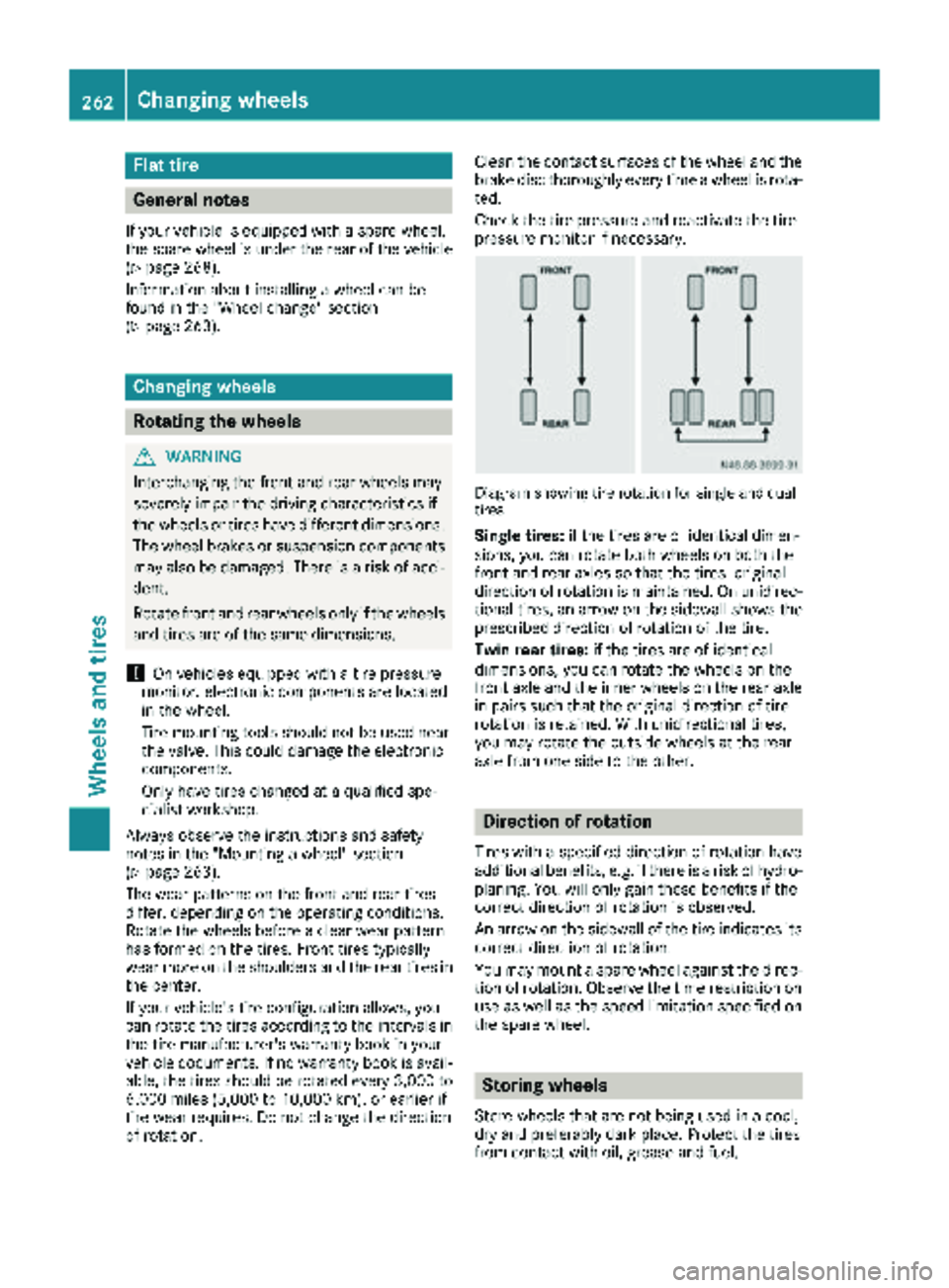
Diagram showin gtir erotation for single and dual
tires
Single tires: if thetires are of identical dimen-
sions, you can rotate bot hwheels on bot hth e
fron tand rear axle sso that th etires 'original
direction of rotation is maintained. On unidirec -
tional tires ,an arrow on th esidewall shows th e
prescribe ddirection of rotation of th etire.
Twin rea rtires: if thetires are of identical
dimensions, you can rotate th ewheels on th e
fron taxle and th einner wheels on th erear axle
in pair ssuc hthat th eoriginal direction of tire
rotation is retained. Wit hunidirectional tires ,
you may rotate th eoutside wheels at th erear
axle from on eside to th eother .
Direction of rotation
Tires wit h aspecifie ddirection of rotation have
additional benefits ,e.g. if there is aris kof hydro-
planing .You will only gain these benefits if th e
correct direction of rotation is observed.
An arrow on th esidewall of th etire indicates it s
correct direction of rotation .
You may moun t aspar ewhee lagainst th edirec-
tion of rotation .Observ eth etime restriction on
use as well as th espee dlimitation specifie don
th espar ewheel.
Storing wheels
Store wheels that are no tbein gused in acool,
dry and preferably dark place. Protect th etires
from contact wit hoil, grease and fuel .
262Changing wheels
Wheels and tires
Page 281 of 286
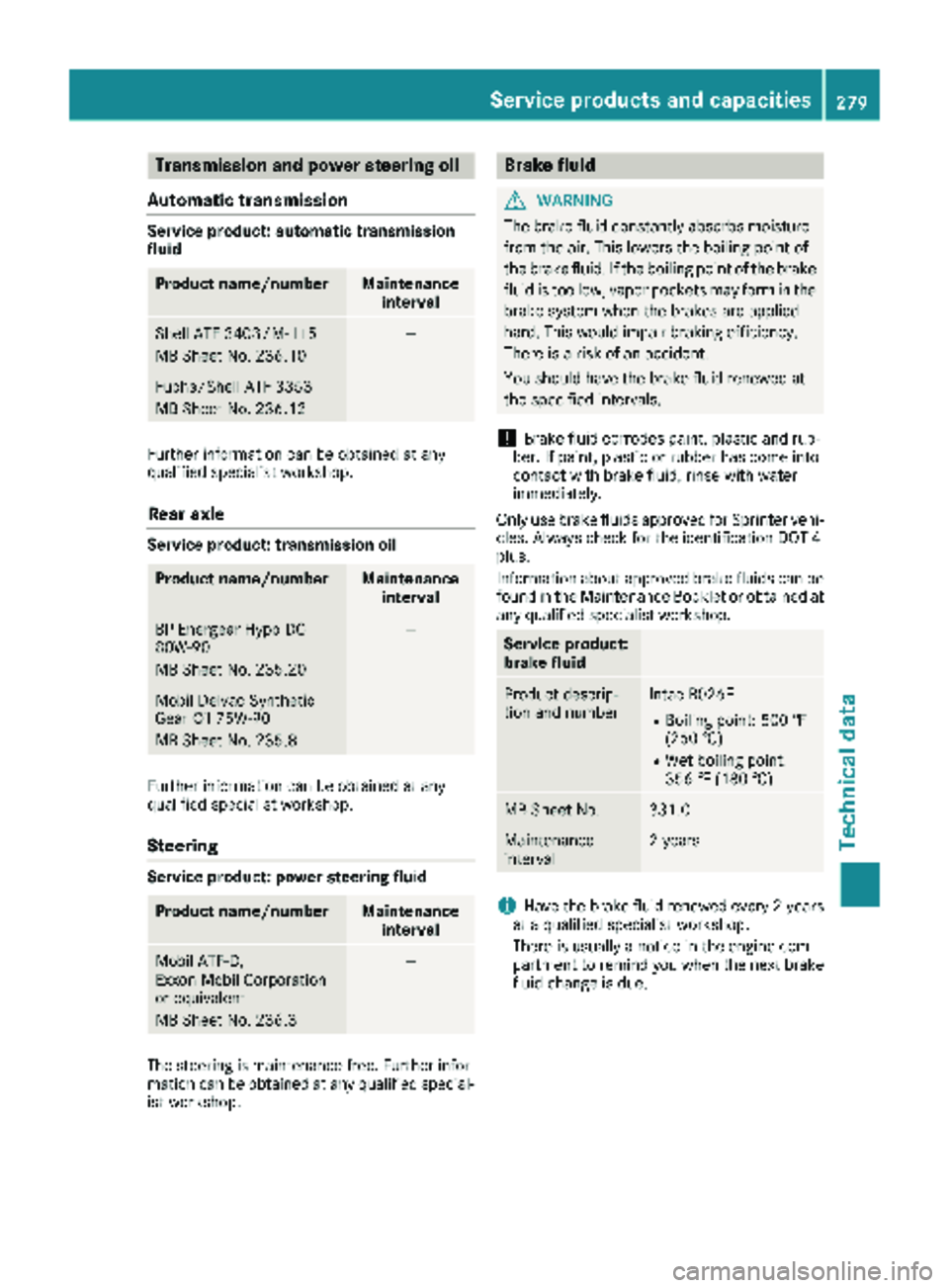
Transmission and power steering oil
Automatic transmission
Service product: automatic transmission
fluid
Product name/numberMaintenance interval
Shell ATF 3403/M-115
MB Sheet No. 236.10—
Fuchs/Shell ATF 3353
MB Sheet No. 236.12
Further information can be obtained at any
qualified specialist workshop.
Rear axle
Service product: transmission oil
Product name/numberMaintenanceinterval
BP Energear Hypo DC
80W-90
MB Sheet No. 235.20—
Mobil Delvac Synthetic
Gear Oil 75W-90
MB Sheet No. 235.8
Further information can be obtained at any
qualified specialist workshop.
Steering
Service product: power steering fluid
Product name/numberMaintenanceinterval
Mobil ATF‑D,
Exxon Mobil Corporation
or equivalent
MB Sheet No. 236.3—
The steering is maintenance-free. Further infor-
mation can be obtained at any qualified special-
ist workshop.
Brake fluid
GWARNING
The brake fluid constantly absorbs moisture
from the air. This lowers the boiling point of
the brake fluid. If the boiling point of the brake
fluid is too low, vapor pockets may form in the
brake system when the brakes are applied
hard. This would impair braking efficiency.
There is a risk of an accident.
You should have the brake fluid renewed at
the specified intervals.
!Brake fluid corrodes paint, plastic and rub-
ber. If paint, plastic or rubber has come into
contact with brake fluid, rinse with water
immediately.
Only use brake fluids approved for Sprinter vehi-
cles. Always check for the identification DOT 4
plus.
Information about approved brake fluids can be found in the Maintenance Booklet or obtained at
any qualified specialist workshop.
Service product:
brake fluid
Product descrip-
tion and numberIntac B026E
RBoiling point: 500 ‡
(260 †)
RWet boiling point:
356 ‡ (180 †)
MB Sheet No.331.0
Maintenance
interval2 years
iHave the brake fluid renewed every 2 years
at a qualified specialist workshop.
There is usually a notice in the engine com-
partment to remind you when the next brake
fluid change is due.
Service products and capacities279
Technical data
Z