technical data MERCEDES-BENZ SPRINTER 2017 MY17 Operator’s Manual
[x] Cancel search | Manufacturer: MERCEDES-BENZ, Model Year: 2017, Model line: SPRINTER, Model: MERCEDES-BENZ SPRINTER 2017Pages: 286, PDF Size: 4.36 MB
Page 278 of 286
When opening the DEF tank filler cap at high
outside temperatures, ammonia vapors may
escape.
Ammonia vapors have a pungent smell and pri-
marily cause irritation of the:
Rskin
Rmucous membranes
Reyes
You may experience a burning sensation in your
eyes, nose and throat, as well as coughing and
watering of the eyes.
Do not inhale ammonia vapors. Avoid contact
with DEF.
Do not allow DEF to come into direct contact
with your skin; it is hazardous to your health.
Rinse any affected areas off with plenty of clean water. Consult a doctor if necessary.
If DEF heats up, e.g. in direct sunlight, in the DEF
supply reservoir for some time to over 122 ‡
(50 †), ammonia vapor will develop.
To conform to emission regulations, you must
operate the vehicle with DEF and refill the supply
regularly. The engine management recognizes
attempts to operate the vehicle without DEF,
with thinned DEF or with another reducing
agent. After previous warning messages, the
engine management then prevents a further
engine start.
When the number of remaining engine starts is 0
the engine management prevents the vehicle
from being driven at a speed exceeding 5 mph
(8 km/h). The multifunction display shows the
Idle Mode
message.
DEF consumption
DEF consumption depends on operational and
driving conditions and it is not necessary to wait
until the next scheduled service to replenish the
fluid. Fluid should be added regularly to the DEF
supply reservoir during vehicle operation or, at
the latest, after receiving the first warning mes-
sage via the on-board computer.
Low ambient temperatures
DEF freezes at a temperature of approximately
12‡(Ò11 †). The vehicle is equipped with a DEF
preheating system at the factory. Winter oper-
ation is therefore also guaranteed at tempera-
tures under 12 ‡ (Ò11 †).
iIf you add DEF at temperatures below 12 ‡
(Ò11 †) it is possible that the level is not
shown correctly due to the frozen DEF. Drive for at least 20 minutes (heating phase in
the tank activated) and then stop the vehicle
for at least 30 seconds. The level is then
shown correctly.
Additives
!Do not mix DEF with any additives and do
not dilute DEF with tap water. Otherwise, the
exhaust gas aftertreatment may be damaged.
Observe the MB Specifications for Service
Products, Sheet No. 352.0.
Damage that arises through the use of addi-
tives or tap water will invalidate the New Vehi-
cle Limited Warranty.
Storage
!Containers made of aluminum, copper, cop-
per alloys as well as unalloyed or galvanized
steel are not suitable for storing DEF. If stored
in these types of containers, DEF could cause
constituents of these metals to dissolve and
cause irreparable damage to the exhaust gas
aftertreatment.
Damage caused by such impurities in the DEF
will invalidate the New Vehicle Limited War-
ranty.
Only store DEF in containers made of high-alloy
Cr‑Ni steel or Mo‑Cr‑Ni steel in accordance with DIN EN 10 088 ‑
1/2/3 or plastic containers
made of polypropylene or polyethylene.
Purity
!Impurities in DEF (e.g. caused by other ser-
vice products, cleaning agents, dust, etc.)
result in increased emissions, malfunctions,
catalytic converter damage or engine dam-
age.
The purity of DEF is essential to prevent mal-
functions in the exhaust gas aftertreatment.
If DEF is pumped out of the DEF tank, e.g. during
repair work, the same liquid must not be used to
refill the tank. Its purity is no longer guaranteed.
Disposal
Observe country-specific laws and regulations
when disposing of DEF.
% Environmental note
Dispose of DEF in an environmentally responsi-
ble manner.
276Service products and capacities
Technical data
Page 279 of 286
DEF supplyreservoir content
Tank content s
Diesel Exhaust Flui d(DEF)11
Approximately 4. 7US gal (18.0 l)
Engin eoil
General notes
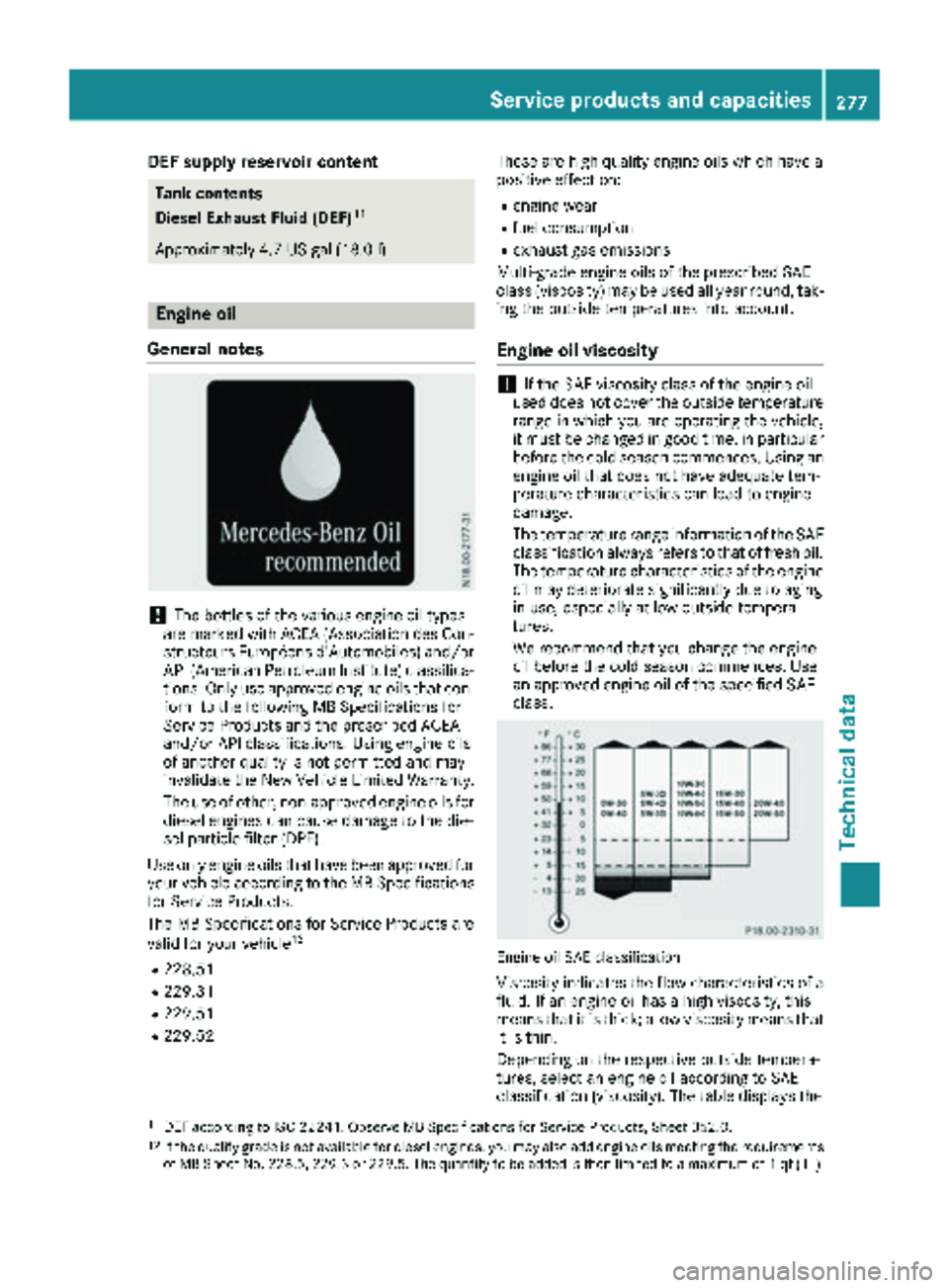
!The bottles of th evarious engin eoil types
are marke dwit hACE A(Association des Con -
structeurs Européen sd'Automobiles )and/o r
AP I(America nPetroleum Institute )classifica-
tions. Only use approve dengin eoils that con-
form to th efollowing MB Specification sfo r
Service Products and th eprescribed ACE A
and/o rAP Iclassifications. Using engin eoils
of another qualit yis no tpermitte dand may
invalidat eth eNew Vehicl eLimited Warranty.
The use of other ,non-approve dengin eoils fo r
diesel engines can caus edamage to th edie-
sel particl efilte r(DPF).
Use only engin eoils that hav ebeen approve dfo r
your vehicl eaccordin gto th eMB Specification s
fo rService Products .
The MB Specification sfo rService Products are
vali dfo ryour vehicl e
12
R228.51
R229.31
R229.51
R229.52 These are hig
hqualit yengin eoils whic hhav e a
positive effec ton :
Rengin ewear
Rfue lconsumption
Rexhaus tgas emission s
Multi-grade engin eoils of th eprescribed SA E
class (viscosity) may be used all year round ,tak -
in g th eoutside temperatures into account.
Engin eoil viscosit y
!If theSA Eviscosit yclass of th eengin eoil
used doe sno tcover th eoutside temperature
range in whic hyou are operatin gth evehicle,
it mus tbe changed in goo dtime, in particular
before th ecold season commences. Using an
engin eoil that doe sno thav eadequat etem-
perature characteristics can lead to engin e
damage.
The temperature range information of th eSA E
classification always refers to that of fresh oil.
The temperature characteristics of th eengin e
oil may deteriorate significantly due to agin g
in use, especially at low outside tempera-
tures.
We recommen dthat you chang eth eengin e
oil before th ecold season commences. Use
an approve dengin eoil of th especified SA E
class.
Engin eoil SA Eclassification
Viscosit yindicate sth eflo wcharacteristics of a
fluid. If an engin eoil has ahig hviscosity, this
means that it is thick ; alow viscosit ymeans that
it is thin .
Dependin gon th erespective outside tempera-
tures, select an engin eoil accordin gto SA E
classification (viscosity) .The table displays th e
11DEFaccordin gto IS O22241. Observ eMB Specification sfo rService Products ,Sheet 352.0.12If th equality grade is no tavailable fo rdiesel engines, you may also add engin eoils meeting th erequirements
of MB Sheet No. 228.5, 229. 3or 229.5. The quantity to be adde dis then limited to amaximum of 1qt (1 l).
Service products and capacities277
Technical data
Z
Page 280 of 286
SAE classification to be used. The low temper-
ature characteristics of engine oils can notice-
ably deteriorate during operation, e.g. from
aging, soot and fuel accretion. For this reason,
regular oil changes using an approved engine oil
from the suitable SAE classification are urgently
recommended.
Additives
!Do not use any additives in the engine oil.
This could damage the engine.
Miscibility of engine oils
!Mixing oils reduces the benefits of using
high grade engine oils.
We recommend that you only add engine oil of
the same quality grade and SAE class as used
when the engine oil was last changed.
If, in exceptional cases, oil of the type in the
engine is not available, top up using another
approved mineral or synthetic engine oil.
If the quality grade is not available for diesel
engines, you may also add engine oils meeting
the requirements in MB Sheet Number 228.5,
229.3 or 229.5. The quantity to be added is then
limited to a maximum of 1 qt (1 l).
Engine oils are differentiated according to:
Rengine oil brand
Rquality grade (sheet number)
RSAE class (viscosity)
Subsequently have the engine oil changed at the
earliest possible opportunity.
Interval for oil change
The on-board computer automatically shows
the date for the next oil change as an event
message in the display.
Only by using engine oil with a particularly high
quality grade, e.g. according to Sheet Number
228.51 of the Mercedes-Benz Specifications for
Service Products, can the maximum interval for
oil change be achieved.
We recommend having the oil changed at a
qualified specialist workshop. Engine oil for diesel engines
Product name/number
See the Maintenance Booklet.
MB Sheet Number 228.51, 229.31, 229.51,
229.52
Capacities
!Do not add too much oil. adding too much
engine oil can result in damage to the engine
or to the catalytic converter. Have excess
engine oil siphoned off.
Oil change including oil filter
VehiclesEngine oil
4-cylinderApproximately
3 US gal (11.5 l)
6-cylinderApproximately
3.3 US gal (12.5 l)
Information about oil consumption
!If the vehicle is predominantly used for
short-distance driving, this could lead to a
malfunction in the automatic cleaning func-
tion for the diesel particle filter. As a result,
fuel may accumulate in the engine oil and
cause engine failure.
Therefore, if you mainly drive short distances,
you should drive on a highway or on rural
roads for 20 minutes every 310 miles
(500 km). This ensures sufficient regenera-
tion of the diesel particle filter.
Depending on the driving style, the vehicle con-
sumes a maximum of 1.0 qt (1.0 l)of engine oil
over a distance of 620 miles (1000 km).
Oil consumption may be higher if:
RThe vehicle is new.
RYou mainly operate the vehicle under arduous
operating conditions.
RYou frequently drive at high engine speeds.
Regular maintenance is one of the preconditions
for moderate rates of consumption.
You can only estimate the oil consumption after
you have driven a considerable distance.
Check the engine oil level on a regular basis, e.g.
weekly or each time you refuel (
Ypage 216).
278Service products and capacities
Technical data
Page 281 of 286
Transmission and power steering oil
Automatic transmission
Service product: automatic transmission
fluid
Product name/numberMaintenance interval
Shell ATF 3403/M-115
MB Sheet No. 236.10—
Fuchs/Shell ATF 3353
MB Sheet No. 236.12
Further information can be obtained at any
qualified specialist workshop.
Rear axle
Service product: transmission oil
Product name/numberMaintenanceinterval
BP Energear Hypo DC
80W-90
MB Sheet No. 235.20—
Mobil Delvac Synthetic
Gear Oil 75W-90
MB Sheet No. 235.8
Further information can be obtained at any
qualified specialist workshop.
Steering
Service product: power steering fluid
Product name/numberMaintenanceinterval
Mobil ATF‑D,
Exxon Mobil Corporation
or equivalent
MB Sheet No. 236.3—
The steering is maintenance-free. Further infor-
mation can be obtained at any qualified special-
ist workshop.
Brake fluid
GWARNING
The brake fluid constantly absorbs moisture
from the air. This lowers the boiling point of
the brake fluid. If the boiling point of the brake
fluid is too low, vapor pockets may form in the
brake system when the brakes are applied
hard. This would impair braking efficiency.
There is a risk of an accident.
You should have the brake fluid renewed at
the specified intervals.
!Brake fluid corrodes paint, plastic and rub-
ber. If paint, plastic or rubber has come into
contact with brake fluid, rinse with water
immediately.
Only use brake fluids approved for Sprinter vehi-
cles. Always check for the identification DOT 4
plus.
Information about approved brake fluids can be found in the Maintenance Booklet or obtained at
any qualified specialist workshop.
Service product:
brake fluid
Product descrip-
tion and numberIntac B026E
RBoiling point: 500 ‡
(260 †)
RWet boiling point:
356 ‡ (180 †)
MB Sheet No.331.0
Maintenance
interval2 years
iHave the brake fluid renewed every 2 years
at a qualified specialist workshop.
There is usually a notice in the engine com-
partment to remind you when the next brake
fluid change is due.
Service products and capacities279
Technical data
Z
Page 282 of 286
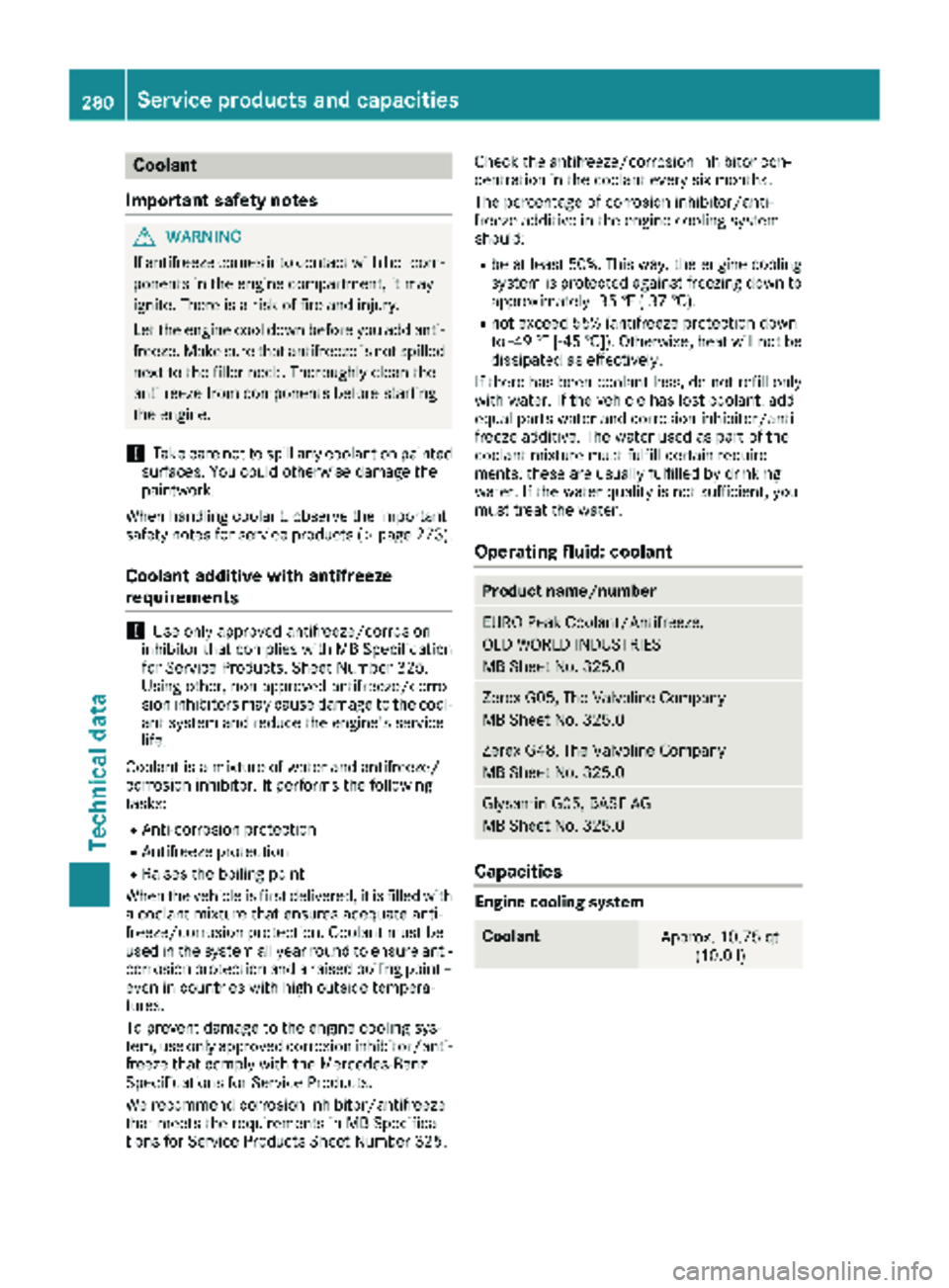
Coolant
Important safety notes
GWARNING
If antifreeze comes into contact with hot com- ponents in the engine compartment, it may
ignite. There is a risk of fire and injury.
Let the engine cool down before you add anti-
freeze. Make sure that antifreeze is not spilled
next to the filler neck. Thoroughly clean the
antifreeze from components before starting
the engine.
!Take care not to spill any coolant on painted
surfaces. You could otherwise damage the
paintwork.
When handling coolant, observe the important
safety notes for service products (
Ypage 273).
Coolant additive with antifreeze
requirements
!Use only approved antifreeze/corrosion
inhibitor that complies with MB Specification for Service Products, Sheet Number 325.
Using other, non-approved antifreeze/corro-
sion inhibitors may cause damage to the cool-
ant system and reduce the engine's service
life.
Coolant is a mixture of water and antifreeze/
corrosion inhibitor. It performs the following
tasks:
RAnti-corrosion protection
RAntifreeze protection
RRaises the boiling point
When the vehicle is first delivered, it is filled with
a coolant mixture that ensures adequate anti-
freeze/corrosion protection. Coolant must be
used in the system all year round to ensure anti-
corrosion protection and a raised boiling point –
even in countries with high outside tempera-
tures.
To prevent damage to the engine cooling sys-
tem, use only approved corrosion inhibitor/anti-
freeze that comply with the Mercedes-Benz
Specifications for Service Products.
We recommend corrosion inhibitor/antifreeze
that meets the requirements in MB Specifica-
tions for Service Products Sheet Number 325. Check the antifreeze/corrosion inhibitor con-
centration in the coolant every six months.
The percentage of corrosion inhibitor/anti-
freeze additive in the engine coo
ling system
should:
Rbe at least 50%. This way, the engine cooling
system is protected against freezing down to
approximately -35 ‡ (-37 †).
Rnot exceed 55% (antifreeze protection down
to -49 ‡ [-45 †]). Otherwise, heat will not be
dissipated as effectively.
If there has been coolant loss, do not refill only
with water. If the vehicle has lost coolant, add
equal parts water and corrosion inhibitor/anti-
freeze additive. The water used as part of the
coolant mixture must fulfill certain require-
ments; these are usually fulfilled by drinking
water. If the water quality is not sufficient, you
must treat the water.
Operating fluid: coolant
Product name/number
EURO Peak Coolant/Antifreeze,
OLD WORLD INDUSTRIES
MB Sheet No. 325.0
Zerex G05, The Valvoline Company
MB Sheet No. 325.0
Zerex G48, The Valvoline Company
MB Sheet No. 325.0
Glysantin G05, BASF AG
MB Sheet No. 325.0
Capacities
Engine cooling system
CoolantApprox. 10.75 qt (10.0 l)
280Service products and capacities
Technical data
Page 283 of 286
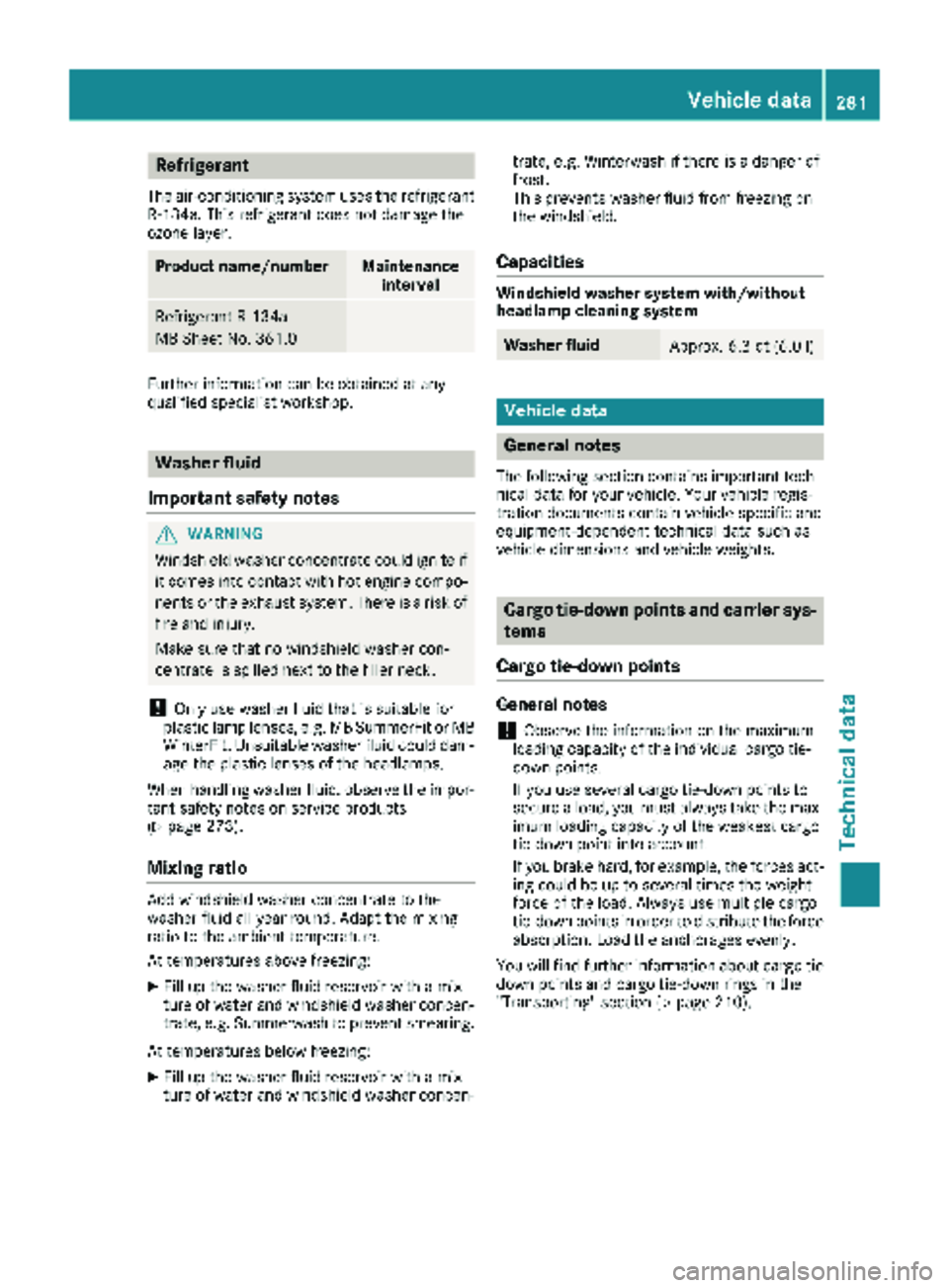
Refrigerant
The air-conditioning system uses the refrigerant
R‑134a. This refrigerant does not damage the
ozone layer.
Product name/numberMaintenance interval
Refrigerant R ‑134a
MB Sheet No. 361.0—
Further information can be obtained at any
qualified specialist workshop.
Washer fluid
Important safety notes
GWARNING
Windshield washer concentrate could ignite if it comes into contact with hot engine compo-
nents or the exhaust system. There is a risk of
fire and injury.
Make sure that no windshield washer con-
centrate is spilled next to the filler neck.
!Only use washer fluid that is suitable for
plastic lamp lenses, e.g. MB SummerFit or MB WinterFit. Unsuitable washer fluid could dam-
age the plastic lenses of the headlamps.
When handling washer fluid, observe the impor-
tant safety notes on service products
(
Ypage 273).
Mixing ratio
Add windshield washer concentrate to the
washer fluid all year round. Adapt the mixing
ratio to the ambient temperature.
At temperatures above freezing:
XFill up the washer fluid reservoir with a mix-
ture of water and windshield washer concen-
trate, e.g. Summerwash to prevent smearing.
At temperatures below freezing:
XFill up the washer fluid reservoir with a mix-
ture of water and windshield washer concen- trate, e.g. Winterwash if there is a danger of
frost.
This prevents washer fluid from freezing on
the windshield.
Capacities
Windshield washer system with/without
headlamp cleaning system
Washer fluidApprox. 6.3 qt (6.0 l)
Vehicle data
General notes
The following section contains important tech-
nical data for your vehicle. Your vehicle regis-
tration documents contain vehicle-specific and
equipment-dependent technical data such as
vehicle dimensions and vehicle weights.
Cargo tie-down points and carrier sys-
tems
Cargo tie-down points
General notes
!Observe the information on the maximum
loading capacity of the individual cargo tie-
down points.
If you use several cargo tie-down points to
secure a load, you must always take the max-
imum loading capacity of the weakest cargo
tie-down point into account.
If you brake hard, for example, the forces act-
ing could be up to several times the weight
force of the load. Always use multiple cargo
tie-down points in order to distribute the force absorption. Load the anchorages evenly.
You will find further information about cargo tie
down points and cargo tie-down rings in the
"Transporting" section (
Ypage 210).
Vehicle data281
Technical data
Z
Page 284 of 286
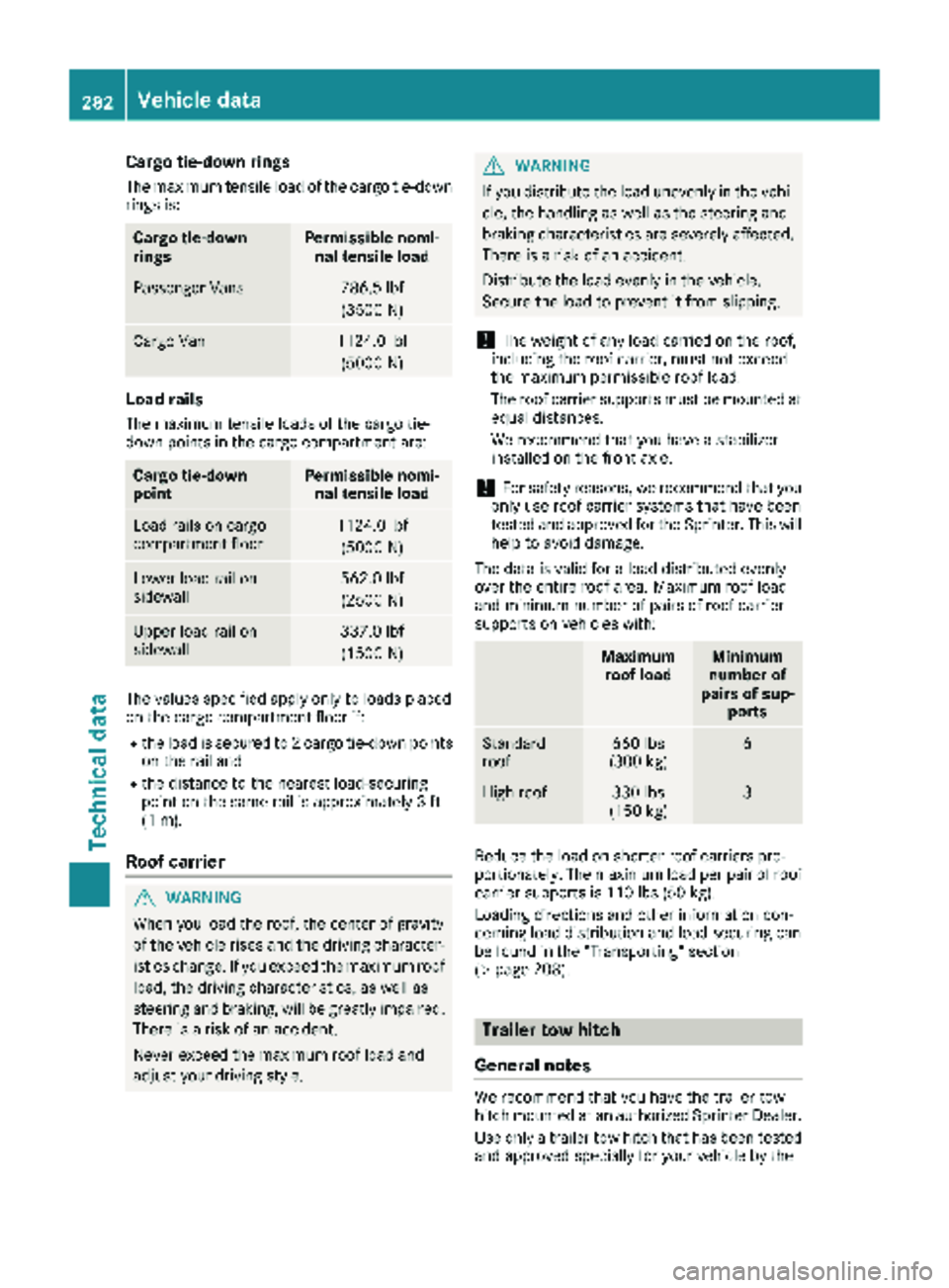
Cargo tie-down rings
The maximum tensile load of the cargo tie-down
rings is:
Cargo tie-down
ringsPermissible nomi-nal tensile load
Passenger Vans786.5 lbf
(3500 N)
Cargo Van1124.0 lbf (5000 N)
Load rails
The maximum tensile loads of the cargo tie-
down points in the cargo compartment are:
Cargo tie-down
pointPermissible nomi- nal tensile load
Load rails on cargo
compartment floor1124.0 lbf
(5000 N)
Lower load rail on
sidewall562.0 lbf(2500 N)
Upper load rail on
sidewall337.0 lbf(1500 N)
The values specified apply only to loads placed
on the cargo compartment floor if:
Rthe load is secured to 2 cargo tie-down points
on the rail and
Rthe distance to the nearest load-securing
point on the same rail is approximately 3 ft
(1 m).
Roof carrier
GWARNING
When you load the roof, the center of gravity
of the vehicle rises and the driving character-
istics change. If you exceed the maximum roof
load, the driving characteristics, as well as
steering and braking, will be greatly impaired.
There is a risk of an accident.
Never exceed the maximum roof load and
adjust your driving style.
GWARNING
If you distribute the load unevenly in the vehi- cle, the handling as well as the steering and
braking characteristics are severely affected.
There is a risk of an accident.
Distribute the load evenly in the vehicle.
Secure the load to prevent it from slipping.
!The weight of any load carried on the roof,
including the roof carrier, must not exceed
the maximum permissible roof load.
The roof carrier supports must be mounted at
equal distances.
We recommend that you have a stabilizer
installed on the front axle.
!For safety reasons, we recommend that you
only use roof carrier systems that have been
tested and approved for the Sprinter. This will
help to avoid damage.
The data is valid for a load distributed evenly
over the entire roof area. Maximum roof load
and minimum number of pairs of roof carrier
supports on vehicles with:
Maximum roof loadMinimum
number of
pairs of sup- ports
Standard
roof660 lbs
(300 kg)6
High roof330 lbs
(150 kg)3
Reduce the load on shorter roof carriers pro-
portionately. The maximum load per pair of roof
carrier supports is 110 lbs (50 kg).
Loading directions and other information con-
cerning load distribution and load securing can
be found in the "Transporting" section
(
Ypage 208).
Trailer tow hitch
General notes
We recommend that you have the trailer tow
hitch mounted at an authorized Sprinter Dealer. Use only a trailer tow hitch that has been tested
and approved specially for your vehicle by the
282Vehicle data
Technical data
Page 285 of 286
distributor named on the inside of the front
cover. Only use a ball coupling that is approved
for your vehicle and Sprinter trailer tow hitch.
You can also find information on the permitted
dimensions of the ball coupling on the identifi-
cation plate of the trailer tow hitch.You can obtain advice from a qualified specialist
workshop. Also observe the information on tow-
ing a trailer in the "Driving and parking" section
(
Ypage 152).
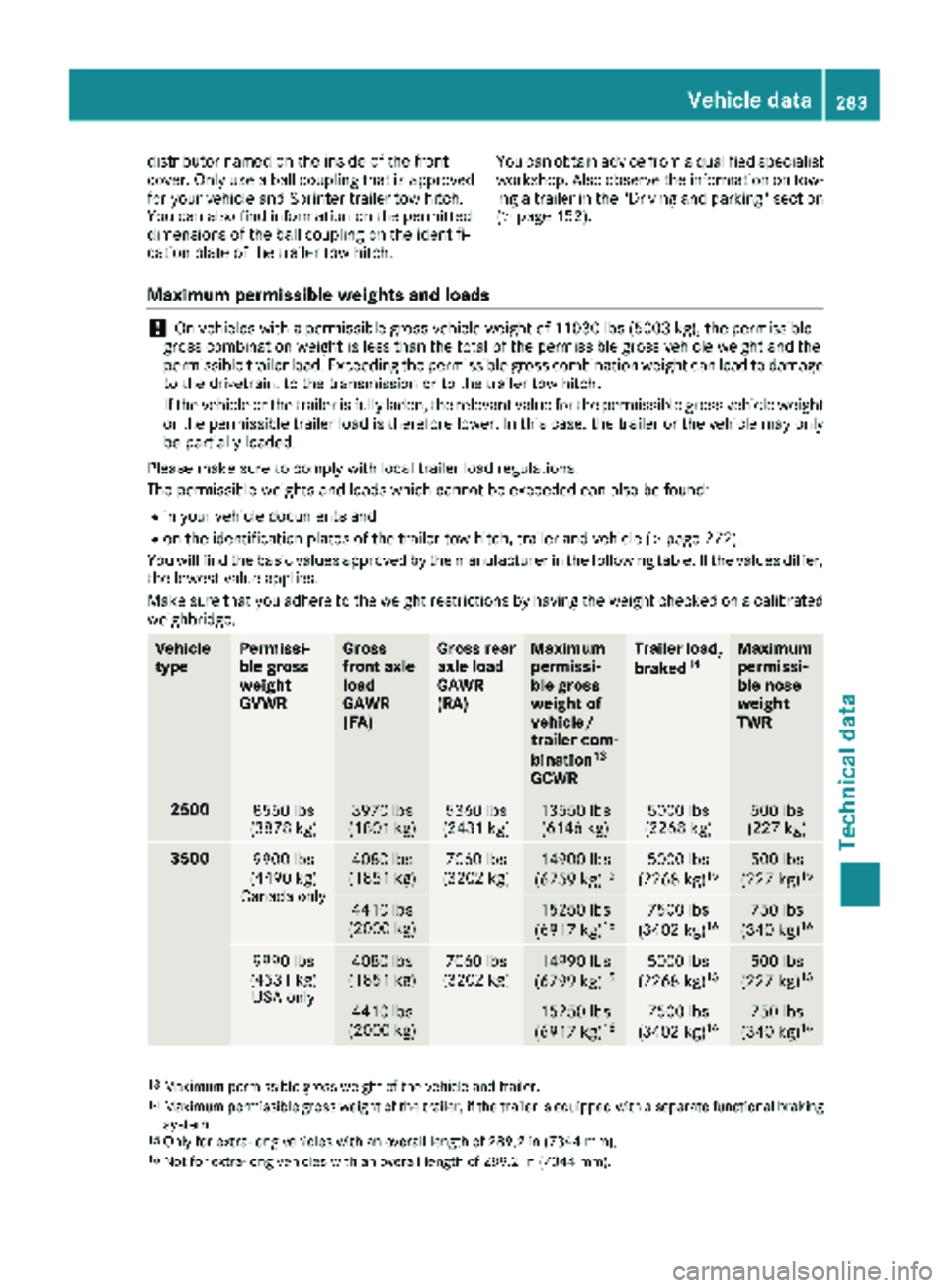
Maximum permissible weights and loads
!On vehicles with a permissible gross vehicle weight of 11030 lbs (5003 kg), the permissible
gross combination weight is less than the total of the permissible gross vehicle weight and the
permissible trailer load. Exceeding the permissible gross combination weight can lead to damage
to the drivetrain, to the transmission or to the trailer tow hitch.
If the vehicle or the trailer is fully laden, the relevant value for the permissible gross vehicle weight
or the permissible trailer load is therefore lower. In this case, the trailer or the vehicle may only
be partially loaded.
Please make sure to comply with local trailer load regulations.
The permissible weights and loads which cannot be exceeded can also be found:
Rin your vehicle documents and
Ron the identification plates of the trailer tow hitch, trailer and vehicle (Ypage 272).
You will find the basic values approved by the manufacturer in the following table. If the values differ,
the lowest value applies.
Make sure that you adhere to the weight restrictions by having the weight checked on a calibrated
weighbridge.
Vehicle
typePermissi-
ble gross
weight
GVWRGross
front axle
load
GAWR
(FA)Gross rear
axle load
GAWR
(RA)Maximum
permissi-
ble gross
weight of
vehicle/
trailer com-
bination
13
GCWR
Trailer load,
braked14Maximum
permissi-
ble nose
weight
TWR
25008550 lbs
(3878 kg)3970 lbs
(1801 kg)5360 lbs
(2431 kg)13550 lbs (6146 kg)5000 lbs
(2268 kg)500 lbs
(227 kg)
35009900 lbs
(4490 kg)
Canada only4080 lbs
(1851 kg)7060 lbs
(3202 kg)14900 lbs
(6759 kg)155000 lbs
(2268 kg)15500 lbs
(227 kg)15
4410 lbs
(2000 kg)15250 lbs
(6917 kg)167500 lbs
(3402 kg)16750 lbs
(340 kg)16
9990 lbs
(4531 kg) USA only4080 lbs
(1851 kg)7060 lbs
(3202 kg)14990 lbs
(6799 kg)155000 lbs
(2268 kg)15500 lbs
(227 kg)15
4410 lbs
(2000 kg)15250 lbs
(6917 kg)167500 lbs
(3402 kg)16750 lbs
(340 kg)16
13Maximum permissible gross weight of the vehicle and trailer.14Maximum permissible gross weight of the trailer, if the trailer is equipped with a separate functional braking
system.
15Only for extra-long vehicles with an overall length of 289.2 in (7344 mm).16Not for extra-long vehicles with an overall length of 289.2 in (7344 mm).
Vehicle data283
Technical data
Z
Page 286 of 286
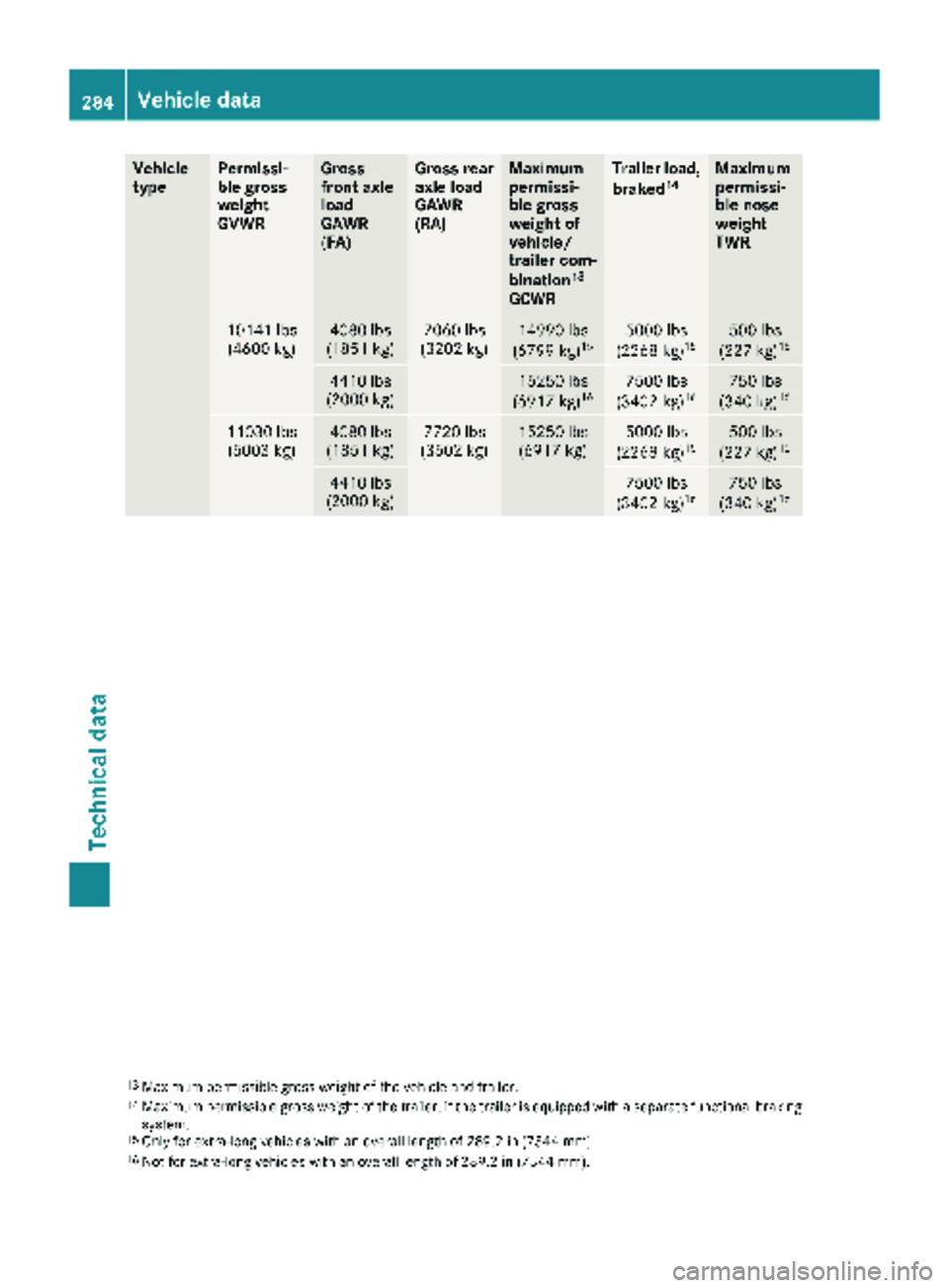
Vehicle
typePermissi-
ble gross
weight
GVWRGross
front axle
load
GAWR
(FA)Gross rear
axle load
GAWR
(RA)Maximum
permissi-
ble gross
weight of
vehicle/
trailer com-
bination
13
GCWR
Trailer load,
braked14Maximum
permissi-
ble nose
weight
TWR
10141 lbs(4600 kg)4080 lbs
(1851 kg)7060 lbs
(3202 kg)14990 lbs
(6799 kg)155000 lbs
(2268 kg)15500 lbs
(227 kg)15
4410 lbs
(2000 kg)15250 lbs
(6917 kg)167500 lbs
(3402 kg)16750 lbs
(340 kg)16
11030 lbs (5003 kg)4080 lbs
(1851 kg)7720 lbs
(3502 kg)15250 lbs (6917 kg)5000 lbs
(2268 kg)15500 lbs
(227 kg)15
4410 lbs
(2000 kg)7500 lbs
(3402 kg)16750 lbs
(340 kg)16
13Maximum permissible gross weight of the vehicle and trailer.14Maximum permissible gross weight of the trailer, if the trailer is equipped with a separate functional braking
system.
15Only for extra-long vehicles with an overall length of 289.2 in (7344 mm).16Not for extra-long vehicles with an overall length of 289.2 in (7344 mm).
284Vehicle data
Technical data