air filter MERCEDES-BENZ SPRINTER 2017 MY17 Operator’s Manual
[x] Cancel search | Manufacturer: MERCEDES-BENZ, Model Year: 2017, Model line: SPRINTER, Model: MERCEDES-BENZ SPRINTER 2017Pages: 286, PDF Size: 4.36 MB
Page 6 of 286
1, 2, 3 ...
4ETS (Electronic Traction System).... 55
12 V socket ........................................ 206
A
ABS (Anti-lock Braking System)
Display message ............................ 178
Function/notes ................................ 53
Important safety notes .................... 53
Indicator lamp ................................ 191
Access step in the bumper
Cleaning .........................................2 33
Activating/deactivating cooling
with air dehumidification ................. 101
Activating/deactivating the roof
ventilator ...........................................1 15
Adaptive Brake Assist
Function/notes .............................1 40
ADAPTIVE ESP
®
see ESP®(Electronic Stability Program)
Add-on equipment ............................... 28
Additional indicators
Replacing bulbs ............................... 89
Replacing bulbs (roof) ......................9 2
Additives
Diesel ............................................ 274
Engine oil ...................................... .278
Adjusting the headlamp range ........... 82
ADR (working speed governor) ........151
Air bags
Deployment ..................................... 46
Front air bag (driver, front
passenger) ....................................... 45
Important safety notes .................... 44
Introduction ..................................... 44
Side impact air bag .......................... 45
Window curtain air bag .................... 46
Air filter
Indicator lamp ................................ 197
Air pressure
see Tire pressure
Air vents
Adjusting for the passenger com-
partment ........................................ 105
Adjusting on the roof ..................... 105
Importa nt sa
fety notes .................. 104 Setting the center air vents ........... 104
Setting the side air vents ...............1
05
Air vents
see Air vents
Air-conditioning system
Refrigerant ..................................... 281
see Climate control
Air-recirculation mode
Important safety notes .................. 103
Switching on/off ........................... 103
Alarm system
see ATA (Anti-Theft Alarm system)
All-wheel drive
Engaging/disengaging ................... 145
Important safety notes .................. 144
LOW RANGE transmission ratio ..... 145
Anti-lock Braking System
see ABS (Anti-lock Braking System)
Anti-lock braking system
see ABS (Anti-lock Braking System)
Anti-Theft Alarm system
see ATA (Anti-Theft Alarm system)
Anti-theft system
Interior motion sensor ..................... 58
Armrests .............................................. 76
Ashtray ............................................... 205
ASR (acceleration skid control)
Activating/deactivating ................... 54
Display message ............................ 179
Function/notes ................................ 54
Important safety notes .................... 54
Indicator lamp ................................ 191
ATA (Anti-Theft Alarm system)
Activating/deactivating ................... 57
Switching off the alarm .................... 57
Authorized workshop
see Qualified specialist workshop
Automatic car wash (care) ...............229
Automatic climate control
see Climate control
Automatic headlamp mode ................ 81
Automatic locking ............................... 64
Automatic transmission
Accelerator pedal position ............. 123
Changing gear ............................... 122
Changing gear yourself .................. 122
Driving tips .................................... 123
4Index
Page 9 of 286
Central lockingAutomatic locking ............................ 64
Important safety notes .................... 63
Locking/unlocking (buttons) ........... 63
Locking/unlocking (SmartKey) ........ 59
Locking/unlocking manually ............ 63
Central locking system
see Central locking
Change of address .............................. 24
Change of ownership .......................... 24
Changing bulbs
Additional indicators (roof) .............. 92
Additional turn signals ..................... 89
Backup lamp (Chassis Cab) ............. 91
Backup lamps .................................. 90
Bi-Xenon bulbs ................................. 87
Brake lamps ..................................... 90
Brake lamps (Chassis Cab) .............. 91
Cornering lamps .............................. 88
Courtesy lights ................................. 92
Daytime running lamps (halogen
headlamps) ...................................... 88
Display message ............................ 182
Front interior light ............................ 93
High-beam headlamps ..................... 88
Interior light ..................................... 93
Interior lighting ................................ 93
License plate lamp ........................... 91
License plate lamp (Chassis Cab) .... 91
Low-beam headlamps ...................... 88
Overview of lamp types (front
bulbs) ............................................... 87
Overview of lamp types (rear
bulbs, Cargo Van/Passenger
Van) ................................................. 90
Overview of lamp types (rear
bulbs, Chassis Cab) ......................... 91
Parking lamps .................................. 88
Perimeter lamp .......................... 91, 92
Rear fog lamp .................................. 90
Rear fog lamp (Chassis Cab) ............ 91
Rear interior light ............................. 93
Standing lamps (rear, Chassis
Cab) ................................................. 91
Standing lamps (rear) ...................... 90
Tail lamps ........................................ 90
T
ail lamps (Chassis Cab) .................. 91
Turn signals (front) ........................... 89 Turn signals (rear, Chassis Cab) ....... 91
Turn signals (rear) ............................ 90
Warning and indicator lamps ......... 198
see Replacing bulbs
Changing bulbs
see Replacing bulbs
Checklist
Before driving off-road ................... 136
Child
Restraint system .............................. 49
Child seat
Forward-facing restraint system ...... 51
LATCH-type (ISOFIX) child seat
anchors ............................................ 50
On the front-passenger seat ............ 51
Rearward-facing restraint system .... 51
Top Tether ....................................... 50
Child-proof locks
Important safety notes .................... 52
Rear door ......................................... 52
Children
Special seat belt retractor ............... 48
Children in the vehicle
Important safety notes .................... 47
Chock ................................................. 129
Cigarette lighter ................................ 205
Cleaning
Mirror turn signal ........................... 232
Trailer tow hitch ............................. 233
Cleaning
see Care
Climate control
Air conditioning in the rear com-
partment ........................................ 100
Air-conditioning system ................... 98
Auxiliary heating ............................ 105
Checking/cleaning the air filter
(rear-compartment air condition-
ing) ................................................ 221
Cooling with air dehumidification .. 101
Defrosting the windows ................. 102
Heating ............................................ 97
Heating in the rear compartment ..... 99
Important safety notes .................... 97
Operating the cargo compartment
air vents ......................................... 115
Overview of systems ........................ 97
Index7
Page 18 of 286
R
Radiator cover..................................... 29
Radio
Changing stations (vehicles with
steering wheel buttons) ................. 164
see separate operating instructions
Radio-wave reception/transmis-
sion in the vehicle
Declaration of conformity ................ 27
Rain and light sensor
Setting the sensitivity (vehicles
with steering wheel buttons) ......... 170
Windshield wiper .............................. 94
Range (vehicles with steering
wheel buttons) .................................. 171
Rear bench seat
Installing/removing (Passenger
Van) ................................................. 75
Stowage compartment (crewcab) .. 203
Rear compartment
Activating/deactivating climate
control ........................................... 100
Setting the air vents ...................... 105
Rear door
Child-proof locks .............................. 52
Important safety notes .................... 67
Opening/closing .............................. 67
Opening/closing from inside ........... 69
Rear fog lamp
Replacing bulbs ............................... 90
Switching on/off .............................. 81
Rear fog lamp (Chassis Cab)
Replacing bulbs ............................... 91
Rear interior light
Replacing bulbs ............................... 93
Rear lamps
see Lights
Rear rack
Notes ............................................. 212
Rear view camera
Cleaning instructions ..................... 232
Important safety notes .................. 151
Switching on .................................. 151
Rear window defroster
Problem (malfunction) ................... 103
Switching on/off ........................... 103 Rear window wiper
............................. 95
Switching on/off .............................. 95
Rear-compartment air-condition-
ing system
see Climate control
Rear-compartment heating
see Climate control
Rear-view mirror
Anti-glare mode ............................... 78
Refilling
DEF filler neck ............................... 126
Important safety notes (Diesel
Exhaust Fluid – DEF) ...................... 126
Refilling procedure (Diesel
Exhaust Flu id – DEF) ...................... 126
Re
frigerant ......................................... 281
Refueling
Fuel filler flap ................................. 125
Fuel gauge ..................................... 159
Important safety notes (fuel) ......... 124
Refueling procedure (fuel) ............. 125
see Fuel
Releasing the parking lock man-
ually (automatic transmission) ........ 124
Remote control
Changing the operating duration
(auxiliary heating) .......................... 109
Replacing the battery (auxiliary
heating ) ........................................ 110
Switching on/off (auxiliary heat-
ing) ................................................ 109
Synchronizing (auxiliary heating) ... 109
Replacing bulbs
Important safety notes .................... 87
Replacing the battery (auxiliary
heating remote control) .................... 110
Replacing the fuel filter .................... 198
Reporting safety defects .................... 28
Rescue card ......................................... 30
Restraint system
Introduction ..................................... 40
Warning lamp (function) .......... 40, 194
Reverse warning feature .................. 119
Roadside Assistance (breakdown) .... 24
Roof carrier
Maximum payload .......................... 282
Notes ............................................. 212
16Index
Page 23 of 286
Trip computer (on-board com-
puter).................................................. 171
Trip meter
see Trip odometer
Trip odometer
Display (vehicles with steering
wheel buttons) ............................... 164
Display (vehicles without steering
wheel buttons) ............................... 160
Resetting ....................................... 159
see Trip computer (on-board computer)
Turn signals
Replacing bulbs (front) ..................... 89
Replacing bulbs (rear) ...................... 90
Switching on/off .............................. 82
Turn signals (Chassis Cab)
Replacing bulbs (rear) ...................... 91
Twin front-passenger seat
Stowage compartment .................. 202
Two-way radios
Type approval/frequency .............. 271
TWR (Tongue Weight Rating) (defi-
nition) ................................................. 261
U
Unlocking
From inside the vehicle (central
unlocking button) ............................. 63
USB port ............................................. 207
V
Vehicle
Data acquisition ............................... 30
Display message ............................ 189
Electronics ..................................... 271
Equipment ....................................... 23
Individual settings (vehicles with
steering wheel buttons) ................. 165
Limited Warranty ............................. 23
Loading .......................................... 254
Locking (SmartKey) .......................... 59
Lowering ........................................ 267
Maintenance .................................... 24
Operating safety .............................. 26
Parking for a long period ................ 129
Pulling away ................................... 119 Raising ........................................... 263
Registration ..................................... 28
Reporting problems ......................... 28
Securing from rolling away ............ 127
Towing away .................................. 239
Transporting .................................. 242
Unlocking (SmartKey) ...................... 59
Vehicle battery
see Battery (vehicle)
Vehicle bodies ..................................... 28
Body/equipment mounting direc-
tives for trucks ................................. 28
Vehicle data ....................................... 281
Vehicle identification number .......... 272
Vehicle identification plate .............. 272
Vehicle tool kit .................................. 236
Voltage supply
Fuses ............................................. 242
W
WarningStickers ........................................... 25
Warning and indicator lamp
Power assistance for the steering .. 199
Warning and indicator lamps
Brakes ........................................... 192
Check Engine ................................. 196
Coolant .......................................... 195
Diesel Exhaust Fluid (DEF) ............. 193
Electrical step ................................ 199
ESP
®.............................................. 190
ESP®function ................................ 194
Overview .......................................... 34
Seat belt ........................................ 198
Warning lamp .................................... 237
Warning triangle ................................ 237
Warning- and indicator lamps
ABS ................................................ 191
Air filter .......................................... 197
ASR ................................................ 190
BAS ................................................ 191
Battery charge ............................... 194
Brake wear .................................... 194
Bulbs .............................................. 198
Doors ............................................. 198
Engine oil level ............................... 195
Preglow .......................................... 197
Index21
Page 37 of 286
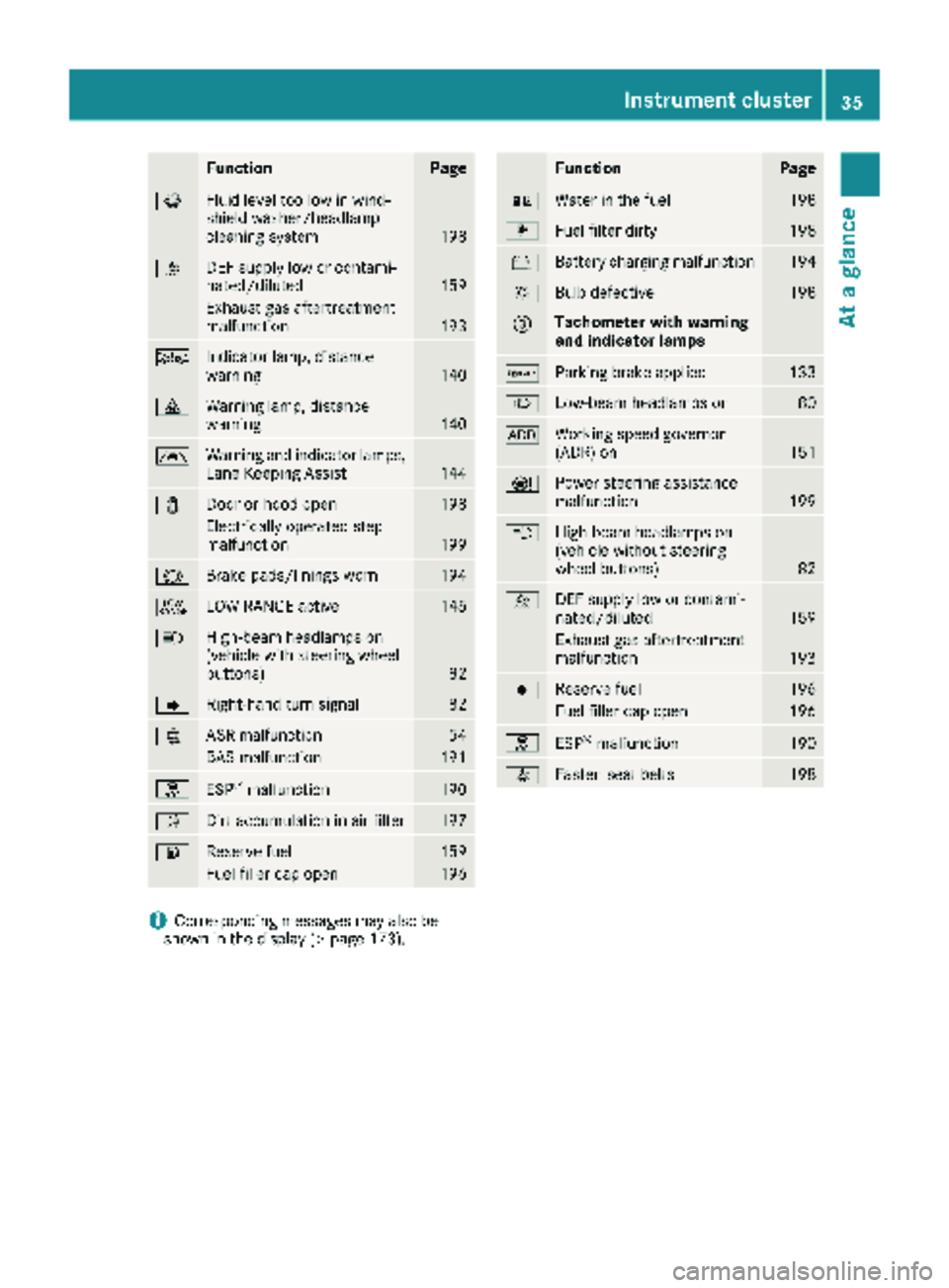
FunctionPage
¦Fluid level too low in wind-
shield washer/headlamp
cleaning system
198
åDEF supply low or contami-
nated/diluted159
Exhaust gas aftertreatment
malfunction193
ÄIndicator lamp, distance
warning140
·Warning lamp, distance
warning140
ÃWarning and indicator lamps,
Lane Keeping Assist144
1Door or hood open198
Electrically operated step
malfunction199
#Brake pads/linings worn194
+LOW RANGE active145
KHigh-beam headlamps on
(vehicle with steering wheel
buttons)
82
JRight-hand turn signal82
:ASR malfunction54
BAS malfunction191
hESP®malfunction190
ÈDirt accumulation in air filter197
6Reserve fuel159
Fuel filler cap open196
FunctionPage
:Water in the fuel198
mFuel filter dirty198
#Battery charging malfunction194
bBulb defective198
=Tachometer with warning
and indicator lamps
cParking brake applied133
LLow-beam headlamps on80
KWorking speed governor
(ADR) on151
ÐPower steering assistance
malfunction199
KHigh-beam headlamps on
(vehicle without steering
wheel buttons)
82
åDEF supply low or contami-
nated/diluted159
Exhaust gas aftertreatment
malfunction193
|Reserve fuel196
Fuel filler cap open196
hESP®malfunction190
7Fasten seat belts198
iCorresponding messages may also be
shown in the display (Ypage 173).
Instrument cluster35
At a glance
Page 88 of 286
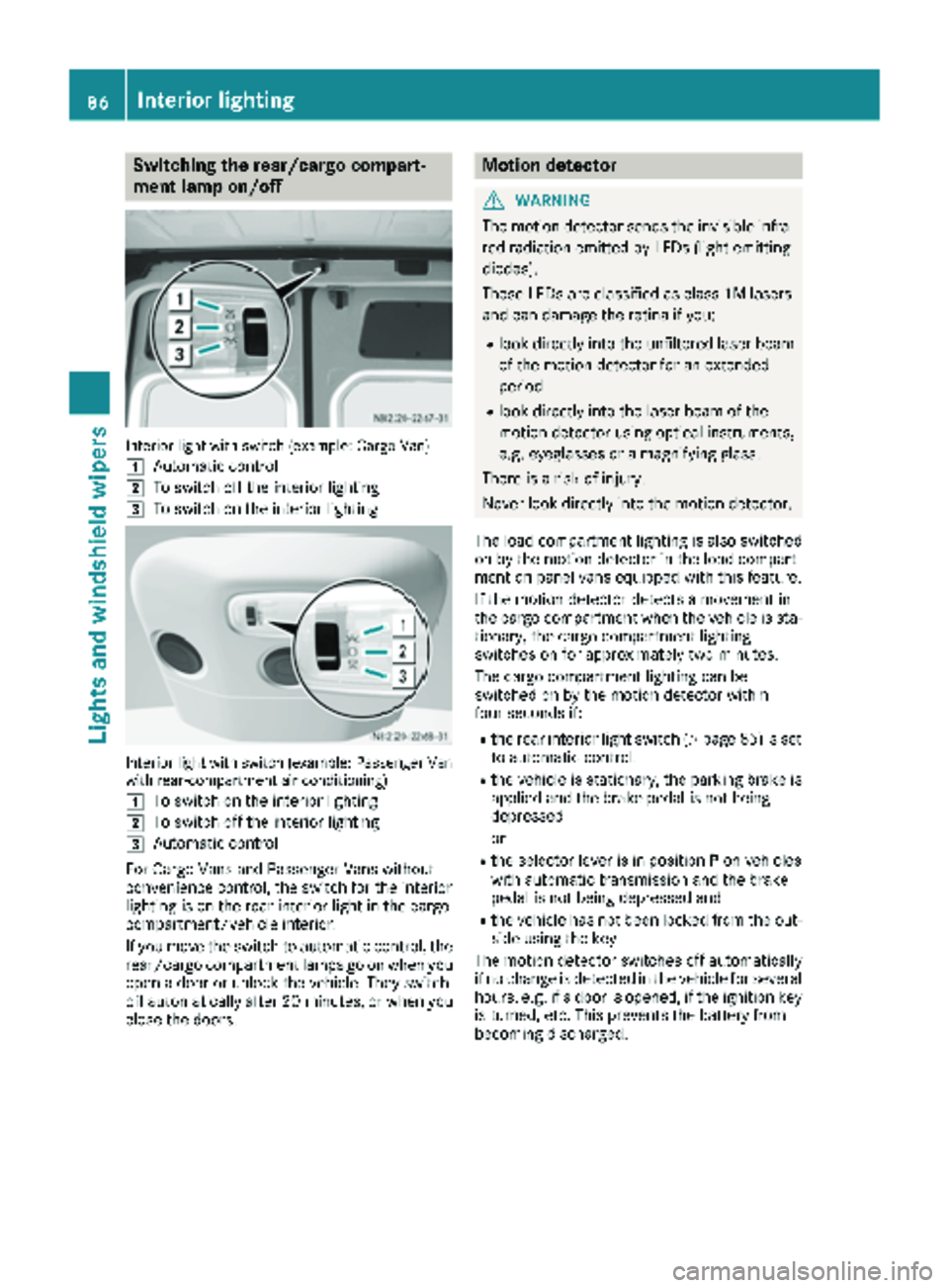
Switching the rear/cargo compart-
ment lamp on/off
Interior light with switch (example: Cargo Van)
1
Automatic control
2To switch off the interior lighting
3To switch on the interior lighting
Interior light with switch (example: Passenger Van
with rear-compartment air conditioning)
1
To switch on the interior lighting
2To switch off the interior lighting
3Automatic control
For Cargo Vans and Passenger Vans without
convenience control, the switch for the interior
lighting is on the rear interior light in the cargo
compartment/vehicle interior.
If you move the switch to automatic control, the
rear/cargo compartment lamps go on when you
open a door or unlock the vehicle. They switch
off automatically after 20 minutes, or when you
close the doors.
Motion detector
GWARNING
The motion detector sends the invisible infra- red radiation emitted by LEDs (light emitting
diodes).
These LEDs are classified as class 1M lasers
and can damage the retina if you:
Rlook directly into the unfiltered laser beam
of the motion detector for an extended
period
Rlook directly into the laser beam of the
motion detector using optical instruments,
e.g. eyeglasses or a magnifying glass.
There is a risk of injury.
Never look directly into the motion detector.
The load compartment lighting is also switched
on by the motion detector in the load compart-
ment on panel vans equipped with this feature.
If the motion detector detects a movement in
the cargo compartment when the vehicle is sta-
tionary, the cargo compartment lighting
switches on for approximately two minutes.
The cargo compartment lighting can be
switched on by the motion detector within
four seconds if:
Rthe rear interior light switch (Ypage 85) is set
to automatic control.
Rthe vehicle is stationary, the parking brake is
applied and the brake pedal is not being
depressed
or
Rthe selector lever is in position Pon vehicles
with automatic transmission and the brake
pedal is not being depressed and
Rthe vehicle has not been locked from the out-
side using the key
The motion detector switches off automatically
if no change is detected in the vehicle for several
hours, e.g. if a door is opened, if the ignition key
is turned, etc. This prevents the battery from
becoming discharged.
86Interior lighting
Lights and windshield wipers
Page 99 of 286
Useful information
This Operator's Manual describes all models as
well as standard and optional equipment of your
vehicle that were available at the time of going
to print. Country-specific variations are possi-
ble. Note that your vehicle may not be equipped
with all of the described functions. This also
applies to systems and functions relevant to
safety.
Read the information on qualified specialist
workshops (
Ypage 27).
Overview of climate control systems
Important safety notes
Observe the recommended settings on the fol-
lowing pages. Otherwise, the windows could fog
up.
Climate control regulates the temperature and
the humidity in the vehicle interior and filters
undesirable substances from the air.Climate control is only operational when the
engine is running. The system only functions
optimally when the side windows are closed.
iVentilate the vehicle for a brief period during
warm weather. In order to cool the vehicle
more rapidly, switch climate control to air-
recirculation mode briefly. This will speed up
the cooling process and the desired interior
temperature will be reached more quickly.
iThe integrated filter can filter out most par-
ticles of dust and completely filters out pollen.
A clogged filter reduces the airflow into the
vehicle interior. For this reason, you should
always observe the interval for replacing the
filter, which is specified in the Maintenance
Booklet. As it depends on environmental con-
ditions, e.g. heavy air pollution, the interval
may be shorter than that stated in the Main-
tenance Booklet.
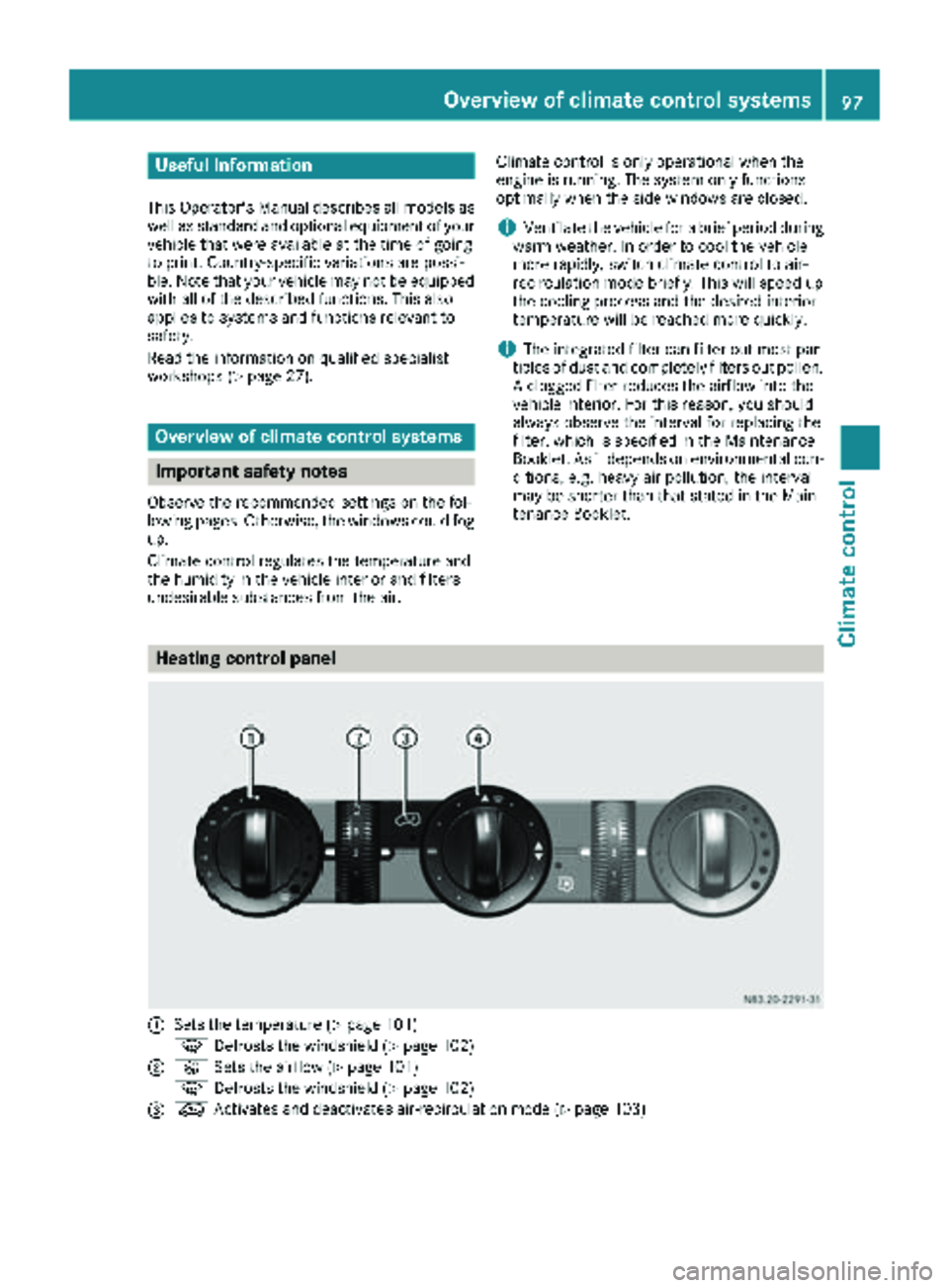
Heating control panel
:Sets the temperature (Ypage 101)
z Defrosts the windshield (
Ypage 102)
;KSets the airflow (Ypage 101)
z Defrosts the windshield (
Ypage 102)
=eActivates and deactivates air-recirculation mode (Ypage 103)
Overview of climate control systems97
Climate control
Page 199 of 286
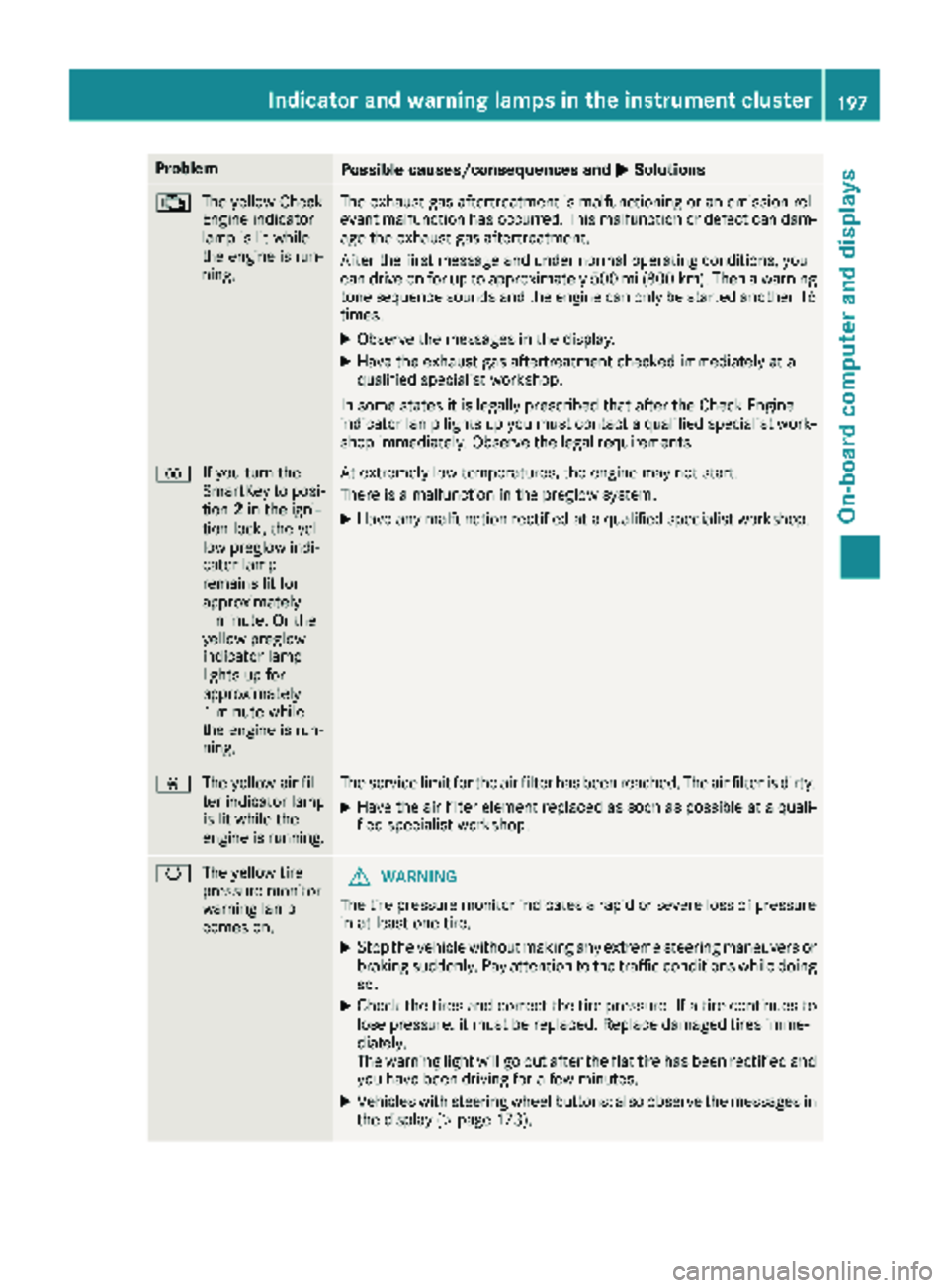
ProblemPossible causes/consequences andMSolutions
;
The yellow Check
Engine indicator
lamp is lit while
the engine is run-
ning.The exhaust gas aftertreatment is malfunctioning or an emission rel-
evant malfunction has occurred. This malfunction or defect can dam-
age the exhaust gas aftertreatment.
After the first message and under normal operating conditions, you
can drive on for up to approximately 500 mi (800 km). Then a warning
tone sequence sounds and the engine can only be started another 16
times.
XObserve the messages in the display.
XHave the exhaust gas aftertreatment checked immediately at a
qualified specialist workshop.
In some states it is legally prescribed that after the Check Engine
indicator lamp lights up you must contact a qualified specialist work-
shop immediately. Observe the legal requirements.
% If you turn the
SmartKey to posi-
tion2in the igni-
tion lock, the yel-
low preglow indi-
cator lamp
remains lit for
approximately
1 minute. Or the
yellow preglow
indicator lamp
lights up for
approximately
1 minute while
the engine is run-
ning.At extremely low temperatures, the engine may not start.
There is a malfunction in the preglow system.
XHave any malfunction rectified at a qualified specialist workshop.
È The yellow air fil-
ter indicator lamp
is lit while the
engine is running.The service limit for the air filter has been reached. The air filter is dirty.
XHave the air filter element replaced as soon as possible at a quali-
fied specialist workshop.
hThe yellow tire
pressure monitor
warning lamp
comes on.GWARNING
The tire pressure monitor indicates a rapid or severe loss of pressure
in at least one tire.
XStop the vehicle without making any extreme steering maneuvers or
braking suddenly. Pay attention to the traffic conditions while doing
so.
XCheck the tires and correct the tire pressure. If a tire continues to
lose pressure, it must be replaced. Replace damaged tires imme-
diately.
The warning light will go out after the flat tire has been rectified and
you have been driving for a few minutes.
XVehicles with steering wheel buttons: also observe the messages in the display (Ypage 173).
Indicator and warning lamps in the instrument cluster197
On-board computer and displays
Z
Page 223 of 286
If the: indicator lamp in the instrument
cluster goes on, drain the fuel filter with the
water separator immediately.
iWe recommend that you have this mainte-
nance work carried out at a qualified special-
ist workshop.
XPark the vehicle safely and secure it from roll-
ing away.
XSwitch off the auxiliary heating system .
XSwitch off the engine.
XOpen the hood (Ypage 214).
XPlace a suitable receptacle under drain
hose :.
XTurn the SmartKey to position 2in the ignition
lock.
XOpen drain plug ;immediately until the
water/fuel mixture flows out of drain hose :.
XScrew in drain plug;as soon as approx-
imately 0.2 qt (0.2 l)of the water/fuel mixture
has been collected.
The electrical fuel pump automatically halts
the flow of the water/fuel mixture after
30 seconds.
XAfter draining, turn the SmartKey back to
position 0in the ignition lock.
XDispose of the collected water/fuel mixture
in an environmentally responsible manner,
e.g. at a qualified specialist workshop.
XCheck drain plug ;. The drain plug must be
closed.
When the engine is running and drain hose ;
is open, fuel is lost through drain hose :.
XClose the hood (Ypage 215).
If the : indicator lamp does not go out after
draining:
XDrain the fuel filter again.
XIf the : indicator lamp does not go out
after draining for the second time, have the
cause checked immediately at a qualified spe-
cialist workshop.
Vehicle interior
Air filter for the rear-compartment air
conditioning
!
Regularly check the air filters for visible dirt.
Clean or replace a dirty filter mat. The dirt may otherwise lead to damage to the air-condi-
tioning system.
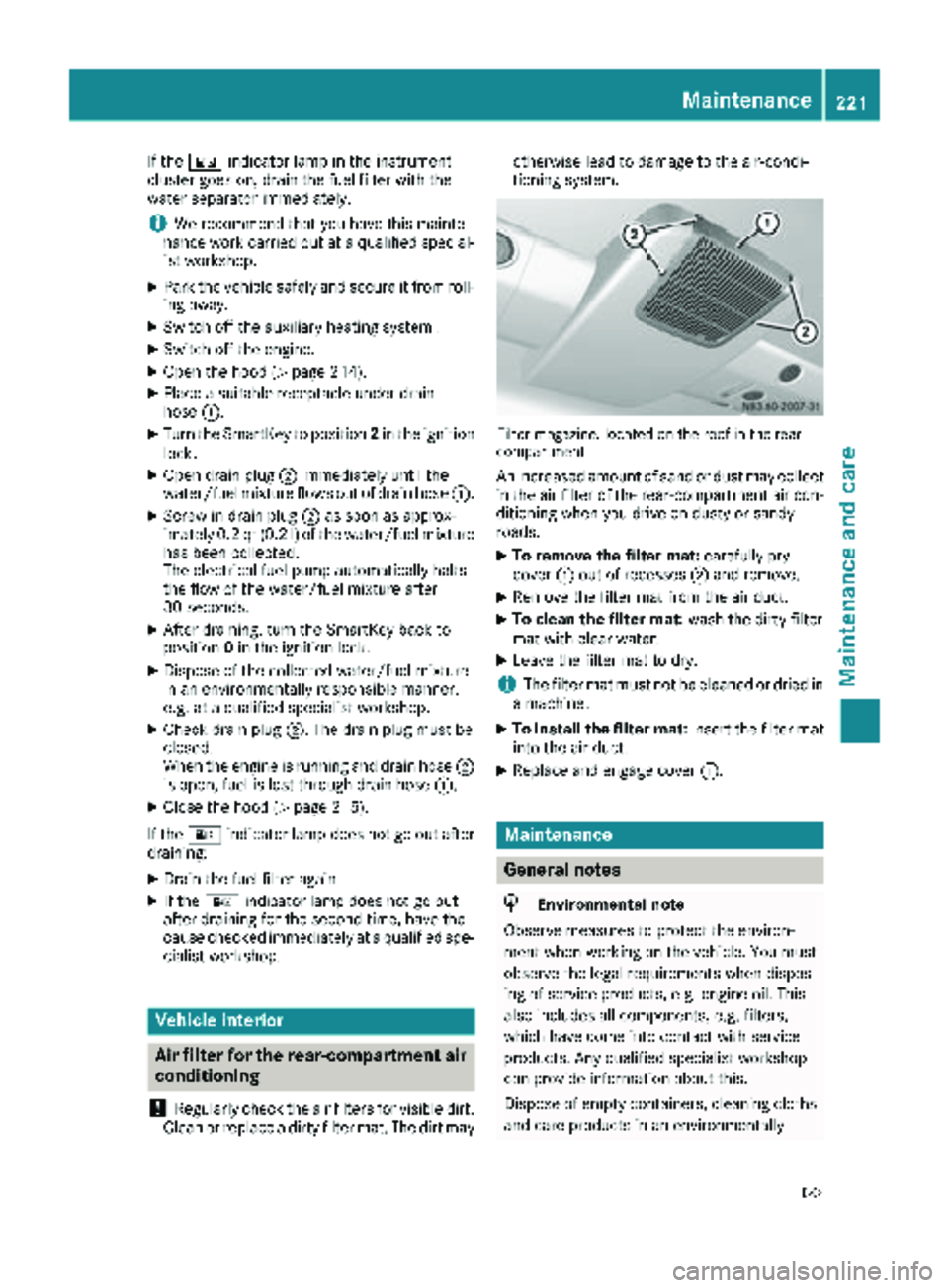
Filter magazine, located on the roof in the rear
compartment
An increased amount of sand or dust may collect
in the air filter of the rear-compartment air con-
ditioning when you drive on dusty or sandy
roads.
XTo remove the filter mat: carefully pry
cover :out of recesses ;and remove.
XRemove the filter mat from the air duct.
XTo clean the filter mat: wash the dirty filter
mat with clear water.
XLeave the filter mat to dry.
iThe filter mat must not be cleaned or dried in
a machine.
XTo install the filter mat: insert the filter mat
into the air duct.
XReplace and engage cover :.
Maintenance
General notes
HEnvironmental note
Observe measures to protect the environ-
ment when working on the vehicle. You must
observe the legal requirements when dispos-
ing of service products, e.g. engine oil. This
also includes all components, e.g. filters,
which have come into contact with service
products. Any qualified specialist workshop
can provide information about this.
Dispose of empty containers, cleaning cloths
and care products in an environmentally
Maintenance221
Maintenance and care
Z
Page 276 of 286
When handling, storing and disposing of fuels,
please observe the relevant regulations.
Tank contents
Depending on equipment, the total capacity of
the fuel tank may vary.
Vehicle typeTotal capa-cityof which
reserve fuel
2500
3500Approx-imately
26.4 US gal (100 l)Approx-
imately
5.0 US gal
(19 l)
All-wheel-
drive vehi-
clesApprox-
imately
24.6 US gal (93 l)
Diesel
Fuel grade
GWARNING
If you mix diesel fuel with gasoline, the flash
point is lower than that of pure diesel fuel.
When the engine is running, exhaust system
components could overheat without being
noticed. There is a risk of fire.
Never refuel with gasoline. Never mix gasoline with diesel fuel.
!Filter the fuel before transferring it to the
vehicle if you are refueling the vehicle from
barrels or containers.
This will prevent malfunctions in the fuel sys-
tem due to contaminated fuel.
!You will damage the diesel engine if you do
not refuel with ULSD or a diesel fuel with a
sulfur content of more than 15 ppm.
!Do not use the following:
Rmarine diesel
Rheating oil
Rvegetable oil
Rgasoline
Rparaffin
Rkerosene
Do not mix such fuels with diesel fuel and do
not use any special additives. This can other- wise lead to engine damage. This does not
include flow improvers. For further informa-
tion, see "Flow improvers".
Usually you will find information about the fuel
grade on the filling pump. If there is no identifi-
cation on the filling pump, consult a gas station
attendant.
For more information about refueling
(
Ypage 124).
Diesel at very low outside temperatures
GWARNING
If you heat fuel system components, e.g. with
a hot-air gun or open flame, these compo-
nents could be damaged. This can cause fuel
to escape and ignite. Depending on the type
of damage, fuel may also not escape until the
engine is running. There is a risk of fire and
explosion.
Never heat fuel system components. Contact
a qualified specialist workshop to rectify the
malfunction.
Refill only with commercially available ULTRA-
LOW SULFUR DIESEL (ULSD, maximum sulfur
content 15 ppm), which fulfills the ASTM D975
standard.
The flow properties of diesel may be inadequate
at low outside temperatures due to paraffin sep-
aration.
iMalfunctions resulting from paraffin sepa-
ration can only be rectified by heating the
entire fuel system. Park the vehicle in a
heated garage, for example.
To prevent operating problems, diesel with bet-
ter flow qualities is available during the winter
months. You can obtain information at the gas
station or from your fuel supplier.
Your vehicle is equipped with a fuel preheating
system. This improves the flow properties of the
diesel by approximately 14.5 ‡ (8 †). ULTRA-
LOW SULFUR DIESEL can be used without ris k
o
f malfunction down to an outside temperature
of approximately 14 ‡ ( Ò10 †).
Fuel additives
!Do not add gasoline or kerosene to diesel
fuel to improve its flow characteristics. Gas-
oline or kerosene impairs the lubricating
properties of the diesel fuel. This can result in
274Service products and capacities
Technical data