weight MERCEDES-BENZ SPRINTER 2017 MY17 Operator’s Manual
[x] Cancel search | Manufacturer: MERCEDES-BENZ, Model Year: 2017, Model line: SPRINTER, Model: MERCEDES-BENZ SPRINTER 2017Pages: 286, PDF Size: 4.36 MB
Page 14 of 286
Fuel tanksee Fuel tank
Fuel tank content
Reserve, display message .............. 185
Fuses .................................................. 242
G
Gasoline
Reserve fuel warning lamp ............ .196
General driving tips
Driving short distances .................. 131
Genuine parts ...................................... 29
Glove box ...........................................2 00
GTW (Gross Trailer Weight) (defini-
tion) .................................................... 260
H
Handbrake
see Parking brake
Handbrake
see Parking brake
Hazard warning lamps ........................ 83
Head restraints
Adjusting ......................................... 76
Adjusting (rear) ................................ 76
Headlamps
Adding fluid to cleaning system ..... 220
Cleaning system (function) .............. 83
Fogging up ....................................... 84
see Automatic headlamp mode
Headliner (cleaning instructions) .... 234
Heating
see Climate control
High-beam headlamps
Highbeam Assist .............................. 84
Replacing bulbs ............................... 88
Switching on/off .............................. 82
Highbeam Assist
Function/notes ................................ 84
Switching Highbeam Assist
on/off ............................................ 168
Hood
Closing ...........................................2 15
Display message ............................ 189
Important safety notes .................. 214
Indicator lamp ................................ 198 Opening ......................................... 214
Hot-water auxiliary heater
Problem (malfunction) ................... 111
Hydroplaning ..................................... 134
I
Ignition lock
see Key positions
Ignition lock
see SmartKey positions (ignition lock)
Immobilizer .......................................... 57
Indicator lamp
see Warning and indicator lamps
Indicators
see Turn signals
Insect protection on the radiator ...... 29
Installing a wheel
Installing the adapter (spare
wheel) ............................................ 265
Instrument cluster
Fuel gage ....................................... 159
Important safety notes .................. 158
Instrument cluster lighting ............. 159
Outside temperature display .......... 159
Overview .......................................... 33
Speedometer ................................. 159
Tachometer ................................... 159
Warning and indicator lamps ........... 34
Instrument cluster lighting .............. 159
Instrument lighting
see Instrument cluster lighting
Interior lighting ................................... 85
Front ................................................ 85
Motion detectors ............................. 86
Notes on replacing bulbs ................. 93
Overview .......................................... 85
Replacing bulbs ............................... 93
Switching the rear compartment
lighting on centrally ......................... 85
Interior motion sensor
Arming ............................................. 58
Deactivating ..................................... 58
Function ........................................... 58
Switching off .................................... 58
12Index
Page 21 of 286
Cargo tie-down rings ...................... 282
Loading rails .................................. 282
Roof carrier .................................... 282
Tires/wheels........................ .252, 268
Trailer tow hitch .............................2 82
Vehicle data ................................... 281
Telephone .................................. 206, 207
Telephone (on-board computer)
Accepting an incoming call ............ 172
Display messages .......................... 189
Numbers from the phone book ...... 172
Operating ....................................... 172
Redialing ........................................ 173
Rejecting or ending a call .............. 172
Temperature
Outside temperature ......................1 59
Setting (climate control) ................ 101
Setting the unit (vehicles with
steering wheel buttons) ................. 166
Theft deterrent systems
Immobilizer ...................................... 57
Tow-away alarm ............................... 57
Tightening torques for wheel nuts/
wheel bolts ........................................ 267
Time
Setting the time (vehicles with
steering wheel buttons) ................. 168
Setting the time (vehicles without
steering wheel buttons) ................. 161
Timer
Activating ....................................... 113
Auxiliary heating ............................ 112
Important safety notes .................. 112
Overview ........................................ 113
Setting the heating level (auxiliary
heating) ......................................... 114
Setting the preselection time
(auxiliary heating) .......................... 114
Setting weekday, time and oper-
ating duration (auxiliary heating) ... 113
Switching immediate heating
mode on/off (auxiliary heating) ..... 114
Tire pressure
Calling up (on-board computer) ..... 249
C
hecking manually ........................ 249
Display messages (vehicles with
steering wheel buttons) ................. 188 Display messages (vehicles with-
out steering wheel buttons) ........... 174
Maximum ....................................... 249
Notes ............................................. 248
Recommended ............................... 246
Setting the unit (vehicles with
steering wheel buttons) ................. 167
Tire label ........................................ 247
Tire pressure loss warning system .. 251
Tire pressure monitor
Checking the tire pressure elec-
tronically ........................................ 251
Display message ............................ 188
Function/notes .............................2 49
Indicator lamp ................................ 197
Restarting ...................................... 251
Warning lamp ................................. 251
Tire pressure table ............................ 252
Tires
Aspect ratio (definition) ................. 261
Average weight of the vehicle
occupants (definition) .................... 260
Bar (definition) ............................... 260
Changing a wheel .......................... 262
Characteristics .............................. 259
Checking ........................................ 244
Curb weight (definition) ................. 261
Definition of terms ......................... 259
Direction of rotation ...................... 262
Distribution of the vehicle occu-
pants (definition) ............................ 261
DOT (Department of Transporta-
tion) (definition) ............................. 260
DOT, Tire Identification Number
(TIN) ............................................... 259
GAWR (Gross Axle Weight Rating)
(definition) ..................................... 260
GTW (Gross Trailer Weight) (defi-
nition) ............................................ 260
GVW (Gross Vehicle Weight) (def-
inition) ........................................... 260
GVWR (Gross Vehicle Weight Rat-
ing) (definition) .............................. 260
Important safety notes .................. 243
Increased vehicle weight due to
optional equipment (definition) ...... 260
Kilopascal (kPa) (definition) ........... 260
Labeling (overview) ........................ 257
Index19
Page 22 of 286
Load bearing index (definition) ...... 261
Load index .....................................258
Load index (definition) ................... 260
M+S tires ....................................... 245
Maximum load on a tire (defini-
tion) ............................................... 261
Maximum loaded vehicle weight
(definition) ..................................... 260
Maximum permissible tire pres-
sure (definition) .............................2 61
Maximum tire load ......................... 259
Maximum tire load (definition) ....... 261
Optional equipment weight (defi-
nition) ............................................ 261
PSI (pounds per square inch) (def-
inition) ...........................................2 61
Replacing ....................................... 262
Service life ..................................... 244
Sidewall (definition) ....................... 261
Snow chains .................................. 246
Speed rating (definition) ................ 260
Storing ...........................................2 62
Structure and characteristics
(definition) ..................................... 259
Summer tires ................................. 245
TIN (Tire Identification Number)
(definition) ..................................... 261
Tire bead (definition) ......................2 61
Tire pressure (definition) ................ 261
Tire pressures (recommended) ...... 260
Tire size (data) ....................... 252, 268
Tire size designation, load-bearing
capacity, speed rating .................... 257
Tire tread ....................................... 244
Tire tread (definition) ..................... 261
Total load limit (definition) ............. 261
Traction (definition) ....................... 261
TWR (permissible trailer drawbar
noseweight) (definition) ................. 261
Uniform Tire Quality Grading
Standards (definition) .................... 260
Wear indicator (definition) ............. 261
Wheel rim (definition) .................... 260
Top Tether ............................................ 50
To
uchshift (automatic transmis-
sion) .................................................... 122
Tow-away alarm
Arming/deactivating ........................ 57 Deactivating ..................................... 57
Operation ......................................... 57
Tow-starting
Emergency engine starting ............ 242
Important safety notes .................. 239
Towing
If the vehicle is stuck ..................... 241
Installing/removing the towing
eye ................................................. 240
With a raised front or rear axle ...... 241
Towing a trailer
Axle load, permissible .................... 283
Cleaning the trailer tow hitch ......... 233
Coupling up a trailer ......................1 54
Decoupling a trailer ....................... 156
Driving tips ....................................1 52
Important safety notes .................. 152
Notes on retrofitting ......................2 82
Trailer loads ................................... 283
Towing away
Important safety guidelines ........... 239
In the event of malfunctions .......... 240
With both axles on the ground ....... 241
Trailer
Brake force booster malfunction ... 192
Trailer coupling
see Towing a trailer
Trailer loads and drawbar nose-
weights ............................................... 156
Trailer towing
Blind Spot Assist ............................ 143
PARKTRONIC ................................. 150
Permissible trailer loads and
drawbar noseweights ..................... 156
Transmission
see Automatic transmission
Transmission oil ................................ 279
Transport
Loading guidelines ......................... 208
Vehicle ...........................................2 42
Transport by rail ................................ 132
Transportation
Rail ................................................ 132
Transporting
Load distribution ............................ 210
Securing a load .............................. 210
Trim pieces (cleaning instruc-
tions) ..................................................2 34
20Index
Page 23 of 286
Trip computer (on-board com-
puter).................................................. 171
Trip meter
see Trip odometer
Trip odometer
Display (vehicles with steering
wheel buttons) ............................... 164
Display (vehicles without steering
wheel buttons) ............................... 160
Resetting ....................................... 159
see Trip computer (on-board computer)
Turn signals
Replacing bulbs (front) ..................... 89
Replacing bulbs (rear) ...................... 90
Switching on/off .............................. 82
Turn signals (Chassis Cab)
Replacing bulbs (rear) ...................... 91
Twin front-passenger seat
Stowage compartment .................. 202
Two-way radios
Type approval/frequency .............. 271
TWR (Tongue Weight Rating) (defi-
nition) ................................................. 261
U
Unlocking
From inside the vehicle (central
unlocking button) ............................. 63
USB port ............................................. 207
V
Vehicle
Data acquisition ............................... 30
Display message ............................ 189
Electronics ..................................... 271
Equipment ....................................... 23
Individual settings (vehicles with
steering wheel buttons) ................. 165
Limited Warranty ............................. 23
Loading .......................................... 254
Locking (SmartKey) .......................... 59
Lowering ........................................ 267
Maintenance .................................... 24
Operating safety .............................. 26
Parking for a long period ................ 129
Pulling away ................................... 119 Raising ........................................... 263
Registration ..................................... 28
Reporting problems ......................... 28
Securing from rolling away ............ 127
Towing away .................................. 239
Transporting .................................. 242
Unlocking (SmartKey) ...................... 59
Vehicle battery
see Battery (vehicle)
Vehicle bodies ..................................... 28
Body/equipment mounting direc-
tives for trucks ................................. 28
Vehicle data ....................................... 281
Vehicle identification number .......... 272
Vehicle identification plate .............. 272
Vehicle tool kit .................................. 236
Voltage supply
Fuses ............................................. 242
W
WarningStickers ........................................... 25
Warning and indicator lamp
Power assistance for the steering .. 199
Warning and indicator lamps
Brakes ........................................... 192
Check Engine ................................. 196
Coolant .......................................... 195
Diesel Exhaust Fluid (DEF) ............. 193
Electrical step ................................ 199
ESP
®.............................................. 190
ESP®function ................................ 194
Overview .......................................... 34
Seat belt ........................................ 198
Warning lamp .................................... 237
Warning triangle ................................ 237
Warning- and indicator lamps
ABS ................................................ 191
Air filter .......................................... 197
ASR ................................................ 190
BAS ................................................ 191
Battery charge ............................... 194
Brake wear .................................... 194
Bulbs .............................................. 198
Doors ............................................. 198
Engine oil level ............................... 195
Preglow .......................................... 197
Index21
Page 28 of 286
Operating conditions:
Ravoid short trips as these increase fuel con-
sumption.
Ralways make sure that the tire pressures
are correct.
Rdo not carry any unnecessary weight.
Rremove roof racks once you no longer need
them.
Ra regularly serviced vehicle will contribute
to environmental protection. You should
therefore adhere to the service intervals.
Ralways have service work carried out at a
qualified specialist workshop.
Personal driving style:
Rdo not depress the accelerator pedal when
starting the engine.
Rdo not warm up the engine when the vehicle
is stationary.
Rdrive carefully and maintain a safe distance
from the vehicle in front.
Ravoid frequent, sudden acceleration and
braking.
Rchange gear in good time and use each gear
only up to Ôof its maximum engine speed.
Rswitch off the engine in stationary traffic.
Rkeep an eye on the vehicle's fuel consump-
tion.
Environmental issues and recommen-
dations
When prompted by this Operator's Manual to
dispose of materials, please try to regenerate
and recycle these materials. Observe all rele-
vant environmental guidelines and regulations
when disposing of materials. This helps to pro-
tect the environment.
Operating safety and vehicle approval
Important safety notes
GWARNING
If you do not have the prescribed service/
maintenance work or any required repairs
carried out, this can result in malfunctions or system failures. There is a risk of an accident.
Always have the prescribed service/mainte-
nance work as well as any required repairs
carried out at a qualified specialist workshop.
Air bags and pyrotechnic Emergency Tensioning
Devices (ETDs) contain perchlorate material,
which may require special handling and regard
for the environment. The guidelines must be
observed during disposal.
In California, you can find more information on
the Internet at www.dtsc.ca.gov.
Notes on operating the vehicle
There is a risk of damage to the vehicle if:
Rthe vehicle makes contact with the ground,
e.g. on a high curb or a loose road surface
Ryou drive too quickly over an obstacle, e.g. a
curb, speed bump or pothole
Ra heavy object hits the underbody or chassis
component
In these or similar situations, the vehicle body/
frame, the underbody, chassis components,
wheels or tires could be damaged even if this is
not visible from the outside. Components that
have been damaged in this way can unexpect-
edly fail or no longer be able to assimilate the
loads occurring in the event of an accident. If the underbody paneling is damaged, flammable
material, such as leaves, grass or twigs, could
collect between the underbody and underbody
paneling. These materials could ignite if they
remain in contact with hot components of the
exhaust system for an extended period.
GWARNING
Flammable material such as leaves, grass or
twigs may ignite if they come into contact with
hot parts of the exhaust system. There is a risk of fire.
26Introduction
Page 44 of 286
poses an increased risk of injury or even fatalinjury.
Adjust the seat properly before beginning
your journey. Always ensure that the backrest
is in an almost vertical position and that the
shoulder section of your seat belt is routed
across the center of your shoulder.
GWARNING
Persons less than 5 ft (1.50 m) tall cannot
wear the seat belt correctly without an addi-
tional and suitable restraint system. If the
seat belt is not worn correctly, it cannot per-
form its intended protective function. An
incorrectly fastened seat belt can also cause
injuries, for example, in the event of an acci-
dent or when braking or changing direction
abruptly. This poses an increased risk of injury or even fatal injury.
For this reason, always secure persons under
5 ft (1.50 m) tall in suitable additional restraint
systems.
If a child younger than twelve years old and
under 5 ft (1.50 m) in height is traveling in the
vehicle:
Ralways secure the child in a child restraint
system suitable for this vehicle. The child
restraint system must be appropriate to the
age, weight and size of the child
Ralways observe the instructions and safety
notes on "Children in the vehicle"
(
Ypage 47) in addition to the child restraint
system manufacturer's installation and oper-
ating instructions
GWARNING
The seat belts may not perform their intended protective function if:
Rthey are damaged, modified, extremely
dirty, bleached or dyed
Rthe seat belt buckle is damaged or
extremely dirty
Rthe Emergency Tensioning Devices, belt
anchorages or inertia reels have been modi-
fied.
Seat belts may be damaged in an accident,
although the damage may not be visible, e.g.
due to splinters of glass. Modified or damagedseat belts may tear or fail, e.g. in an accident.
Modified Emergency Tensioning Devices
could accidentally trigger or fail to deploy
when necessary. This poses an increased risk of injury or even fatal injury.
Never modify the seat belts, Emergency Ten-
sioning Devices, belt anchorages and inertia
reels. Make sure that the seat belts are
undamaged, not worn out and clean. Follow-
ing an accident, have the seat belts checked
immediately at a qualified specialist work-
shop.
Only use seat belts that have been approved for
your vehicle by the sales organization named on
the inside cover.
Proper use of the seat belts
Observe the safety notes on the seat belt
(Ypage 41).
All vehicle occupants must be wearing the seat
belt correctly before beginning the journey. Also
make sure that all vehicle occupants are always
wearing the seat belt correctly while the vehicle
is in motion.
When fastening the seat belt, always make sure
that:
Rthe seat belt buckle tongue is inserted only
into the belt buckle belonging to that seat
Rthe seat belt is pulled tight across your body
Avoid wearing bulky clothing, e.g. a winter
coat.
Rthe seat belt is not twisted
Only then can the forces which occur be dis-
tributed over the area of the belt.
Rthe shoulder section of the belt is routed
across the center of your shoulder
The shoulder section of the seat belt should
not touch your neck or be routed under your
arm or behind your back. Where possible,
adjust the seat belt to the appropriate height.
Rthe lap belt is taut and passes across your lap as low down as possible
The lap belt must always be routed across
your hip joints and not across your abdomen.
This applies particularly to pregnant women.
42Occupant safety
Safety
Page 50 of 286
restraint system must be appropriate to the
age, weight and size of the child
Rbe sure to observe the instructions and safety
notes in this section in addition to the child
restraint system manufacturer's installation
instructions
GWARNING
If you leave children unsupervised in the vehi-
cle, they could set it in motion by, for example:
Rrelease the parking brake.
Rshift the automatic transmission out of the
parking position P.
Rstart the engine.
In addition, they may operate vehicle equip-
ment and become trapped. There is a risk of
an accident and injury.
When leaving the vehicle, always take the
SmartKey with you and lock the vehicle. Never
leave children unsupervised in the vehicle.
GWARNING
If persons, particularly children are subjected to prolonged exposure to extreme heat or
cold, there is a risk of injury, possibly even
fatal. Never leave children unattended in the
vehicle.
GWARNING
If the child restraint system is subjected to
direct sunlight, parts may get very hot. Chil-
dren may burn themselves on these parts,
particularly on the metal parts of the child
restraint system. There is a risk of injury.
If you leave the vehicle, taking the child with
you, always ensure that the child restraint
system is not exposed to direct sunlight. Pro- tect it with a blanket, for example. If the child
restraint system has been exposed to direct
sunlight, let it cool down before securing the
child in it. Never leave children unattended in
the vehicle.
Always ensure that all vehicle occupants have
their seat belts fastened correctly and are sitting
properly. Particular attention must be paid to
children. Observe the safety notes on the seat belt
(
Ypage 41) and the notes on correct use of seat
belts (Ypage 42).
A booster seat may be necessary to achieve
proper seat belt positioning for children over
41 lbs (18 kg) until they reach a height where a
three-point seat belt can be properly fastened
without a booster seat.
Special seat belt retractor
GWARNING
If the seat belt is released while driving, the
child restraint system will no longer be
secured properly. The special seat belt retrac- tor is disabled and the inertia real draws in a
portion of the seat belt. The seat belt cannot
be immediately refastened. There is an
increased risk of injury, possibly even fatal.
Stop the vehicle immediately, paying atten-
tion to road and traffic conditions. Reactivate
the special seat belt retractor and secure the
child restraint system properly.
All seat belts in the vehicle, except the driver's
seat belt, are equipped with a special seat belt
retractor. When activated, the special seat belt
retractor ensures that the seat belt cannot
slacken once the child seat is secured.
Installing a child restraint system:
XMake sure you observe the child restraint
system manufacturer's installation instruc-
tions.
XPull the seat belt smoothly from the belt out-
let.
XEngage seat belt tongue in belt buckle.
Activating the special seat belt retractor:
XPull the seat belt out fully and let the inertia
reel retract it again.
While the seat belt is retracting, you should
hear a ratcheting sound. The special seat belt
retractor is enabled.
XPush the child restraint system down so that
the seat belt is tight and does not loosen.
48Children in the vehicle
Safety
Page 52 of 286
Observe the warning labels in the vehicle inte-
rior and on the child restraint system.
LATCH-type (ISOFIX) child seat secur-
ing system
GWARNING
LATCH-type (ISOFIX) child restraint systems
do not offer sufficient protective effect for
children whose weight is greater than 48 lbs
(22 kg) who are secured using the safety belt integrated in the child restraint system. In the
event of an accident, a child might not be
restrained correctly. This poses an increased
risk of injury or even fatal injury.
If the child weighs more than 48 lbs (22 kg),
only use LATCH-type (ISOFIX) child restraint
systems with which the child is also secured
with the vehicle seat belt. Also secure the
child restraint system with the Top Tether
belt, if available.
Always comply with the manufacturer's instal-
lation and operating instructions for the child
restraint system used.
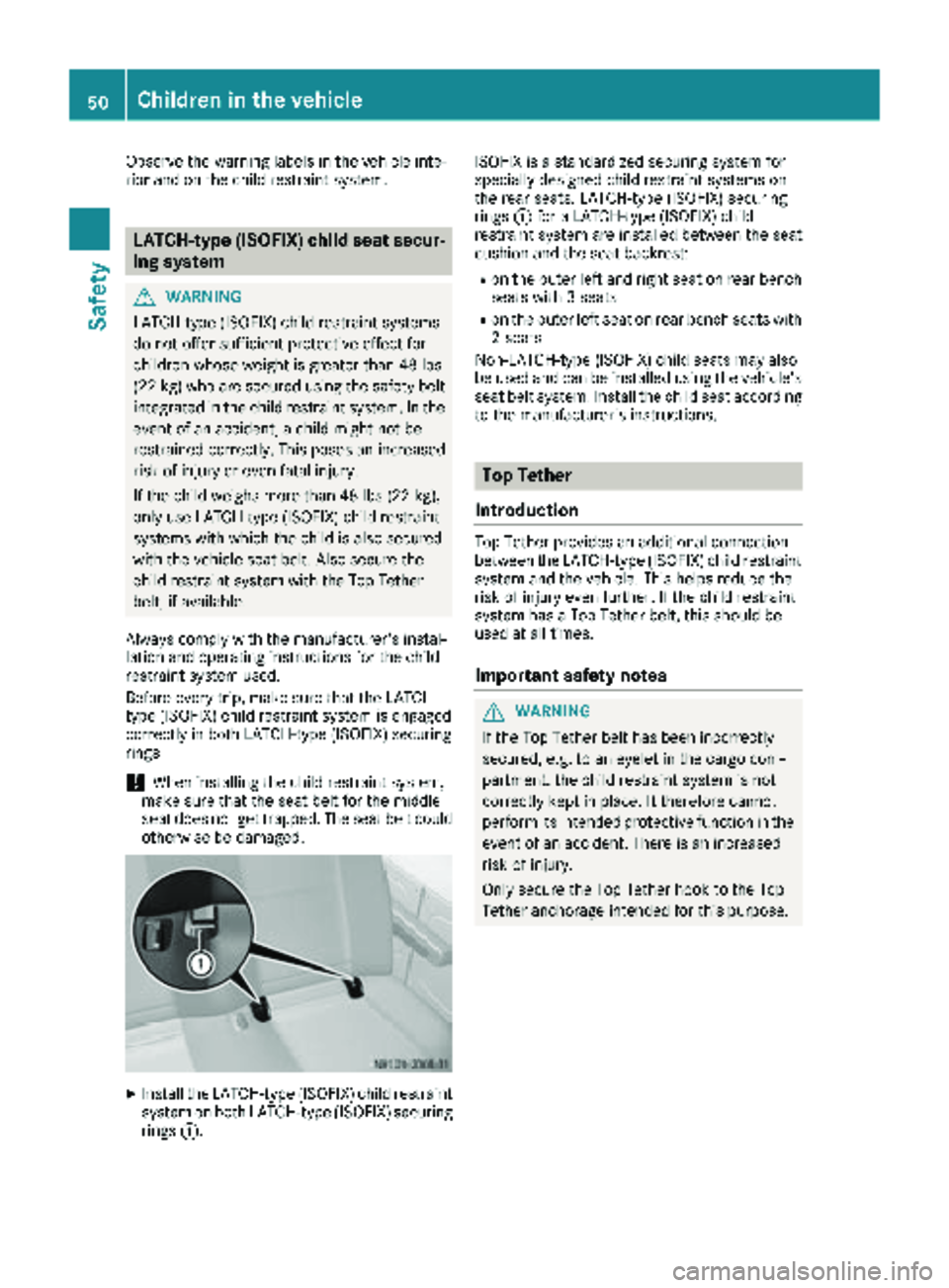
Before every trip, make sure that the LATCH-
type (ISOFIX) child restraint system is engaged
correctly in both LATCH-type (ISOFIX) securing
rings
!When installing the child restraint system,
make sure that the seat belt for the middle
seat does not get trapped. The seat belt could
otherwise be damaged.
XInstall the LATCH-type (ISOFIX) child restraint system on both LATCH-type (ISOFIX) securing
rings :. ISOFIX is a standardized securing system for
specially designed child restraint systems on
the rear seats. LATCH-type (ISOFIX) securing
rings
:for a LATCH-type (ISOFIX) child
restraint system are installed between the seat
cushion and the seat backrest:
Ron the outer left and right seat on rear bench
seats with 3 seats
Ron the outer left seat on rear bench seats with
2 seats
Non-LATCH-type (ISOFIX) child seats may also
be used and can be installed using the vehicle's
seat belt system. Install the child seat according
to the manufacturer's instructions.
Top Tether
Introduction
Top Tether provides an additional connection
between the LATCH-type (ISOFIX) child restraint system and the vehicle. This helps reduce the
risk of injury even further. If the child restraint
system has a Top Tether belt, this should be
used at all times.
Important safety notes
GWARNING
If the Top Tether belt has been incorrectly
secured, e.g. to an eyelet in the cargo com-
partment, the child restraint system is not
correctly kept in place. It therefore cannot
perform its intended protective function in the
event of an accident. There is an increased
risk of injury.
Only secure the Top Tether hook to the Top
Tether anchorage intended for this purpose.
50Children in the vehicle
Safety
Page 75 of 286
Use the head restraint pad to adjust the head
restraint so that it is as close as possible to the
back of your head.
Before the journey, make sure the head
restraints have been correctly set for each of the
vehicle's passengers (
Ypage 76).
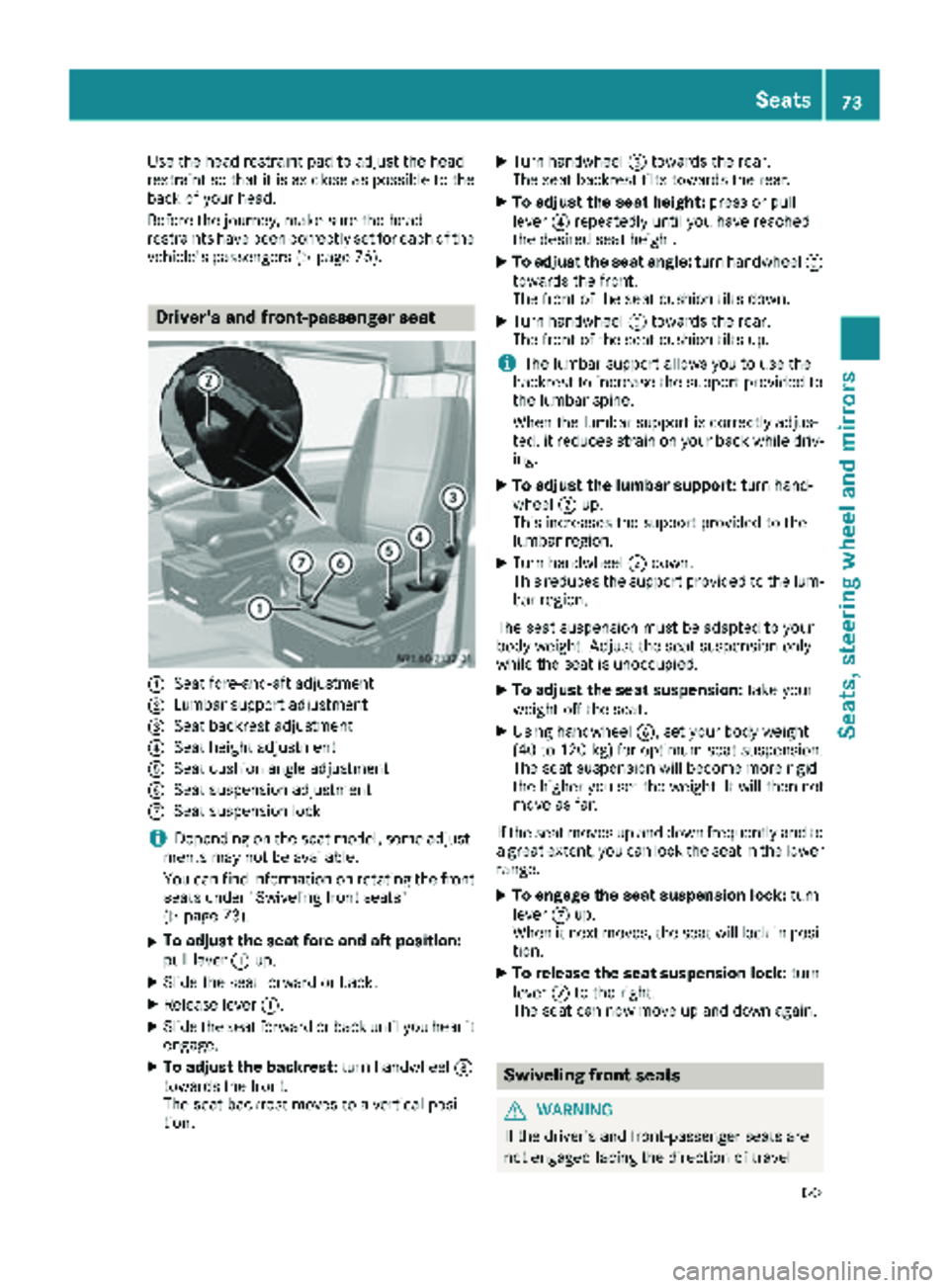
Driver's and front-passenger seat
:Seat fore-and-aft adjustment
;Lumbar support adjustment
=Seat backrest adjustment
?Seat height adjustment
ASeat cushion angle adjustment
BSeat suspension adjustment
CSeat suspension lock
iDepending on the seat model, some adjust-
ments may not be available.
You can find information on rotating the front
seats under "Swiveling front seats"
(
Ypage 73).
XTo adjust the seat fore-and-aft position:
pull lever :up.
XSlide the seat forward or back.
XRelease lever :.
XSlide the seat forward or back until you hear it
engage.
XTo adjust the backrest: turn handwheel=
towards the front.
The seat backrest moves to a vertical posi-
tion.
XTurn handwheel =towards the rear.
The seat backrest tilts towards the rear.
XTo adjust the seat height: press or pull
lever ?repeatedly until you have reached
the desired seat height.
XTo adjust the seat angle: turn handwheelA
towards the front.
The front of the seat cushion tilts down.
XTurn handwheel Atowards the rear.
The front of the seat cushion tilts up.
iThe lumbar support allows you to use the
backrest to increase the support provided to
the lumbar spine.
When the lumbar support is correctly adjus-
ted, it reduces strain on your back while driv-
ing.
XTo adjust the lumbar support: turn hand-
wheel ;up.
This increases the support provided to the
lumbar region.
XTurn handwheel ;down.
This reduces the support provided to the lum-
bar region.
The seat suspension must be adapted to your
body weight. Adjust the seat suspension only
while the seat is unoccupied.
XTo adjust the seat suspension: take your
weight off the seat.
XUsing handwheel B, set your body weight
(40 to 120 kg) for optimum seat suspension.
The seat suspension will become more rigid
the higher you set the weight. It will then not
move as far.
If the seat moves up and down frequently and to a great extent, you can lock the seat in the lower
range.
XTo engage the seat suspension lock: turn
lever Cup.
When it next moves, the seat will lock in posi-
tion.
XTo release the seat suspension lock: turn
lever Cto the right.
The seat can now move up and down agai n.
Swiveling front seats
GWARNING
If the driver's and front-passenger seats are
not engaged facing the direction of travel
Seats73
Seats, steering wheel and mirrors
Z
Page 155 of 286
Install and secure the ball coupling as descri-
bed in the ball coupling manufacturer's instal-
lation instructions. Make sure that the ball
coupling is correctly installed and secured
before every journey.
GWARNING
When the vehicle/trailer combination begins
to lurch, you could lose control of it. The vehi- cle/trailer combination could even rollover.
There is a risk of an accident.
On no account should you attempt to
straighten up the vehicle/trailer combination
by increasing the speed. Reduce vehicle
speed and do not countersteer. Apply the
brake as necessary.
Always observe the operating instructions pro-
vided by the manufacturers of the trailer cou-
pling and the ball coupling.
Couple and decouple the trailer carefully. When backing up the towing vehicle, make sure
nobody is standing between the vehicle and the
trailer.
A trailer which is incorrectly coupled to the tow-
ing vehicle could break away. A correctly cou-
pled trailer must be positioned horizontally
behind the towing vehicle.
Ensure that the following weights are not excee-
ded:
Rthe permissible noseweight
Rthe permissible trailer load
Rthe permissible rear axle load of the towing
vehicle
Rthe permissible gross weight of both the tow-
ing vehicle and the trailer
Rthe permissible gross combination weight
The applicable permissible values that may not
be exceeded can be found:
Rin your vehicle documents
Ron the type plates for the trailer tow hitch
Ron the type plates for the trailer
Ron the vehicle identification plate
(Ypage 272).
Where the values differ, the lowest is valid.
You will find values approved by the manufac-
turer on the identification plates and those for
the towing vehicle in the "Permissible trailer loads and trailer drawbar noseweights" section
(
Ypage 156).
Your vehicle behaves differently with a trailer
than without one.
The vehicle/trailer combination:
Ris heavier
Ris restricted in its acceleration and gradient-
climbing capability
Rhas an increased braking distance
Ris more susceptible to strong crosswinds
Rrequires more sensitive steering
Rhas a larger turning circle
This may impair the handling characteristics.
When towing a trailer, always adjust your speed
to suit the road and w
eather conditions. Drive
carefully. Maintain a safe distance.
If you require any further explanation of the
information contained in the Operator's Manual,
please contact an authorized Sprinter dealer.
General notes
RObserve the legally prescribed maximum
speed for vehicle/trailer combinations in the
relevant country, state or Canadian province. Before setting off, check the vehicle docu-
ments of the your trailer to find out the per-
missible maximum speed.
This reduces the risk of accidents.
RInstall only an approved trailer coupling on
your vehicle. Only use a ball coupling that is
approved for your vehicle and Sprinter trailer
tow hitch. More information on the availabil-
ity, mounting and installation of the trailer
electrics is available at any qualified specialist
workshop.
RThe trailer coupling is one of the most impor-
tant vehicle parts with regard to road safety.
The notes on operation, care and mainte-
nance issued by the manufacturer should be
observed.
RThe bumpers of your vehicle are not suitable
for installing detachable trailer couplings.
RDo not attach rented trailer tow hitches or
other detachable trailer tow hitches to the
bumper.
RMinimize the risk of damage to the ball cou-
pling. If you do not require the ball coupling,
remove it from the ball coupling recess.
Towing a trailer153
Driving and parking
Z