change time MERCEDES-BENZ SPRINTER 2018 MY18 Operator’s Manual
[x] Cancel search | Manufacturer: MERCEDES-BENZ, Model Year: 2018, Model line: SPRINTER, Model: MERCEDES-BENZ SPRINTER 2018Pages: 294, PDF Size: 4.36 MB
Page 269 of 294
Flat tire
General notes
If your vehicleis equipped wit h aspar ewheel,
th espar ewhee lis under th erear of th evehicl e
(
Ypage 273).
Information about installin g awhee lcan be
foun din th e"Whee lchange" section
(
Ypage 268).
Changing wheels
Rotating the wheels
GWARNIN G
Interchangin gth efron tand rear wheels may
severely impair th edriving characteristics if
th ewheels or tires have different dimensions.
The whee lbrakes or suspension component s
may also be damaged. Ther eis aris kof acci-
dent.
Rotate fron tand rear wheels only if th ewheels
and tires are of th esam edimensions.
!On vehicles equipped wit h atire pressur e
monitor, electronic component sare locate d
in th ewheel.
Tire-mounting tools should no tbe used near
th evalve. This could damag eth eelectronic
components.
Only have tires changed at aqualified spe-
cialist workshop.
Always observ eth einstruction sand safet y
note sin th e"Mounting awheel" section
(
Ypage 268).
The wear pattern son th efron tand rear tires
differ, depending on th eoperating conditions.
Rotate th ewheels before aclear wear pattern
has formed on th etires .Fron ttires typically
wear mor eon th eshoulder sand th erear tires in
th ecenter.
If your vehicle's tire configuration allows ,you
can rotate th etires according to th eintervals in
th etire manufacturer' swarrant ybook in your
vehicl edocuments .If no warrant ybook is avail-
able, th etires should be rotate devery 3,000 to
6,000 mile
s(
5,00 0to 10,00 0km), or earlier if
tire wear requires. Do no tchang eth edirection
of rotation . Clean th
econtact surface sof th ewhee land th e
brak edisc thoroughly every time awhee lis rota-
ted.
Chec kth etire pressur eand reactivat eth etire
pressur emonitor if necessary.
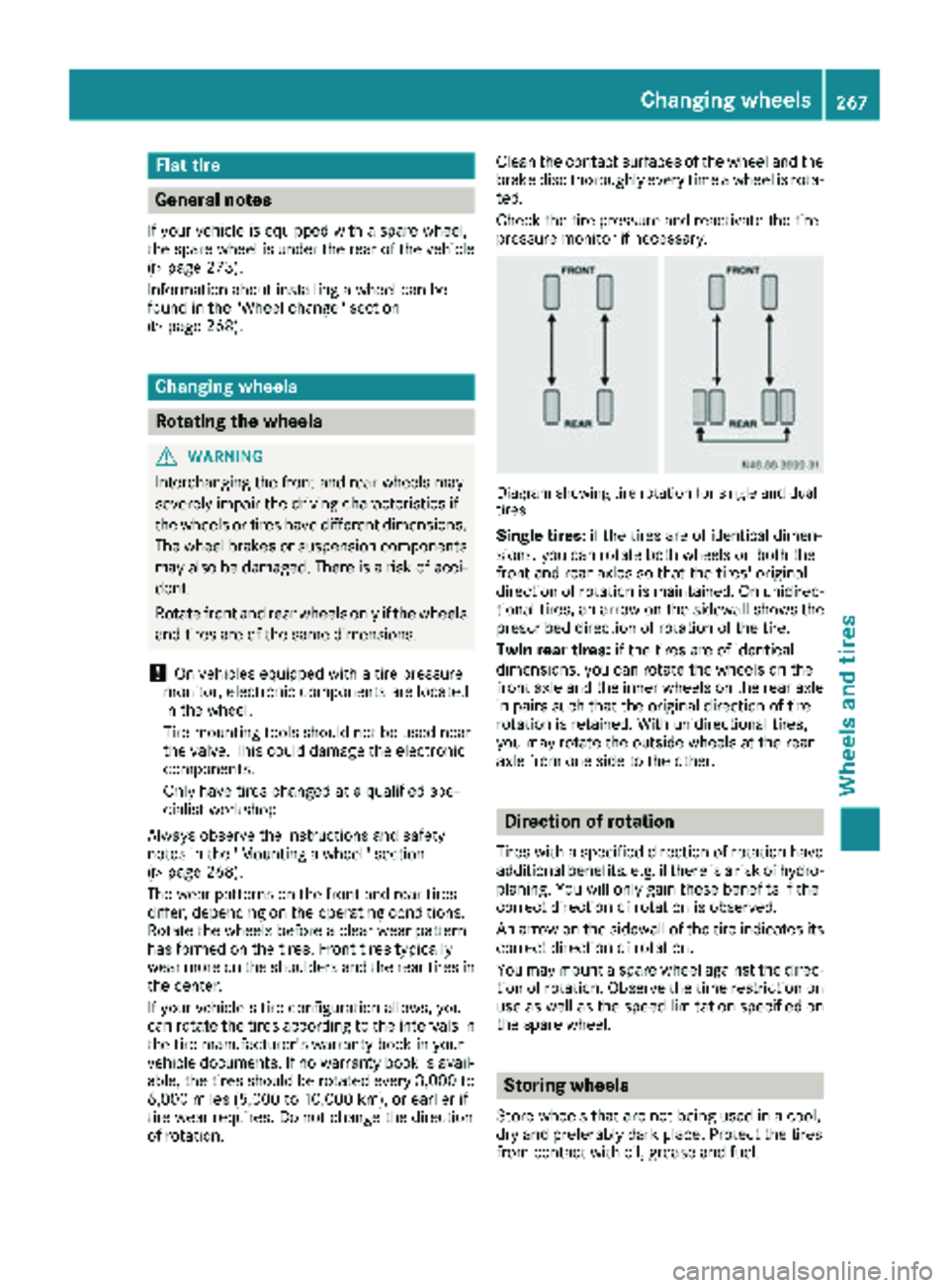
Diagram showin gtir erotation for single and dual
tires
Single tires: if thetires are of identical dimen-
sions, you can rotate bot hwheels on bot hth e
fron tand rear axle sso that th etires 'original
direction of rotation is maintained. On unidirec -
tional tires ,an arrow on th esidewall shows th e
prescribe ddirection of rotation of th etire.
Twin rea rtires: if thetires are of identical
dimensions, you can rotate th ewheels on th e
fron taxle and th einner wheels on th erear axle
in pair ssuc hthat th eoriginal direction of tire
rotation is retained. Wit hunidirectional tires ,
you may rotate th eoutside wheels at th erear
axle from on eside to th eother .
Direction of rotation
Tires wit h aspecifie ddirection of rotation have
additional benefits ,e.g. if there is aris kof hydro-
planing .You will only gain these benefits if th e
correct direction of rotation is observed.
An arrow on th esidewall of th etire indicates it s
correct direction of rotation .
You may moun t aspar ewhee lagainst th edirec-
tion of rotation .Observ eth etime restriction on
use as well as th espee dlimitation specifie don
th espar ewheel.
Storing wheels
Store wheels that are no tbein gused in acool,
dry and preferably dark place. Protect th etires
from contact wit hoil, grease and fuel .
Changing wheels267
Wheels and tires
Z
Page 275 of 294
iVehicles with the tire pressure monitor sys-
tem: all mounted wheels must be equipped
with functioning sensors.
Wheel and tire combination
General notes
!
Retreaded tires are neither tested nor rec-
ommended for Sprinter vehicles, since previ-
ous damage cannot always be detected on
retreaded tires. We can therefore not guar-
antee driving safety. Do not mount used tires
if you have no information about their previ-
ous usage.
The recommended tire pressures can be found:
Ron the Tire and Loading Information placard9
on the B-pillar on the driver's side
Ron the tire pressure table on the B-pillar on the driver's side
The recommended tire pressure can also be
found in the "Tire pressure table" section in this
Operator's Manual (
Ypage 257). The wheel/tire
combination for your vehicle can be found on
the tire pressure table. Further information on
wheel/tire combination can be obtained at any
qualified specialist workshop.
Check tire pressures regularly and only when
the tires are cold. Observe the notes on the rec-
ommended tire pressure (
Ypage 251).
Follow the maintenance recommendations in
the tire manufacturer's warranty book in your
vehicle documents.
Notes on the vehicle equipment – always equip the vehicle:
Rwith tires of the same size across an axle (left
and right)
Rwith the same type of tires on all wheels at a
given time (summer tires, winter tires)
Tires that have been specially designed and
approved for your vehicle are marked with MO
(Mercedes-Benz Original). You can find this
identification on the tires themselves and in the following table.
iNot all wheel/tire combinations can be
installed at the factory in all countries.
Spare wheel
Important safety notes
GWARNING
Wheel and tire dimensions as well as the type of tire can vary between the spare wheel and
the wheel to be replaced. When the spare
wheel is mounted, driving characteristics may be severely affected. There is a risk of an acci-
dent.
In order to reduce risks:
Ryou should therefore adapt your driving
style and drive carefully.
Rnever mount more than one spare wheel
that differs from the wheel to be replaced.
Ronly use a spare wheel that differs from the
wheel to be replaced for a short time.
Rdo not deactivate ESP®.
Rhave a spare wheel that differs from the
wheel that has been changed replaced at
the nearest qualified specialist workshop.
You must observe the correct wheel and
tire dimensions as well as the wheel type.
When using a spare wheel of a different size, do
not exceed the maximum speed of 80 km/h.
General notes
!
Check the spare wheel regularly to see that
it is secure and has the prescribed tire pres-
sure.
The procedure for mounting the spare wheel is
described in "Mounting a wheel" (
Ypage 268).
The following should be checked regularly, par-
ticularly prior to long journeys:
Rthe tire pressure of the spare wheel, which
should then be corrected if necessary
(
Ypage 251).
Rthe fastenings of the spare wheel bracket.
The spare wheel is located in a spare wheel
bracket under the rear of the vehicle.
Replace the tires after 6 years at the latest,
regardless of wear. This also applies to the spare
wheel.
9Only for vehicles with a gross weight of less than 10,000 lbs (4,536 kg).
Spare wheel273
Wheels and tires
Z
Page 284 of 294
Disposal
HEnvironmental not e
Dispose of DE Fin an environmentally respon -
sibl emanner.
Observ ecountry-specific laws and regulation s
when disposing of DEF.
DEF suppl yreservoir content
Tank content s
Diesel Exhaust Flui d(DEF)11
Approximately 4. 7US gal (18.0 l)
Engin eoil
General notes
!The bottles of th evarious engin eoil types
are marke dwit hACE A(Association des Con -
structeurs Européen sd'Automobiles )and/o r
AP I(America nPetroleum Institute )classifica-
tions. Only use approve dengin eoils that con-
form to th efollowing MB Specification sfo r
Service Products and th eprescribed ACE A
and/o rAP Iclassifications. Using engin eoils
of another qualit yis no tpermitte dand may
invalidat eth eNew Vehicl eLimited Warranty.
The use of other ,non-approve dengin eoils fo r
diesel engines can caus edamage to th edie-
sel particl efilte r(DPF).
Use only engin eoils that hav ebeen approve dfo r
your vehicl eaccordin gto th eMB Specification s
fo rService Products . The MB Specification
sfo rService Products are
vali dfo ryour vehicl e
R228.51
R229.31
R229.51
R229.52
These are hig hqualit yengin eoils whic hhav e a
positive effec ton :
Rengin ewear
Rfue lconsumption
Rexhaus tgas emission s
If th equalit ygrade is no tavailable fo rdiesel
engines, you may also add engin eoils meeting
th erequirements in MB Sheet Number 228.5,
229. 3or 229.5. The topping-up quantity is then
limite dto
ama
ximum of 1qt (1 l).
Multi-gr ade engine oils of the prescribed SAE
class (viscosity) may be used all year round, tak-
ing the outside temperatures into account.
Engine oil viscosity
!If the SAE viscosity class of the engine oil
used does not cover the outside temperature
range in which you are operating the vehicle,
it must be changed in good time, in particular
before the cold season commences. Using an
engine oil that does not have adequate tem-
perature characteristics can lead to engine
damage.
The temperature range information of the SAE
classification always refers to that of fresh oil.
The temperature characteristics of the engine
oil may deteriorate significantly due to aging
in use, especially at low outside tempera-
tures.
We recommend that you change the engine
oil before the cold season commences. Use
an approved engine oil of the specified SAE
class.
11DE Faccording to IS O2224 1.Observe MB Specifications for Service Products, Sheet 352.0.
282Service products and capacities
Technical data
Page 286 of 294
Depending on the driving style, the vehicle con-
sumes a maximum of 1.0 qt (1.0l)of engine oil
over a distance of 620 miles (1000 km).
Oil consumption may be higher if:
RThe vehicle is new.
RYou mainly operate the vehicle under arduous
operating conditions.
RYou frequently drive at high engine speeds.
Regular maintenance is one of the preconditions
for moderate rates of consumption.
You can only estimate the oil consumption after
you have driven a considerable distance.
Check the engine oil level on a regular basis, e.g.
weekly or each time you refuel (
Ypage 221).
Transmission and power steering oil
Automatic transmission
Service product: automatic transmission
fluid
Product name/numberMaintenance interval
Shell ATF 3403/M-115
MB Sheet No. 236.10—
Fuchs/Shell ATF 3353
MB Sheet No. 236.12
Further information can be obtained at any
qualified specialist workshop.
Rear axle
Service product: transmission oil
Product name/numberMaintenanceinterval
BP Energear Hypo DC
80W-90
MB Sheet No. 235.20—
Mobil Delvac Synthetic
Gear Oil 75W-90
MB Sheet No. 235.8
Further information can be obtained at any
qualified specialist workshop.
Steering
Service product: power steering fluid
Product name/numberMaintenanceinterval
Mobil ATF‑D,
Exxon Mobil Corporation
or equivalent
MB Sheet No. 236.3—
The steering is maintenance-free. Further infor-
mation can be obtained at any qualified special-
ist workshop.
Brake fluid
GWARNING
The brake fluid constantly absorbs moisture
from the air. This lowers the boiling point of
the brake fluid. If the boiling point of the brake
fluid is too low, vapor pockets may form in the
brake system when the brakes are applied
hard. This would impair braking efficiency.
There is a risk of an accident.
You should have the brake fluid renewed at
the specified intervals.
!Brake fluid corrodes paint, plastic and rub-
ber. If paint, plastic or rubber has come into
contact with brake fluid, rinse with water
immediately.
When handling, storing and disposing of brake
fluid, please observe the relevant regulations
and the important safety notes for service prod-
ucts.
Over a period of time, the brake fluid absorbs
moisture from the air. This reduces its boiling
point.
Have the brake fluid replaced at specified inter-
vals by a qualified specialist workshop.
iThere is usually a notice in the engine com-
partment to remind you when the next brake
fluid change is due.
Only use brake fluid approved by Mercedes-
Benz in accordance with MB-Freigabe or MB-
Approval 331.0.
284Service products and capacities
Technical data
Page 289 of 294
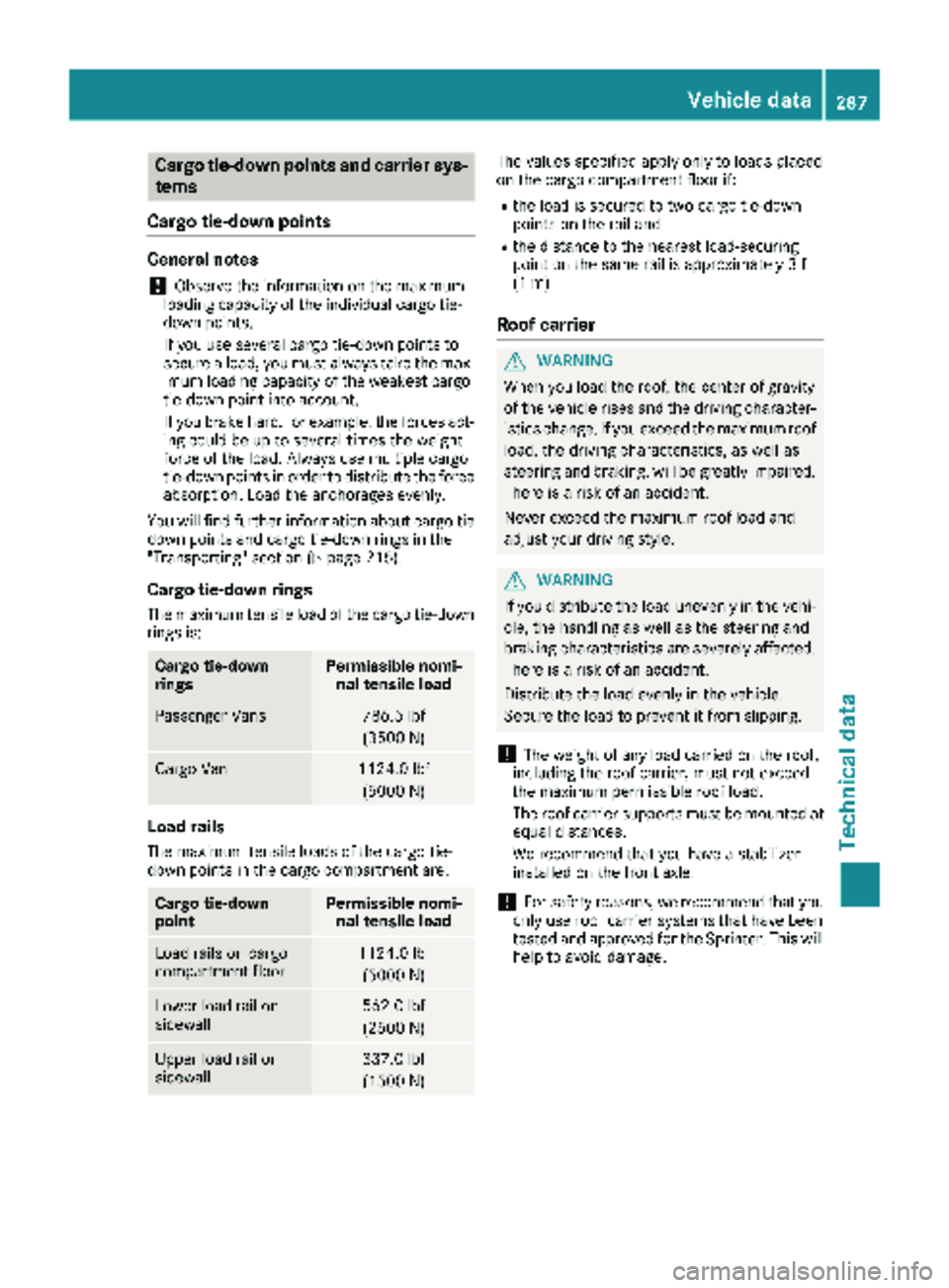
Cargo tie-down points and carrier sys-
tems
Cargo tie-down points
General notes
!Observe the information on the maximum
loading capacity of the individual cargo tie-
down points.
If you use several cargo tie-down points to
secure a load, you must always take the max-
imum loading capacity of the weakest cargo
tie-down point into account.
If you brake hard, for example, the forces act-
ing could be up to several times the weight
force of the load. Always use multiple cargo
tie-down points in order to distribute the force absorption. Load the anchorages evenly.
You will find further information about cargo tie
down points and cargo tie-down rings in the
"Transporting" section (
Ypage 215).
Cargo tie-down rings
The maximum tensile load of the cargo tie-down rings is:
Cargo tie-down
ringsPermissible nomi- nal tensile load
Passenger Vans786.5 lbf
(3500 N)
Cargo Van1124.0 lbf (5000 N)
Load rails
The maximum tensile loads of the cargo tie-
down points in the cargo compartment are:
Cargo tie-down
pointPermissible nomi- nal tensile load
Load rails on cargo
compartment floor1124.0 lbf
(5000 N)
Lower load rail on
sidewall562.0 lbf(2500 N)
Upper load rail on
sidewall337.0 lbf(1500 N)
The values specified apply only to loads placed
on the cargo compartment floor if:
Rthe load is secured to two cargo tie-down
points on the rail and
Rthe distance to the nearest load-securing
point on the same rail is approximately 3 ft
(1 m)
Roof carrier
GWARNING
When you load the roof, the center of gravity
of the vehicle rises and the driving character-
istics change. If you exceed the maximum roof
load, the driving characteristics, as well as
steering and braking, will be greatly impaired.
There is a risk of an accident.
Never exceed the maximum roof load and
adjust your driving style.
GWARNING
If you distribute the load unevenly in the vehi- cle, the handling as well as the steering and
braking characteristics are severely affected.
There is a risk of an accident.
Distribute the load evenly in the vehicle.
Secure the load to prevent it from slipping.
!The weight of any load carried on the roof,
including the roof carrier, must not exceed
the maximum permissible roof load.
The roof carrier supports must be mounted at
equal distances.
We recommend that you have a stabilizer
installed on the front axle.
!For safety reasons, we recommend that you
only use roof carrier systems that have been
tested and approved for the Sprinter. This will
help to avoid damage.
Vehicle data287
Technical data
Z