spare tire MERCEDES-BENZ SPRINTER 2018 MY18 Operator’s Manual
[x] Cancel search | Manufacturer: MERCEDES-BENZ, Model Year: 2018, Model line: SPRINTER, Model: MERCEDES-BENZ SPRINTER 2018Pages: 294, PDF Size: 4.36 MB
Page 5 of 294
Indicator and warning lamps in the
instrument cluster ............................... 195
Stowing and features.......................205
Useful information ............................... 205
Stowage spaces and stowage com-
partments ............................................ 205
Cup holder ........................................... 209
Bottle holder ........................................ 209
Ashtray ................................................ 210
Cigarette lighter ................................... 210
12-V socket .........................................2 11
Mobile phone ....................................... 211
Additional communications equip-
ment .................................................... 212
Transporting loads ............................213
Useful information ............................... 213
Loading guidelines ............................... 213
Load distribution ................................. 215
Securing loads ..................................... 215
Carrier systems ................................... 217
Maintenance and care ......................219
Useful information ............................... 219
Engine compartment ........................... 219
Vehicle interior ....................................2 26
Maintenance ........................................ 226
Battery ................................................. 228
Care ..................................................... 234
Breakdown assistance .....................241
Useful information ............................... 241
Where will I find...? .............................. 241
Flat tire ................................................ 243
Jump-starting ....................................... 243
Tow-starting and towing away ............. 244
Electrical fuses ....................................2 47
Wheels and tires............................... 248
Useful information ............................... 248
Important safety notes ........................ 248
Operation ............................................ 248
Operation in winter .............................. 250
Tire pressure ....................................... 251 Loading the vehicle .............................. 259
What you should know about wheels
and tires .............................................. 262
Flat tire ................................................ 267
Changing wheels ................................. 267
Wheel and tire combination ................. 273
Spare wheel ......................................... 273
Technical data
................................... 276
Useful information ............................... 276
Vehicle electronics .............................. 276
Identification plates .............................2 76
Service products and capacities .......... 278
Vehicle data ......................................... 286
Contents3
Page 13 of 294
Notes about oil grades ................... 282
Oil change ...................................... 283
Oil level (note) ............................... 221
Viscosity ........................................ 282
Warning lamp .................................200
Engine speed setting (working
mode) ................................................. 153
ESP
®(Electronic Stability Pro-
gram)
Crosswind Assist .............................5 7
Display message ............................ 184
Important safety information ........... 56
Indicator lamp ................................ 199
Warning lamp ................................. 195
Exhaust check ................................... 133
Exhaust gas aftertreatment
DEF level indicator .........................1 61
DEF reducing agent ....................... 281
Diesel Exhaust Fluid (DEF) ............. 281
Indicator lamp ................................ 202
Refilling DEF .................................. 128
Exterior lighting
see Lights
Exterior mirrors
Adjusting ......................................... 80
Important safety notes .................... 80
Eyeglasses compartment ................. 206
F
Fire extinguisher............................... 243
First-aid kit ......................................... 242
Flat tire
Changing a wheel/mounting the
spare wheel ................................... 268
General notes ................................ 267
Fog lamps
Switching on/off .............................. 83
Fogged up-up windows
see Climate control
Folding seat ......................................... 76
Frequencies
Mobile phone ................................. 276
Two-way radio ................................ 276
Front interior light
Replacing bulbs ............................... 95
Fuel
Additives (diesel) ........................... 280 Consumption information .............. 280
Consumption statistics .................. 173
Diesel at very low outside temper-
atures ............................................ 279
Driving tips ....................................1 32
Fuel gauge ..................................... 161
Problem (malfunction) ................... 128
Quality (diesel) ............................... 279
Refueling ........................................ 126
Showing the range (vehicles with
steering wheel buttons) ................. 173
Tank content/reserve fuel ............. 279
Fuel filter with water separator
draining ......................................... 225
Indicator lamp ................................ 203
Fuel gauge ......................................... 161
Fuel tank
Problem (malfunction) ................... 128
Fuel tank
see Fuel tank
Fuses .................................................. 247
G
Gasoline
Reserve fuel warning lamp ............. 201
General driving tips
Driving short distances .................. 133
Genuine parts ...................................... 29
Glove box ........................................... 205
GTW (Gross Trailer Weight) (defini-
tion) .................................................... 265
H
Handbrake
see Parking brake
Hazard warning lamps ........................ 85
Head restraints
Adjusting ......................................... 78
Headlamps
Adding fluid to cleaning system ..... 225
Cleaning system (function) .............. 85
Fogging up ....................................... 86
see Automatic headlamp mode
Headliner (cleaning instructions) .... 239
Heating
see Climate control
Index11
Page 24 of 294
WheelsChanging a wheel .......................... 267
Checking ........................................ 249
Cleaning ......................................... 236
Important safety notes .................. 248
Installing the adapter (spare
wheel) ............................................ 270
Interchanging/changing ................ 267
Mounting a wheel .......................... 268
Removing a wheel .......................... 270
Removing and mounting the spare
wheel ............................................. 274
Snow chains .................................. 251
Storing ...........................................2 67
Tightening torque ........................... 272
Wheel/tire combinations ...............2 73
Window curtain air bag ....................... 47
Windows
see Side windows
Windshield
Cleaning ......................................... 236
Defrosting ...................................... 104
Windshield heating
Problem (malfunction) ................... 105
Switching on/off ........................... 105
Windshield washer fluid
Adding ...........................................2 25
Indicator lamp ................................ 203
Windshield wipers
Problem (malfunction) ..................... 98
Rain and light sensor ....................... 96
Rear window wiper .......................... 97
Replacing the wiper blades .............. 97
Setting the sensitivity (vehicles
with steering wheel buttons and
rain/light sensor) ........................... 171
Switching on/off .............................. 96
Wiping with windshield washer
fluid ................................................. 96
Winter diesel ..................................... 279
Winter driving
Slippery road surfaces ................... 136
Snow chains .................................. 251
Winter operation
General notes ................................ 250
Radiator cover ................................. 29
Winter tires
M+S tires ....................................... 250 Setting a limit spee
d ......................1
33
Wi
per blades
Cleaning ......................................... 236
Replacing ......................................... 97
Workshop
see Qualified specialist workshop
22Index
Page 195 of 294
Tires
Display messagesPossible causes/consequences andMSolutions
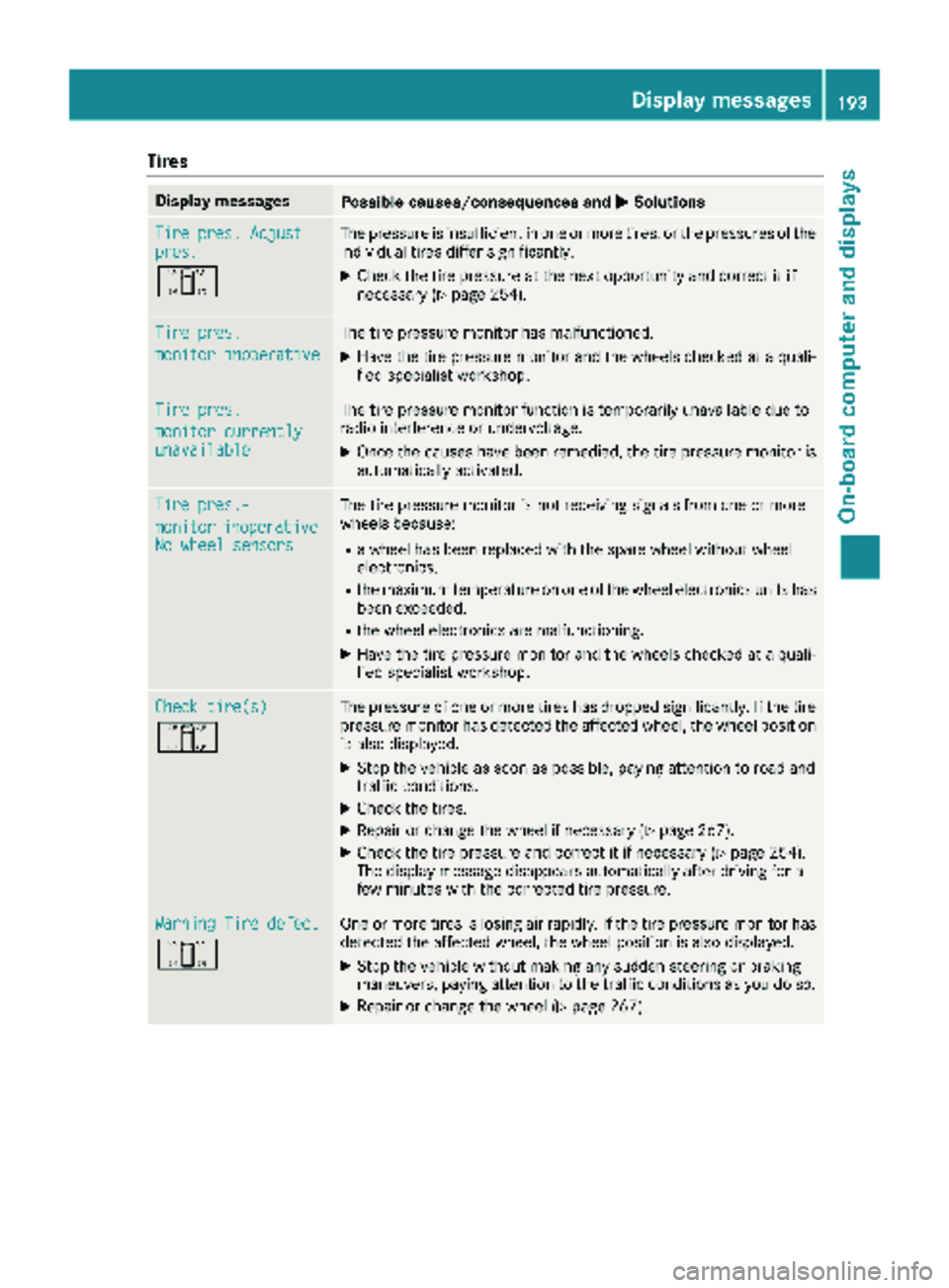
Tire pres. Adjustpres.
O
The pressure is insufficient in one or more tires, or the pressures of the
individual tires differ significantly.
XCheck the tire pressure at the next opportunity and correct it if
necessary (Ypage 254).
Tire pres.
monitor inoperative
The tire pressure monitor has malfunctioned.
XHave the tire pressure monitor and the wheels checked at a quali-
fied specialist workshop.
Tire pres.
monitor currentlyunavailable
The tire pressure monitor function is temporarily unavailable due to
radio interference or undervoltage.
XOnce the causes have been remedied, the tire pressure monitor is
automatically activated.
Tire pres.-
monitorinoperativeNo wheel sensors
The tire pressure monitor is not receiving signals from one or more
wheels because:
Ra wheel has been replaced with the spare wheel without wheel
electronics.
Rthe maximum temperature on one of the wheel electronics units has
been exceeded.
Rthe wheel electronics are malfunctioning.
XHave the tire pressure monitor and the wheels checked at a quali-
fied specialist workshop.
Check tire(s)
O
The pressure of one or more tires has dropped significantly. If the tire
pressure monitor has detected the affected wheel, the wheel position
is also displayed.
XStop the vehicle as soon as possible, paying attention to road and
traffic conditions.
XCheck the tires.
XRepair or change the wheel if necessary (Ypage 267).
XCheck the tire pressure and correct it if necessary (Ypage 254).
The display message disappears automatically after driving for a
few minutes with the corrected tire pressure.
Warning Tire defect
O
One or more tires is losing air rapidly. If the tire pressure monitor has
detected the affected wheel, the wheel position is also displayed.
XStop the vehicle without making any sudden steering or braking
maneuvers, paying attention to the traffic conditions as you do so.
XRepair or change the wheel (Ypage 267).
Displa y messages193
On-board computer and displays
Z
Page 250 of 294
Useful information
This Operator's Manual describes all models as
well as standard and optional equipment of your
vehicle that were available at the time of going
to print. Country-specific variations are possi-
ble. Note that your vehicle may not be equipped
with all of the described functions. This also
applies to systems and functions relevant to
safety.
Read the information on qualified specialist
workshops (
Ypage 27).
Important safety notes
GWarning
A flat tire severely impairs the driving, steer-
ing and braking characteristics of the vehicle.
There is a risk of an accident.
do not drive with a flat tire. Immediately
replace the flat tire with your spare wheel, or
consult a qualified specialist workshop.
GWARNING
If wheels and tires of the wrong size are used, the wheel brakes or suspension components
may be damaged. There is a risk of an acci-
dent.
Always replace wheels and tires with those
that fulfill the specifications of the original
part.
When replacing wheels, make sure to use the
correct:
Rdesignation
Rmodel
When replacing tires, make sure to use the
correct:
Rdesignation
Rmanufacturer
Rmodel
Accessories that are not approved for your vehi-
cle by Mercedes-Benz or are not being used cor-
rectly can impair operating safety. Before purchasing and using non-approved
accessories, visit a qualified specialist work-
shop and inquire about:
Rsuitability
Rlegal stipulations
Rfactory recommendations
Contact an authorized Sprinter dealer if you
require information on tested and recommen-
ded wheels and tires for summer and winter
driving. Advice on purchasing and caring for
tires is also available there.
Information on tire and wheel dimensions and
types as well as the recommended tire pressure
for your vehicle can be found in the "Tire pres-
sure" section (
Ypage 257).
This data can also be found on the Tire and
Loading Information placard on the B-pillar.
Modifications to the brake system or wheels are
not permitted. The use of a spacer and brake
dust shields is not permitted. This invalidates
the general operating permit for the vehicle.
iFurther information on wheels and tires can
be obtained at any qualified specialist work-
shop.
Operation
Information for a journey
If the vehicle is heavily laden, check the tire
pressures, and correct them, if necessary
(
Ypage 251).
While driving, pay attention to vibrations, noises
and unusual handling characteristics, e.g. pull-
ing to one side. This may indicate that the
wheels or tires are damaged. If you suspect that
a tire is defective, reduce your speed immedi-
ately. Stop the vehicle as soon as possible to
check the wheels and tires for damage. Hidden
tire damage could also be causing the unusual
handling characteristics. If you find no signs of
damage, have the tires and wheels checked at a
qualified specialist workshop.
When parking your vehicle, make sure that the
tires do not get deformed by the curb or other
obstacles. If it is necessary to drive over curbs,
speed humps or similar elevations, try to do so
slowly and not at a sharp angle. Otherwise, the
tires, particularly the sidewalls, can get dam-
aged.
248Operation
Wheels and tires
Page 252 of 294
RDo not drive with tires which have too little
tread depth, as this significantly reduces the
traction on wet roads (hydroplaning).
RReplace the tires after six years at the latest,
regardless of wear. This also applies to the
spare wheel.
Operation in winter
General notes
Have your vehicle winterproofed at a qualified
specialist workshop at the onset of winter.
Prior to the onset of winter, ensure that snow
chains are stowed in the vehicle (
Ypage 251).
Also observe the notes in the "Changing a
wheel" section (
Ypage 267).
Regularly check the vehicle and remove snow or
ice when traveling in wintry conditions.
An accumulation of snow and ice, particularly
when frozen, caught in the area around the air
intake slots, moving parts, the axles and the
wheel arches may:
Rrestrict air intake
Rdamage vehicle parts
Rcause malfunctions by restricting the mobility
intended by the design (e.g. reduced possible
steering input).
If there is any damage, inform a qualified spe-
cialist workshop.
Driving with summer tires
At temperatures below 45 ‡ (+7 †), summer
tires lose elasticity and therefore traction and
braking power. Change the tires on your vehicle
to M+S tire. Using summer tires at very cold
temperatures could cause tears to form,
thereby damaging the tires permanently. We
cannot accept responsibility for this type of
damage.
M+S tires
GWARNING
Wheel and tire dimensions as well as the type of tire can vary between the spare wheel and
the wheel to be replaced. When the spare
wheel is mounted, driving characteristics may
be severely affected. There is a risk of an acci- dent.
In order to reduce risks:
Ryou should therefore adapt your driving
style and drive carefully.
Rnever mount more than one spare wheel
that differs from the wheel to be replaced.
Ronly use a spare wheel that differs from the
wheel to be replaced for a short time.
Rdo not deactivate ESP®.
Rhave a spare wheel that differs from the
wheel that has been changed replaced at
the nearest qualified specialist workshop.
You must observe the correct wheel and
tire dimensions as well as the wheel type.
GWARNING
M+S tires with a tire tread depth of less than
ã in (4 mm) are not suitable for use in winter
and do not provide sufficient traction. There is
a risk of an accident.
M+S tires with a tread depth of less than ãin
(4 mm) must be replaced immediately.
Use winter tires or all-season tires at tempera-
tures below 45 ‡ (+7 †). Both types of tire are
identified by the M+S marking.
Only winter tires bearing the isnowflake
symbol in addition to the M+S marking provide
the best possible grip in wintry road conditions.
Only these tires will allow driving safety systems
such as ABS and ESP
®to function optimally in
winter. These tires have been developed specif-
ically for driving in snow.
For safe driving, use M+S tire sof the same make
and tread pattern on all wheels.
Always observe the maximum permissible
speed specified for the M+S tires you have
mounted.
If you install M+S tires that have a lower maxi-
mum permissible speed than the maximum per-
missible speed of the vehicle, affix an appropri-
ate warning sign in the driver's field of vision.
You can obtain this at a qualified specialist work-
shop.
250Operation in winter
Wheels and tires
Page 254 of 294
There is a risk of an accident.
Follow recommended tire inflation pressures
and check the pressure of all the tires includ-
ing the spare wheel:
Rmonthly, at least
Rif the load changes
Rbefore beginning a long journey
Runder different operating conditions, e.g.
off-road driving
If necessary, correct the tire pressure.
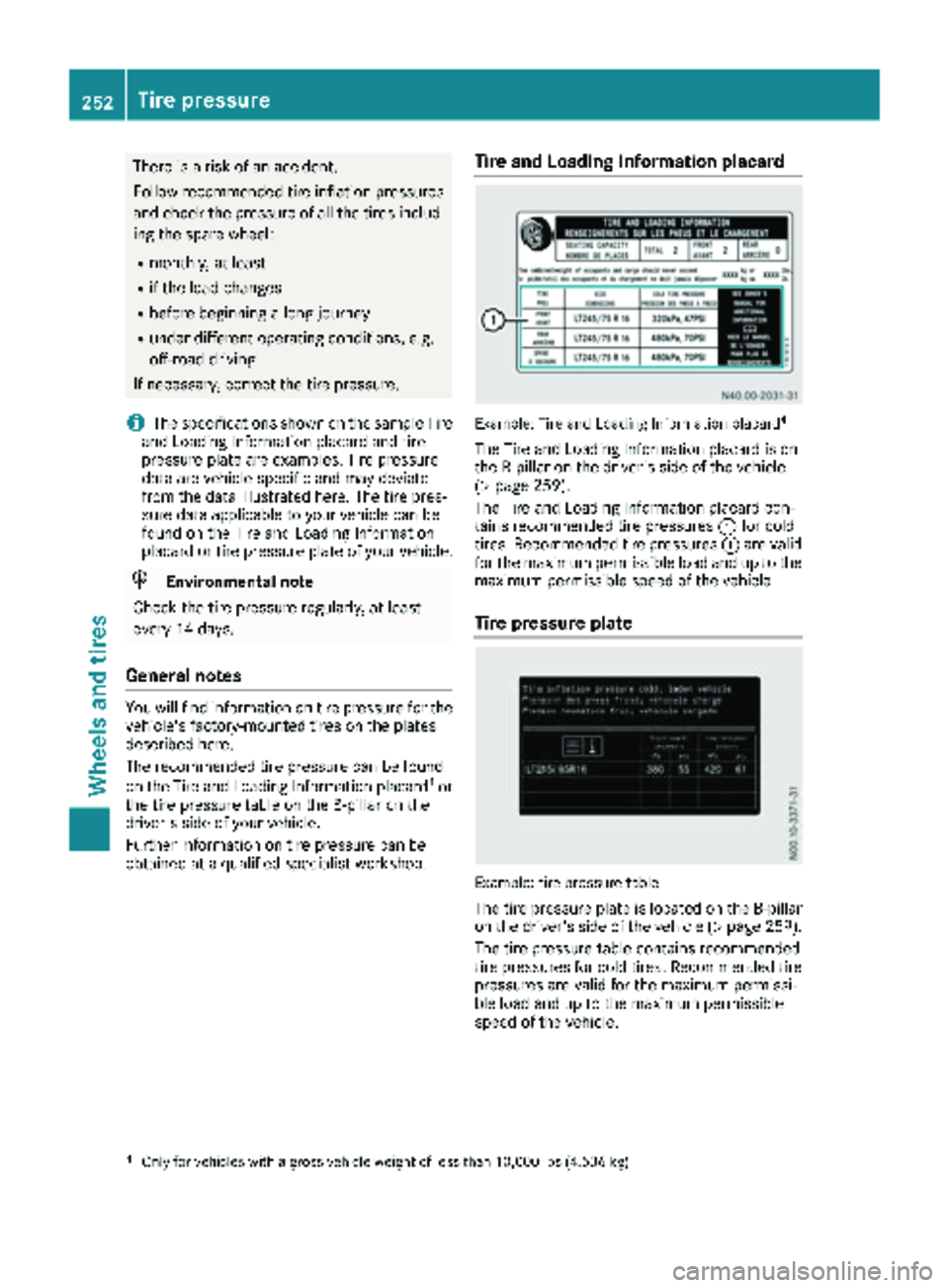
iThe specifications shown on the sample Tire
and Loading Information placard and tire
pressure plate are examples. Tire pressure
data are vehicle-specific and may deviate
from the data illustrated here. The tire pres-
sure data applicable to your vehicle can be
found on the Tire and Loading Information
placard or tire pressure plate of your vehicle.
HEnvironmental note
Check the tire pressure regularly, at least
every 14 days.
General notes
You will find information on tire pressure for the
vehicle's factory-mounted tires on the plates
described here.
The recommended tire pressure can be found
on the Tire and Loading Information placard
4or
the tire pressure table on the B-pillar on the
driver's side of your vehicle.
Further information on tire pressure can be
obtained at a qualified specialist workshop.
Tire and Loading Information placard
Example: Tire and Loading Information placard4
The Tire and Loading Information placard is on
the B-pillar on the driver's side of the vehicle
(
Ypage 259).
The Tire and Loading Information placard con-
tains recommended tire pressures :for cold
tires. Recommended tire pressures :are valid
for the maximum permissible load and up to the
maximum permissible speed of the vehicle.
Tire pressure plate
Example: tire pressure table
The tire pressure plate is located on the B-pillar
on the driver's side of the vehicle (Ypage 259).
The tire pressure table contains recommended
tire pressures for cold tires. Recommended tire pressures are valid for the maximum permissi-
ble load and up to the maximum permissible
speed of the vehicle.
4Only for vehicles with a gross vehicle weight of less than 10,000 lbs (4,536 kg)
252Tire pressure
Wheels and tires
Page 255 of 294
Important notes on tire pressure
GWARNING
If th etire pressur edrops repeatedly, th e
wheel, valv eor tire may be damaged. Tir e
pressur ethat is to olow may result in atire
blow-out .Ther eis aris kof an accident.
RChec kth etire for foreign objects .
RCheckwhether th ewhee lis losing air or th e
valv eis leaking .
If you are unable to rectify th edamage, con-
tac t a qualified specialist workshop.
Use asuitable pressur egauge to chec kth etire
pressure. The outer appearanc eof atire does
no tpermit any reliable conclusio nabout th etire
pressure. On vehicles equipped wit hth eelec -
tronic tire pressur emonitor, th etire pressur e
can be checke dusin gth eon-board computer.
The tire temperature and pressur eincreas e
when th evehicl eis in motion .This is dependen t
on th edriving spee dand th eload.
Therefore, you should only correc ttire pressur e
when th etires are cold.
The tires are cold:
Rif th evehicl ehas been parked for at least
three hour swithout direct sunligh ton th e
tires ,and
Rif th evehicl ehas no tbeen driven further than
1 mile (1. 6km)
Tir etemperature changes depending on th e
ambien ttemperature, driving spee dand tire
load. If th etire temperature changes by 18 ‡
(10 †), th etire pressur echa
nges by approx
-
imately 10 kP a(0.1 ba r/1.5psi) . Take this into
account when checking the pressure of warm
tires. Only correct the tire pressure if it is too low
for the current operating conditions. If you
check the tire pressure when the tires are warm,
it results in a higher value than when the tires
are cold. This is normal. Do not under any cir-
cumstances release the air in order to adjust the pressure to the prescribed value for cold tires.
The tire pressure would otherwise be too low. Observe the recommended tire pressures for
cold tires:
Ron the Tire and Loading Information placard5
on the B-pillar on the driver's side, or
Ron the tire pressure plate on the B-pillar on the
driver's side of the vehicle
Underinflated or overinflated tires
Underinflated tires:
GWARNING
Tires with pressure that is too low can over-
heat and burst as a consequence. In addition, they also suffer from excessive and/or irreg-
ular wear, which can severely impair the brak-
ing properties and the driving characteristics.
There is a risk of an accident.
Avoid tire pressures that are too low in all the
tires, including the spare wheel.
Underinflated tires can:
Rfail from being overheated
Radversely affect handling
Rwear excessively and/or unevenly
Rhave an adverse effect on fuel consumption
Overinflated tires
GWARNING
Tires with excessively high pressure can burst
because they are damaged more easily by
road debris, potholes etc. In addition, they
also suffer from irregular wear, which can
severely impair the braking properties and the driving characteristics. There is a risk of an
accident.
Avoid tire pressures that are too high in all the
tires, including the spare wheel.
Overinflated tires can:
Rincrease the braking distance
Radversely affect handling
Rwear excessively and/or unevenly
5Only for vehicles with a gross weight of less than 10,000 lbs (4,536 kg).
Tire pressure253
Wheels and tires
Z
Page 256 of 294
Radversely affect ride comfort
Rbe more susceptible to damage
Maximum tire pressures
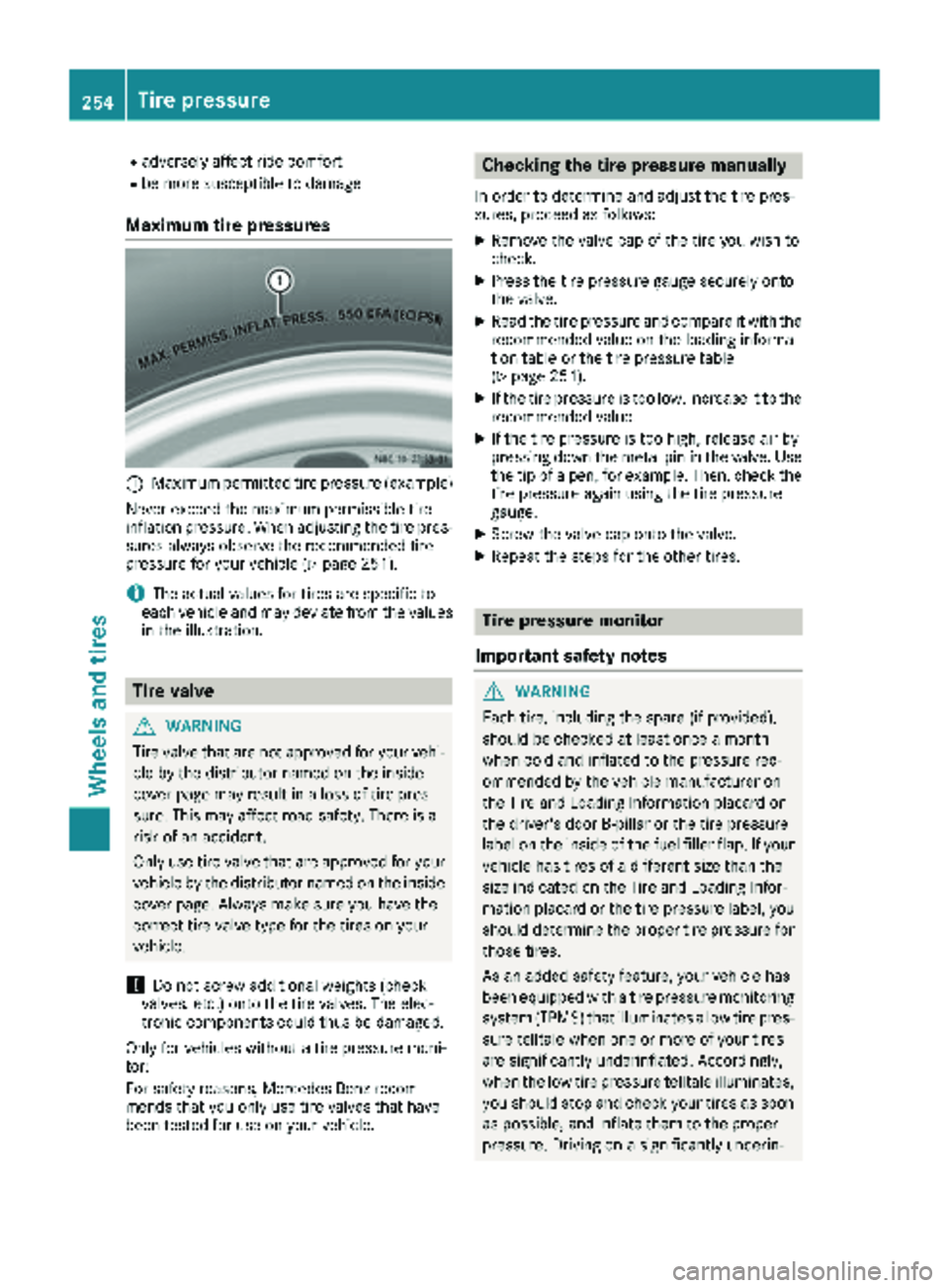
:Maximum permitted tire pressure (example)
Never exceed the maximum permissible tire
inflation pressure. When adjusting the tire pres-
sures always observe the recommended tire
pressure for your vehicle (
Ypage 251).
iThe actual values for tires are specific to
each vehicle and may deviate from the values in the illustration.
Tire valve
GWARNING
Tire valve that are not approved for your vehi-
cle by the distributor named on the inside
cover page may result in a loss of tire pres-
sure. This may affect road safety. There is a
risk of an accident.
Only use tire valve that are approved for your
vehicle by the distributor named on the inside
cover page. Always make sure you have the
correct tire valve type for the tires on your
vehicle.
!Do not screw additional weights (check
valves, etc.) onto the tire valves. The elec-
tronic components could thus be damaged.
Only for vehicles without a tire pressure moni-
tor:
For safety reasons, Mercedes-Benz recom-
mends that you only use tire valves that have
been tested for use on your vehicle.
Checking the tire pressure manually
In order to determine and adjust the tire pres-
sures, proceed as follows:
XRemove the valve cap of the tire you wish to
check.
XPress the tire pressure gauge securely onto
the valve.
XRead the tire pressure and compare it with the
recommended value on the loading informa-
tion table or the tire pressure table
(
Ypage 251).
XIf the tire pressure is too low, increase it to the
recommended value.
XIf the tire pressure is too high, release air by
pressing down the metal pin in the valve. Use
the tip of a pen, for example. Then, check the
tire pressure again using the tire pressure
gauge.
XScrew the valve cap onto the valve.
XRepeat the steps for the other tires.
Tire pressure monitor
Important safety notes
GWARNING
Each tire, including the spare (if provided),
should be checked at least once a month
when cold and inflated to the pressure rec-
ommended by the vehicle manufacturer on
the Tire and Loading Information placard on
the driver's door B-pillar or the tire pressure
label on the inside of the fuel filler flap. If your
vehicle has tires of a different size than the
size indicated on the Tire and Loading Infor-
mation placard or the tire pressure label, you
should determine the proper tire pressure for
those tires.
As an added safety feature, your vehicle has
been equipped with a tire pressure monitoring
system (TPMS) that illuminates a low tire pres-
sure telltale when one or more of your tires
are significantly underinflated. Accordingly,
when the low tire pressure telltale illuminates,
you should stop and check your tires as soon
as possible, and inflate them to the proper
pressure. Driving on a significantly underin-
254Tire pressure
Wheels and tires
Page 260 of 294
Tires/disc wheelFront axle load
3970 lbs
(1801 kg) 4100 lbs
(1860 kg)4080 lbs
(1851 kg)4410 lbs
(2000 kg)
LT 245/75 R 16 120/116Q
6.5J x 16
Wheel offset: 2.13 in (54 mm)340 kPa
(3.4 bar/49 psi)——
235/65 R 16 C 121N (118R)
6.5J x 16
Spare wheel for vehicles with
Super Single tires—380 kPa
(3.8 bar/55 psi)420 kPa
(4.2 bar/61 psi)
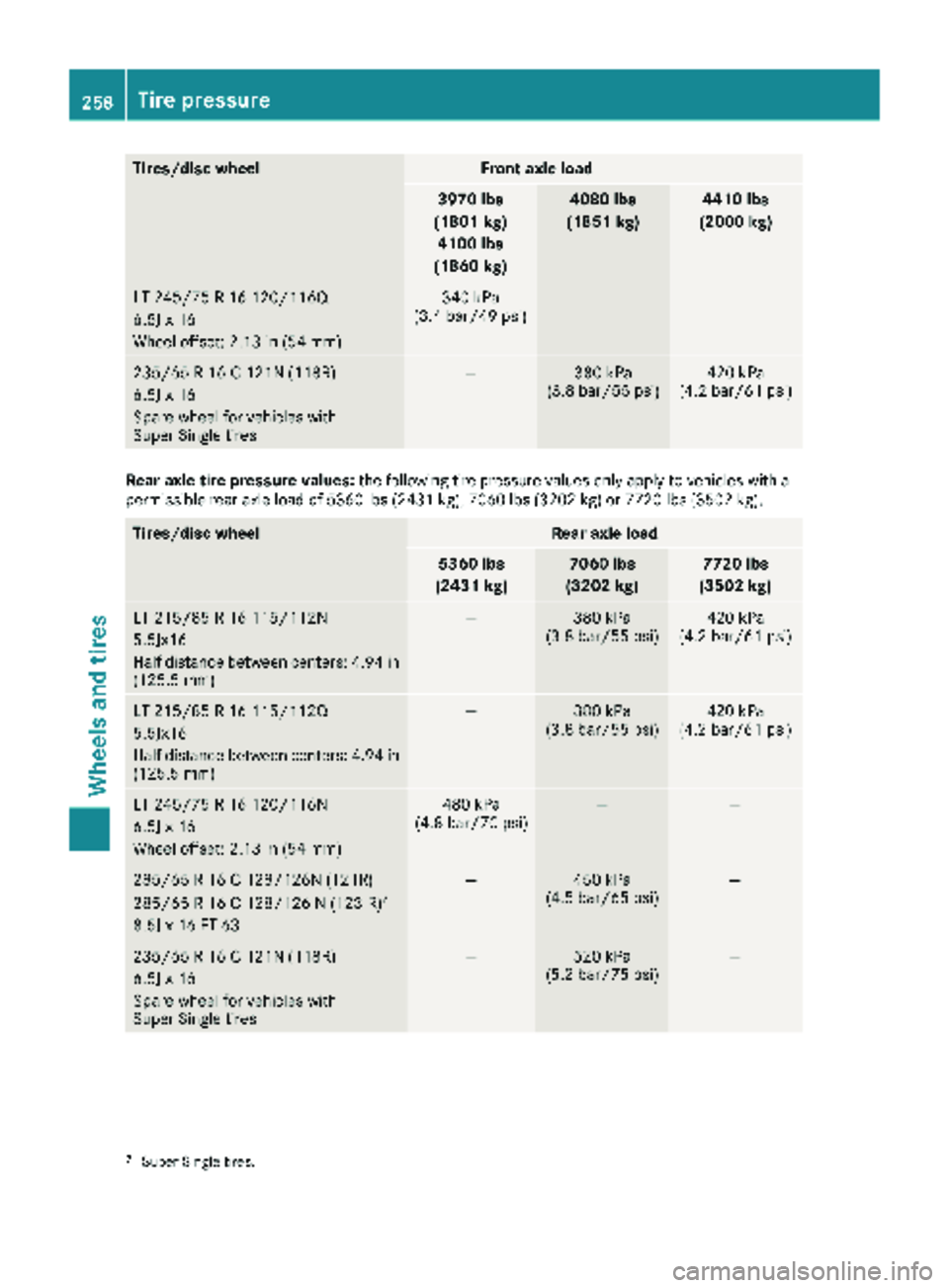
Rear axle tire pressure values: the following tire pressure values only apply to vehicles with a
permissible rear axle load of 5360 lbs (2431 kg), 7060 lbs (3202 kg) or 7720 lbs (3502 kg).
Tires/disc wheelRear axle load
5360 lbs
(2431 kg)7060 lbs
(3202 kg)7720 lbs
(3502 kg)
LT 215/85 R 16 115/112N
5.5Jx16
Half distance between centers: 4.94 in
(125.5 mm)—380 kPa
(3.8 bar/55 psi)420 kPa
(4.2 bar/61 psi)
LT 215/85 R 16 115/112Q
5.5Jx16
Half distance between centers: 4.94 in
(125.5 mm)—380 kPa
(3.8 bar/55 psi)420 kPa
(4.2 bar/61 psi)
LT 245/75 R 16 120/116N
6.5J x 16
Wheel offset: 2.13 in (54 mm)480 kPa
(4.8 ba r/70 psi)——
285/65 R16 C128/126N (121R)
285/65 R16 C128/12 6 N(123 R)7
8.5J x 16 ET 63
—450 kPa
(4.5 bar/65 psi)—
235/65 R 16 C 121N (118R)
6.5J x 16
Spare wheel for vehicles with
Super Single tires—520 kPa
(5.2 bar/75 psi)—
7Super Single tires.
258Tire pressure
Wheels and tires