wheels and tires MERCEDES-BENZ WAGON 2015 S212 Owner's Manual
[x] Cancel search | Manufacturer: MERCEDES-BENZ, Model Year: 2015, Model line: WAGON, Model: MERCEDES-BENZ WAGON 2015 S212Pages: 426, PDF Size: 8.27 MB
Page 5 of 426
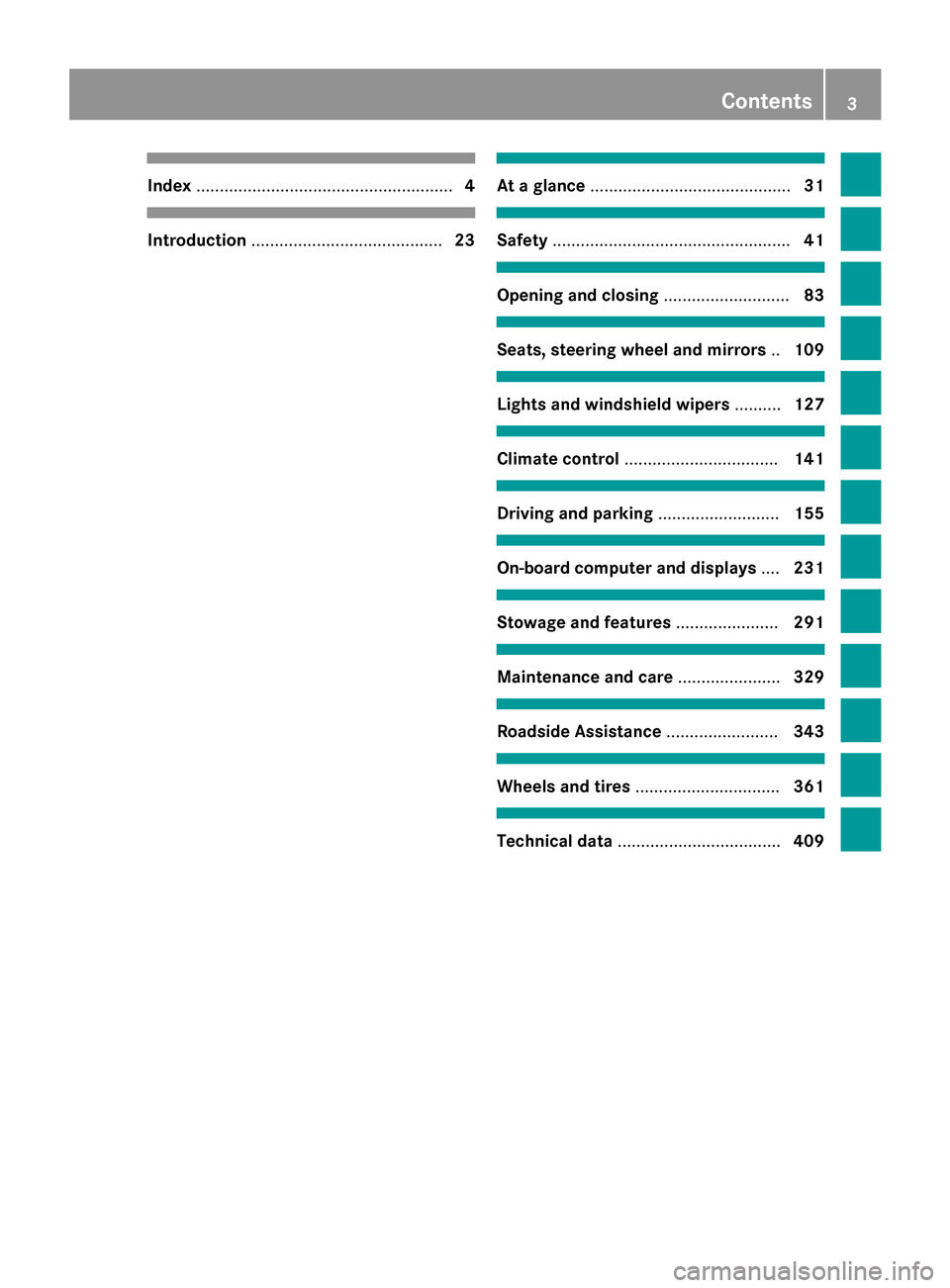
Index
....................................................... 4Introduction
......................................... 23 At a glance
........................................... 31 Safety
................................................... 41 Opening and closing
...........................83 Seats, steering wheel and mirrors
..109 Lights and windshield wipers
..........127 Climate control
................................. 141 Driving and parking
..........................155 On-board computer and displays
....231 Stowage and features
......................291 Maintenance and care
......................329 Roadside Assistance
........................343 Wheels and tires
............................... 361 Technical data
................................... 409 Contents
3
Page 16 of 426
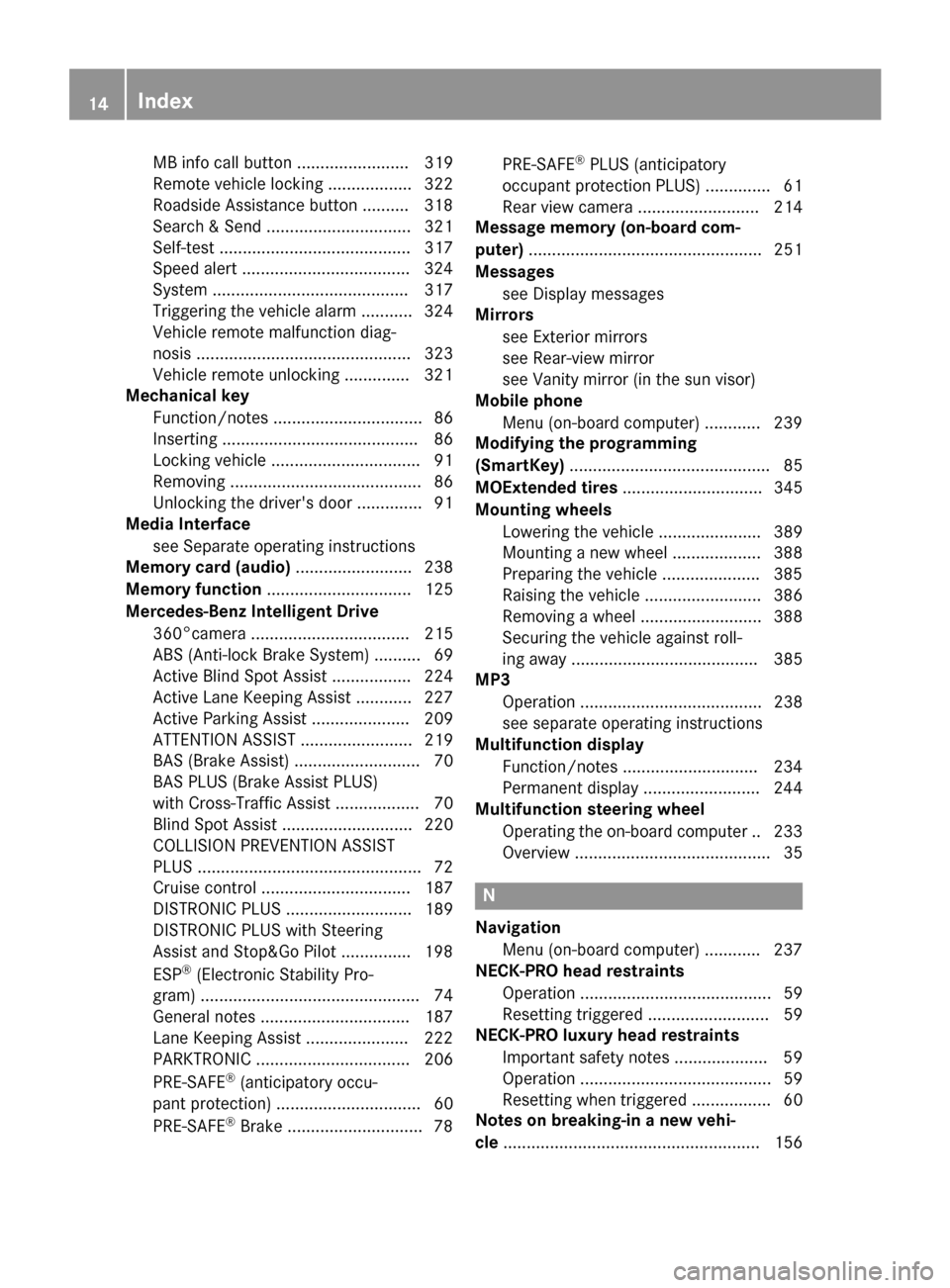
MB info call button ........................ 319
Remote vehicle locking .................. 322
Roadside Assistance button ..........3 18
Search & Send ............................... 321
Self-test ......................................... 317
Speed alert ................................... .324
System .......................................... 317
Triggering the vehicle alarm ........... 324
Vehicle remote malfunction diag-
nosis .............................................. 323
Vehicle remote unlocking .............. 321
Mechanical key
Function/notes ................................ 86
Inserting .......................................... 86
Locking vehicle ................................ 91
Removing ......................................... 86
Unlocking the driver's door .............. 91
Media Interface
see Separate operating instructions
Memory card (audio) ......................... 238
Memory function ............................... 125
Mercedes-Benz Intelligent Drive 360°camera .................................. 215
ABS (Anti-lock Brake System) .......... 69
Active Blind Spot Assist ................. 224
Active Lane Keeping Assist ............ 227
Active Parking Assist ..................... 209
ATTENTION ASSIST ........................ 219
BAS (Brake Assist) ........................... 70
BAS PLUS (Brake Assist PLUS)
with Cross-Traffic Assist .................. 70
Blind Spot Assist ............................ 220
COLLISION PREVENTION ASSIST
PLUS ................................................ 72
Cruise control ................................ 187
DISTRONIC PLUS ........................... 189
DISTRONIC PLUS with Steering
Assist and Stop&Go Pilot .............. .198
ESP ®
(Electronic Stability Pro-
gram) ............................................... 74
General notes ................................ 187
Lane Keeping Assist ..................... .222
PARKTRONIC ................................. 206
PRE-SAFE ®
(anticipatory occu-
pant protection) ............................... 60
PRE-SAFE ®
Brake ............................ .78PRE-SAFE
®
PLUS (anticipatory
occupant protection PLUS) .............. 61
Rear view camera .......................... 214
Message memory (on-board com-
puter) .................................................. 251
Messages see Display messages
Mirrors
see Exterior mirrors
see Rear-view mirror
see Vanity mirror (in the sun visor)
Mobile phone
Menu (on-board computer) ............ 239
Modifying the programming
(SmartKey) ...........................................85
MOExtended tires .............................. 345
Mounting wheels Lowering the vehicle ...................... 389
Mounting a new wheel ................... 388
Preparing the vehicle .................... .385
Raising the vehicle ......................... 386
Removing a wheel .......................... 388
Securing the vehicle against roll-
ing away ........................................ 385
MP3
Operation ....................................... 238
see separate operating instructions
Multifunction display
Function/notes ............................ .234
Permanent display ......................... 244
Multifunction steering wheel
Operating the on-board computer .. 233
Overview .......................................... 35 N
Navigation Menu (on-board computer) ............ 237
NECK-PRO head restraints
Operation ......................................... 59
Resetting triggered .......................... 59
NECK-PRO luxury head restraints
Important safety notes .................... 59
Operation ......................................... 59
Resetting when triggered ................. 60
Notes on breaking-in a new vehi-
cle ....................................................... 156 14
Index
Page 21 of 426
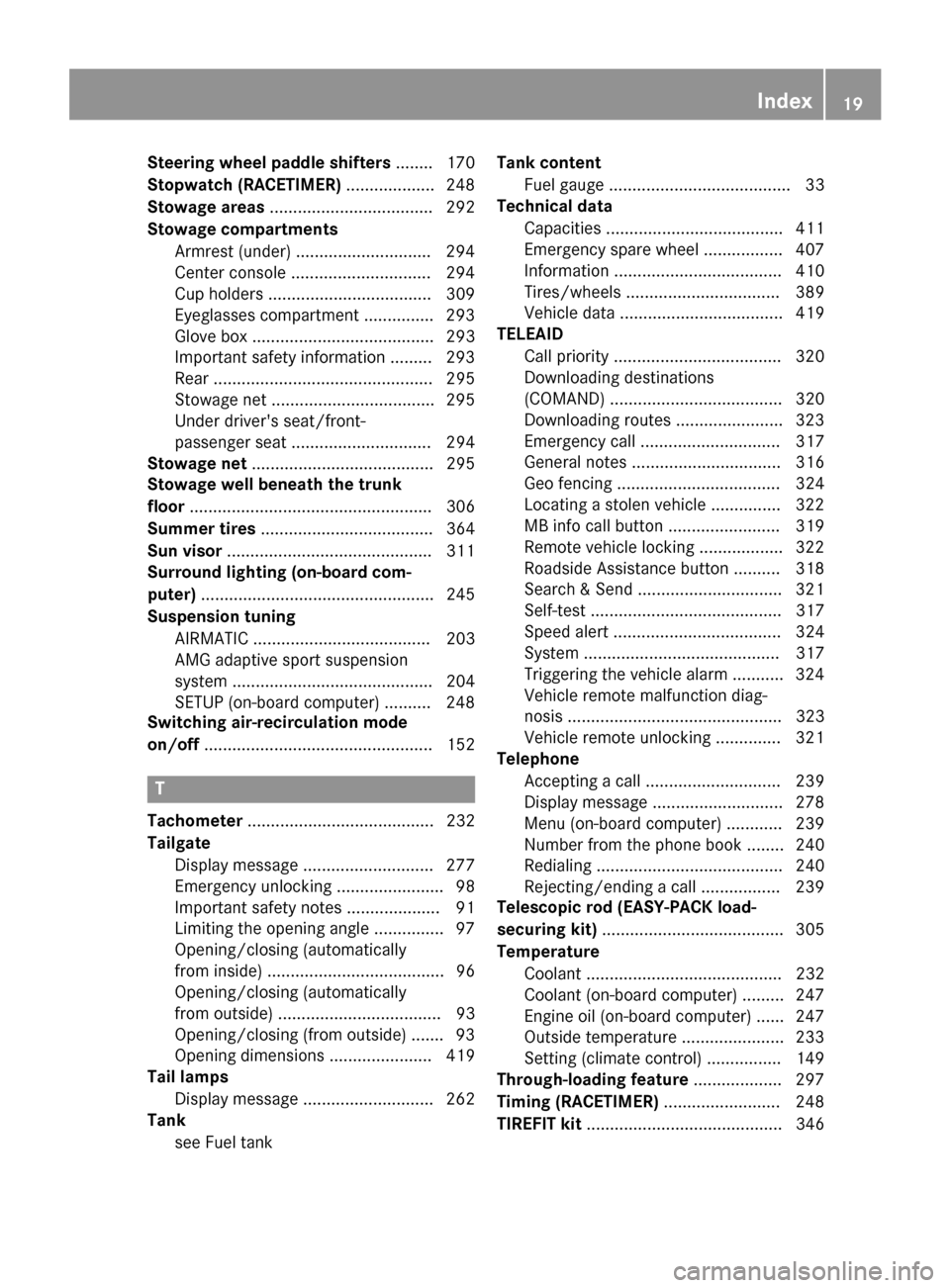
Steering wheel paddle shifters
........ 170
Stopwatch (RACETIMER) ...................248
Stowage areas ................................... 292
Stowage compartments Armrest (under) ............................ .294
Center console .............................. 294
Cup holders ................................... 309
Eyeglasses compartment .............. .293
Glove box ....................................... 293
Important safety information ......... 293
Rear ............................................... 295
Stowage net ................................... 295
Under driver's seat/front-
passenger sea t.............................. 294
Stowage net ....................................... 295
Stowage well beneath the trunk
floor .................................................... 306
Summer tires ..................................... 364
Sun visor ............................................ 311
Surround lighting (on-board com-
puter) .................................................. 245
Suspension tuning AIRMATIC ...................................... 203
AMG adaptive sport suspension
system ........................................... 204
SETUP (on-board computer) .......... 248
Switching air-recirculation mode
on/off ................................................. 152 T
Tachometer ........................................ 232
Tailgate Display message ............................ 277
Emergency unlocking ....................... 98
Important safety notes .................... 91
Limiting the opening angle ............... 97
Opening/closing (automatically
from inside) ...................................... 96
Opening/closing (automatically
from outside) ................................... 93
Opening/closing (from outside) ....... 93
Opening dimensions ...................... 419
Tail lamps
Display message ............................ 262
Tank
see Fuel tank Tank content
Fuel gauge ....................................... 33
Technical data
Capacities ...................................... 411
Emergency spare wheel ................. 407
Information .................................... 410
Tires/wheels ................................. 389
Vehicle data ................................... 419
TELEAID
Call priority .................................... 320
Downloading destinations
(COMAND) ..................................... 320
Downloading routes ....................... 323
Emergency call .............................. 317
General notes ................................ 316
Geo fencing ................................... 324
Locating a stolen vehicle ............... 322
MB info call button ........................ 319
Remote vehicle locking .................. 322
Roadside Assistance button .......... 318
Search & Send ............................... 321
Self-test ......................................... 317
Speed alert .................................... 324
System .......................................... 317
Triggering the vehicle alarm ........... 324
Vehicle remote malfunction diag-
nosis .............................................. 323
Vehicle remote unlocking .............. 321
Telephone
Accepting a cal l............................. 239
Display message ............................ 278
Menu (on-board computer) ............ 239
Number from the phone book ........ 240
Redialing ........................................ 240
Rejecting/ending a call ................. 239
Telescopic rod (EASY-PACK load-
securing kit) ....................................... 305
Temperature Coolant .......................................... 232
Coolant (on-board computer) ......... 247
Engine oil (on-board computer) ...... 247
Outside temperature ...................... 233
Setting (climate control )................ 149
Through-loading feature ................... 297
Timing (RACETIMER) ......................... 248
TIREFIT kit .......................................... 346 Index
19
Page 24 of 426
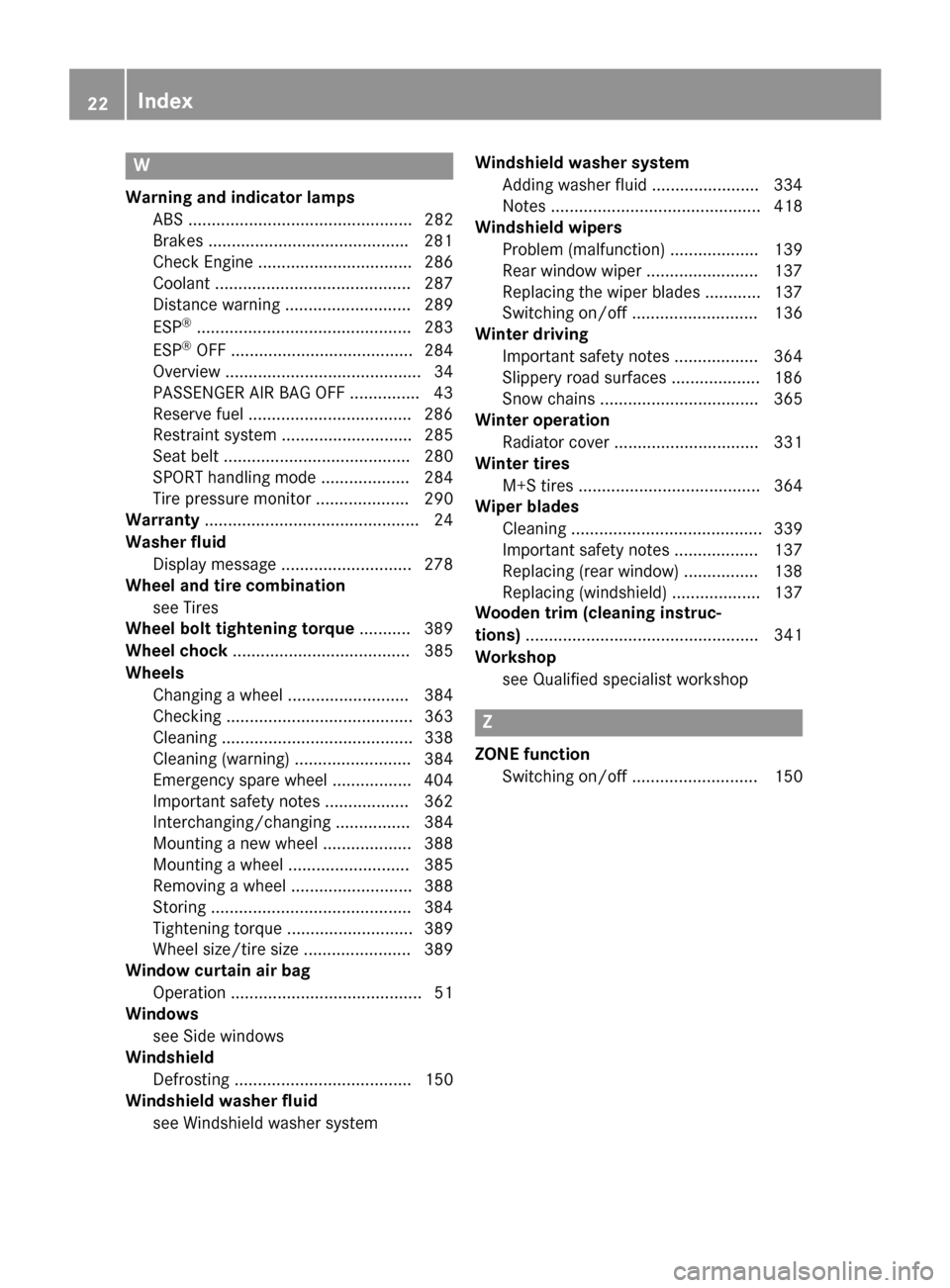
W
Warning and indicator lamps ABS ................................................ 282
Brakes .......................................... .281
Check Engine ................................. 286
Coolant .......................................... 287
Distance warning ........................... 289
ESP ®
.............................................. 283
ESP ®
OFF ....................................... 284
Overview .......................................... 34
PASSENGER AIR BAG OFF .............. .43
Reserve fuel .................................. .286
Restraint system ............................ 285
Seat belt ........................................ 280
SPORT handling mode ................... 284
Tire pressure monitor .................... 290
Warranty .............................................. 24
Washer fluid Display message ............................ 278
Wheel and tire combination
see Tires
Wheel bolt tightening torque ........... 389
Wheel chock ...................................... 385
Wheels Changing a wheel .......................... 384
Checking ........................................ 363
Cleaning ......................................... 338
Cleaning (warning) ......................... 384
Emergency spare wheel ................. 404
Important safety notes .................. 362
Interchanging/changing ................ 384
Mounting a new wheel ................... 388
Mounting a wheel .......................... 385
Removing a wheel .......................... 388
Storing .......................................... .384
Tightening torque ........................... 389
Wheel size/tire size ....................... 389
Window curtain air bag
Operation ......................................... 51
Windows
see Side windows
Windshield
Defrosting ...................................... 150
Windshield washer fluid
see Windshield washer system Windshield washer system
Adding washer fluid ....................... 334
Notes ............................................. 418
Windshield wipers
Problem (malfunction) ................... 139
Rear window wiper ........................ 137
Replacing the wiper blades ............ 137
Switching on/off ........................... 136
Winter driving
Important safety notes .................. 364
Slippery road surfaces ................... 186
Snow chains .................................. 365
Winter operation
Radiator cover ............................... 331
Winter tires
M+S tires ....................................... 364
Wiper blades
Cleaning ......................................... 339
Important safety notes .................. 137
Replacing (rear window) ................ 138
Replacing (windshield )................... 137
Wooden trim (cleaning instruc-
tions) .................................................. 341
Workshop see Qualified specialist workshop Z
ZONE function Switching on/of f........................... 150 22
Index
Page 26 of 426
You could jeopardize the operating safety of
your vehicle if you use parts, tires and wheels as well as accessories relevant to safety
which have not been approved by Mercedes.
This could lead to malfunctions in safety-rel-
evant systems, e.g. the brake system. Use
only genuine Mercedes-Benz parts or parts of
equal quality. Only use tires, wheels and
accessories that have been specifically
approved for your vehicle.
Genuine Mercedes-Benz parts are subject to
strict quality control. Every part has been spe- cifically developed, manufactured or selected
for and adapted to Mercedes-Benz vehicles.
Only genuine Mercedes-Benz parts should
therefore be used.
More than 300,000 different genuine
Mercedes-Benz parts are available for
Mercedes-Benz models.
All authorized Mercedes-Benz Centers main-
tain a supply of genuine Mercedes-Benz parts for necessary service and repair work. In addi-
tion, strategically located parts delivery cen-
ters provide quick and reliable parts service.
Always specify the vehicle identification num- ber (VIN) when ordering genuine Mercedes-
Benz parts (Y page 410). Operator's Manual
Vehicle equipment
This Operator's Manual describes all models
and all standard and optional equipment of
your vehicle available at the time of going to
print. Country-specific differences are possi-
ble. Bear in mind that your vehicle may not
feature all functions described here. This also applies to safety-relevant systems and func-
tions. The equipment in your vehicle may
therefore differ from that shown in the
descriptions and illustrations.
The original purchase agreement lists all sys- tems installed in your vehicle.
Should you have any questions concerning
equipment and operation, please consult an
authorized Mercedes-Benz Center. The Operator's Manual and Maintenance
Booklet are important documents and should
be kept in the vehicle. Service and vehicle operation
Warranty
The implied warranty for your vehicle applies in accordance with the warranty terms and
conditions in the Service and Warranty Infor-
mation booklet.
Your authorized Mercedes-Benz Center will
replace and repair all factory-installed parts in
accordance with the following warranty terms
and conditions:
R New Vehicle Limited Warranty
R Emission System Warranty
R Emission Performance Warranty
R California, Connecticut, Maine, Massachu-
setts, New York, Pennsylvania, Rhode
Island and Vermont Emission Control Sys-
tem Warranty
R State warranty enforcement laws (lemon
laws)
Replacement parts and accessories are cov-
ered by the Mercedes-Benz Parts and Acces- sories warranties. These are available at any
authorized Mercedes-Benz Center.
i Should you lose your Service and War-
ranty Information booklet, have an author-
ized Mercedes-Benz Center arrange for a
replacement. The new Service and War-
ranty Information booklet will be posted to you. 24
Introduction
Page 29 of 426
In situations like this, the body, the under-
carriage, chassis parts, wheels or tires
could be damaged without the damage
being visible. Components damaged in this way can unexpectedly fail or, in the case of
an accident, no longer withstand the strain
they are designed to.
If the underbody paneling is damaged,
combustible materials such as leaves,
grass or twigs can gather between the
underbody and the underbody paneling. If
these materials come in contact with hot
parts of the exhaust system, they can catch fire.
In such situations, have the vehicle
checked and repaired immediately at a
qualified specialist workshop. If on con-
tinuing your journey you notice that driving
safety is impaired, pull over and stop the
vehicle immediately, paying attention to
road and traffic conditions. In such cases,
visit a qualified specialist workshop. Declarations of conformity
Vehicle components which receive
and/or transmit radio waves USA:
"The wireless devices of this vehicle
comply with Part 15 of the FCC Rules. Oper-
ation is subject to the following two condi-
tions: 1) These devices may not cause harm-
ful interference, and 2) These devices must
accept any interference received, including
interference that may cause undesired oper-
ation. Changes or modifications not expressly approved by the party responsible for com-
pliance could void the user’s authority to
operate the equipment."
Canada: "The wireless devices of this vehicle
comply with Industry Canada license-exempt RSS standard(s). Operation is subject to the
following two conditions: (1) These devices
may not cause interference, and (2) These
devices must accept any interference, includ-
ing interference that may cause undesired
operation of the device." Diagnostics connection
The diagnostics connection is only intended
for the connection of diagnostic equipment at
a qualified specialist workshop. G
WARNING
If you connect equipment to the diagnostics
connection in the vehicle, it may affect the
operation of the vehicle systems. As a result, the operating safety of the vehicle could be
affected. There is a risk of an accident.
Do not connect any equipment to a diagnos-
tics connection in the vehicle. G
WARNING
Objects in the driver's footwell can restrict the pedal travel or obstruct a depressed pedal.
The operating and road safety of the vehicle is
jeopardized. There is a risk of an accident.
Make sure that all objects in the vehicle are
stowed correctly, and that they cannot enter
the driver's footwell. Install the floormats
securely and as specified in order to ensure
sufficient clearance for the pedals. Do not use loose floormats and do not place floormats on
top of one another.
! If the engine is switched off and equip-
ment on the diagnostics connection is
used, the starter battery may discharge.
Connecting equipment to the diagnostics
connection can lead to emissions monitoring information being reset, for example. This
may lead to the vehicle failing to meet the
requirements of the next emissions test dur-
ing the main inspection. Qualified specialist workshop
An authorized Mercedes-Benz Center is a
qualified specialist workshop. It has the nec-
essary specialist knowledge, tools and quali-
fications to correctly carry out the work
required on your vehicle. This is especially the case for work relevant to safety. Introduction
27 Z
Page 71 of 426
Never leave animals unattended in the vehi-
cle. Always secure animals properly during
the journey, e.g. use a suitable animal trans-
port box. Driving safety systems
Overview of driving safety systems
In this section, you will find information about the following driving safety systems:
R ABS ( Anti-lock BrakingSystem)
(Y page 69)
R BAS ( Brake Assist System) (Y page 70)
R BAS PLUS (B rakeAssist System PLUS) with
Cross-Traffic Assist (Y page 70)
R COLLISION PREVENTION ASSIST PLUS
(distance warning function and adaptive
Brake Assist) (Y page 72)
R ESP ®
(Electronic StabilityProgram)
(Y page 74)
R EBD ( Electronic Brake force Distribution)
(Y page 78)
R ADAPTIVE BRAKE (Y page 78)
R PRE-SAFE ®
Brake (Y page 78)
R STEER CONTROL (Y page 80) Important safety notes
If you fail to adapt your driving style or
become distracted, the driving safety sys-
tems can neither reduce the risk of accident
nor override the laws of physics. Driving
safety systems are merely aids designed to
assist driving. You are responsible for the dis-
tance to the vehicle in front, for vehicle speed and for braking in good time. Always adapt
your driving style to suit the prevailing road,
weather and traffic conditions and maintain a
safe distance from the vehicle in front. Drive
carefully.
i In wintry driving conditions, always use
winter tires (M+S tires) and if necessary,
snow chains. Only in this way will the driv- ing safety systems described in this section
work as effectively as possible. ABS (Anti-lock Braking System)
General information ABS regulates brake pressure in such a way
that the wheels do not lock when you brake.
This allows you to continue steering the vehi- cle when braking.
The yellow 0025ABS warning lamp in the
instrument cluster lights up when the ignition is switched on. It goes out when the engine is
running.
Important safety notes i
Observe the "Important safety notes" sec-
tion (Y page 69). G
WARNING
If ABS is faulty, the wheels could lock when
braking. The steerability and braking charac-
teristics may be severely impaired. Addition-
ally, further driving safety systems are deac-
tivated. There is an increased danger of skid- ding and accidents.
Drive on carefully. Have ABS checked imme-
diately at a qualified specialist workshop.
When ABS is malfunctioning, other systems,
including driving safety systems, will also
become inoperative. Observe the information on the ABS warning lamp (Y page 282) and
display messages which may be shown in the
instrument cluster (Y page 252).
ABS works from a speed of about 5 mph
(8 km/h), regardless of road-surface condi-
tions. ABS works on slippery surfaces, even if
you only brake gently. Driving safety systems
69Safety Z
Page 76 of 426
Adaptive Brake Assist provides braking assis-
tance in hazardous situations at speeds
above 4 mph (7 km/h). It uses radar sensor
technology to assess the traffic situation. G
WARNING
Adaptive Brake Assist cannot always clearly
identify objects and complex traffic situa-
tions.
In such cases, Adaptive Brake Assist may:
R intervene unnecessarily
R not intervene
There is a risk of an accident.
Always pay careful attention to the traffic sit- uation and be ready to brake. Terminate the
intervention in a non-critical driving situation. G
WARNING
Adaptive Brake Assist does not react:
R to people or animals
R to oncoming vehicles
R to crossing traffic
R when cornering
As a result, Adaptive Brake Assist may not
intervene in all critical conditions. There is a
risk of an accident.
Always pay careful attention to the traffic sit- uation and be ready to brake.
Due to the nature of the system, particularly
complicated but non-critical driving condi-
tions may also cause Brake Assist to inter-
vene.
If Adaptive Brake Assist is not available due to a malfunction in the radar sensor system, thebrake system remains available with full
brake boosting effect and BAS.
With the help of Adaptive Brake Assist, the
distance warning signal can detect obstacles
that are in the path of your vehicle for an
extended period of time.
If adaptive Brake Assist has detected that
there is a risk of a collision, it calculates the
braking force necessary to avoid a collision.
Should you apply the brakes vigorously, Adaptive Brake Assist will automatically
increase the braking force to a level suitable
for the traffic conditions.
X Keep the brake pedal depressed until the
emergency braking situation is over.
ABS prevents the wheels from locking.
The brakes will work normally again if:
R you release the brake pedal.
R there is no longer any danger of a collision.
R no obstacle is detected in front of your
vehicle.
Adaptive Brake Assist is then deactivated.
If adaptive Brake Assist demands particularly
high braking force, preventative passenger
protection measures (PRE-SAFE ®
) are activa-
ted simultaneously.
Up to vehicle speeds of around 155 mph
(250 km/h), adaptive Brake Assist is capable
of reacting to moving objects that have
already been recognized as such at least once
over the period of observation.
Up to a speed of approximately 44 mph
(70 km/h), adaptive Brake Assist reacts to
stationary obstacles. ESP
®
(Electronic Stability Program)
General notes i
Observe the "Important safety notes" sec-
tion (Y page 69).
ESP ®
monitors driving stability and traction,
i.e. power transmission between the tires and
the road surface.
If ESP ®
detects that the vehicle is deviating
from the direction desired by the driver, one
or more wheels are braked to stabilize the
vehicle. The engine output is also modified to keep the vehicle on the desired course within
physical limits. ESP ®
assists the driver when
pulling away on wet or slippery roads. ESP ®
can also stabilize the vehicle during braking. 74
Driving safety systemsSafety
Page 188 of 426
For this reason, in the event of heavy rain or in
conditions in which hydroplaning may occur,
you must drive in the following manner:
R lower your speed.
R avoid ruts.
R avoid sudden steering movements.
R brake carefully.
Driving on flooded roads !
Do not drive through flooded areas.
Check the depth of any water before driving
through it. Drive slowly through standing
water. Otherwise, water may enter the
vehicle interior or the engine compartment.
This can damage the electronic compo-
nents in the engine or the automatic trans- mission. Water can also be drawn in by the engine's air suction nozzles and this can
cause engine damage. Winter driving
G
WARNING
If you shift down on a slippery road surface in an attempt to increase the engine's braking
effect, the drive wheels could lose their grip.
There is an increased danger of skidding and
accidents.
Do not shift down for additional engine brak-
ing on a slippery road surface. G
DANGER
If the exhaust pipe is blocked or adequate
ventilation is not possible, poisonous gases
such as carbon monoxide (CO) may enter the vehicle. This is the case, e.g. if the vehicle
becomes trapped in snow. There is a risk of
fatal injury.
If you leave the engine or the auxiliary heating
running, make sure the exhaust pipe and area
around the vehicle are clear of snow. To
ensure an adequate supply of fresh air, open a window on the side of the vehicle that is not
facing into the wind. Have your vehicle winter-proofed at a quali-
fied specialist workshop at the onset of win-
ter.
Drive particularly carefully on slippery road
surfaces. Avoid sudden acceleration, steering and braking maneuvers. Do not use the cruise
control or DISTRONIC PLUS.
If the vehicle threatens to skid or cannot be
stopped when moving at low speed:
X Shift the transmission to position N.
i Vehicles with a diesel engine:
do not
cover the radiator, e.g. with a protective
cover. The measuring function of the
onboard diagnosis system may otherwise
provide inaccurate values. Some of these
values are required by law and must there- fore always be accurate.
The outside temperature indicator is not
designed to serve as an ice-warning device
and is therefore unsuitable for that purpose.
Changes in the outside temperature are dis-
played after a short delay.
Indicated temperatures just above the freez-
ing point do not guarantee that the road sur-
face is free of ice. The road may still be icy,
especially in wooded areas or on bridges. The vehicle could skid if you fail to adapt your
driving style. Always adapt your driving style
and drive at a speed to suit the prevailing
weather conditions.
You should pay special attention to road con-
ditions when temperatures are around freez-
ing point.
For more information on driving with snow
chains, see (Y page 365).
For more information on driving with summer
tires, see (Y page 364).
Observe the notes in the "Winter operation"
section (Y page 364). 186
Driving tipsDriving and parking
Page 208 of 426
!
Never tow the vehicle with one axle
raised. This may damage the transfer case.
Damage of this sort is not covered by the
Mercedes-Benz Limited Warranty. All
wheels must remain either on the ground or be fully raised. Observe the instructions for
towing the vehicle with all wheels in full
contact with the ground.
i In wintry driving conditions, the maximum
effect of 4MATIC can only be achieved if
you use winter tires (M+S tires), with snow
chains if necessary.
4MATIC ensures that all four wheels are per-
manently driven. Together with ESP ®
, it
improves the traction of your vehicle when-
ever a drive wheel spins due to insufficient
grip. PARKTRONIC
Important safety notes PARKTRONIC is an electronic parking aid with
ultrasonic sensors. It monitors the area
around your vehicle using six sensors in the
front bumper and six sensors in the rear
bumper. PARKTRONIC indicates visually and
audibly the distance between your vehicle
and an object.
PARKTRONIC is only an aid. It is not a replace-
ment for your attention to your immediate
surroundings. You are always responsible for
safe maneuvering, parking and exiting a park-
ing space. When maneuvering, parking or
pulling out of a parking space, make sure that there are no persons, animals or objects in
the area in which you are maneuvering.
! When parking, pay particular attention to
objects above or below the sensors, such
as flower pots or trailer drawbars.
PARKTRONIC does not detect such objects
when they are in the immediate vicinity of
the vehicle. You could damage the vehicle
or the objects.
The sensors may not detect snow and other
objects that absorb ultrasonic waves. Ultrasonic sources such as an automatic
car wash, the compressed-air brakes on a
truck or a pneumatic drill could cause
PARKTRONIC to malfunction.
PARKTRONIC may not function correctly on
uneven terrain.
PARKTRONIC is activated automatically when you:
R switch on the ignition
R shift the transmission to position D,Ror N
R release the parking brake
PARKTRONIC is deactivated at speeds above
11 mph (18 km/h). It is reactivated at lower
speeds.
Range of the sensors General notes
PARKTRONIC does not take objects into con-
sideration that are:
R below the detection range, e.g. people, ani-
mals or objects.
R above the detection range, e.g. overhang-
ing loads, truck overhangs or loading
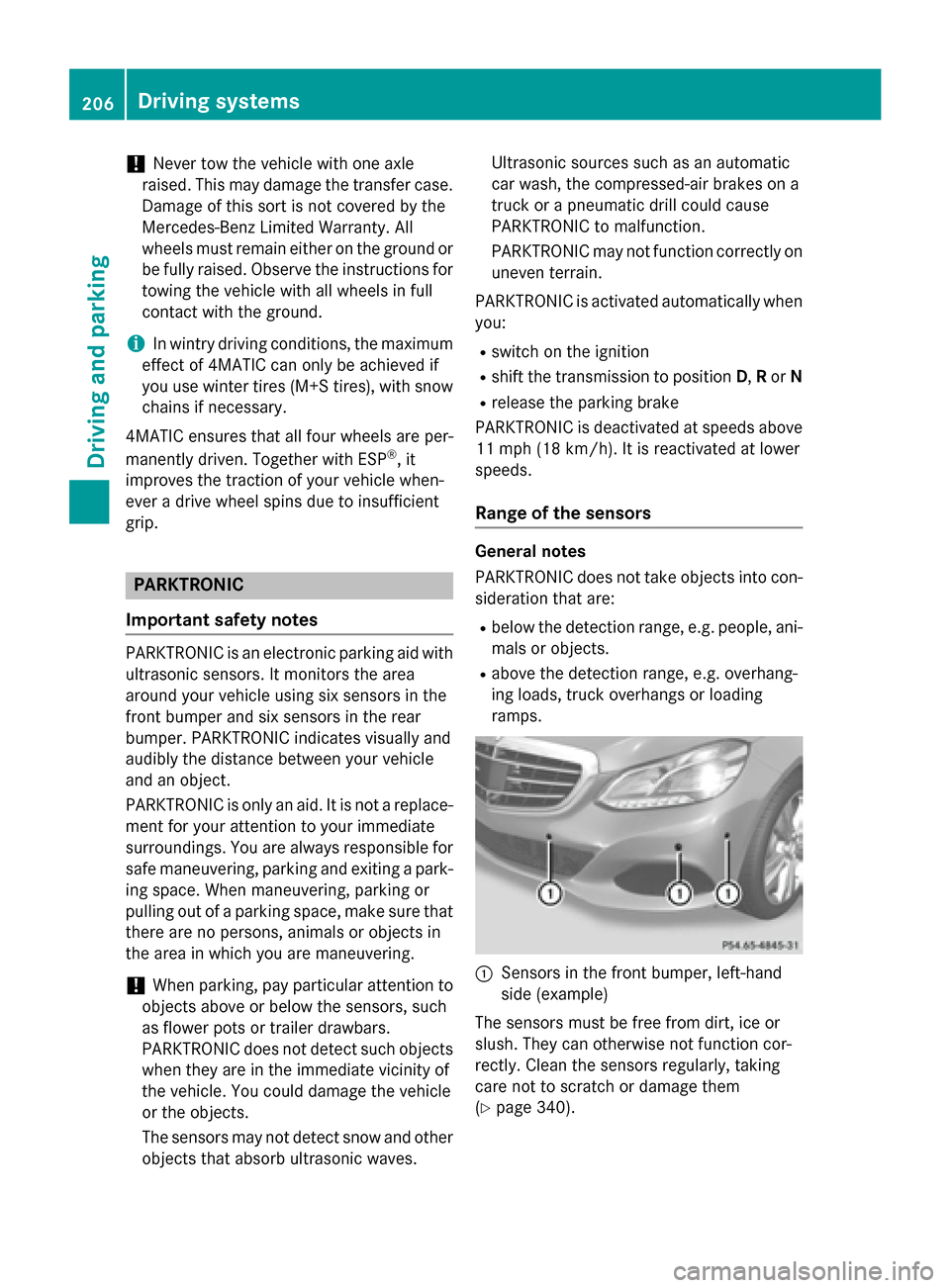
ramps. 0043
Sensors in the front bumper, left-hand
side (example)
The sensors must be free from dirt, ice or
slush. They can otherwise not function cor-
rectly. Clean the sensors regularly, taking
care not to scratch or damage them
(Y page 340). 206
Driving systemsDriving and parking