wheel MERCEDES-BENZ WAGON 2016 User Guide
[x] Cancel search | Manufacturer: MERCEDES-BENZ, Model Year: 2016, Model line: WAGON, Model: MERCEDES-BENZ WAGON 2016Pages: 350, PDF Size: 6.71 MB
Page 23 of 350
Reached (TIREFIT) .......................... 274
Recommended .............................. .291
Tire pressure monitor
Checking the tire pressure elec-
tronically ........................................ 296
Function/notes .............................2 94
General notes ................................ 294
Important safety notes .................. 295
Radio type approval for the tire
pressure monitor ........................... 297
Restarting ...................................... 297
Warning lamp ................................. 211
Warning message .......................... 296
Tire-change tool kit ........................... 270
TIREFIT kit .......................................... 273
Tires
Aspect ratio (definition) ................. 308
Average weight of the vehicle
occupants (definition) .................... 307
Bar (definition) ............................... 306
Changing a wheel .......................... 309
Characteristics .............................. 306
Checking ........................................ 289
Curb weight (definition) ................. 308
Definition of terms ......................... 306
Direction of rotation ...................... 309
Display message ............................ 200
Distribution of the vehicle occu-
pants (definition) ............................ 309
DOT (Department of Transporta-
tion) (definition) ............................. 307
DOT, Tire Identification Number
(TIN) ............................................... 306
GAWR (Gross Axle Weight Rating)
(definition) ..................................... 307
General notes ................................ 314
GVW (Gross Vehicle Weight) (def-
inition) ........................................... 307
GVWR (Gross Vehicle Weight Rat-
ing) (definition) .............................. 307
Important safety notes .................. 288
Increased vehicle weight due to
optional equipment (definition) ...... 307
Information on driving .................... 288
Kilopascal (kPa ) (
definition) ........... 307
Labeling (overview) ........................ 303
Load bearing index (definition) ...... 308
Load index ..................................... 305 Load index (definition) ................... 307
Maximum load on a tire (defini-
tion) ............................................... 308
Maximum loaded vehicle weight
(definition) ..................................... 307
Maximum permissible tire pres-
sure (definition) ............................. 308
Maximum tire load ......................... 305
Maximum tire load (definition) ....... 308
MOExtended tires .......................... 290
Optional equipment weight (defi-
nition) ............................................ 308
PSI (pounds per square inch) (def-
inition) ........................................... 308
Replacing ....................................... 309
Service life ..................................... 290
Sidewall (definition) ....................... 308
Speed rating (definition) ................ 307
Storing ........................................... 309
Structure and characteristics
(definition) ..................................... 306
Temperature .................................. 302
TIN (Tire Identification Number)
(definition) ..................................... 308
Tire bead (definition) ...................... 308
Tire pressure (definition) ................ 308
Tire pressures (recommended) ...... 307
Tire size (data) ............................... 314
Tire size designation, load-bearing
capacity, speed rating .................... 303
Tire tread ....................................... 289
Tire tread (definition) ..................... 308
Total load limit (definition) ............. 309
Traction ......................................... 302
Traction (definition) ....................... 308
Tread wear ..................................... 302
Uniform Tire Quality Grading
Standards ...................................... 301
Uniform Tire Quality Grading
Standards (definition) .................... 307
Wear indicator (definition) ............. 308
Wheel and tire combination ........... 316
Wheel rim (definition) .................... 307
see Fl
at tire
Top Tether ............................................ 71
Tow-starting
Emergency engine starting ............ 284
Important safety notes .................. 281
Index21
Page 25 of 350
Vehicle dimensions........................... 344
Vehicle emergency locking ................ 96
Vehicle identification number
see VIN
Vehicle identification plate .............. 336
Vehicle level
AIRMATIC ...................................... 166
Vehicle maintenance
see ASSYST PLUS
Vehicle tool kit .................................. 270
Video
see also Digital Operator's Man-
ual .................................................. 214
Video (DVD) ........................................ 190
VIN
Seat ............................................... 336
Type plate ...................................... 336
Voice Control System
see Separate operating instructions
W
Warning and indicator lampsABS ................................................ 205
Brakes ........................................... 204
Check Engine ................................. 202
Coolant .......................................... 209
Distance warning ........................... 210
ESP
®.............................................. 206
ESP®OFF ....................................... 207
Fuel tank ........................................ 202
General notes ................................ 202
Overview .......................................... 38
PASSENGER AIR BAG OFF ............... 49
Reserve fuel ................................... 202
Restraint system ............................ 208
Seat belt ........................................ 202
SPORT handling mode ................... 207
Tire pressure monitor .................... 211
Warranty .............................................. 28
Washer fluid
Display message ............................ 191
Wheel and tire combination
see Tires
Wheel bolt tightening torque ........... 313
Wheel chock ...................................... 310
Wheels
Changing a wheel .......................... 309 Checking ........................................ 289
Cleaning ......................................... 268
Emergency spare wheel ................. 329
General notes ................................ 314
Important safety notes .................. 288
Information on driving .................... 288
Interchanging/changing ................ 309
Mounting a new wheel ................... 313
Mounting a wheel .......................... 309
Removing a wheel .......................... 312
Storing ........................................... 309
Tightening torque ........................... 313
Wheel size/tire size ....................... 314
Window curtain air bag
Operation ......................................... 57
Windows
see Side windows
Windshield
Defrosting ...................................... 133
Windshield washer fluid
see Windshield washer system
Windshield washer system
Adding washer fluid ....................... 266
Important safety notes .................. 343
Windshield wipers
Problem (malfunction) ................... 127
Rear window wiper ........................ 125
Replacing the wiper blades ............ 125
Switching on/off ........................... 125
Winter driving
Important safety notes .................. 290
Slippery road surfaces ................... 155
Snow chains .................................. 291
Winter operation
Radiator cove r ............................... 263
Wi
nter tires
M+S tires ....................................... 290
Wiper blades
Cleaning ......................................... 268
Important safety notes .................. 125
Replacing (rear window) ................ 126
Replacing (windshield) ................... 126
Wooden trim (cleaning instruc-
tions) .................................................. 268
Workshop
see Qualified specialist workshop
Index23
Page 30 of 350
You could jeopardize the operating safety of
your vehicle if you use parts, tires and wheels
as well as accessories relevant to safety
which have not been approved by Mercedes.
This could lead to malfunctions in safety-rel-
evant systems, e.g. the brake system. Use
only genuine Mercedes-Benz parts or parts of
equal quality. Only use tires, wheels and
accessories that have been specifically
approved for your vehicle.
Genuine Mercedes-Benz parts are subject to
strict quality control. Every part has been spe- cifically developed, manufactured or selected
for and adapted to Mercedes-Benz vehicles.
Only genuine Mercedes-Benz parts should
therefore be used.
More than 300,000 different genuine
Mercedes-Benz parts are available for
Mercedes-Benz models.
All authorized Mercedes-Benz Centers main-
tain a supply of genuine Mercedes-Benz parts for necessary service and repair work. In addi-
tion, strategically located parts delivery cen-
ters provide quick and reliable parts service.
Always specify the vehicle identification num-
ber (VIN) when ordering genuine Mercedes-
Benz parts (
Ypage 336).
Operator's Manual
Vehicle equipment
This Operator's Manual describes all models
and all standard and optional equipment of
your vehicle available at the time of going to
print. Country-specific differences are possi-
ble. Bear in mind that your vehicle may not
feature all functions described here. This also
applies to safety-relevant systems and func-
tions. The equipment in your vehicle may
therefore differ from that shown in the
descriptions and illustrations.
The original purchase agreement lists all sys-
tems installed in your vehicle.
Should you have any questions concerning
equipment and operation, please consult an
authorized Mercedes-Benz Center. The Operator's Manual and Maintenance
Booklet are important documents and should
be kept in the vehicle.
Service and vehicle operation
Warranty
The implied warranty for your vehicle applies
in accordance with the warranty terms and
conditions in the Service and Warranty Infor-
mation booklet.
Your authorized Mercedes-Benz Center will
replace and repair all factory-installed parts in
accordance with the following warranty terms
and conditions:
RNew Vehicle Limited Warranty
REmission System Warranty
REmission Performance Warranty
RCalifornia, Connecticut, Maine, Massachu-
setts, New York, Pennsylvania, Rhode
Island and Vermont Emission Control Sys-
tem Warranty
RState warranty enforcement laws (lemon
laws)
Replacement parts and accessories are cov-
ered by the Mercedes-Benz Parts and Acces-
sories warranties. These are available at any
authorized Mercedes-Benz Center.
iShould you lose your Service and War-
ranty Information booklet, have an author-
ized Mercedes-Benz Center arrange for a
replacement. The new Service and War-
ranty Information booklet will be posted to
you.
28Introduction
Page 32 of 350
the Service and Guarantee booklet or simply
call the Mercedes-Benz Customer Assistance
Center (USA) at the hotline number
1-800-FOR-MERCedes(1-800-367-6372) or
Customer Service (Canada) at
1-800-387-0100.
Vehicle operation outside the USA
and Canada
If you plan to operate your vehicle in foreign
countries, please be aware that:
Rservice facilities or replacement parts may
not be readily available.
Runleaded fuel for vehicles with a catalytic
converter may not be available. Leaded fuel may cause damage to the catalytic con-
verter.
Rthe fuel may have a considerably lower
octane rating. Unsuitable fuel can cause
engine damage.
Some Mercedes-Benz models are available
for delivery in Europe through our European
Delivery Program. For details, consult an
authorized Mercedes-Benz Center or write to
one of the following addresses.
In the USA
Mercedes-Benz USA, LLC
European Delivery Department
One Mercedes Drive
Montvale, NJ 07645-0350
In Canada
Mercedes-Benz Canada, Inc.
European Delivery Department
98 Vanderhoof Avenue
Toronto, Ontario M4G 4C9
Operating safety
Important safety notes
GWARNING
If you do not have the prescribed service/
maintenance work or any required repairs
carried out, this can result in malfunctions or system failures. There is a risk of an accident.
Always have the prescribed service/mainte-
nance work as well as any required repairs
carried out at a qualified specialist workshop.
GWARNING
Flammable material such as leaves, grass or
twigs may ignite if they come into contact with
hot parts of the exhaust system. There is a risk of fire.
When driving off road or on unpaved roads,
check the vehicle's underside regularly. In
particular, remove parts of plants or other
flammable materials which have become
trapped. In the case of damage, contact a
qualified specialist workshop.
GWARNING
Modifications to electronic components, their software as well as wiring can impair their
function and/or the function of other net-
worked components. In particular, systems
relevant to safety could also be affected. As a
result, these may no longer function as inten-
ded and/or jeopardize the operating safety of
the vehicle. There is an increased risk of an
accident and injury.
Never tamper with the wiring as well as elec-
tronic components or their software. You
should have all work to electrical and elec-
tronic equipment carried out at a qualified
specialist workshop.
!There is a risk of damage to the vehicle if:
Rthe vehicle becomes stuck, e.g. on a high
curb or an unpaved road
Ryou drive too fast over an obstacle, e.g. a
curb or a hole in the road
Ra heavy object strikes the undercarriage
or parts of the chassis
In situations like this, the body, the under-
carriage, chassis parts, wheels or tires
could be damaged without the damage
being visible. Components damaged in this
way can unexpectedly fail or, in the case of
30Introduction
Page 37 of 350
Cockpit................................................. 36
Instrument cluster ..............................37
Multifunction steering wheel .............39
Center console .................................... 41
Overhead control panel ......................44
Door control panel .............................. 45
35
At a glance
Page 38 of 350
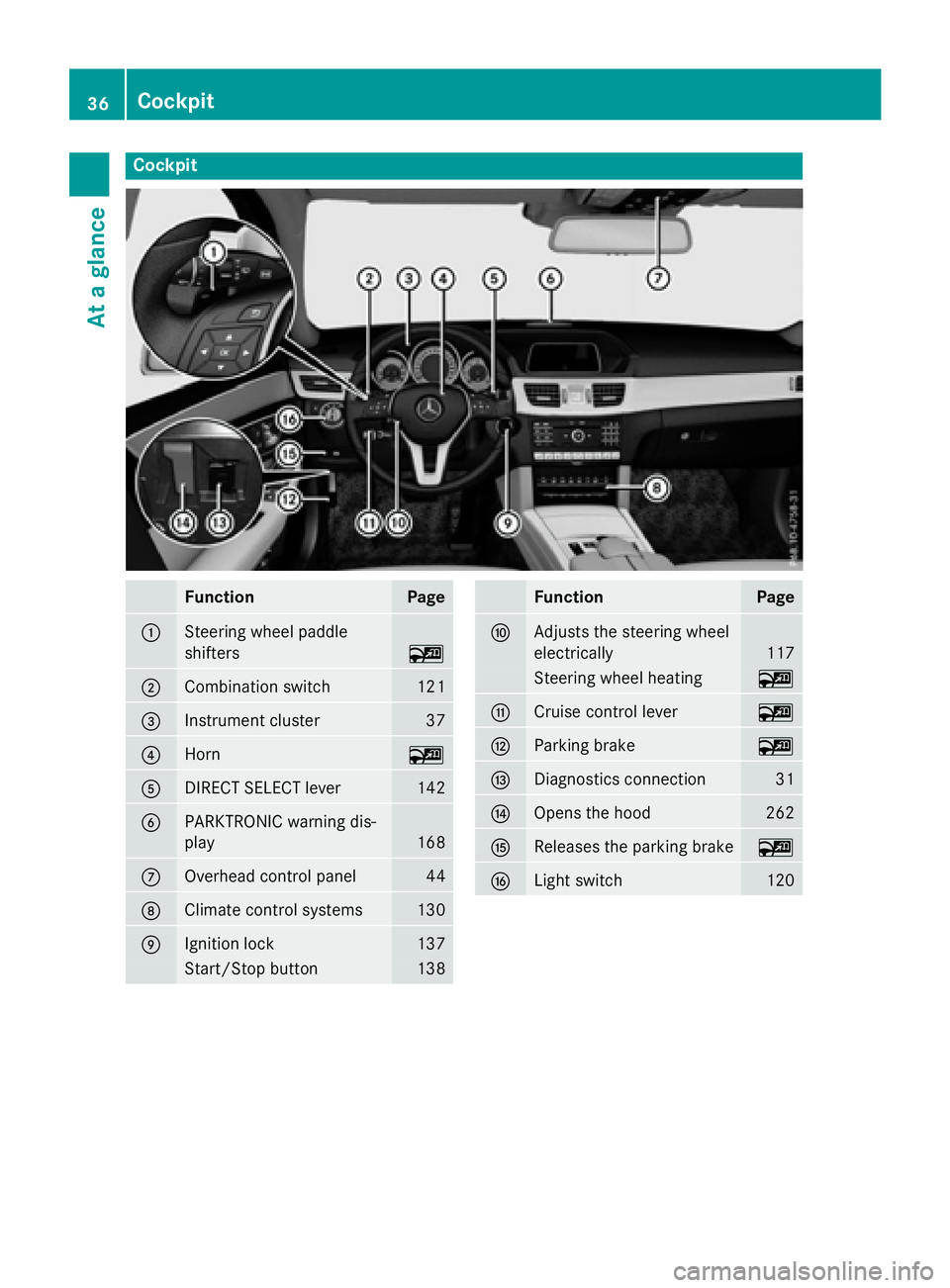
Cockpit
FunctionPage
:Steering wheel paddle
shifters
~
;Combination switch121
=Instrument cluster37
?Horn~
ADIRECT SELECT lever142
BPARKTRONIC warning dis-
play
168
COverhead control panel44
DClimate control systems130
EIgnition lock137
Start/Stop button138
FunctionPage
FAdjusts the steering wheel
electrically
117
Steering wheel heating~
GCruise control lever~
HParking brake~
IDiagnostics connection31
JOpens the hood262
KReleases the parking brake~
LLight switch120
36Cockpit
At a glance
Page 41 of 350
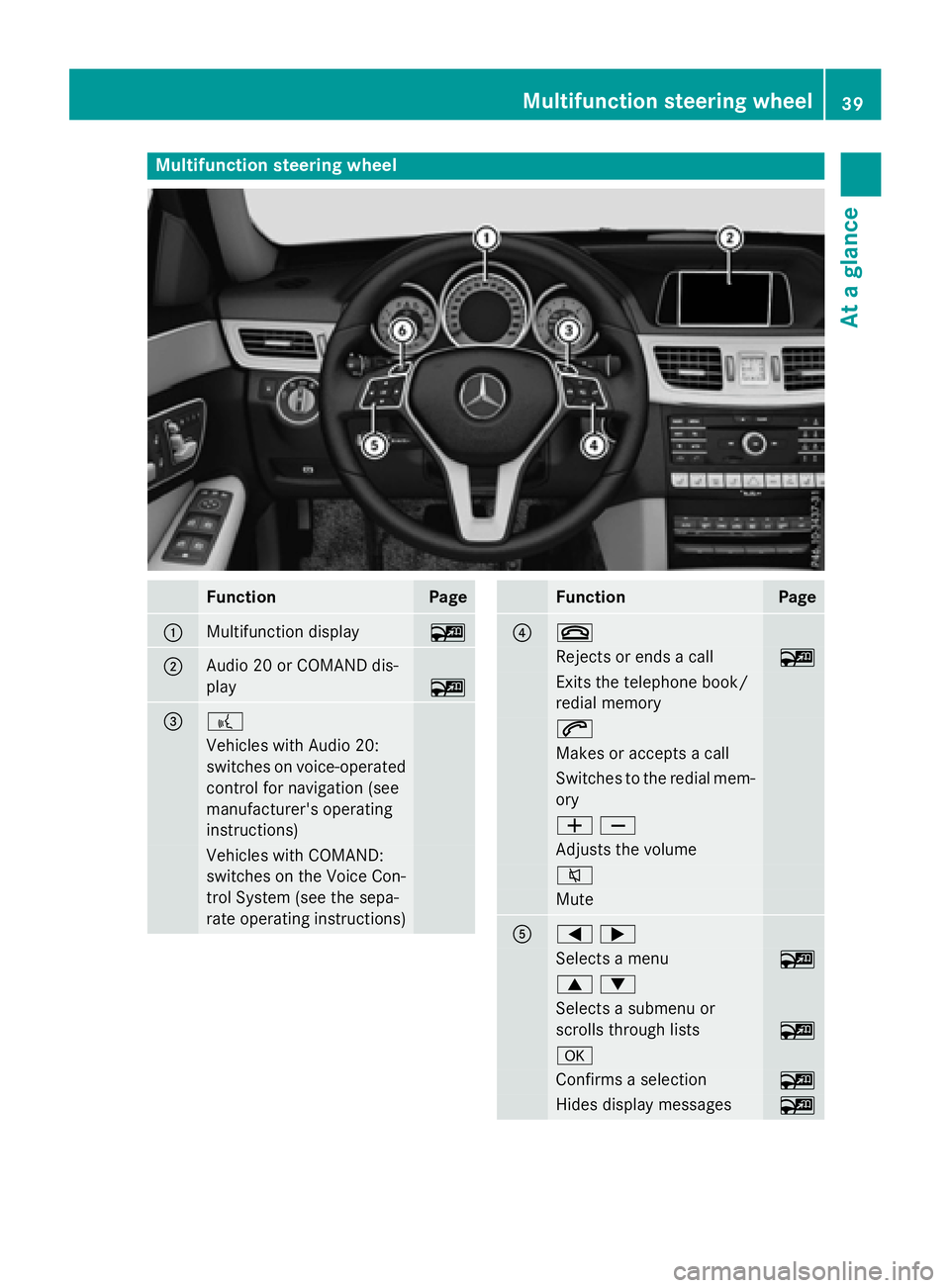
Multifunction steering wheel
FunctionPage
:Multifunction display~
;Audio 20 or COMAND dis-
play
~
=?
Vehicles with Audio 20:
switches on voice-operated
control for navigation (see
manufacturer's operating
instructions)
Vehicles with COMAND:
switches on the Voice Con-
trol System (see the sepa-
rate operating instructions)
FunctionPage
?~
Rejects or ends a call~
Exits the telephone book/
redial memory
6
Makes or accepts a call
Switches to the redial mem-
ory
WX
Adjusts the volume
8
Mute
A=;
Selects a menu~
9:
Selects a submenu or
scrolls through lists
~
a
Confirms a selection~
Hides display messages~
Multifunction steering wheel39
At a glance
Page 42 of 350
FunctionPage
B%
Back189
Vehicles with Audio 20:
switches off voice-operated
control of the navigation
FunctionPage
(see the manufacturer's
Operating Instructions)
Vehicles with COMAND:
switches off the Voice Con-
trol System (see the sepa-
rate Operating Instruc-
tions)
40Multifunction steering wheel
At a glance
Page 47 of 350

Door controlpanel
FunctionPage
:r 45=
Stores settings for the seat,
exterior mirrors and steer-
ing wheel
~
;Adjusts the seats electri-
cally
~
=%& Unlocks/locks
the vehicle
~
?Opens the door~
A7Zö\
Adjusts and folds the exte-
rior mirrors in/out electri-
cally
~
FunctionPage
BW Opens/closes the
side windows
~
Cn Activates/deacti-
vates the override feature
for the side windows in the
rear compartment
~
Dp Opens/closes the
trunk lid/tailgate
101
Door control panel45
At a glance
Page 50 of 350
Useful information
i
This Operator's Manual describes all
models and all standard and optional equip-
ment of your vehicle available at the time of
publication of the Operator's Manual.
Country-specific differences are possible.
Please note that your vehicle may not be
equipped with all features described. This
also applies to safety-related systems and
functions.
iRead the information on qualified special-
ist workshops (
Ypage 31).
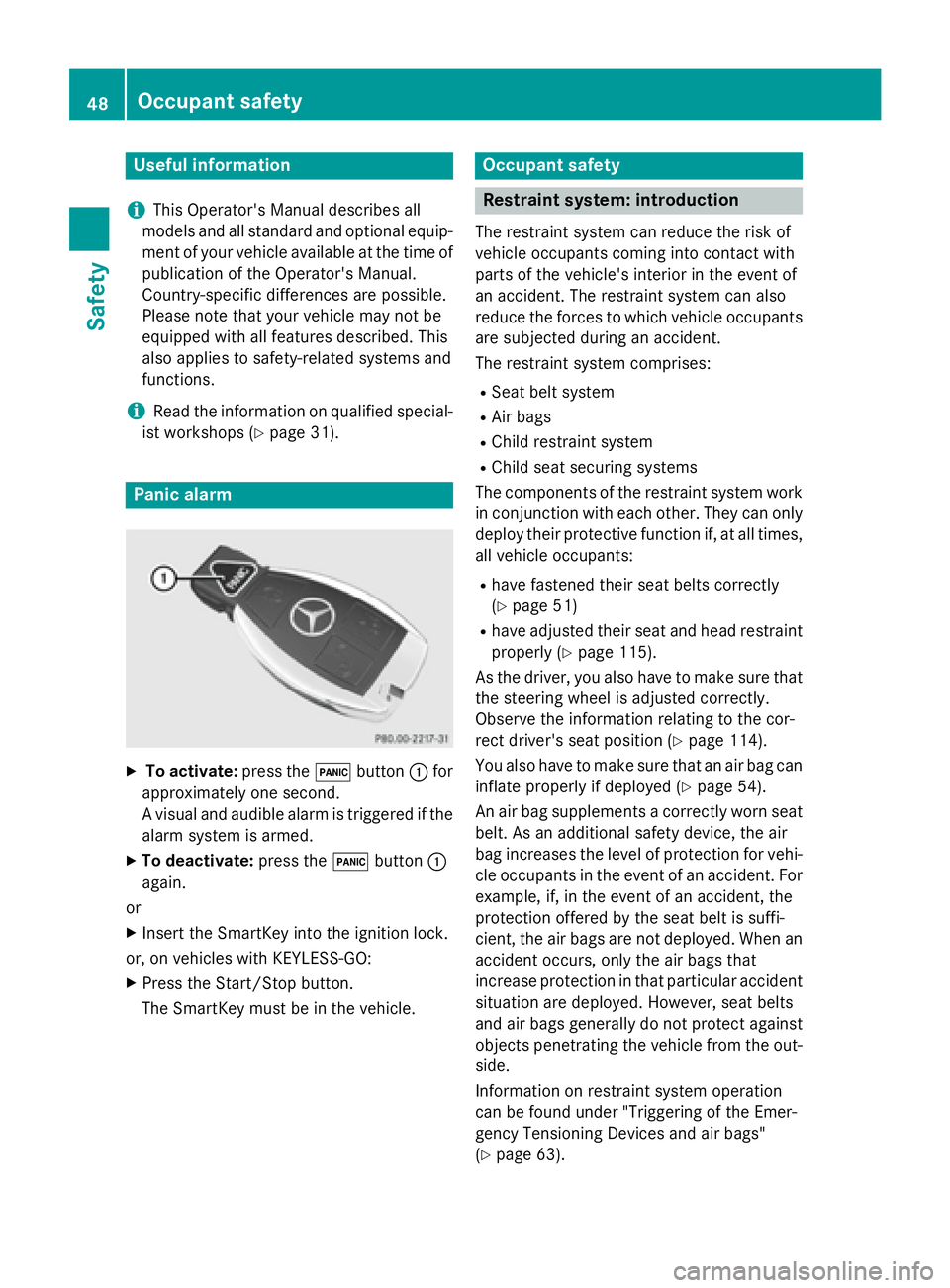
Panic alarm
XTo activate: press the!button :for
approximately one second.
A visual and audible alarm is triggered if the
alarm system is armed.
XTo deactivate: press the!button :
again.
or
XInsert the SmartKey into the ignition lock.
or, on vehicles with KEYLESS ‑GO:
XPress the Start/Stop button.
The SmartKey must be in the vehicle.
Occupant safety
Restraint system: introduction
The restraint system can reduce the risk of
vehicle occupants coming into contact with
parts of the vehicle's interior in the event of
an accident. The restraint system can also
reduce the forces to which vehicle occupants
are subjected during an accident.
The restraint system comprises:
RSeat belt system
RAir bags
RChild restraint system
RChild seat securing systems
The components of the restraint system work
in conjunction with each other. They can only
deploy their protective function if, at all times,
all vehicle occupants:
Rhave fastened their seat belts correctly
(
Ypage 51)
Rhave adjusted their seat and head restraint
properly (
Ypage 115).
As the driver, you also have to make sure that
the steering wheel is adjusted correctly.
Observe the information relating to the cor-
rect driver's seat position (
Ypage 114).
You also have to make sure that an air bag can inflate properly if deployed (
Ypage 54).
An air bag supplements a correctly worn seat
belt. As an additional safety device, the air
bag increases the level of protection for vehi-
cle occupants in the event of an accident. For
example, if, in the event of an accident, the
protection offered by the seat belt is suffi-
cient, the air bags are not deployed. When an
accident occurs, only the air bags that
increase protection in that particular accident
situation are deployed. However, seat belts
and air bags generally do not protect against objects penetrating the vehicle from the out-
side.
Information on restraint system operation
can be found under "Triggering of the Emer-
gency Tensioning Devices and air bags"
(
Ypage 63).
48Occupant safety
Safety