radiator Mercury Grand Marquis 1011 Owner's Manuals
[x] Cancel search | Manufacturer: MERCURY, Model Year: 1011, Model line: Grand Marquis, Model: Mercury Grand Marquis 2011Pages: 333, PDF Size: 2.23 MB
Page 55 of 333
Replacing exterior bulbs
Check the operation of all bulbs frequently.
Replacing headlamp bulbs (Crown Victoria only)
To remove the headlamp bulb:
1. Make sure the headlamp switch is in the off position, then open the
hood.
2. Remove the radiator cover by turning the three retainers to the unlock
position.
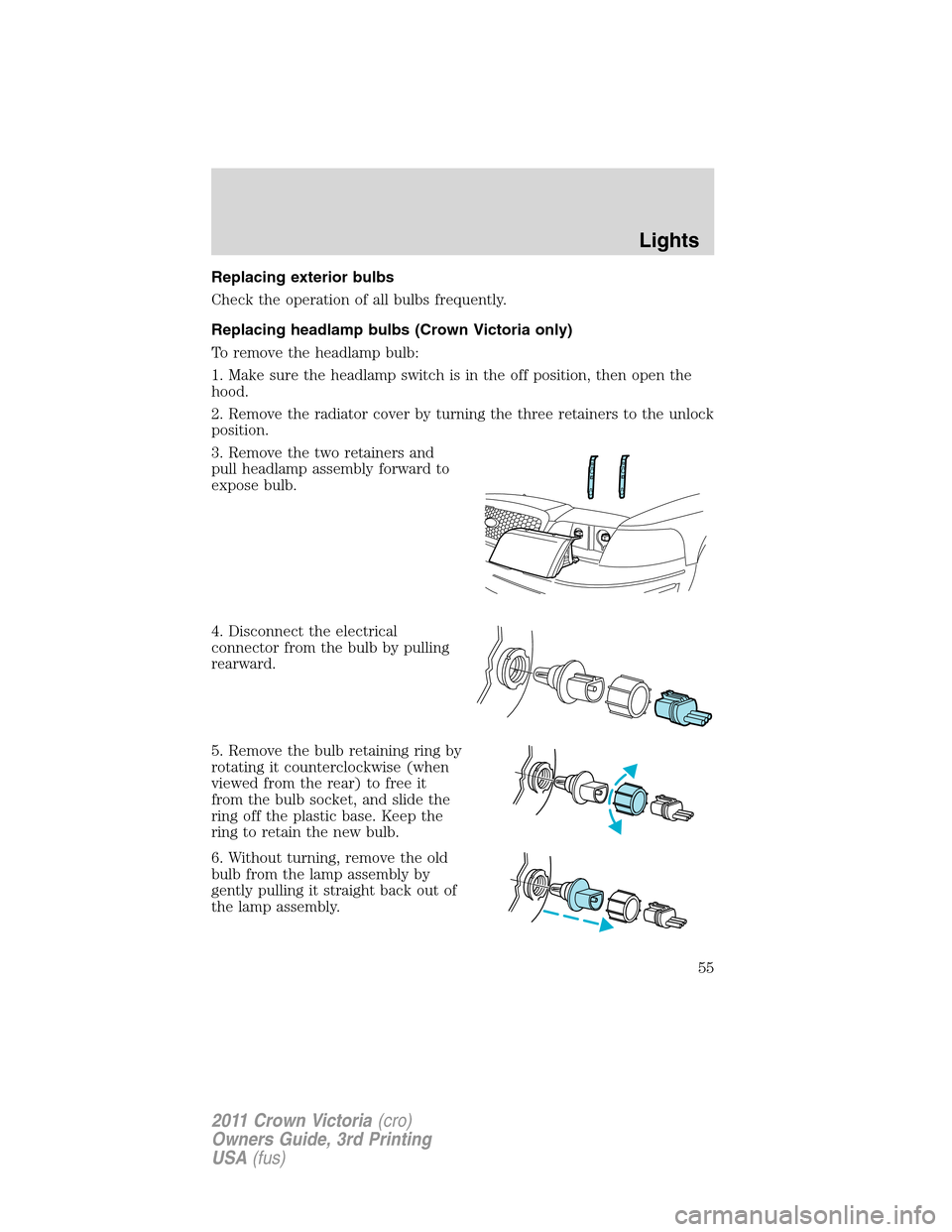
3. Remove the two retainers and
pull headlamp assembly forward to
expose bulb.
4. Disconnect the electrical
connector from the bulb by pulling
rearward.
5. Remove the bulb retaining ring by
rotating it counterclockwise (when
viewed from the rear) to free it
from the bulb socket, and slide the
ring off the plastic base. Keep the
ring to retain the new bulb.
6. Without turning, remove the old
bulb from the lamp assembly by
gently pulling it straight back out of
the lamp assembly.
Lights
55
2011 Crown Victoria(cro)
Owners Guide, 3rd Printing
USA(fus)
Page 56 of 333
To install the new bulb:
WARNING:Handle a halogen headlamp bulb carefully and keep
out of children’s reach. Grasp the bulb only by its plastic base
and do not touch the glass. The oil from your hand could cause the
bulb to break the next time the headlamps are operated.
Note:If the bulb is accidentally touched, it should be cleaned with
rubbing alcohol before being used.
1. With the flat side of the new bulb’s plastic base facing upward, insert
the glass end of the bulb into the lamp assembly. Turn the bulb left or
right to align the grooves in the plastic base with the tabs in the lamp
assembly. When the grooves are aligned, push the bulb into the lamp
assembly until the plastic base contacts the rear of the lamp assembly.
2. Install the bulb retaining ring over the plastic base until it contacts the
rear of the socket by rotating it clockwise until you feel a “stop.”
3. Connect the electrical connector into the rear of the plastic base until
it snaps, locking it into position.
4. Install the headlamp assembly with two retainers.
5. Install the radiator cover locking it in place with three retainers.
6. Turn the headlamps on and make sure they work properly. If the
headlamp was correctly aligned before you changed the bulb, you should
not need to align it again.
Replacing front parking/turn signal lamp bulbs
To remove the front parking/turn signal lamp bulbs:
1. Make sure headlamp switch is in the off position, then open the hood.
2. Remove the radiator cover by turning the three retainers to the unlock
position.
Lights
56
2011 Crown Victoria(cro)
Owners Guide, 3rd Printing
USA(fus)
Page 57 of 333
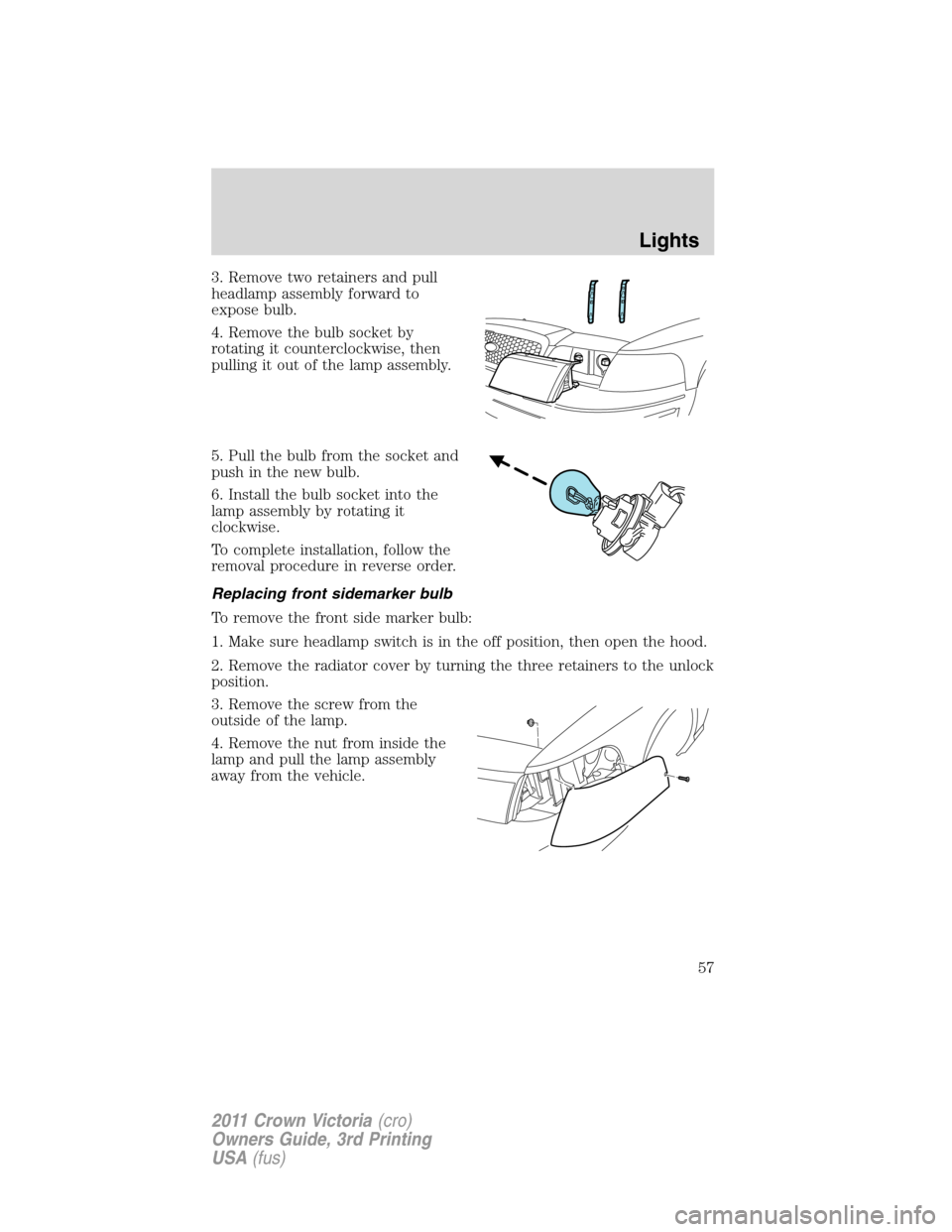
3. Remove two retainers and pull
headlamp assembly forward to
expose bulb.
4. Remove the bulb socket by
rotating it counterclockwise, then
pulling it out of the lamp assembly.
5. Pull the bulb from the socket and
push in the new bulb.
6. Install the bulb socket into the
lamp assembly by rotating it
clockwise.
To complete installation, follow the
removal procedure in reverse order.
Replacing front sidemarker bulb
To remove the front side marker bulb:
1. Make sure headlamp switch is in the off position, then open the hood.
2. Remove the radiator cover by turning the three retainers to the unlock
position.
3. Remove the screw from the
outside of the lamp.
4. Remove the nut from inside the
lamp and pull the lamp assembly
away from the vehicle.
Lights
57
2011 Crown Victoria(cro)
Owners Guide, 3rd Printing
USA(fus)
Page 60 of 333
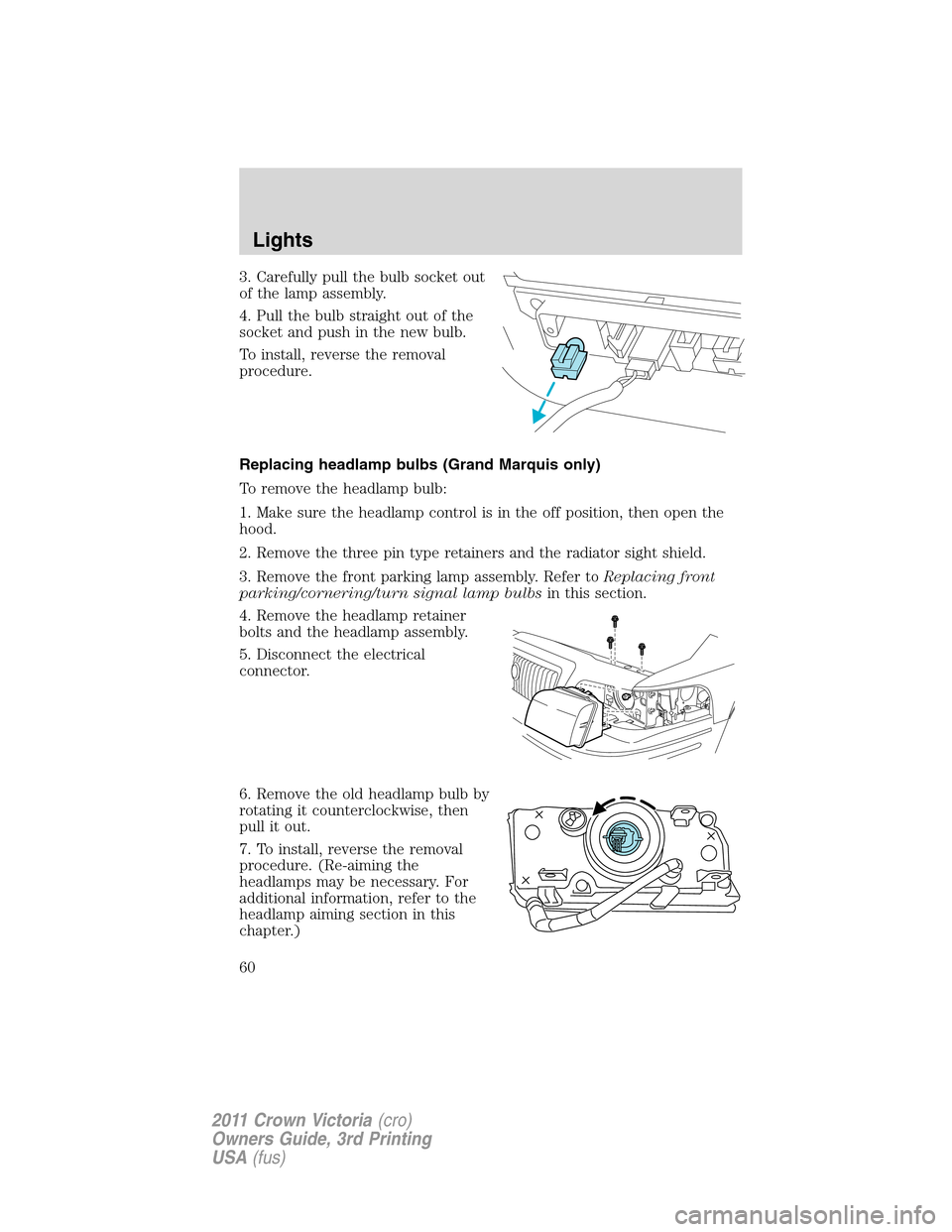
3. Carefully pull the bulb socket out
of the lamp assembly.
4. Pull the bulb straight out of the
socket and push in the new bulb.
To install, reverse the removal
procedure.
Replacing headlamp bulbs (Grand Marquis only)
To remove the headlamp bulb:
1. Make sure the headlamp control is in the off position, then open the
hood.
2. Remove the three pin type retainers and the radiator sight shield.
3. Remove the front parking lamp assembly. Refer toReplacing front
parking/cornering/turn signal lamp bulbsin this section.
4. Remove the headlamp retainer
bolts and the headlamp assembly.
5. Disconnect the electrical
connector.
6. Remove the old headlamp bulb by
rotating it counterclockwise, then
pull it out.
7. To install, reverse the removal
procedure. (Re-aiming the
headlamps may be necessary. For
additional information, refer to the
headlamp aiming section in this
chapter.)
Lights
60
2011 Crown Victoria(cro)
Owners Guide, 3rd Printing
USA(fus)
Page 61 of 333
WARNING:Handle a halogen headlamp bulb carefully and keep
out of children’s reach. Grasp the bulb only by its plastic base
and do not touch the glass. The oil from your hand could cause the
bulb to break the next time the headlamps are operated.
Note:If the bulb is accidentally touched, it should be cleaned with
rubbing alcohol before being used.
Note:The headlamp bulb should not be removed from the headlamp
until just before a replacement bulb is installed. Removing the bulb for
an extended period of time may affect headlamp bulb performance.
Contaminants may enter the headlamp where they can settle on the lens
and reflector. Never turn the headlamps on with the bulb removed.
Replacing front parking/cornering/turn signal lamp bulbs
To remove the parking/cornering/turn signal lamp bulbs:
1. Make sure the headlamp switch is in the off position, then open the
hood.
2. Remove the three pin type retainers and the radiator shield.
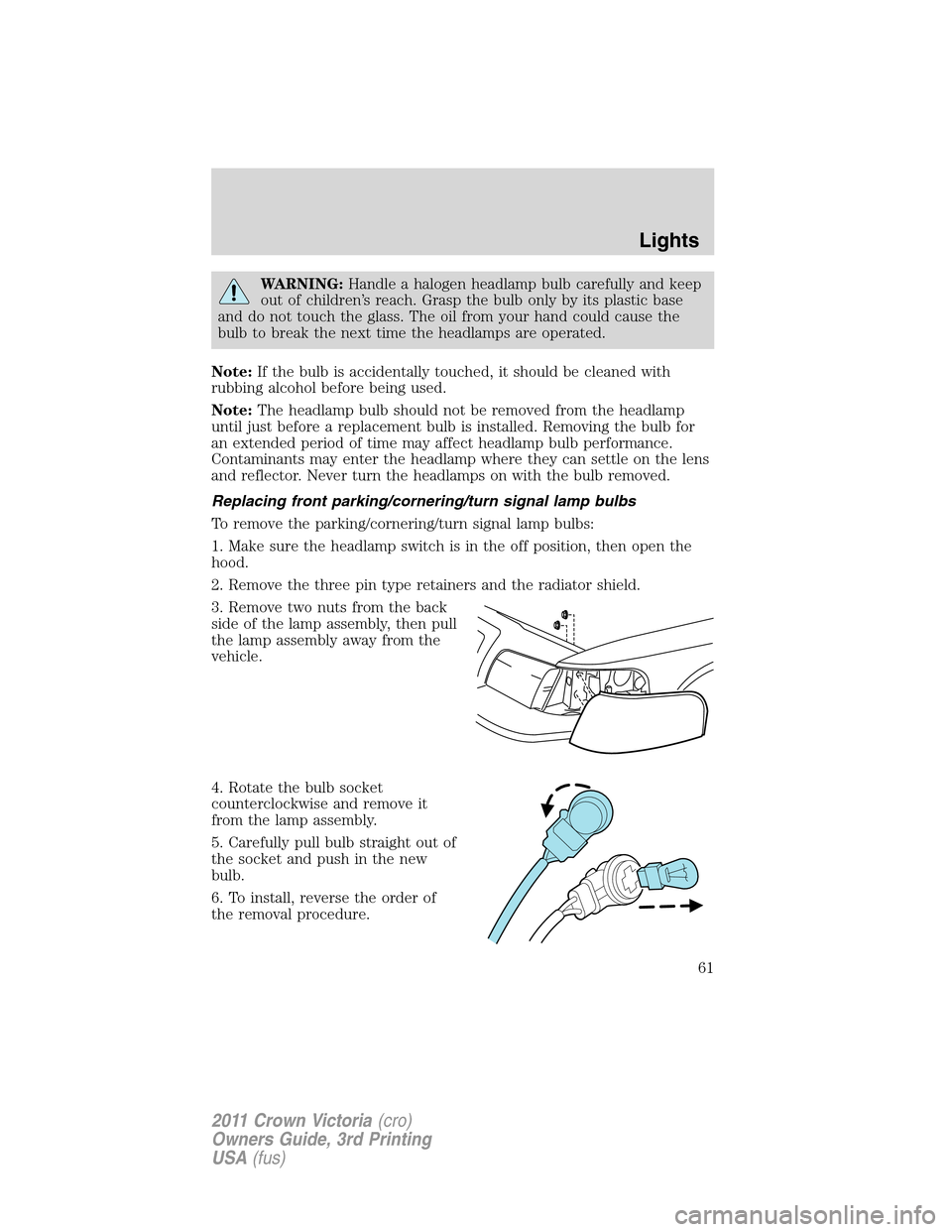
3. Remove two nuts from the back
side of the lamp assembly, then pull
the lamp assembly away from the
vehicle.
4. Rotate the bulb socket
counterclockwise and remove it
from the lamp assembly.
5. Carefully pull bulb straight out of
the socket and push in the new
bulb.
6. To install, reverse the order of
the removal procedure.
Lights
61
2011 Crown Victoria(cro)
Owners Guide, 3rd Printing
USA(fus)
Page 240 of 333
WARNING:Do not add engine coolant when the engine is hot.
Steam and scalding liquids released from a hot cooling system
can burn you badly. Also, you can be burned if you spill coolant on hot
engine parts.
WARNING:Do not put engine coolant in the windshield washer
fluid container. If sprayed on the windshield, engine coolant
could make it difficult to see through the windshield.
•DO NOT MIXdifferent colors or types of coolant in your vehicle.
Make sure the correct coolant is used. Mixing of engine coolants may
harm your engine’s cooling system. The use of an improper coolant
may harm engine and cooling system components and may void the
warranty. Refer toMaintenance product specifications and
capacitiesin this chapter.
•A large amount of water without engine coolant may be added, in case
of emergency, to reach a vehicle service location. In this instance, the
cooling system must be drained and refilled with a 50/50 mixture of
engine coolant and distilled water as soon as possible. Water alone
(without engine coolant) can cause engine damage from corrosion,
overheating or freezing.
•Do not use alcohol, methanol, brine or any engine coolants
mixed with alcohol or methanol antifreeze (coolant).Alcohol
and other liquids can cause engine damage from overheating or
freezing.
•Do not add extra inhibitors or additives to the coolant.These
can be harmful and compromise the corrosion protection of the engine
coolant.
For vehicles with overflow coolant systems with a non-pressurized cap
on the coolant recovery system, add coolant to the coolant recovery
reservoir when the engine is cool. Add the proper mixture of coolant and
distilled water to the FULL COLD level. For all other vehicles which have
a coolant degas system with a pressurized cap, or if it is necessary to
remove the coolant pressure relief cap on the radiator of a vehicle with
an overflow system, follow these steps to add engine coolant.
WARNING:To reduce the risk of personal injury, make sure the
engine is cool before unscrewing the coolant pressure relief cap.
The cooling system is under pressure; steam and hot liquid can come
out forcefully when the cap is loosened slightly.
Maintenance and Specifications
240
2011 Crown Victoria(cro)
Owners Guide, 3rd Printing
USA(fus)
Page 241 of 333
Add the proper mixture of coolant and water to the cooling system by
following these steps:
1. Before you begin, turn the engine off and let it cool.
2. When the engine is cool, wrap a thick cloth around the coolant
pressure relief cap on the coolant reservoir (a translucent plastic bottle).
Slowly turn cap counterclockwise (left) until pressure begins to release.
3. Step back while the pressure releases.
4. When you are sure that all the pressure has been released, use the
cloth to turn it counterclockwise and remove the cap.
5. Fill the coolant reservoir slowly with the proper coolant mixture, to
within the COLD FILL RANGE or the FULL COLD level on the reservoir.
If you removed the radiator cap in an overflow system, fill the radiator
until the coolant is visible and radiator is almost full.
6. Replace the cap. Turn until tightly installed. Cap must be tightly
installed to prevent coolant loss.
After any coolant has been added, check the coolant concentration (refer
toChecking engine coolant). If the concentration is not 50/50, drain
some coolant and adjust the concentration. It may take several drains
and additions to obtain a 50/50 coolant concentration.
Whenever coolant has been added, the coolant level in the coolant
reservoir should be checked the next few times you drive the vehicle. If
necessary, add enough 50/50 concentration of engine coolant and
distilled water to bring the liquid level to the proper level.
If you have to add more than 1.0 quart (1.0 liter) of engine coolant per
month, have your authorized dealer check the engine cooling system.
Your cooling system may have a leak. Operating an engine with a low
level of coolant can result in engine overheating and possible engine
damage.
Recycled engine coolant
Ford Motor Company does NOT recommend the use of recycled engine
coolant since a Ford-approved recycling process is not yet available.
Used engine coolant should be disposed of in an appropriate
manner. Follow your community’s regulations and standards for recycling
and disposing of automotive fluids.
Coolant refill capacity
To find out how much fluid your vehicle’s cooling system can hold, refer
toMaintenance product specifications and capacitiesin this chapter.
Maintenance and Specifications
241
2011 Crown Victoria(cro)
Owners Guide, 3rd Printing
USA(fus)
Page 275 of 333
Headlight flashers (wig-wags) - police
An interfacing connector is provided on the headlight circuit for use of
the headlights as alternating flashers (wig-wags). The connector is
located in front of the radiator. A protective cap is attached to prevent
contaminants from entering the connector when a wig-wag module is not
installed. When installing a headlight flasher (wig-wag) module, remove
the connector and tape it to the wigwag module harness. This will ensure
that the cap is available to be reattached if the wig-wag module is
removed. For additional information, refer to theCrown Victoria
Wiring Diagram Manual.
If your vehicle is equipped with one of the optional Police Interceptor
Equipment packages, the connector will already be used by the supplied
wig-wag module that comes with the option package.
Note:Use of the wig-wag feature overrides normal operation of the high
beam headlights, including flash-to-pass. However, the low beam
headlights will remain on and unaffected.
HEAVY DUTY SUSPENSION - POLICE
This option includes certain heavy duty components that contribute to
the vehicle’s stability and road handling capability under extremes of
operation. The police vehicle has a heavy duty steering gear, extra
control shock absorbers and heavy duty front and rear stabilizer bars.
COOLERS
It is strongly recommended that auxiliary devices such as lights not be
installed at the grille. Such devices will reduce airflow through the grille
and could potentially impact the cooling system performance.
Oil cooler - police
The 4.6L engine has an engine oil cooler to maintain engine oil
temperatures.
Engine and transmission coolers
External transmission and power steering coolers are located behind the
grille and in front of the radiator. It is strongly recommended that
auxiliary devices such as lights and sirens not be installed in the air path
of these coolers as they will impact cooling system performance.
Crown Victoria Severe Duty
275
2011 Crown Victoria(cro)
Owners Guide, 3rd Printing
USA(fus)
Page 309 of 333
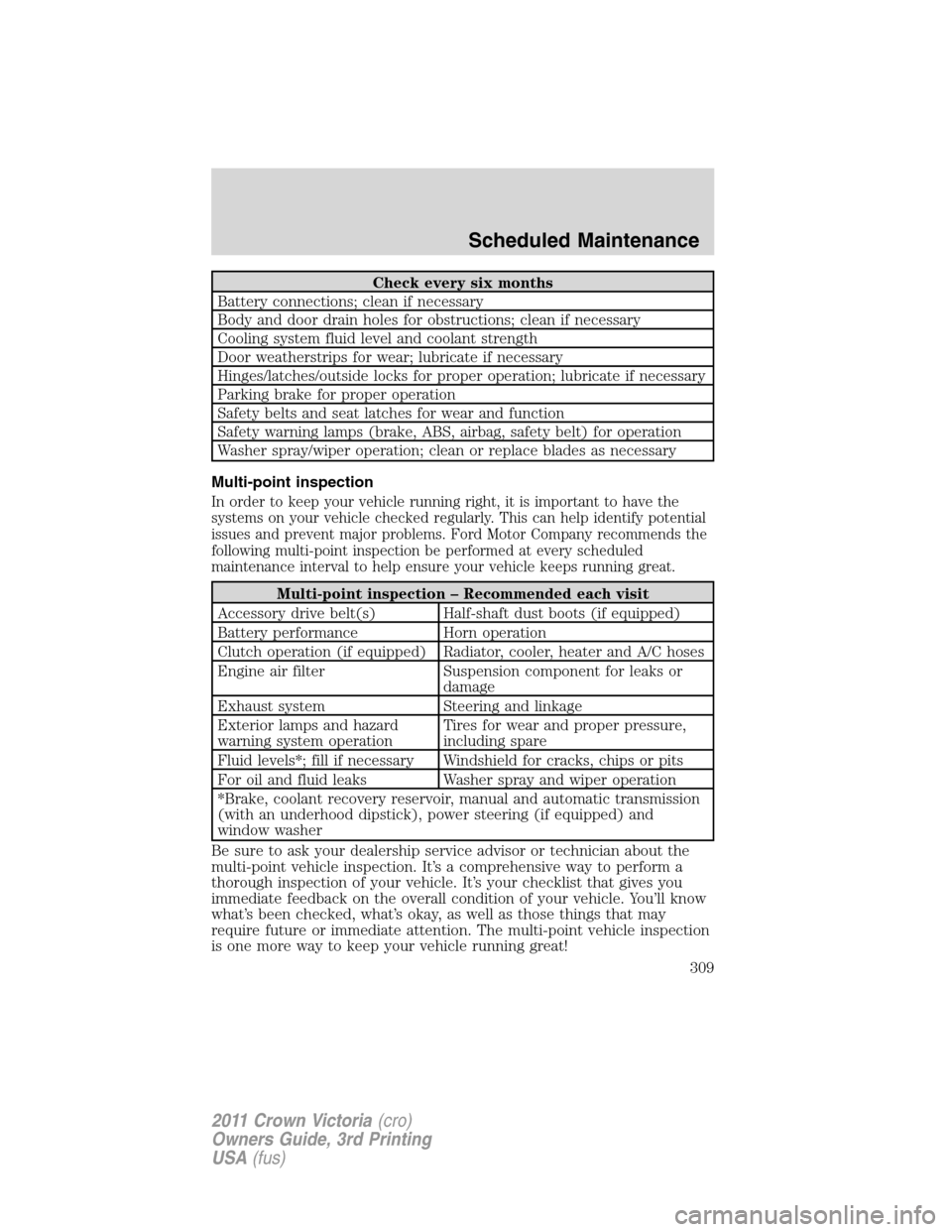
Check every six months
Battery connections; clean if necessary
Body and door drain holes for obstructions; clean if necessary
Cooling system fluid level and coolant strength
Door weatherstrips for wear; lubricate if necessary
Hinges/latches/outside locks for proper operation; lubricate if necessary
Parking brake for proper operation
Safety belts and seat latches for wear and function
Safety warning lamps (brake, ABS, airbag, safety belt) for operation
Washer spray/wiper operation; clean or replace blades as necessary
Multi-point inspection
In order to keep your vehicle running right, it is important to have the
systems on your vehicle checked regularly. This can help identify potential
issues and prevent major problems. Ford Motor Company recommends the
following multi-point inspection be performed at every scheduled
maintenance interval to help ensure your vehicle keeps running great.
Multi-point inspection – Recommended each visit
Accessory drive belt(s) Half-shaft dust boots (if equipped)
Battery performance Horn operation
Clutch operation (if equipped) Radiator, cooler, heater and A/C hoses
Engine air filter Suspension component for leaks or
damage
Exhaust system Steering and linkage
Exterior lamps and hazard
warning system operationTires for wear and proper pressure,
including spare
Fluid levels*; fill if necessary Windshield for cracks, chips or pits
For oil and fluid leaks Washer spray and wiper operation
*Brake, coolant recovery reservoir, manual and automatic transmission
(with an underhood dipstick), power steering (if equipped) and
window washer
Be sure to ask your dealership service advisor or technician about the
multi-point vehicle inspection. It’s a comprehensive way to perform a
thorough inspection of your vehicle. It’s your checklist that gives you
immediate feedback on the overall condition of your vehicle. You’ll know
what’s been checked, what’s okay, as well as those things that may
require future or immediate attention. The multi-point vehicle inspection
is one more way to keep your vehicle running great!
Scheduled Maintenance
309
2011 Crown Victoria(cro)
Owners Guide, 3rd Printing
USA(fus)