wheel Mercury Grand Marquis 1999 s Owner's Guide
[x] Cancel search | Manufacturer: MERCURY, Model Year: 1999, Model line: Grand Marquis, Model: Mercury Grand Marquis 1999Pages: 200, PDF Size: 1.16 MB
Page 154 of 200
Temperature A B C
The temperature grades are A (the highest), B, and C, representing the
tire's resistance to the generation of heat and its ability to dissipate heat
when tested under controlled conditions on a specified indoor laboratory
test wheel. Sustained high temperature can cause the material of the tire
to degenerate and reduce tire life, and excessive temperature can lead to
sudden tire failure. The grade C corresponds to a level of performance
which all passenger car tires must meet under the Federal Motor Vehicle
Safety Standard No. 109. Grades B and A represent higher levels of
performance on the laboratory test wheel than the minimum required by
law.
The temperature grade for this tire is established for a tire that
is properly inflated and not overloaded. Excessive speed,
underinflation, or excessive loading, either separately or in
combination, can cause heat buildup and possible tire failure.
SERVICING YOUR TIRES
Checking the tire pressure
²Use an accurate tire pressure gauge.
²Check the tire pressure when tires are cold, after the vehicle has been
parked for at least one hour or has been driven less than 5 km
(3 miles).
²Adjust tire pressure to recommended specifications found on the
Certification Label.
Improperly inflated tires can affect vehicle handling and can fail
suddenly, possibly resulting in loss of vehicle control.
Tire rotation
Because your vehicle's tires perform different jobs, they often wear
differently. To make sure your tires wear evenly and last longer, rotate
them as indicated in the Scheduled Maintenance Guide. If you notice
that the tires wear unevenly, have them checked.
Maintenance and care
154
Page 155 of 200
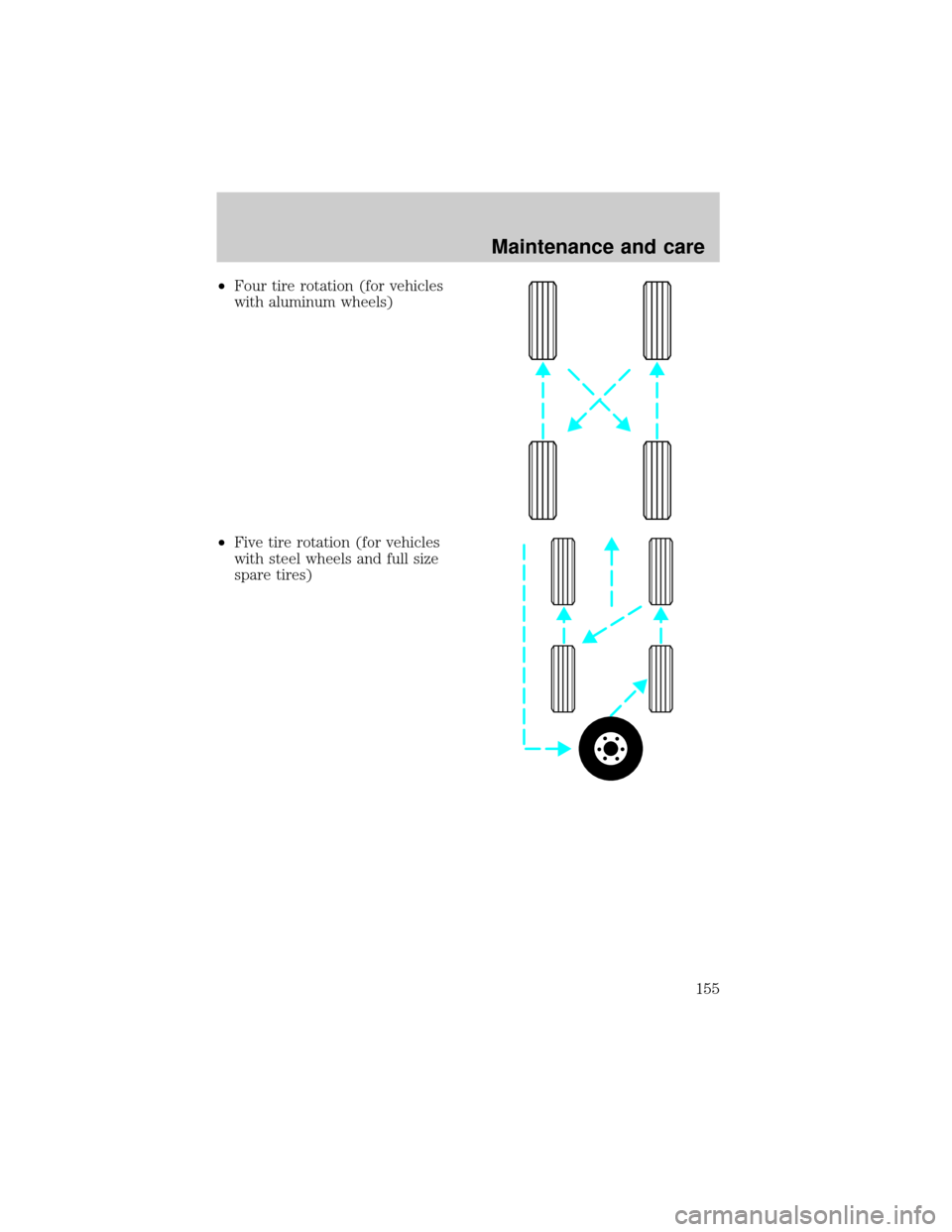
²Four tire rotation (for vehicles
with aluminum wheels)
²Five tire rotation (for vehicles
with steel wheels and full size
spare tires)
Maintenance and care
155
Page 157 of 200
SNOW TIRES AND CHAINS
Snow tires must be the same size and grade as the tires you
currently have on your vehicle.
The tires on your vehicle have all weather treads to provide traction in
rain and snow. However, in some climates, you may need to use snow
tires and chains. If you need to use chains, it is recommended that steel
wheels (of the same size and specifications) be used as chains may chip
aluminum wheels.
Follow these guidelines when using snow tires and chains:
²Use only SAE Class S chains.
²Install chains securely, verifying that the chains do not touch any
wiring, brake lines or fuel lines.
²Drive cautiously. If you hear the chains rub or bang against your
vehicle, stop and re-tighten the chains. If this does not work, remove
the chains to prevent damage to your vehicle.
²If possible, avoid fully loading your vehicle.
²Remove the tire chains when they are no longer needed. Do not use
tire chains on dry roads.
²The suspension insulation and bumpers will help prevent vehicle
damage. Do not remove these components from your vehicle when
using snow tires and chains.
WHAT YOU SHOULD KNOW ABOUT AUTOMOTIVE FUELS
Important safety precautions
Do not overfill the fuel tank. The pressure in an overfilled tank
may cause leakage and lead to fuel spray and fire.
If you do not use the proper fuel cap, the pressure in the fuel
tank can damage the fuel system or cause it to work improperly
in a collision.
Maintenance and care
157
Page 163 of 200
economy. Additionally, keeping records during summer and winter will
show how temperature impacts fuel economy. In general, lower
temperatures give lower fuel economy.
Driving style Ð good driving and fuel economy habits
Give consideration to the lists that follow and you may be able to change
a number of variables and improve your fuel economy.
Habits
²Smooth, moderate operation can yield up to 10% savings in fuel.
²Steady speeds without stopping will usually give the best fuel
economy.
²Idling for long periods of time (greater than one minute) may waste
fuel.
²Anticipate stopping; slowing down may eliminate the need to stop.
²Sudden or hard accelerations may reduce fuel economy.
²Slow down gradually.
²Drive at reasonable speeds (traveling at 105 km /h [65 mph] uses 15%
more fuel than traveling at 88 km/h [55 mph]).
²Revving the engine before turning it off may reduce fuel economy.
²Use of the air conditioner or defroster may reduce fuel economy.
²Use of speed control (if equipped) may improve fuel economy. Speed
control can help maintain a constant speed and reduce speed changes.
You may want to turn off the speed control in hilly terrain as
unnecessary shifting between third and fourth gears may occur and
could result in reduced fuel economy.
²Warming up a vehicle on cold mornings is not required and may
reduce fuel economy.
²Resting your foot on the brake pedal while driving may reduce fuel
economy.
²Combine errands and minimize stop-and-go driving.
Maintenance
²Keep tires properly inflated and use only recommended size.
²Operating a vehicle with the wheels out of alignment will reduce fuel
economy.
Maintenance and care
163
Page 172 of 200
Cleaning the wheels
Wash with the same detergent as the body of your vehicle. Do not use
acid-based or alcohol-based wheel cleaners, steel wool, fuel or strong
detergents. Never use abrasives that will damage the finish of special
wheel surfaces. Use a tar remover to remove grease and tar.
The brushes used in some automatic car washes may damage the finish
on your wheels. Before going to a car wash, find out if the brushes are
abrasive.
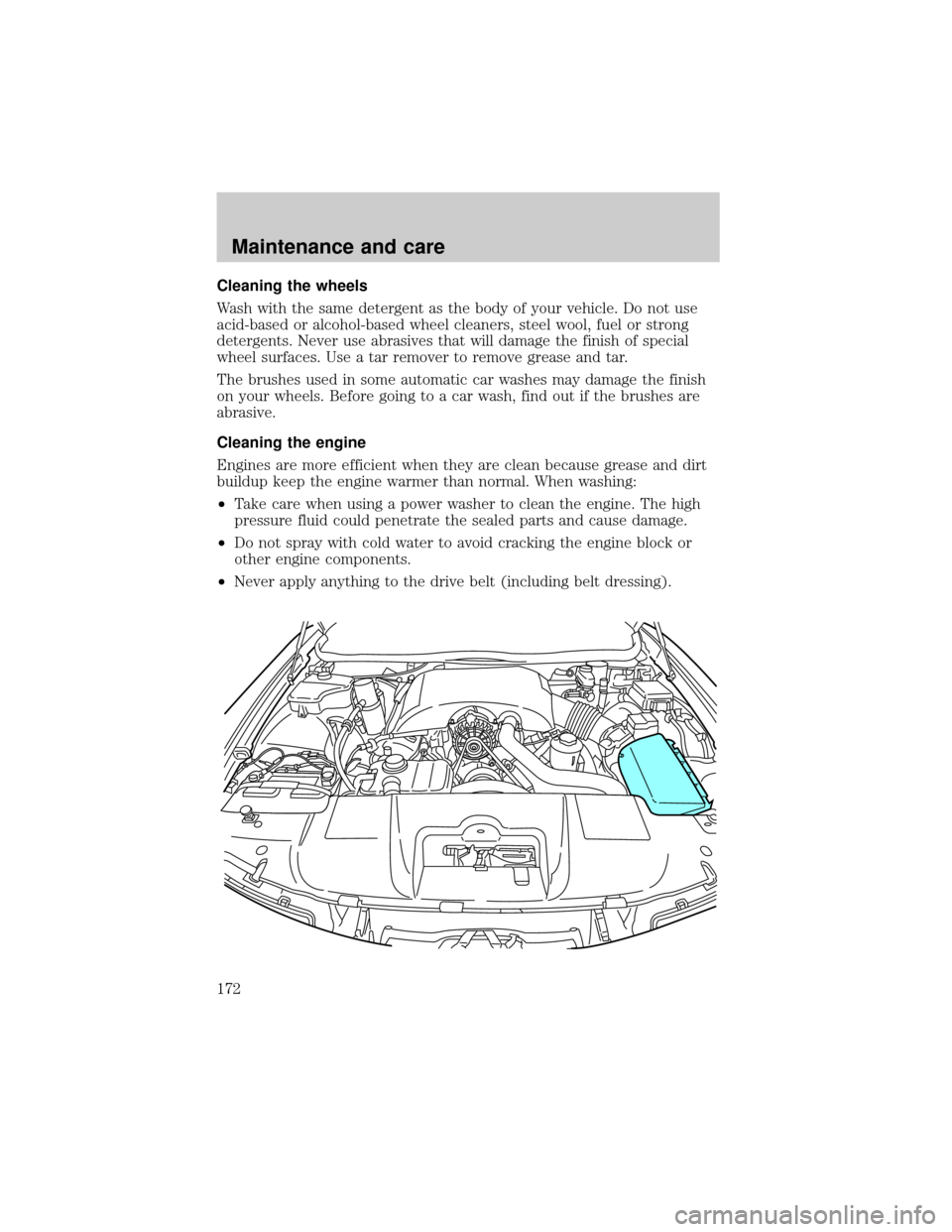
Cleaning the engine
Engines are more efficient when they are clean because grease and dirt
buildup keep the engine warmer than normal. When washing:
²Take care when using a power washer to clean the engine. The high
pressure fluid could penetrate the sealed parts and cause damage.
²Do not spray with cold water to avoid cracking the engine block or
other engine components.
²Never apply anything to the drive belt (including belt dressing).
Maintenance and care
172
Page 177 of 200
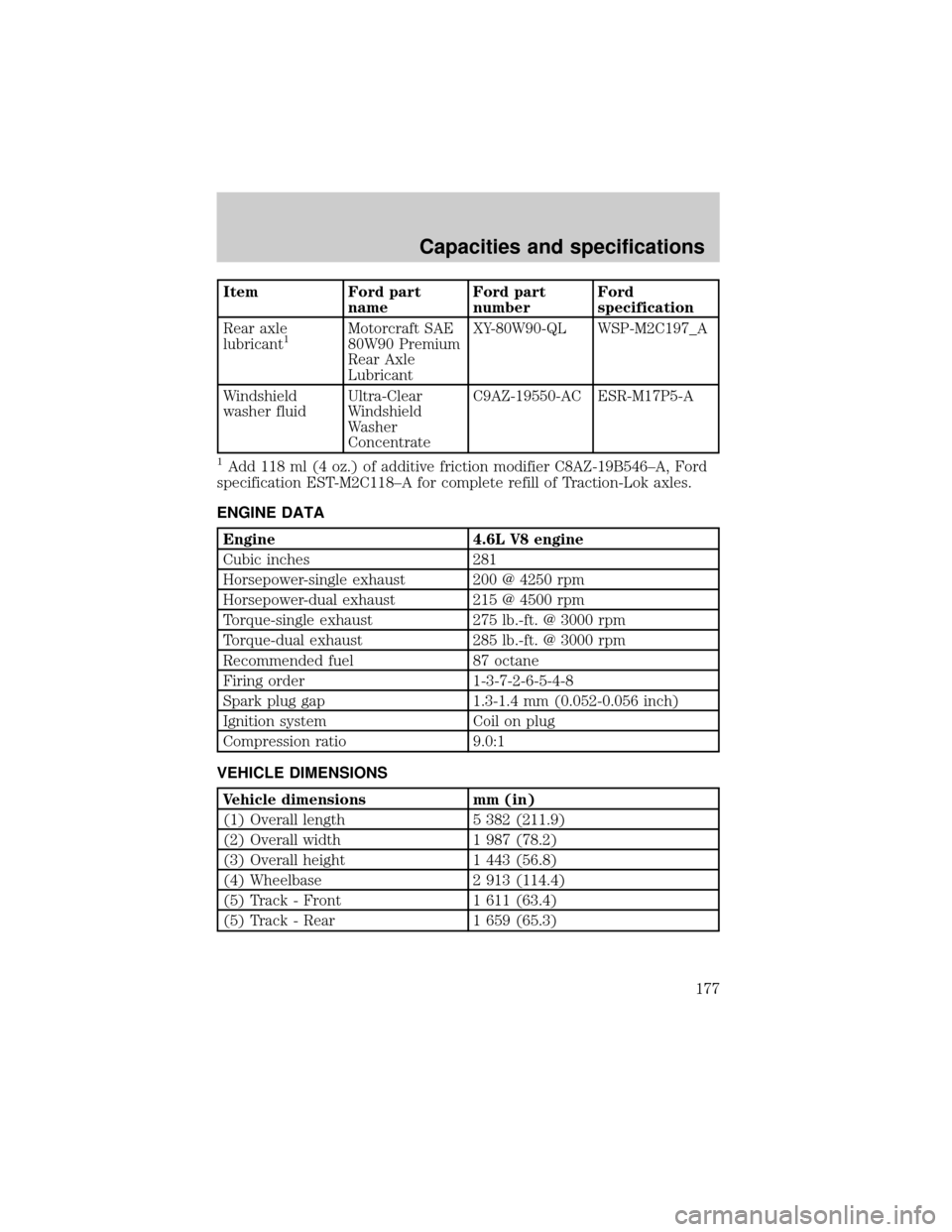
Item Ford part
nameFord part
numberFord
specification
Rear axle
lubricant
1Motorcraft SAE
80W90 Premium
Rear Axle
LubricantXY-80W90-QL WSP-M2C197_A
Windshield
washer fluidUltra-Clear
Windshield
Washer
ConcentrateC9AZ-19550-AC ESR-M17P5-A
1Add 118 ml (4 oz.) of additive friction modifier C8AZ-19B546±A, Ford
specification EST-M2C118±A for complete refill of Traction-Lok axles.
ENGINE DATA
Engine 4.6L V8 engine
Cubic inches 281
Horsepower-single exhaust 200 @ 4250 rpm
Horsepower-dual exhaust 215 @ 4500 rpm
Torque-single exhaust 275 lb.-ft. @ 3000 rpm
Torque-dual exhaust 285 lb.-ft. @ 3000 rpm
Recommended fuel 87 octane
Firing order 1-3-7-2-6-5-4-8
Spark plug gap 1.3-1.4 mm (0.052-0.056 inch)
Ignition system Coil on plug
Compression ratio 9.0:1
VEHICLE DIMENSIONS
Vehicle dimensions mm (in)
(1) Overall length 5 382 (211.9)
(2) Overall width 1 987 (78.2)
(3) Overall height 1 443 (56.8)
(4) Wheelbase 2 913 (114.4)
(5) Track - Front 1 611 (63.4)
(5) Track - Rear 1 659 (65.3)
Capacities and specifications
177
Page 188 of 200
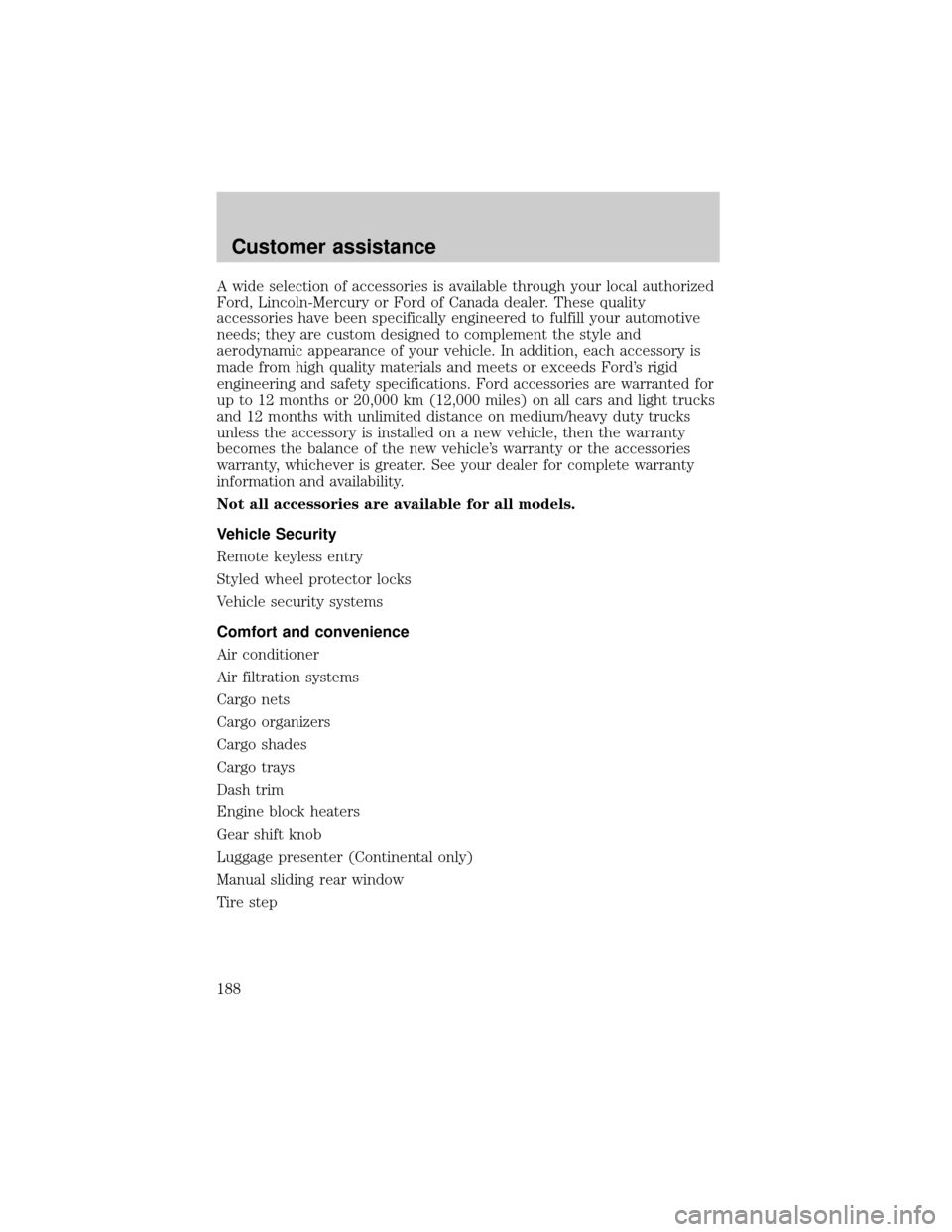
A wide selection of accessories is available through your local authorized
Ford, Lincoln-Mercury or Ford of Canada dealer. These quality
accessories have been specifically engineered to fulfill your automotive
needs; they are custom designed to complement the style and
aerodynamic appearance of your vehicle. In addition, each accessory is
made from high quality materials and meets or exceeds Ford's rigid
engineering and safety specifications. Ford accessories are warranted for
up to 12 months or 20,000 km (12,000 miles) on all cars and light trucks
and 12 months with unlimited distance on medium/heavy duty trucks
unless the accessory is installed on a new vehicle, then the warranty
becomes the balance of the new vehicle's warranty or the accessories
warranty, whichever is greater. See your dealer for complete warranty
information and availability.
Not all accessories are available for all models.
Vehicle Security
Remote keyless entry
Styled wheel protector locks
Vehicle security systems
Comfort and convenience
Air conditioner
Air filtration systems
Cargo nets
Cargo organizers
Cargo shades
Cargo trays
Dash trim
Engine block heaters
Gear shift knob
Luggage presenter (Continental only)
Manual sliding rear window
Tire step
Customer assistance
188
Page 193 of 200
Air bag supplemental restraint
system ..........................................90
and child safety seats ..............91
description ................................90
disposal ......................................94
indicator light ...........................93
passenger air bag .....................92
Air conditioning
automatic temperature
control system ......28,29,30,31,33
Air suspension ...........................111
Anti-theft system ........................76
Automatic transmission
driving an automatic
overdrive ...................113,114,115
Axle
refill capacities ........................175
Brakes ........................................106
anti-lock ............................106,107
anti-lock brake system
(ABS) warning light ...............107
fluid, checking and adding ....141
shift interlock ..........................112
Break-in period .............................2
CD changer ..................51,53,54,55
Child safety seats
attaching with tether straps ..100
in rear seat ...........................97,99
tether anchorage hardware ...100
Cleaning your vehicle ...............170
engine compartment ..............172
exterior .............................171,174
exterior lamps .........................173
interior .....................................174
plastic parts ............................173
washing ....................................171
waxing .....................................171
wheels ......................................172
windows ..................................174
wiper blades ............................173
Clock ............................................34
Compass, electronic ....................65calibration .................................67
set zone adjustment .................66
Controls ........................61,62,63,64
power seat ............................82,83
Coolant ......................................144
checking and adding ..............143
refill capacities ........................144
Customer Assistance
Ford accessories for your
vehicle .......................187,188,189
Ford Extended Service Plan .181
Getting assistance outside the
U.S. and Canada .....................186
Getting roadside assistance ...180
Getting the service you
need .........................................182
Ordering additional owner's
literature .................................191
The Dispute Settlement
Board ..................183,184,185,186
Defrost
rear window ..............................25
Emission control system ..........164
Engine
check engine/
service engine soon light ...........7
coolant .....................................142
idle speed control ...................150
service points ..........................138
starting after a collision .........120
Engine block heater .................104
Engine oil
checking and adding ..............140
dipstick ....................................139
specifications ...................139,140
Exhaust fumes ..........................105
Fail safe cooling .................145,146
Floor mats ...................................70
Fuel
choosing the right fuel ...........159
comparisons with EPA fuel
economy estimates .................164
Index
193
Page 195 of 200
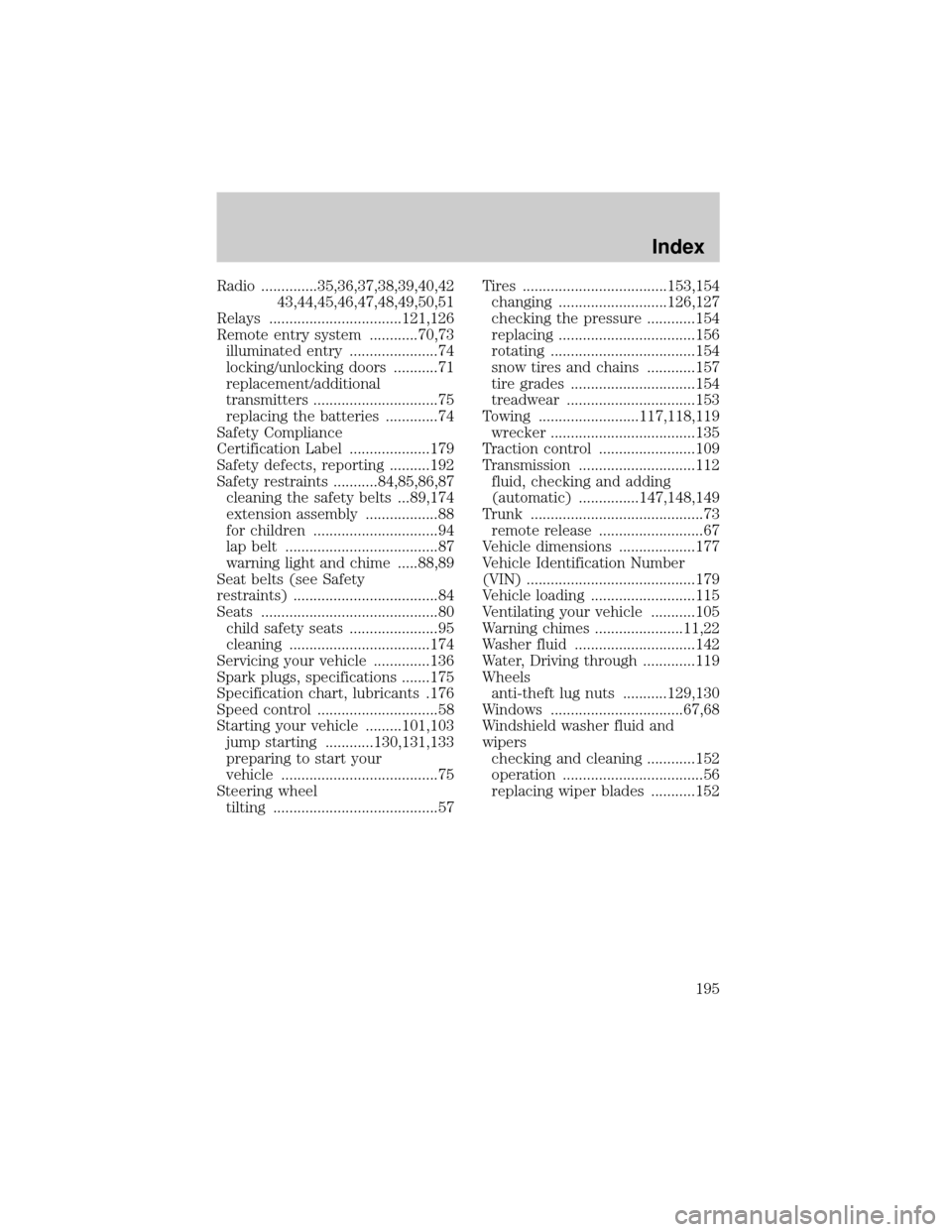
Radio ..............35,36,37,38,39,40,42
43,44,45,46,47,48,49,50,51
Relays .................................121,126
Remote entry system ............70,73
illuminated entry ......................74
locking/unlocking doors ...........71
replacement/additional
transmitters ...............................75
replacing the batteries .............74
Safety Compliance
Certification Label ....................179
Safety defects, reporting ..........192
Safety restraints ...........84,85,86,87
cleaning the safety belts ...89,174
extension assembly ..................88
for children ...............................94
lap belt ......................................87
warning light and chime .....88,89
Seat belts (see Safety
restraints) ....................................84
Seats ............................................80
child safety seats ......................95
cleaning ...................................174
Servicing your vehicle ..............136
Spark plugs, specifications .......175
Specification chart, lubricants .176
Speed control ..............................58
Starting your vehicle .........101,103
jump starting ............130,131,133
preparing to start your
vehicle .......................................75
Steering wheel
tilting .........................................57Tires ....................................153,154
changing ...........................126,127
checking the pressure ............154
replacing ..................................156
rotating ....................................154
snow tires and chains ............157
tire grades ...............................154
treadwear ................................153
Towing .........................117,118,119
wrecker ....................................135
Traction control ........................109
Transmission .............................112
fluid, checking and adding
(automatic) ...............147,148,149
Trunk ...........................................73
remote release ..........................67
Vehicle dimensions ...................177
Vehicle Identification Number
(VIN) ..........................................179
Vehicle loading ..........................115
Ventilating your vehicle ...........105
Warning chimes ......................11,22
Washer fluid ..............................142
Water, Driving through .............119
Wheels
anti-theft lug nuts ...........129,130
Windows .................................67,68
Windshield washer fluid and
wipers
checking and cleaning ............152
operation ...................................56
replacing wiper blades ...........152
Index
195