change time Mercury Grand Marquis 2000 Owner's Manuals
[x] Cancel search | Manufacturer: MERCURY, Model Year: 2000, Model line: Grand Marquis, Model: Mercury Grand Marquis 2000Pages: 224, PDF Size: 1.61 MB
Page 3 of 224

WARNINGS
Warnings provide information which may reduce the risk of personal
injury and prevent possible damage to others, your vehicle and its
equipment.
BREAKING-IN YOUR VEHICLE
There are no particular breaking-in rules for your vehicle. During the
first 1 600 km (1 000 miles) of driving, vary speeds frequently. This is
necessary to give the moving parts a chance to break in.
INFORMATION ABOUT THIS GUIDE
The information found in this guide was in effect at the time of printing.
Ford may change the contents without notice and without incurring
obligation.
Introduction
3
Page 30 of 224
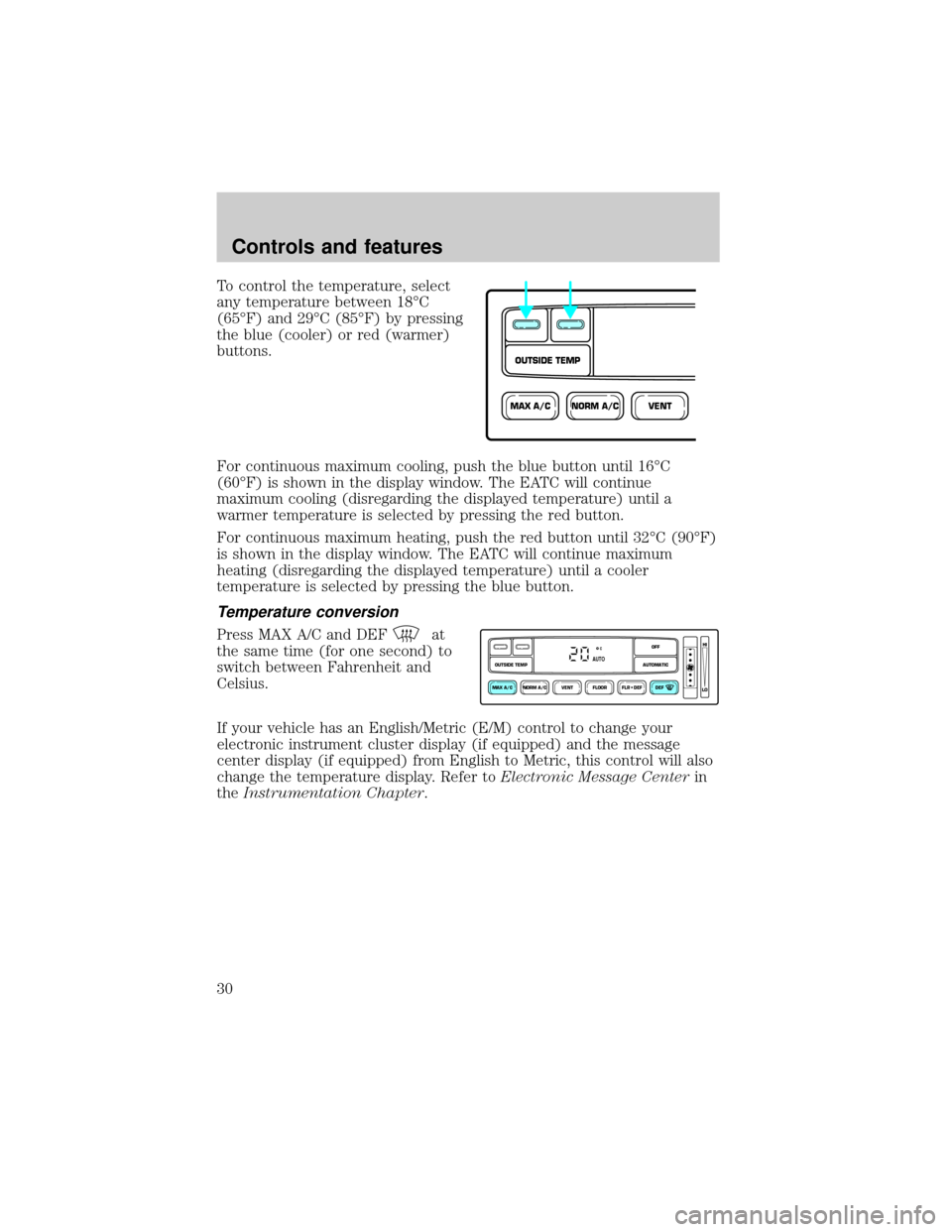
To control the temperature, select
any temperature between 18ÉC
(65ÉF) and 29ÉC (85ÉF) by pressing
the blue (cooler) or red (warmer)
buttons.
For continuous maximum cooling, push the blue button until 16ÉC
(60ÉF) is shown in the display window. The EATC will continue
maximum cooling (disregarding the displayed temperature) until a
warmer temperature is selected by pressing the red button.
For continuous maximum heating, push the red button until 32ÉC (90ÉF)
is shown in the display window. The EATC will continue maximum
heating (disregarding the displayed temperature) until a cooler
temperature is selected by pressing the blue button.
Temperature conversion
Press MAX A/C and DEFat
the same time (for one second) to
switch between Fahrenheit and
Celsius.
If your vehicle has an English/Metric (E/M) control to change your
electronic instrument cluster display (if equipped) and the message
center display (if equipped) from English to Metric, this control will also
change the temperature display. Refer toElectronic Message Centerin
theInstrumentation Chapter.
NORM A/CVENTMAX A/C
OUTSIDE TEMP
NORM A/CVENT FLOOR FLR • DEF DEF
HI
LO
MAX A/C
OUTSIDE TEMP AUTOMATICOFFAUTO
Controls and features
30
Page 58 of 224
Cleaning compact discs
Inspect all discs for contamination before playing. If necessary, clean
discs only with an approved CD cleaner and wipe from the center out to
the edge. Do not use circular motion.
CD and CD changer care
²Handle discs by their edges only. Never touch the playing surface.
²Do not expose discs to direct sunlight or heat sources for extended
periods of time.
²Do not insert more than one disc into each slot of the CD changer
magazine.
Cleaning cassette player (if equipped)
Clean the tape player head with a cassette cleaning cartridge after 10 to
12 hours of play in order to maintain the best sound and operation.
Cassette and cassette player care
²Use only cassettes that are 90 minutes long or less.
²Do not expose tapes to direct sunlight, high humidity, extreme heat or
extreme cold. Allow tapes that may have been exposed to extreme
temperatures to reach a moderate temperature before playing.
²Tighten very loose tapes by inserting a finger or pencil into the hole
and turning the hub.
²Remove loose labels before inserting tapes.
²Do not leave tapes in the cassette player for a long time when not
being played.
Radio frequency information
The Federal Communications Commission (FCC) and the Canadian Radio
and Telecommunications Commission(CRTC) establish the frequencies
AM and FM stations may use for their broadcasts. Allowable frequencies
are:
AM 530, 540±1600, 1610 kHz
FM 87.7, 87.9±107.7, 107.9 MHz
Not all frequencies are used in a given area.
Controls and features
58
Page 122 of 224

The Traction Controlysystem will be on every time you turn the ignition
key from OFF to ON until you deactivate the system using the traction
control switch in the glove compartment.
STEERING
Your vehicle is equipped with power steering. Power steering uses energy
from the engine to help steer the vehicle.
To prevent damage to the power steering pump:
²Never hold the steering wheel to the extreme right or the extreme left
for more than a few seconds when the engine is running.
²Do not operate the vehicle with a low power steering pump fluid level.
If the power steering system breaks down (or if the engine is turned
off), you can steer the vehicle manually, but it takes more effort.
If the steering wanders or pulls, the condition could be caused by any of
the following:
²underinflated tire(s) on any wheel(s)
²high crown in center of road
²high crosswinds
²wheels out of alignment
²loose or worn components in steering linkage
Speed sensitive steering (except police vehicles)
The steering in your vehicle is speed sensitive. At high speeds, steering
assist will decrease to improve steering feel. At lower speeds,
maneuverability will be increased.
If the amount of effort required to steer your vehicle changes at a
constant vehicle speed, have the power steering system checked by your
dealer or a qualified service technician.
AIR SUSPENSION SYSTEM (IF EQUIPPED)
The air suspension system is designed to improve ride, handling and
general vehicle performance during:
²certain road conditions
²steering maneuvers
²braking
²accelerations
Driving
122
Page 131 of 224

²Do not allow waves to break higher than 15 cm (6 inches) above the
bottom edge of the rear bumper.
Exceeding these limits may allow water to enter critical vehicle
components, adversely affecting driveability, emissions, reliability and
causing internal transmission damage.
Replace the rear axle lubricant anytime the axle has been submerged in
water. Rear axle lubricant quantities are not to be checked or changed
unless a leak is suspected or repair required.
Disconnect the wiring to the trailer before backing the trailer into the
water. Reconnect the wiring to the trailer after the trailer is removed
from the water.
Recreational towing (all wheels on the ground)
Follow these guidelines for your specific powertrain combination to tow
your vehicle with all four wheels on the ground (such as behind a
recreational vehicle).
These guidelines are designed to ensure that your transmission is not
damaged due to insufficient lubrication.
All Rear Wheel Drive (RWD) vehicles
This applies to all cars and 4x2 trucks/sport utilities with rear wheel
drive capability.
An example of recreational towing is towing your vehicle behind a
Motorhome. The following recreational towing guidelines are designed to
ensure that your transmission is not damaged.
²Place the transmission in N (Neutral).
²Maximum speed is 56 km/h (35 mph).
²Maximum distance is 80 km (50 miles).
If a distance of 80 km (50 miles) or a speed of 56 km/h (35 mph) must
be exceeded, you must disconnect the driveshaft. Ford recommends the
driveshaft be removed/installed only by a qualified technician. See your
local dealer for driveshaft removal/installation.
Improper removal/installation of the driveshaft can cause
transmission fluid loss, damage to the driveshaft and internal
transmission components.
Driving
131
Page 164 of 224
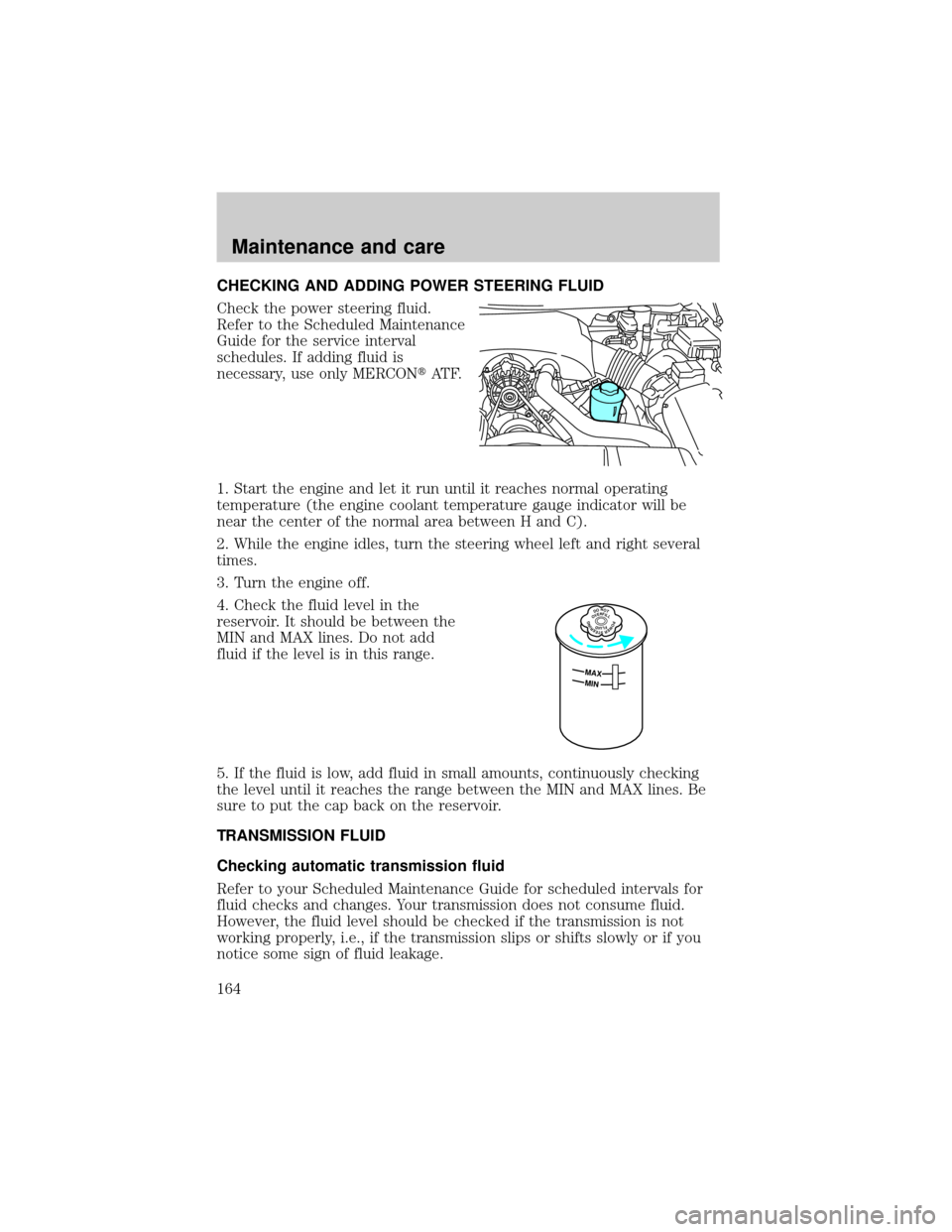
CHECKING AND ADDING POWER STEERING FLUID
Check the power steering fluid.
Refer to the Scheduled Maintenance
Guide for the service interval
schedules. If adding fluid is
necessary, use only MERCONtAT F.
1. Start the engine and let it run until it reaches normal operating
temperature (the engine coolant temperature gauge indicator will be
near the center of the normal area between H and C).
2. While the engine idles, turn the steering wheel left and right several
times.
3. Turn the engine off.
4. Check the fluid level in the
reservoir. It should be between the
MIN and MAX lines. Do not add
fluid if the level is in this range.
5. If the fluid is low, add fluid in small amounts, continuously checking
the level until it reaches the range between the MIN and MAX lines. Be
sure to put the cap back on the reservoir.
TRANSMISSION FLUID
Checking automatic transmission fluid
Refer to your Scheduled Maintenance Guide for scheduled intervals for
fluid checks and changes. Your transmission does not consume fluid.
However, the fluid level should be checked if the transmission is not
working properly, i.e., if the transmission slips or shifts slowly or if you
notice some sign of fluid leakage.
DONOTOVERFILLPOWERSTEERINGFLUID
MAX
MIN
Maintenance and care
164
Page 181 of 224

For consistent results when filling the fuel tank:
²Use the same filling rate setting (low Ð medium Ð high) each time
the tank is filled.
²Allow three automatic click-offs when filling.
²Always use fuel with the recommended octane rating.
²Use a known quality gasoline, preferably a national brand.
²Use the same side of the same pump and have the vehicle facing the
same direction each time you fill up.
²Have the vehicle loading and distribution the same every time.
Your results will be most accurate if your filling method is consistent.
Calculating fuel economy
1. Fill the fuel tank completely and record the initial odometer reading
(in kilometers or miles).
2. Each time you fill the tank, record the amount of fuel added (in liters
or gallons).
3. After at least three to five tank fill-ups, fill the fuel tank and record
the current odometer reading.
4. Subtract your initial odometer reading from the current odometer
reading.
5. Follow one of the simple calculations in order to determine fuel
economy:
Multiply liters used by 100, then divide by total kilometers
traveled.
Divide total miles traveled by total gallons used.
Keep a record for at least one month and record the type of driving (city
or highway). This will provide an accurate estimate of the vehicle's fuel
economy under current driving conditions. Additionally, keeping records
during summer and winter will show how temperature impacts fuel
economy. In general, lower temperatures give lower fuel economy.
Driving style Ð good driving and fuel economy habits
Give consideration to the lists that follow and you may be able to change
a number of variables and improve your fuel economy.
Maintenance and care
181
Page 203 of 224
Ford Extended Service Plan
You can get more protection for your new car or light truck by
purchasing Ford Extended Service Plan (Ford ESP) coverage. Ford ESP
is an optional service contract which is backed by Ford Motor Company
or Ford Motor Service Company (in the U.S.) and Ford of Canada (in
Canada). It provides the following:
²benefits during the warranty period depending on the plan you
purchase (such as: reimbursement for rentals; coverage for certain
maintenance and wear items)
²protection against repair costs after your Bumper to Bumper Warranty
expires
You may purchase Ford ESP from any participating Ford and Lincoln/
Mercury and Ford of Canada dealer. There are several plans available in
various time, distance and deductible combinations which can be tailored
to fit your own driving needs. Ford ESP also offers reimbursement
benefits for towing and rental coverage. (In Hawaii, rules vary. See your
dealer for details.)
When you buy Ford ESP, you receive Peace-of-Mind protection
throughout the United States and Canada, provided by a network of
more than 5,000 participating Ford or Lincoln/Mercury and Ford of
Canada dealers.
If you did not take advantage of the Ford Extended Service Plan at the
time of purchasing your vehicle, you may still be eligible. Please contact
your dealer for further information. Since this information is subject to
change, please ask your dealer for complete details about Ford Extended
Service Plan coverage options.
Getting the service you need
At home
Ford Motor Company and Ford of Canada have authorized dealerships to
service your vehicle. When you need warranty repairs your selling dealer
would like you to return to it for that service, but you may also take your
vehicle to another Ford Motor Company dealership authorized for
warranty repairs. Certain warranty repairs require special training
though, so not all dealers are authorized to perform all warranty repairs.
That means that depending on the warranty repair needed, the vehicle
may need to be taken to another dealer. If a particular dealership can not
assist you, then contact the Customer Assistance Center.
Customer assistance
203
Page 216 of 224

set zone adjustment .................70
Controls
power seat ............................89,90
Coolant
checking and adding ..............157
coolant temperature light ........10
refill capacities .................160,197
specifications ...................198,200
Cruise control
(see Speed control) ....................62
Customer Assistance ................133
Ford accessories
for your vehicle ......................210
Ford Extended
Service Plan ............................203
Getting assistance outside
the U.S. and Canada ..............209
Getting roadside assistance ...133
Getting the service
you need .................................203
Ordering additional
owner's literature ...................213
The Dispute
Settlement Board ...................206
Utilizing the Mediation/
Arbitration Program ...............209
Daytime running lamps
(see Lamps) ................................24
Defrost
rear window ..............................25
Dipstick
automatic
transmission fluid ...................164
engine oil .................................153
Doors
lubricant specifications ..........198
Driving under special
conditions
through water .........................132
Emergencies, roadside
jump-starting ..........................144
Emission control system ..........183Engine ........................................200
check engine/
service engine soon light ...........9
cleaning ...................................193
coolant .....................................157
fail-safe coolant ......................161
idle speed control ...................167
lubrication
specifications ...................198,200
refill capacities ........................197
service points ..........................152
starting after a collision .........134
Engine block heater .................116
Engine oil ..................................153
change oil soon warning,
message center .......................153
checking and adding ..............153
dipstick ....................................153
filter, specifications .........155,197
recommendations ...................155
refill capacities ........................197
specifications ...................198,200
Exhaust fumes ..........................116
Fail safe cooling ........................161
Floor mats ...................................74
Fluid capacities .........................197
Fuel ............................................175
calculating fuel economy .......180
cap ...........................................177
capacity ...................................197
choosing the right fuel ...........178
comparisons with EPA fuel
economy estimates .................183
detergent in fuel .....................179
filling your
vehicle with fuel .......175,177,180
filter, specifications .........180,197
fuel pump shut-off switch .....134
gauge .........................................15
improving fuel economy ........180
low fuel warning light ................8
octane rating ....................179,200
Index
216
Page 217 of 224

quality ......................................179
running out of fuel .................179
safety information relating
to automotive fuels ................175
Fuses ...................................135,136
Garage door opener ....................65
Gas cap (see Fuel cap) ............177
Gas mileage
(see Fuel economy) .................180
Gauges .........................................15
battery voltage gauge ...............19
engine coolant
temperature gauge ...................18
engine oil pressure gauge ........19
fuel gauge ..................................15
odometer ...................................17
speedometer .............................16
trip odometer ............................18
GAWR
(Gross Axle Weight Rating) .....127
definition .................................127
driving with a heavy load ......127
location ....................................127
GVWR (Gross
Vehicle Weight Rating) .............127
calculating ...............................127
definition .................................127
driving with a heavy load ......127
location ....................................127
Hazard flashers .........................134
Head restraints ...........................87
Headlamps ...................................24
aiming ......................................190
autolamp system .......................25
bulb specifications ..................189
daytime running lights .............24
flash to pass ..............................25
high beam ............................11,25
replacing bulbs .......................185
turning on and off ....................24
warning chime ..........................15
Heating ........................................26heating and air conditioning
system .......................................26
HomeLink universal
transceiver (see Garage
door opener) ................65,66,67,68
Hood ..........................................151
Ignition .......................................200
positions of the ignition ...........60
Infant seats
(see Safety seats) .....................107
Inspection/
maintenance (I/M) testing .......184
Instrument panel
cleaning ...................................194
cluster ...................................8,194
lighting up
panel and interior .....................24
location of components ..............8
Jump-starting your vehicle ......144
Keyless entry system .................82
autolock .....................................76
keypad .......................................82
programming entry code .........83
Keys
key in ignition chime ...............14
positions of the ignition ...........60
Lamps
autolamp system .......................25
bulb replacement
specifications chart ................189
cargo lamps ...............................24
daytime running light ...............24
headlamps .................................24
headlamps, flash to pass ..........25
instrument panel, dimming .....24
interior lamps ....................24,189
replacing bulbs .........185,187,189
Lane change indicator
(see Turn signal) ........................59
Lights, warning and indicator ......8
air bag ........................................10
air suspension ...........................12
Index
217