heating Mercury Grand Marquis 2000 Owner's Manuals
[x] Cancel search | Manufacturer: MERCURY, Model Year: 2000, Model line: Grand Marquis, Model: Mercury Grand Marquis 2000Pages: 224, PDF Size: 1.61 MB
Page 18 of 224
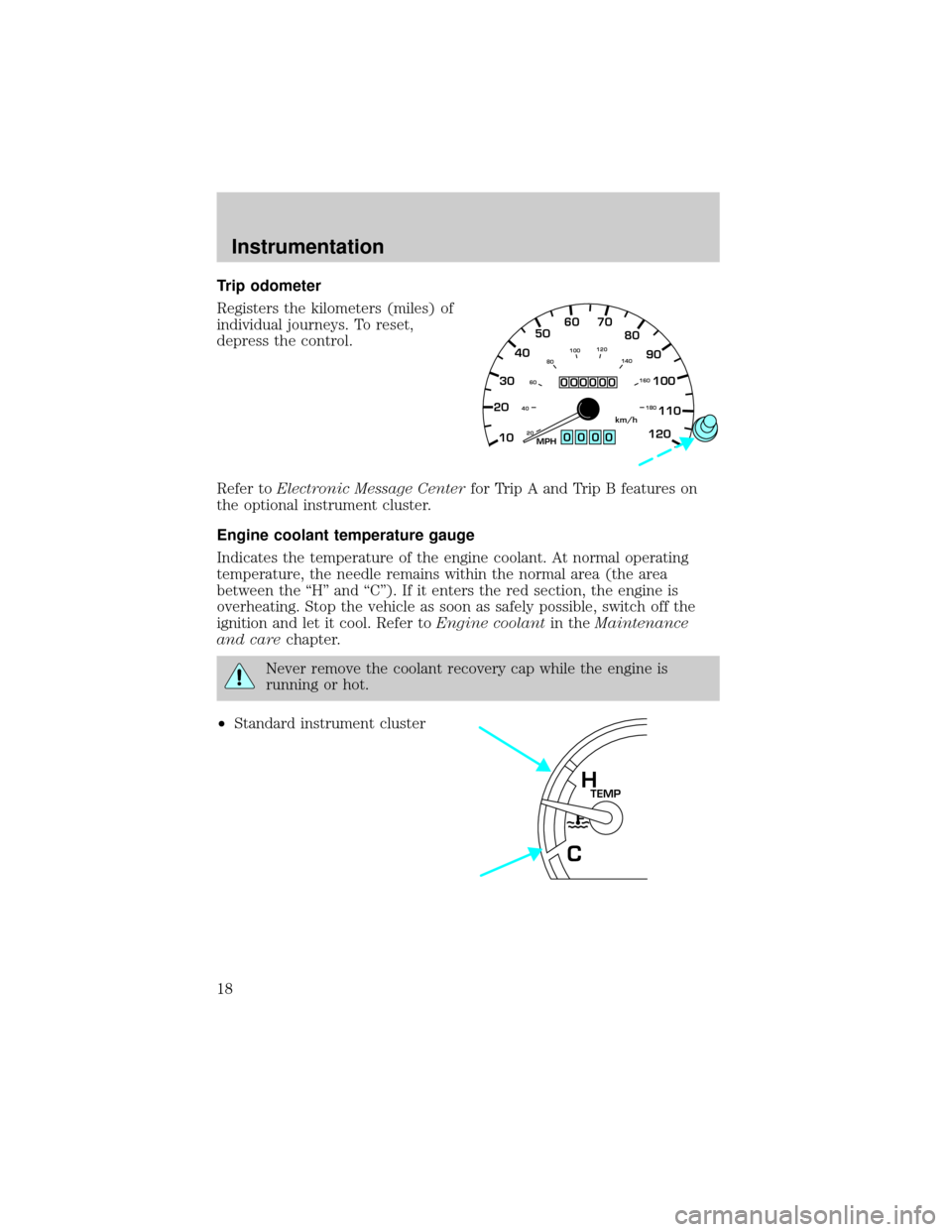
Trip odometer
Registers the kilometers (miles) of
individual journeys. To reset,
depress the control.
Refer toElectronic Message Centerfor Trip A and Trip B features on
the optional instrument cluster.
Engine coolant temperature gauge
Indicates the temperature of the engine coolant. At normal operating
temperature, the needle remains within the normal area (the area
between the ªHº and ªCº). If it enters the red section, the engine is
overheating. Stop the vehicle as soon as safely possible, switch off the
ignition and let it cool. Refer toEngine coolantin theMaintenance
and carechapter.
Never remove the coolant recovery cap while the engine is
running or hot.
²Standard instrument cluster
0000
2030405060 70
80
90
100
110
120
10
20 406080100120
140
160
180MPHkm/h
000000
TEMPH
C
Instrumentation
18
Page 26 of 224
Press the rear defroster control to clear the rear window of thin ice and
fog.
²A small LED will illuminate when the rear defroster is activated.
The ignition must be in the ON position to operate the rear window
defroster.
The defroster turns off automatically after 10 minutes or when the
ignition is turned to the OFF position. To manually turn off the defroster
before 10 minutes have passed, push the control again.
CLIMATE CONTROL SYSTEM
Manual heating and air conditioning system (if equipped)
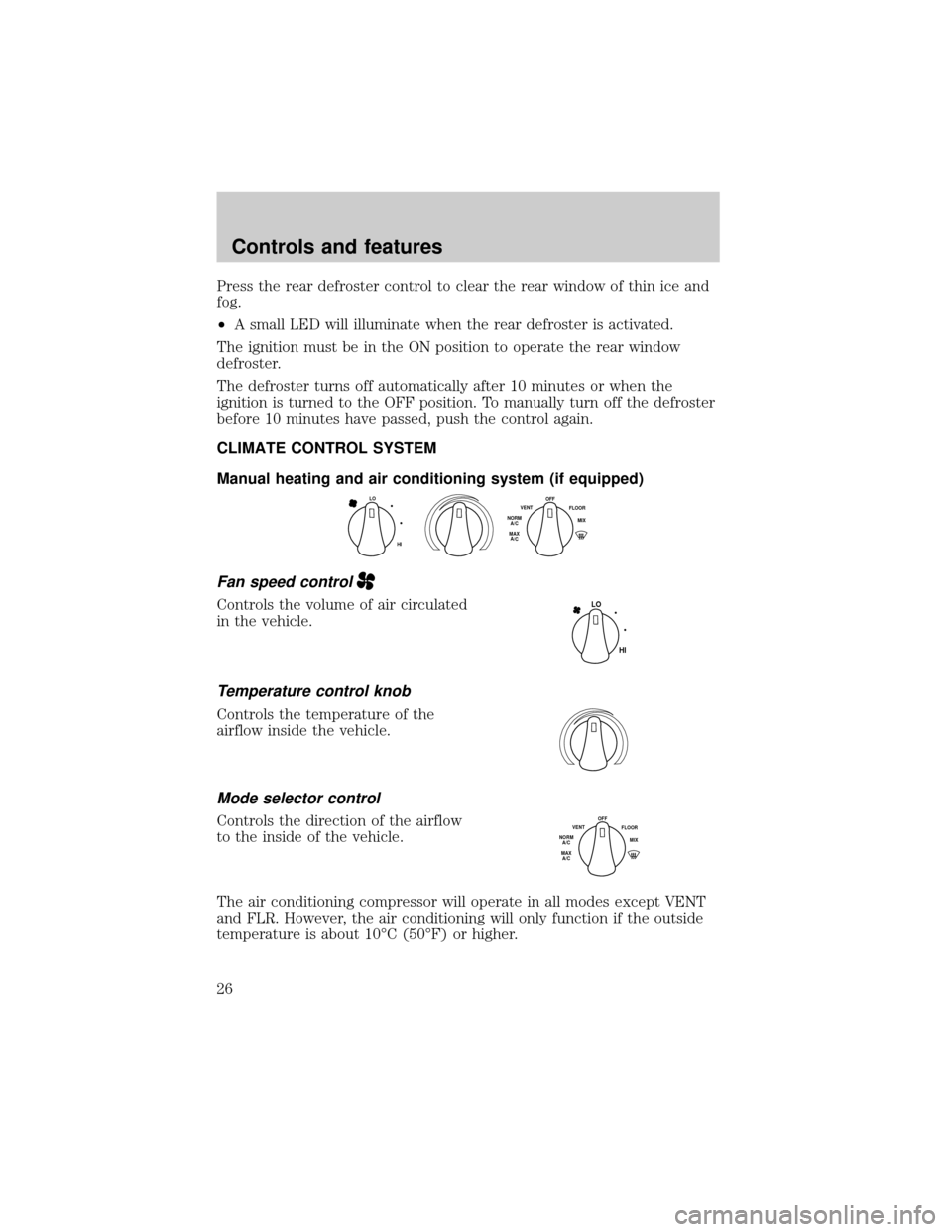
Fan speed control
Controls the volume of air circulated
in the vehicle.
Temperature control knob
Controls the temperature of the
airflow inside the vehicle.
Mode selector control
Controls the direction of the airflow
to the inside of the vehicle.
The air conditioning compressor will operate in all modes except VENT
and FLR. However, the air conditioning will only function if the outside
temperature is about 10ÉC (50ÉF) or higher.
LO
HIOFF
MIX VENTFLOOR
MAX
A/C NORM
A/C
LO
HI
OFF
MIX VENTFLOOR
MAX
A/C NORM
A/C
Controls and features
26
Page 27 of 224

Since the air conditioner removes considerable moisture from the air
during operation, it is normal if clear water drips on the ground under
the air conditioner drain while the system is working and even after you
have stopped the vehicle.
²MAX A/C-Uses recirculated air to cool the vehicle. MAX A/C is noisier
than NORM A/C but more economical and will cool the inside of the
vehicle faster. Airflow will be from the instrument panel registers. This
mode can also be used to prevent undesirable odors from entering the
vehicle.
²NORM A/C-Uses outside air to cool the vehicle. It is quieter than MAX
A/C but not as economical. Airflow will be from the instrument panel
registers.
²VENT-Distributes outside air through the instrument panel registers.
However, the air will not be cooled below the outside temperature
because the air conditioning does not operate in this mode.
²OFF-Outside air is shut out and the fan will not operate. For short
periods of time only, use this mode to prevent undesirable odors from
entering the vehicle.
²FLR-Allows for maximum heating by distributing outside air through
the floor ducts. However, the air will not be cooled below the outside
temperature because the air conditioning does not operate in this
mode.
²MIX-Distributes outside air through the windshield defroster ducts and
the floor ducts. Heating and air conditioning capabilities are provided
in this mode. For added customer comfort, when the temperature
control knob is anywhere in between the full hot and full cold
positions, the air distributed through the floor ducts will be slightly
warmer than the air sent to the windshield defroster ducts. If the
temperature is about 10ÉC (50ÉF) or higher, the air conditioner will
automatically dehumidify the air to reduce fogging.
²DEF
-Distributes outside air through the windshield defroster
ducts. It can be used to clear ice or fog from the windshield. If the
temperature is about 10ÉC (50ÉF) or higher, the air conditioner will
automatically dehumidify the air to reduce fogging.
Operating tips
²In humid weather, selectbefore driving. This will reduce fogging
on your windshield. After a few minutes, select any desired position.
Controls and features
27
Page 30 of 224
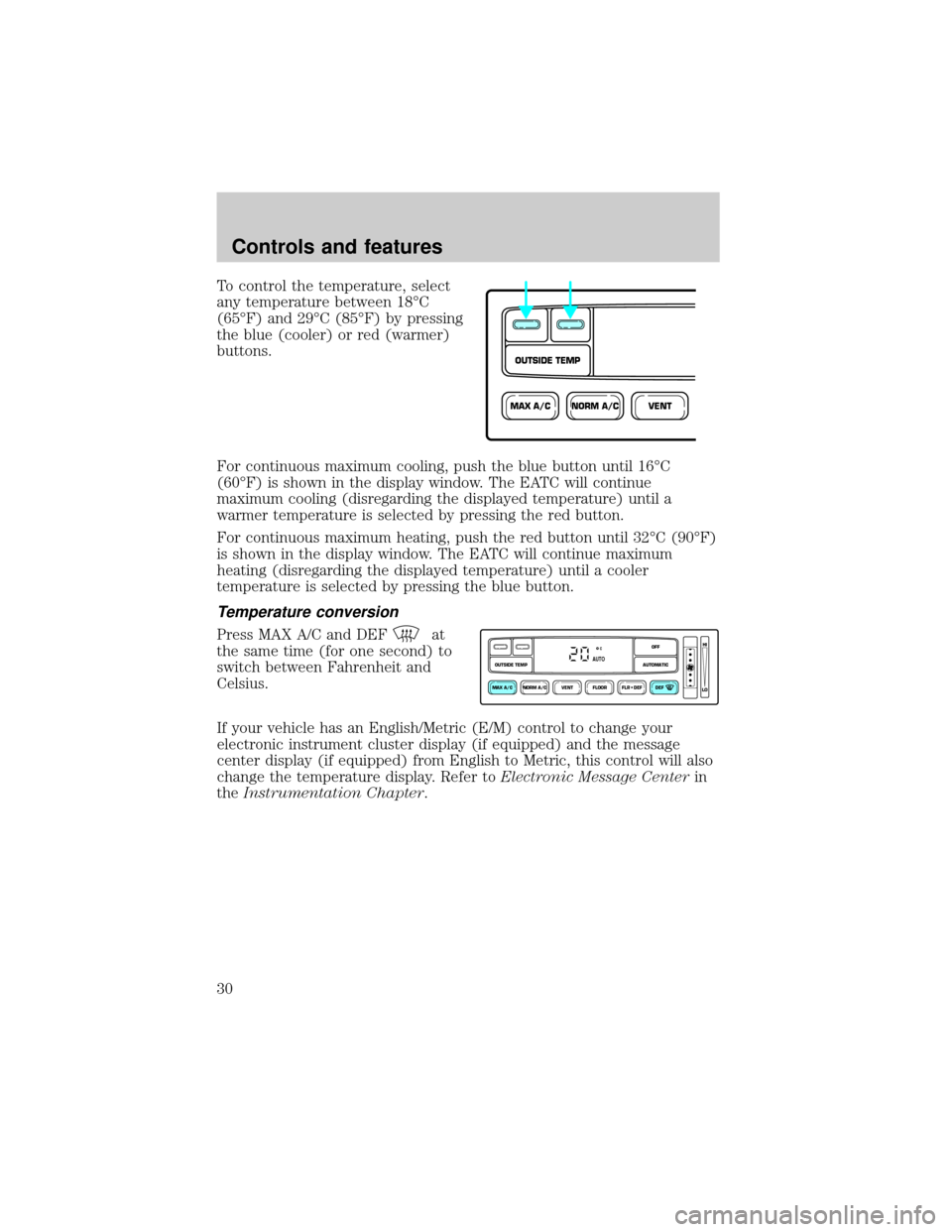
To control the temperature, select
any temperature between 18ÉC
(65ÉF) and 29ÉC (85ÉF) by pressing
the blue (cooler) or red (warmer)
buttons.
For continuous maximum cooling, push the blue button until 16ÉC
(60ÉF) is shown in the display window. The EATC will continue
maximum cooling (disregarding the displayed temperature) until a
warmer temperature is selected by pressing the red button.
For continuous maximum heating, push the red button until 32ÉC (90ÉF)
is shown in the display window. The EATC will continue maximum
heating (disregarding the displayed temperature) until a cooler
temperature is selected by pressing the blue button.
Temperature conversion
Press MAX A/C and DEFat
the same time (for one second) to
switch between Fahrenheit and
Celsius.
If your vehicle has an English/Metric (E/M) control to change your
electronic instrument cluster display (if equipped) and the message
center display (if equipped) from English to Metric, this control will also
change the temperature display. Refer toElectronic Message Centerin
theInstrumentation Chapter.
NORM A/CVENTMAX A/C
OUTSIDE TEMP
NORM A/CVENT FLOOR FLR • DEF DEF
HI
LO
MAX A/C
OUTSIDE TEMP AUTOMATICOFFAUTO
Controls and features
30
Page 32 of 224

economical and will cool the inside of the vehicle faster. Airflow is
from the instrument panel registers. This mode can also be used to
prevent undesirable odors from entering the vehicle.
²NORM A/C-Uses outside air to cool the vehicle. The temperature
display will remain the same and air will be cooled based on the
selected temperature. It is quieter than MAX A/C but not as
economical. Fan speed will remain automatic. Airflow is from the
instrument panel registers.
²VENT-Distributes outside air through the instrument panel registers.
However, the air cannot be cooled below the outside temperature
because the air conditioning does not operate in this mode.
²FLOOR-Allows for maximum heating by distributing outside air
through the floor ducts. However, the air cannot be cooled below the
outside temperature because the air conditioning does not operate in
this mode.
²FLR²DEF-Distributes outside air through the windshield defroster
ducts and the floor ducts. Heating and air conditioning capabilities are
provided in this mode. The air will be heated or cooled based on the
temperature selection. For added customer comfort, the air
distributed through the floor ducts will be slightly warmer than the air
sent to the windshield defroster ducts. If the temperature is about
10ÉC (50ÉF) or higher, the air conditioner will automatically
dehumidify the air to reduce fogging.
²DEF
-Distributes outside air through the windshield defroster
ducts. It can be used to clear ice or fog from the windshield. If the
outside air temperature is about 10ÉC (50ÉF) or higher, the air
conditioner will automatically dehumidify the air to reduce fogging.
²OFF-Outside air is shut out and the fan will not operate. For short
periods of time, use this mode to reduce undesirable odors from
entering the vehicle.
Controls and features
32
Page 117 of 224
Important ventilating information
If the engine is idling while the vehicle is stopped in an open area for
long periods of time, open the windows at least 2.5 cm (one inch).
Adjust the heating or air conditioning (if equipped) to bring in fresh air.
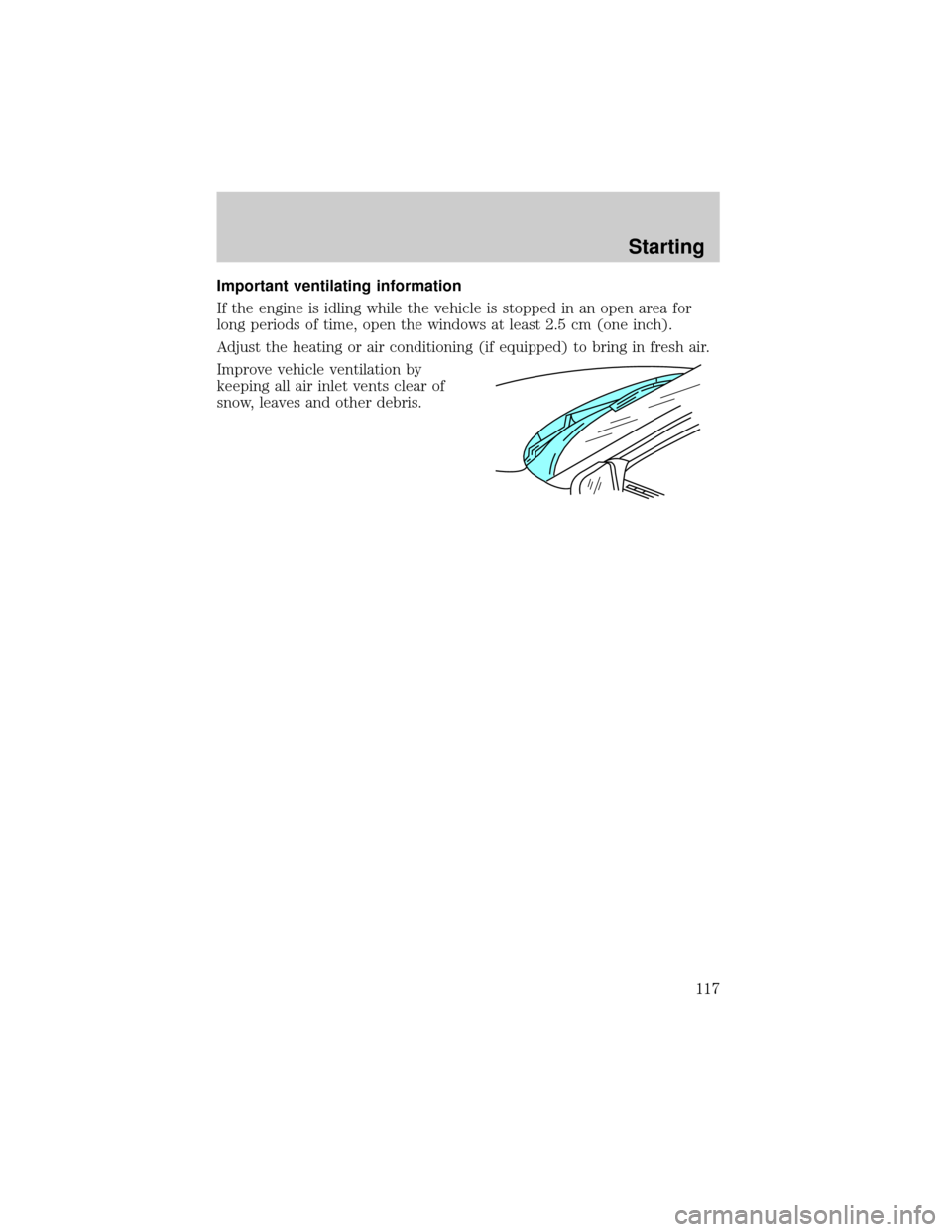
Improve vehicle ventilation by
keeping all air inlet vents clear of
snow, leaves and other debris.
Starting
117
Page 121 of 224

The system operates by detecting and controlling wheel spin. The system
borrows many of the electronic and mechanical elements already present
in the anti-lock braking system (ABS).
Wheel-speed sensors allow excess rear wheel spin to be detected by the
Traction Controlyportion of the ABS computer. Any excessive wheel
spin is controlled by automatically applying and releasing the rear brakes
in conjunction with engine torque reductions. Engine torque reduction is
realized via the fully electronic spark and fuel injection systems. This
process is very sensitive to driving conditions and very fast acting. The
rear wheels ªsearchº for optimum traction several times a second and
adjustments are made accordingly.
The Traction Controlysystem will allow your vehicle to make better use
of available traction on slippery surfaces. The system is a driver aid
which makes your vehicle easier to handle primarily on snow and ice
covered roads.
During Traction Controlyoperation you may hear an electric motor type
of sound coming from the engine compartment and the engine will not
ªrev-upº when you push further on the accelerator. This is normal
system behavior.
If you should become stuck in snow or ice or on a very slippery road
surface, try switching the Traction Controlysystem off. This may allow
excess wheel spin to ªdigº the vehicle out and enable a successful
ªrockingº maneuver.
If the Traction Controlysystem is cycled excessively, the brake portion
of the system will shut down to prevent the rear brakes from
overheating. A limited Traction Controlyfunction using only engine
torque reduction will still control wheels from over-spinning. When the
rear brakes have cooled down, the system will again function normally.
Anti-lock braking is not affected by this condition and will function
normally during the cool down period.
The traction control indicator
flashes during a Traction Controly
system event.
If the traction control indicator
comes on and stays lit, either:
²the Traction Controlysystem requires service, or
²the customer has disabled the system using the traction control switch
located on the left side of the glove compartment.
TRAC
CNTL
Driving
121
Page 166 of 224
![Mercury Grand Marquis 2000 Owners Manuals The transmission fluid should be in
this range if at normal operating
temperature (66ÉC-77ÉC
[150ÉF-170ÉF]).
The transmission fluid should be in
this range if at ambient temperature
(10ÉC-35ÉC [](/img/33/10918/w960_10918-165.png "Mercury Grand Marquis 2000 Owners Manuals The transmission fluid should be in
this range if at normal operating
temperature (66ÉC-77ÉC
[150ÉF-170ÉF]).
The transmission fluid should be in
this range if at ambient temperature
(10ÉC-35ÉC [")
The transmission fluid should be in
this range if at normal operating
temperature (66ÉC-77ÉC
[150ÉF-170ÉF]).
The transmission fluid should be in
this range if at ambient temperature
(10ÉC-35ÉC [50ÉF-95ÉF]).
High fluid level
Fluid levels above the safe range
may result in transmission failure.
An overfill condition of transmission
fluid may cause shift and/or
engagement concerns and/or
possible damage.
High fluid levels can be caused by an overheating condition.
Adjusting automatic transmission fluid levels
Before adding any fluid, make sure the correct type is used. The type of
fluid used is normally indicated on the dipstick and also in the
Lubricant specificationssection in theCapacities and specifications
chapter.
Use of a non-approved automatic transmission fluid may cause
internal transmission component damage.
If necessary, add fluid in 250 mL (1/2 pint) increments through the filler
tube until the level is correct.
If an overfill occurs, excess fluid
should be removed by a qualified
technician.
An overfill condition of
transmission fluid may cause shift and/or engagement concerns
and/or possible damage.
DON’T ADD
DON’T ADD
DON’T ADD
DON’T ADD
Maintenance and care
166
Page 215 of 224

Air bag supplemental
restraint system ........................101
and child safety seats ............103
description ..............................101
disposal ....................................105
driver air bag ..........................103
indicator light ....................10,105
operation .................................103
passenger air bag ...................103
Air cleaner filter ................169,197
Air conditioning ..........................26
automatic temperature
control system ..........................28
Air suspension ...........................122
description ..............................122
warning light .............................12
Antifreeze
(see Engine coolant) ................157
Anti-lock brake system
(see Brakes) .......................118,119
Audio system (see Radio) .........35
Automatic transmission
driving an automatic
overdrive .................................124
fluid, adding ............................164
fluid, checking ........................164
fluid, refill capacities ..............197
fluid, specification ..................200
Axle
lubricant specifications ...198,200
refill capacities ........................197
traction lok ..............................126
Battery .......................................167
acid, treating emergencies .....167
charging system
warning light .............................12
jumping a disabled battery ....144
maintenance-free ....................167
replacement, specifications ...197
servicing ..................................167
voltage gauge ............................19
Belt minder .................................97Brakes ........................................118
anti-lock ............................118,119
anti-lock brake system
(ABS) warning light ..........11,119
brake warning light ..................11
fluid, checking and adding ....156
fluid, refill capacities ..............197
fluid, specifications ..........198,200
lubricant specifications ...198,200
shift interlock ..........................123
Break-in period .............................3
Capacities for refilling fluids ....197
Cassette tape player ...................46
CD changer .................................55
Certification Label ....................202
Child safety restraints ..............106
child safety belts ....................106
Child safety seats ......................107
attaching with tether straps ..111
in front seat ............................108
in rear seat .......................108,111
Cleaning your vehicle ...............190
engine compartment ..............193
exterior ....................................192
exterior lamps .........................192
instrument panel ....................194
instrument panel lens ............194
interior ..............................195,196
mirrors .....................................192
plastic parts ............................192
safety belts ..............................195
washing ....................................191
waxing .....................................191
wheels ......................................192
windows ..................................195
wiper blades ............................193
woodtone trim ........................195
Climate control (see Air
conditioning or Heating) ............26
Clock ............................................34
Compass, electronic ....................69
calibration .................................71
Index
215
Page 217 of 224

quality ......................................179
running out of fuel .................179
safety information relating
to automotive fuels ................175
Fuses ...................................135,136
Garage door opener ....................65
Gas cap (see Fuel cap) ............177
Gas mileage
(see Fuel economy) .................180
Gauges .........................................15
battery voltage gauge ...............19
engine coolant
temperature gauge ...................18
engine oil pressure gauge ........19
fuel gauge ..................................15
odometer ...................................17
speedometer .............................16
trip odometer ............................18
GAWR
(Gross Axle Weight Rating) .....127
definition .................................127
driving with a heavy load ......127
location ....................................127
GVWR (Gross
Vehicle Weight Rating) .............127
calculating ...............................127
definition .................................127
driving with a heavy load ......127
location ....................................127
Hazard flashers .........................134
Head restraints ...........................87
Headlamps ...................................24
aiming ......................................190
autolamp system .......................25
bulb specifications ..................189
daytime running lights .............24
flash to pass ..............................25
high beam ............................11,25
replacing bulbs .......................185
turning on and off ....................24
warning chime ..........................15
Heating ........................................26heating and air conditioning
system .......................................26
HomeLink universal
transceiver (see Garage
door opener) ................65,66,67,68
Hood ..........................................151
Ignition .......................................200
positions of the ignition ...........60
Infant seats
(see Safety seats) .....................107
Inspection/
maintenance (I/M) testing .......184
Instrument panel
cleaning ...................................194
cluster ...................................8,194
lighting up
panel and interior .....................24
location of components ..............8
Jump-starting your vehicle ......144
Keyless entry system .................82
autolock .....................................76
keypad .......................................82
programming entry code .........83
Keys
key in ignition chime ...............14
positions of the ignition ...........60
Lamps
autolamp system .......................25
bulb replacement
specifications chart ................189
cargo lamps ...............................24
daytime running light ...............24
headlamps .................................24
headlamps, flash to pass ..........25
instrument panel, dimming .....24
interior lamps ....................24,189
replacing bulbs .........185,187,189
Lane change indicator
(see Turn signal) ........................59
Lights, warning and indicator ......8
air bag ........................................10
air suspension ...........................12
Index
217