Transfer Mercury Mariner 2007 Manual de Usuario (in Spanish)
[x] Cancel search | Manufacturer: MERCURY, Model Year: 2007, Model line: Mariner, Model: Mercury Mariner 2007Pages: 48, tamaño PDF: 0.37 MB
Page 4 of 48
CARACTERŒSTICAS DEL VEHŒCULO
Sistemas 4WD y AWD
Un vehÛculo equipado con AWD o 4WD (cuando selecciona el modo
4WD) tiene la capacidad de usar las cuatro ruedas para impulsarse. Esto
aumenta la tracciân y puede permitirle manejar con seguridad sobre
terrenos y caminos en condiciones que los vehÛculos convencionales con
tracciân en dos ruedas no pueden recorrer.
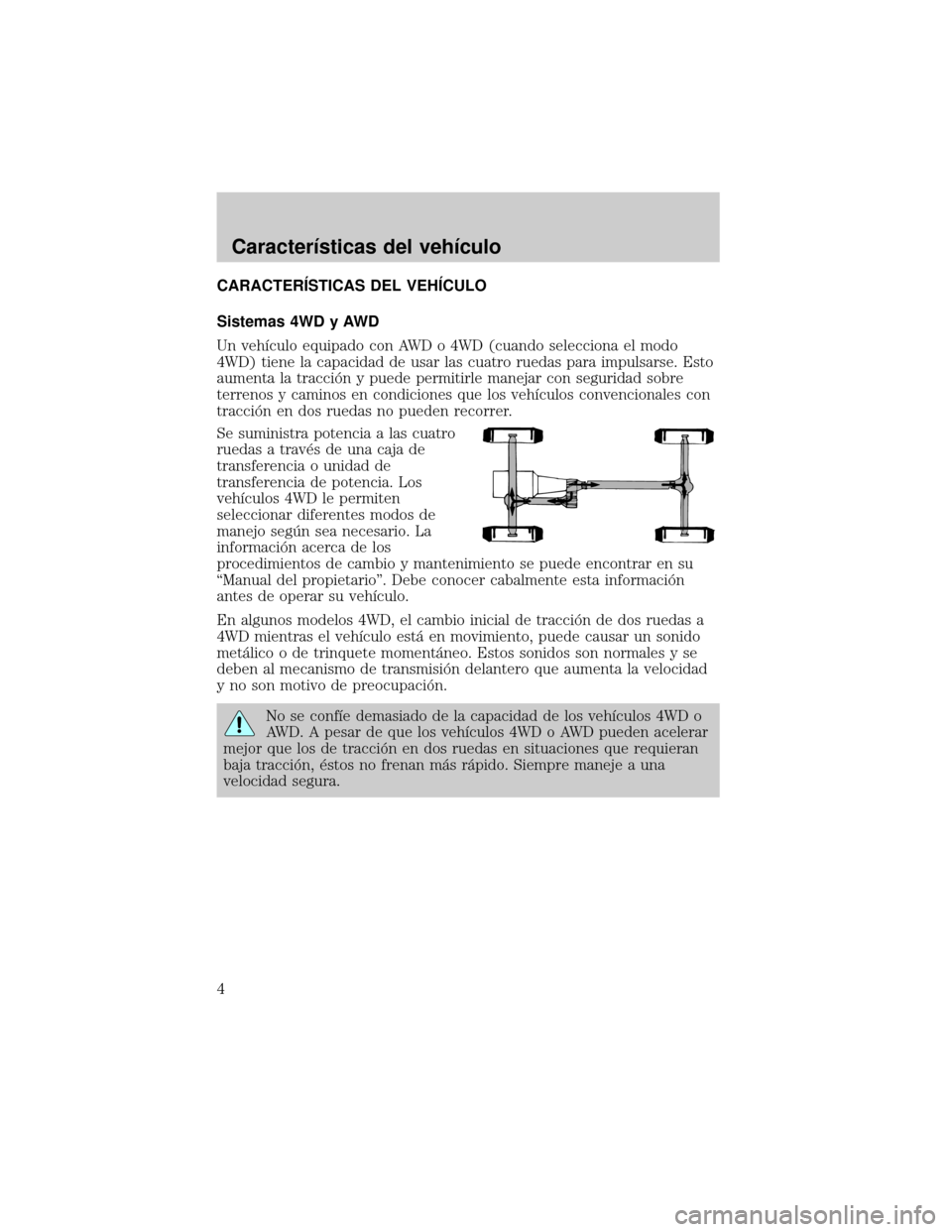
Se suministra potencia a las cuatro
ruedas a trav×s de una caja de
transferencia o unidad de
transferencia de potencia. Los
vehÛculos 4WD le permiten
seleccionar diferentes modos de
manejo segìn sea necesario. La
informaciân acerca de los
procedimientos de cambio y mantenimiento se puede encontrar en su
ªManual del propietarioº. Debe conocer cabalmente esta informaciân
antes de operar su vehÛculo.
En algunos modelos 4WD, el cambio inicial de tracciân de dos ruedas a
4WD mientras el vehÛculo estµ en movimiento, puede causar un sonido
metµlico o de trinquete momentµneo. Estos sonidos son normales y se
deben al mecanismo de transmisiân delantero que aumenta la velocidad
y no son motivo de preocupaciân.
No se confÛe demasiado de la capacidad de los vehÛculos 4WD o
AWD. A pesar de que los vehÛculos 4WD o AWD pueden acelerar
mejor que los de tracciân en dos ruedas en situaciones que requieran
baja tracciân, ×stos no frenan mµs rµpido. Siempre maneje a una
velocidad segura.
CaracterÛsticas del vehÛculo
4
Page 9 of 48
Algunos vehÛculos 4WD incluyen un modo Neutro. Cuando la caja de
transferencia estµ en N (Neutro), el motor y la transmisiân estµn
desconectados del resto de la lÛnea de transmisiân. Por lo tanto, el
vehÛculo puede rodar libremente aun si la transmisiân estµ en P
(Estacionamiento) o la transmisiân manual estµ engranada.
Est× atento al vehÛculo cuando la caja de transferencia est× en la
posiciân N (Neutro). Coloque siempre el freno de
estacionamiento completamente y apague el encendido cuando salga
del vehÛculo. Si no sigue estas precauciones, el vehÛculo puede moverse
en forma inesperada y lesionar a alguien.
Manejo en carreteras
9
Page 13 of 48
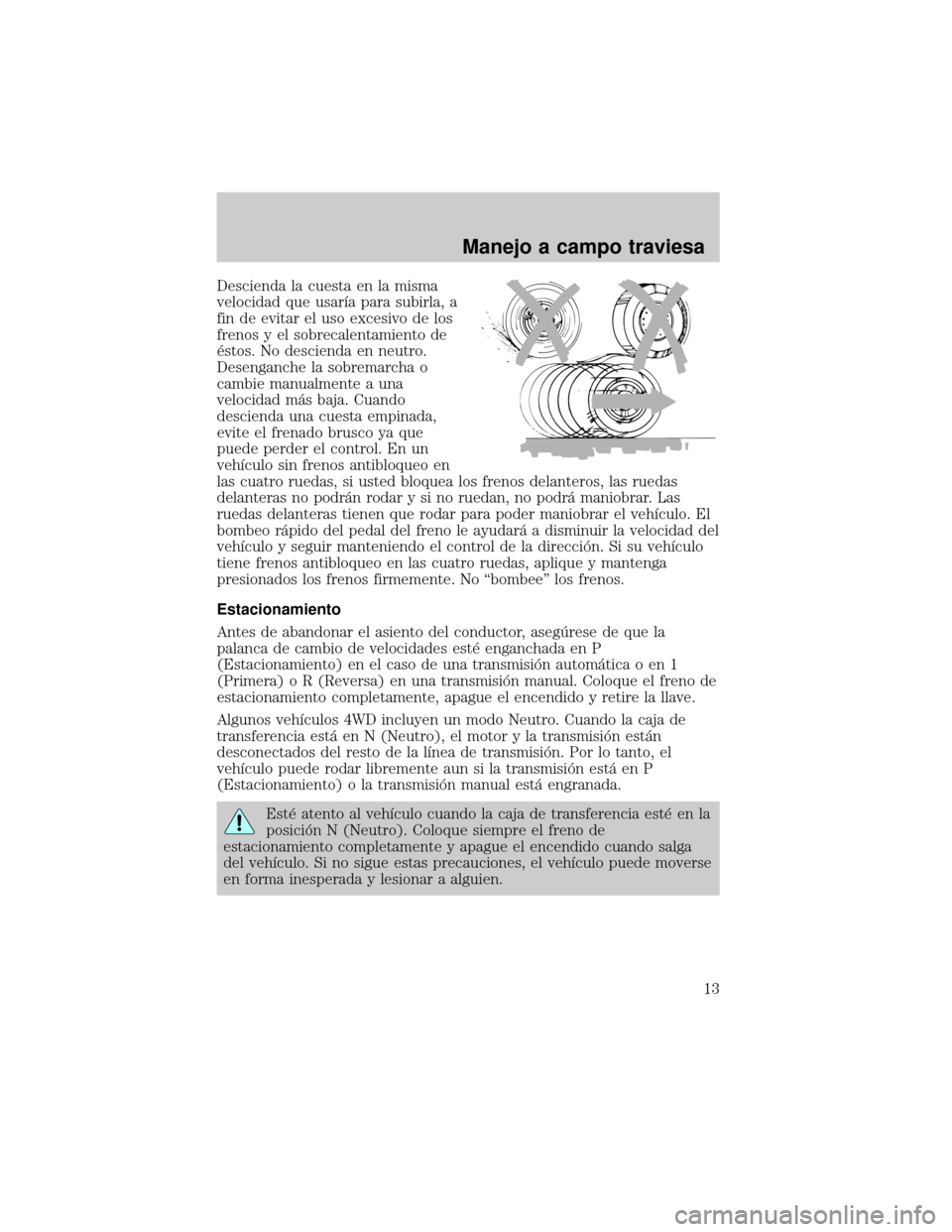
Descienda la cuesta en la misma
velocidad que usarÛa para subirla, a
fin de evitar el uso excesivo de los
frenos y el sobrecalentamiento de
×stos. No descienda en neutro.
Desenganche la sobremarcha o
cambie manualmente a una
velocidad mµs baja. Cuando
descienda una cuesta empinada,
evite el frenado brusco ya que
puede perder el control. En un
vehÛculo sin frenos antibloqueo en
las cuatro ruedas, si usted bloquea los frenos delanteros, las ruedas
delanteras no podrµn rodar y si no ruedan, no podrµ maniobrar. Las
ruedas delanteras tienen que rodar para poder maniobrar el vehÛculo. El
bombeo rµpido del pedal del freno le ayudarµ a disminuir la velocidad del
vehÛculo y seguir manteniendo el control de la direcciân. Si su vehÛculo
tiene frenos antibloqueo en las cuatro ruedas, aplique y mantenga
presionados los frenos firmemente. No ªbombeeº los frenos.
Estacionamiento
Antes de abandonar el asiento del conductor, asegìrese de que la
palanca de cambio de velocidades est× enganchada en P
(Estacionamiento) en el caso de una transmisiân automµtica o en 1
(Primera) o R (Reversa) en una transmisiân manual. Coloque el freno de
estacionamiento completamente, apague el encendido y retire la llave.
Algunos vehÛculos 4WD incluyen un modo Neutro. Cuando la caja de
transferencia estµ en N (Neutro), el motor y la transmisiân estµn
desconectados del resto de la lÛnea de transmisiân. Por lo tanto, el
vehÛculo puede rodar libremente aun si la transmisiân estµ en P
(Estacionamiento) o la transmisiân manual estµ engranada.
Est× atento al vehÛculo cuando la caja de transferencia est× en la
posiciân N (Neutro). Coloque siempre el freno de
estacionamiento completamente y apague el encendido cuando salga
del vehÛculo. Si no sigue estas precauciones, el vehÛculo puede moverse
en forma inesperada y lesionar a alguien.
Manejo a campo traviesa
13
Page 17 of 48
REQUERIMIENTOS DE REEMPLAZO DE LLANTAS
Su vehÛculo estµ equipado con llantas diseÞadas para proporcionar una
marcha y capacidad de manejo seguras.
Sâlo use llantas y ruedas de reemplazo que sean del mismo
tamaÞo y tipo (como P-metric contra LT-metric o toda estaciân
contra todo terreno) que las proporcionadas originalmente por Ford. El
uso de cualquier llanta o rueda no recomendada por Ford puede
afectar la seguridad y el rendimiento de su vehÛculo, lo que podrÛa
producir un aumento en el riesgo de p×rdida de control del vehÛculo,
volcadura, lesiân personal y muerte. De manera adicional, el uso de
llantas y ruedas no recomendadas podrÛa causar que la direcciân,
suspensiân, eje o caja de transferencia o unidad de transferencia de
potencia fallen. Consulte su Manual del propietario para obtener
informaciân adicional. Si tiene dudas acerca del reemplazo de llantas,
consulte a un distribuidor Ford o Lincoln/Mercury autorizado.
Asegìrese de que todas las llantas y ruedas del vehÛculo sean del mismo
tamaÞo, tipo, diseÞo de banda de rodadura, marca, capacidad de carga y
r×gimen de velocidad, ya que esto puede afectar la seguridad y
rendimiento de su vehÛculo, lo que puede provocar la p×rdida de control
del vehÛculo, su volcadura, lesiones personales y muerte.
Requerimientos de reemplazo de llantas
17
Page 28 of 48
VEHICLE CHARACTERISTICS
4WD and AWD Systems
A vehicle equipped with AWD or 4WD (when you select the 4WD mode)
has the ability to use all four wheels to power itself. This increases
traction which may enable you to safely drive over terrain and road
conditions that a conventional two-wheel drive vehicle cannot.
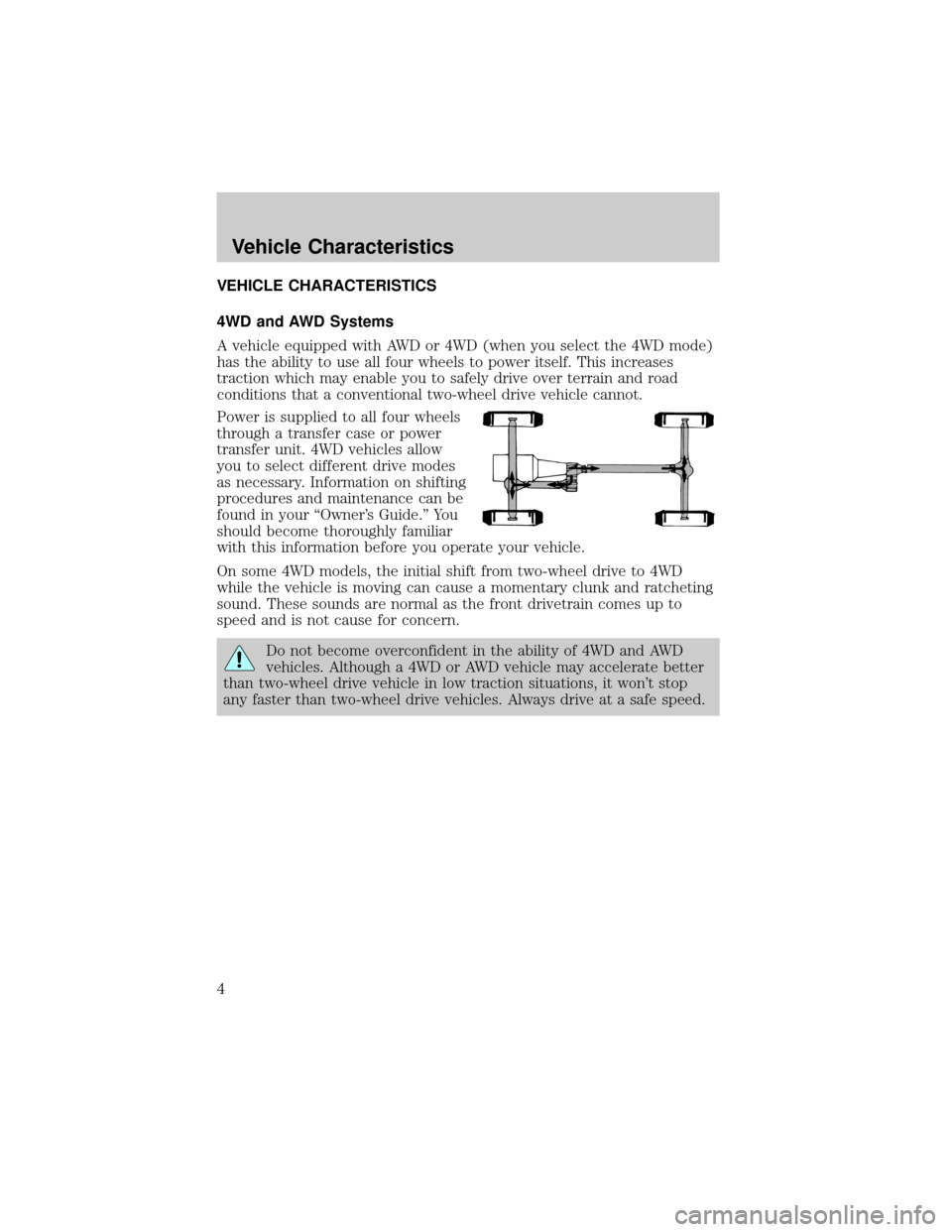
Power is supplied to all four wheels
through a transfer case or power
transfer unit. 4WD vehicles allow
you to select different drive modes
as necessary. Information on shifting
procedures and maintenance can be
found in your ªOwner's Guide.º You
should become thoroughly familiar
with this information before you operate your vehicle.
On some 4WD models, the initial shift from two-wheel drive to 4WD
while the vehicle is moving can cause a momentary clunk and ratcheting
sound. These sounds are normal as the front drivetrain comes up to
speed and is not cause for concern.
Do not become overconfident in the ability of 4WD and AWD
vehicles. Although a 4WD or AWD vehicle may accelerate better
than two-wheel drive vehicle in low traction situations, it won't stop
any faster than two-wheel drive vehicles. Always drive at a safe speed.
Vehicle Characteristics
Vehicle Characteristics
4
Page 32 of 48
²For vehicles with anti-lock brakes, apply and hold the brake firmly. Do
not ªpumpº the brakes. During hard stopping or stopping on slippery
surfaces, you may feel or hear a pulsing or vibration in the brake
pedal. Do not be alarmed because this is your anti-lock brake system
working. See your ªOwner's Guideº for additional information on the
operation of the anti-lock brake system.
Parking
Before leaving the driver's seat, make sure that the gearshift is engaged
in P (Park) with an automatic transmission or either 1 (First) or R
(Reverse) with a manual transmission. Set the parking brake fully, shut
off the ignition and remove the key.
Some 4WD vehicles include a Neutral mode. When the transfer case is in
the N (Neutral) position, the engine and transmission are disconnected
from the rest of the driveline. Therefore, the vehicle is free to roll even if
the automatic transmission is in P (Park) or the manual transmission is
in gear.
Do not leave the vehicle unattended with the transfer case in N
(Neutral) position. Always set the parking brake fully and turn
off the ignition when leaving the vehicle. If you do not follow these
precautions your vehicle may move unexpectedly and injure someone.
Driving On Roadways
8
Page 36 of 48
Parking
Before leaving the driver's seat, make sure that the gearshift is engaged
in P (Park) with an automatic transmission or either 1 (First) or R
(Reverse) with a manual transmission. Set the parking brake fully, shut
off the ignition and remove the key.
Some 4WD vehicles include a Neutral mode. When the transfer case is in
the N (Neutral) position, the engine and transmission are disconnected
from the rest of the driveline. Therefore, the vehicle is free to roll even if
the automatic transmission is in P (Park) or the manual transmission is
in gear.
Do not leave the vehicle unattended with the transfer case in N
(Neutral) position. Always set the parking brake fully and turn
off the ignition when leaving the vehicle. If you do not follow these
precautions your vehicle may move unexpectedly and injure someone.
Driving Off-Road
12
Page 39 of 48
3. Add air to reach the Ford recommended air pressure.
Note:If you overfill the tire, release air by pushing on the metal stem in
the center of the valve. Then recheck the pressure with your tire gauge.
4. Replace the valve cap.
5. Repeat this procedure for each tire, including the spare.
Note:Some spare tires require higher inflation pressure than the other tires.
6. Visually inspect the tires to make sure there are no nails or other objects
embedded that could poke a hole in the tire and cause an air leak.
7. Check the sidewalls to make sure there are no gouges, cuts, bulges or
other irregularities.
TIRE REPLACEMENT REQUIREMENTS
Your vehicle is equipped with tires designed to provide safe ride and
handling capability.
Only use replacement tires and wheels that are the same size
and type (such as P-metric versus LT-metric or all-season versus
all-terrain) as those originally provided by Ford. Use of any tire or
wheel not recommended by Ford can affect the safety and
performance of your vehicle, which could result in an increased risk of
loss of vehicle control, vehicle rollover, personal injury and death.
Additionally the use of non-recommended tires and wheels could cause
steering, suspension, axle or transfer case/power transfer unit failure.
See your Owner Guide for additional information. If you have questions
regarding tire replacement, see an authorized Ford or Lincoln/Mercury
dealer.
Make sure all tires and wheels on the vehicle are of the same size, type,
tread design, brand, load-carrying capacity and speed rating because it
can affect the safety and performance of your vehicle, which could result
in an increased risk of loss of vehicle control, vehicle rollover, personal
injury and death.
Tire Replacement Requirements
Tire Replacement Requirements
15