Seat Mercury Mariner 2008 s Manual PDF
[x] Cancel search | Manufacturer: MERCURY, Model Year: 2008, Model line: Mariner, Model: Mercury Mariner 2008Pages: 304, PDF Size: 2.66 MB
Page 182 of 304

If you smell exhaust fumes inside your vehicle, have your dealer
inspect your vehicle immediately. Do not drive if you smell
exhaust fumes.
Important safety precautions
A computer system controls the engine’s idle revolutions per minute
(RPM). When the engine starts, the idle RPM runs higher than normal in
order to warm the engine. If the engine idle speed does not slow down
automatically, have the vehicle checked.
Before starting the vehicle:
1. Make sure all vehicle occupants have buckled their safety belts. For
more information on safety belts and their proper usage, refer to the
Seating and Safety Restraintschapter.
2. Make sure vehicle accessories are off.
•Make sure the parking brake is
set.
2008 Mariner(mrn)
Owners Guide (post-2002-fmt)
USA(fus)
Driving
182
Page 194 of 304
PREPARING TO DRIVE
Utility vehicles have a significantly higher rollover rate than
other types of vehicles.
In a rollover crash, an unbelted person is significantly more likely
to die than a person wearing a seat belt.
Utility vehicles and trucks have larger tires and increased ground
clearance, giving the vehicle a higher center of gravity than a passenger
car.
Vehicles with a higher center of gravity such as utility vehicles
and trucks handle differently than vehicles with a lower center
of gravity. Utility vehicles and trucks arenotdesigned for cornering at
speeds as high as passenger cars any more than low-slung sports cars
are designed to perform satisfactorily under off-road conditions. Avoid
sharp turns, excessive speed or abrupt maneuvers in these vehicles.
Failure to drive cautiously could result in an increased risk of loss of
vehicle control, vehicle rollover, personal injury and death.
Loaded vehicles, with a higher center of gravity, may handle
differently than unloaded vehicles. Do not overload your vehicle
and use extra precautions, such as driving at slower speeds, avoiding
abrupt steering changes and allowing for increased stopping distance,
when driving a heavily loaded vehicle. Over-loading or loading the
vehicle improperly can deteriorate handling capability and contribute
to loss of vehicle control and vehicle rollover.
AUTOMATIC TRANSMISSION OPERATION
Brake-shift interlock
This vehicle is equipped with a brake-shift interlock feature that prevents
the gearshift lever from being moved from P (Park) when the ignition is
in the RUN position unless brake pedal is depressed.
If you cannot move the gearshift lever out of P (Park) with ignition in
the RUN position and the brake pedal depressed, it is possible that a
fuse has blown or the vehicle’s brakelamps are not operating properly.
Refer toFuses and relaysin theRoadside Emergencieschapter.
2008 Mariner(mrn)
Owners Guide (post-2002-fmt)
USA(fus)
Driving
194
Page 214 of 304
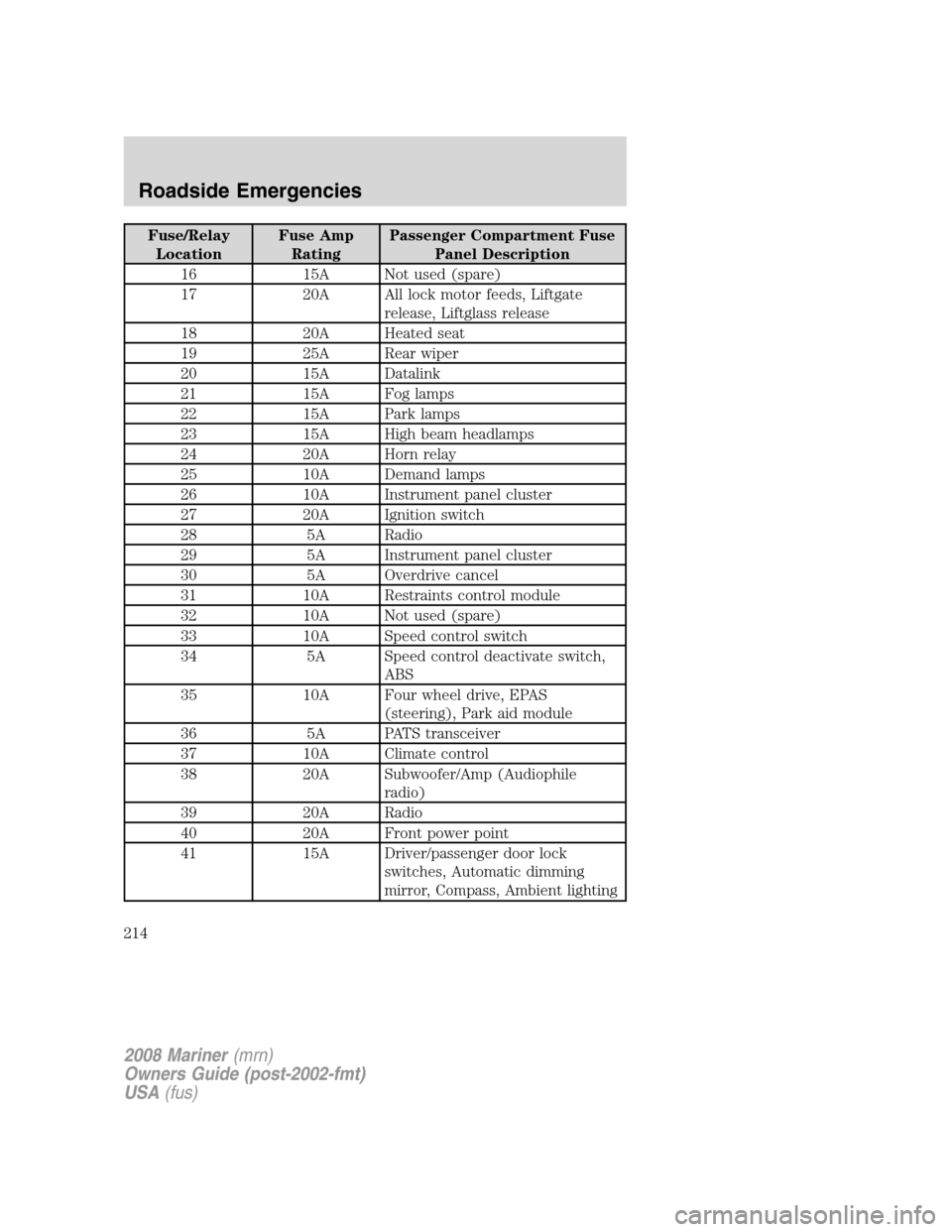
Fuse/Relay
LocationFuse Amp
RatingPassenger Compartment Fuse
Panel Description
16 15A Not used (spare)
17 20A All lock motor feeds, Liftgate
release, Liftglass release
18 20A Heated seat
19 25A Rear wiper
20 15A Datalink
21 15A Fog lamps
22 15A Park lamps
23 15A High beam headlamps
24 20A Horn relay
25 10A Demand lamps
26 10A Instrument panel cluster
27 20A Ignition switch
28 5A Radio
29 5A Instrument panel cluster
30 5A Overdrive cancel
31 10A Restraints control module
32 10A Not used (spare)
33 10A Speed control switch
34 5A Speed control deactivate switch,
ABS
35 10A Four wheel drive, EPAS
(steering), Park aid module
36 5A PATS transceiver
37 10A Climate control
38 20A Subwoofer/Amp (Audiophile
radio)
39 20A Radio
40 20A Front power point
41 15A Driver/passenger door lock
switches, Automatic dimming
mirror, Compass, Ambient lighting
2008 Mariner(mrn)
Owners Guide (post-2002-fmt)
USA(fus)
Roadside Emergencies
214
Page 215 of 304
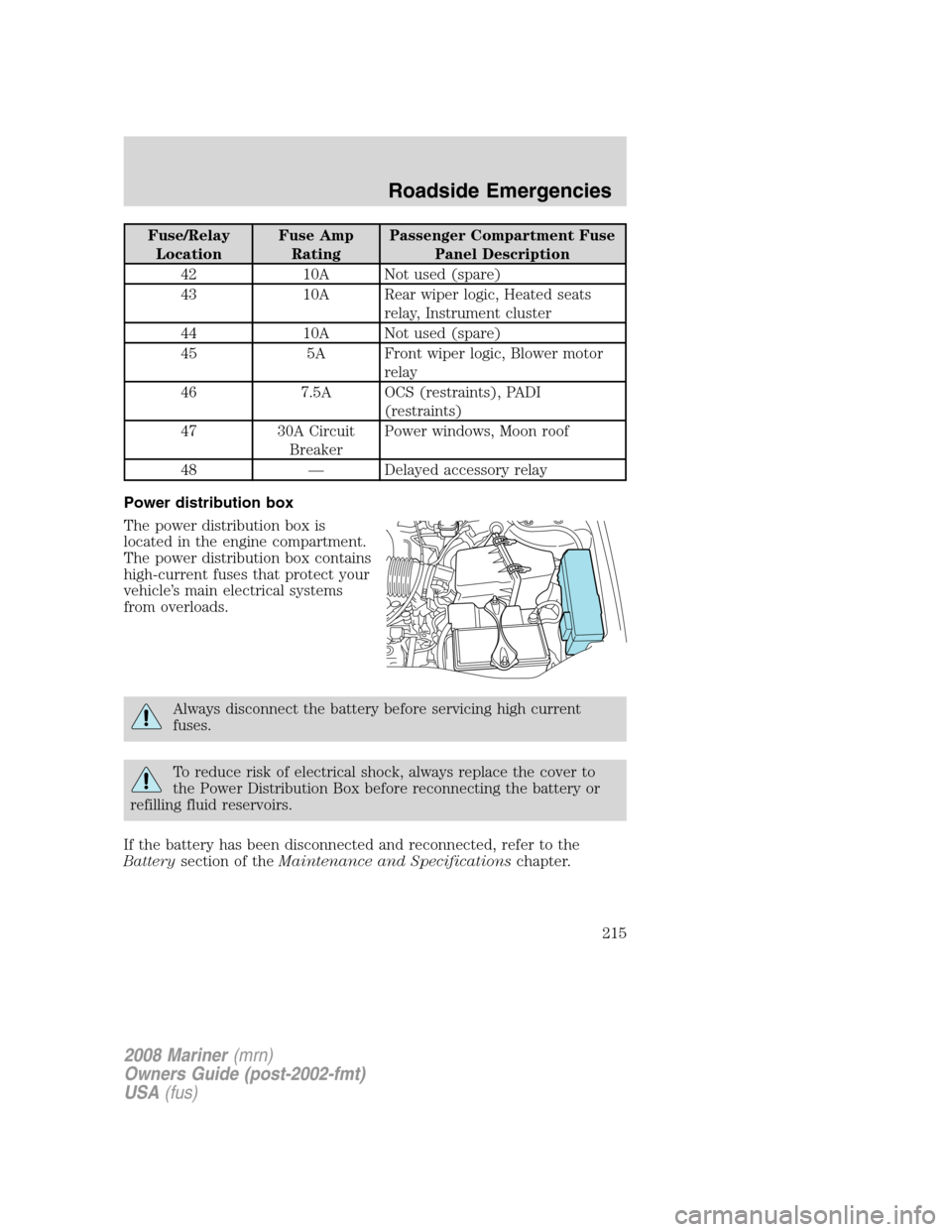
Fuse/Relay
LocationFuse Amp
RatingPassenger Compartment Fuse
Panel Description
42 10A Not used (spare)
43 10A Rear wiper logic, Heated seats
relay, Instrument cluster
44 10A Not used (spare)
45 5A Front wiper logic, Blower motor
relay
46 7.5A OCS (restraints), PADI
(restraints)
47 30A Circuit
BreakerPower windows, Moon roof
48 — Delayed accessory relay
Power distribution box
The power distribution box is
located in the engine compartment.
The power distribution box contains
high-current fuses that protect your
vehicle’s main electrical systems
from overloads.
Always disconnect the battery before servicing high current
fuses.
To reduce risk of electrical shock, always replace the cover to
the Power Distribution Box before reconnecting the battery or
refilling fluid reservoirs.
If the battery has been disconnected and reconnected, refer to the
Batterysection of theMaintenance and Specificationschapter.
2008 Mariner(mrn)
Owners Guide (post-2002-fmt)
USA(fus)
Roadside Emergencies
215
Page 217 of 304
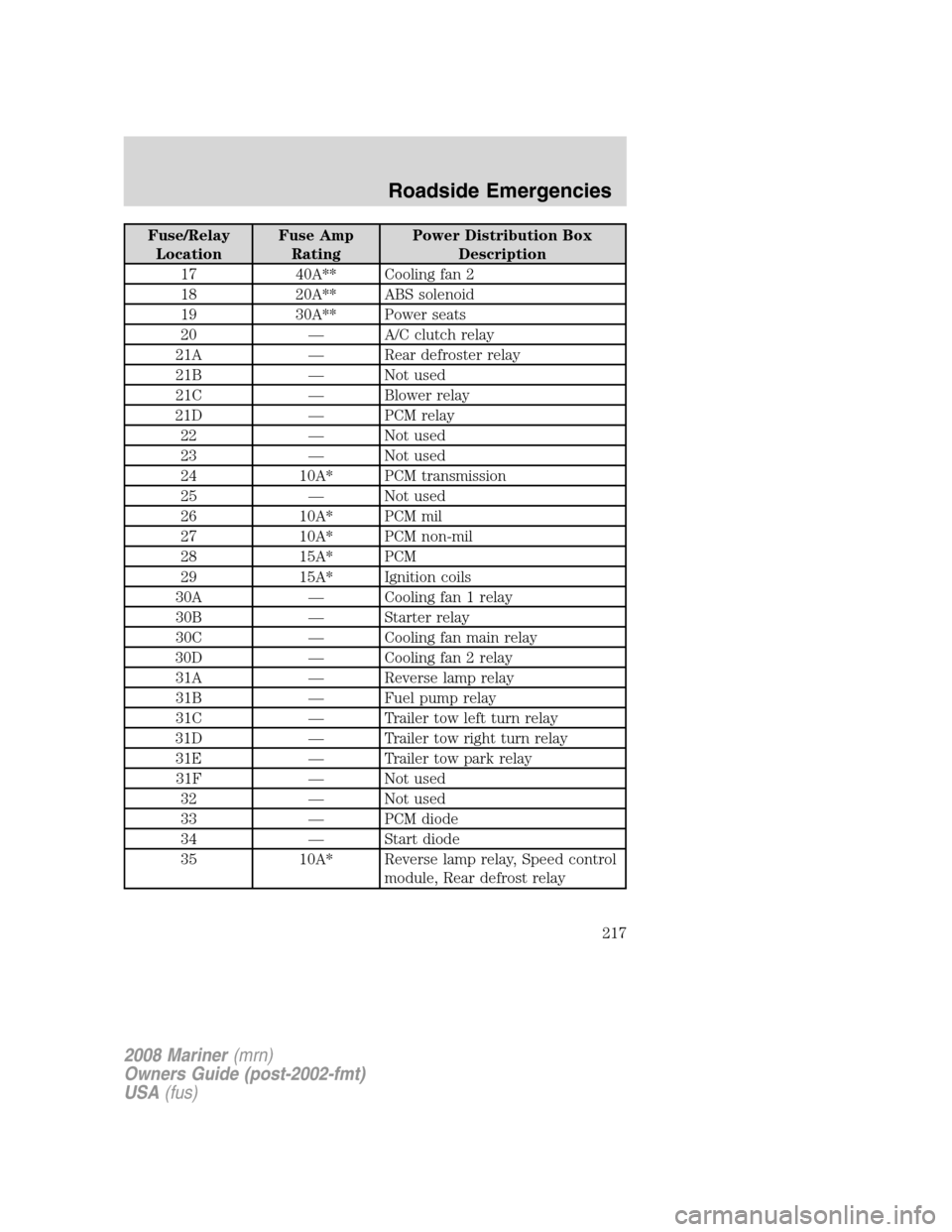
Fuse/Relay
LocationFuse Amp
RatingPower Distribution Box
Description
17 40A** Cooling fan 2
18 20A** ABS solenoid
19 30A** Power seats
20 — A/C clutch relay
21A — Rear defroster relay
21B — Not used
21C — Blower relay
21D — PCM relay
22 — Not used
23 — Not used
24 10A* PCM transmission
25 — Not used
26 10A* PCM mil
27 10A* PCM non-mil
28 15A* PCM
29 15A* Ignition coils
30A — Cooling fan 1 relay
30B — Starter relay
30C — Cooling fan main relay
30D — Cooling fan 2 relay
31A — Reverse lamp relay
31B — Fuel pump relay
31C — Trailer tow left turn relay
31D — Trailer tow right turn relay
31E — Trailer tow park relay
31F — Not used
32 — Not used
33 — PCM diode
34 — Start diode
35 10A* Reverse lamp relay, Speed control
module, Rear defrost relay
2008 Mariner(mrn)
Owners Guide (post-2002-fmt)
USA(fus)
Roadside Emergencies
217
Page 227 of 304
1. Place tire on end with valve stem
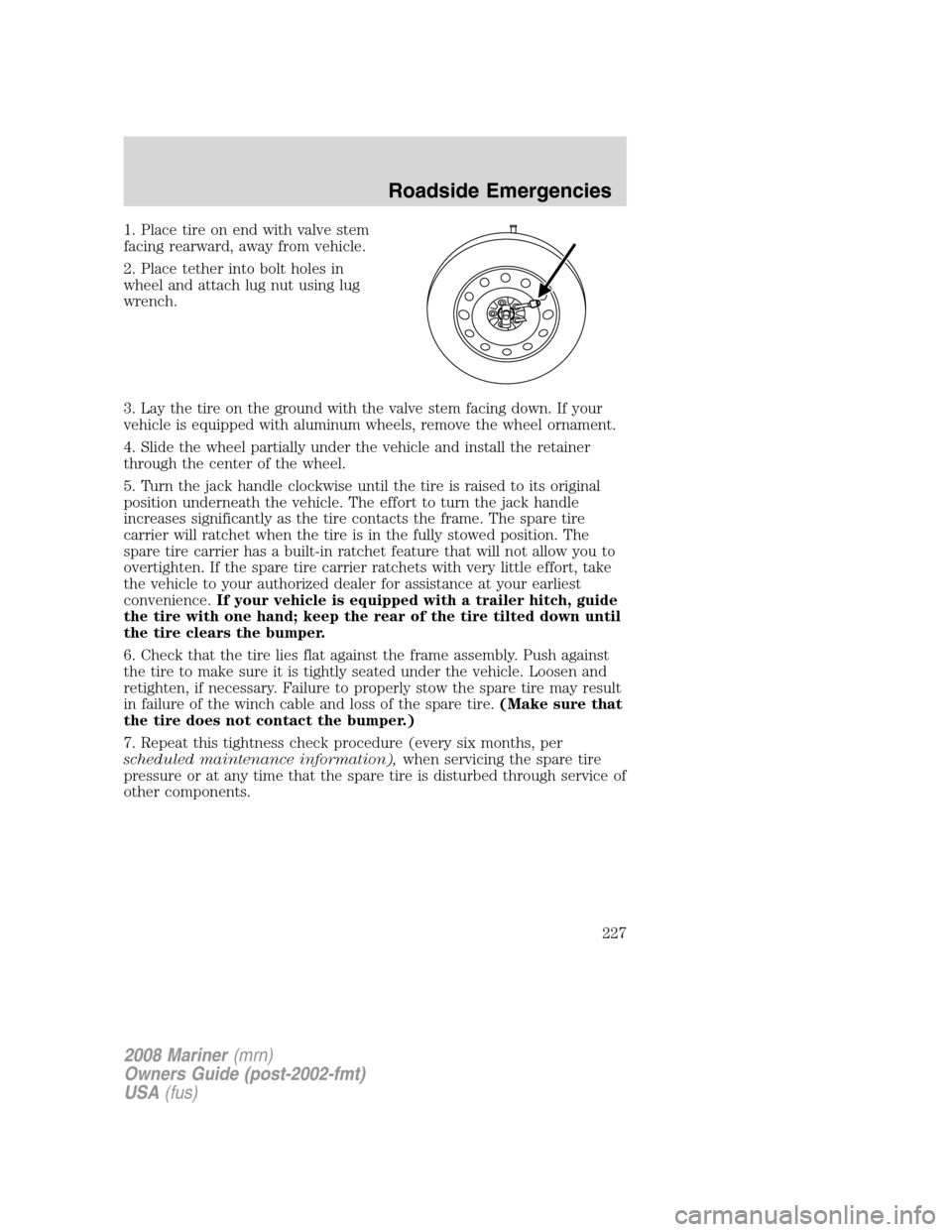
facing rearward, away from vehicle.
2. Place tether into bolt holes in
wheel and attach lug nut using lug
wrench.
3. Lay the tire on the ground with the valve stem facing down. If your
vehicle is equipped with aluminum wheels, remove the wheel ornament.
4. Slide the wheel partially under the vehicle and install the retainer
through the center of the wheel.
5. Turn the jack handle clockwise until the tire is raised to its original
position underneath the vehicle. The effort to turn the jack handle
increases significantly as the tire contacts the frame. The spare tire
carrier will ratchet when the tire is in the fully stowed position. The
spare tire carrier has a built-in ratchet feature that will not allow you to
overtighten. If the spare tire carrier ratchets with very little effort, take
the vehicle to your authorized dealer for assistance at your earliest
convenience.If your vehicle is equipped with a trailer hitch, guide
the tire with one hand; keep the rear of the tire tilted down until
the tire clears the bumper.
6. Check that the tire lies flat against the frame assembly. Push against
the tire to make sure it is tightly seated under the vehicle. Loosen and
retighten, if necessary. Failure to properly stow the spare tire may result
in failure of the winch cable and loss of the spare tire.(Make sure that
the tire does not contact the bumper.)
7. Repeat this tightness check procedure (every six months, per
scheduled maintenance information),when servicing the spare tire
pressure or at any time that the spare tire is disturbed through service of
other components.
2008 Mariner(mrn)
Owners Guide (post-2002-fmt)
USA(fus)
Roadside Emergencies
227
Page 249 of 304
3. Apply more Motorcraft cleaner to a clean, white, cotton cloth and
press the cloth onto the soiled area–allow this to set at room
temperature for 30 minutes.
4. Remove the soaked cloth, and if it is not soiled badly, use this cloth to
clean the area by using a rubbing motion for 60 seconds.
5. Following this, wipe area dry with a clean, white, cotton cloth.
INTERIOR
For fabric, carpets, cloth seats, safety belts and seats equipped with side
airbags:
•Remove dust and loose dirt with a vacuum cleaner.
•Remove light stains and soil with Motorcraft Professional Strength
Carpet & Upholstery Cleaner (ZC-54).
•If grease or tar is present on the material, spot-clean the area first
with Motorcraft Spot and Stain Remover (ZC-14). In Canada, use
Motorcraft Multi-Purpose Cleaner (CXC-101).
•If a ring forms on the fabric after spot cleaning, clean the entire area
immediately (but do not oversaturate) or the ring will set.
•Do not use household cleaning products or glass cleaners, which can
stain and discolor the fabric and affect the flame retardant abilities of
the seat materials.
Do not use cleaning solvents, bleach or dye on the vehicle’s
safety belts, as these actions may weaken the belt webbing.
On vehicles equipped with seat-mounted airbags, do not use
chemical solvents or strong detergents. Such products could
contaminate the side-airbag system and affect performance of the side
airbag in a collision.
LEATHER SEATS (IF EQUIPPED)
Your leather seating surfaces have a clear, protective coating over the
leather.
•To clean, use a soft cloth with Motorcraft Deluxe Leather and Vinyl
Cleaner (ZC-11-A). In Canada, use Motorcraft Vinyl Cleaner (CXC-93).
Dry the area with a soft cloth.
2008 Mariner(mrn)
Owners Guide (post-2002-fmt)
USA(fus)
Cleaning
249
Page 260 of 304
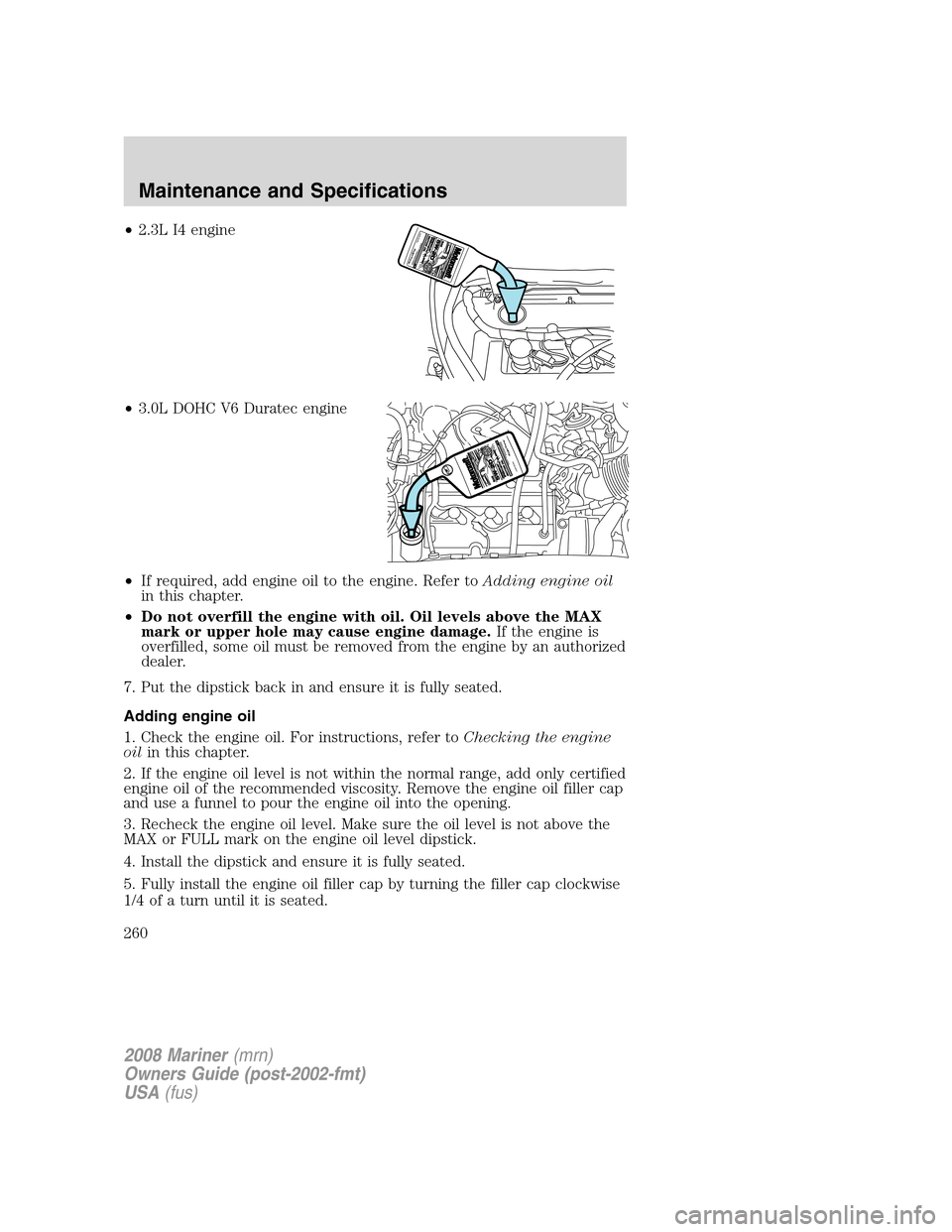
•2.3L I4 engine
•3.0L DOHC V6 Duratec engine
•If required, add engine oil to the engine. Refer toAdding engine oil
in this chapter.
•Do not overfill the engine with oil. Oil levels above the MAX
mark or upper hole may cause engine damage.If the engine is
overfilled, some oil must be removed from the engine by an authorized
dealer.
7. Put the dipstick back in and ensure it is fully seated.
Adding engine oil
1. Check the engine oil. For instructions, refer toChecking the engine
oilin this chapter.
2. If the engine oil level is not within the normal range, add only certified
engine oil of the recommended viscosity. Remove the engine oil filler cap
and use a funnel to pour the engine oil into the opening.
3. Recheck the engine oil level. Make sure the oil level is not above the
MAX or FULL mark on the engine oil level dipstick.
4. Install the dipstick and ensure it is fully seated.
5. Fully install the engine oil filler cap by turning the filler cap clockwise
1/4 of a turn until it is seated.
2008 Mariner(mrn)
Owners Guide (post-2002-fmt)
USA(fus)
Maintenance and Specifications
260
Page 282 of 304
1. Drive the vehicle 20 miles (30 km) or until it reaches normal operating
temperature.
2. Park the vehicle on a level surface and engage the parking brake.
3. With the parking brake engaged and your foot on the brake pedal,
start the engine and move the gearshift lever through all of the gear
ranges. Allow sufficient time for each gear to engage.
4. Latch the gearshift lever in P (Park) and leave the engine running.
5. Remove the dipstick, wiping it clean with a clean, dry, lint-free rag. If
necessary, refer toIdentifying components in the engine compartment
in this chapter for the location of the dipstick.
6. Install the dipstick, making sure it is fully seated in the filler tube.
7. Remove the dipstick and inspect the fluid level. The fluid should be in
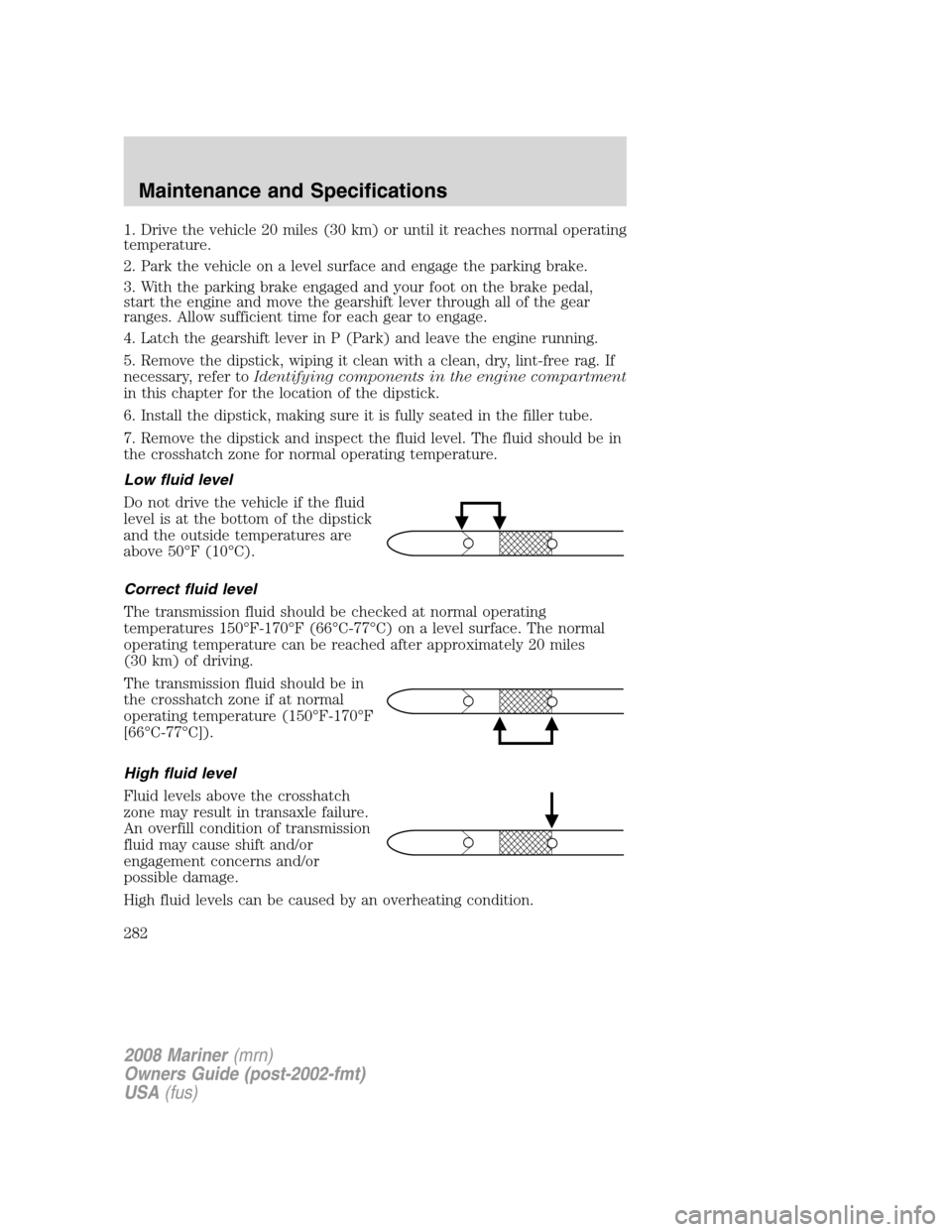
the crosshatch zone for normal operating temperature.
Low fluid level
Do not drive the vehicle if the fluid
level is at the bottom of the dipstick
and the outside temperatures are
above 50°F (10°C).
Correct fluid level
The transmission fluid should be checked at normal operating
temperatures 150°F-170°F (66°C-77°C) on a level surface. The normal
operating temperature can be reached after approximately 20 miles
(30 km) of driving.
The transmission fluid should be in
the crosshatch zone if at normal
operating temperature (150°F-170°F
[66°C-77°C]).
High fluid level
Fluid levels above the crosshatch
zone may result in transaxle failure.
An overfill condition of transmission
fluid may cause shift and/or
engagement concerns and/or
possible damage.
High fluid levels can be caused by an overheating condition.
2008 Mariner(mrn)
Owners Guide (post-2002-fmt)
USA(fus)
Maintenance and Specifications
282
Page 284 of 304

3. Carefully separate the two halves
of the air filter housing.
4. Remove the air filter element from the air filter housing.
5. Wipe the air filter housing and cover clean to remove any dirt or
debris and to ensure good sealing.
6. Install a new air filter element. Be
careful not to crimp the filter
element edges between the air filter
housing and cover. This could cause
filter damage and allow unfiltered
air to enter the engine if not
properly seated.
7. Replace the air filter housing cover and secure the clamps.
8. Replace the air inlet tube and secure the clamp.
Note:Failure to use the correct air filter element may result in severe
engine damage. The customer warranty may be void for any damage to
the engine if the correct air filter element is not used.
2008 Mariner(mrn)
Owners Guide (post-2002-fmt)
USA(fus)
Maintenance and Specifications
284