steering Mercury Mariner 2009 s Owner's Guide
[x] Cancel search | Manufacturer: MERCURY, Model Year: 2009, Model line: Mariner, Model: Mercury Mariner 2009Pages: 312, PDF Size: 2.27 MB
Page 218 of 312
Driving on hilly or sloping terrain
Although natural obstacles may make it necessary to travel diagonally up
or down a hill or steep incline, you should always try to drive straight up
or straight down.Avoid driving crosswise or turning on steep
slopes or hills.A danger lies in losing traction, slipping sideways and
possibly rolling over. Whenever driving on a hill, determine beforehand
the route you will use. Do not drive over the crest of a hill without
seeing what conditions are on the other side. Do not drive in reverse
over a hill without the aid of an observer.
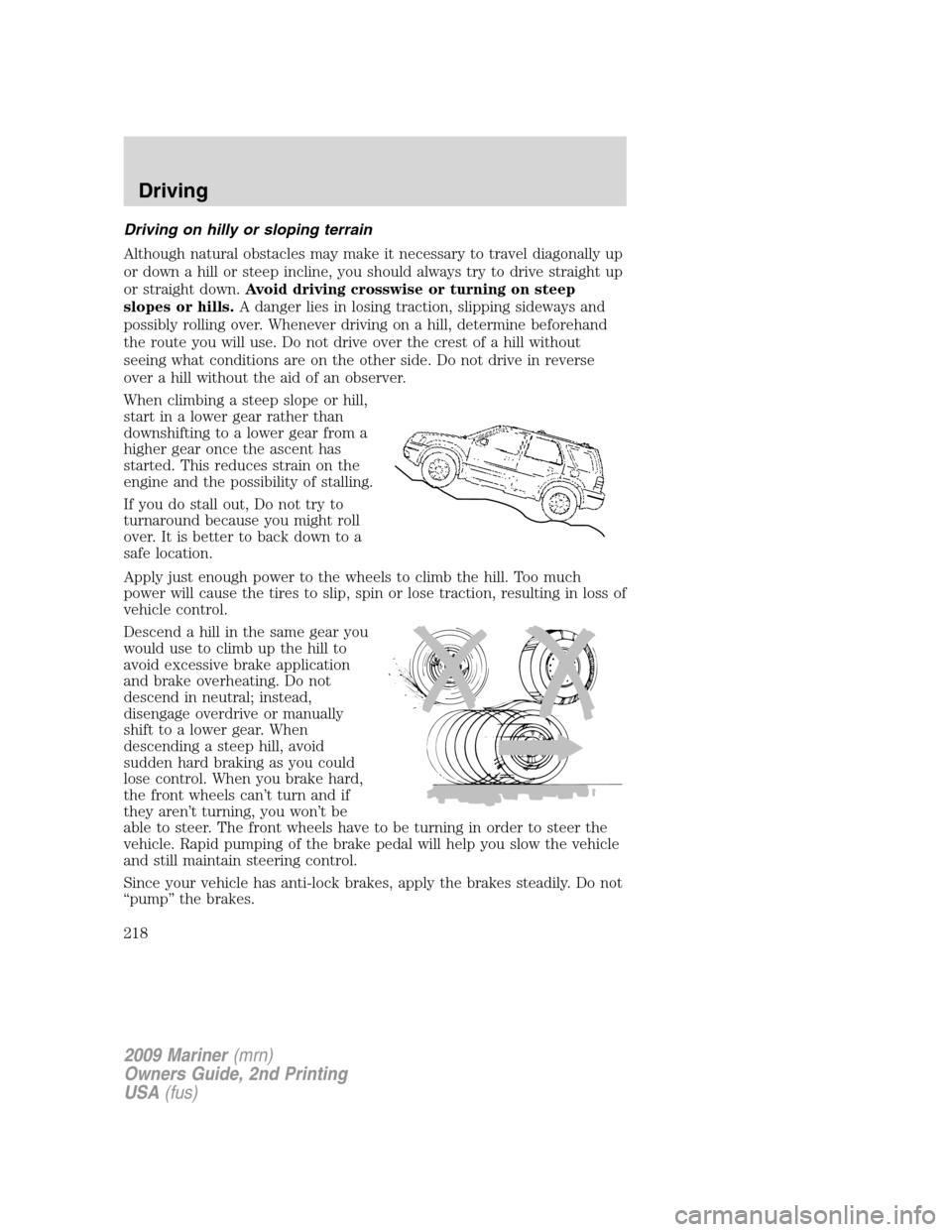
When climbing a steep slope or hill,
start in a lower gear rather than
downshifting to a lower gear from a
higher gear once the ascent has
started. This reduces strain on the
engine and the possibility of stalling.
If you do stall out, Do not try to
turnaround because you might roll
over. It is better to back down to a
safe location.
Apply just enough power to the wheels to climb the hill. Too much
power will cause the tires to slip, spin or lose traction, resulting in loss of
vehicle control.
Descend a hill in the same gear you
would use to climb up the hill to
avoid excessive brake application
and brake overheating. Do not
descend in neutral; instead,
disengage overdrive or manually
shift to a lower gear. When
descending a steep hill, avoid
sudden hard braking as you could
lose control. When you brake hard,
the front wheels can’t turn and if
they aren’t turning, you won’t be
able to steer. The front wheels have to be turning in order to steer the
vehicle. Rapid pumping of the brake pedal will help you slow the vehicle
and still maintain steering control.
Since your vehicle has anti-lock brakes, apply the brakes steadily. Do not
“pump” the brakes.
2009 Mariner(mrn)
Owners Guide, 2nd Printing
USA(fus)
Driving
218
Page 219 of 312

Driving on snow and ice
4WD vehicles have advantages over 2WD vehicles in snow and ice but
can skid like any other vehicle.
Should you start to slide while driving on snowy or icy roads, turn the
steering wheel in the direction of the slide until you regain control.
Avoid sudden applications of power and quick changes of direction on
snow and ice. Apply the accelerator slowly and steadily when starting
from a full stop.
Avoid sudden braking as well. Although a 4WD vehicle may accelerate
better than a two-wheel drive vehicle in snow and ice, it won’t stop any
faster, because as in other vehicles, braking occurs at all four wheels. Do
not become overconfident as to road conditions.
Make sure you allow sufficient distance between you and other vehicles
for stopping. Drive slower than usual and consider using one of the lower
gears. In emergency stopping situations, avoid locking of the wheels. Use
a “squeeze” technique, push on the brake pedal with a steadily increasing
force which allows the wheels to brake yet continue to roll so that you
may steer in the direction you want to travel. If you lock the wheels,
release the brake pedal and repeat the squeeze technique. Since your
vehicle is equipped with a Four Wheel Anti-Lock Brake System (ABS),
apply the brake steadily. Do not “pump” the brakes. Refer to theBrakes
section of this chapter for additional information on the operation of the
anti-lock brake system.
4WD vehicles should be driven with traction devices as referred to in
Using snow tires and traction devicesin theTires, Wheels and
Loadingchapter.
Maintenance and Modifications
The suspension and steering systems on your vehicle have been designed
and tested to provide predictable performance whether loaded or empty
and durable load carrying capability. For this reason, Ford Motor
Company strongly recommends that you do not make modifications such
as adding or removing parts (such as lift kits or stabilizer bars) or by
using replacement parts not equivalent to the original factory equipment.
Any modifications to a vehicle that raise the center of gravity can make
it more likely the vehicle will roll over as a result of a loss of control.
Ford Motor Company recommends that caution be used with any vehicle
equipped with a high load or device (such as ladder racks or pickup box
cover).
2009 Mariner(mrn)
Owners Guide, 2nd Printing
USA(fus)
Driving
219
Page 222 of 312

•towing of your disabled vehicle
•emergency travel expense reimbursement
•travel planning benefits
In Canada, for uninterrupted Roadside Assistance coverage, you may
purchase extended coverage prior to your Basic Warranty’s Roadside
Assistance expiring. For more information and enrollment, contact
1–877–294–2582 or visit our website at www.ford.ca.
Using roadside assistance
Complete the roadside assistance identification card and place it in your
wallet for quick reference. In the United States, this card is found in the
Owner Guide portfolio in the glove compartment. In Canada, the card is
found in theCustomer Information Guidein the glove compartment.
U.S. Ford, Mercury and Lincoln vehicle customers who require Roadside
Assistance, call 1-800-241-3673.
Canadian customers who require roadside assistance, call
1-800-665-2006.
If you need to arrange roadside assistance for yourself, Ford Motor
Company will reimburse a reasonable amount for towing to the nearest
dealership within 35 miles. To obtain reimbursement information, U.S.
Ford, Mercury and Lincoln vehicle customers call 1-800-241-3673.
Customers will be asked to submit their original receipts.
Canadian customers who need to obtain reimbursement information, call
1–800–665–2006.
HAZARD FLASHER CONTROL
The hazard flasher is located on the
steering column, just behind the
steering wheel. The hazard flashers
will operate when the ignition is in
any position or if the key is not in
the ignition.
Push in the flasher control and all
front and rear direction signals will
flash. Press the flasher control again
to turn them off. Use it when your
vehicle is disabled and is creating a
safety hazard for other motorists.
Note:With extended use, the flasher may run down your battery.
2009 Mariner(mrn)
Owners Guide, 2nd Printing
USA(fus)
Roadside Emergencies
222
Page 226 of 312
Fuse/Relay
LocationFuse Amp
RatingProtected Circuits
16 15A Not used (spare)
17 20A All lock motor feeds, Liftgate
release, Liftglass release
18 20A Heated seat
19 25A Rear wiper
20 15A Datalink
21 15A Fog lamps
22 15A Park lamps
23 15A High beam headlamps
24 20A Horn relay
25 10A Demand lamps
26 10A Instrument panel cluster
27 20A Ignition switch
28 5 A Radio
29 5A Instrument panel cluster
30 5A Not used (spare)
31 10A Restraints control module
32 10A Not used (spare)
33 10A Not used (spare)
34 5A Not used (spare)
35 10A Four wheel drive, Electric Power
Steering Module (EPAS) , Park
aid module
36 5A PATS transceiver
37 10A Climate control
38 20A Subwoofer/Amp
(Audiophile radio)
39 20A Radio, Radio Amplifier
(Navigation only)
40 20A Front power point
2009 Mariner(mrn)
Owners Guide, 2nd Printing
USA(fus)
Roadside Emergencies
226
Page 228 of 312
If the battery has been disconnected and reconnected, refer to the
Batterysection of theMaintenance and Specificationschapter.
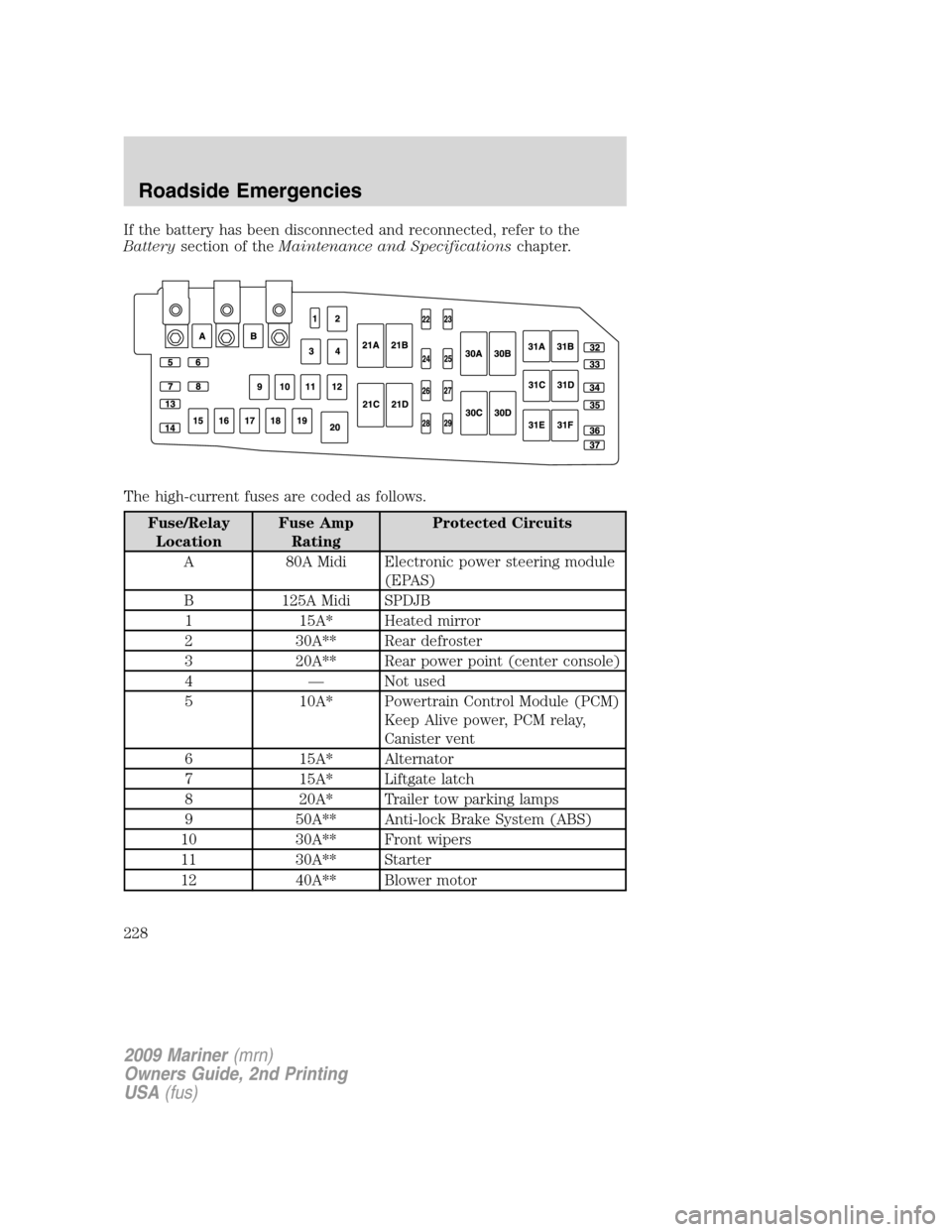
The high-current fuses are coded as follows.
Fuse/Relay
LocationFuse Amp
RatingProtected Circuits
A 80A Midi Electronic power steering module
(EPAS)
B 125A Midi SPDJB
1 15A* Heated mirror
2 30A** Rear defroster
3 20A** Rear power point (center console)
4 — Not used
5 10A* Powertrain Control Module (PCM)
Keep Alive power, PCM relay,
Canister vent
6 15A* Alternator
7 15A* Liftgate latch
8 20A* Trailer tow parking lamps
9 50A** Anti-lock Brake System (ABS)
10 30A** Front wipers
11 30A** Starter
12 40A** Blower motor
2009 Mariner(mrn)
Owners Guide, 2nd Printing
USA(fus)
Roadside Emergencies
228
Page 230 of 312
Fuse/Relay
LocationFuse Amp
RatingProtected Circuits
31F — Liftgate latch relay
32 — Not used
33 — PCM diode
34 — Start diode
35 10A* Run/start, Reverse lamps, Rear
defrost relay
36 — Not used
37 — Not used
* Mini fuse ** Cartridge fuse
CHANGING A FLAT TIRE
If you get a flat tire while driving:
•do not brake heavily.
•gradually decrease the vehicle’s speed.
•hold the steering wheel firmly.
•slowly move to a safe place on the side of the road.
Your vehicle may be equipped with a conventional spare tire that is
different in one or more of the following: type, brand, size, speed rating
and tread design. If this is the case, this dissimilar spare tire is still rated
for your vehicle loads (GAWR and GVWR). This temporary spare tire is
not equipped with a Tire Pressure Monitor System (TPMS) sensor.
Note:The tire pressure monitoring system (TPMS) indicator light will
illuminate when the spare is in use. To restore the full functionality of
the TPMS system, all road wheels equipped with the tire pressure
monitoring sensors must be mounted on the vehicle.
Have a flat tire serviced by an authorized dealer in order to prevent
damage to the TPMS sensor, refer toTire Pressure Monitoring System
(TPMS)in theTires, Wheels, and Loadingchapter. Replace the spare
tire with a road tire as soon as possible. During repairing or replacing of
the flat tire, have the authorized dealer inspect the TPMS sensor for
damage.
WARNING:The use of tire sealants may damage your Tire
Pressure Monitoring System and should not be used.
2009 Mariner(mrn)
Owners Guide, 2nd Printing
USA(fus)
Roadside Emergencies
230
Page 261 of 312

•The wiper blades can be cleaned with isopropyl (rubbing) alcohol or
Motorcraft Premium Windshield Washer Concentrate (ZC-32-A),
available from your authorized dealer. This washer fluid contains
special solution in addition to alcohol which helps to remove the hot
wax deposited on the wiper blade and windshield from automated car
wash facilities. Be sure to replace wiper blades when they appear
worn or do not function properly.
•Do not use abrasives, as they may cause scratches.
•Do not use fuel, kerosene, or paint thinner to clean any parts.
If you cannot remove those streaks after cleaning with the glass cleaner
or if the wipers chatter and move in a jerky motion, clean the outer
surface of the windshield and the wiper blades using a sponge or soft
cloth with a neutral detergent or mild-abrasive cleaning solution. After
cleaning, rinse the windshield and wiper blades with clean water. The
windshield is clean if beads do not form when you rinse the windshield
with water.
Do not use sharp objects, such as a razor blade, to clean the
inside of the rear window or to remove decals, as it may cause
damage to the rear window defroster’s heated grid lines.
INSTRUMENT PANEL/INTERIOR TRIM AND CLUSTER LENS
Clean the instrument panel, interior trim areas and cluster lens with a
clean and damp white cotton cloth, then with a clean and dry white
cotton cloth; you may also use Motorcraft Dash & Vinyl Cleaner
(ZC-38-A) on the instrument panel and interior trim areas.
•Avoid cleaners or polishes that increase the gloss of the upper portion
of the instrument panel. The dull finish in this area helps protect the
driver from undesirable windshield reflection.
•Be certain to wash or wipe your hands clean if you have been in
contact with certain products such as insect repellent and suntan
lotion in order to avoid possible damage to the interior painted
surfaces.
•Do not use household or glass cleaners as these may damage the
finish of the instrument panel, interior trim and cluster lens.
WARNING:Do not use chemical solvents or strong detergents
when cleaning the steering wheel or instrument panel to avoid
contamination of the airbag system.
2009 Mariner(mrn)
Owners Guide, 2nd Printing
USA(fus)
Cleaning
261
Page 282 of 312
How fail-safe cooling works
If the engine begins to overheat:
•The engine coolant temperature gauge will move to the red (hot)
area.
•The service engine soon
indicator light will illuminate.
If the engine reaches a preset over-temperature condition, the engine
will automatically switch to alternating cylinder operation. Each disabled
cylinder acts as an air pump and cools the engine.
When this occurs the vehicle will still operate. However:
•The engine power will be limited.
•The air conditioning system will be disabled.
Continued operation will increase the engine temperature and the engine
will completely shut down, causing steering and braking effort to
increase.
Once the engine temperature cools, the engine can be re-started. Take
your vehicle to an authorized dealer as soon as possible to minimize
engine damage.
When fail-safe mode is activated
You have limited engine power when in the fail-safe mode, so drive the
vehicle with caution. The vehicle will not be able to maintain high-speed
operation and the engine will run rough. Remember that the engine is
capable of completely shutting down automatically to prevent engine
damage, therefore:
1. Pull off the road as soon as safely possible and turn off the engine.
2. Arrange for the vehicle to be taken to an authorized dealer.
3. If this is not possible, wait a short period for the engine to cool.
4. Check the coolant level and replenish if low.
WARNING:Never remove the coolant reservoir cap while the
engine is running or hot.
5. Re-start the engine and take your vehicle to an authorized dealer.
Driving the vehicle without repairing the engine problem
increases the chance of engine damage. Take your vehicle to an
authorized dealer as soon as possible.
FUEL FILTER
Your vehicle is equipped with a lifetime fuel filter that is integrated with
the fuel tank. Regular maintenance or replacement is not needed.
2009 Mariner(mrn)
Owners Guide, 2nd Printing
USA(fus)
Maintenance and Specifications
282
Page 308 of 312
Child safety seats ......................144
attaching with tether
straps .......................................150
in front seat ............................145
in rear seat ..............................145
LATCH .....................................148
recommendations ...................142
Child safety seats - booster
seats ...........................................153
Cleaning your vehicle
engine compartment ..............259
instrument panel ....................261
interior .....................................262
plastic parts ............................260
washing ....................................257
waxing .....................................258
wheels ......................................258
wiper blades ............................260
Climate control (see Air
conditioning or Heating) ......36, 39
Clock ............................................18
Compass, electronic ....................57
calibration .................................59
set zone adjustment .................58
Console ........................................59
overhead ....................................57
Controls
power seat ...............................105
steering column ........................67
Coolant
checking and adding ..............277
refill capacities ................281, 300
specifications ..........................300
Cruise control
(see Speed control) ....................64
Customer Assistance ................221
Ford Extended Service
Plan ..........................................254Getting assistance outside the
U.S. and Canada .....................254
Getting roadside assistance ...221
Getting the service you
need .........................................250
Ordering additional owner’s
literature .................................255
Utilizing the
Mediation/Arbitration
Program ...................................253
D
Dipstick
automatic transmission
fluid ..........................................295
engine oil .................................271
Driving under special
conditions ..................212, 215, 218
sand .........................................216
snow and ice ...........................219
through water .................217, 220
E
Electronic message center .........70
Emergencies, roadside
jump-starting ..........................242
running out of fuel .........242, 287
Emergency Flashers .................222
Emission control system ..........292
Engine ........................................302
cleaning ...................................259
coolant .....................................277
fail-safe cooling .......................281
idle speed control ...................275
lubrication specifications .......300
refill capacities ........................300
service points ..................267–268
starting after a collision .........223
Engine block heater .................196
2009 Mariner(mrn)
Owners Guide, 2nd Printing
USA(fus)
Index
308
Page 310 of 312
J
Jump-starting your vehicle ......242
K
Keyless entry system
autolock ...............................86, 88
keypad .......................................96
locking and unlocking doors ....97
programming entry code .........96
Keys .......................................84, 98
positions of the ignition .........193
L
Lamps
bulb replacement
specifications chart ..................50
fog lamps ...................................44
headlamps .................................43
headlamps, flash to pass ..........45
instrument panel, dimming .....45
interior lamps ...............47–48, 50
replacing bulbs .........................51
LATCH anchors .........................148
Liftgate ..................................79, 92
Lights, warning and indicator ....12
anti-lock brakes (ABS) ..........199
Load limits .................................180
Loading instructions .................186
Locks
autolock ...............................86, 88
childproof ..................................90
doors ..........................................86
Lubricant specifications ...........300
Lug nuts ....................................241
Luggage rack ...............................81
Lumbar support, seats .....104–105M
Message center ...........................71
english/metric button ...............74
system check button ................73
warning messages .....................76
Mirrors .........................................63
automatic dimming rearview
mirror ........................................63
fold away ...................................64
heated ........................................64
side view mirrors (power) .......63
Moon roof ....................................69
Motorcraft parts ................263, 299
N
Navigation system .......................35
O
Octane rating ............................286
Oil (see Engine oil) ..................271
Overdrive ...................................209
P
Parking brake ............................200
Parts (see Motorcraft parts) ....299
Passenger Occupant
Classification Sensor .................113
Power distribution box
(see Fuses) ...............................227
Power door locks ........................86
Power mirrors .............................63
Power point .................................60
Power steering ..........................207
fluid, refill capacity ................300
2009 Mariner(mrn)
Owners Guide, 2nd Printing
USA(fus)
Index
310