brake Mercury Mariner 2009 s Service Manual
[x] Cancel search | Manufacturer: MERCURY, Model Year: 2009, Model line: Mariner, Model: Mercury Mariner 2009Pages: 312, PDF Size: 2.27 MB
Page 225 of 312
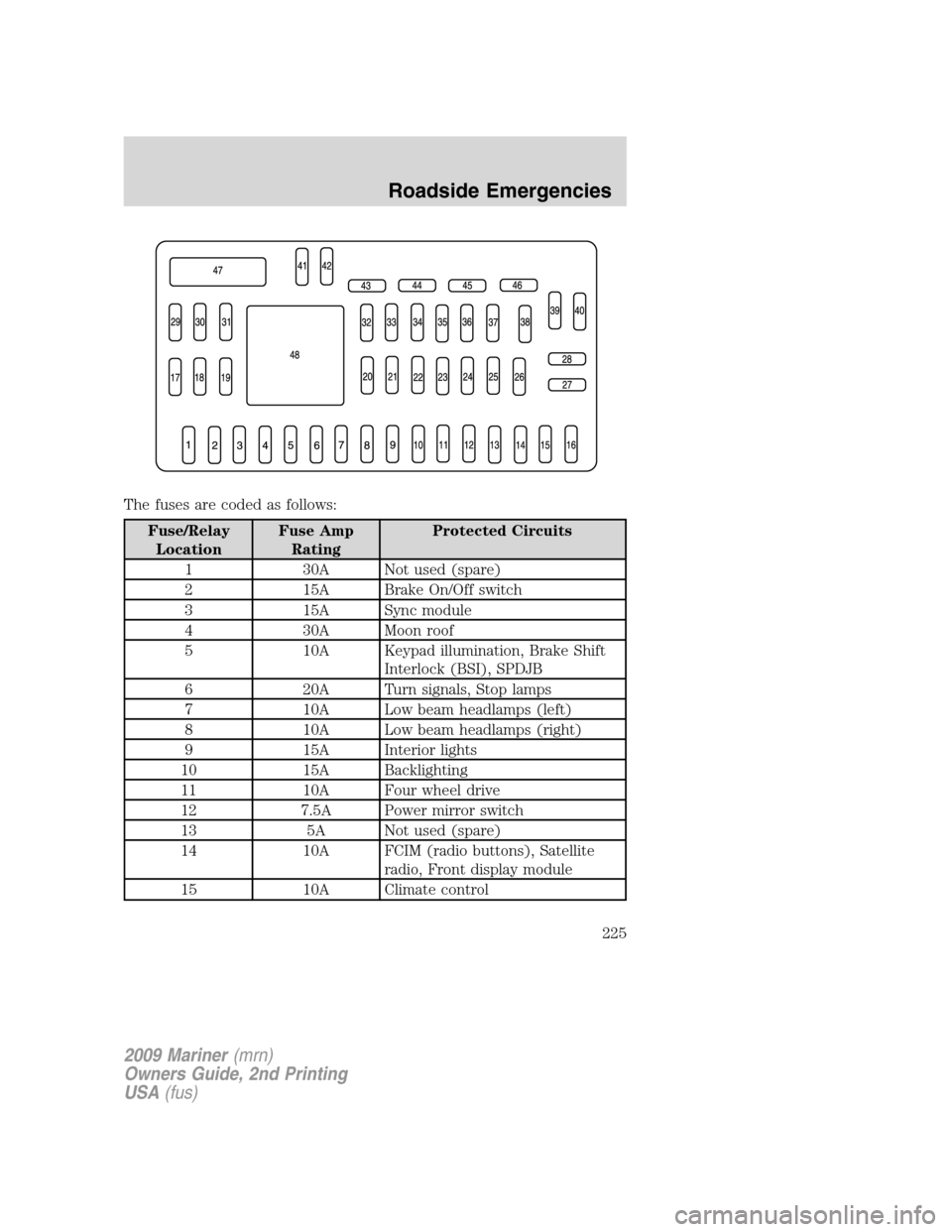
The fuses are coded as follows:
Fuse/Relay
LocationFuse Amp
RatingProtected Circuits
1 30A Not used (spare)
2 15A Brake On/Off switch
3 15A Sync module
4 30A Moon roof
5 10A Keypad illumination, Brake Shift
Interlock (BSI), SPDJB
6 20A Turn signals, Stop lamps
7 10A Low beam headlamps (left)
8 10A Low beam headlamps (right)
9 15A Interior lights
10 15A Backlighting
11 10A Four wheel drive
12 7.5A Power mirror switch
13 5A Not used (spare)
14 10A FCIM (radio buttons), Satellite
radio, Front display module
15 10A Climate control
2009 Mariner(mrn)
Owners Guide, 2nd Printing
USA(fus)
Roadside Emergencies
225
Page 228 of 312
If the battery has been disconnected and reconnected, refer to the
Batterysection of theMaintenance and Specificationschapter.
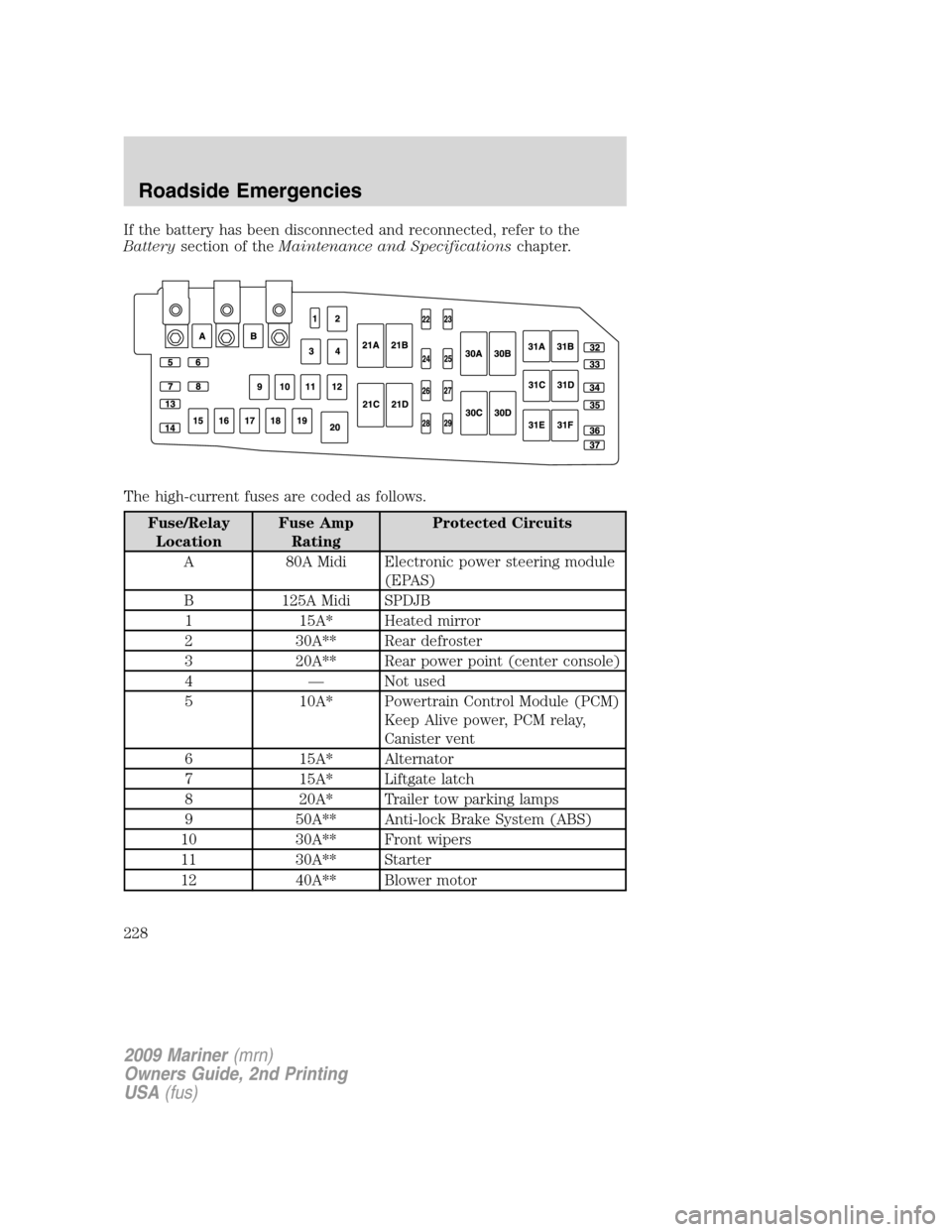
The high-current fuses are coded as follows.
Fuse/Relay
LocationFuse Amp
RatingProtected Circuits
A 80A Midi Electronic power steering module
(EPAS)
B 125A Midi SPDJB
1 15A* Heated mirror
2 30A** Rear defroster
3 20A** Rear power point (center console)
4 — Not used
5 10A* Powertrain Control Module (PCM)
Keep Alive power, PCM relay,
Canister vent
6 15A* Alternator
7 15A* Liftgate latch
8 20A* Trailer tow parking lamps
9 50A** Anti-lock Brake System (ABS)
10 30A** Front wipers
11 30A** Starter
12 40A** Blower motor
2009 Mariner(mrn)
Owners Guide, 2nd Printing
USA(fus)
Roadside Emergencies
228
Page 229 of 312
Fuse/Relay
LocationFuse Amp
RatingProtected Circuits
13 10A* A/C clutch
14 15A* Trailer tow turn lamps
15 — Not used
16 40A** Cooling fan 1
17 40A** Cooling fan 2
18 20A** ABS solenoid
19 30A** Power seats
20 — A/C clutch relay
21A — Rear defroster relay
21B — Fuel relay
21C — Blower relay
21D — PCM relay
22 20A* Fuel pump
23 15A* Fuel injectors
24 — Not used
25 5A* Anti-lock Brake System (ABS)
26 15A* Ignition coils
27 10A* PCM non mil-malfunction
indicator lamp
28 20A* PCM mil-on malfunction indicator
lamp
29 15A* Powertrain Control Module
30A — Cooling fan 1 relay
30B — Starter relay
30C — Cooling fan main relay
30D — Cooling fan 2 relay
31A — Reverse lamp relay
31B — Not used
31C — Trailer tow left turn relay
31D — Trailer tow right turn relay
31E — Trailer tow park relay
2009 Mariner(mrn)
Owners Guide, 2nd Printing
USA(fus)
Roadside Emergencies
229
Page 230 of 312
Fuse/Relay
LocationFuse Amp
RatingProtected Circuits
31F — Liftgate latch relay
32 — Not used
33 — PCM diode
34 — Start diode
35 10A* Run/start, Reverse lamps, Rear
defrost relay
36 — Not used
37 — Not used
* Mini fuse ** Cartridge fuse
CHANGING A FLAT TIRE
If you get a flat tire while driving:
•do not brake heavily.
•gradually decrease the vehicle’s speed.
•hold the steering wheel firmly.
•slowly move to a safe place on the side of the road.
Your vehicle may be equipped with a conventional spare tire that is
different in one or more of the following: type, brand, size, speed rating
and tread design. If this is the case, this dissimilar spare tire is still rated
for your vehicle loads (GAWR and GVWR). This temporary spare tire is
not equipped with a Tire Pressure Monitor System (TPMS) sensor.
Note:The tire pressure monitoring system (TPMS) indicator light will
illuminate when the spare is in use. To restore the full functionality of
the TPMS system, all road wheels equipped with the tire pressure
monitoring sensors must be mounted on the vehicle.
Have a flat tire serviced by an authorized dealer in order to prevent
damage to the TPMS sensor, refer toTire Pressure Monitoring System
(TPMS)in theTires, Wheels, and Loadingchapter. Replace the spare
tire with a road tire as soon as possible. During repairing or replacing of
the flat tire, have the authorized dealer inspect the TPMS sensor for
damage.
WARNING:The use of tire sealants may damage your Tire
Pressure Monitoring System and should not be used.
2009 Mariner(mrn)
Owners Guide, 2nd Printing
USA(fus)
Roadside Emergencies
230
Page 233 of 312

Stopping and securing the vehicle
1. Park on a level surface, set the
parking brake and activate hazard
flashers.
2. Place gearshift lever in P (Park)
and turn engine off.
Removing the jack and tools
The jack and tools are located under
the carpeted load floor.
Pull back the carpet away from the
liftgate, and remove the hardboard
cover. If your vehicle is equipped
with a cargo management system,
the jack and tools are in the forward
compartment under a lid.
Unbuckle the strap and remove the
jack and tools by pulling the right
side up first. Remove the tools from
the jack in order to remove the
spare tire from under the vehicle.
BRAKE RELEASE P
2009 Mariner(mrn)
Owners Guide, 2nd Printing
USA(fus)
Roadside Emergencies
233
Page 236 of 312

Tire change procedure
WARNING:When one of the front wheels is off the ground, the
transmission alone will not prevent the vehicle from moving or
slipping off the jack, even if the vehicle is in P (Park).
WARNING:To help prevent the vehicle from moving when you
change a tire, be sure the parking brake is set, then block (in
both directions) the wheel that is diagonally opposite (other side and
end of the vehicle) to the tire being changed.
WARNING:If the vehicle slips off the jack, you or someone else
could be seriously injured.
WARNING:Do not attempt to change a tire on the side of the
vehicle close to moving traffic. Pull far enough off the road to
avoid the danger of being hit when operating the jack or changing the
wheel.
1. Block the diagonally opposite
wheel.
2. Loosen each wheel lug nut
one-half turn counterclockwise but
do not remove them until the wheel
is raised off the ground.
2009 Mariner(mrn)
Owners Guide, 2nd Printing
USA(fus)
Roadside Emergencies
236
Page 241 of 312

spare tire carrier has a built-in ratchet feature that will not allow you to
overtighten. If the spare tire carrier ratchets with very little effort, take
the vehicle to your authorized dealer for assistance at your earliest
convenience.If your vehicle is equipped with a trailer hitch, guide
the tire with one hand; keep the rear of the tire tilted down until
the tire clears the bumper.
6. Check that the tire lies flat against the frame assembly. Push against
the tire to make sure it is tightly seated under the vehicle. Loosen and
retighten, if necessary. Failure to properly stow the spare tire may result
in failure of the winch cable and loss of the spare tire.(Make sure that
the tire does not contact the bumper.)
7. Repeat this tightness check procedure (every six months, per
scheduled maintenance information),when servicing the spare tire
pressure or at any time that the spare tire is disturbed through service of
other components.
WHEEL LUG NUT TORQUE SPECIFICATIONS
Retighten the lug nuts to the specified torque at 500 miles (800 km)
after any wheel disturbance (tire rotation, changing a flat tire, wheel
removal, etc.).
Bolt size Wheel lug nut torque*
lb.ft. N•m
M12 x 1.5 100 135
* Torque specifications are for nut and bolt threads free of dirt and
rust. Use only Ford recommended replacement fasteners.
WARNING:When a wheel is installed, always remove any
corrosion, dirt or foreign materials present on the mounting
surfaces of the wheel or the surface of the wheel hub, brake drum or
brake disc that contacts the wheel. Ensure that any fasteners that
attach the rotor to the hub are secured so they do not interfere with
the mounting surfaces of the wheel. Installing wheels without correct
metal-to-metal contact at the wheel mounting surfaces can cause the
wheel nuts to loosen and the wheel to come off while the vehicle is in
motion, resulting in loss of control.
2009 Mariner(mrn)
Owners Guide, 2nd Printing
USA(fus)
Roadside Emergencies
241
Page 242 of 312

Note:Inspect the wheel pilot hole
prior to installation. If there is
visible corrosion in wheel pilot hole,
remove loose particles by wiping
with clean rag and apply grease.
Apply grease only to the wheel pilot
hole surface by smearing a “dime”
(1 square cm) sized glob of grease
around the wheel pilot surface (1)
with end of finger. DO NOT apply
grease to lugnut/stud holes or
wheel-to-brake surfaces.
RUNNING OUT OF FUEL
If you have run out of fuel and need to refill the vehicle with a portable
fuel container, seeRunning out of fuelin theMaintenance and
Specificationschapter for proper fuel filling method using a portable
fuel container and the included fuel filler funnel.Do notinsert the
nozzle of portable fuel containers or any type of aftermarket funnels into
the Easy Fuel™ “no cap” fuel system as it can be damaged. You must
use the included funnel in such circumstances.
WARNING:Do not insert the nozzle of portable fuel containers
or aftermarket funnels into the Easy Fuel™ system. This could
damage the fuel system and its seal, and may cause fuel to run onto
the ground instead of filling the tank, all of which could result in
serious personal injury.
JUMP STARTING
WARNING:The gases around the battery can explode if
exposed to flames, sparks, or lit cigarettes. An explosion could
result in injury or vehicle damage.
WARNING:Batteries contain sulfuric acid which can burn skin,
eyes and clothing, if contacted.
Do not attempt to push-start your automatic transmission
vehicle. Automatic transmissions do not have push-start
capability. Attempting to push-start a vehicle with an automatic
transmission may cause transmission damage.
2009 Mariner(mrn)
Owners Guide, 2nd Printing
USA(fus)
Roadside Emergencies
242
Page 243 of 312
Preparing your vehicle
When the battery is disconnected or a new battery is installed, the
automatic transmission must relearn its shift strategy. As a result, the
transmission may have firm and/or soft shifts. This operation is
considered normal and will not affect function or durability of the
transmission. Over time, the adaptive learning process will fully update
transmission operation.
1.Use only a 12–volt supply to start your vehicle.
2. Do not disconnect the battery of the disabled vehicle as this could
damage the vehicle’s electrical system.
3. Park the booster vehicle close to the hood of the disabled vehicle
making sure the two vehiclesdo nottouch. Set the parking brake on
both vehicles and stay clear of the engine cooling fan and other moving
parts.
4. Check all battery terminals and remove any excessive corrosion before
you attach the battery cables. Ensure that vent caps are tight and level.
5. Turn the heater fan on in both vehicles to protect from any electrical
surges. Turn all other accessories off.
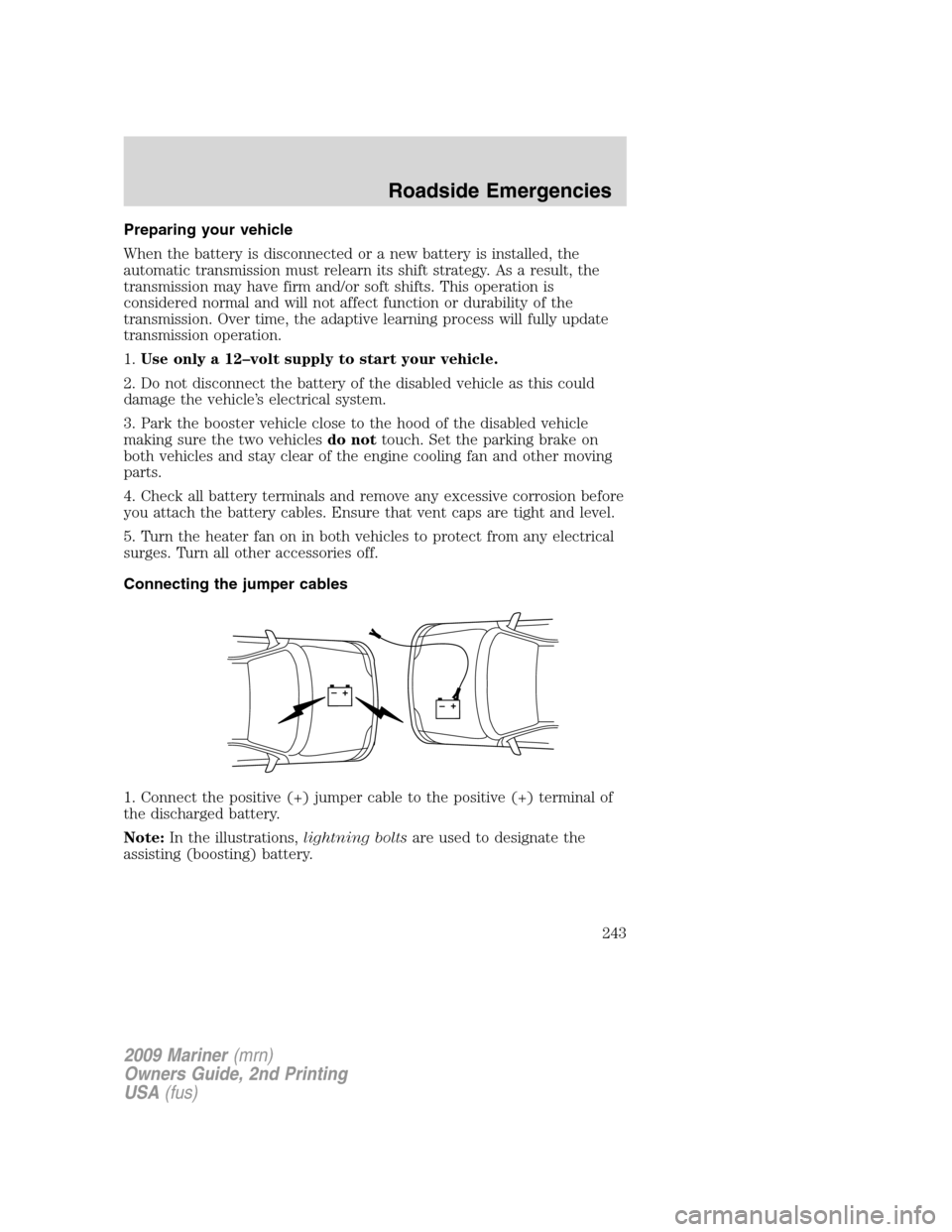
Connecting the jumper cables
1. Connect the positive (+) jumper cable to the positive (+) terminal of
the discharged battery.
Note:In the illustrations,lightning boltsare used to designate the
assisting (boosting) battery.
+–+–
2009 Mariner(mrn)
Owners Guide, 2nd Printing
USA(fus)
Roadside Emergencies
243
Page 249 of 312

If your vehicle is to be towed from the rear using wheel lift equipment, it
isrequiredthat the front wheels (drive wheels) be placed on a dolly to
prevent damage to the transmission.
On 4WD vehicles, it isrequiredthat your vehicle be towed with a wheel
lift and dollies or flatbed equipment with all the wheels off the ground to
prevent damage to the automatic transmission, 4WD system or vehicle.
Ford Motor Company produces a towing manual for all authorized tow
truck operators. Have your tow truck operator refer to this manual for
proper hook-up and towing procedures for your vehicle.
If the vehicle is towed by other means or incorrectly, vehicle
damage may occur.
Emergency towing
In case of a roadside emergency with a disabled vehicle (without access
to wheel dollies, car hauling trailer, or flatbed transport vehicle) your
vehicle (regardless of transmission powertrain configuration) can be flat
towed (all wheels on the ground) under the following conditions:
•Vehicle is facing forward so that it is being towed in a forward
direction.
•Place the transmission in N (Neutral). Refer toBrake shift interlock
in theDrivingchapter for specific instructions if you cannot move the
gear shift lever into N (Neutral).
•Maximum speed is not to exceed 35 mph (56 km/h).
•Maximum distance is 50 miles (80 km).
2009 Mariner(mrn)
Owners Guide, 2nd Printing
USA(fus)
Roadside Emergencies
249