change wheel Mercury Mariner Hybrid 2007 s User Guide
[x] Cancel search | Manufacturer: MERCURY, Model Year: 2007, Model line: Mariner Hybrid, Model: Mercury Mariner Hybrid 2007Pages: 336, PDF Size: 2.89 MB
Page 216 of 336
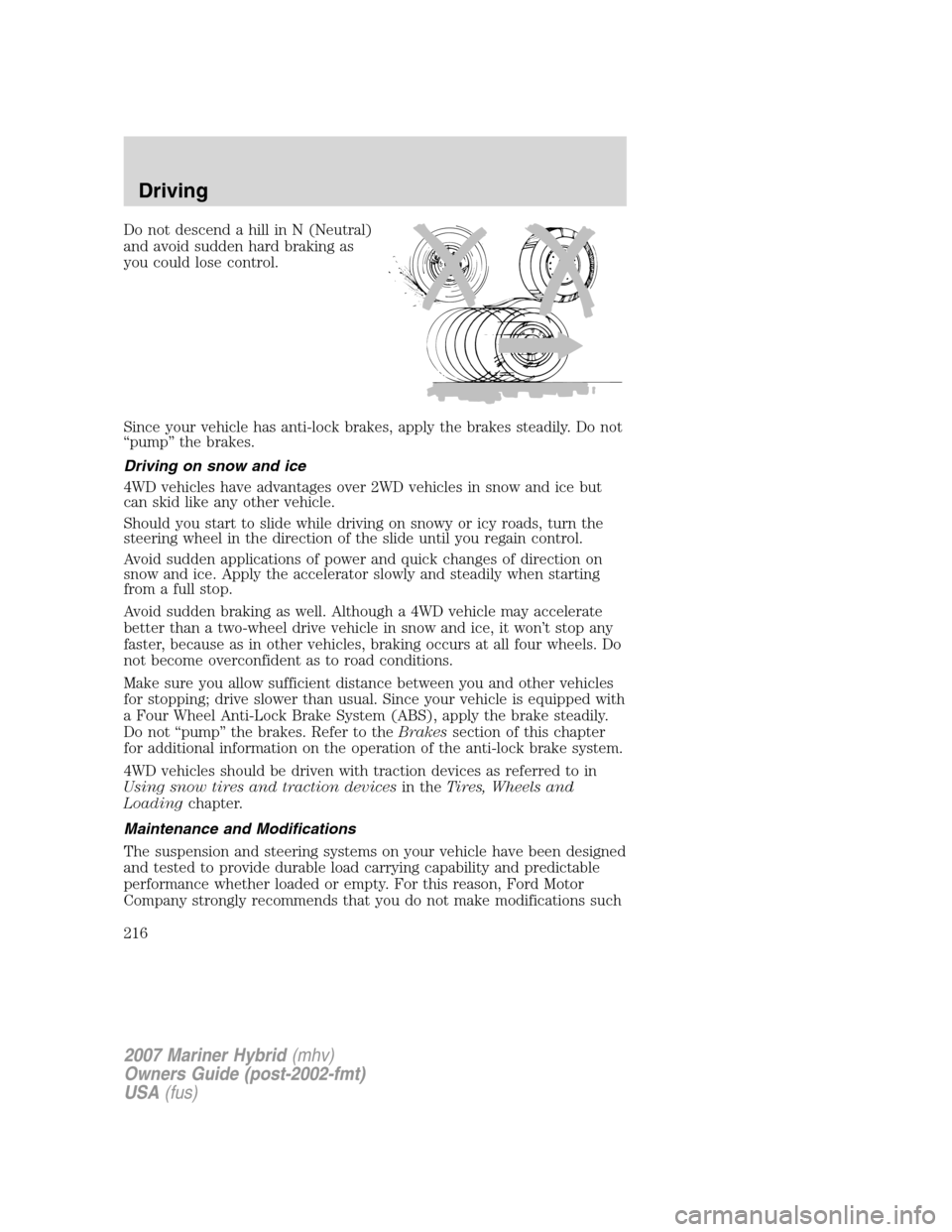
Do not descend a hill in N (Neutral)
and avoid sudden hard braking as
you could lose control.
Since your vehicle has anti-lock brakes, apply the brakes steadily. Do not
“pump” the brakes.
Driving on snow and ice
4WD vehicles have advantages over 2WD vehicles in snow and ice but
can skid like any other vehicle.
Should you start to slide while driving on snowy or icy roads, turn the
steering wheel in the direction of the slide until you regain control.
Avoid sudden applications of power and quick changes of direction on
snow and ice. Apply the accelerator slowly and steadily when starting
from a full stop.
Avoid sudden braking as well. Although a 4WD vehicle may accelerate
better than a two-wheel drive vehicle in snow and ice, it won’t stop any
faster, because as in other vehicles, braking occurs at all four wheels. Do
not become overconfident as to road conditions.
Make sure you allow sufficient distance between you and other vehicles
for stopping; drive slower than usual. Since your vehicle is equipped with
a Four Wheel Anti-Lock Brake System (ABS), apply the brake steadily.
Do not “pump” the brakes. Refer to theBrakessection of this chapter
for additional information on the operation of the anti-lock brake system.
4WD vehicles should be driven with traction devices as referred to in
Using snow tires and traction devicesin theTires, Wheels and
Loadingchapter.
Maintenance and Modifications
The suspension and steering systems on your vehicle have been designed
and tested to provide durable load carrying capability and predictable
performance whether loaded or empty. For this reason, Ford Motor
Company strongly recommends that you do not make modifications such
2007 Mariner Hybrid(mhv)
Owners Guide (post-2002-fmt)
USA(fus)
Driving
216
Page 231 of 336

•Winter weather driving capability
•Wet weather driving capability
•All-Wheel driving capability (if applicable)
•Load leveling adjustment (if applicable)
When driving with the full-size dissimilar spare tire/wheel additional
caution should be given to:
•Towing a trailer
•Driving vehicles equipped with a camper body
•Driving vehicles with a load on the cargo rack
Drive cautiously when using a full-size dissimilar spare tire/wheel and
seek service as soon as possible.
Tire change procedure
Note:The tire pressure monitoring system (TPMS) indicator light will
illuminate when the spare is in use. To restore the full functionality of
the TPMS system, all road wheels equipped with the tire pressure
monitoring sensors must be mounted on the vehicle.
Have a flat tire serviced by an authorized dealer in order to prevent
damage to the TPMS sensor, refer toTire Pressure Monitoring System
(TPMS)in theTires, Wheels, and Loadingchapter. Replace the spare
tire with a road tire as soon as possible. During the repairing or replacing
of the flat tire, have the authorized dealer inspect the TPMS sensor for
damage.
When one of the front wheels is off the ground, the transmission
alone will not prevent the vehicle from moving or slipping off the
jack, even if the vehicle is in P (Park).
To help prevent the vehicle from moving when you change a tire,
be sure the parking brake is set, then block (in both directions)
the wheel that is diagonally opposite (other side and end of the
vehicle) to the tire being changed.
If the vehicle slips off the jack, you or someone else could be
seriously injured.
2007 Mariner Hybrid(mhv)
Owners Guide (post-2002-fmt)
USA(fus)
Roadside Emergencies
231
Page 288 of 336

BRAKE FLUID
The fluid level will drop slowly as
the brakes wear, and will rise when
the brake components are replaced.
Check fluid levels with the ignition
in the RUN position. Fluid levels
between the “MIN” and “MAX” lines
are within the normal operating
range; there is no need to add fluid.
If the fluid levels are outside of the
normal operating range the
performance of your brake system could be compromised; seek service
from your authorized dealer immediately.
Brake pad replacement information
The Regenerative Braking System checks the integrity of the brake
system at times when the vehicle is parked. This is done by developing
brake pressure for short periods of time. In order to change the brake
pads, it is necessary to enter the Pad Service Mode. This will prevent
brake pressure from being applied.
To enter the Pad Service Mode, perform the following with the vehicle
stationary:
1. Place the vehicle in Park and turn ignition to the ON position.
2. Apply the brake pedal.
3. Turn the ignition OFF, then ON three times and then release the brake
pedal. The total time elapsed for the three ignition cycles and brake
release must be less than 3 seconds.
The brake warning lamp will:
•flash as stored hydraulic pressure is released.
•remain illuminated once the pressure is completely released.
•flash if the brake is applied.
To exit the Pad Service Mode:
1. Apply the brake pedal and turn the ignition OFF then ON. This will
cause brake pressure to be developed within the brake system. Once
brake pressure is developed, the brake warning light will turn off.
2. The Pad Service Mode will also be exited if the gear shift lever is
moved from the (P) Park position, the vehicle is moved (wheels rotate)
or the ignition is turned OFF.
MAX
MIN
2007 Mariner Hybrid(mhv)
Owners Guide (post-2002-fmt)
USA(fus)
Maintenance and Specifications
288
Page 289 of 336

Note:The brake system on this vehicle can only be bled at a authorized
dealer.
TRANSMISSION FLUID
Checking electronically controlled continuously variable
transmission (eCVT)
Refer to yourscheduled maintenance informationchapter for
scheduled intervals for fluid checks and changes. Your transaxle does not
consume fluid. It is designed to be filled for life. However, the fluid level
should be checked if you notice some sign of fluid leakage.
Automatic transmission fluid expands when warmed. To obtain an
accurate fluid check, drive the vehicle until it is warmed up
(approximately 20 miles [30 km]). If your vehicle has been
operated for an extended period at high speeds, in city traffic
during hot weather or pulling a trailer, the vehicle should be
turned off for about 30 minutes to allow fluid to cool before
checking.
1. Drive the vehicle 20 miles (30 km) or until it reaches normal operating
temperature.
2. Park the vehicle on a level surface and engage the parking brake.
3. With the parking brake engaged
and your foot on the brake pedal,
turn the key to the ACCESSORY
position but do not start the engine.
Turn the wheel to the left to gain
access to the check plug.
4. Latch the gearshift lever in P (Park) and make sure that the engine is
OFF by placing the ignition in the Lock position.
2007 Mariner Hybrid(mhv)
Owners Guide (post-2002-fmt)
USA(fus)
Maintenance and Specifications
289