ignition Mercury Mariner Hybrid 2007 s Workshop Manual
[x] Cancel search | Manufacturer: MERCURY, Model Year: 2007, Model line: Mariner Hybrid, Model: Mercury Mariner Hybrid 2007Pages: 336, PDF Size: 2.89 MB
Page 210 of 336

The RSS detects obstacles up to 6
feet (1.8 meters) from the rear
bumper with a decreased coverage
area at the outer corners of the
bumper, (refer to the figures for
approximate zone coverage areas).
As you move closer to the obstacle,
the rate of the tone increases. When
the obstacle is less than 10 inches
(25.0 cm) away, the tone will sound
continuously. If the RSS detects a
stationary or receding object further
than 10 inches (25.0 cm) from the
side of the vehicle, the tone will
sound for only three seconds. Once
the system detects an object
approaching, the tone will sound
again.
The RSS automatically turns on
when the gear selector is placed in
R (Reverse) and the ignition is on.
An RSS control allows the driver to
turn the RSS on and off. To turn the RSS off, the ignition must be on.
The system will remain off until either the RSS control is pressed again
or the ignition is turned off, then on again. An indicator light on the
control will illuminate when the system is turned off. If the indicator
light illuminates when the RSS is not turned off, it may indicate a failure
in the RSS.
Keep the RSS sensors (located on the rear bumper/fascia) free
from snow, ice and large accumulations of dirt (do not clean the
sensors with sharp objects). If the sensors are covered, it will
affect the accuracy of the RSS.
If your vehicle sustains damage to the rear bumper/fascia, leaving
it misaligned or bent, the sensing zone may be altered causing
inaccurate measurement of obstacles or false alarms.
2007 Mariner Hybrid(mhv)
Owners Guide (post-2002-fmt)
USA(fus)
Driving
210
Page 213 of 336

If your vehicle gets stuck
If your vehicle gets stuck in mud or snow it may be rocked out by
shifting between forward and reverse gears, stopping between shifts, in a
steady pattern. Press lightly on the accelerator in each gear.
Do not rock the vehicle if the engine is not at normal operating
temperature or damage to the transmission may occur.
Do not rock the vehicle for more than a few minutes or damage
to the transmission and tires may occur or the engine may
overheat.
Always set the parking brake fully and make sure the gearshift is
latched in P (Park). Turn the ignition to the LOCK position and
remove the key whenever you leave your vehicle.
If the parking brake is fully released, but the brake warning lamp
remains illuminated, the brakes may not be working properly.
See your authorized dealer.
Do not spin the wheels at over 35 mph (56 km/h). The tires may
fail and injure a passenger or bystander.
Emergency maneuvers
•In an unavoidable emergency situation where a sudden sharp turn
must be made, remember to avoid “over-driving” your vehicle, i.e.,
turn the steering wheel only as rapidly and as far as required to avoid
the emergency. Excessive steering will result in less vehicle control,
not more. Additionally, smooth variations of the accelerator and/or
brake pedal pressure should be utilized if changes in vehicle speed are
required. Avoid abrupt steering, acceleration or braking which could
result in an increased risk of loss of vehicle control, vehicle rollover
and/or personal injury. Use all available road surface to return the
vehicle to a safe direction of travel.
•In the event of an emergency stop, avoid skidding the tires and do not
attempt any sharp steering wheel movements.
2007 Mariner Hybrid(mhv)
Owners Guide (post-2002-fmt)
USA(fus)
Driving
213
Page 214 of 336

Vehicles with a higher center of gravity such as utility and
four-wheel drive vehicles handle differently than vehicles with a
lower center of gravity. Utility and four-wheel drive vehicles arenot
designed for cornering at speeds as high as passenger cars any more
than low-slung sports cars are designed to perform satisfactorily under
off-road conditions. Avoid sharp turns, excessive speed and abrupt
maneuvers in these vehicles. Failure to drive cautiously could result in
an increased risk of loss of vehicle control, vehicle rollover, personal
injury and death.
•If the vehicle goes from one type of surface to another (i.e., from
concrete to gravel) there will be a change in the way the vehicle
responds to a maneuver (steering, acceleration or braking). Again,
avoid these abrupt inputs.
Sand
When driving over sand, try to keep all four wheels on the most solid
area of the trail. Avoid reducing the tire pressures and drive steadily
through the terrain. Apply the accelerator slowly and avoid spinning the
wheels.
Avoid excessive speed because vehicle momentum can work against you
and cause the vehicle to become stuck to the point that assistance may
be required from another vehicle. Remember, you may be able to back
out the way you came if you proceed with caution.
Mud and water
If you must drive through high
water, drive slowly. Traction or
brake capability may be limited.
When driving through water,
determine the depth; avoid water
higher than the bottom of the hubs
(if possible) and proceed slowly. If
the ignition system gets wet, the vehicle may stall.
Once through water, always try the brakes. Wet brakes do not stop the
vehicle as effectively as dry brakes. Drying can be improved by moving
your vehicle slowly while applying light pressure on the brake pedal.
Be cautious of sudden changes in vehicle speed or direction when you
are driving in mud. Even 4WD vehicles can lose traction in slick mud. As
when you are driving over sand, apply the accelerator slowly and avoid
2007 Mariner Hybrid(mhv)
Owners Guide (post-2002-fmt)
USA(fus)
Driving
214
Page 219 of 336

•exact fuel amounts
•towing of your disabled vehicle
•emergency travel expense reimbursement
•travel planning benefits
Using roadside assistance
Complete the roadside assistance identification card and place it in your
wallet for quick reference. In the United States, this card is found in the
Owner Guide portfolio in the glove compartment. In Canada, the card is
found in theOwner Information Guidein the glove compartment.
U.S. Ford or Mercury vehicle customers who require roadside assistance,
call 1–800–241–3673; Lincoln vehicle customers call 1–800–521–4140.
Canadian customers who require roadside assistance, call
1–800–665–2006.
If you need to arrange roadside assistance for yourself, Ford Motor
Company will reimburse a reasonable amount. To obtain reimbursement
information, U.S. Ford or Mercury vehicles customers call
1–800–241–3673; Lincoln vehicle customers call 1–800–521–4140.
Canadian customers who need to obtain reimbursement information, call
1–800–665–2006.
Roadside coverage beyond basic warranty
In the United States, you may purchase additional roadside assistance
coverage beyond this period through the Ford Auto Club by contacting
your authorized dealer.
Similarly in Canada, for uninterrupted Roadside Assistance coverage, you
may purchase extended coverage prior to your Basic Warranty’s Roadside
Assistance expiring. For more information and enrollment, contact
1–877–294–2582 or visit our website at www.ford.ca.
HAZARD FLASHER CONTROL
The hazard flasher is located on the
instrument panel by the radio. The
hazard flashers will operate when
the ignition is in any position or if
the key is not in the ignition.
Push in the flasher control and all
front and rear direction signals will
2007 Mariner Hybrid(mhv)
Owners Guide (post-2002-fmt)
USA(fus)
Roadside Emergencies
219
Page 221 of 336
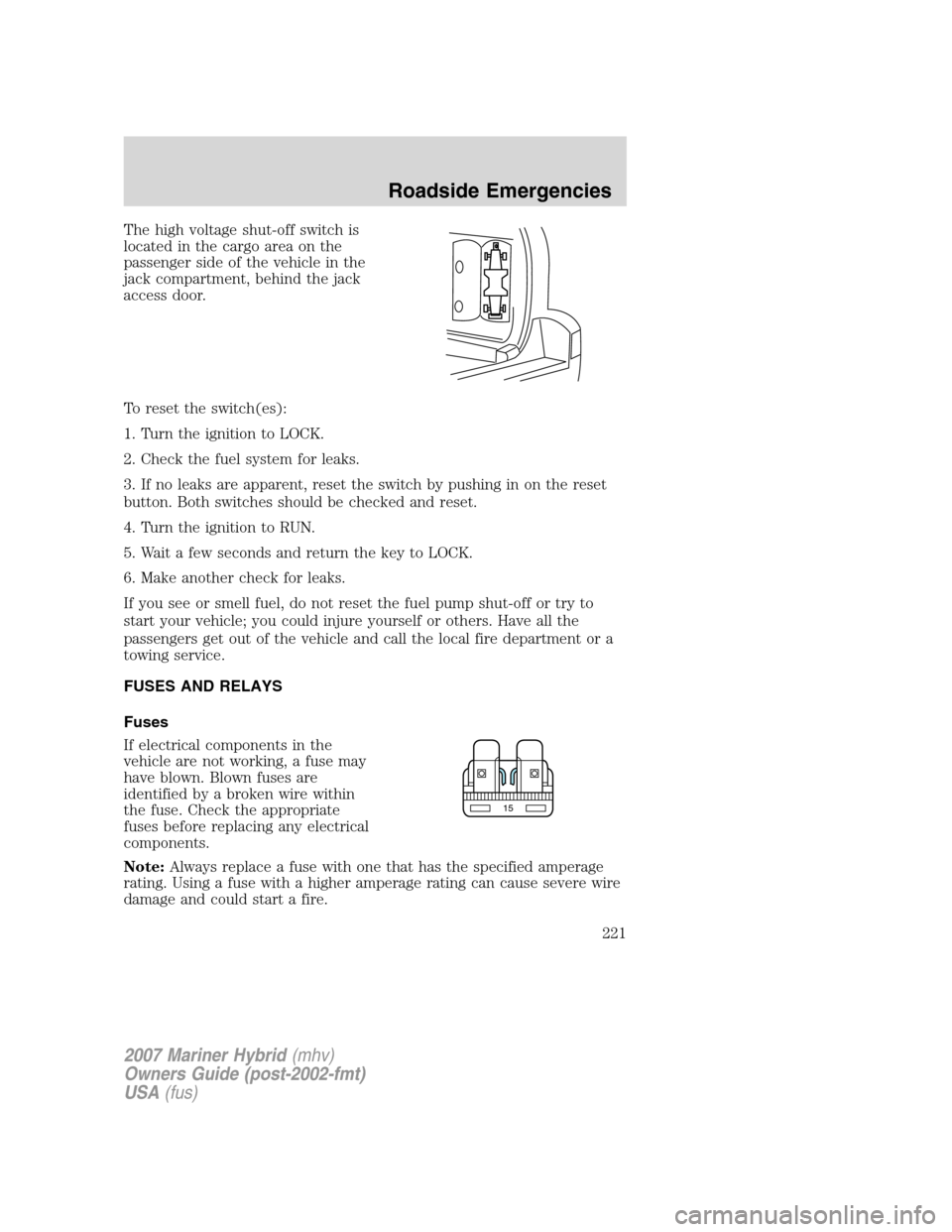
The high voltage shut-off switch is
located in the cargo area on the
passenger side of the vehicle in the
jack compartment, behind the jack
access door.
To reset the switch(es):
1. Turn the ignition to LOCK.
2. Check the fuel system for leaks.
3. If no leaks are apparent, reset the switch by pushing in on the reset
button. Both switches should be checked and reset.
4. Turn the ignition to RUN.
5. Wait a few seconds and return the key to LOCK.
6. Make another check for leaks.
If you see or smell fuel, do not reset the fuel pump shut-off or try to
start your vehicle; you could injure yourself or others. Have all the
passengers get out of the vehicle and call the local fire department or a
towing service.
FUSES AND RELAYS
Fuses
If electrical components in the
vehicle are not working, a fuse may
have blown. Blown fuses are
identified by a broken wire within
the fuse. Check the appropriate
fuses before replacing any electrical
components.
Note:Always replace a fuse with one that has the specified amperage
rating. Using a fuse with a higher amperage rating can cause severe wire
damage and could start a fire.
15
2007 Mariner Hybrid(mhv)
Owners Guide (post-2002-fmt)
USA(fus)
Roadside Emergencies
221
Page 224 of 336
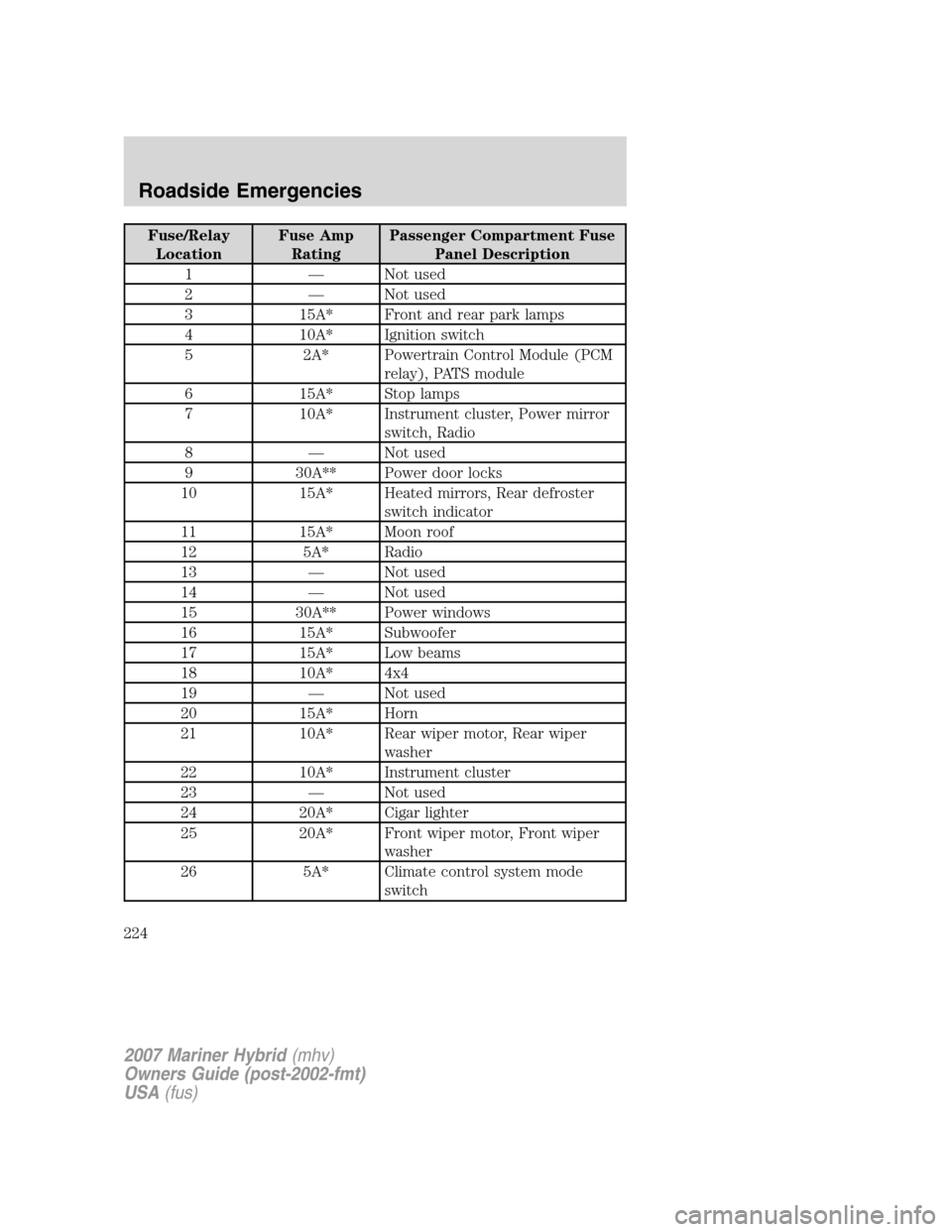
Fuse/Relay
LocationFuse Amp
RatingPassenger Compartment Fuse
Panel Description
1 — Not used
2 — Not used
3 15A* Front and rear park lamps
4 10A* Ignition switch
5 2A* Powertrain Control Module (PCM
relay), PATS module
6 15A* Stop lamps
7 10A* Instrument cluster, Power mirror
switch, Radio
8 — Not used
9 30A** Power door locks
10 15A* Heated mirrors, Rear defroster
switch indicator
11 15A* Moon roof
12 5A* Radio
13 — Not used
14 — Not used
15 30A** Power windows
16 15A* Subwoofer
17 15A* Low beams
18 10A* 4x4
19 — Not used
20 15A* Horn
21 10A* Rear wiper motor, Rear wiper
washer
22 10A* Instrument cluster
23 — Not used
24 20A* Cigar lighter
25 20A* Front wiper motor, Front wiper
washer
26 5A* Climate control system mode
switch
2007 Mariner Hybrid(mhv)
Owners Guide (post-2002-fmt)
USA(fus)
Roadside Emergencies
224
Page 227 of 336
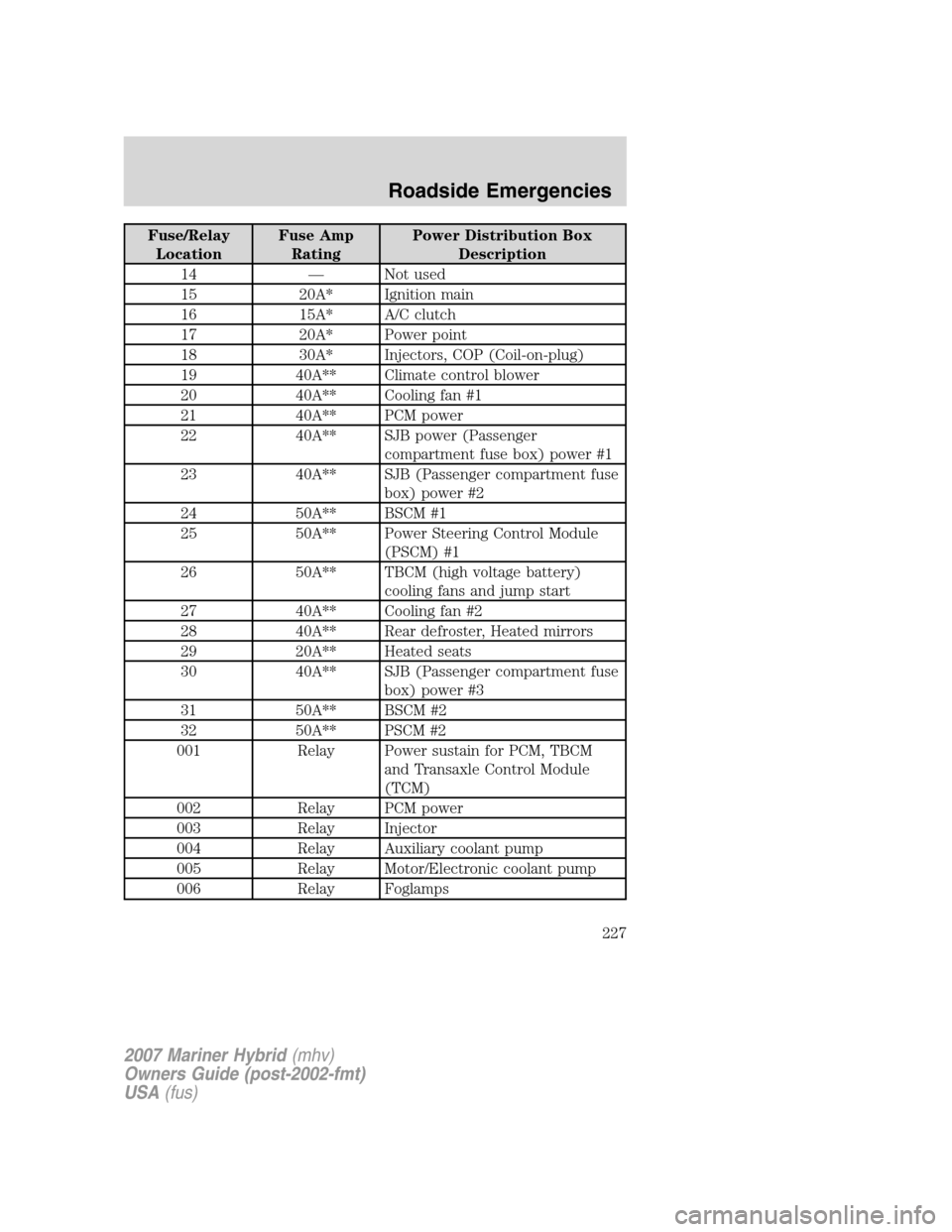
Fuse/Relay
LocationFuse Amp
RatingPower Distribution Box
Description
14 — Not used
15 20A* Ignition main
16 15A* A/C clutch
17 20A* Power point
18 30A* Injectors, COP (Coil-on-plug)
19 40A** Climate control blower
20 40A** Cooling fan #1
21 40A** PCM power
22 40A** SJB power (Passenger
compartment fuse box) power #1
23 40A** SJB (Passenger compartment fuse
box) power #2
24 50A** BSCM #1
25 50A** Power Steering Control Module
(PSCM) #1
26 50A** TBCM (high voltage battery)
cooling fans and jump start
27 40A** Cooling fan #2
28 40A** Rear defroster, Heated mirrors
29 20A** Heated seats
30 40A** SJB (Passenger compartment fuse
box) power #3
31 50A** BSCM #2
32 50A** PSCM #2
001 Relay Power sustain for PCM, TBCM
and Transaxle Control Module
(TCM)
002 Relay PCM power
003 Relay Injector
004 Relay Auxiliary coolant pump
005 Relay Motor/Electronic coolant pump
006 Relay Foglamps
2007 Mariner Hybrid(mhv)
Owners Guide (post-2002-fmt)
USA(fus)
Roadside Emergencies
227
Page 240 of 336

When a wheel is installed, always remove any corrosion, dirt or
foreign materials present on the mounting surfaces of the wheel
or the surface of the wheel hub, brake drum or brake disc that
contacts the wheel. Ensure that any fasteners that attach the rotor to
the hub are secured so they do not interfere with the mounting
surfaces of the wheel. Installing wheels without correct metal-to-metal
contact at the wheel mounting surfaces can cause the wheel nuts to
loosen and the wheel to come off while the vehicle is in motion,
resulting in loss of control.
JUMP STARTING (LOW VOLTAGE [UNDERHOOD] BATTERY
ONLY)
Your vehicle has two separate jump starting procedures; the following
procedure is for the low voltage (underhood) battery only. Refer to
Jump starting the high voltage batteryin this chapter for information
on jump starting the high voltage battery.
The gases around the battery can explode if exposed to flames,
sparks, or lit cigarettes. An explosion could result in injury or
vehicle damage.
Batteries contain sulfuric acid which can burn skin, eyes and
clothing, if contacted.
Do not attempt to push-start your automatic transmission
vehicle. Automatic transmissions do not have push-start
capability. Attempting to push-start a vehicle with an automatic
transmission may cause transmission damage.
Preparing your vehicle
If your low voltage (underhood) battery becomes disconnected or
disabled for any reason, the vehicle controller must relearn the engine’s
operating characteristics in order to operate it at maximum efficiency.
This relearning process occurs the first time the vehicle is driven after
reconnecting the low voltage battery. If the learning procedure does not
have time to complete during the drive, the engine will continue to
operate for 3-5 seconds after you turn the ignition off to complete the
relearning process. This is a normal condition and will not re-occur until
the low voltage battery is disconnected again. The brake system must
also be reset. Refer toLow voltage (underhood) batteryin the
Maintenance and Specificationchapter for more information.
2007 Mariner Hybrid(mhv)
Owners Guide (post-2002-fmt)
USA(fus)
Roadside Emergencies
240
Page 245 of 336

The high voltage battery contains potassium hydroxide (a strong
alkaline electrolyte) which can burn skin, eyes and clothing, if
contacted.
Do not attempt to push-start your vehicle. This vehicle does not
have push-start capability.
If you attempt to start your vehicle and the engine cranks but does not
start, the high voltage battery may need to be jump started.
The Service Soon (yellow wrench)
light in the instrument cluster may
also be illuminated and the message
center may display a message.
To jump start the high voltage
battery, turn the ignition to OFF,
open the access panel in the driver
side foot well and press the jump
start button momentarily. After
pressing the button, you should wait
eight minutes before attempting to
start the engine, otherwise the high
voltage battery may not receive
sufficient charge to start the engine.
The high voltage battery will use
voltage from the low voltage
(underhood) battery to charge itself.
When the button is pressed, the indicator light on the button will
illuminate. After eight minutes has passed, the indicator light will flash
rapidly for two minutes. Turn the ignition to RUN. You may now attempt
to start the engine.If you attempt to start the engine before the
eight minutes passes, the jump starting procedure will stop and
will have to be restarted if the engine does not start.
2007 Mariner Hybrid(mhv)
Owners Guide (post-2002-fmt)
USA(fus)
Roadside Emergencies
245
Page 280 of 336

When refueling always shut the engine off and never allow
sparks or open flames near the filler neck. Never smoke while
refueling. Fuel vapor is extremely hazardous under certain conditions.
Care should be taken to avoid inhaling excess fumes.
The flow of fuel through a fuel pump nozzle can produce static
electricity, which can cause a fire if fuel is pumped into an
ungrounded fuel container.
Refueling
Fuel vapor burns violently and a fuel fire can cause severe
injuries. To help avoid injuries to you and others:
•Read and follow all the instructions on the pump island;
•Turn off your engine when you are refueling;
•Do not smoke if you are near fuel or refueling your vehicle;
•Keep sparks, flames and smoking materials away from fuel;
•Stay outside your vehicle and do not leave the fuel pump unattended
when refueling your vehicle — this is against the law in some places;
•Keep children away from the fuel pump; never let children pump fuel.
Use the following guidelines to avoid electrostatic charge build-up when
filling an ungrounded fuel container:
•Place approved fuel container on the ground.
•DO NOT fill a fuel container while it is in the vehicle (including the
cargo area).
•Keep the fuel pump nozzle in contact with the fuel container while
filling.
•DO NOT use a device that would hold the fuel pump handle in the fill
position.
Fuel Filler Cap
Your fuel tank filler cap has an indexed design with a 1/4 turn on/off
feature.
When fueling your vehicle:
1. Turn the engine/ignition switch to the off position.
2007 Mariner Hybrid(mhv)
Owners Guide (post-2002-fmt)
USA(fus)
Maintenance and Specifications
280