ignition Mercury Mariner Hybrid 2008 s Manual PDF
[x] Cancel search | Manufacturer: MERCURY, Model Year: 2008, Model line: Mariner Hybrid, Model: Mercury Mariner Hybrid 2008Pages: 320, PDF Size: 2.5 MB
Page 227 of 320
![Mercury Mariner Hybrid 2008 s Manual PDF JUMP STARTING (LOW VOLTAGE [UNDERHOOD] BATTERY ONLY)
Your vehicle has two separate jump starting procedures; the following
procedure is for the low voltage (underhood) battery only. Refer to
Jump star](/img/33/10941/w960_10941-226.png "Mercury Mariner Hybrid 2008 s Manual PDF JUMP STARTING (LOW VOLTAGE [UNDERHOOD] BATTERY ONLY)
Your vehicle has two separate jump starting procedures; the following
procedure is for the low voltage (underhood) battery only. Refer to
Jump star")
JUMP STARTING (LOW VOLTAGE [UNDERHOOD] BATTERY ONLY)
Your vehicle has two separate jump starting procedures; the following
procedure is for the low voltage (underhood) battery only. Refer to
Jump starting the high voltage batteryin this chapter for information
on jump starting the high voltage battery.
The gases around the battery can explode if exposed to flames,
sparks, or lit cigarettes. An explosion could result in injury or
vehicle damage.
Batteries contain sulfuric acid which can burn skin, eyes and
clothing, if contacted.
Do not attempt to push-start your automatic transmission
vehicle. Automatic transmissions do not have push-start
capability. Attempting to push-start a vehicle with an automatic
transmission may cause transmission damage.
Preparing your vehicle
If your low voltage (underhood) battery becomes disconnected or
disabled for any reason, the vehicle controller must relearn the engine’s
operating characteristics in order to operate it at maximum efficiency.
This relearning process occurs the first time the vehicle is driven after
reconnecting the low voltage battery. If the learning procedure does not
have time to complete during the drive, the engine will continue to
operate for 3-5 seconds after you turn the ignition off to complete the
relearning process. This is a normal condition and will not re-occur until
the low voltage battery is disconnected again. The brake system must
also be reset. Refer toLow voltage (underhood) batteryin the
Maintenance and Specificationchapter for more information.
1.Use only a 12–volt supply to start your vehicle.
2. Do not disconnect the battery of the disabled vehicle as this could
damage the vehicle’s electrical system.
3. Park the booster vehicle close to the hood of the disabled vehicle
making sure the two vehiclesdo nottouch. Set the parking brake on
both vehicles and stay clear of the engine cooling fan and other moving
parts.
4. Check all battery terminals and remove any excessive corrosion before
you attach the battery cables. Ensure that vent caps are tight and level.
5. Turn the heater fan on in both vehicles to protect from any electrical
surges. Turn all other accessories off.
2008 Mariner Hybrid(mhv)
Owners Guide (post-2002-fmt)
USA(fus)
Roadside Emergencies
227
Page 232 of 320
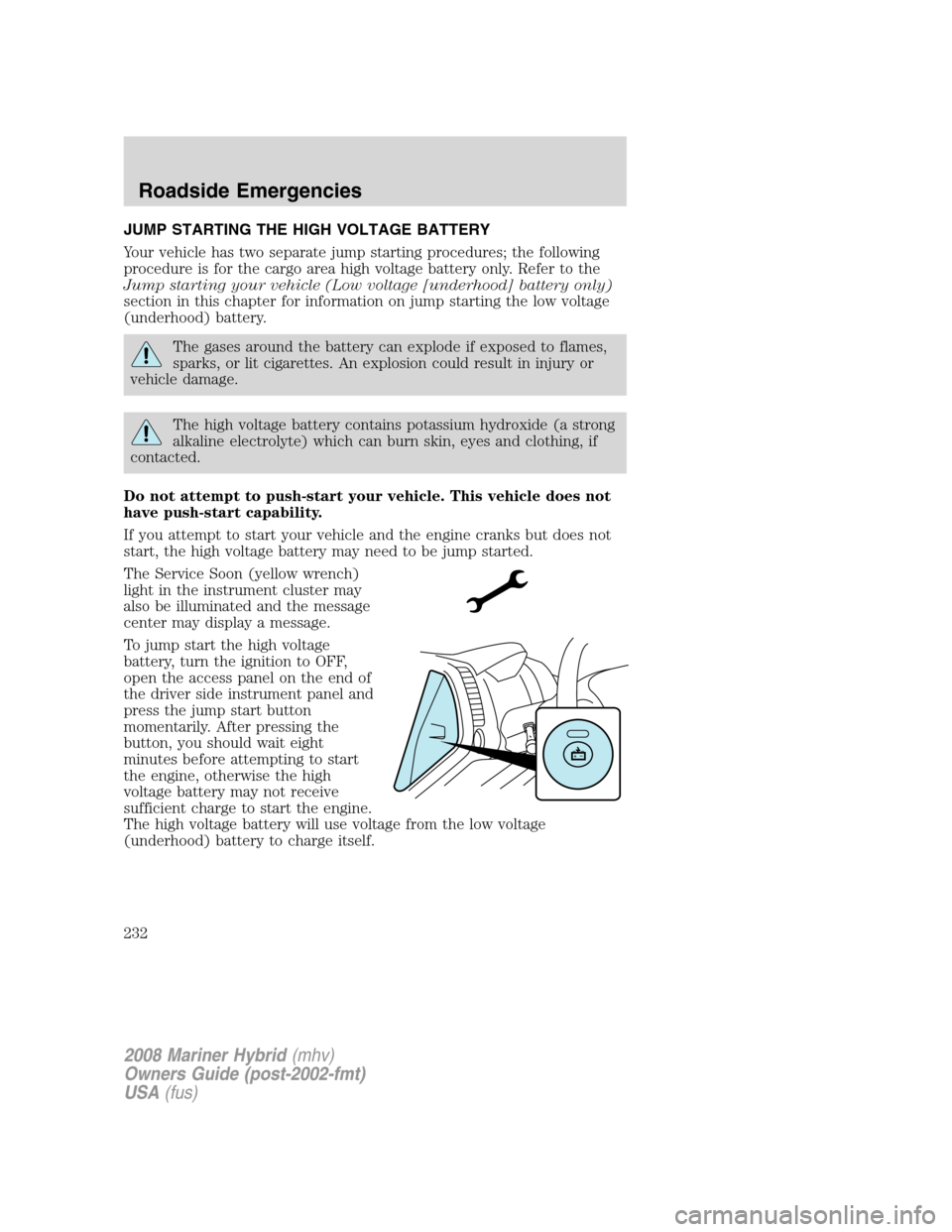
JUMP STARTING THE HIGH VOLTAGE BATTERY
Your vehicle has two separate jump starting procedures; the following
procedure is for the cargo area high voltage battery only. Refer to the
Jump starting your vehicle (Low voltage [underhood] battery only)
section in this chapter for information on jump starting the low voltage
(underhood) battery.
The gases around the battery can explode if exposed to flames,
sparks, or lit cigarettes. An explosion could result in injury or
vehicle damage.
The high voltage battery contains potassium hydroxide (a strong
alkaline electrolyte) which can burn skin, eyes and clothing, if
contacted.
Do not attempt to push-start your vehicle. This vehicle does not
have push-start capability.
If you attempt to start your vehicle and the engine cranks but does not
start, the high voltage battery may need to be jump started.
The Service Soon (yellow wrench)
light in the instrument cluster may
also be illuminated and the message
center may display a message.
To jump start the high voltage
battery, turn the ignition to OFF,
open the access panel on the end of
the driver side instrument panel and
press the jump start button
momentarily. After pressing the
button, you should wait eight
minutes before attempting to start
the engine, otherwise the high
voltage battery may not receive
sufficient charge to start the engine.
The high voltage battery will use voltage from the low voltage
(underhood) battery to charge itself.
2008 Mariner Hybrid(mhv)
Owners Guide (post-2002-fmt)
USA(fus)
Roadside Emergencies
232
Page 233 of 320
When the button is pressed, the indicator light on the button will
illuminate. After eight minutes has passed, the indicator light will flash
rapidly for two minutes. Turn the ignition to RUN. You may now attempt
to start the engine.If you attempt to start the engine before the
eight minutes passes, the jump starting procedure will stop and
will have to be restarted if the engine does not start.
If the engine still does not start after the first complete high voltage
jump start, a second jump start procedure can be attempted after a
two-minute period (indicated by the button light changing from a rapid
flash to no illumination). This jump start procedure can only be done
twice before the low voltage (underhood) battery becomes discharged
and must also be jump started.
If the jump start button is pressed, but the indicator on the button
flashes slowly, the low voltage (underhood) battery may not have enough
energy to charge the high voltage battery. If this occurs, refer to the
Jump starting your vehicle (Low voltage [underhood] battery only)
section in this chapter for information on jump starting the low voltage
(underhood) battery. You may perform another high voltage battery jump
start by pressing the jump start button after having connected the
jumper cables and starting the booster vehicle.
Once the engine is started, the jumper cables should be removed as
described in theJump starting your vehicle (Low voltage
[underhood] battery only)section.
2008 Mariner Hybrid(mhv)
Owners Guide (post-2002-fmt)
USA(fus)
Roadside Emergencies
233
Page 270 of 320

Fuel Filler Cap
Your fuel tank filler cap has an indexed design with a 1/4 turn on/off
feature.
When fueling your vehicle:
1. Turn the engine/ignition switch to the off position.
2. Carefully turn the filler cap counterclockwise until it spins off.
3. To install the cap, align the lugs on the cap with the threads on the
filler pipe.
4. Turn the filler cap clockwise until it clicks at least once.
After refueling, if the
indicator comes on and stays on when you
start the engine, the fuel filler cap may not be properly installed. Turn
off the engine, remove the fuel filler cap, align the cap properly and
reinstall it securely. The
indicator should turn off after three driving
cycles with the fuel filler cap properly installed. A driving cycle consists
of a cold engine start-up followed by mixed city/highway driving.
If you must replace the fuel filler cap, replace it with a fuel filler
cap that is designed for your vehicle. The customer warranty may
be void for any damage to the fuel tank or fuel system if the
correct genuine Ford or Motorcraft fuel filler cap is not used.
The fuel system may be under pressure. Remove fuel filler cap
slowly. Otherwise, fuel may spray out and injure you or others.
If you do not use the proper fuel filler cap, excessive vacuum in
the fuel tank may damage the fuel system or cause the fuel cap
to disengage in a collision, which may result in possible personal injury.
Choosing the right fuel
Use only UNLEADED fuel or UNLEADED fuel blended with a maximum
of 10% ethanol. Your vehicle was not designed to run on E85 fuels that
are blended with a maximum of 85% ethanol. The use of leaded fuel is
prohibited by law and could damage your vehicle. Do not use fuel
containing methanol. It can damage critical fuel system components.
Your vehicle was not designed to use fuel or fuel additives with metallic
compounds, including manganese-based additives. Studies indicate that
these additives can cause your vehicle’s emission control system to
deteriorate more rapidly.
Repairs to correct the effects of using a fuel for which your vehicle was
not designed may not be covered by your warranty.
2008 Mariner Hybrid(mhv)
Owners Guide (post-2002-fmt)
USA(fus)
Maintenance and Specifications
270
Page 272 of 320
If you have run out of fuel:
•You may need to cycle the ignition from OFF to ON several times after
refueling to allow the fuel system to pump the fuel from the tank to
the engine. On restarting, cranking time will take a few seconds longer
than normal.
•Normally, adding 1 gallon (3.8L) of fuel is enough to restart the
engine. If the vehicle is out of fuel and on a steep grade, more than 1
gallon (3.8L) may be required.
•The
indicator may come on. For more information on the “check
engine” or the “service engine soon” indicator, refer toWarning lights
and chimesin theInstrument Clusterchapter.
ESSENTIALS OF GOOD FUEL ECONOMY
Measuring techniques
Your best source of information about actual fuel economy is you, the
driver. You must gather information as accurately and consistently as
possible. Fuel expense, frequency of fill-ups or fuel gauge readings are
NOT accurate as a measure of fuel economy. We do not recommend taking
fuel economy measurements during the first 1,000 miles (1,600 km) of
driving (engine break-in period). You will get a more accurate
measurement after 2,000 miles–3,000 miles (3,000 km–5,000 km).
Filling the tank
When the fuel gauge indicates empty, there is still a small reserve of fuel
in the fuel system. When refueling your vehicle after the fuel gauge
indicates empty, you might not be able to refuel the full amount of the
advertised capacity of the fuel tank due to the empty reserve still
present in the tank. The amount of usable fuel in the empty reserve
varies and should not be relied upon to increase driving range.
For consistent results when filling the fuel tank:
•Turn the engine/ignition switch to the off position prior to refueling;
an error in the reading will result if the engine is left running.
•Allow no more than two automatic click-offs when filling.
•Always use fuel with the recommended octane rating.
•Use a known quality gasoline, preferably a national brand.
Your results will be most accurate if your filling method is consistent.
Calculating fuel economy
1. Fill the fuel tank completely and record the initial odometer reading
(in miles or kilometers).
2008 Mariner Hybrid(mhv)
Owners Guide (post-2002-fmt)
USA(fus)
Maintenance and Specifications
272
Page 275 of 320
EMISSION CONTROL SYSTEM
Your vehicle is equipped with various emission control components and a
catalytic converter which will enable your vehicle to comply with
applicable exhaust emission standards. To make sure that the catalytic
converter and other emission control components continue to work
properly:
•Use only the specified fuel listed.
•Avoid running out of fuel.
•Do not turn off the ignition while your vehicle is moving, especially at
high speeds.
•Have the items listed inscheduled maintenance information
performed according to the specified schedule.
The scheduled maintenance items listed inscheduled maintenance
informationare essential to the life and performance of your vehicle
and to its emissions system.
If other than Ford, Motorcraft or Ford-authorized parts are used for
maintenance replacements or for service of components affecting
emission control, such non-Ford parts should be equivalent to genuine
Ford Motor Company parts in performance and durability.
Do not park, idle, or drive your vehicle in dry grass or other dry
ground cover. The emission system heats up the engine
compartment and exhaust system, which can start a fire.
Illumination of the
indicator, charging system warning light or the
temperature warning light, fluid leaks, strange odors, smoke or loss of
engine power could indicate that the emission control system is not
working properly.
An improperly operating or damaged exhaust system may allow exhaust
to enter the vehicle. Have a damaged or improperly operating exhaust
system inspected and repaired immediately.
Exhaust leaks may result in entry of harmful and potentially
lethal fumes into the passenger compartment.
2008 Mariner Hybrid(mhv)
Owners Guide (post-2002-fmt)
USA(fus)
Maintenance and Specifications
275
Page 277 of 320
Readiness for Inspection/Maintenance (I/M) testing
Some state/provincial and local governments may have
Inspection/Maintenance (I/M) programs to inspect the emission control
equipment on your vehicle. Failure to pass this inspection could prevent
you from getting a vehicle registration. Your vehicle may not pass the I/M
test if the
indicator is on or not working properly (bulb is burned
out), or if the OBD-II system has determined that some of the emission
control systems have not been properly checked. In this case, the vehicle
is considered not ready for I/M testing.
If the
indicator is on or the bulb does not work, the vehicle may
need to be serviced. Refer to the On board diagnostics (OBD-II)
description in this chapter.
If the vehicle’s engine or transmission has just been serviced, or the
battery has recently run down or been replaced, the OBD-II system may
indicate that the vehicle is not ready for I/M testing. To determine if the
vehicle is ready for I/M testing, turn the ignition key to the ON position
for 15 seconds without cranking the engine. If the
indicator blinks
eight times, it means that the vehicle is not ready for I/M testing; if
the
indicator stays on solid, it means that the vehicle is ready for
I/M testing.
The OBD-II system is designed to check the emission control system
during normal driving. A complete check may take several days. If the
vehicle is not ready for I/M testing, the following driving cycle consisting
of mixed city and highway driving may be performed:
15 minutes of steady driving on an expressway/highway followed by 20
minutes of stop-and-go driving with at least four 30-second idle periods.
Allow the vehicle to sit for at least eight hours without starting the
engine. Then, start the engine and complete the above driving cycle. The
engine must warm up to its normal operating temperature. Once started,
do not turn off the engine until the above driving cycle is complete. If
the vehicle is still not ready for I/M testing, the above driving cycle will
have to be repeated.
2008 Mariner Hybrid(mhv)
Owners Guide (post-2002-fmt)
USA(fus)
Maintenance and Specifications
277
Page 278 of 320
BRAKE FLUID
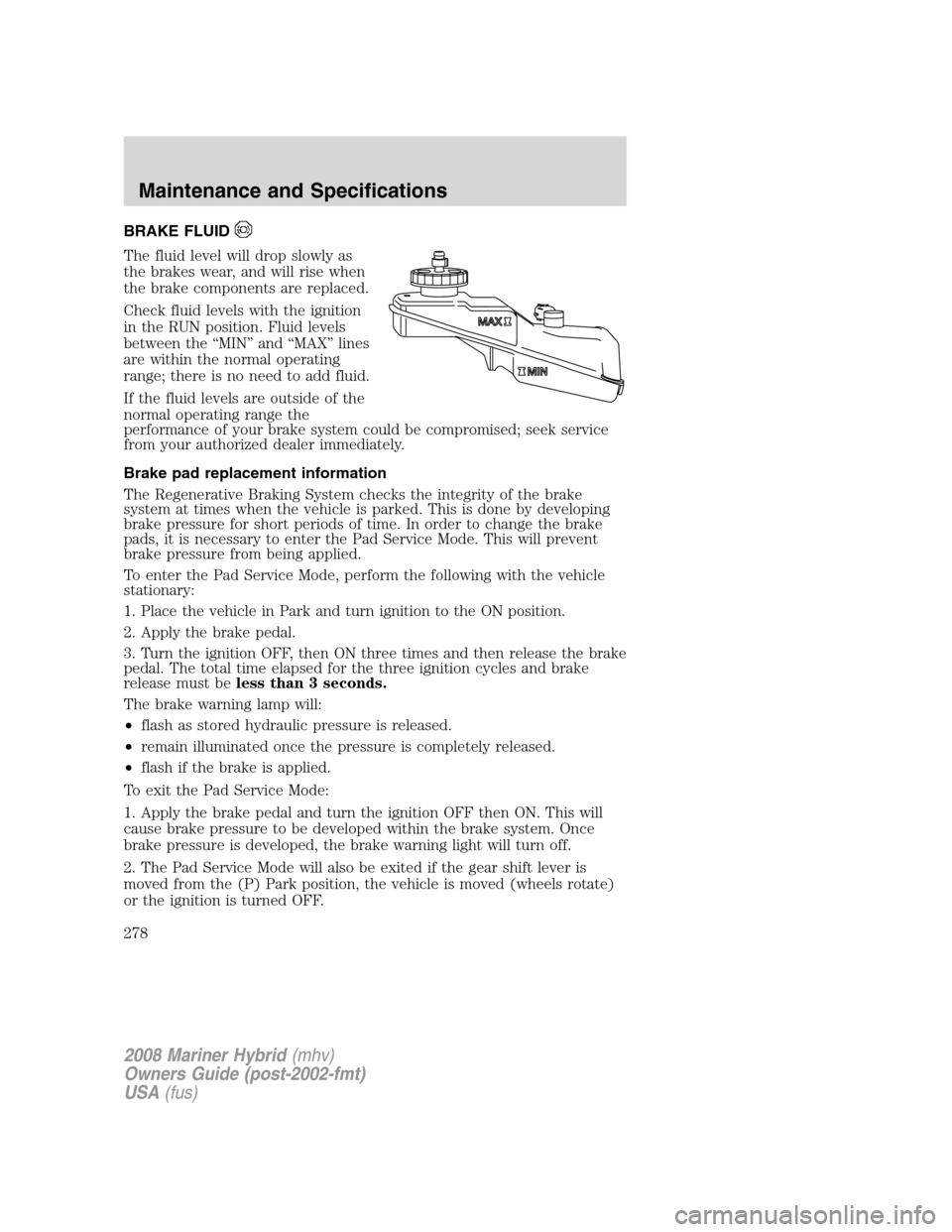
The fluid level will drop slowly as
the brakes wear, and will rise when
the brake components are replaced.
Check fluid levels with the ignition
in the RUN position. Fluid levels
between the “MIN” and “MAX” lines
are within the normal operating
range; there is no need to add fluid.
If the fluid levels are outside of the
normal operating range the
performance of your brake system could be compromised; seek service
from your authorized dealer immediately.
Brake pad replacement information
The Regenerative Braking System checks the integrity of the brake
system at times when the vehicle is parked. This is done by developing
brake pressure for short periods of time. In order to change the brake
pads, it is necessary to enter the Pad Service Mode. This will prevent
brake pressure from being applied.
To enter the Pad Service Mode, perform the following with the vehicle
stationary:
1. Place the vehicle in Park and turn ignition to the ON position.
2. Apply the brake pedal.
3. Turn the ignition OFF, then ON three times and then release the brake
pedal. The total time elapsed for the three ignition cycles and brake
release must beless than 3 seconds.
The brake warning lamp will:
•flash as stored hydraulic pressure is released.
•remain illuminated once the pressure is completely released.
•flash if the brake is applied.
To exit the Pad Service Mode:
1. Apply the brake pedal and turn the ignition OFF then ON. This will
cause brake pressure to be developed within the brake system. Once
brake pressure is developed, the brake warning light will turn off.
2. The Pad Service Mode will also be exited if the gear shift lever is
moved from the (P) Park position, the vehicle is moved (wheels rotate)
or the ignition is turned OFF.
MAX
MIN
2008 Mariner Hybrid(mhv)
Owners Guide (post-2002-fmt)
USA(fus)
Maintenance and Specifications
278
Page 279 of 320
Note:The brake system on this vehicle can only be bled at a authorized
dealer.
TRANSMISSION FLUID
Checking electronically controlled continuously variable
transmission (eCVT)
Refer to yourscheduled maintenance informationchapter for
scheduled intervals for fluid checks and changes. Your transaxle does not
consume fluid. It is designed to be filled for life. However, the fluid level
should be checked if you notice some sign of fluid leakage.
Automatic transmission fluid expands when warmed. To obtain an
accurate fluid check, drive the vehicle until it is warmed up
(approximately 20 miles [30 km]). If your vehicle has been
operated for an extended period at high speeds, in city traffic
during hot weather or pulling a trailer, the vehicle should be
turned off for about 30 minutes to allow fluid to cool before
checking.
1. Drive the vehicle 20 miles (30 km) or until it reaches normal operating
temperature.
2. Park the vehicle on a level surface and engage the parking brake.
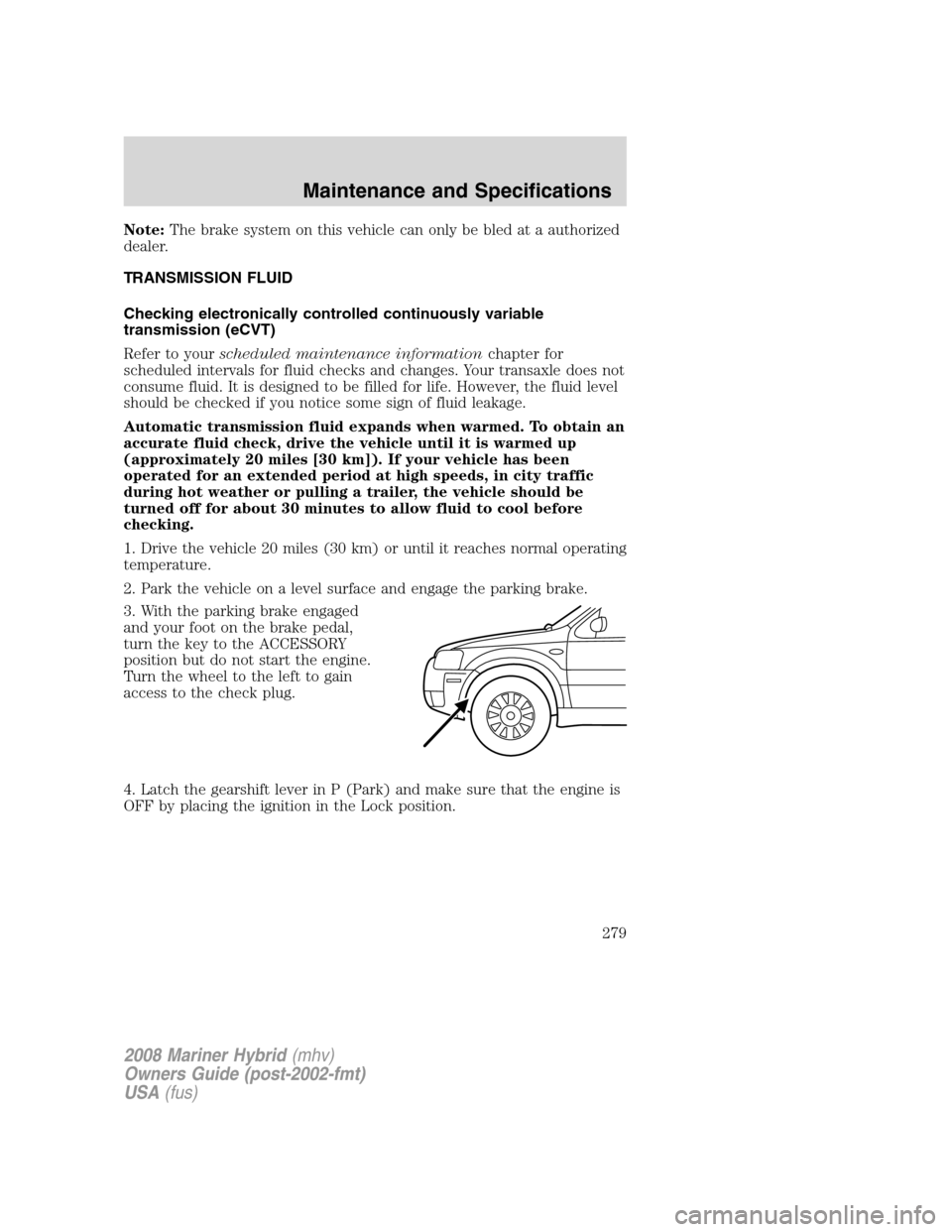
3. With the parking brake engaged
and your foot on the brake pedal,
turn the key to the ACCESSORY
position but do not start the engine.
Turn the wheel to the left to gain
access to the check plug.
4. Latch the gearshift lever in P (Park) and make sure that the engine is
OFF by placing the ignition in the Lock position.
2008 Mariner Hybrid(mhv)
Owners Guide (post-2002-fmt)
USA(fus)
Maintenance and Specifications
279
Page 287 of 320
ENGINE DATA
Engine 2.3L I4 engine
Cubic inches 140
Required fuel 87 octane
Firing order 1-3-4-2
Ignition system Coil on plug
Spark plug gap 0.049–0.053 inch (1.25–1.35mm)
Compression ratio 12.3:1
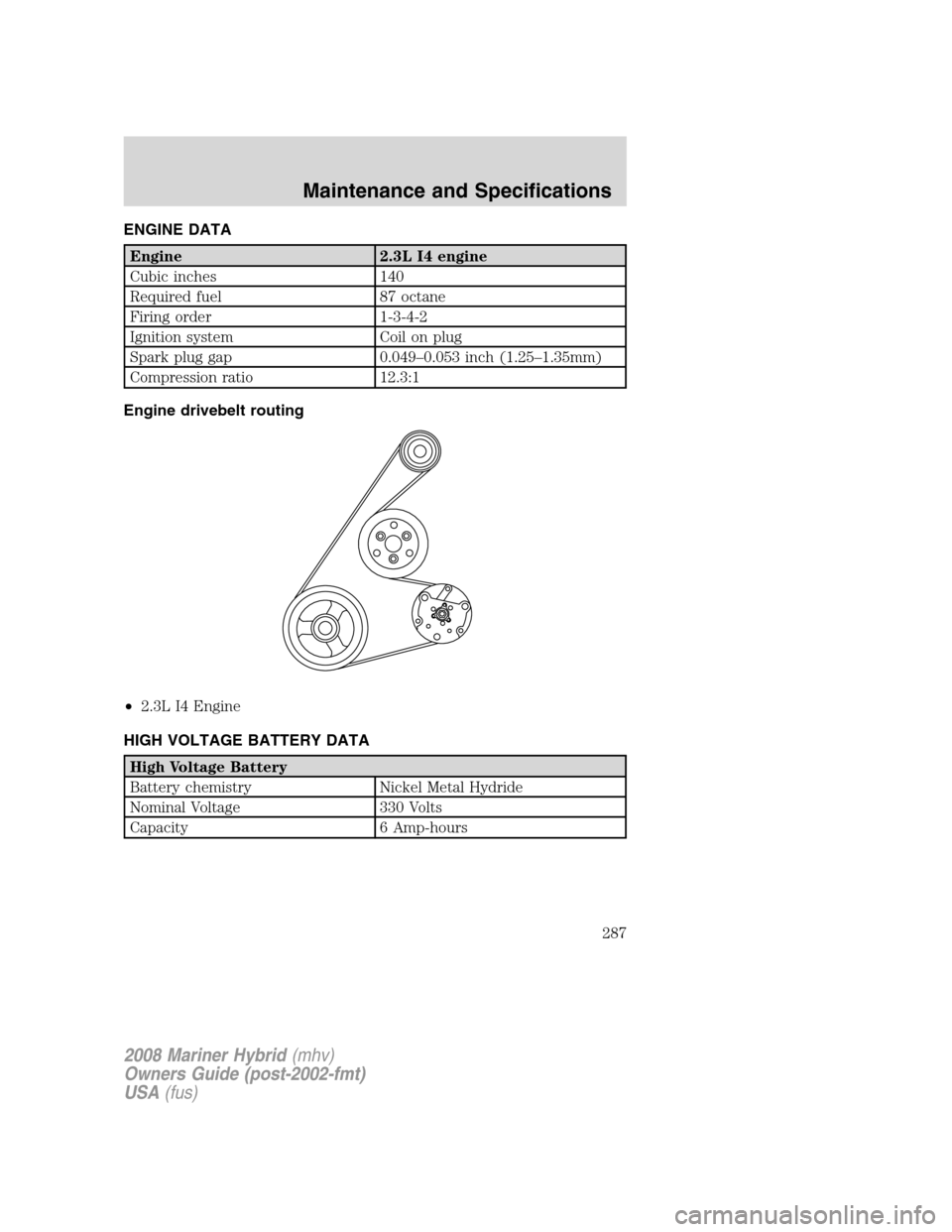
Engine drivebelt routing
•2.3L I4 Engine
HIGH VOLTAGE BATTERY DATA
High Voltage Battery
Battery chemistry Nickel Metal Hydride
Nominal Voltage 330 Volts
Capacity 6 Amp-hours
2008 Mariner Hybrid(mhv)
Owners Guide (post-2002-fmt)
USA(fus)
Maintenance and Specifications
287