ignition Mercury Milan 2008 s Workshop Manual
[x] Cancel search | Manufacturer: MERCURY, Model Year: 2008, Model line: Milan, Model: Mercury Milan 2008Pages: 304, PDF Size: 2.83 MB
Page 143 of 304
Any alteration/modification to the front passenger seat may
affect the performance of the front passenger sensing system.
Determining if the system is operational
The supplemental restraint system uses a warning indicator light in the
instrument cluster or a back-up tone to indicate the condition of the
system. Refer to theWarning lights and chimessection in the
Instrument Clusterchapter. Routine maintenance of the airbag is not
required.
A difficulty with the system is indicated by one or more of the following:
•The readiness light (same light
for front and side airbag system)
will either flash or stay lit.
•The readiness light will not
illuminate immediately after ignition is turned on.
•A series of five beeps will be heard. The tone pattern will repeat
periodically until the problem and/or light are repaired.
If any of these things happen, even intermittently, have the supplemental
restraint system serviced at an authorized dealer immediately. Unless
serviced, the system may not function properly in the event of a
collision.
Seat-mounted side airbag system
Do not place objects or mount equipment on or near the airbag
cover on the side of the seatbacks of the front seats or in front
seat areas that may come into contact with a deploying airbag. Failure
to follow these instructions may increase the risk of personal injury in
the event of a collision.
Do not use accessory seat covers. The use of accessory seat
covers may prevent the deployment of the side airbags and
increase the risk of injury in an accident.
Do not lean your head on the door. The side airbag could injure
you as it deploys from the side of the seatback.
2008 Milan(mln)
Owners Guide (post-2002-fmt)
USA(fus)
Seating and Safety Restraints
143
Page 145 of 304

The fact that the airbags did not inflate in a collision does not mean that
something is wrong with the system. Rather, it means the forces were
not of the type sufficient to cause activation. Side airbags are designed
to inflate in side-impact collisions, not roll-over, rear-impact, frontal or
near-frontal collisions, unless the collision causes sufficient lateral
deceleration.
Several air bag system components get hot after inflation. Do not
touch them after inflation.
If the side airbag has
deployed,the airbag will
not function again. The side
airbag system (including the
seat) must be inspected and
serviced by an authorized
dealer.If the airbag is not
replaced, the unrepaired area will
increase the risk of injury in a
collision.
Determining if the system is operational
The SRS uses a readiness light in the instrument cluster or a tone to
indicate the condition of the system. Refer to theAirbag readiness
section in theInstrument clusterchapter. Routine maintenance of the
airbag is not required.
Any difficulty with the system is indicated by one or more of the
following:
•The readiness light (same light as used for front airbag system) will
either flash or stay lit.
•The readiness light will not illuminate immediately after ignition is
turned to the RUN position.
•A series of five beeps will be heard. The tone pattern will repeat
periodically until the problem and light are repaired.
If any of these things happen, even intermittently, have the SRS serviced
at an authorized dealer immediately. Unless serviced, the system may not
function properly in the event of a collision.
2008 Milan(mln)
Owners Guide (post-2002-fmt)
USA(fus)
Seating and Safety Restraints
145
Page 149 of 304

Any difficulty with the system is indicated by one or more of the
following:
•The readiness light (same light as used for front airbag system) will
either flash or stay lit.
•The readiness light will not illuminate immediately after ignition is
turned to the RUN position.
•A series of five beeps will be heard. The tone pattern will repeat
periodically until the problem and light are repaired.
If any of these things happen, even intermittently, have the SRS serviced
at an authorized dealer immediately. Unless serviced, the system may not
function properly in the event of a collision.
Disposal of airbags and airbag equipped vehicles (including
pretensioners)
See your authorized dealer. Airbags MUST BE disposed of by qualified
personnel.
SAFETY RESTRAINTS FOR CHILDREN
See the following sections for directions on how to properly use safety
restraints for children. Also seeAirbag supplemental restraint system
(SRS)in this chapter for special instructions about using airbags.
Important child restraint precautions
You are required by law to use safety restraints for children in the U.S.
and Canada. If small children (generally children who are four years old
or younger and who weigh 40 lb. [18 kg] or less) ride in your vehicle, you
must put them in safety seats made especially for children. Many states
require that children use approved booster seats until they are eight
years old. Check your local and state or provincial laws for specific
requirements regarding the safety of children in your vehicle. When
possible, always place children under age 12 in the rear seat of your
vehicle. Accident statistics suggest that children are safer when properly
restrained in the rear seating positions than in the front seating position.
Never let a passenger hold a child on his or her lap while the
vehicle is moving. The passenger cannot protect the child from
injury in a collision.
Always follow the instructions and warnings that come with any infant or
child restraint you might use.
2008 Milan(mln)
Owners Guide (post-2002-fmt)
USA(fus)
Seating and Safety Restraints
149
Page 186 of 304
Front Wheel Drive (FWD) vehicles with automatic transaxle:
Do not tow your vehicle with the front drive wheels on the ground as
transaxle damage may occur. It is recommended to tow your vehicle with
the front drive wheels on a dolly or use a car-hauling trailer.
Front Wheel Drive (FWD) vehicles with manual transaxle:
Your vehicle can be flat-towed (all wheels on the ground), with
well-designed towing equipment under the following conditions:
•The parking brake is released
•The gearshift is moved to the neutral position
•The ignition is turned to the OFF/UNLOCK position
•Towing speed does not exceed 70 mph (112 km/h). Always obey local
speed limits.
•The vehicle is towed in the forward direction to ensure no damage is
done to the internal transaxle components
Note:There is no limit on how far the vehicle can be towed as long as
these conditions are met.
In addition, it is recommended that you follow the instructions
provided by the aftermarket manufacturer of the towing
apparatus if one has been installed.
All Wheel Drive (AWD) vehicles:
Do not tow your All Wheel Drive vehicle with any wheels on the ground
as vehicle or transaxle damage may occur. It is recommended to tow
your vehicle using a car-hauling trailer.
2008 Milan(mln)
Owners Guide (post-2002-fmt)
USA(fus)
Tires, Wheels and Loading
186
Page 187 of 304
STARTING
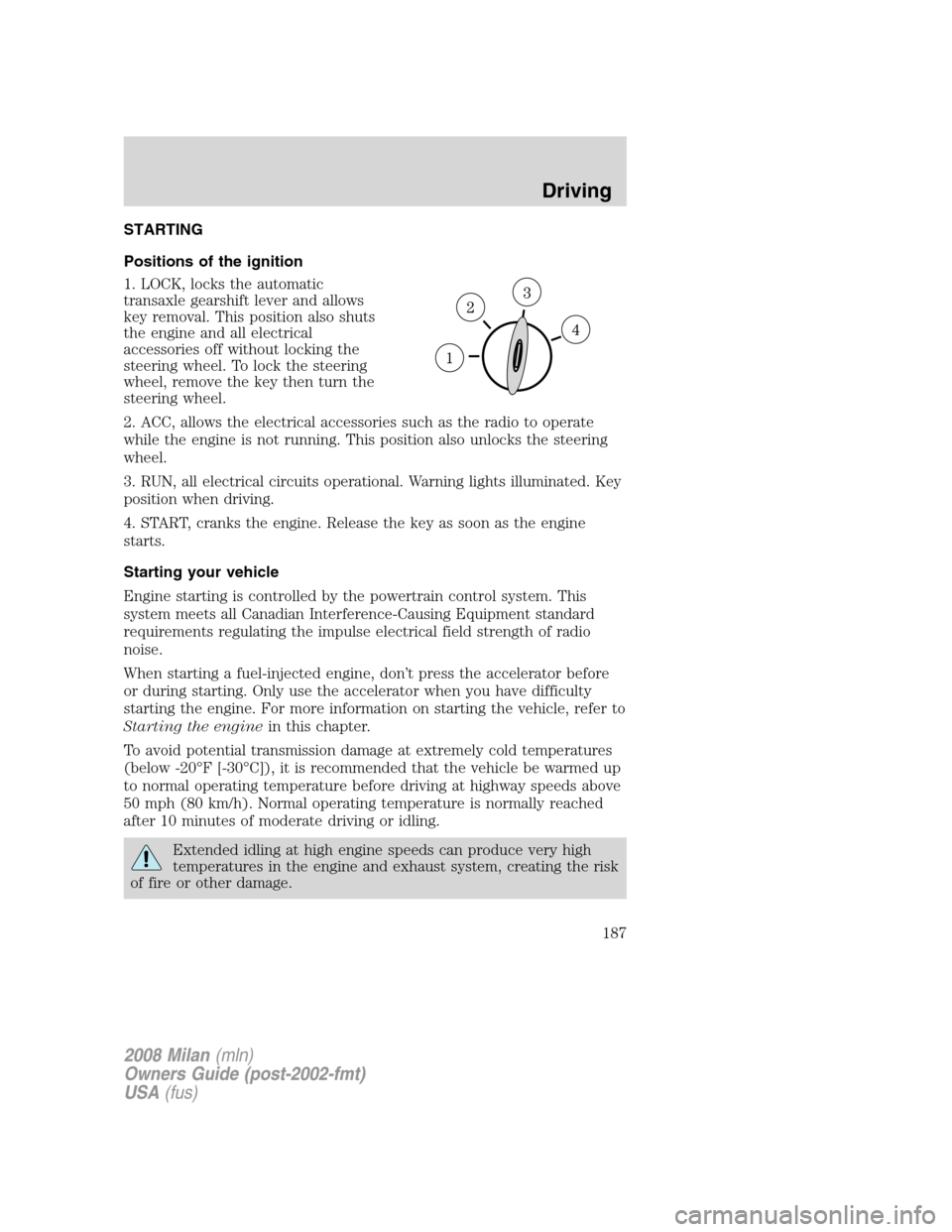
Positions of the ignition
1. LOCK, locks the automatic
transaxle gearshift lever and allows
key removal. This position also shuts
the engine and all electrical
accessories off without locking the
steering wheel. To lock the steering
wheel, remove the key then turn the
steering wheel.
2. ACC, allows the electrical accessories such as the radio to operate
while the engine is not running. This position also unlocks the steering
wheel.
3. RUN, all electrical circuits operational. Warning lights illuminated. Key
position when driving.
4. START, cranks the engine. Release the key as soon as the engine
starts.
Starting your vehicle
Engine starting is controlled by the powertrain control system. This
system meets all Canadian Interference-Causing Equipment standard
requirements regulating the impulse electrical field strength of radio
noise.
When starting a fuel-injected engine, don’t press the accelerator before
or during starting. Only use the accelerator when you have difficulty
starting the engine. For more information on starting the vehicle, refer to
Starting the enginein this chapter.
To avoid potential transmission damage at extremely cold temperatures
(below -20°F [-30°C]), it is recommended that the vehicle be warmed up
to normal operating temperature before driving at highway speeds above
50 mph (80 km/h). Normal operating temperature is normally reached
after 10 minutes of moderate driving or idling.
Extended idling at high engine speeds can produce very high
temperatures in the engine and exhaust system, creating the risk
of fire or other damage.
2008 Milan(mln)
Owners Guide (post-2002-fmt)
USA(fus)
Driving
187
Page 190 of 304
Starting the engine
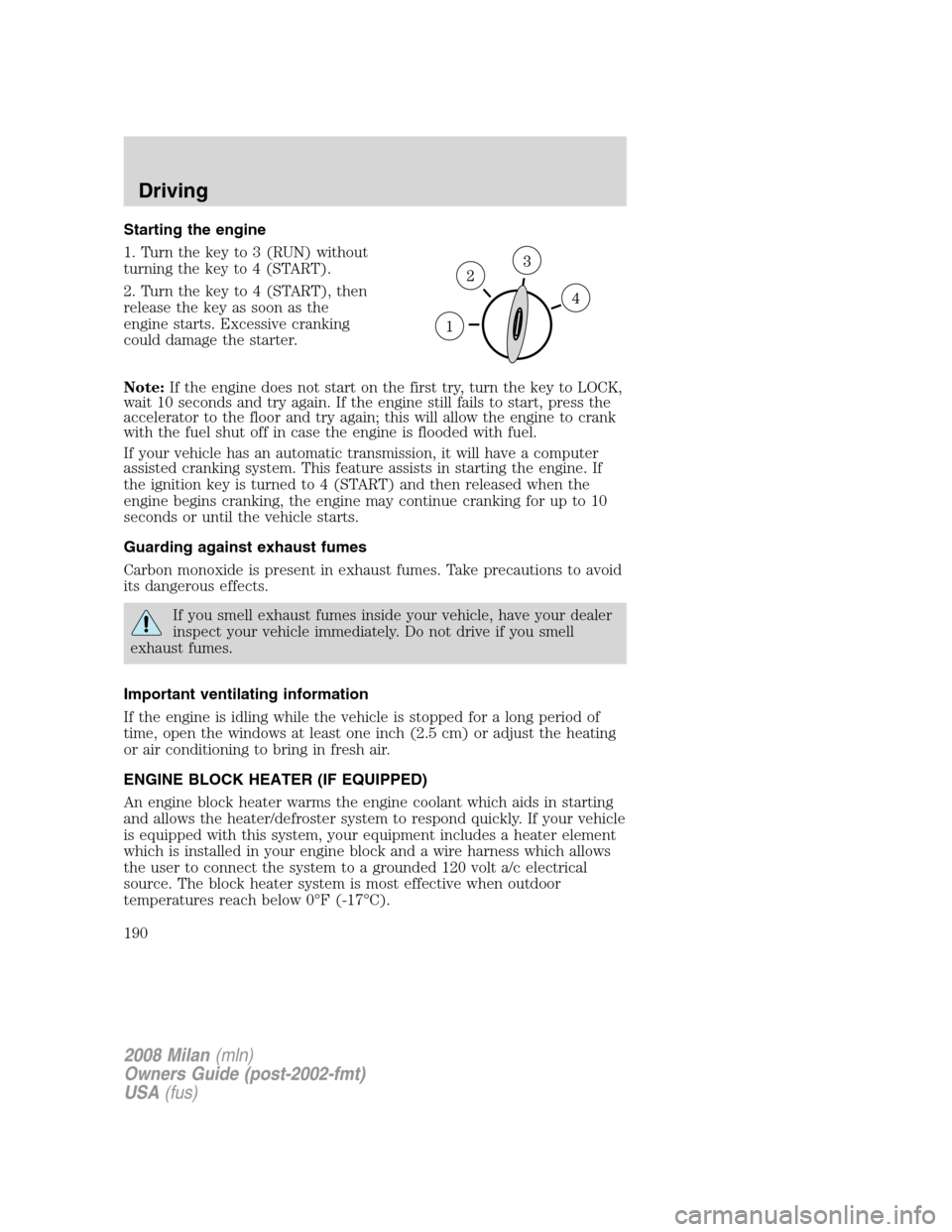
1. Turn the key to 3 (RUN) without
turning the key to 4 (START).
2. Turn the key to 4 (START), then
release the key as soon as the
engine starts. Excessive cranking
could damage the starter.
Note:If the engine does not start on the first try, turn the key to LOCK,
wait 10 seconds and try again. If the engine still fails to start, press the
accelerator to the floor and try again; this will allow the engine to crank
with the fuel shut off in case the engine is flooded with fuel.
If your vehicle has an automatic transmission, it will have a computer
assisted cranking system. This feature assists in starting the engine. If
the ignition key is turned to 4 (START) and then released when the
engine begins cranking, the engine may continue cranking for up to 10
seconds or until the vehicle starts.
Guarding against exhaust fumes
Carbon monoxide is present in exhaust fumes. Take precautions to avoid
its dangerous effects.
If you smell exhaust fumes inside your vehicle, have your dealer
inspect your vehicle immediately. Do not drive if you smell
exhaust fumes.
Important ventilating information
If the engine is idling while the vehicle is stopped for a long period of
time, open the windows at least one inch (2.5 cm) or adjust the heating
or air conditioning to bring in fresh air.
ENGINE BLOCK HEATER (IF EQUIPPED)
An engine block heater warms the engine coolant which aids in starting
and allows the heater/defroster system to respond quickly. If your vehicle
is equipped with this system, your equipment includes a heater element
which is installed in your engine block and a wire harness which allows
the user to connect the system to a grounded 120 volt a/c electrical
source. The block heater system is most effective when outdoor
temperatures reach below 0°F (-17°C).
2008 Milan(mln)
Owners Guide (post-2002-fmt)
USA(fus)
Driving
190
Page 193 of 304
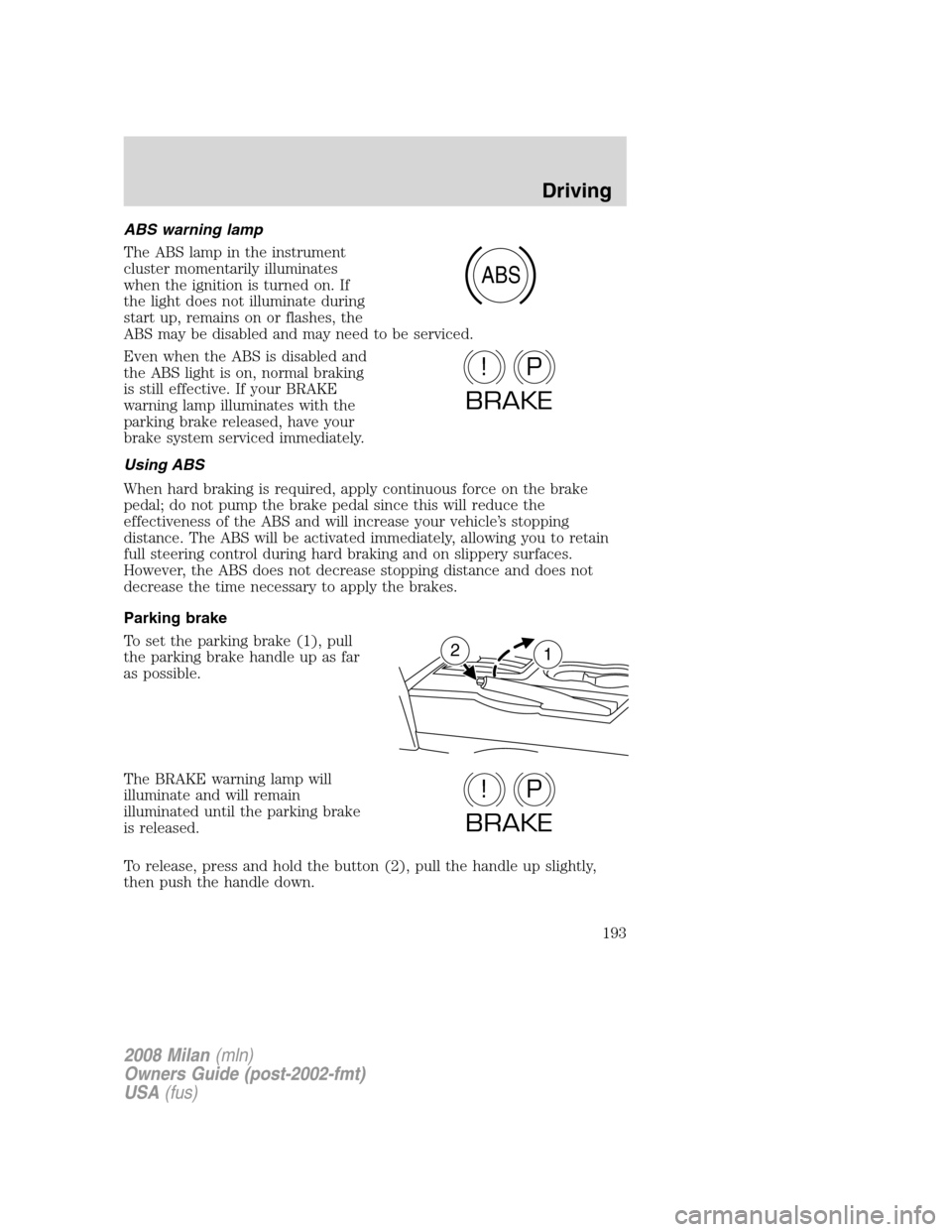
ABS warning lamp
The ABS lamp in the instrument
cluster momentarily illuminates
when the ignition is turned on. If
the light does not illuminate during
start up, remains on or flashes, the
ABS may be disabled and may need to be serviced.
Even when the ABS is disabled and
the ABS light is on, normal braking
is still effective. If your BRAKE
warning lamp illuminates with the
parking brake released, have your
brake system serviced immediately.
Using ABS
When hard braking is required, apply continuous force on the brake
pedal; do not pump the brake pedal since this will reduce the
effectiveness of the ABS and will increase your vehicle’s stopping
distance. The ABS will be activated immediately, allowing you to retain
full steering control during hard braking and on slippery surfaces.
However, the ABS does not decrease stopping distance and does not
decrease the time necessary to apply the brakes.
Parking brake
To set the parking brake (1), pull
the parking brake handle up as far
as possible.
The BRAKE warning lamp will
illuminate and will remain
illuminated until the parking brake
is released.
To release, press and hold the button (2), pull the handle up slightly,
then push the handle down.
ABS
P!
BRAKE
12
P!
BRAKE
2008 Milan(mln)
Owners Guide (post-2002-fmt)
USA(fus)
Driving
193
Page 195 of 304
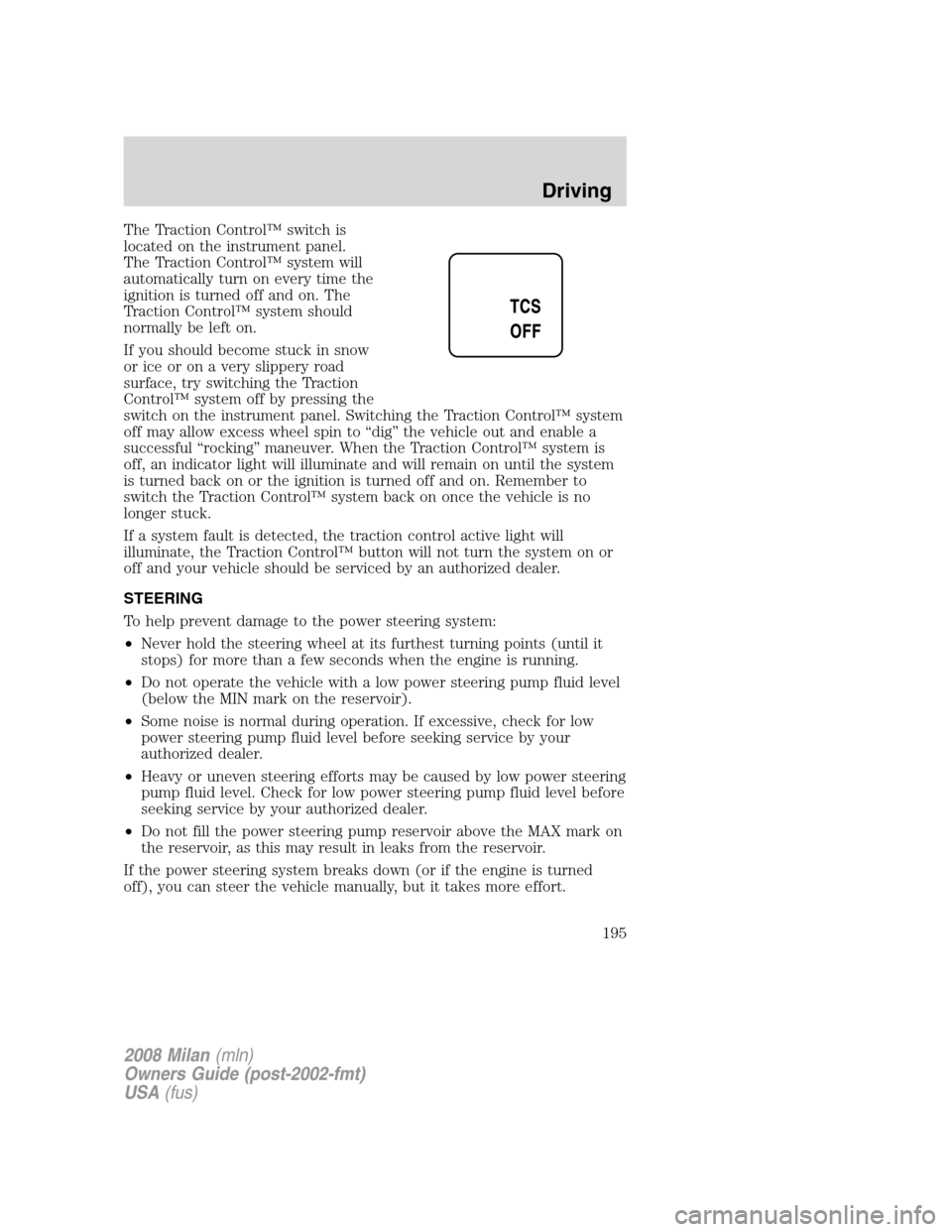
The Traction Control™ switch is
located on the instrument panel.
The Traction Control™ system will
automatically turn on every time the
ignition is turned off and on. The
Traction Control™ system should
normally be left on.
If you should become stuck in snow
or ice or on a very slippery road
surface, try switching the Traction
Control™ system off by pressing the
switch on the instrument panel. Switching the Traction Control™ system
off may allow excess wheel spin to “dig” the vehicle out and enable a
successful “rocking” maneuver. When the Traction Control™ system is
off, an indicator light will illuminate and will remain on until the system
is turned back on or the ignition is turned off and on. Remember to
switch the Traction Control™ system back on once the vehicle is no
longer stuck.
If a system fault is detected, the traction control active light will
illuminate, the Traction Control™ button will not turn the system on or
off and your vehicle should be serviced by an authorized dealer.
STEERING
To help prevent damage to the power steering system:
•Never hold the steering wheel at its furthest turning points (until it
stops) for more than a few seconds when the engine is running.
•Do not operate the vehicle with a low power steering pump fluid level
(below the MIN mark on the reservoir).
•Some noise is normal during operation. If excessive, check for low
power steering pump fluid level before seeking service by your
authorized dealer.
•Heavy or uneven steering efforts may be caused by low power steering
pump fluid level. Check for low power steering pump fluid level before
seeking service by your authorized dealer.
•Do not fill the power steering pump reservoir above the MAX mark on
the reservoir, as this may result in leaks from the reservoir.
If the power steering system breaks down (or if the engine is turned
off), you can steer the vehicle manually, but it takes more effort.
2008 Milan(mln)
Owners Guide (post-2002-fmt)
USA(fus)
Driving
195
Page 196 of 304
If the steering wanders or pulls, check for:
•an improperly inflated tire
•uneven tire wear
•loose or worn suspension components
•loose or worn steering components
•improper steering alignment
A high crown in the road or high crosswinds may also make the steering
seem to wander/pull.
Speed sensitive steering
The steering in your vehicle is speed sensitive. At high speeds, steering
assist will decrease to improve steering feel. At lower speeds,
maneuverability will be increased.
If the amount of effort required to steer your vehicle changes while
driving at a constant vehicle speed, have the power steering system
checked by your authorized dealer.
AUTOMATIC TRANSMISSION OPERATION
Brake-shift interlock
This vehicle is equipped with a brake-shift interlock feature that prevents
the gearshift lever from being moved from P (Park) when the ignition is
in the RUN position unless brake pedal is depressed.
If you cannot move the gearshift lever out of P (Park) with ignition in
the RUN position and the brake pedal depressed:
2008 Milan(mln)
Owners Guide (post-2002-fmt)
USA(fus)
Driving
196
Page 197 of 304
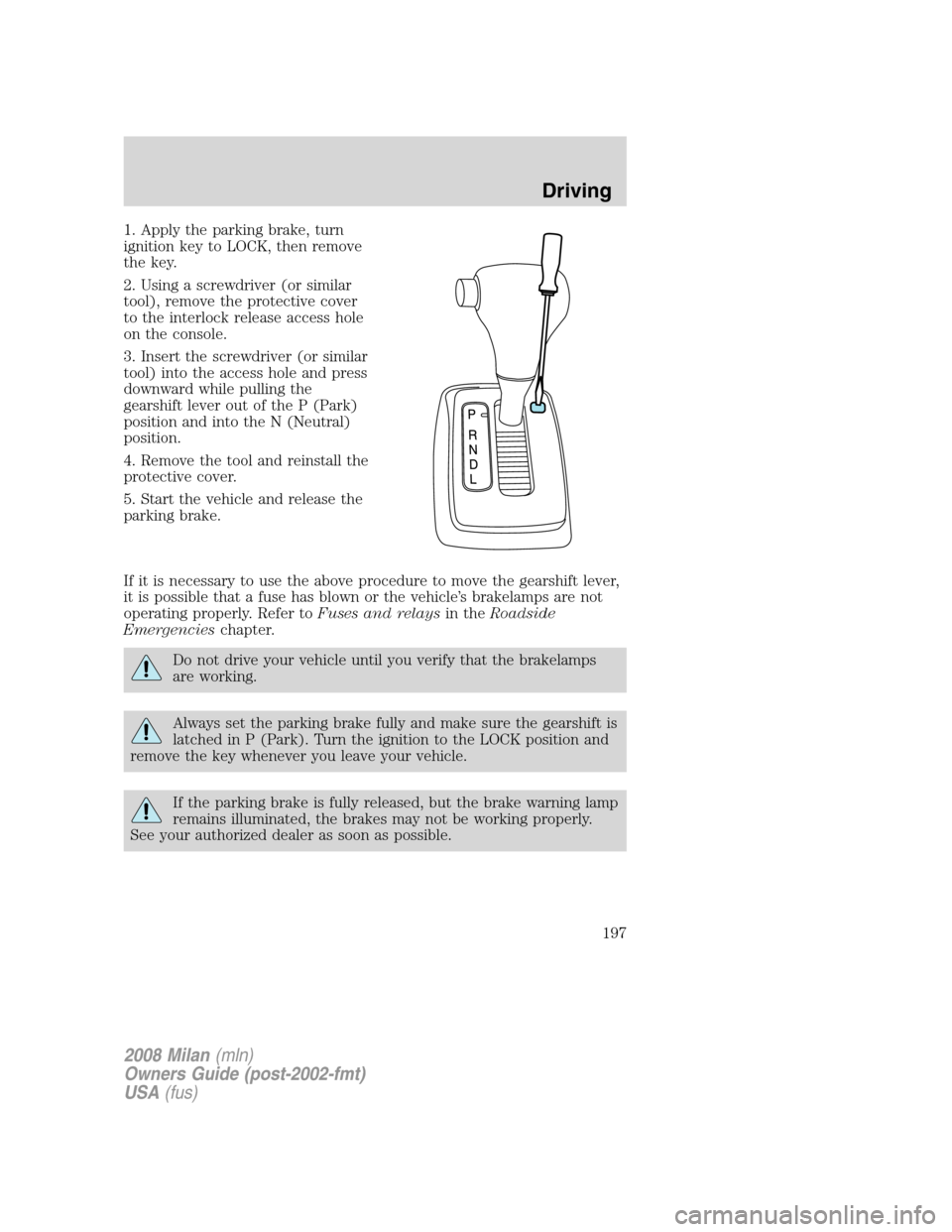
1. Apply the parking brake, turn
ignition key to LOCK, then remove
the key.
2. Using a screwdriver (or similar
tool), remove the protective cover
to the interlock release access hole
on the console.
3. Insert the screwdriver (or similar
tool) into the access hole and press
downward while pulling the
gearshift lever out of the P (Park)
position and into the N (Neutral)
position.
4. Remove the tool and reinstall the
protective cover.
5. Start the vehicle and release the
parking brake.
If it is necessary to use the above procedure to move the gearshift lever,
it is possible that a fuse has blown or the vehicle’s brakelamps are not
operating properly. Refer toFuses and relaysin theRoadside
Emergencieschapter.
Do not drive your vehicle until you verify that the brakelamps
are working.
Always set the parking brake fully and make sure the gearshift is
latched in P (Park). Turn the ignition to the LOCK position and
remove the key whenever you leave your vehicle.
If the parking brake is fully released, but the brake warning lamp
remains illuminated, the brakes may not be working properly.
See your authorized dealer as soon as possible.
2008 Milan(mln)
Owners Guide (post-2002-fmt)
USA(fus)
Driving
197