warning lights Mercury Milan Hybrid 2010 s User Guide
[x] Cancel search | Manufacturer: MERCURY, Model Year: 2010, Model line: Milan Hybrid, Model: Mercury Milan Hybrid 2010Pages: 329, PDF Size: 2.39 MB
Page 201 of 329
Low Tire
Pressure
Warning LightPossible
causeCustomer Action Required
Flashing Warning
LightSpare tire in
useYour temporary spare tire is in use.
Repair the damaged road wheel and
re-mount it on the vehicle to restore
system functionality. For a
description of how the system
functions under these conditions,
refer toWhen your temporary
spare tire is installedin this
section.
TPMS
malfunctionIf your tires are properly inflated and
your spare tire is not in use and the
TPMS warning light still flashes,
contact your authorized dealer as
soon as possible.
When inflating your tires
When putting air into your tires (such as at a gas station or in your
garage), the Tire Pressure Monitoring System may not respond
immediately to the air added to your tires.
It may take up to two minutes of driving over 20 mph (32 km/h) for the
light to turn OFF after you have filled your tires to the recommended
inflation pressure.
How temperature affects your tire pressure
The Tire Pressure Monitoring System (TPMS) monitors tire pressure in
each pneumatic tire. While driving in a normal manner, a typical
passenger tire inflation pressure may increase approximately 2 to 4 psi
(14 to 28 kPa) from a cold start situation. If the vehicle is stationary
over night with the outside temperature significantly lower than the
daytime temperature, the tire pressure may decrease approximately 3 psi
(20.7 kPa) for a drop of 30° F (16.6°C) in ambient temperature. This
lower pressure value may be detected by the TPMS as being significantly
lower than the recommended inflation pressure and activate the TPMS
warning for low tire pressure. If the low tire pressure warning light is
ON, visually check each tire to verify that no tire is flat. (If one or more
tires are flat, repair as necessary.) Check air pressure in the road tires. If
2010 Milan Hybrid(hmv)
Owners Guide, 1st Printing
USA(fus)
Tires, Wheels and Loading
201
Page 209 of 329

STARTING
Positions of the ignition
1. Off— locks the gearshift lever
and allows key removal.
2. Accessory— allows the electrical
accessories such as the radio to
operate while the vehicle is not
running.
3. On— all electrical circuits
operational and warning lights will
illuminate. This is the position the key is in when you’re driving.
4. Start— starts the vehicle and electrical power systems.
Preparing to start your vehicle
Engine starting is controlled by the electronically-controlled
Continuously Variable Transaxle (eCVT). For more information on
starting the vehicle, refer toStarting the vehiclein this chapter.
WARNING:Extended idling at high engine speeds can produce
very high temperatures in the engine and exhaust system,
creating the risk of fire or other damage.
WARNING:Do not park, idle, or drive your vehicle in dry grass
or other dry ground cover. The emission system heats up the
engine compartment and exhaust system, which can start a fire.
WARNING:Do not start your vehicle in a closed garage or in
other enclosed areas. Exhaust fumes can be toxic. Always open
the garage door before you start the engine. SeeGuarding against
exhaust fumesin this chapter for more instructions.
WARNING:If you smell exhaust fumes inside your vehicle, have
your dealer inspect your vehicle immediately. Do not drive if you
smell exhaust fumes.
Important safety precautions
A computer system controls the engine’s idle revolutions per minute
(RPM). When the engine starts, the idle RPM runs higher than normal in
2010 Milan Hybrid(hmv)
Owners Guide, 1st Printing
USA(fus)
Driving
209
Page 211 of 329
Some warning lights will briefly illuminate. SeeWarning lights and
chimesin theInstrument Clusterchapter for more information
regarding the warning lights.
Starting the vehicle
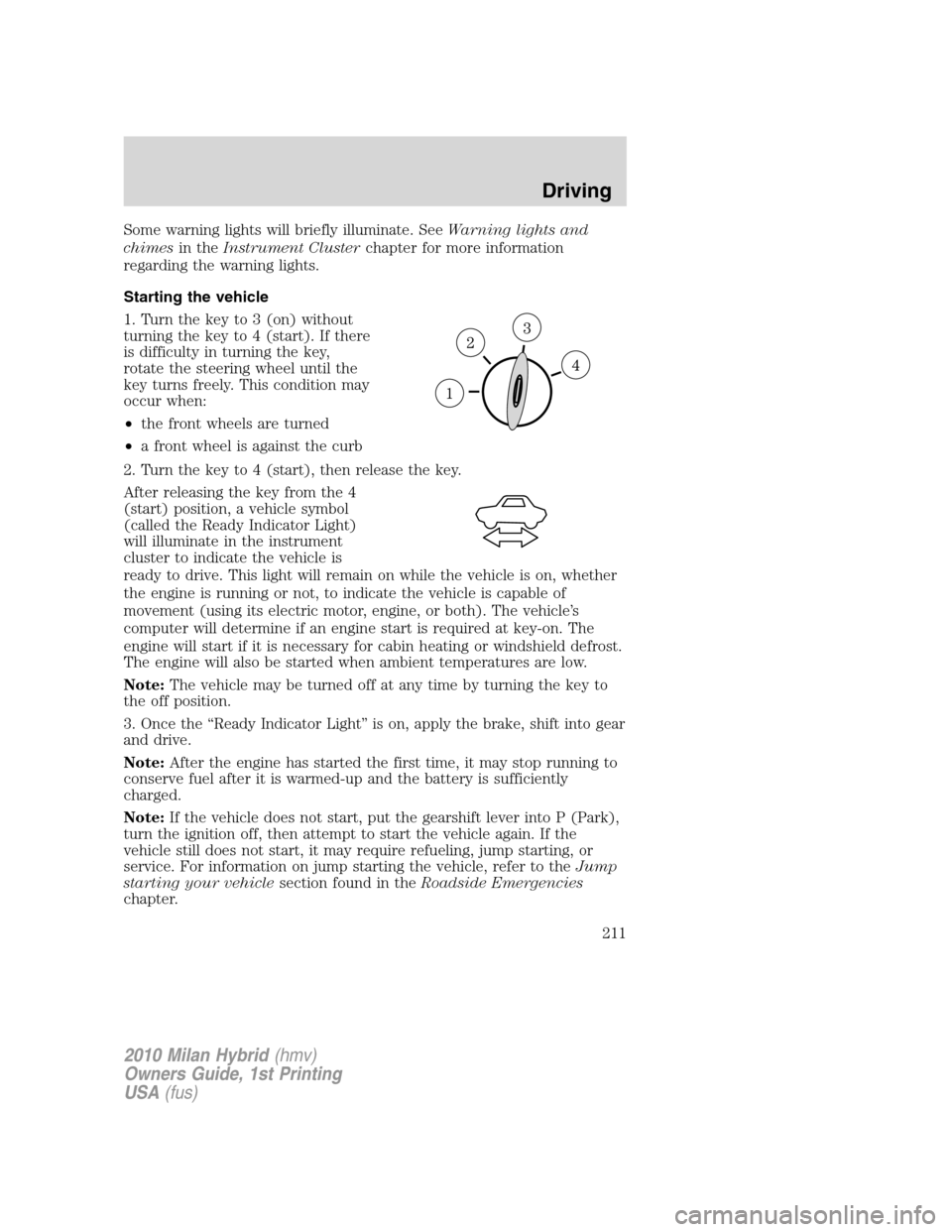
1. Turn the key to 3 (on) without
turning the key to 4 (start). If there
is difficulty in turning the key,
rotate the steering wheel until the
key turns freely. This condition may
occur when:
•the front wheels are turned
•a front wheel is against the curb
2. Turn the key to 4 (start), then release the key.
After releasing the key from the 4
(start) position, a vehicle symbol
(called the Ready Indicator Light)
will illuminate in the instrument
cluster to indicate the vehicle is
ready to drive. This light will remain on while the vehicle is on, whether
the engine is running or not, to indicate the vehicle is capable of
movement (using its electric motor, engine, or both). The vehicle’s
computer will determine if an engine start is required at key-on. The
engine will start if it is necessary for cabin heating or windshield defrost.
The engine will also be started when ambient temperatures are low.
Note:The vehicle may be turned off at any time by turning the key to
the off position.
3. Once the “Ready Indicator Light” is on, apply the brake, shift into gear
and drive.
Note:After the engine has started the first time, it may stop running to
conserve fuel after it is warmed-up and the battery is sufficiently
charged.
Note:If the vehicle does not start, put the gearshift lever into P (Park),
turn the ignition off, then attempt to start the vehicle again. If the
vehicle still does not start, it may require refueling, jump starting, or
service. For information on jump starting the vehicle, refer to theJump
starting your vehiclesection found in theRoadside Emergencies
chapter.
2010 Milan Hybrid(hmv)
Owners Guide, 1st Printing
USA(fus)
Driving
211
Page 281 of 329
For longer, trouble-free operation, keep the top of the battery clean and
dry. Also, make certain the battery cables are always tightly fastened to
the battery terminals.
If you see any corrosion on the battery or terminals, remove the cables
from the terminals and clean with a wire brush. You can neutralize the
acid with a solution of baking soda and water.
Note: Electrical or electronic accessories or components added to
the vehicle by the dealer or the owner (e.g. spot lights, electric
winch, etc.) may adversely affect vehicle performance and
durability.
WARNING:Batteries normally produce explosive gases which
can cause personal injury. Therefore, do not allow flames, sparks
or lighted substances to come near the battery. When working near the
battery, always shield your face and protect your eyes. Always provide
proper ventilation.
WARNING:When lifting a plastic-cased battery, excessive
pressure on the end walls could cause acid to flow through the
vent caps, resulting in personal injury and/or damage to the vehicle or
battery. Lift the battery with a battery carrier or with your hands on
opposite corners.
WARNING:Keep batteries out of reach of children. Batteries
contain sulfuric acid. Avoid contact with skin, eyes or clothing.
Shield your eyes when working near the battery to protect against
possible splashing of acid solution. In case of acid contact with skin or
eyes, flush immediately with water for a minimum of 15 minutes and
get prompt medical attention. If acid is swallowed, call a physician
immediately.
WARNING:Battery posts, terminals and related accessories
contain lead and lead compounds.Wash hands after handling.
If the battery is disconnected, the Regenerative Braking System will need
to relearn the initial brake pedal position. After reconnecting the battery,
slowly depress and release the brake pedal one time.
Because your vehicle’s engine is electronically controlled by a computer,
some control conditions are maintained by power from the battery. When
2010 Milan Hybrid(hmv)
Owners Guide, 1st Printing
USA(fus)
Maintenance and Specifications
281
Page 293 of 329
If you have run out of fuel:
•You may need to cycle the ignition from off to on several times after
refueling to allow the fuel system to pump the fuel from the tank to
the engine. On restarting, cranking time will take a few seconds longer
than normal.
•Normally, adding 1 gallon (3.8L) of fuel is enough to restart the
engine. If the vehicle is out of fuel and on a steep grade, more than
1 gallon (3.8L) may be required.
•TheService engine soon
indicator may come on. For more
information on the “service engine soon” indicator, refer toWarning
lights and chimesin theInstrument Clusterchapter.
Refilling with a portable fuel container
With the Easy Fuel™ “no cap” fuel system, use the following directions
when filling from a portable fuel container:
WARNING:Do not insert the nozzle of portable fuel containers
or aftermarket funnels into the Easy Fuel™ system. This could
damage the fuel system and its seal, and may cause fuel to run onto
the ground instead of filling the tank, which could result in serious
personal injury.
WARNING:Do not try to pry open or push open the Easy
Fuel™ system with foreign objects. This could damage the fuel
system and its seal and cause injury to you or others.
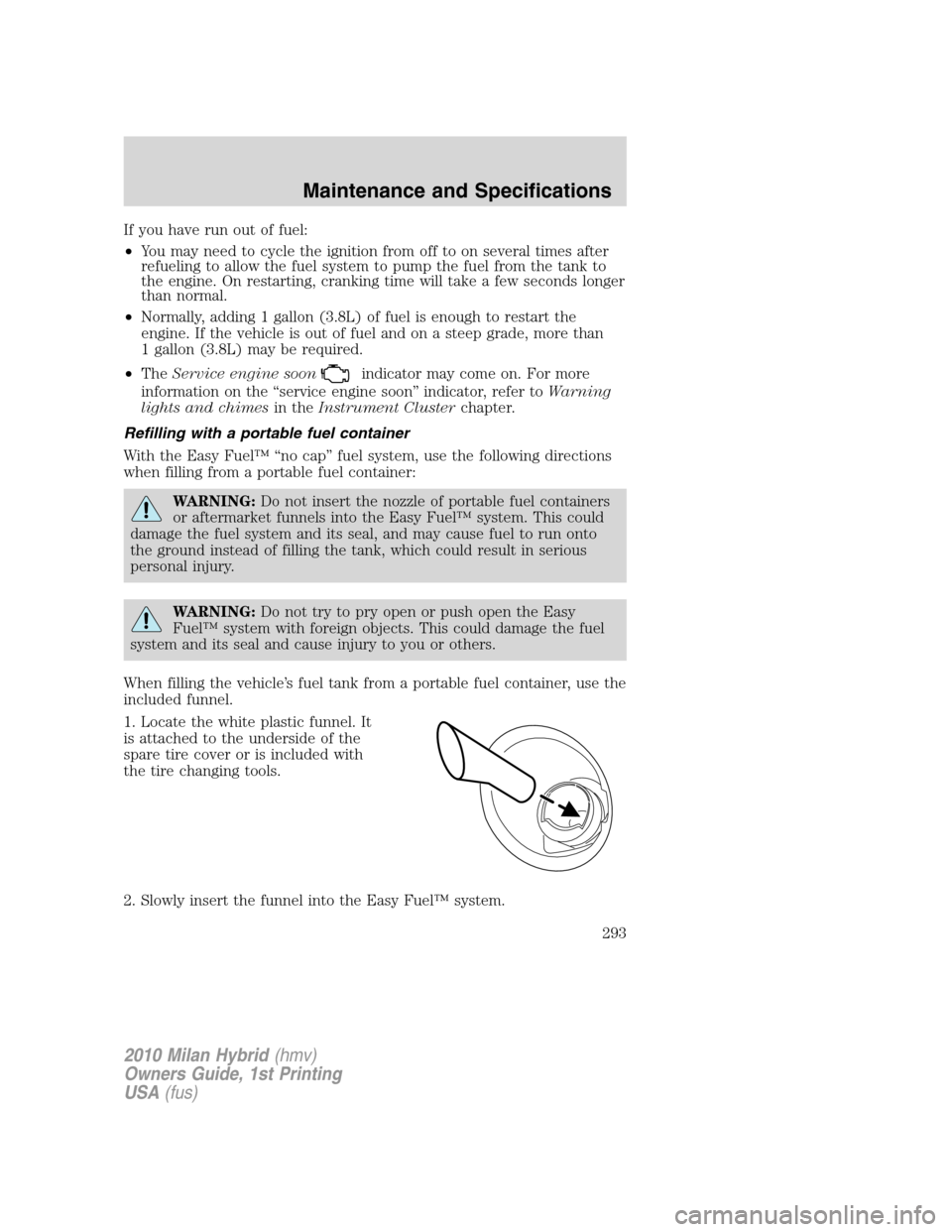
When filling the vehicle’s fuel tank from a portable fuel container, use the
included funnel.
1. Locate the white plastic funnel. It
is attached to the underside of the
spare tire cover or is included with
the tire changing tools.
2. Slowly insert the funnel into the Easy Fuel™ system.
2010 Milan Hybrid(hmv)
Owners Guide, 1st Printing
USA(fus)
Maintenance and Specifications
293
Page 311 of 329
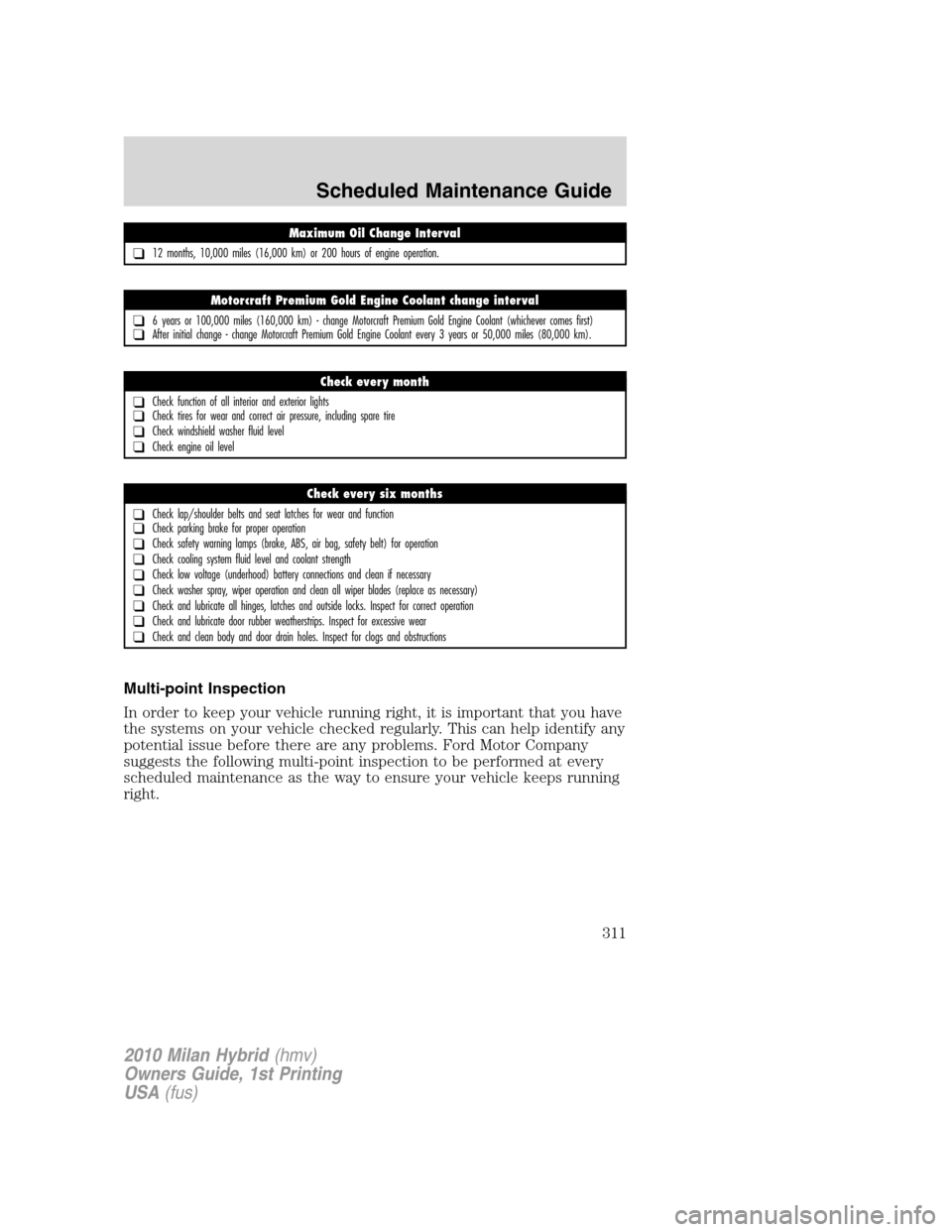
Multi-point Inspection
In order to keep your vehicle running right, it is important that you have
the systems on your vehicle checked regularly. This can help identify any
potential issue before there are any problems. Ford Motor Company
suggests the following multi-point inspection to be performed at every
scheduled maintenance as the way to ensure your vehicle keeps running
right.
Maximum Oil Change Interval
❑12 months, 10,000 miles (16,000 km) or 200 hours of engine operation.
Motorcraft Premium Gold Engine Coolant change interval
❑6 years or 100,000 miles (160,000 km) - change Motorcraft Premium Gold Engine Coolant (whichever comes first)❑After initial change - change Motorcraft Premium Gold Engine Coolant every 3 years or 50,000 miles (80,000 km).
Check every month
❑Check function of all interior and exterior lights❑Check tires for wear and correct air pressure, including spare tire
❑Check windshield washer fluid level
❑Check engine oil level
Check every six months
❑Check lap/shoulder belts and seat latches for wear and function❑Check parking brake for proper operation
❑Check safety warning lamps (brake, ABS, air bag, safety belt) for operation
❑Check cooling system fluid level and coolant strength
❑Check low voltage (underhood) battery connections and clean if necessary
❑Check washer spray, wiper operation and clean all wiper blades (replace as necessary)
❑Check and lubricate all hinges, latches and outside locks. Inspect for correct operation
❑Check and lubricate door rubber weatherstrips. Inspect for excessive wear
❑Check and clean body and door drain holes. Inspect for clogs and obstructions
2010 Milan Hybrid(hmv)
Owners Guide, 1st Printing
USA(fus)
Scheduled Maintenance Guide
311
Page 312 of 329
NORMAL SCHEDULED MAINTENANCE AND LOG
The following section contains the “Normal Schedule”. This schedule is
presented at specific mileage (kilometer) intervals with exceptions
noted.
ADDITIONAL INFORMATION AVAILABLE ON THE WEB
To learn more about the importance of routine and dealer-performed
maintenance on your vehicle, please visit the Ford Customer Service Web
site. You’ll also find important warranty information, customer assistance,
technical expertise, frequently asked questions and much more. The Web
site location is: www.genuineservice.com.
Then go to the vehicles and services pick at the Web site.
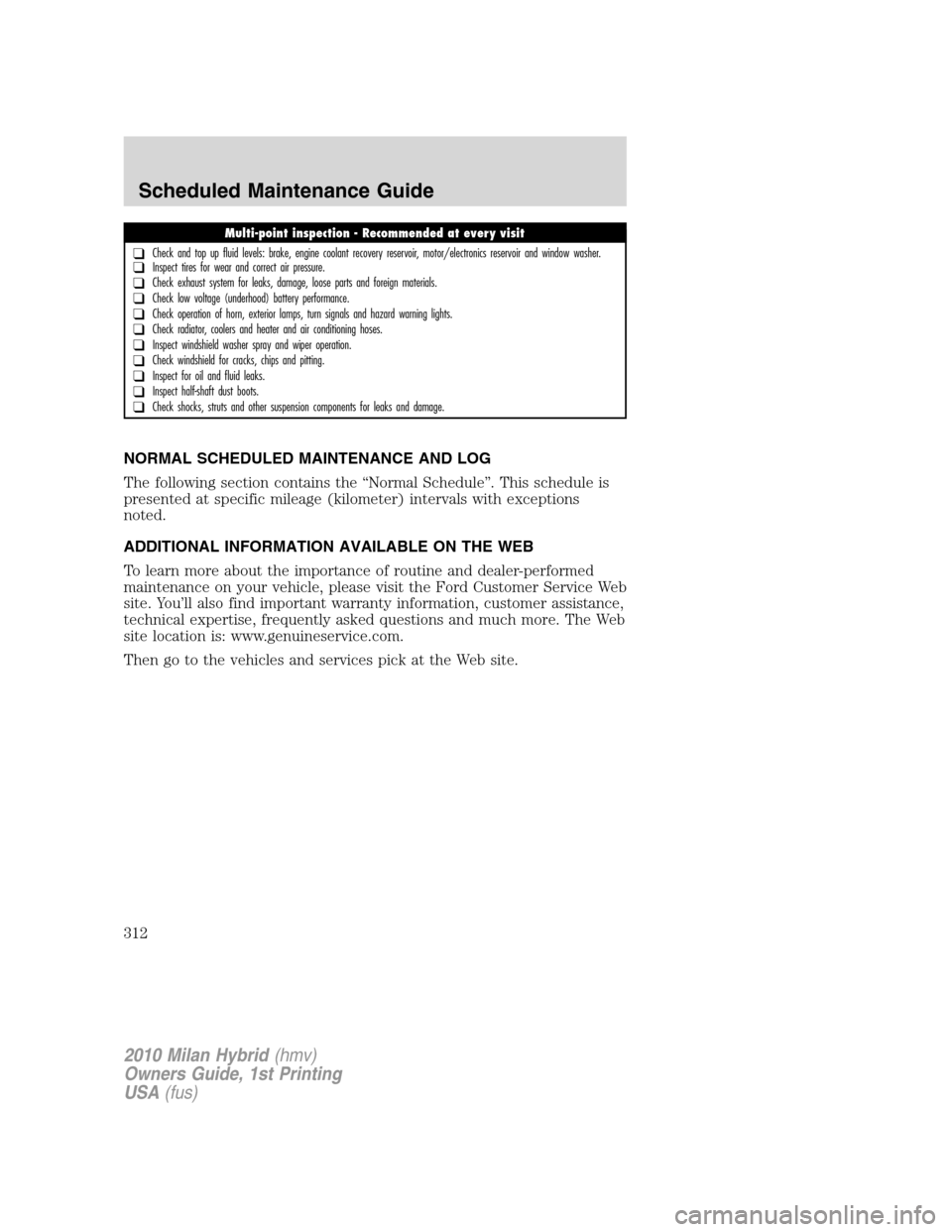
Multi-point inspection - Recommended at every visit
❑Check and top up fluid levels: brake, engine coolant recovery reservoir, motor/electronics reservoir and window washer.❑Inspect tires for wear and correct air pressure.
❑Check exhaust system for leaks, damage, loose parts and foreign materials.
❑Check low voltage (underhood) battery performance.
❑Check operation of horn, exterior lamps, turn signals and hazard warning lights.
❑Check radiator, coolers and heater and air conditioning hoses.
❑Inspect windshield washer spray and wiper operation.
❑Check windshield for cracks, chips and pitting.
❑Inspect for oil and fluid leaks.
❑Inspect half-shaft dust boots.
❑Check shocks, struts and other suspension components for leaks and damage.
2010 Milan Hybrid(hmv)
Owners Guide, 1st Printing
USA(fus)
Scheduled Maintenance Guide
312
Page 327 of 329
locking and unlocking
doors ........................................116
programming entry code .......115
Keys ...................................102, 119
positions of the ignition .........209
L
Lamps
autolamp system .......................72
bulb replacement
specifications chart ..................78
daytime running light ...............73
fog lamps ...................................73
headlamps .................................72
headlamps, flash to pass ..........74
instrument panel, dimming .....74
interior lamps ...........................76
replacing bulbs .........................79
LATCH anchors .........................174
Lights, warning and indicator ....16
anti-lock brakes (ABS) ..........214
Load limits .................................202
Locks
autolock ...................................104
childproof ................................108
doors ........................................104
Lubricant specifications ...........301
Lug nuts ....................................252
Lumbar support, seats .............126
M
Manual transmission
fluid capacities ........................301
lubricant specifications ..........301
Message center .....................32–33
system check button ................42
warning messages .....................43Mirrors ...................................92–93
automatic dimming rearview
mirror ........................................92
heated ........................................94
side view mirrors (power) .......93
Moon roof ....................................99
Motorcraft parts ................273, 300
N
Navigation system .......................64
O
Octane rating ............................292
Oil (see Engine oil) ..................278
P
Parking brake ............................215
Parts (see Motorcraft parts) ....300
Passenger Occupant
Classification Sensor .................135
Power distribution box
(see Fuses) ...............................242
Power door locks ......................104
Power mirrors .............................93
Power point .................................88
Power steering ..................220–221
Power Windows ...........................90
R
Radio ............................................48
Rear-view camera system .........227
Recommendations for
attaching safety restraints for
children ......................................166
2010 Milan Hybrid(hmv)
Owners Guide, 1st Printing
USA(fus)
Index
327
Page 329 of 329
T
Tilt steering wheel ......................84
Tire Pressure Monitoring
System (TPMS)
Tires, Wheels and Loading ....198
Tires ...........................183–184, 246
alignment ................................191
care ..........................................187
changing ..................................246
checking the pressure ............187
inflating ...................................185
label .........................................197
replacing ..................................189
rotating ....................................191
safety practices .......................190
sidewall information ...............192
snow tires and chains ............202
spare tire .................................247
terminology .............................184
tire grades ...............................184
treadwear ........................183, 188
Towing .......................................208
recreational towing .................208
trailer towing ..........................208
wrecker ....................................258
Transmission .............................223
brake-shift interlock (BSI) ....221
fluid, checking and adding
(automatic) .............................300fluid, refill capacities ..............301
lubricant specifications ..........301
Trunk .........................................108
remote release ................101, 112
Turn signal ..................................76
U
USB port ......................................58
V
Vehicle Identification Number
(VIN) ..........................................304
Vehicle loading ..........................202
Ventilating your vehicle ...........212
W
Warning lights (see Lights) .......16
Washer fluid ..............................277
Water, Driving through .............235
Windows
power .........................................90
Windshield washer fluid and
wipers ..........................................83
checking and adding fluid .....277
replacing wiper blades ...........277
Wrecker towing .........................258
2010 Milan Hybrid(hmv)
Owners Guide, 1st Printing
USA(fus)
Index
329