air condition Mercury Monterey 2005 s Owner's Guide
[x] Cancel search | Manufacturer: MERCURY, Model Year: 2005, Model line: Monterey, Model: Mercury Monterey 2005Pages: 304, PDF Size: 3.45 MB
Page 271 of 304

The fuel system may be under pressure. If the fuel filler cap is
venting vapor or if you hear a hissing sound, wait until it stops
before completely removing the fuel filler cap. Otherwise, fuel may
spray out and injure you or others.
If you do not use the proper fuel filler cap, excessive pressure or
vacuum in the fuel tank may damage the fuel system or cause
the fuel cap to disengage in a collision, which may result in possible
personal injury.
Choosing the right fuel
Use only UNLEADED FUEL. The use of leaded fuel is prohibited by law
and could damage your vehicle.
Your vehicle was not designed to use fuel or fuel additives with metallic
compounds, including manganese-based additives. Studies indicate that
these additives can cause your vehicle’s emission control system to
deteriorate more rapidly. In Canada, premium grade fuel generally
contains more metallic additives than regular fuel. We recommend using
regular grade fuel. In Canada, many fuels contain metallic additives, but
fuels free of such additives may be available; check with your local fuel
dealer.
Do not use fuel containing methanol. It can damage critical fuel system
components.
Repairs to correct the effects of using a fuel for which your vehicle was
not designed may not be covered by your warranty.
Octane recommendations
Your vehicle is designed to use
“Regular” unleaded gasoline with
pump (R+M)/2 octane rating of 87.
We do not recommend the use of
gasolines labeled as “Regular” that
are sold with octane ratings of 86 or lower in high altitude areas.
Do not be concerned if your engine sometimes knocks lightly. However, if
it knocks heavily under most driving conditions while you are using fuel
with the recommended octane rating, see your dealer or a qualified
service technician to prevent any engine damage.
87(R+M)/2 METHOD
2005 Monterey(mty)
Owners Guide (post-2002-fmt)
USA_English(fus)
Maintenance and Specifications
271
Page 274 of 304

Calculating fuel economy
1. Fill the fuel tank completely and record the initial odometer reading
(in miles or kilometers).
2. Each time you fill the tank, record the amount of fuel added (in
gallons or liters).
3. After at least three to five tank fill-ups, fill the fuel tank and record
the current odometer reading.
4. Subtract your initial odometer reading from the current odometer
reading.
5. Follow one of the simple calculations in order to determine fuel
economy:
Calculation 1:Divide total miles traveled by total gallons used.
Calculation 2:Multiply liters used by 100, then divide by total
kilometers traveled.
Keep a record for at least one month and record the type of driving (city
or highway). This will provide an accurate estimate of the vehicle’s fuel
economy under current driving conditions. Additionally, keeping records
during summer and winter will show how temperature impacts fuel
economy. In general, lower temperatures give lower fuel economy.
Driving style — good driving and fuel economy habits
Give consideration to the lists that follow and you may be able to change
a number of variables and improve your fuel economy.
Habits
•Smooth, moderate operation can yield up to 10% savings in fuel.
•Steady speeds without stopping will usually give the best fuel
economy.
•Idling for long periods of time (greater than one minute) may waste
fuel.
•Anticipate stopping; slowing down may eliminate the need to stop.
•Sudden or hard accelerations may reduce fuel economy.
•Slow down gradually.
•Driving at reasonable speeds (traveling at 55 mph [88 km/h] uses 15%
less fuel than traveling at 65 mph [105 km/h]).
•Revving the engine before turning it off may reduce fuel economy.
•Using the air conditioner or defroster may reduce fuel economy.
2005 Monterey(mty)
Owners Guide (post-2002-fmt)
USA_English(fus)
Maintenance and Specifications
274
Page 276 of 304

It is important to note the box in the lower left corner of the window
sticker. These numbers represent the Range of MPG (L/100 km)
expected on the vehicle under optimum conditions. Your fuel economy
may vary depending upon the method of operation and conditions.
EMISSION CONTROL SYSTEM
Your vehicle is equipped with various emission control components and a
catalytic converter which will enable your vehicle to comply with
applicable exhaust emission standards. To make sure that the catalytic
converter and other emission control components continue to work
properly:
•Use only the specified fuel listed.
•Avoid running out of fuel.
•Do not turn off the ignition while your vehicle is moving, especially at
high speeds.
•Have the items listed inscheduled maintenance information
performed according to the specified schedule.
The scheduled maintenance items listed inscheduled maintenance
informationare essential to the life and performance of your vehicle
and to its emissions system.
If other than Ford, Motorcraft or Ford-authorized parts are used for
maintenance replacements or for service of components affecting
emission control, such non-Ford parts should be equivalent to genuine
Ford Motor Company parts in performance and durability.
Do not park, idle, or drive your vehicle in dry grass or other dry
ground cover. The emission system heats up the engine
compartment and exhaust system, which can start a fire.
Illumination of the “Check Engine” light, charging system warning light
or the temperature warning light, fluid leaks, strange odors, smoke or
loss of engine power, could indicate that the emission control system is
not working properly.
Exhaust leaks may result in entry of harmful and potentially
lethal fumes into the passenger compartment.
Do not make any unauthorized changes to your vehicle or engine. By
law, vehicle owners and anyone who manufactures, repairs, services,
sells, leases, trades vehicles, or supervises a fleet of vehicles are not
2005 Monterey(mty)
Owners Guide (post-2002-fmt)
USA_English(fus)
Maintenance and Specifications
276
Page 297 of 304
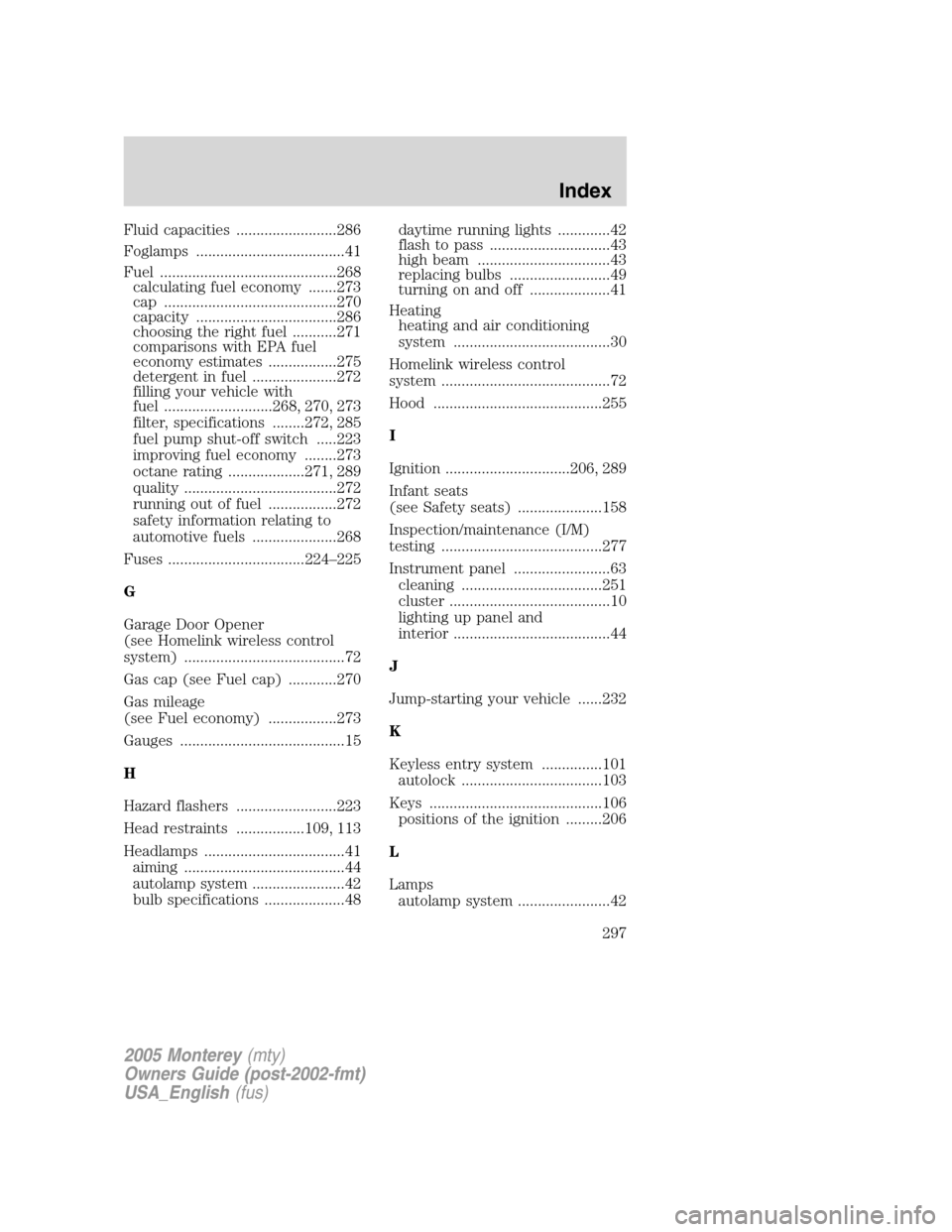
Fluid capacities .........................286
Foglamps .....................................41
Fuel ............................................268
calculating fuel economy .......273
cap ...........................................270
capacity ...................................286
choosing the right fuel ...........271
comparisons with EPA fuel
economy estimates .................275
detergent in fuel .....................272
filling your vehicle with
fuel ...........................268, 270, 273
filter, specifications ........272, 285
fuel pump shut-off switch .....223
improving fuel economy ........273
octane rating ...................271, 289
quality ......................................272
running out of fuel .................272
safety information relating to
automotive fuels .....................268
Fuses ..................................224–225
G
Garage Door Opener
(see Homelink wireless control
system) ........................................72
Gas cap (see Fuel cap) ............270
Gas mileage
(see Fuel economy) .................273
Gauges .........................................15
H
Hazard flashers .........................223
Head restraints .................109, 113
Headlamps ...................................41
aiming ........................................44
autolamp system .......................42
bulb specifications ....................48daytime running lights .............42
flash to pass ..............................43
high beam .................................43
replacing bulbs .........................49
turning on and off ....................41
Heating
heating and air conditioning
system .......................................30
Homelink wireless control
system ..........................................72
Hood ..........................................255
I
Ignition ...............................206, 289
Infant seats
(see Safety seats) .....................158
Inspection/maintenance (I/M)
testing ........................................277
Instrument panel ........................63
cleaning ...................................251
cluster ........................................10
lighting up panel and
interior .......................................44
J
Jump-starting your vehicle ......232
K
Keyless entry system ...............101
autolock ...................................103
Keys ...........................................106
positions of the ignition .........206
L
Lamps
autolamp system .......................42
2005 Monterey(mty)
Owners Guide (post-2002-fmt)
USA_English(fus)
Index
297