ignition Mercury Mountaineer 1997 s Owner's Guide
[x] Cancel search | Manufacturer: MERCURY, Model Year: 1997, Model line: Mountaineer, Model: Mercury Mountaineer 1997Pages: 197, PDF Size: 2.08 MB
Page 99 of 197

Pull gearshift lever towards you
and downward to move the
automatic gearshift.
P - ParkAlways come to a
complete stop before shifting into
or out of P (Park).
Always set the parking
brake fully and make sure
that the gearshift is securely
latched in P (Park).
R - ReverseAlways come to a
complete stop before shifting into
or out of R (Reverse).
N - NeutralVehicle is free to roll.
Do not leave the vehicle
unattended with the
transfer case in the N (Neutral)
position. Always set the parking
brake fully and turn off the
ignition when leaving the vehicle.
P RND21
P RND21
Driving
99
Page 101 of 197

on downgrades. Transmission
operates in gears 1-2.
1 - LowUse 1 (Low) to provide
maximum engine braking on steep
downgrades. Upshifts can be made
by shifting to 2 (Second) or to
D(Overdrive). Selecting 1 (Low)
at higher speeds causes a shift to 2
(Second), and will shift to 1 (Low)
after vehicle decelerates to the
proper speed.
Brake-shift interlock
This vehicle is equipped with a
brake-shift interlock feature that
prevents the gearshift from being
moved from P unless the brake
pedal is depressed.
If you cannot move the gearshift
out of P with the brake pedal
depressed:
1. Apply the parking brake.
2. Turn ignition key to LOCK, then
remove the key.
3. Insert the key and turn to OFF.
4. Apply brake pedal and shift to N
(Neutral).
5. Start the vehicle.
If it is necessary to use the above
procedure to move the gearshift, it
is possible that a fuse has blown
and the vehicle's brakelamps may
not be operating properly. Refer to
Fuses and relaysin theRoadside
emergencieschapter.
Driving
101
Page 104 of 197

should either know the terrain or
examine maps of the area before
driving. Map out your route before
driving in the area. For more
information on driving off-road,
readFour-Wheelingin your
owner's portfolio.
Sand
When driving over sand, try to
keep all four wheels on the most
solid area of the trail. Do not
reduce the tire pressures but shift
to a lower gear and drive steadily
through the terrain. Apply the
accelerator slowly and avoid
spinning the wheels.
Mud and water
If you must drive through high
water, drive slowly. Traction or
brake capability may be limited.
When driving through water,
determine the depth; avoid water
higher than the bottom of the hubs
(if possible) and proceed slowly. If
the ignition system gets wet, the
vehicle may stall.
Once through water, always try the
brakes. Wet brakes do not stop the
vehicle as effectively as dry brakes.
Drying can be improved by moving
your vehicle slowly while applying
light pressure on the brake pedal.
After driving through mud, clean
off residue stuck to rotating
driveshafts and tires. Excess mud
stuck on tires and rotating
driveshafts causes an imbalance
Driving
104
Page 122 of 197

Number Fuse Amperage
RatingCircuits Protected
7 7.5 amp Illumination switches
8 10 amp Right headlamp, fog
lamp system
9 10 amp Autolamps
10 7.5 amp Rear blower, speed
control, GEM system,
brake interlock,
overhead console
11 7.5 amp Warning lamps
12 10 amp Liftgate wiper/washer,
front washer
13 15 amp Brake on/off switch
14 10 amp Anti-lock system
15 7.5 amp Air bag system,
instrument cluster
16 30 amp Wiper run relay
17 15 amp Cigar lighter
18 15 amp A/C system
19 25 amp Ignition coil, PCM
system
20 7.5 amp Radio, power antenna,
GEM system,
anti-theft
21 15 amp Turn/hazard flasher
22 10 amp Turn signals
23 10 amp Rear wiper system
24 10 amp Anti-theft relay
25 7.5 amp Instrument cluster,
GEM system
Roadside emergencies
122
Page 126 of 197

Maxi fuses
Fuse Amps Circuits protected
8 30 amp Battery saver relay,
headlamp relay
9 50 amp Blower motor relay,
blower motor
10 30 amp Power seats, power
lumbar, door
lock/unlock relays,
accessory delay relay
11 20 amp Horn relay,
Powertrain control
module (PCM)
12 - Not used
13 60 amp Hazard flasher, brake
ON/OFF switch, cigar
lighter, power
antenna, power
mirrors, autolamps,
instrument cluster,
GEM, radio, blower
motor relay
14 60 amp Ignition switch
Mini fuses
Fuse Amps Circuits protected
1 30 amp Premium sound
2 15 amp Liftgate wiper relays
3 30 amp Auxiliary power
4 10 amp Air bag diagnostic
monitor
5 - Not used
Roadside emergencies
126
Page 137 of 197

come on unexpectedly; always
turn the engine off and let it
cool.
The cooling fan is
automatic and may come
on at any time. Always
disconnect the negative terminal
of the battery before working
near the fan.
²Never get under a vehicle
supported only by a jack. If you
must work under a vehicle, use
safety stands.
²Keep all lit cigarettes and other
smoking materials away from
the battery and all fuel-related
parts.
Working with the engine off
1. Set the parking brake and make
sure that the gearshift is securely
latched in P (Park).
2. Turn the engine off and remove
the key from the ignition.
3. Block the wheels to prevent the
vehicle from moving unexpectedly.
0020406080100
120
140
160
180
200P RND21
000000oooo
MPH km/h
UNLEADED
FUEL ONLY
RPM x 100012345
6H
C
F
E
RSM
SET
ACC
COAST OFF ON
SRS
- +H
H
L L
Maintenance and care
137
Page 139 of 197
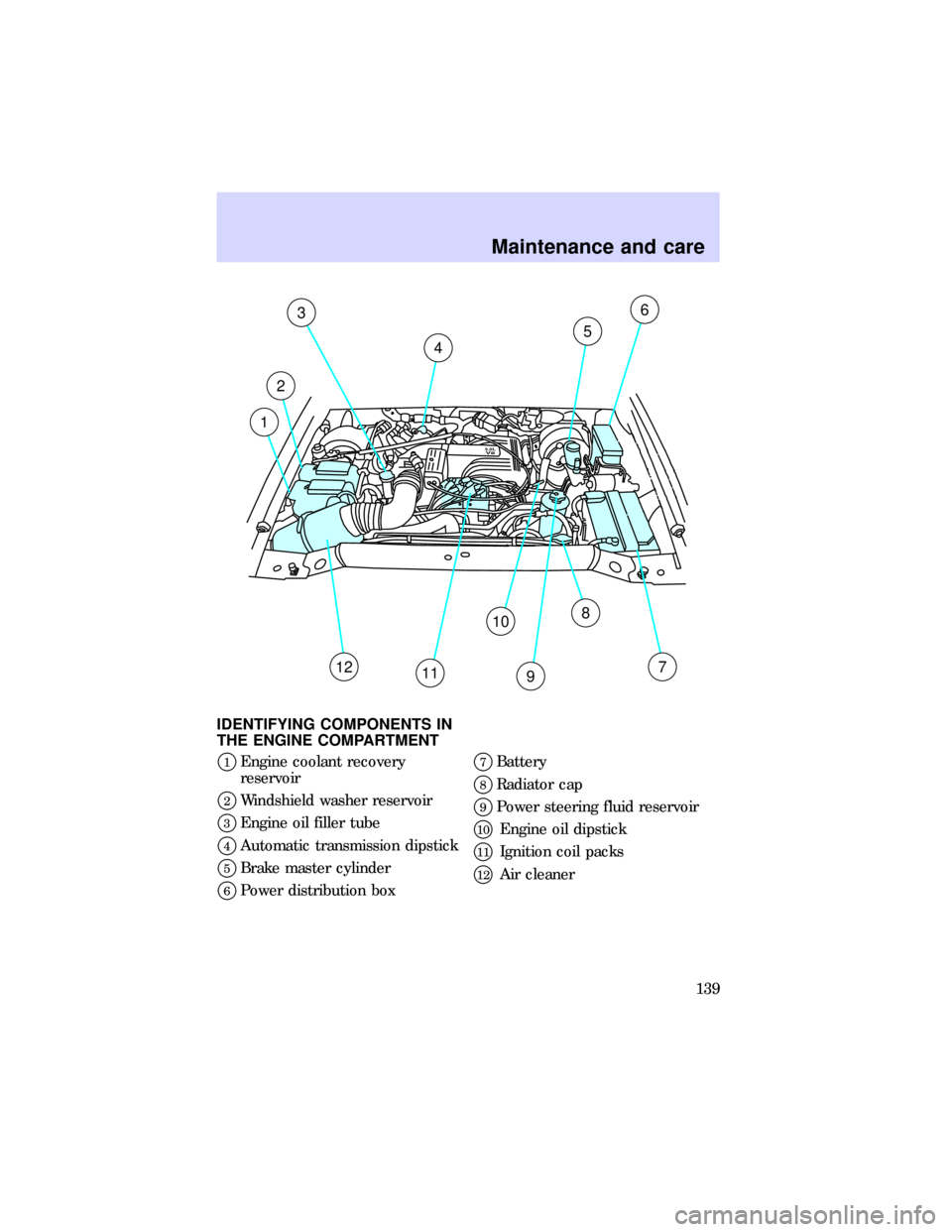
IDENTIFYING COMPONENTS IN
THE ENGINE COMPARTMENT
V1Engine coolant recovery
reservoir
V2Windshield washer reservoir
V3Engine oil filler tube
V4Automatic transmission dipstick
V5Brake master cylinder
V6Power distribution box
V7Battery
V8Radiator cap
V9Power steering fluid reservoir
V10Engine oil dipstick
V11Ignition coil packs
V12Air cleaner
3
4
5
6
2
1
1211
108
79
5.0L
V8
Maintenance and care
139
Page 157 of 197

To make reaching the wiper blades
easy, simply turn the ignition to
the ON position and turn the
wipers on. Wait for them to reach
a vertical position and turn the
ignition to LOCK. Do not move the
wipers manually across the
windshield as this may cause
damage to the wipers.
Inspect the wiper arm pivots on a
regular basis to ensure that the
wiper arms move freely. Lubricate
the pivot points as necessary.
Replacing wiper blades
If the wiper blades do not work
properly after cleaning,
replacement of the blade assembly
or the blade element may be
necessary.
There are two different length
wiper blades on your vehicle. The
windshield wiper blades are 45 cm
(17.75 in) long and the liftgate
wiper is 34.9 cm (13 3/4 in) long.
Make sure you install the correct
size wiper blade in the correct
location.
To replace windshield wiper
blades:
1. Pull the wiper arm away from
the windshield and lock it into the
service position.
2. Turn the blade at an angle from
the wiper arm. Depress lock tab
and push wiper mounting arm
away from wiper blade assembly.
3. Attach the new wiper blade by
pulling wiper mounting arm down
Maintenance and care
157
Page 169 of 197

your vehicle to comply with
applicable exhaust emission
requirements. For more
information on your vehicle's
emission control system, see the
Vehicle Emission Control
Information decal located on the
left side of the engine
compartment.
Follow these guidelines to ensure
proper emission system operation:
²Use only unleaded fuel.
²Avoid running out of fuel.
²Do not turn off the ignition
while your vehicle is in motion.
²Have the services performed
according to the intervals in the
Service Guide.
When servicing your vehicle, never
use a metal exhaust collector. A
metal collector may melt or deform
plastic parts.
Do not park, idle, or drive
your vehicle in dry grass
or other dry ground cover. The
emission system heats up the
engine compartment and exhaust
system, which can start a fire.
On vehicles without
original equipment floor
covering or insulation, do not let
passengers ride in your truck in
a manner that allows contact
between skin and the metal floor.
Maintenance and care
169
Page 183 of 197

Cleaning the engine
A clean engine is more efficient
than a dirty one because a buildup
of grease and dirt acts as an
insulator and keeps the engine
warmer than normal. Follow these
guidelines to clean your engine:
²Take care when using a power
washer to clean the engine. The
high pressure fluid could
penetrate the sealed parts and
cause damage.
²In order to avoid cracking the
engine block, do not spray with
cold water.
²The alternator, ignition coil
packs, and air intake must be
covered to prevent water
damage when cleaning the
engine.
²Never wash or rinse the engine
while it is running; water in the
running engine may cause
internal damage.
Cleaning the wiper blades
If the wiper blades do not wipe
properly, clean both the windshield
and the wiper blades using
undiluted windshield washer
solution or a mild detergent. Rinse
thoroughly with clean water. Do
not use fuel, kerosene, paint
thinner, or other solvents to clean
your wiper blades; these fluids will
damage your blades.
Maintenance and care
183