battery Mercury Mountaineer 1997 Owner's Manuals
[x] Cancel search | Manufacturer: MERCURY, Model Year: 1997, Model line: Mountaineer, Model: Mercury Mountaineer 1997Pages: 197, PDF Size: 2.08 MB
Page 41 of 197

liftgate will unlock when the key
is returned to the vertical
position (position of key before
removal).
This feature can be activated by all
outside locks on vehicles equipped
with keyless entry.
Illuminated entry
Interior lamps illuminate when
either outside front door handle is
lifted, unlocked with the keyless
entry keypad or the UNLOCK
button is pressed on the remote
entry transmitter (seeRemote
entry systemorKeyless entry
systemfor further information).
The system will automatically turn
off after 25 seconds or when the
ignition switch is turned to START
or ON position.
The inside lights will not turn off if
you have turned them on with the
dimmer thumbwheel or if any door
is open. However, the battery saver
will turn them off after ten
minutes. SeeBattery saverfor
more information.
Controls and features
41
Page 58 of 197

Delayed accessory
Delayed accessory provides power
to operate the power windows and
power moon roof (if equipped) for
10 minutes after the ignition
switch is turned to OFF.
If either front door is opened
during the 10 minute period the
delayed accessory feature is
disabled.
Battery saver
Battery saver is a feature that
automatically shuts off power to
these lights after 40 minutes: glove
box, engine compartment,
overhead console, mirror, courtesy
and interior lamps.
Battery saver prevents the battery
from being drained if these lights
are left on or if a door is not
completely closed. Battery power
is restored if the remote entry
transmitter is used, any door is
opened, the liftgate is opened, or
ignition key is turned to ON.
Controls and features
58
Page 125 of 197
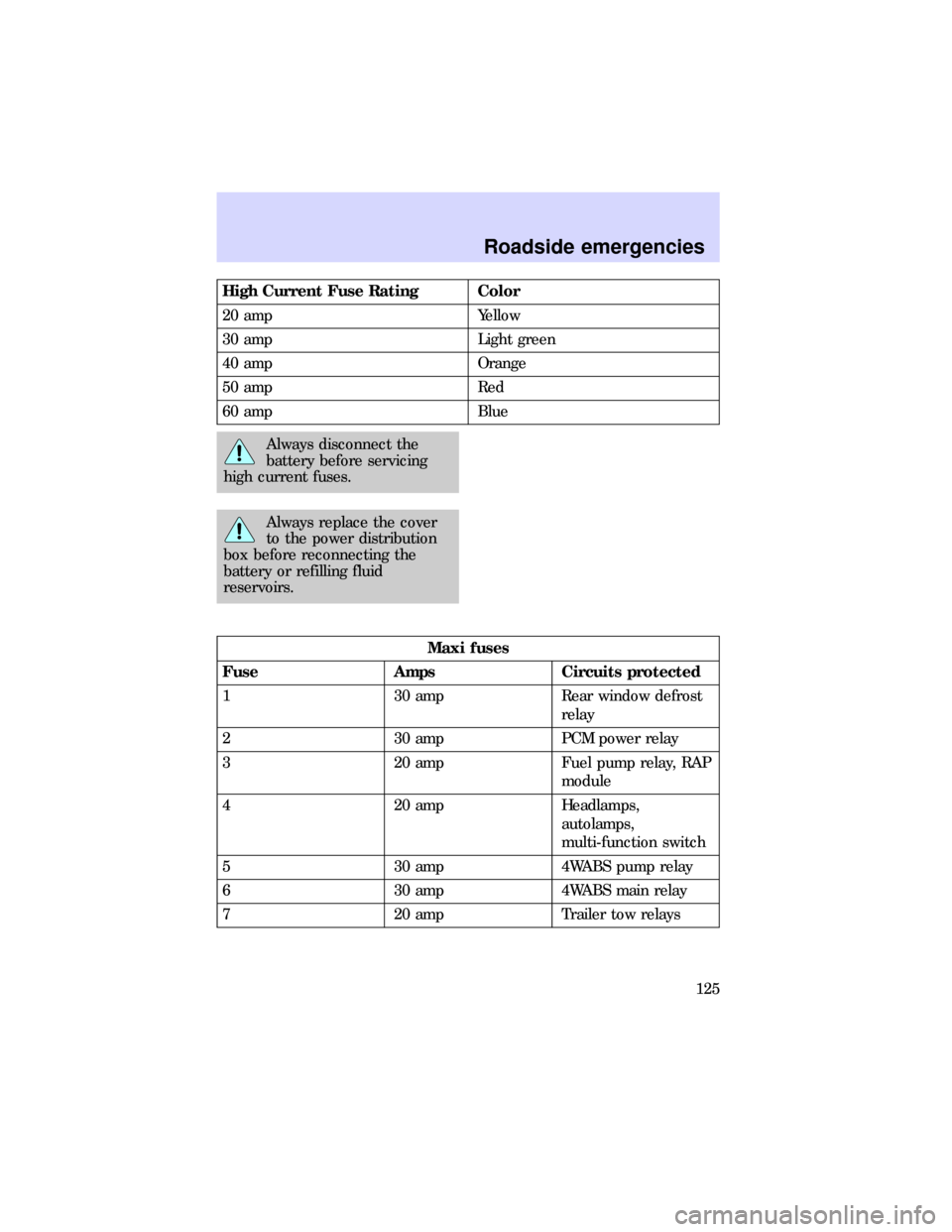
High Current Fuse Rating Color
20 amp Yellow
30 amp Light green
40 amp Orange
50 amp Red
60 amp Blue
Always disconnect the
battery before servicing
high current fuses.
Always replace the cover
to the power distribution
box before reconnecting the
battery or refilling fluid
reservoirs.
Maxi fuses
Fuse Amps Circuits protected
1 30 amp Rear window defrost
relay
2 30 amp PCM power relay
3 20 amp Fuel pump relay, RAP
module
4 20 amp Headlamps,
autolamps,
multi-function switch
5 30 amp 4WABS pump relay
6 30 amp 4WABS main relay
7 20 amp Trailer tow relays
Roadside emergencies
125
Page 126 of 197
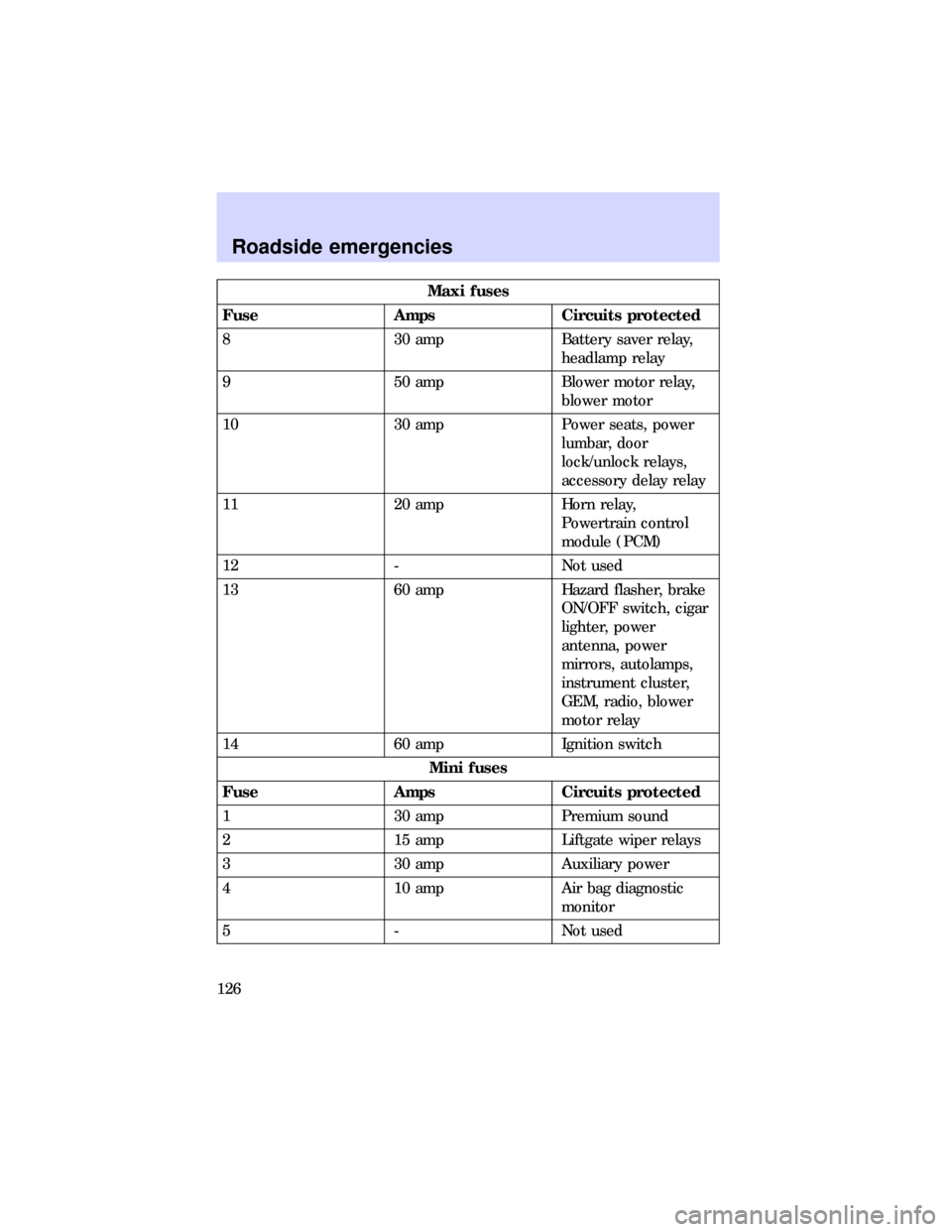
Maxi fuses
Fuse Amps Circuits protected
8 30 amp Battery saver relay,
headlamp relay
9 50 amp Blower motor relay,
blower motor
10 30 amp Power seats, power
lumbar, door
lock/unlock relays,
accessory delay relay
11 20 amp Horn relay,
Powertrain control
module (PCM)
12 - Not used
13 60 amp Hazard flasher, brake
ON/OFF switch, cigar
lighter, power
antenna, power
mirrors, autolamps,
instrument cluster,
GEM, radio, blower
motor relay
14 60 amp Ignition switch
Mini fuses
Fuse Amps Circuits protected
1 30 amp Premium sound
2 15 amp Liftgate wiper relays
3 30 amp Auxiliary power
4 10 amp Air bag diagnostic
monitor
5 - Not used
Roadside emergencies
126
Page 132 of 197

To stow largest flat tire, place
inside vehicle and secure with
webbing retainer.
JUMP STARTING A DISABLED
VEHICLE
The gases around the
battery can explode if
exposed to flames, sparks, or lit
cigarettes. An explosion could
result in injury or vehicle
damage.
To protect yourself when
charging a battery, always
shield your face and eyes. Make
sure that you can breath fresh
air.
Batteries contain sulfuric
acid which burns skin,
eyes and clothing.
If the acid touches someone's skin,
eyes, or clothing, immediately flush
the area with water for at least 15
minutes. If someone swallows the
acid, have him or her drink lots of
milk or water first, then Milk of
Magnesia, a beaten egg, or
Roadside emergencies
132
Page 133 of 197

vegetable oil. Call a doctor
immediately.
To avoid damage or injury,
follow these directions in
the order they are given. If in
doubt, call for road service.
Before jump starting a vehicle:
²Make sure the booster battery
vehicle has a 12-volt starting
system (a 24-volt power supply
will cause vehicle damage).
²Park the vehicles close to each
other, but do not allow the
vehicles to touch each other.
²Check to make sure neither
battery is disconnected.
²Remove any excessive corrosion
from the battery terminals.
²Turn on the heater fan in each
vehicle to prevent damage from
voltage surges.
To jump start the vehicle, connect
the jumper cables in the following
order:
1. Disabled battery positive
terminal.
2. Booster battery positive
terminal.
3. Booster battery negative
terminal.
4. Disabled vehicle engine.
+ –
4
2
3
1
+ –
Roadside emergencies
133
Page 134 of 197

Do not connect the end of
the second cable to the
negative (-) terminal of the
battery to be jumped. A spark
may cause an explosion of the
gases that surround the battery.
5. Start the engine in the vehicle
with the booster battery.
6. Wait a few minutes and start the
engine in the vehicle with the
disabled battery.
7. After a few minutes, the
disabled battery should be
recharged. Disconnect the jumper
cables in reverse order.
Let the vehicle idle for a few
minutes to allow the engine to
relearn the proper idle conditions.
Avoid using unnecessary electrical
accessories for a short while to let
the battery fully recharge. A
battery charger may need to be
used to fully recharge the battery.
Roadside emergencies
134
Page 137 of 197

come on unexpectedly; always
turn the engine off and let it
cool.
The cooling fan is
automatic and may come
on at any time. Always
disconnect the negative terminal
of the battery before working
near the fan.
²Never get under a vehicle
supported only by a jack. If you
must work under a vehicle, use
safety stands.
²Keep all lit cigarettes and other
smoking materials away from
the battery and all fuel-related
parts.
Working with the engine off
1. Set the parking brake and make
sure that the gearshift is securely
latched in P (Park).
2. Turn the engine off and remove
the key from the ignition.
3. Block the wheels to prevent the
vehicle from moving unexpectedly.
0020406080100
120
140
160
180
200P RND21
000000oooo
MPH km/h
UNLEADED
FUEL ONLY
RPM x 100012345
6H
C
F
E
RSM
SET
ACC
COAST OFF ON
SRS
- +H
H
L L
Maintenance and care
137
Page 139 of 197
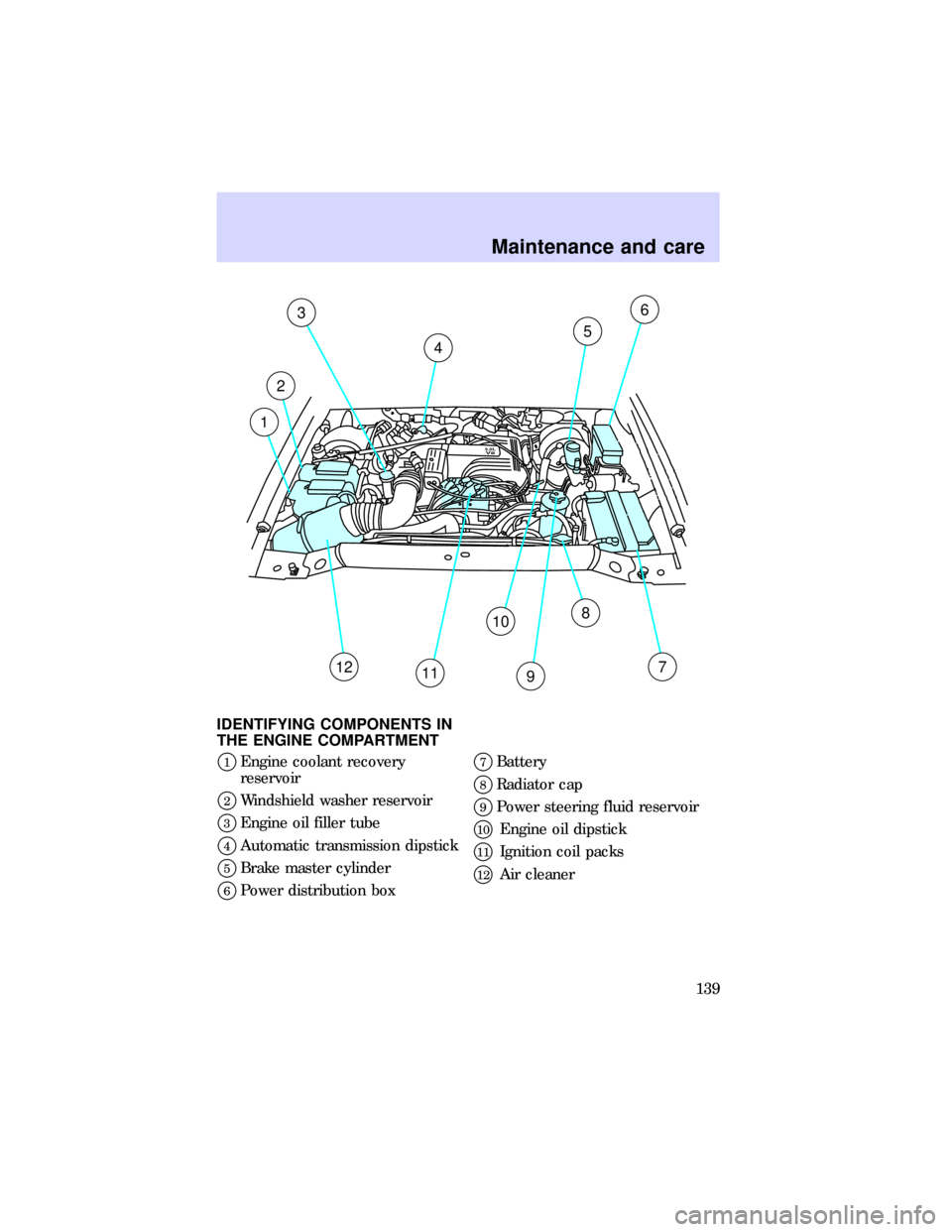
IDENTIFYING COMPONENTS IN
THE ENGINE COMPARTMENT
V1Engine coolant recovery
reservoir
V2Windshield washer reservoir
V3Engine oil filler tube
V4Automatic transmission dipstick
V5Brake master cylinder
V6Power distribution box
V7Battery
V8Radiator cap
V9Power steering fluid reservoir
V10Engine oil dipstick
V11Ignition coil packs
V12Air cleaner
3
4
5
6
2
1
1211
108
79
5.0L
V8
Maintenance and care
139
Page 153 of 197
²Add only enough fluid through
the filler opening so that the
fluid level is at the bottom of
the opening.
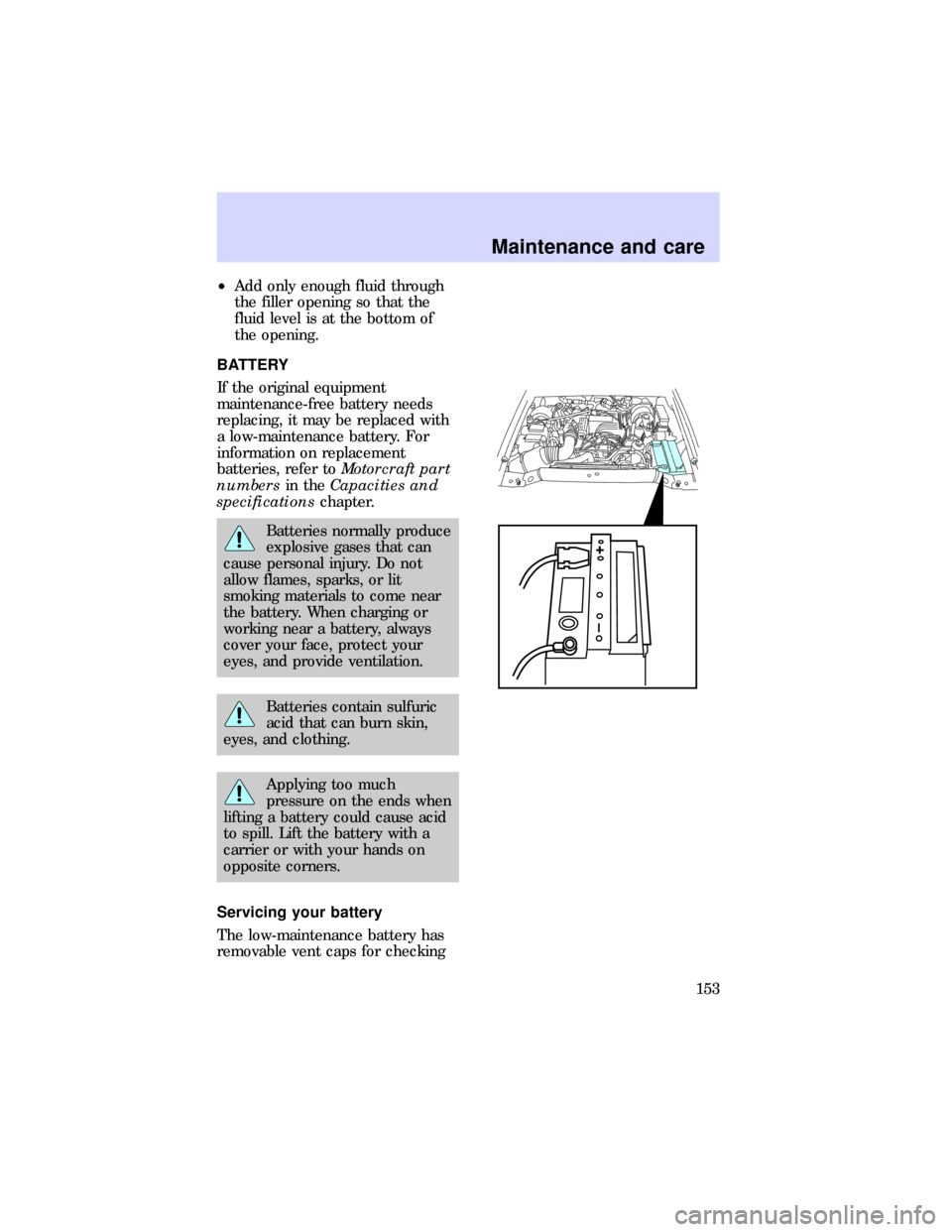
BATTERY
If the original equipment
maintenance-free battery needs
replacing, it may be replaced with
a low-maintenance battery. For
information on replacement
batteries, refer toMotorcraft part
numbersin theCapacities and
specificationschapter.
Batteries normally produce
explosive gases that can
cause personal injury. Do not
allow flames, sparks, or lit
smoking materials to come near
the battery. When charging or
working near a battery, always
cover your face, protect your
eyes, and provide ventilation.
Batteries contain sulfuric
acid that can burn skin,
eyes, and clothing.
Applying too much
pressure on the ends when
lifting a battery could cause acid
to spill. Lift the battery with a
carrier or with your hands on
opposite corners.
Servicing your battery
The low-maintenance battery has
removable vent caps for checking
+
–
Maintenance and care
153