parking brake Mercury Mountaineer 2006 s User Guide
[x] Cancel search | Manufacturer: MERCURY, Model Year: 2006, Model line: Mountaineer, Model: Mercury Mountaineer 2006Pages: 344, PDF Size: 2.66 MB
Page 239 of 344

If your vehicle gets stuck
If your vehicle gets stuck in mud or snow it may be rocked out by
shifting between forward and reverse gears, stopping between shifts, in a
steady pattern. Press lightly on the accelerator in each gear.
Do not rock the vehicle if the engine is not at normal operating
temperature or damage to the transmission may occur.
Do not rock the vehicle for more than a few minutes or damage
to the transmission and tires may occur or the engine may
overheat.
Always set the parking brake fully and make sure the gearshift is
latched in P (Park). Turn the ignition to the LOCK position and
remove the key whenever you leave your vehicle.
If the parking brake is fully released, but the brake warning lamp
remains illuminated, the brakes may not be working properly.
See your authorized dealer.
Do not spin the wheels at over 35 mph (56 km/h). The tires may
fail and injure a passenger or bystander.
Emergency maneuvers
•In an unavoidable emergency situation where a sudden sharp turn
must be made, remember to avoid “over-driving” your vehicle (i.e.,
turn the steering wheel only as rapidly and as far as required to avoid
the emergency). Excessive steering will result in less vehicle control,
not more. Additionally, smooth variations of the accelerator and/or
brake pedal pressure should be utilized if changes in vehicle speed are
called for. Avoid abrupt steering, acceleration or braking which could
result in an increased risk of loss of vehicle control, vehicle rollover
and/or personal injury. Use all available road surface to return the
vehicle to a safe direction of travel.
•In the event of an emergency stop, avoid skidding the tires and do not
attempt any sharp steering wheel movements.
2006 Mountaineer(mnt)
Owners Guide (post-2002-fmt)
USA(fus)
Driving
239
Page 259 of 344

When driving with the full-size dissimilar spare tire/wheel additional
caution should be given to:
•Towing a trailer
•Driving vehicles equipped with a camper body
•Driving vehicles with a load on the cargo rack
Drive cautiously when using a full-size dissimilar spare tire/wheel and
seek service as soon as possible.
Stopping and securing the vehicle
1. If you get a flat tire while driving,
do not apply the brake heavily;
instead, gradually decrease your
speed. Hold the steering wheel
firmly and slowly move to a safe
place on the side of the road.
2. Park on a level surface, activate
the hazard flashers and set the
parking brake.
3. Place gearshift lever in P (Park)
and turn engine OFF.
When one of the rear wheels is off the ground, the transmission
alone will not prevent the vehicle from moving or slipping off the
jack, even if the transmission is in P (Park).
4. Turn off the power running boards (if equipped). Refer toPower
deployable running boardsin theDriver Controlschapter.
Note:Passengers should not remain
in the vehicle when the vehicle is
being jacked.
5. Block the wheel that is diagonally
opposite of the flat tire using the
wheel chock provided with your
vehicle.
Location of the spare tire and tools
Have a flat tire serviced by an authorized dealer in order to prevent
damage to the TPMS sensor, refer toChanging tires with TPMSin the
Tires, Wheels and Loadingchapter. Replace the spare tire with a road
tire as soon as possible.
2006 Mountaineer(mnt)
Owners Guide (post-2002-fmt)
USA(fus)
Roadside Emergencies
259
Page 262 of 344

3. Turn the wrench
counterclockwise until the tire is
lowered to the ground and the cable
has slack. When turning the wrench,
make sure that it does not scuff the
kick plate.
4. Slide the tire rearward, lift one
side and remove the retainer from
the spare tire.
Changing the spare tire
To help prevent the vehicle from moving when you change a tire,
be sure the parking brake is set, then block the wheel that is
diagonally opposite (other end of the vehicle) to the tire being
changed.
If the vehicle slips off the jack, you or someone else could be
seriously injured.
Do not attempt to change a tire on the side of the vehicle close
to moving traffic. Pull far enough off the road to avoid the
danger of being hit when operating the jack or changing the wheel.
Turn off the running boards (if equipped) before working under
the vehicle, jacking, or placing any object under the vehicle.
Never place your hand in the hinge assemblies. A moving running
board may cause injury.
2006 Mountaineer(mnt)
Owners Guide (post-2002-fmt)
USA(fus)
Roadside Emergencies
262
Page 267 of 344
Do not attempt to push-start your vehicle. Automatic
transmissions do not have push-start capability; doing so may
damage the catalytic converter.
Preparing your vehicle
When the battery is disconnected or a new battery is installed, the
transmission must relearn its shift strategy. As a result, the transmission
may have firm and/or soft shifts. This operation is considered normal and
will not affect function or durability of the transmission. Over time, the
adaptive learning process will fully update transmission operation.
1.Use only a 12–volt supply to start your vehicle.
2. Do not disconnect the battery of the disabled vehicle as this could
damage the vehicle’s electrical system.
3. Park the booster vehicle close to the hood of the disabled vehicle
making sure the two vehiclesdo nottouch. Set the parking brake on
both vehicles and stay clear of the engine cooling fan and other moving
parts.
4. Check all battery terminals and remove any excessive corrosion before
you attach the battery cables. Ensure that vent caps are tight and level.
5. Turn the heater fan on in both vehicles to protect any electrical
surges. Turn all other accessories off.
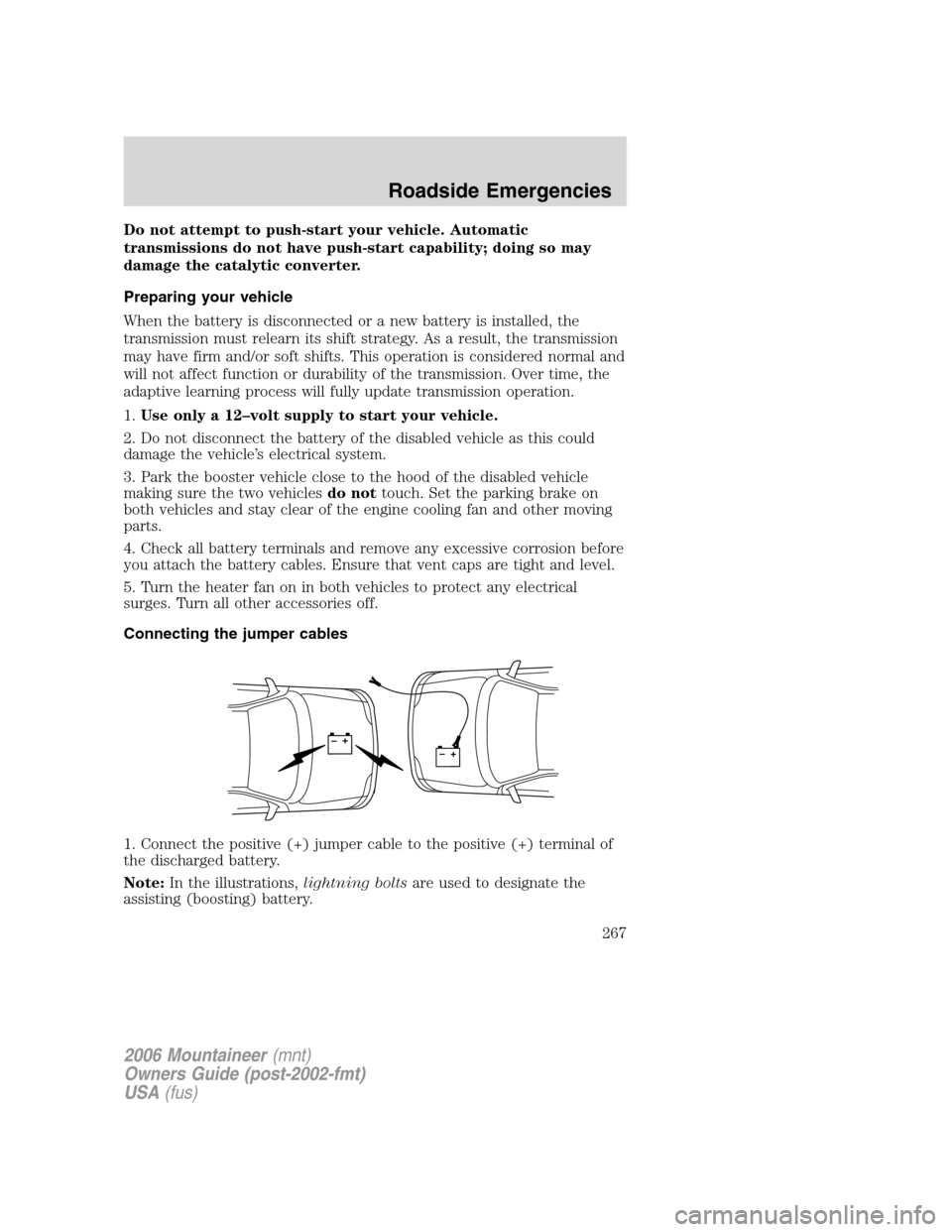
Connecting the jumper cables
1. Connect the positive (+) jumper cable to the positive (+) terminal of
the discharged battery.
Note:In the illustrations,lightning boltsare used to designate the
assisting (boosting) battery.
+–+–
2006 Mountaineer(mnt)
Owners Guide (post-2002-fmt)
USA(fus)
Roadside Emergencies
267
Page 288 of 344

SERVICE RECOMMENDATIONS
•Use thescheduled maintenance informationto track routine
service.
•Use only recommended fuels, lubricants, fluids and service parts
conforming to specifications.
•Your authorized dealer can provide parts and service.
PRECAUTIONS WHEN SERVICING YOUR VEHICLE
•Do not work on a hot engine.
•Make sure that nothing gets caught in moving parts.
•Do not work on a vehicle with the engine running in an enclosed
space, unless you are sure you have enough ventilation.
•Keep all open flames and other lit material away from the battery and
all fuel related parts.
Turn off the power running boards, if equipped, before working
under the vehicle, jacking or placing any object under the
vehicle. Never place your hand between the extended running board
and the vehicle. A moving running board may cause injury.
Working with the engine off
1. Set the parking brake and shift to P (Park).
2. Turn off the engine and remove the key.
3. Block the wheels.
Working with the engine on
1. Set the parking brake and shift to P (Park).
2. Block the wheels.
To reduce the risk of vehicle damage and/or personal burn
injuries do not start your engine with the air cleaner removed
and do not remove it while the engine is running.
2006 Mountaineer(mnt)
Owners Guide (post-2002-fmt)
USA(fus)
Maintenance and Specifications
288
Page 293 of 344

CHANGING THE WIPER BLADES
1. Pull the wiper arm away from the
vehicle. Turn the blade at an angle
from the wiper arm. Push the lock
pin manually to release the blade
and pull the wiper blade down
toward the windshield to remove it
from the arm.
2. Attach the new wiper to the
wiper arm and press it into place
until a click is heard.
Replace wiper blades at least once
per year for optimum performance.
Poor wiper quality can be improved
by cleaning the wiper blades and
the windshield, refer toWindows
and wiper bladesin theCleaningchapter.
To prolong the life of the wiper blades, it is highly recommended to
scrape off the ice on the windshield before turning on the wipers. The
layer of ice has many sharp edges and can damage the micro edge of the
wiper rubber element.
ENGINE OIL
Checking the engine oil
Refer to thescheduled maintenance informationfor the appropriate
intervals for checking the engine oil.
1. Make sure the vehicle is on level ground.
2. Turn the engine off and wait a few minutes for the oil to drain into the
oil pan.
3. Set the parking brake and ensure the gearshift is securely latched in P
(Park).
4. Open the hood. Protect yourself from engine heat.
5. Locate and carefully remove the engine oil level indicator (dipstick).
2006 Mountaineer(mnt)
Owners Guide (post-2002-fmt)
USA(fus)
Maintenance and Specifications
293
Page 299 of 344

When lifting a plastic-cased battery, excessive pressure on the
end walls could cause acid to flow through the vent caps,
resulting in personal injury and/or damage to the vehicle or battery.
Lift the battery with a battery carrier or with your hands on opposite
corners.
Keep batteries out of reach of children. Batteries contain sulfuric
acid. Avoid contact with skin, eyes or clothing. Shield your eyes
when working near the battery to protect against possible splashing of
acid solution. In case of acid contact with skin or eyes, flush
immediately with water for a minimum of 15 minutes and get prompt
medical attention. If acid is swallowed, call a physician immediately.
Battery posts, terminals and related accessories contain lead and
lead compounds.Wash hands after handling.
Because your vehicle’s engine is electronically controlled by a computer,
some control conditions are maintained by power from the battery. When
the battery is disconnected or a new battery is installed, the engine must
relearn its idle and fuel trim strategy for optimum driveability and
performance. To begin this process:
1. With the vehicle at a complete stop, set the parking brake.
2. Put the gearshift in P (Park), turn off all accessories and start the
engine.
3. Run the engine until it reaches normal operating temperature.
4. Allow the engine to idle for at least one minute.
5. Turn the A/C on and allow the engine to idle for at least one minute.
6. Release the parking brake. With your foot on the brake pedal and with
the A/C on, put the vehicle in D (Drive) and allow the engine to idle for
at least one minute.
7. Drive the vehicle to complete the relearning process.
•The vehicle may need to be driven 10 miles (16 km) or more to
relearn the idle and fuel trim strategy.
•If you do not allow the engine to relearn its idle trim, the idle
quality of your vehicle may be adversely affected until the idle
trim is eventually relearned.
2006 Mountaineer(mnt)
Owners Guide (post-2002-fmt)
USA(fus)
Maintenance and Specifications
299
Page 332 of 344
A
Accessory delay ..........................65
AdvanceTrac ..............................221
Air cleaner filter .......................319
Air conditioning ..........................43
Airbag supplemental restraint
system ................151–152, 160, 162
and child safety seats ............153
description ..............152, 160, 162
disposal ....................................165
driver airbag ............154, 161, 163
indicator light .................160, 165
operation .................154, 161, 163
passenger airbag .....154, 161, 163
side airbag ...............................160
All Wheel Drive (AWD),
driving off road .........................235
Ambulance packages ....................8
Antifreeze
(see Engine coolant) ................300
Anti-lock brake system
(see Brakes) ..............................220
Anti-theft system ......................121
Audio system
(see Radio) ......................21, 26, 31
Automatic transmission
driving an automatic
overdrive .........................228, 231
fluid, adding ............................317
fluid, checking ........................317
fluid, refill capacities ..............321
fluid, specification ..................326
Auxiliary power point .................62
Axle
lubricant specifications ..323, 326
refill capacities ........................321
B
Battery .......................................298acid, treating emergencies .....298
jumping a disabled battery ....266
maintenance-free ....................298
replacement, specifications ...319
servicing ..................................298
BeltMinder .................................146
Brakes ........................................219
anti-lock ...................................220
anti-lock brake system (ABS)
warning light ...........................220
fluid, checking and adding ....317
fluid, refill capacities ..............321
fluid, specifications .........323, 326
lubricant specifications ..323, 326
parking ....................................220
shift interlock ..........................227
C
Calculating load ........................209
Capacities for refilling fluids ....321
Cargo cover ...............................105
Cargo management system ......105
Cassette tape player .............21, 26
Cell phone use ..............................9
Changing a tire .........................256
Child safety restraints ..............166
child safety belts ....................166
Child safety seats ......................170
attaching with tether straps ..174
in front seat ............................171
in rear seat ..............................171
Cleaning your vehicle
engine compartment ..............283
instrument panel ....................285
interior .....................................286
interior trim ............................285
plastic parts ............................284
2006 Mountaineer(mnt)
Owners Guide (post-2002-fmt)
USA(fus)
Index
332
Page 335 of 344
Illuminated visor mirror .............60
Infant seats
(see Safety seats) .....................170
Inspection/maintenance (I/M)
testing ........................................316
Instrument panel
cleaning ...................................285
cluster ........................................12
J
Jack ....................................256, 260
positioning .......................256, 262
storage .....................256, 259–260
Jump-starting your vehicle ......266
K
Keyless entry system ...............116
autolock ...........................118–119
keypad .....................................116
locking and unlocking doors ..117
programming entry code .......116
Keys ...........................................122
positions of the ignition .........217
L
Lamps
bulb replacement
specifications chart ............52–53
daytime running light ...............49
fog lamps ...................................48
interior lamps ...........................52
replacing bulbs .........................56
Liftgate ......................................106
remote release ........................112
Lights, warning and indicator ....12
anti-lock brakes (ABS) ..........220
Load limits .................................202Loading instructions .................209
Locks
autolock ...........................118–119
childproof ................................110
doors ........................................108
Lubricant specifications ...323, 326
Lug nuts ....................................266
Luggage rack .............................107
Lumbar support, seats .....126, 129
M
Manual transmission
lubricant specifications ..........326
Message center ...............77, 88–89
english/metric button .........81, 94
system check button ..........80, 93
warning messages .............85, 100
Mirrors .........................................66
automatic dimming rearview
mirror ........................................66
fold away ...................................67
heated ........................................67
side view mirrors (power) .......66
Moon roof ....................................72
Motorcraft parts ........287, 306, 319
N
Navigation system .......................40
O
Octane rating ............................310
Oil (see Engine oil) ..................293
P
Parking brake ............................220
Parts (see Motorcraft parts) ....319
2006 Mountaineer(mnt)
Owners Guide (post-2002-fmt)
USA(fus)
Index
335