oil temperature Mercury Mountaineer 2006 Owner's Manuals
[x] Cancel search | Manufacturer: MERCURY, Model Year: 2006, Model line: Mountaineer, Model: Mercury Mountaineer 2006Pages: 344, PDF Size: 2.66 MB
Page 11 of 344
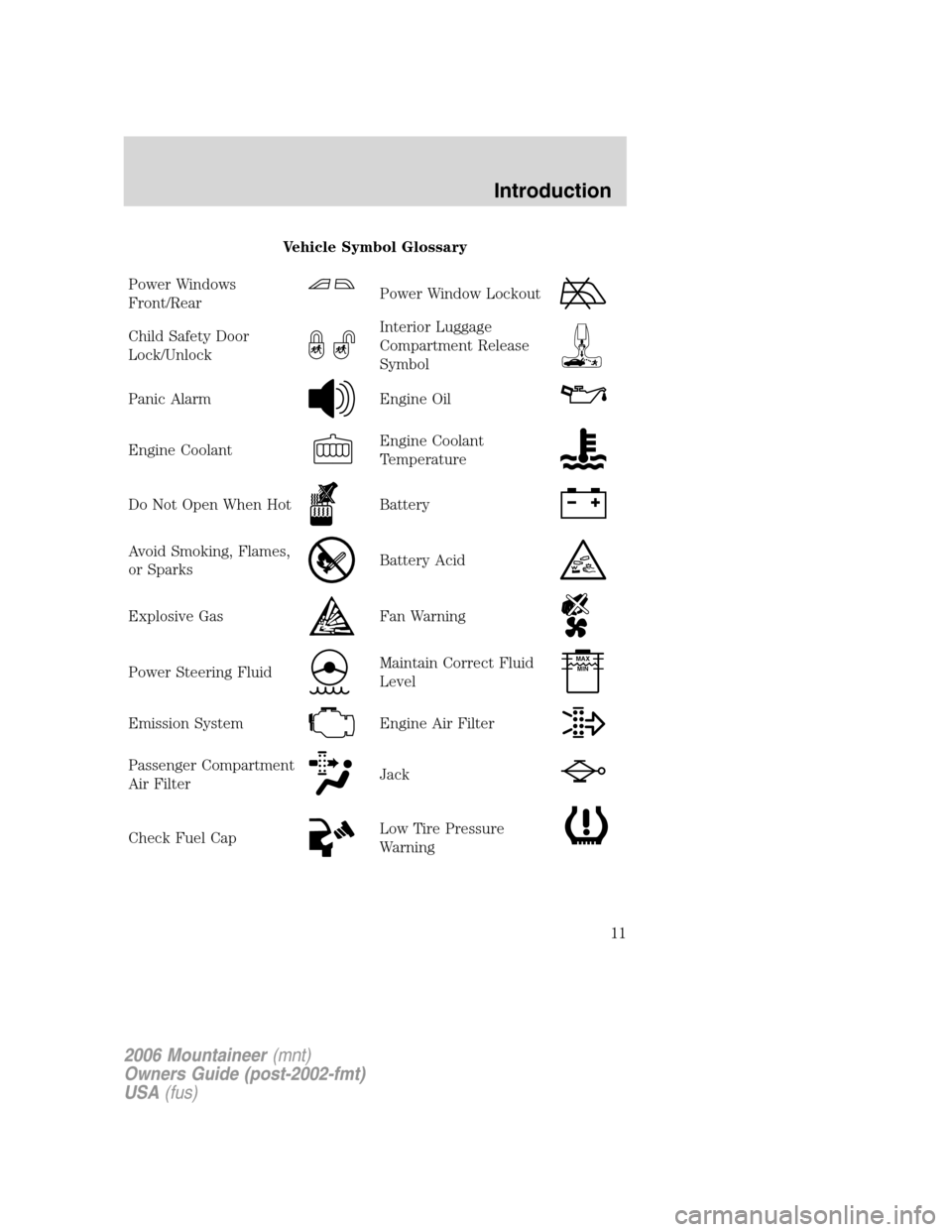
Vehicle Symbol Glossary
Power Windows
Front/Rear
Power Window Lockout
Child Safety Door
Lock/UnlockInterior Luggage
Compartment Release
Symbol
Panic AlarmEngine Oil
Engine CoolantEngine Coolant
Temperature
Do Not Open When HotBattery
Avoid Smoking, Flames,
or SparksBattery Acid
Explosive GasFan Warning
Power Steering FluidMaintain Correct Fluid
LevelMAX
MIN
Emission SystemEngine Air Filter
Passenger Compartment
Air FilterJack
Check Fuel CapLow Tire Pressure
Warning
2006 Mountaineer(mnt)
Owners Guide (post-2002-fmt)
USA(fus)
Introduction
11
Page 15 of 344
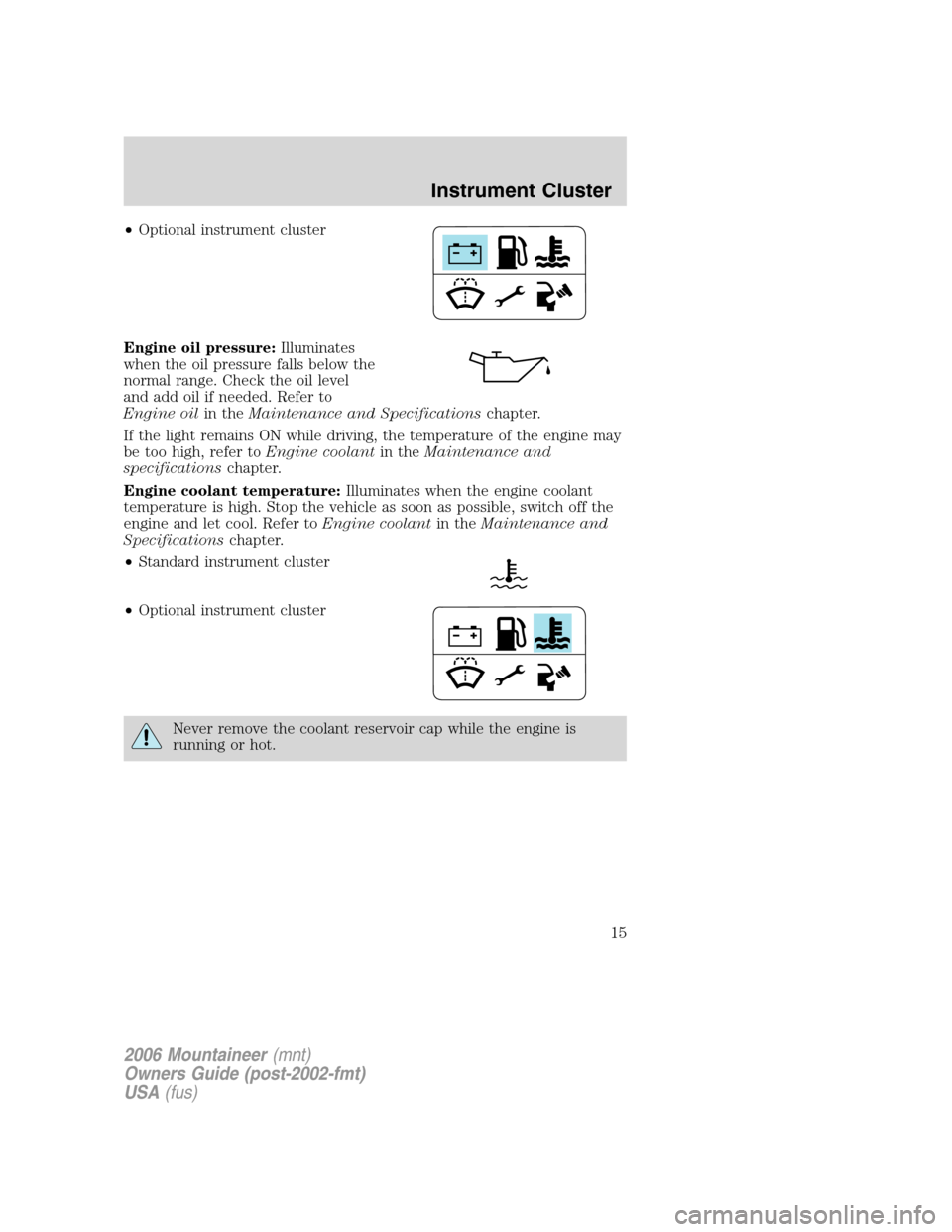
•Optional instrument cluster
Engine oil pressure:Illuminates
when the oil pressure falls below the
normal range. Check the oil level
and add oil if needed. Refer to
Engine oilin theMaintenance and Specificationschapter.
If the light remains ON while driving, the temperature of the engine may
be too high, refer toEngine coolantin theMaintenance and
specificationschapter.
Engine coolant temperature:Illuminates when the engine coolant
temperature is high. Stop the vehicle as soon as possible, switch off the
engine and let cool. Refer toEngine coolantin theMaintenance and
Specificationschapter.
•Standard instrument cluster
•Optional instrument cluster
Never remove the coolant reservoir cap while the engine is
running or hot.
2006 Mountaineer(mnt)
Owners Guide (post-2002-fmt)
USA(fus)
Instrument Cluster
15
Page 305 of 344

•Refer to the chart on the coolant container to ensure the
coolant concentration in your vehicle will provide adequate
protection at the temperatures in which you drive.
Vehicles driven year-round in non-extreme climates should use a 50/50
mixture of engine coolant and distilled water for optimum cooling system
and engine protection.
What you should know about fail-safe cooling (4.6L V8 engine
only)
If the engine coolant supply is depleted, this feature allows the vehicle to
be driven temporarily before incremental component damage is incurred.
The “fail-safe” distance depends on ambient temperatures, vehicle load
and terrain.
Fail-safe cooling and engine oil overheat mode (4.6L V8 only)
If the engine coolant and/or engine oil overheat, the vehicle’s fail-safe
modes will reduce engine power to limit engine damage, even with a
total loss of coolant. The vehicle’s range and/or speed will be reduced,
depending on vehicle load, terrain, and outside temperatures.
The instrument cluster provides warnings for each mode.
•Fail-Safe Cooling Mode:The
(Service engine
soon),
(Engine oil pressure), and(Engine coolant
temperature) indicators will be on.
Along with these warning indicators, the engine coolant temperature
gauge will read in the Hot (H) area.
If the engine coolant reaches even hotter temperatures, fail-safe
cooling mode limits engine power more and disables air conditioning.
The engine will switch to alternating cylinder operation to help cool
the engine. The engine will run rough in this mode.
If continued operation increases the engine coolant temperature to a
critical range, the engine will shut down. Steering and braking effort
will increase. Once engine coolant temperature cools, the engine can
be restarted.
•Engine Oil Overheat Mode:The
(Engine coolant temperature)
indicator will be on. The instrument cluster has no separate oil
temperature indicator.
Along with the
(Engine coolant temperature) indicator, the engine
coolant temperature gauge will read in the Hot (H) area.
2006 Mountaineer(mnt)
Owners Guide (post-2002-fmt)
USA(fus)
Maintenance and Specifications
305
Page 306 of 344
Oil overheat can be triggered in severe driving conditions, such as
towing heavy loads over mountainous terrain in extreme hot
temperatures. As oil temperature increases, engine and vehicle speed
will be limited. The transmission will also shift differently.
When the engine oil has cooled, the vehicle will perform normally.
When fail-safe cooling mode is activated
You have limited engine power when in the fail-safe mode, so drive the
vehicle with caution. Remember that the engine is capable of completely
shutting down automatically to prevent engine damage, therefore:
1. Pull off the road as soon as safely possible and turn off the engine.
2. Arrange for the vehicle to be taken to an authorized dealer.
3. If this is not possible, wait approximately 15 minutes for the engine to
cool.
4. Check the coolant level and replenish if low. Look for coolant leakage
in the engine compartment and under the vehicle.
Never remove the coolant reservoir cap while the engine is
running or hot.
5. Restart the engine and take your vehicle to an authorized dealer.
Driving the vehicle without repairing the engine problem
increases the chance of engine damage. Take your vehicle to an
authorized dealer as soon as possible.
FUEL FILTER
For fuel filter replacement, see your authorized dealer. Refer to
scheduled maintenance informationfor the appropriate intervals for
changing the fuel filter.
Replace the fuel filter with an authorized Motorcraft part. The
customer warranty may be void for any damage to the fuel system
if an authorized Motorcraft fuel filter is not used.
WHAT YOU SHOULD KNOW ABOUT AUTOMOTIVE FUELS
Important safety precautions
Do not overfill the fuel tank. The pressure in an overfilled tank
may cause leakage and lead to fuel spray and fire.
2006 Mountaineer(mnt)
Owners Guide (post-2002-fmt)
USA(fus)
Maintenance and Specifications
306
Page 313 of 344
•Revving the engine before turning it off may reduce fuel economy.
•Using the air conditioner or defroster may reduce fuel economy.
•You may want to turn off the speed control in hilly terrain if
unnecessary shifting between third and fourth gear occurs.
Unnecessary shifting of this type could result in reduced fuel
economy.
•Warming up a vehicle on cold mornings is not required and may
reduce fuel economy.
•Resting your foot on the brake pedal while driving may reduce fuel
economy.
•Combine errands and minimize stop-and-go driving.
Maintenance
•Keep tires properly inflated and use only recommended size.
•Operating a vehicle with the wheels out of alignment will reduce fuel
economy.
•Use recommended engine oil. Refer toLubricant specificationsin
this chapter.
•Perform all regularly scheduled maintenance items. Follow the
recommended maintenance schedule and owner maintenance checks
found inscheduled maintenance information.
Conditions
•Heavily loading a vehicle or towing a trailer may reduce fuel economy
at any speed.
•Carrying unnecessary weight may reduce fuel economy (approximately
1 mpg [0.4 km/L] is lost for every 400 lb [180 kg] of weight carried).
•Adding certain accessories to your vehicle (for example bug
deflectors, rollbars/light bars, running boards, ski/luggage racks) may
reduce fuel economy.
•Fuel economy may decrease with lower temperatures during the first
8–10 miles (12–16 km) of driving.
•Driving on flat terrain offers improved fuel economy as compared to
driving on hilly terrain.
•Transmissions give their best fuel economy when operated in the top
cruise gear and with steady pressure on the gas pedal.
•Four-wheel-drive operation (if equipped) is less fuel efficient than
two-wheel-drive operation.
2006 Mountaineer(mnt)
Owners Guide (post-2002-fmt)
USA(fus)
Maintenance and Specifications
313
Page 333 of 344

washing ....................................281
waxing .....................................281
wheels ......................................282
wiper blades ............................284
Climate control (see Air
conditioning or Heating) ............43
Clock adjust
6-CD in dash .............................32
AM/FM/CD .................................22
AM/FM/Tape/CD .......................27
Compass, electronic ....................83
calibration .................................85
set zone adjustment ...........84, 98
Console ..................................63–64
overhead ....................................61
rear ............................................64
Controls
power seat ...............................126
steering column ........................70
Coolant
checking and adding ..............300
refill capacities ................304, 321
specifications ..................323, 326
Cruise control
(see Speed control) ....................67
Customer Assistance ................245
Ford Extended Service
Plan ..........................................278
Getting assistance outside the
U.S. and Canada .....................278
Getting roadside assistance ...245
Getting the service you
need .........................................274
Ordering additional owner’s
literature .................................279
Utilizing the
Mediation/Arbitration
Program ...................................277D
Daytime running lamps
(see Lamps) ................................49
Defrost
rear window ..............................47
Dipstick
automatic transmission
fluid ..........................................317
engine oil .................................293
Doors
lubricant specifications ..........323
Driveline universal joint and
slip yoke ....................................318
Driving under special
conditions ..................234, 239, 242
sand .........................................240
snow and ice ...........................243
through water .................241, 244
Dual automatic temperature
control (DATC) ...........................43
DVD system .................................40
E
Electronic message center ...77, 88
Emergencies, roadside
jump-starting ..........................266
Emergency Flashers .................247
Emission control system ..........314
Engine ........................................326
cleaning ...................................283
coolant .....................................300
fail-safe cooling .......................305
idle speed control ...................298
lubrication
specifications ..................323, 326
refill capacities ........................321
2006 Mountaineer(mnt)
Owners Guide (post-2002-fmt)
USA(fus)
Index
333