spark Mercury Villager 2000 Owner's Manuals
[x] Cancel search | Manufacturer: MERCURY, Model Year: 2000, Model line: Villager, Model: Mercury Villager 2000Pages: 256, PDF Size: 2.21 MB
Page 5 of 256
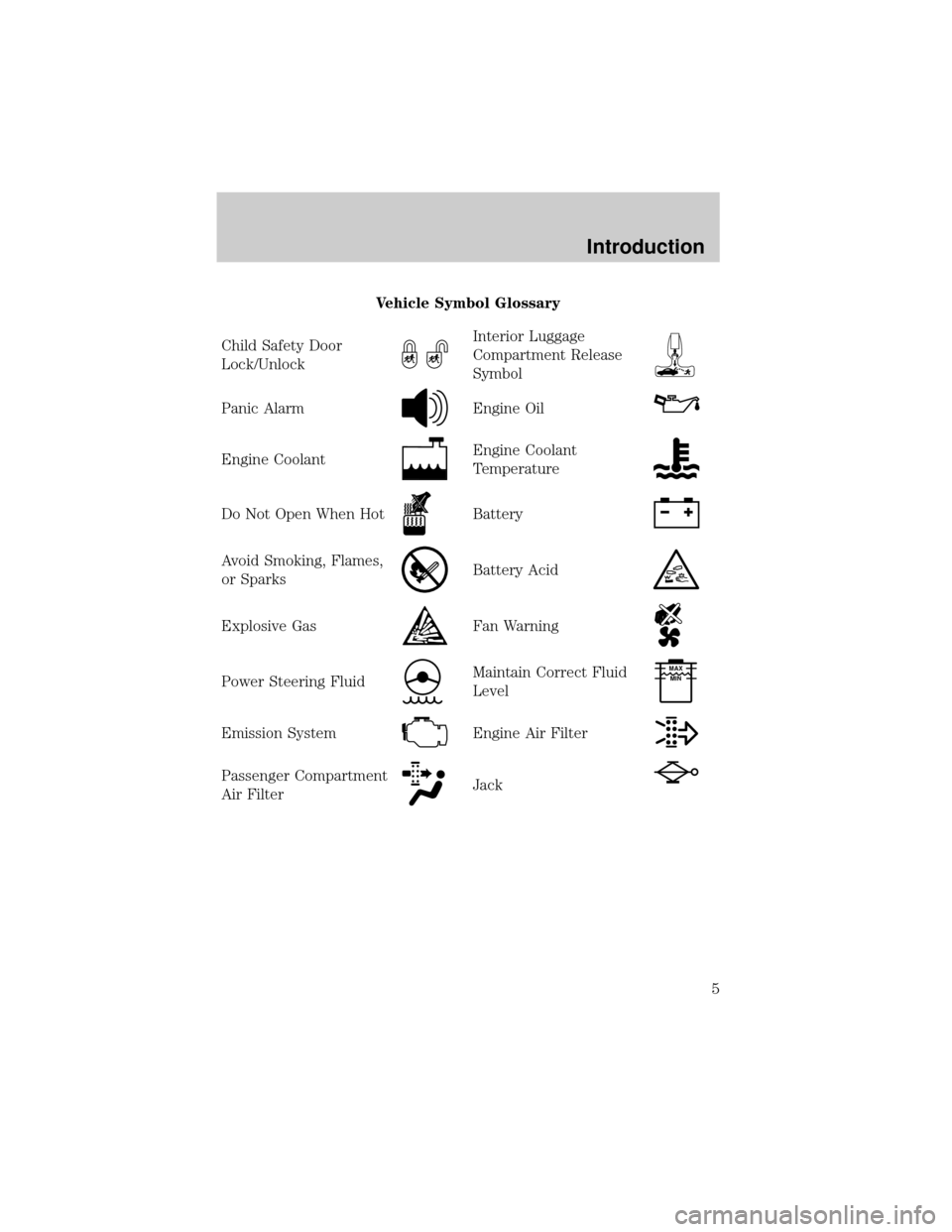
Vehicle Symbol Glossary
Child Safety Door
Lock/Unlock
Interior Luggage
Compartment Release
Symbol
Panic AlarmEngine Oil
Engine CoolantEngine Coolant
Temperature
Do Not Open When HotBattery
Avoid Smoking, Flames,
or SparksBattery Acid
Explosive GasFan Warning
Power Steering FluidMaintain Correct Fluid
LevelMAX
MIN
Emission SystemEngine Air Filter
Passenger Compartment
Air FilterJack
Introduction
5
Page 180 of 256
Jacking notches are located
approximately six inches rearward
of the front wheels and twelve
inches foward of the rear wheels.
6. Locate the jack notch closest to
the tire you are changing, then
place the jack on the frame rail
directly behind the notch.
7. Turn the jack handle clockwise
until the wheel is completely off the
ground.
To lessen the risk of personal injury, do not put any part of your
body under the vehicle while changing a tire. Do not start the
engine when your vehicle is on the jack. The jack is only meant for
changing the tire.
8. Remove the lug nuts with the lug wrench.
9. Replace the flat tire with the spare tire, making sure the valve stem is
facing outward. Reinstall lug nuts until the wheel is snug against the hub.
Do not fully tighten the lug nuts until the wheel has been lowered.
10. Lower the wheel by turning the jack handle counterclockwise.
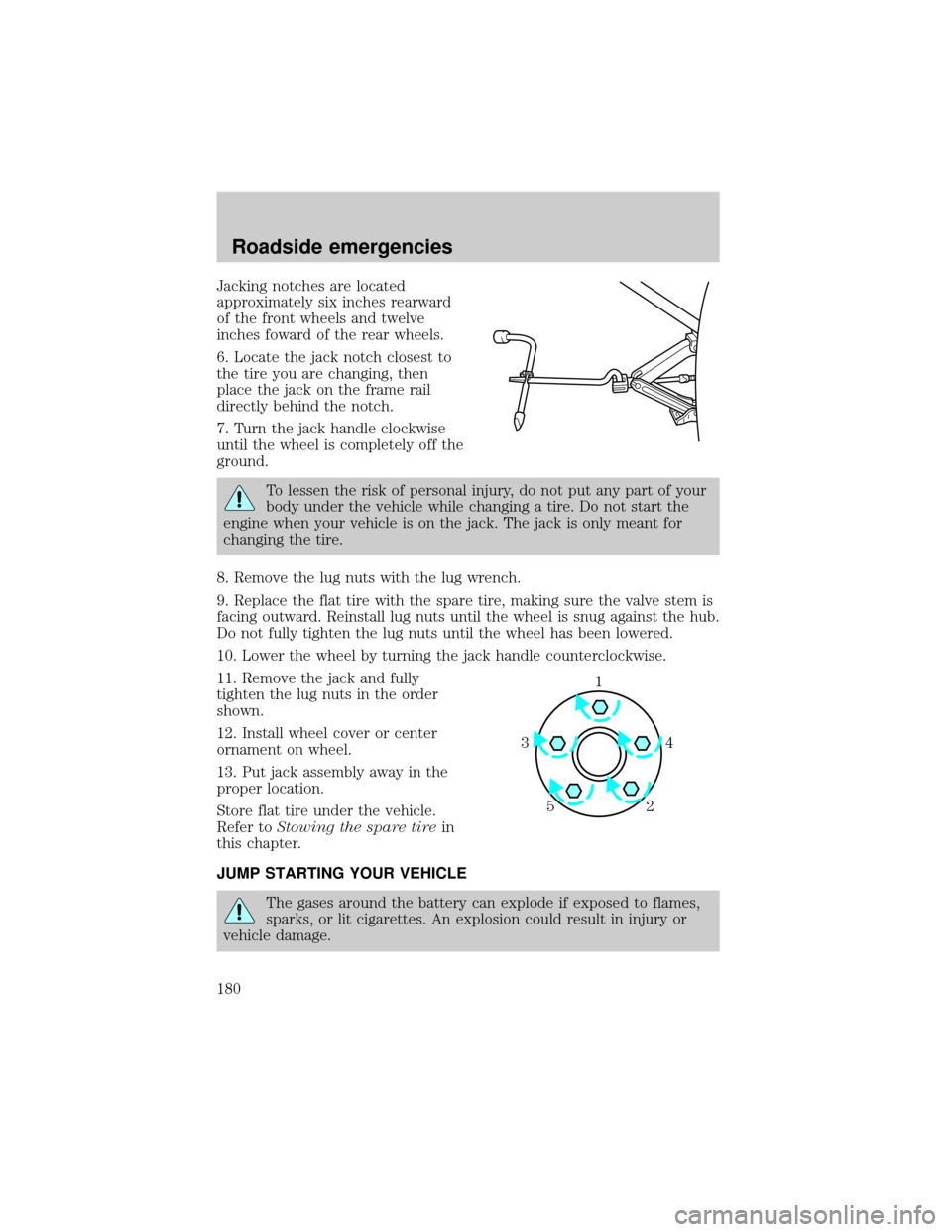
11. Remove the jack and fully
tighten the lug nuts in the order
shown.
12. Install wheel cover or center
ornament on wheel.
13. Put jack assembly away in the
proper location.
Store flat tire under the vehicle.
Refer toStowing the spare tirein
this chapter.
JUMP STARTING YOUR VEHICLE
The gases around the battery can explode if exposed to flames,
sparks, or lit cigarettes. An explosion could result in injury or
vehicle damage.
1
4 3
2 5
Roadside emergencies
180
Page 183 of 256
Do not connect the end of the second cable to the negative (-)
terminal of the battery to be jumped. A spark may cause an
explosion of the gases that surround the battery.
5. Ensure that the cables are clear of fan blades, belts, moving parts of
both engines, or any fuel delivery system parts.
Jump starting
1. Start the engine of the booster vehicle and run the engine at
moderately increased speed.
2. Start the engine of the disabled vehicle.
3. Once the disabled vehicle has been started, run both engines for an
additional three minutes before disconnecting the jumper cables.
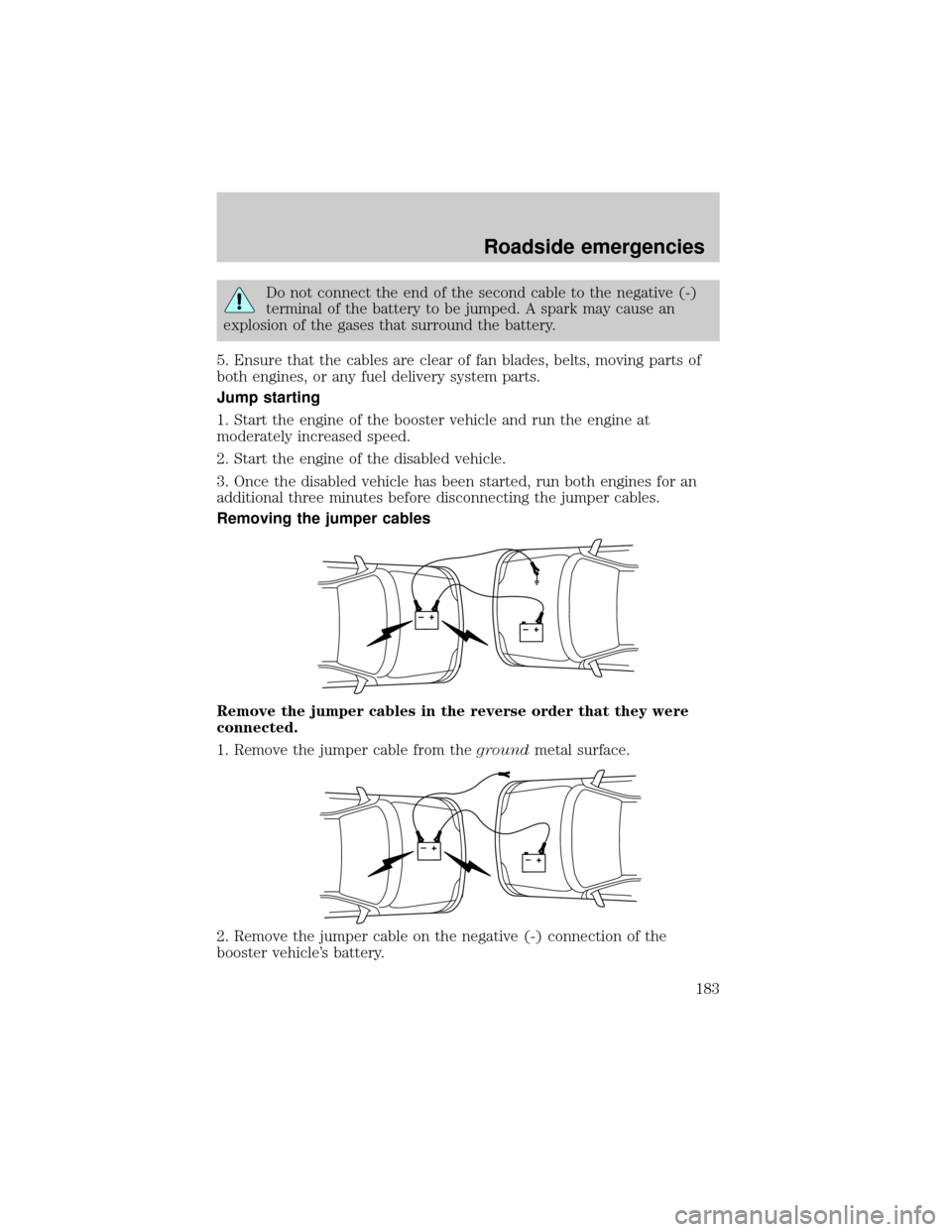
Removing the jumper cables
Remove the jumper cables in the reverse order that they were
connected.
1. Remove the jumper cable from thegroundmetal surface.
2. Remove the jumper cable on the negative (-) connection of the
booster vehicle's battery.
+–+–
+–+–
Roadside emergencies
183
Page 202 of 256
However, for severe usage or in high temperature climates, check the
battery electrolyte level. Refer to the Scheduled Maintenance Guide for
the service interval schedules.
Keep the electrolyte level in each cell up to the ªlevel indicatorº.
Do not overfill the battery cells.
If the electrolyte level in the battery is low, you can add plain tap water
to the battery, as long as you do not use hard water (water with a high
mineral or alkali content). If possible, however, try to only fill the battery
cells with distilled water. If the battery needs water often, have the
charging system checked.
If your battery has a cover/shield, make sure it is reinstalled
after the battery has been cleaned or replaced.
For longer, trouble-free operation, keep the top of the battery clean and
dry. Also, make certain the battery cables are always tightly fastened to
the battery terminals.
If you see any corrosion on the battery or terminals, remove the cables
from the terminals and clean with a wire brush. You can neutralize the
acid with a solution of baking soda and water.
Batteries normally produce explosive gases which can cause
personal injury. Therefore, do not allow flames, sparks or lighted
substances to come near the battery. When working near the battery,
always shield your face and protect your eyes. Always provide proper
ventilation.
When lifting a plastic-cased battery, excessive pressure on the
end walls could cause acid to flow through the vent caps,
resulting in personal injury and/or damage to the vehicle or battery.
Lift the battery with a battery carrier or with your hands on opposite
corners.
Keep batteries out of reach of children. Batteries contain sulfuric
acid. Avoid contact with skin, eyes or clothing. Shield your eyes
when working near the battery to protect against possible splashing of
acid solution. In case of acid contact with skin or eyes, flush
immediately with water for a minimum of 15 minutes and get prompt
medical attention. If acid is swallowed, call a physician immediately.
Maintenance and care
202
Page 214 of 256

²Avoid getting fuel liquid in your eyes. If fuel is splashed in the eyes,
remove contact lenses (if worn), flush with water for 15 minutes and
seek medical attention. Failure to seek proper medical attention could
lead to permanent injury.
²Fuels can also be harmful if absorbed through the skin. If fuel is
splashed on the skin and/or clothing, promptly remove contaminated
clothing and wash skin thoroughly with soap and water. Repeated or
prolonged skin contact with fuel liquid or vapor causes skin irritation.
²Be particularly careful if you are taking ªAntabuseº or other forms of
disulfiram for the treatment of alcoholism. Breathing gasoline vapors,
or skin contact could cause an adverse reaction. In sensitive
individuals, serious personal injury or sickness may result. If fuel is
splashed on the skin, promptly wash skin thoroughly with soap and
water. Consult a physician immediately if you experience an adverse
reaction.
When refueling always shut the engine off and never allow
sparks or open flames near the filler neck. Never smoke while
refueling. Fuel vapor is extremely hazardous under certain conditions.
Care should be taken to avoid inhaling excess fumes.
The flow of fuel through a fuel pump nozzle can produce static
electricity, which can cause a fire if fuel is pumped into an
ungrounded fuel container.
Use the following guidelines to avoid static build-up when filling an
ungrounded fuel container:
²Place approved fuel container on the ground.
²DO NOT fill a fuel container while it is in the vehicle.
²Keep the fuel pump nozzle in contact with the fuel container while
filling.
²DO NOT use a device that would hold the fuel pump handle in the fill
position.
Fuel Filler Cap
Your fuel tank filler cap has an indexed design with a 1/4 turn on/off
feature.
Maintenance and care
214
Page 233 of 256
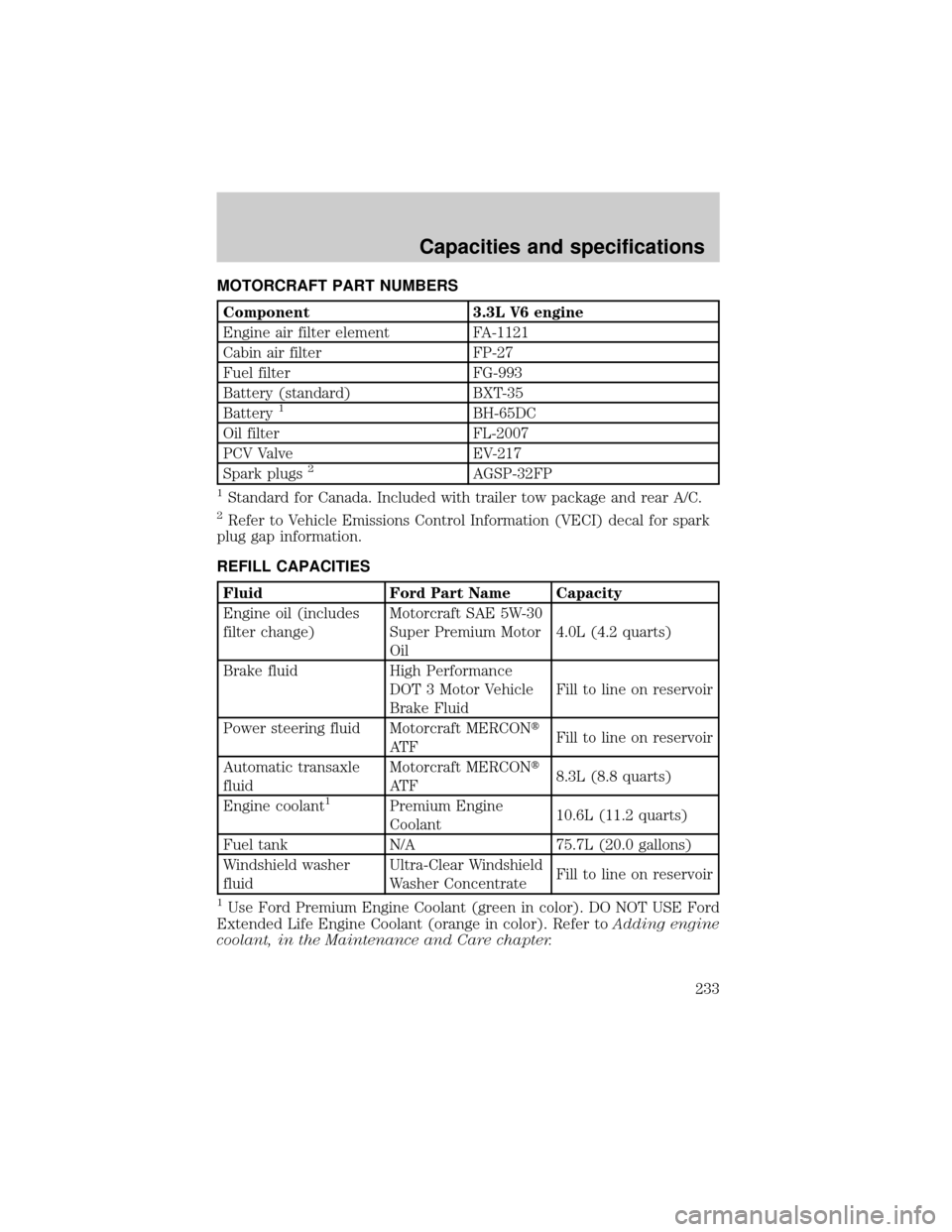
MOTORCRAFT PART NUMBERS
Component 3.3L V6 engine
Engine air filter element FA-1121
Cabin air filter FP-27
Fuel filter FG-993
Battery (standard) BXT-35
Battery
1BH-65DC
Oil filter FL-2007
PCV Valve EV-217
Spark plugs
2AGSP-32FP
1Standard for Canada. Included with trailer tow package and rear A/C.
2Refer to Vehicle Emissions Control Information (VECI) decal for spark
plug gap information.
REFILL CAPACITIES
Fluid Ford Part Name Capacity
Engine oil (includes
filter change)Motorcraft SAE 5W-30
Super Premium Motor
Oil4.0L (4.2 quarts)
Brake fluid High Performance
DOT 3 Motor Vehicle
Brake FluidFill to line on reservoir
Power steering fluid Motorcraft MERCONt
AT FFill to line on reservoir
Automatic transaxle
fluidMotorcraft MERCONt
AT F8.3L (8.8 quarts)
Engine coolant
1Premium Engine
Coolant10.6L (11.2 quarts)
Fuel tank N/A 75.7L (20.0 gallons)
Windshield washer
fluidUltra-Clear Windshield
Washer ConcentrateFill to line on reservoir
1Use Ford Premium Engine Coolant (green in color). DO NOT USE Ford
Extended Life Engine Coolant (orange in color). Refer toAdding engine
coolant, in the Maintenance and Care chapter.
Capacities and specifications
233
Page 235 of 256
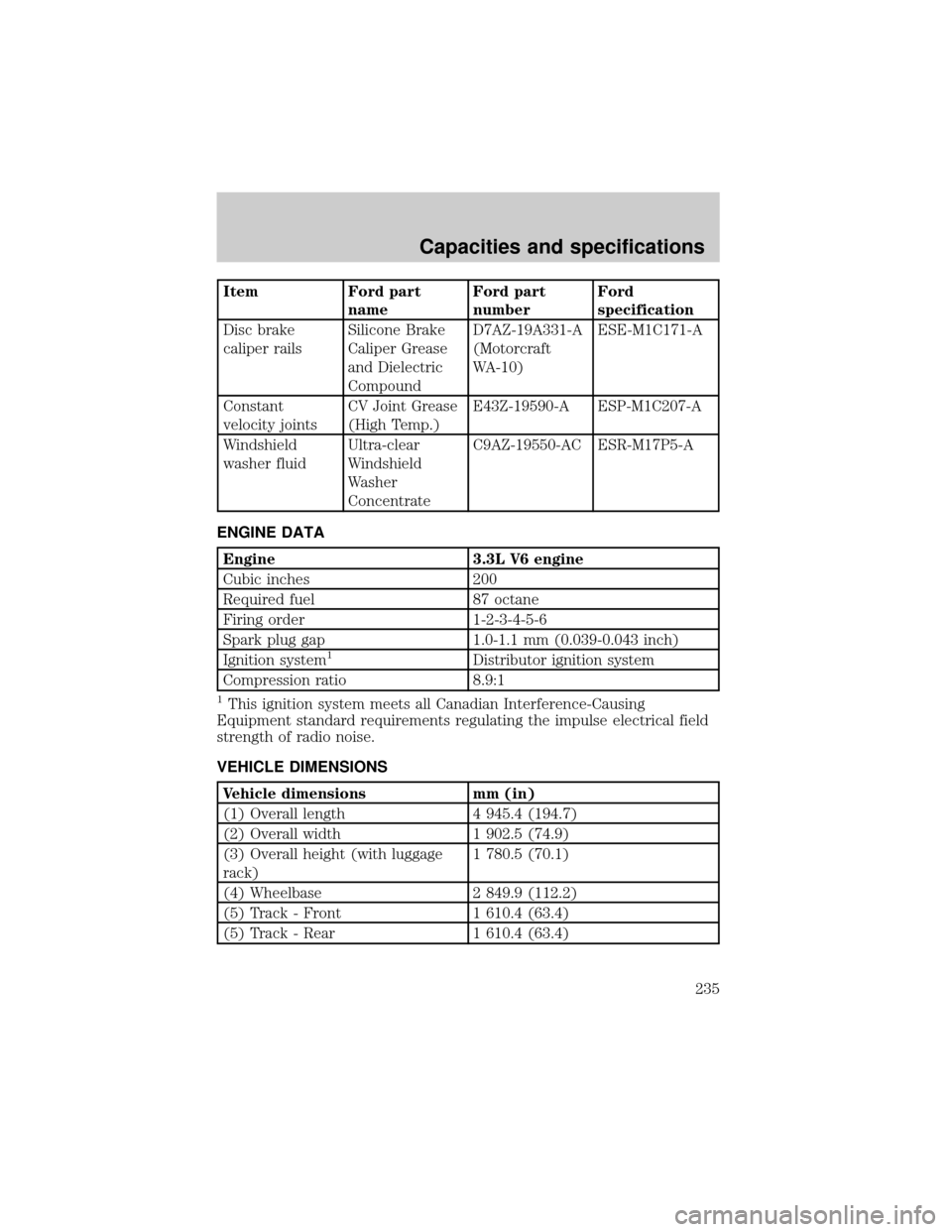
Item Ford part
nameFord part
numberFord
specification
Disc brake
caliper railsSilicone Brake
Caliper Grease
and Dielectric
CompoundD7AZ-19A331-A
(Motorcraft
WA-10)ESE-M1C171-A
Constant
velocity jointsCV Joint Grease
(High Temp.)E43Z-19590-A ESP-M1C207-A
Windshield
washer fluidUltra-clear
Windshield
Washer
ConcentrateC9AZ-19550-AC ESR-M17P5-A
ENGINE DATA
Engine 3.3L V6 engine
Cubic inches 200
Required fuel 87 octane
Firing order 1-2-3-4-5-6
Spark plug gap 1.0-1.1 mm (0.039-0.043 inch)
Ignition system
1Distributor ignition system
Compression ratio 8.9:1
1This ignition system meets all Canadian Interference-Causing
Equipment standard requirements regulating the impulse electrical field
strength of radio noise.
VEHICLE DIMENSIONS
Vehicle dimensions mm (in)
(1) Overall length 4 945.4 (194.7)
(2) Overall width 1 902.5 (74.9)
(3) Overall height (with luggage
rack)1 780.5 (70.1)
(4) Wheelbase 2 849.9 (112.2)
(5) Track - Front 1 610.4 (63.4)
(5) Track - Rear 1 610.4 (63.4)
Capacities and specifications
235
Page 254 of 256

low washer fluid .......................12
oil pressure .................................9
overdrive off ..............................12
safety belt ...................................9
service engine soon ..................11
speed control ............................86
turn signal indicator .................10
Load limits .................................160
GAWR ......................................160
GVWR ......................................160
trailer towing ..........................160
Locks
childproof ..................................92
doors ..........................................91
Lubricant specifications ....234,235
Lumbar support, seats .............115
Message center .................17,18,19
Mirrors .........................................98
cleaning ...................................229
heated ........................................93
side view mirrors (power) .......92
Moon roof ..................................101
Motorcraft parts .................217,233
Octane rating ............................216
Odometer .....................................15
Oil (see Engine oil) ..................189
Overdrive ..............................89,159
Panic alarm feature, remote
entry system ..............................103
Parking brake ............................153
Parts (see Motorcraft parts) ....233
Power distribution box
(see Fuses) ...............................172
Power door locks ........................91
Power steering ..........................154
fluid, checking and adding ....198
fluid, refill capacity ................233
fluid, specifications ..........234,235
Radio ............................................40
Relays .................................168,175
Remote entry system ........102,103
illuminated entry ....................103locking/unlocking doors ..102,103
panic alarm .............................103
replacement/additional
transmitters .............................105
replacing the batteries ...........104
Roof rack ...................................165
Safety belts (see Safety
restraints) ......126,127,128,129,130
Safety defects, reporting ..........250
Safety
restraints .......126,127,128,129,130
cleaning the
safety belts .......................132,232
extension assembly ................131
for adults ...................127,128,129
for children .............................137
lap belt ....................................130
warning light
and chime ........................9,12,131
Safety seats for children ..........138
Seat belts
(see Safety restraints) .............126
Seats ..........................................112
child safety seats ....................138
cleaning ............................231,232
memory seat ...........................115
Servicing your vehicle ..............186
Spark plugs,
specifications ......................233,235
Specification chart,
lubricants ............................234,235
Speed control ..............................82
Speedometer ...............................14
Starting your vehicle ..147,148,149
jump starting ..........................180
Steering wheel
controls ......................................86
tilting .........................................89
Tachometer .................................13
Tires ......................175,208,209,210
changing ....................175,176,178
checking the pressure ............210
Index
254