fuel cap MINI Clubman 2009 Owner's Manual
[x] Cancel search | Manufacturer: MINI, Model Year: 2009, Model line: Clubman, Model: MINI Clubman 2009Pages: 158, PDF Size: 2.51 MB
Page 49 of 158
REFERENCEAT A GLANCE CONTROLS DRIVING TIPS MOBILITY
47
Fuel gauge
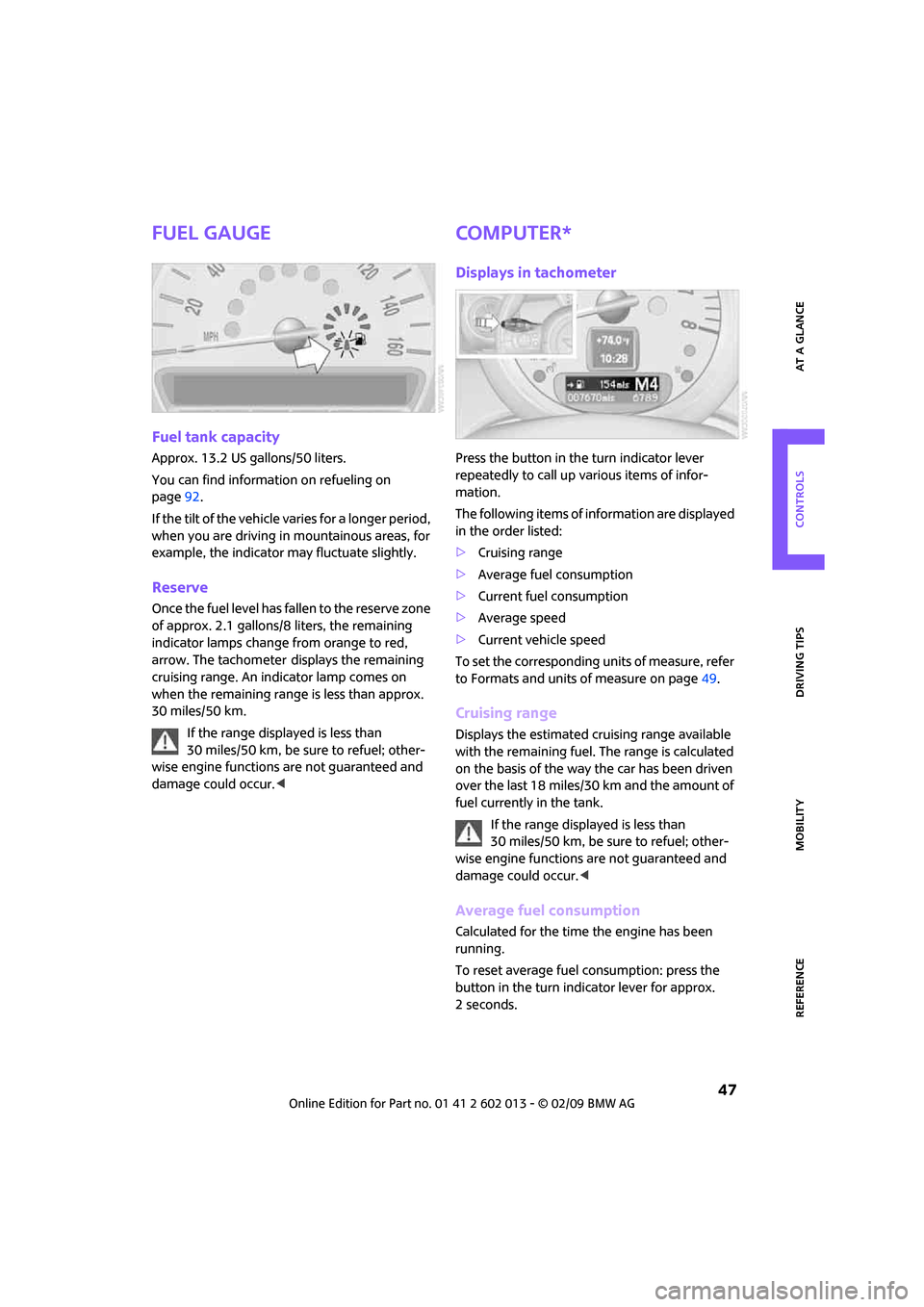
Fuel tank capacity
Approx. 13.2 US gallons/50 liters.
You can find information on refueling on
page92.
If the tilt of the vehicle varies for a longer period,
when you are driving in mountainous areas, for
example, the indicator may fluctuate slightly.
Reserve
Once the fuel level has fallen to the reserve zone
of approx. 2.1 gallons/8 liters, the remaining
indicator lamps change from orange to red,
arrow. The tachometer
displays the remaining
cruising range. An indicator lamp comes on
when the remaining range is less than approx.
30 miles/50 km.
If the range displayed is less than
30 miles/50 km, be sure to refuel; other-
wise engine functions are not guaranteed and
damage could occur.<
Computer*
Displays in tachometer
Press the button in the turn indicator lever
repeatedly to call up various items of infor-
mation.
The following items of information are displayed
in the order listed:
>Cruising range
>Average fuel consumption
>Current fuel consumption
>Average speed
>Current vehicle speed
To set the corresponding units of measure, refer
to Formats and units of measure on page49.
Cruising range
Displays the estimated cruising range available
with the remaining fuel. The range is calculated
on the basis of the way the car has been driven
over the last 18 miles/30 km and the amount of
fuel currently in the tank.
If the range displayed is less than
30 miles/50 km, be sure to refuel; other-
wise engine functions are not guaranteed and
damage could occur.<
Average fuel consumption
Calculated for the time the engine has been
running.
To reset average fuel consumption: press the
button in the turn indicator lever for approx.
2seconds.
Page 89 of 158
REFERENCEAT A GLANCE CONTROLS DRIVING TIPS MOBILITY
87
operating safety is no longer assured and the
vehicle will not be in compliance with the certifi-
cation regulations.
Heavy or hard objects should not be carried
loose inside the car, since they could be thrown
around, for example as a result of heavy braking,
sudden swerves, etc., and endanger the occu-
pants. Do not secure cargo using the fastening
points for the tether strap, page35; they may
become damaged.<
Roof-mounted
luggage rack*
A special rack system is available as an option for
your MINI. Your MINI Dealer will be glad to
advise you. Comply with the installation instruc-
tions supplied with the rack system.
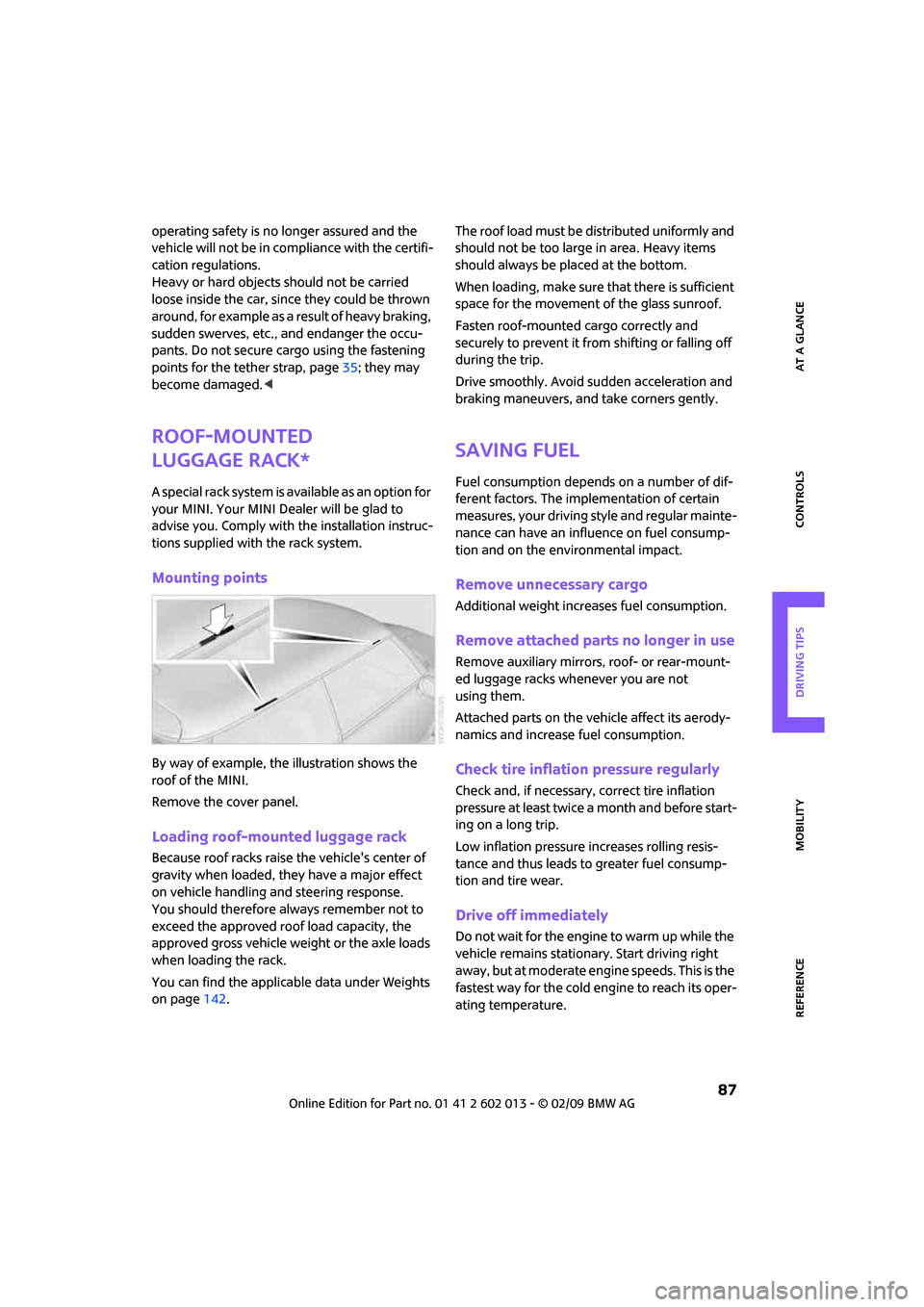
Mounting points
By way of example, the illustration shows the
roof of the MINI.
Remove the cover panel.
Loading roof-mounted luggage rack
Because roof racks raise the vehicle's center of
gravity when loaded, they have a major effect
on vehicle handling and steering response.
You should therefore always remember not to
exceed the approved roof load capacity, the
approved gross vehicle weight or the axle loads
when loading the rack.
You can find the applicable data under Weights
on page142.The roof load must be distributed uniformly and
should not be too large in area. Heavy items
should always be placed at the bottom.
When loading, make sure that there is sufficient
space for the movement of the glass sunroof.
Fasten roof-mounted cargo correctly and
securely to prevent it from shifting or falling off
during the trip.
Drive smoothly. Avoid sudden acceleration and
braking maneuvers, and take corners gently.
Saving fuel
Fuel consumption depends on a number of dif-
ferent factors. The implementation of certain
measures, your driving style and regular mainte-
nance can have an influence on fuel consump-
tion and on the environmental impact.
Remove unnecessary cargo
Additional weight increases fuel consumption.
Remove attached parts no longer in use
Remove auxiliary mirrors, roof- or rear-mount-
ed luggage racks whenever you are not
using them.
Attached parts on the vehicle affect its aerody-
namics and increase fuel consumption.
Check tire inflation pressure regularly
Check and, if necessary, correct tire inflation
pressure at least twice a month and before start-
ing on a long trip.
Low inflation pressure increases rolling resis-
tance and thus leads to greater fuel consump-
tion and tire wear.
Drive off immediately
Do not wait for the engine to warm up while the
vehicle remains stationary. Start driving right
away, but at moderate engine speeds. This is the
fastest way for the cold engine to reach its oper-
ating temperature.
Page 94 of 158
Refueling
92
Refueling
Switch off the engine before refueling,
otherwise fuel cannot be added to the
tank and a message will be displayed.<
Take all precautionary measures and
observe all applicable regulations when
handling fuel. Do not carry any spare fuel con-
tainers in your vehicle. They can develop a leak
and cause an explosion or cause a fire in the
event of an accident.<
Fuel filler door
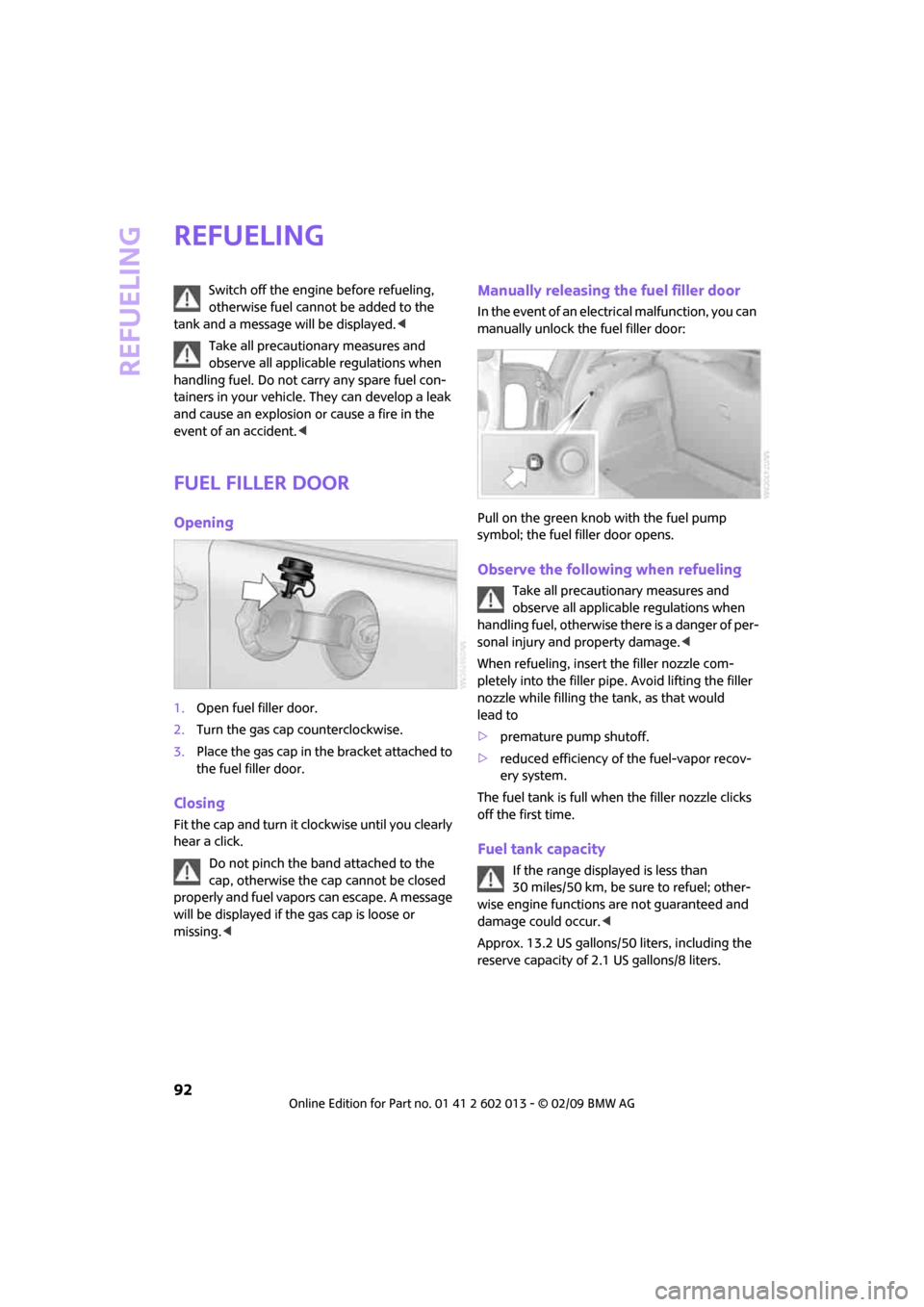
Opening
1.Open fuel filler door.
2.Turn the gas cap counterclockwise.
3.Place the gas cap in the bracket attached to
the fuel filler door.
Closing
Fit the cap and turn it clockwise until you clearly
hear a click.
Do not pinch the band attached to the
cap, otherwise the cap cannot be closed
properly and fuel vapors can escape. A message
will be displayed if the gas cap is loose or
missing.<
Manually releasing the fuel filler door
In the event of an electrical malfunction, you can
manually unlock the fuel filler door:
Pull on the green knob with the fuel pump
symbol; the fuel filler door opens.
Observe the following when refueling
Take all precautionary measures and
observe all applicable regulations when
handling fuel, otherwise there is a danger of per-
sonal injury and property damage.<
When refueling, insert the filler nozzle com-
pletely into the filler pipe. Avoid lifting the filler
nozzle while filling the tank, as that would
lead to
>premature pump shutoff.
>reduced efficiency of the fuel-vapor recov-
ery system.
The fuel tank is full when the filler nozzle clicks
off the first time.
Fuel tank capacity
If the range displayed is less than
30 miles/50 km, be sure to refuel; other-
wise engine functions are not guaranteed and
damage could occur.<
Approx. 13.2 US gallons/50 liters, including the
reserve capacity of 2.1 US gallons/8 liters.
Page 103 of 158
REFERENCEAT A GLANCE CONTROLS DRIVING TIPS MOBILITY
101
When properly used, these tires meet the high-
est standards in terms of safety and handling
characteristics.
Run-Flat Tires*
When mounting new tires or changing over from
summer to winter tires and vice versa, mount
Run-Flat Tires for your own safety. Keep in mind
that no space-saver spare tire is available in the
event of a flat. Your MINI Dealer will be glad to
advise you.
Special characteristics of winter tires
The manufacturer of MINI recommends the use
of winter tires on snowy roads or if temperatures
drop below 457/ +76. Although all-season
M+S tires provide better winter traction than
summer tires, they generally fail to provide the
same levels of cold-weather performance as
winter tires.
Pay attention to speed
Always comply with the speed limit for
the winter tires mounted on your car; fail-
ure to do so could result in tire damage and
accidents.<
If the car is capable of speeds higher than that
permitted for the winter tires, a label stating the
maximum permitted speed for the mounted
tires must be displayed in your field of view. Spe-
cialist tire dealers and your MINI Dealer can sup-
ply these labels.
Storage
Always store wheels and tires in a cool, dry place
with as little exposure to light as possible.
Always protect tires against all contact with oil,
grease and fuels.
Do not exceed the maximum tire inflation pres-
sure indicated on the sidewall of the tire.
Swapping wheels among the axles
Depending on the individual use, front and rear
tires may exhibit different wear and tear.
In order to maintain an even wear and tear, the
wheels may be rotated between the axles. Your
MINI Dealer will be glad to advise you.Always check the inflation pressure after the tire
rotation, if necessary change the pressure.
Snow chains*
Only certain types of fine-link snow chains have
been tested by the manufacturer of your MINI,
classified as road-safe and recommended. Con-
tact your MINI Dealer for more details.
Only attach snow chains in pairs to the front
wheels with the following tires.
>175/65 R 15 M+S
>175/60 R 16 M+S
John Cooper Works:
>185/50 R 17 86 H M+S XL RSC
Observe the manufacturer's instructions when
mounting snow chains. Do not exceed a speed
of 30 mph or 50 km/h.
Do not initialize the Flat Tire Monitor if
snow chains are mounted, otherwise the
instrument might issue an incorrect reading.
When driving with snow chains, it can be useful
to briefly deactivate the DSC or activate the DTC,
refer to page57.<
Page 109 of 158
REFERENCEAT A GLANCE CONTROLS DRIVING TIPS MOBILITY
107
Exhaust emission values
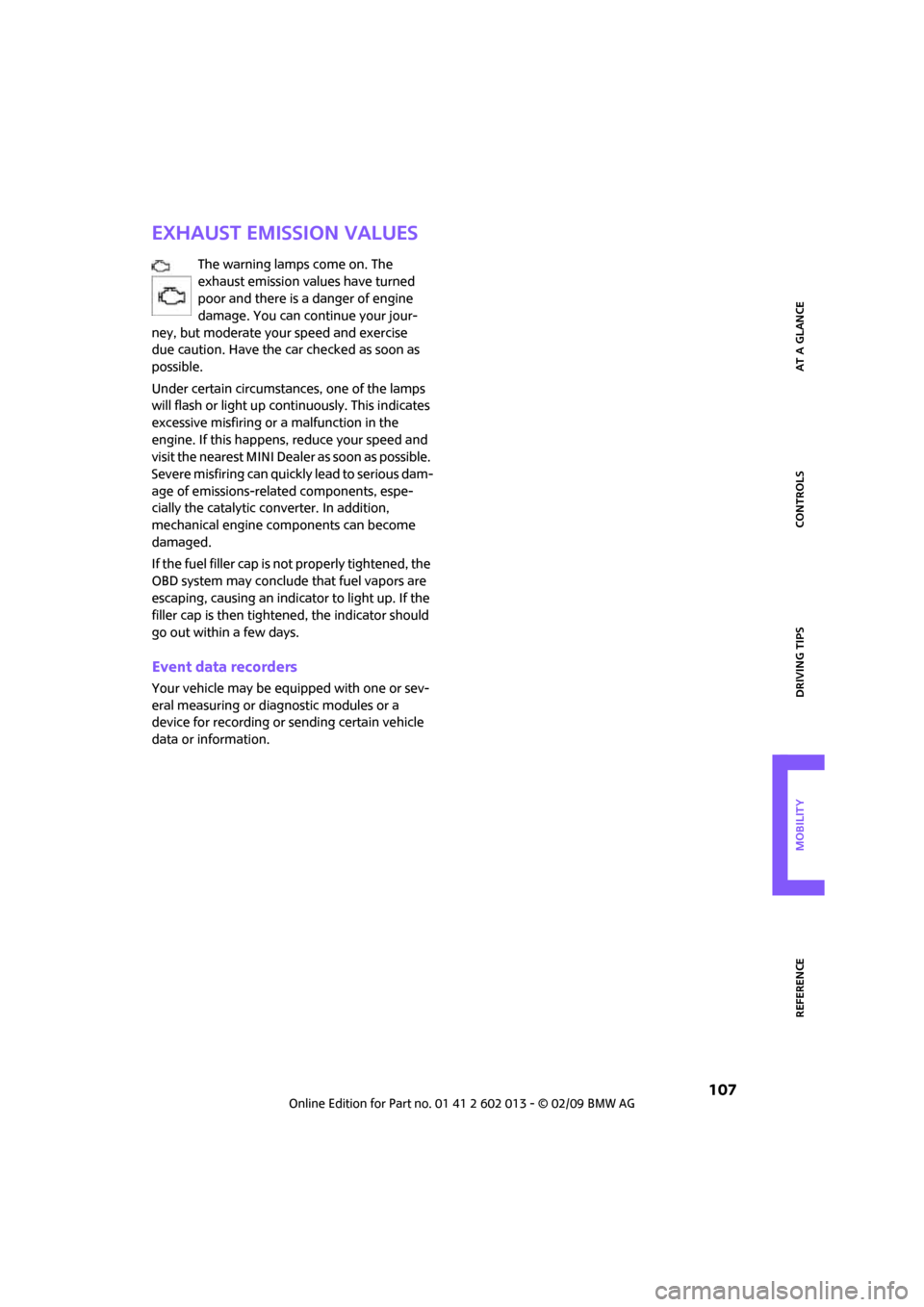
The warning lamps come on. The
exhaust emission values have turned
poor and there is a danger of engine
damage. You can continue your jour-
ney, but moderate your speed and exercise
due caution. Have the car checked as soon as
possible.
Under certain circumstances, one of the lamps
will flash or light up continuously. This indicates
excessive misfiring or a malfunction in the
engine. If this happens, reduce your speed and
visit the nearest MINI Dealer as soon as possible.
Severe misfiring can quickly lead to serious dam-
age of emissions-related components, espe-
cially the catalytic converter. In addition,
mechanical engine components can become
damaged.
If the fuel filler cap is not properly tightened, the
OBD system may conclude that fuel vapors are
escaping, causing an indicator to light up. If the
filler cap is then tightened, the indicator should
go out within a few days.
Event data recorders
Your vehicle may be equipped with one or sev-
eral measuring or diagnostic modules or a
device for recording or sending certain vehicle
data or information.
Page 129 of 158
REFERENCEAT A GLANCE CONTROLS DRIVING TIPS MOBILITY
127
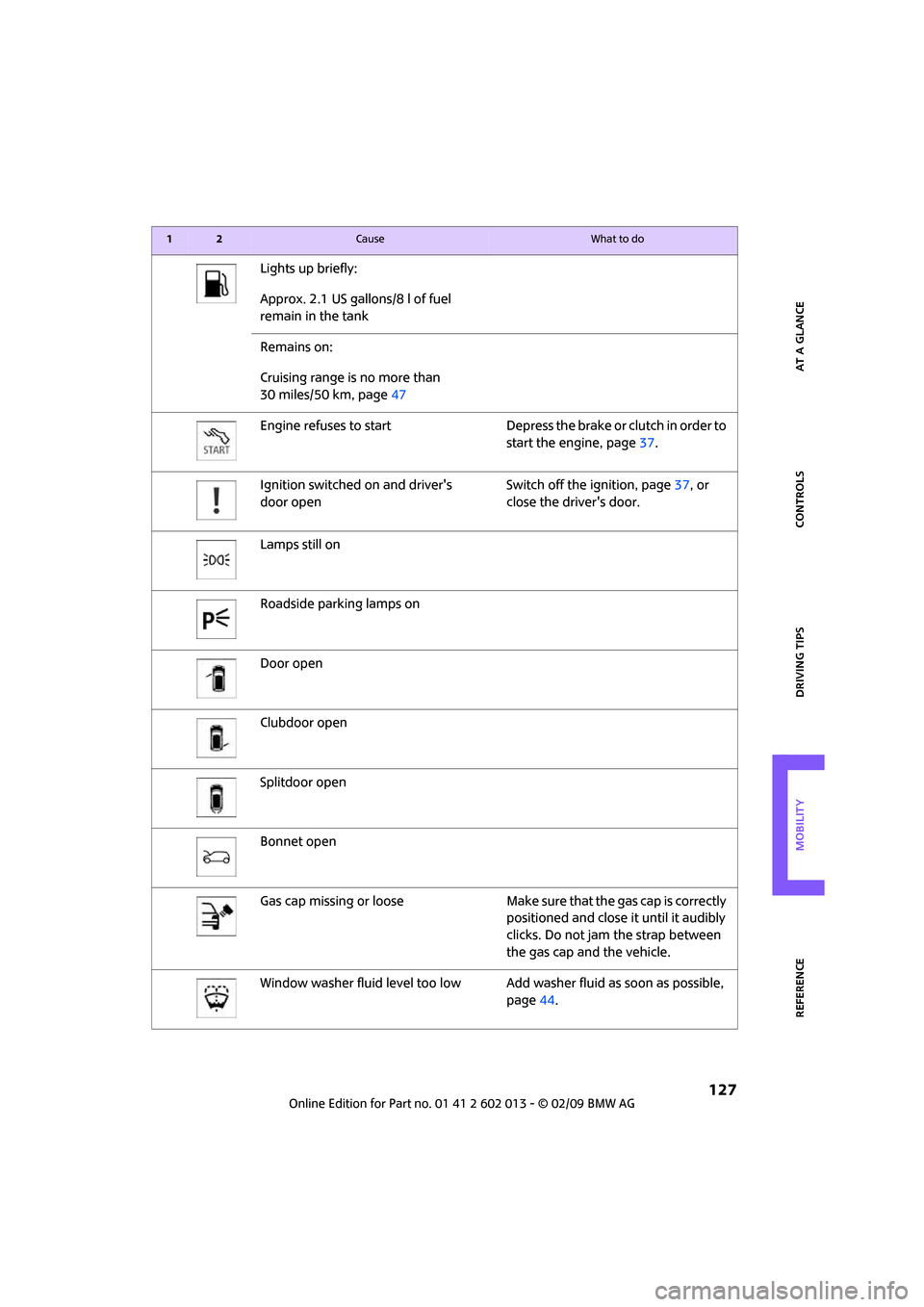
Lights up briefly:
Approx. 2.1 US gallons/8 l of fuel
remain in the tank
Remains on:
Cruising range is no more than
30 miles/50 km, page47
Engine refuses to start Depress the brake or clutch in order to
start the engine, page37.
Ignition switched on and driver's
door openSwitch off the ignition, page37, or
close the driver's door.
Lamps still on
Roadside parking lamps on
Door open
Clubdoor open
Splitdoor open
Bonnet open
Gas cap missing or loose Make sure that the gas cap is correctly
positioned and close it until it audibly
clicks. Do not jam the strap between
the gas cap and the vehicle.
Window washer fluid level too low Add washer fluid as soon as possible,
page44.
12Cause What to do
Page 144 of 158
Technical data
142
Weights
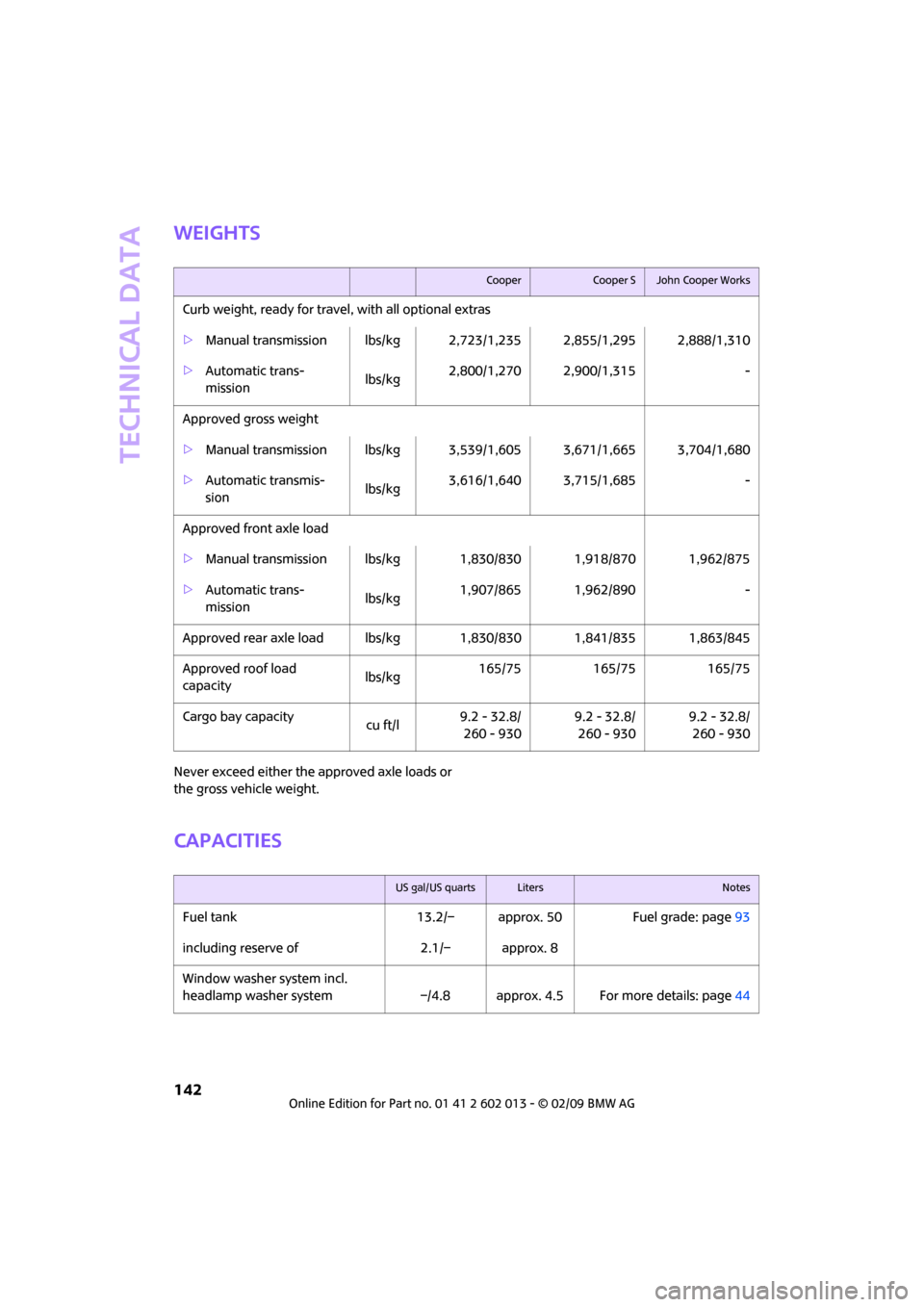
Never exceed either the approved axle loads or
the gross vehicle weight.
Capacities
CooperCooper SJohn Cooper Works
Curb weight, ready for travel, with all optional extras
>Manual transmission lbs/kg 2,723/1,235 2,855/1,295 2,888/1,310
>Automatic trans-
mission lbs/kg2,800/1,270 2,900/1,315 -
Approved gross weight
>Manual transmission lbs/kg 3,539/1,605 3,671/1,665 3,704/1,680
>Automatic transmis-
sion lbs/kg3,616/1,640 3,715/1,685 -
Approved front axle load
>Manual transmission lbs/kg 1,830/830 1,918/870 1,962/875
>Automatic trans-
mission lbs/kg1,907/865 1,962/890 -
Approved rear axle load lbs/kg 1,830/830 1,841/835 1,863/845
Approved roof load
capacitylbs/kg165/75 165/75 165/75
Cargo bay capacity
cu ft/l9.2 - 32.8/
260 - 9309.2 - 32.8/
260 - 9309.2 - 32.8/
260 - 930
US gal/US quartsLitersNotes
Fuel tank 13.2/– approx. 50 Fuel grade: page93
including reserve of 2.1/– approx. 8
Window washer system incl.
headlamp washer system –/4.8 approx. 4.5 For more details: page44
Page 148 of 158
From A to Z
146
Connecting vacuum cleaner,
refer to Connecting electrical
appliances79
Consumption indicator
– average fuel consumption47
Consumption, refer to Average
fuel consumption47
Control Display
– settings48
Controls and displays10
Convenience start, refer to
Starting the engine37
Convenient access25
– replacing the battery27
Convenient operation
– windows20
Coolant105
– checking level105
– filling105
Coolant temperature46
Cooling fluid, refer to
Coolant105
Cooling, maximum73
Copyright2
Cruising range47
Cup holders79
Curb weight, refer to
Weights142
Current fuel consumption48
D
Dashboard instruments, refer
to Displays12
Dashboard lighting, refer to
Instrument lighting68
Dashboard, refer to Cockpit10
Data140
– capacities142
– dimensions141
– engine140
– weights142
Date
– setting53
Daytime running lamps66
DBC Dynamic Brake Control,
refer to Brake assist56
Deactivating front passenger
airbags63Deadlocking, refer to
Locking20
Defect
– door lock22
– fuel filler door92
Defogging windows72,73
Defrost position, refer to
Defrosting windows72,73
Defrosting windows72,73
Defrosting windows and
removing condensation
– air conditioner72
– automatic climate control73
Differential, breaking in82
Digital clock46
Dimensions141
Dipstick, engine oil103
Directional indicators, refer to
Turn signals41
Displacement, refer to Engine
data140
Display lighting, refer to
Instrument lighting68
Displays12
– instrument combination12
Displays and controls10
Displays, care110
Disposal
– of coolant105
– remote control battery27
– vehicle battery120
Distance remaining to service,
refer to Service
requirements51
Distance warning, refer to Park
Distance Control PDC55
Diving stability control
systems55
Door
– rear, refer to Clubdoor23
Door key, refer to Integrated
key/remote control
18
Door lock21
Door lock, confirmation
signals20
Doors, manual operation22
DOT Quality Grades98
Double doors, refer to
Splitdoor23Drinks holders, refer to Cup
holders79
Drive-off assistant, refer to Hill
Start Assist57
Driving dynamics control, refer
to Sport button57
Driving lamps, refer to Parking
lamps/low beams65
Driving notes82
Driving off on inclines, refer to
Hill Start Assist57
Driving through water83
Driving tips, refer to Driving
notes82
Dry air, refer to Cooling
function74
DTC Dynamic Traction Control
DTC57
Dynamic Brake Control DBC,
refer to Brake assist56
Dynamic Stability Control
DSC56
Dynamic Traction Control57
E
Electrical malfunction
– door lock22
– fuel filler door92
Electronic brake-force
distribution56
Electronic Stability Program
ESP, refer to Dynamic
Stability Control DSC56
Emergency operation, refer to
Manual operation
– door lock22
– fuel filler door92
– transmission lock, automatic
transmission41
Emergency services, refer to
Roadside Assistance122
Page 149 of 158
REFERENCEAT A GLANCE CONTROLS DRIVING TIPS MOBILITY
147
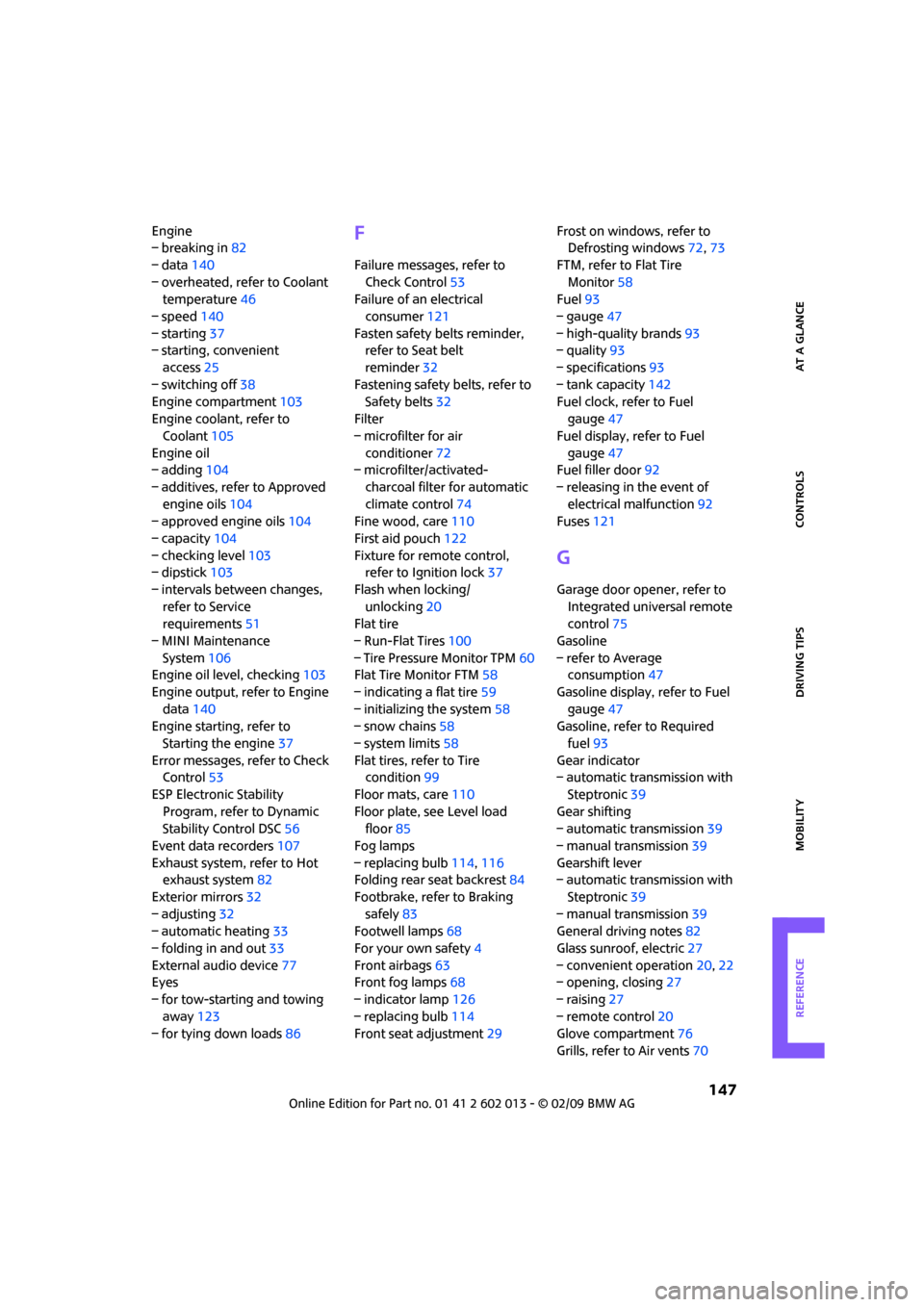
Engine
– breaking in82
– data140
– overheated, refer to Coolant
temperature46
– speed140
– starting37
– starting, convenient
access25
– switching off38
Engine compartment103
Engine coolant, refer to
Coolant105
Engine oil
– adding104
– additives, refer to Approved
engine oils104
– approved engine oils104
– capacity104
– checking level103
– dipstick103
– intervals between changes,
refer to Service
requirements51
– MINI Maintenance
System106
Engine oil level, checking103
Engine output, refer to Engine
data140
Engine starting, refer to
Starting the engine37
Error messages, refer to Check
Control53
ESP Electronic Stability
Program, refer to Dynamic
Stability Control DSC56
Event data recorders107
Exhaust system, refer to Hot
exhaust system82
Exterior mirrors32
– adjusting32
– automatic heating33
– folding in and out33
External audio device77
Eyes
– for tow-starting and towing
away123
– for tying down loads86F
Failure messages, refer to
Check Control53
Failure of an electrical
consumer121
Fasten safety belts reminder,
refer to Seat belt
reminder32
Fastening safety belts, refer to
Safety belts32
Filter
– microfilter for air
conditioner72
– microfilter/activated-
charcoal filter for automatic
climate control74
Fine wood, care110
First aid pouch122
Fixture for remote control,
refer to Ignition lock37
Flash when locking/
unlocking20
Flat tire
– Run-Flat Tires100
– Tire Pressure Monitor TPM60
Flat Tire Monitor FTM58
– indicating a flat tire59
– initializing the system58
– snow chains58
– system limits58
Flat tires, refer to Tire
condition99
Floor mats, care110
Floor plate, see Level load
floor85
Fog lamps
– replacing bulb114,116
Folding rear seat backrest84
Footbrake, refer to Braking
safely83
Footwell lamps68
For your own safety4
Front airbags63
Front fog lamps68
– indicator lamp126
– replacing bulb114
Front seat adjustment29Frost on windows, refer to
Defrosting windows72,73
FTM, refer to Flat Tire
Monitor58
Fuel93
– gauge47
– high-quality brands93
– quality93
– specifications93
– tank capacity142
Fuel clock, refer to Fuel
gauge47
Fuel display, refer to Fuel
gauge47
Fuel filler door92
– releasing in the event of
electrical malfunction92
Fuses121
G
Garage door opener, refer to
Integrated universal remote
control75
Gasoline
– refer to Average
consumption47
Gasoline display, refer to Fuel
gauge47
Gasoline, refer to Required
fuel93
Gear indicator
– automatic transmission with
Steptronic39
Gear shifting
– automatic transmission39
– manual transmission39
Gearshift lever
– automatic transmission with
Steptronic39
– manual transmission39
General driving notes82
Glass sunroof, electric27
– convenient operation20,22
– opening, closing27
– raising27
– remote control20
Glove compartment76
Grills, refer to Air vents70
Page 152 of 158
From A to Z
150
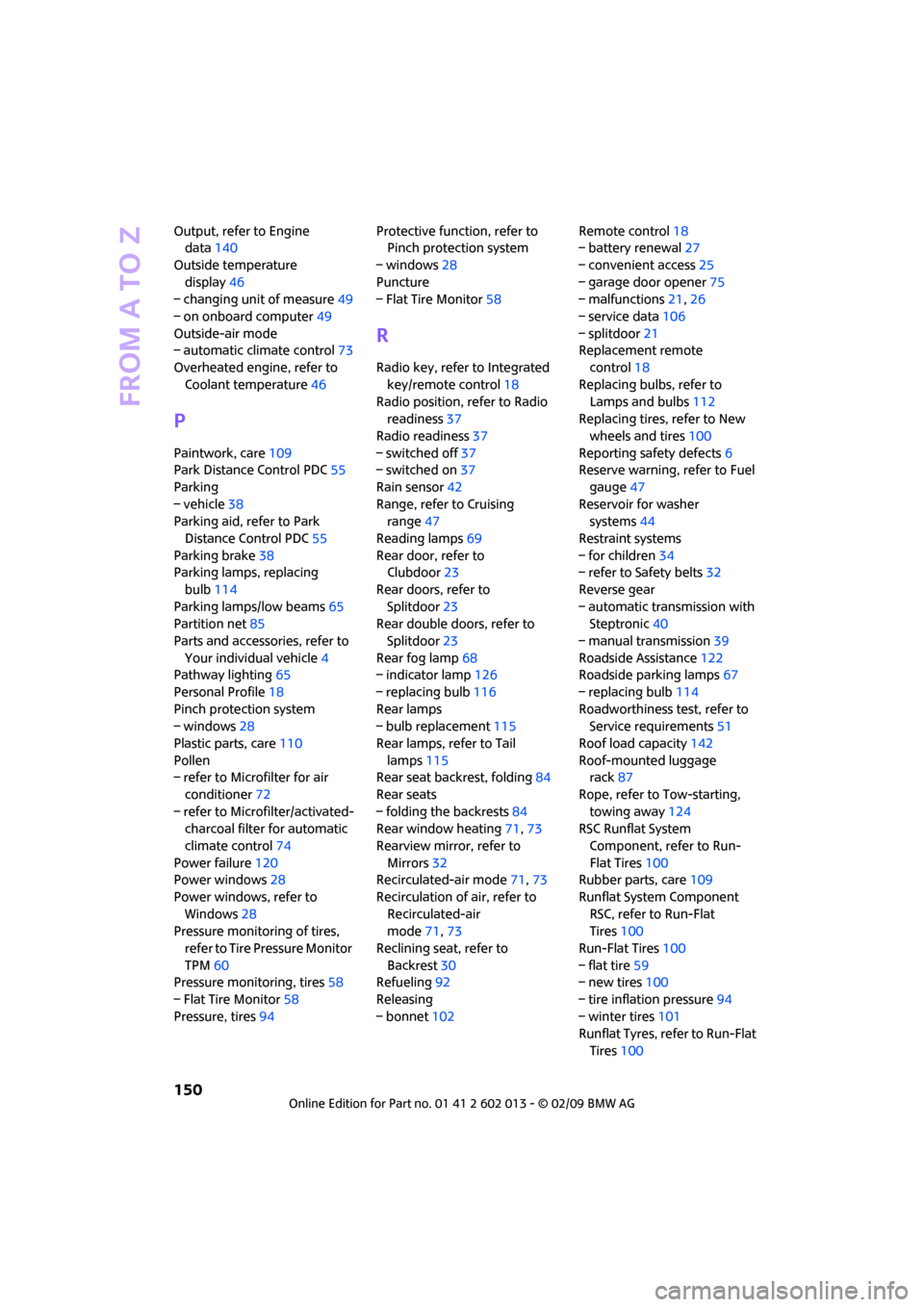
Output, refer to Engine
data140
Outside temperature
display46
– changing unit of measure49
– on onboard computer49
Outside-air mode
– automatic climate control73
Overheated engine, refer to
Coolant temperature46
P
Paintwork, care109
Park Distance Control PDC55
Parking
– vehicle38
Parking aid, refer to Park
Distance Control PDC55
Parking brake38
Parking lamps, replacing
bulb114
Parking lamps/low beams65
Partition net85
Parts and accessories, refer to
Your individual vehicle4
Pathway lighting65
Personal Profile18
Pinch protection system
– windows28
Plastic parts, care110
Pollen
– refer to Microfilter for air
conditioner72
– refer to Microfilter/activated-
charcoal filter for automatic
climate control74
Power failure120
Power windows28
Power windows, refer to
Windows28
Pressure monitoring of tires,
refer to Tire Pressure Monitor
TPM60
Pressure monitoring, tires58
– Flat Tire Monitor58
Pressure, tires94Protective function, refer to
Pinch protection system
– windows28
Puncture
– Flat Tire Monitor58
R
Radio key, refer to Integrated
key/remote control18
Radio position, refer to Radio
readiness37
Radio readiness37
– switched off37
– switched on37
Rain sensor42
Range, refer to Cruising
range47
Reading lamps69
Rear door, refer to
Clubdoor23
Rear doors, refer to
Splitdoor23
Rear double doors, refer to
Splitdoor23
Rear fog lamp68
– indicator lamp126
– replacing bulb116
Rear lamps
– bulb replacement115
Rear lamps, refer to Tail
lamps115
Rear seat backrest, folding84
Rear seats
– folding the backrests84
Rear window heating71,73
Rearview mirror, refer to
Mirrors32
Recirculated-air mode71,73
Recirculation of air, refer to
Recirculated-air
mode71,73
Reclining seat, refer to
Backrest30
Refueling92
Releasing
– bonnet102Remote control18
– battery renewal27
– convenient access25
– garage door opener75
– malfunctions21,26
– service data106
– splitdoor21
Replacement remote
control18
Replacing bulbs, refer to
Lamps and bulbs112
Replacing tires, refer to New
wheels and tires100
Reporting safety defects6
Reserve warning, refer to Fuel
gauge47
Reservoir for washer
systems44
Restraint systems
– for children34
– refer to Safety belts32
Reverse gear
– automatic transmission with
Steptronic40
– manual transmission39
Roadside Assistance122
Roadside parking lamps67
– replacing bulb114
Roadworthiness test, refer to
Service requirements51
Roof load capacity142
Roof-mounted luggage
rack87
Rope, refer to Tow-starting,
towing away124
RSC Runflat System
Component, refer to Run-
Flat Tires100
Rubber parts, care109
Runflat System Component
RSC, refer to Run-Flat
Tires100
Run-Flat Tires100
– flat tire59
– new tires100
– tire inflation pressure94
– winter tires101
Runflat Tyres, refer to Run-Flat
Tires100