mirror MINI Clubman 2011 Owner's Manual
[x] Cancel search | Manufacturer: MINI, Model Year: 2011, Model line: Clubman, Model: MINI Clubman 2011Pages: 196, PDF Size: 3.08 MB
Page 12 of 196
AT A GLANCECockpit
10
Cockpit
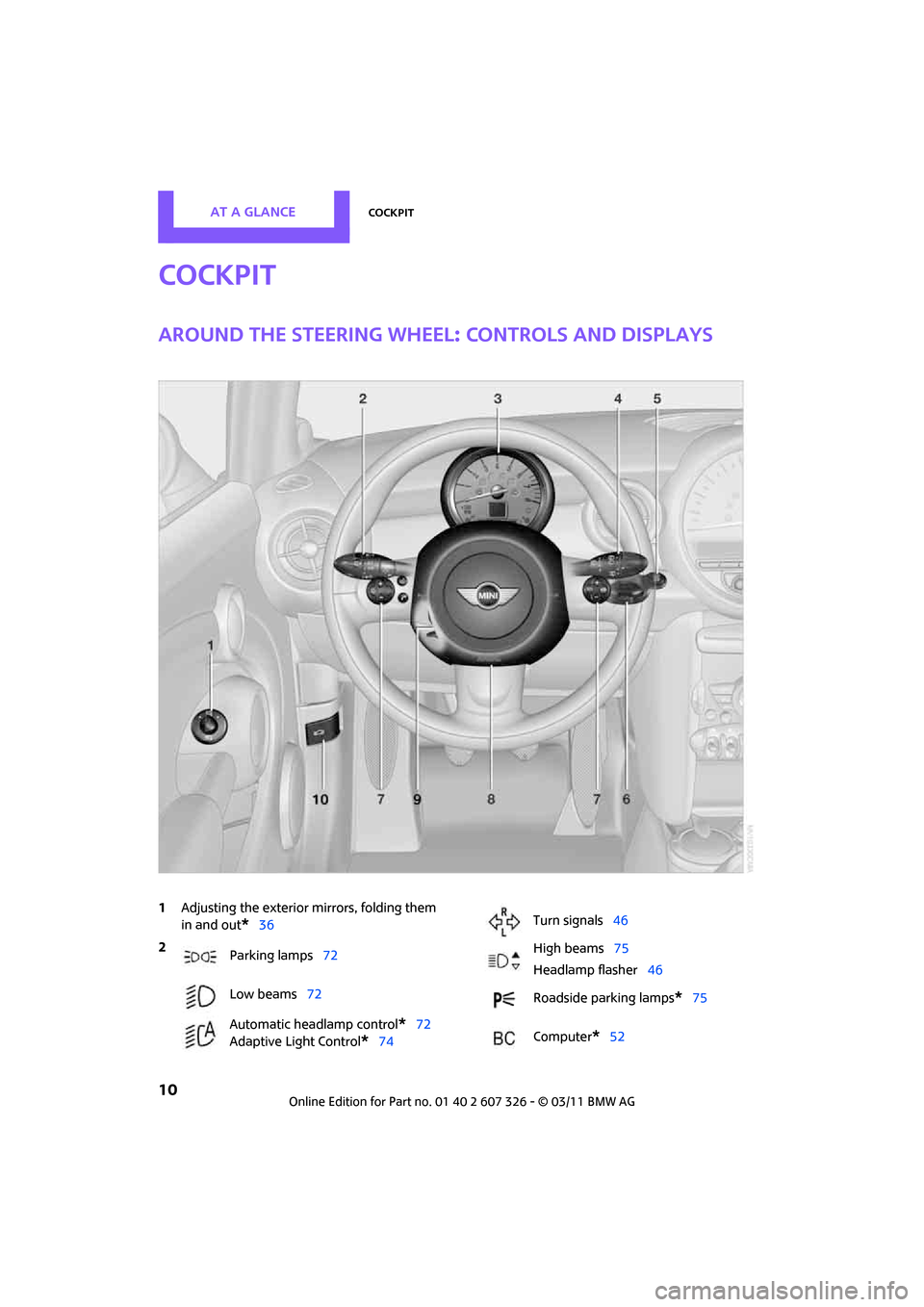
Around the steering wheel: controls and displays
1Adjusting the exterior mirrors, folding them
in and out
*36
2
Parking lamps 72
Low beams 72
Automatic headlamp control
*72
Adaptive Light Control
*74
Turn signals 46
High beams 75
Headlamp flasher 46
Roadside parking lamps
*75
Computer
*52
Page 38 of 196
CONTROLSAdjustments
36
placed on the front passenger seat, or if driver or
front passenger unfasten their safety belts.
Damage to safety belts
If the safety belts are damaged or stressed
in an accident: have th e safety belt system
and its seat-belt tensioners replaced and the
belt anchors checked. Have this work carried out
only by a MINI dealer or by a workshop that has
specially trained personnel working in accor-
dance with the specifications of the MINI manu-
facturer; otherwise, correct operation of these
safety systems is not ensured.<
Mirrors
Exterior mirrors
The front passenger's mirror is more con-
vex than the driver's mirror. The objects
seen in the mirror are cl oser than they appear.
Do not gauge your distance from traffic behind
you on the basis of what you see in the mirror;
otherwise, there is an increased risk of an acci-
dent. <
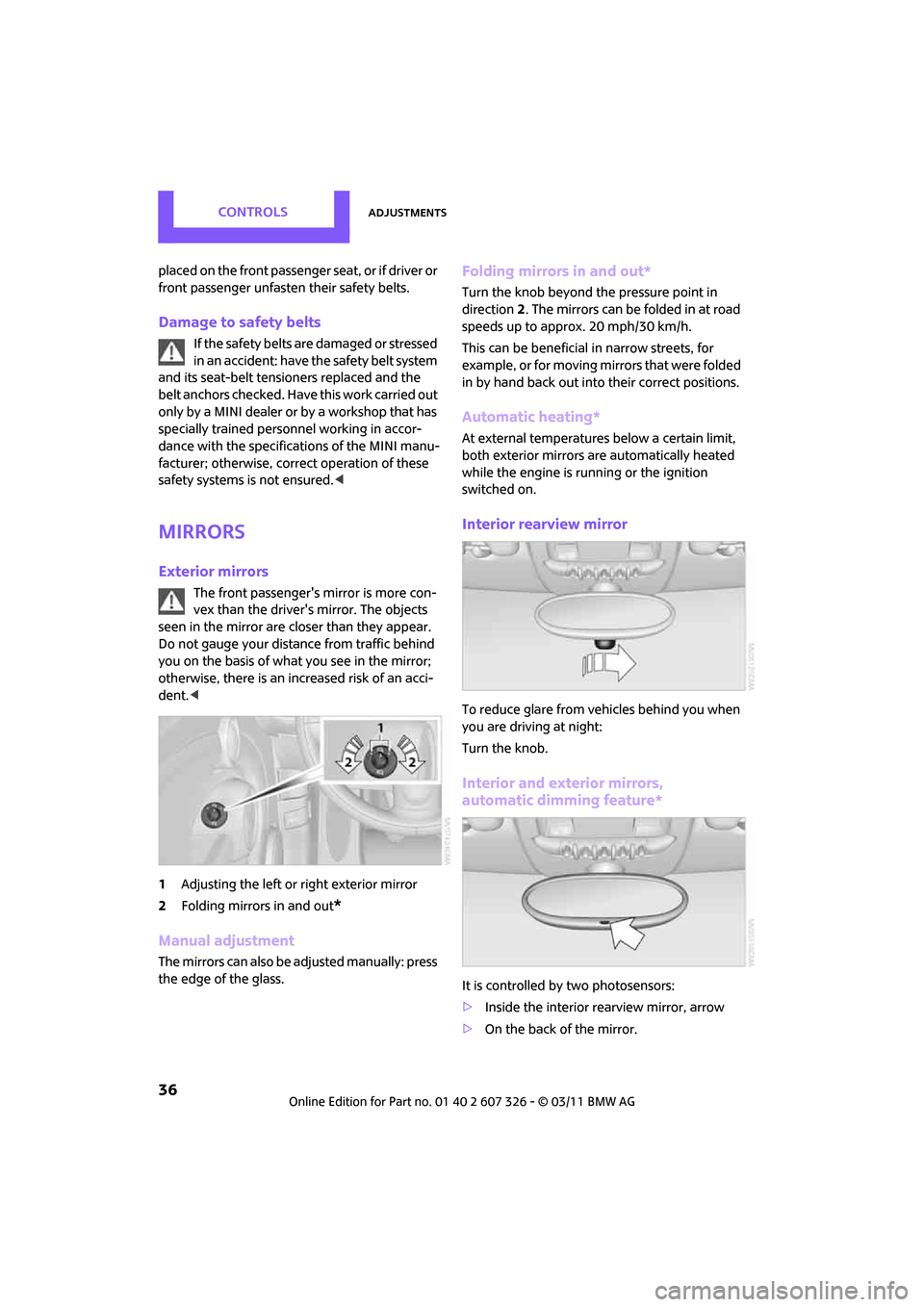
1 Adjusting the left or right exterior mirror
2 Folding mirrors in and out
*
Manual adjustment
The mirrors can also be adjusted manually: press
the edge of the glass.
Folding mirrors in and out*
Turn the knob beyond the pressure point in
direction 2. The mirrors can be folded in at road
speeds up to approx. 20 mph/30 km/h.
This can be beneficial in narrow streets, for
example, or for moving mi rrors that were folded
in by hand back out into their correct positions.
Automatic heating*
At external temperatures below a certain limit,
both exterior mirrors are automatically heated
while the engine is running or the ignition
switched on.
Interior rearview mirror
To reduce glare from vehicles behind you when
you are driving at night:
Turn the knob.
Interior and exterior mirrors,
automatic dimming feature*
It is controlled by two photosensors:
> Inside the interior rearview mirror, arrow
> On the back of the mirror.
Page 39 of 196
AdjustmentsCONTROLS
37
For proper function:
>Keep the photosensors clean
> Do not cover the area between the interior
rearview mirror and the windshield
> Do not place stickers or decals on the wind-
shield in front of the mirror.
Steering wheel
Adjustments
Do not adjust the steering wheel position
while the car is in motion; otherwise, there
is a risk of accident due to an unexpected move-
ment. <
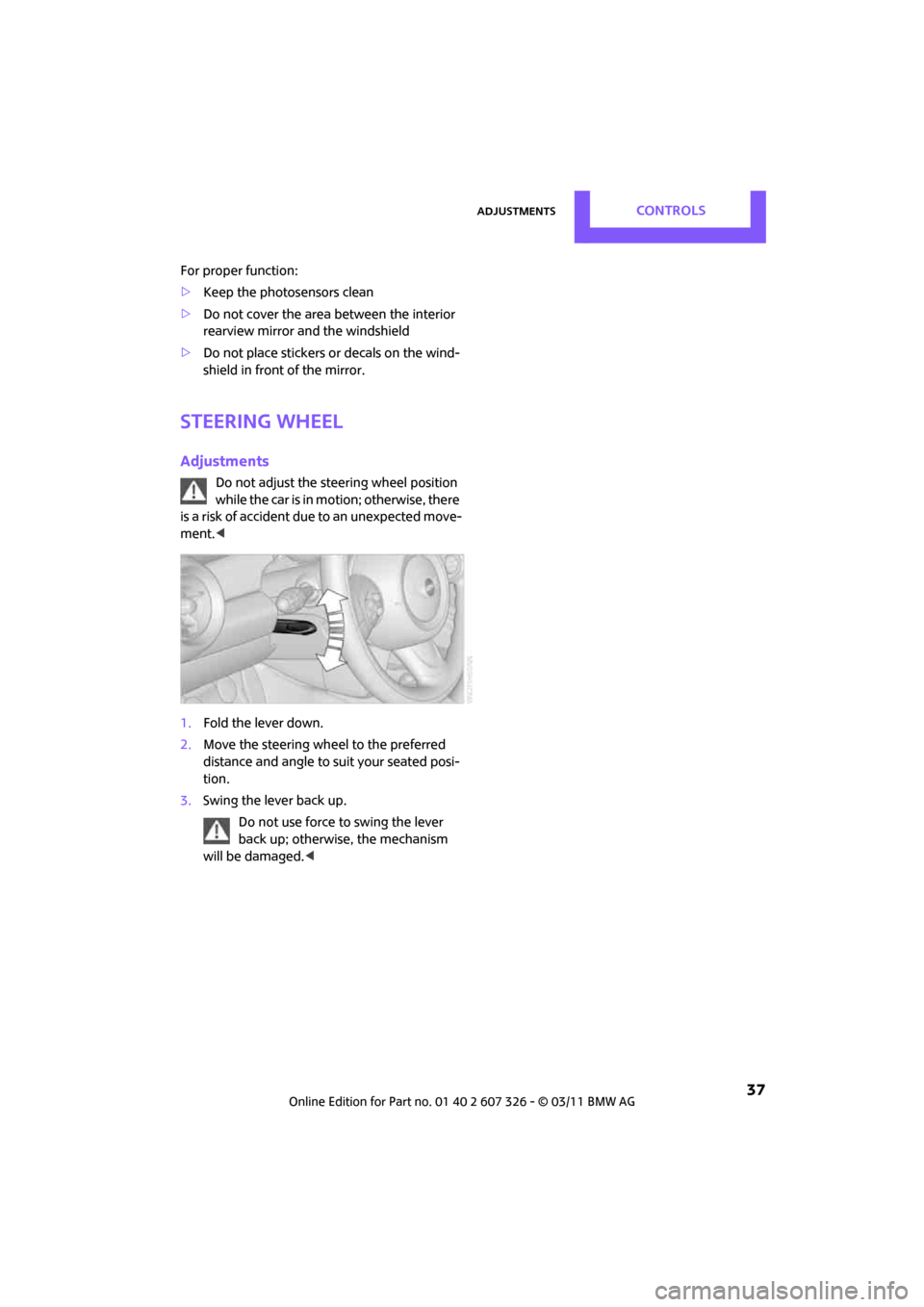
1. Fold the lever down.
2. Move the steering wheel to the preferred
distance and angle to su it your seated posi-
tion.
3. Swing the lever back up.
Do not use force to swing the lever
back up; otherwise, the mechanism
will be damaged. <
Page 49 of 196
DrivingCONTROLS
47
8.Press the button to select:
>
Brief indication of a turn.
> Triple turn signal.
9. Press and hold the butt on until the display
changes. The setting is stored.
Wiper system
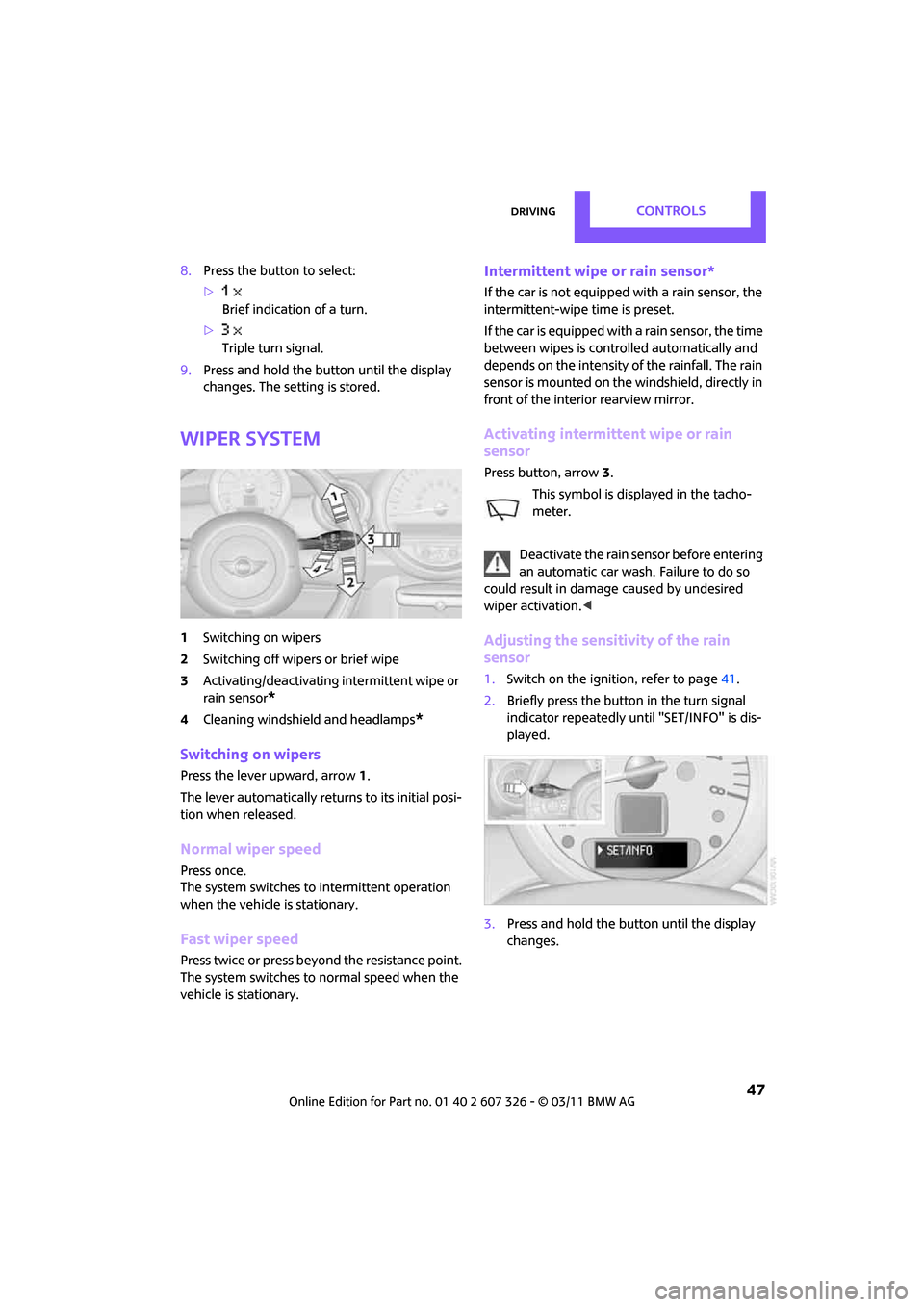
1 Switching on wipers
2 Switching off wipers or brief wipe
3 Activating/deactivating intermittent wipe or
rain sensor
*
4Cleaning windshield and headlamps*
Switching on wipers
Press the lever upward, arrow 1.
The lever automatically returns to its initial posi-
tion when released.
Normal wiper speed
Press once.
The system switches to intermittent operation
when the vehicle is stationary.
Fast wiper speed
Press twice or press beyo nd the resistance point.
The system switches to normal speed when the
vehicle is stationary.
Intermittent wipe or rain sensor*
If the car is not equipped with a rain sensor, the
intermittent-wipe time is preset.
If the car is equipped with a rain sensor, the time
between wipes is contro lled automatically and
depends on the intensity of the rainfall. The rain
sensor is mounted on the windshield, directly in
front of the interior rearview mirror.
Activating intermittent wipe or rain
sensor
Press button, arrow 3.
This symbol is displayed in the tacho-
meter.
Deactivate the rain sensor before entering
an automatic car wash. Failure to do so
could result in damage caused by undesired
wiper activation. <
Adjusting the sensitivity of the rain
sensor
1.Switch on the ignition, refer to page 41.
2. Briefly press the button in the turn signal
indicator repeatedly until "SET/INFO" is dis-
played.
3. Press and hold the butt on until the display
changes.
Page 72 of 196
CONTROLSTechnology for driving comfort and safety
70
Automatic deactivation of the front
passenger airbags
An analysis of the impression in the front pas-
senger seat cushion determines whether and
how the seat is occupied. The front and side air-
bags for the front passenger are activated or
deactivated by the system accordingly.
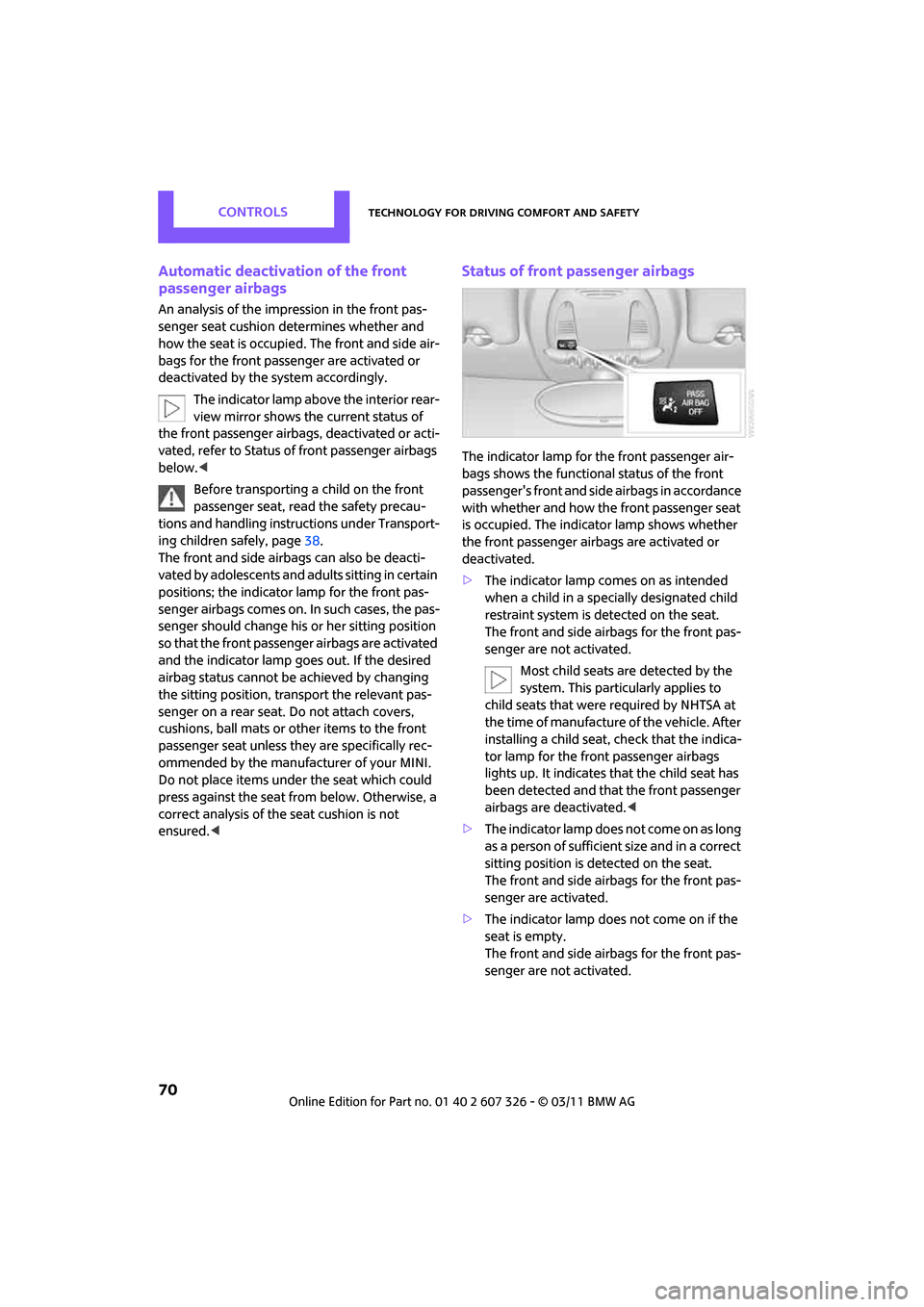
The indicator lamp above the interior rear-
view mirror shows the current status of
the front passenger airbags, deactivated or acti-
vated, refer to Status of front passenger airbags
below. <
Before transporting a child on the front
passenger seat, read the safety precau-
tions and handling instructions under Transport-
ing children safely, page 38.
The front and side airbags can also be deacti-
vated by adolescents and ad ults sitting in certain
positions; the indicator lamp for the front pas-
senger airbags comes on. In such cases, the pas-
senger should change his or her sitting position
so that the front passeng er airbags are activated
and the indicator lamp goes out. If the desired
airbag status cannot be achieved by changing
the sitting position, transport the relevant pas-
senger on a rear seat. Do not attach covers,
cushions, ball mats or other items to the front
passenger seat unless they are specifically rec-
ommended by the manufacturer of your MINI.
Do not place items unde r the seat which could
press against the seat from below. Otherwise, a
correct analysis of th e seat cushion is not
ensured. <
Status of front passenger airbags
The indicator lamp for the front passenger air-
bags shows the functional status of the front
passenger's front and side airbags in accordance
with whether and how the front passenger seat
is occupied. The indica tor lamp shows whether
the front passenger airbags are activated or
deactivated.
> The indicator lamp co mes on as intended
when a child in a specially designated child
restraint system is detected on the seat.
The front and side airbags for the front pas-
senger are not activated.
Most child seats are detected by the
system. This particularly applies to
child seats that were required by NHTSA at
the time of manufacture of the vehicle. After
installing a child seat, check that the indica-
tor lamp for the front passenger airbags
lights up. It indicates that the child seat has
been detected and that the front passenger
airbags are deactivated. <
> T h e i n d i c a t o r l a m p d o e s n o t c o m e o n a s l o n g
as a person of sufficient size and in a correct
sitting position is detected on the seat.
The front and side airbags for the front pas-
senger are activated.
> The indicator lamp does not come on if the
seat is empty.
The front and side airbags for the front pas-
senger are not activated.
Page 98 of 196
DRIVING TIPSThings to remember when driving
96
Loading roof-mounted luggage rack
Because roof racks raise the vehicle's center of
gravity when loaded, they have a major effect
on vehicle handling and steering response.
You should therefore always remember not to
exceed the approved roof load capacity, the
approved gross vehicle weight or the axle loads
when loading the rack.
You can find the applicable data under Weights
on page 178.
The roof load must be distributed uniformly and
should not be too large in area. Heavy items
should always be placed at the bottom.
When loading, make sure that there is sufficient
space for the movement of the glass roof.
Fasten roof-mounted cargo correctly and
securely to prevent it from shifting or falling off
during the trip.
Drive smoothly. Avoid su dden acceleration and
braking maneuvers, and take corners gently.
Saving fuel
Fuel consumption depends on a number of dif-
ferent factors. The implementation of certain
measures, your driving style and regular mainte-
nance can have an influence on fuel consump-
tion and on the environmental impact.
Remove unnecessary cargo
Additional weight incr eases fuel consumption.
Remove attached parts no longer in use
Remove auxiliary mirrors, roof- or rear-mounted
luggage racks whenever you are not using
them.
Attached parts on the ve hicle affect its aerody-
namics and increase fuel consumption.
Check tire inflation pressure regularly
Check and, if necessary, correct tire inflation
pressure at least twice a month and before start-
ing on a long trip. Low inflation pressure increases rolling resis-
tance and thus leads to greater fuel consump-
tion and tire wear.
Drive off immediately
Do not wait for the engine to warm up while the
vehicle remains stationary. Start driving right
away, but at moderate engi
ne speeds. This is the
fastest way for the cold engine to reach its oper-
ating temperature.
Think ahead while driving
Avoid unnecessary acceleration and braking by
maintaining a suitable di stance to the vehicle
driving ahead.
Driving smoothly and an ticipating impending
traffic situations reduces fuel consumption.
Avoid high engine speeds
Use first gear only for driving off. In second and
higher gears, accelerate smoothly to a suitable
engine and road speed. In doing so, avoid high
engine speeds and shift up early.
When you reach your desired traveling speed,
shift to the highest suit able gear and drive at
constant speed.
As a rule: driving at lo w engine speeds lowers
fuel consumption and reduces wear.
Coasting
When approaching a red traffic light, take your
foot off the accelerator and let the vehicle coast
to a halt in the highest suitable gear.
On a downhill gradient, take your foot off the
accelerator and let the vehicle coast in a suitable
gear.
Fuel supply is shut off automatically when the
vehicle is coasting.
Switch off the engine during lengthy
stops
Switch off the engine when stopping for lengthy
periods, e.g. at traffic li ghts, railroad crossings or
in traffic jams.
Page 144 of 196

MOBILITYCare
142
Care
Car-care products
Regular cleaning and care helps to maintain the
value of your MINI.
The manufacturer of your MINI recommends
using manufacturer-approved products to clean
and care for your vehicle.
Your MINI dealer would be pleased to advise
you on cleaning and care products and services
for your MINI.The ingredients of original MINI Care Prod-
ucts have been tested, and the products
have been tested in the laboratory and in prac-
tice. They offer optimum care and protection for
your vehicle. <
Do not use any cleansers containing alco-
hol or solvents as these may cause dam-
age. <
Cleaning agents may contain hazardous
or health-damaging substances. Follow
the warning and hazard instructions on the
packaging. For interior cleaning, always open
the doors or windows of the vehicle.
Do not use any products that are not intended
for cleaning the vehicle. <
External care
Washing your vehicle
Especially during the winter months the
vehicle should be frequently washed. Dirt
and road salt can damage the vehicle. <
After washing the vehicle, apply the
brakes briefly to dry them; otherwise,
water can reduce braking efficiency over the
short term and the brake rotors can corrode. <
Car washes
Preference should be given to cloth car washes. Do not use automatic high-pressure car
washes; otherwise, water may drip into
the vehicle around the windows. <
Before driving in to the car wash, check if the sys-
tem is suitable for your MINI. Observe the fol-
lowing points:
> Vehicle dimensions, page 177
> If necessary: fold in the outside mirrors,
page 36
> Maximum permissible tire width
Avoid car washes with tracks higher than
4 in/10 cm; otherwise, the chassis could
be damaged. <
Preparations for driving into the car wash:
> Unscrew the rod antenna.
> Deactivate the rain sensor
* to prevent unin-
tentional wiping.
> Deactivate the rear window wiper
* and pro-
tect it from damage. Ask the car wash oper-
ator about measures that can be taken to
protect the wipers.
> Remove additional atta chments, e.g. spoil-
ers or telephone antennas, if there is a pos-
sibility that they could be damaged.
> Inserting the remote control into the ignition
lock.
Automatic transmission
Before driving into the car wash, make sure that
the vehicle can roll:
1.Place the remote control, even with Comfort
Access, in the ignition lock.
2. Move the selector le ver to position N.
3. Release the parking brake.
4. Switch off the engine.
5. Insert the remote control in the ignition lock
so that the vehicle can roll.
Page 145 of 196

CareMOBILITY
143
Steam jets/high-pressure washers
When using steam jets or high-pressure
washers, make sure that you maintain suf-
ficient distance from the vehicle and do not
exceed a maximum temperature of 140 7/
60 6 .
If the distance is too close, the pressure too high,
or the temperature too high, parts of the vehicle
can be damaged, or water can penetrate.
Observe the operating in structions for high-
pressure washers. <
Do not spray sensors such as the Park
Distance Control with high-pressure
washers for a long time or at a distance of less
than 1 ft/30 cm. <
Manual washing
Use a great deal of water and, if necessary, car
shampoo when washing your car by hand. Clean
the vehicle with a spon ge or a washing brush
applying a slight amount of pressure.
Before cleaning the windshield, deacti-
vate the rain sensor or turn off the ignition
to prevent unintentional wiping. <
Observe local regulati ons regarding wash-
ing vehicles by hand. <
Headlamps
Do not wipe dry and do not use abrasive or cor-
rosive cleaning agents. Remove dirt and con-
tamination, such as inse cts, by soaking with
shampoo and then washing with plenty of
water.
Do not remove accumula ted ice and snow with
an ice scraper; use window deicers instead.
Windows
Clean the outside and inside of the windows and
mirrors with a window cleaner.
Do not clean the mirrors with cleaners
containing quartz. <
Wiper blades
Clean with soapy water an d change regularly to
prevent the formation of streaks.
Wax, preservatives and dirt on the win-
dows cause streaks when the windshield
wipers are on, and can cause premature wear of
the wiper blades and interfere with the rain sen-
sor. <
Paintwork, care
Regular care helps your vehicle retain its value
and protects the pain t from the long-term
effects of aggressive substances.
In some regions, envi ronmental factors can
affect the vehicl e paintwork and damage it. It is
therefore important to adjust the frequency and
extent of vehicle ca re correspondingly.
Immediately remove aggr essive materials such
as spilled fuel, oil, grease, brake fluid, tree sap or
bird droppings to preven t damage to the paint-
work.
Removing paintwork damage
Depending on the severity of the damage,
immediately repair stone damage or
scratches to prevent rusting. <
The manufacturer of the MINI recommends
repairing paint damage pr ofessionally according
to factory specifications with original MINI
paints.
Preservation
Preservation is necessary when water no longer
beads on the clean paint surface. To preserve
the paint, only use pres ervatives that contain
carnauba or synthetic waxes.
Rubber seals
Only treat with water or rubber care products.
Do not use silicon spra ys or other silicon-
containing care products on rubber seals;
otherwise, noise and damage could occur. <
Page 185 of 196

Everything from A to ZREFERENCE
183
Drive-off assistant, refer to Hill
Assist 63
Driving dynamics control, refer to Sport button 63
Driving lamps, refer to Parking lamps/low beams 72
Driving notes 90
Driving off on inclines, refer to Hill Assist 63
Driving stability control
systems 60
Driving through water 91
Driving tips, refer to Driving
notes 90
Dry air, refer to Cooling function 82
DSC Dynamic Stability Control 61
DTC Dynamic Traction
Control 62
Dynamic Brake Control DBC, refer to Brake Assist 61
Dynamic Stability Control DSC 61
Dynamic Traction Control
DTC 62
E
Eject button 106
Electrical malfunction
– door lock 24
– fuel filler flap 126
Electronic brake-force distribution 61
Electronic Stability Program
ESP, refer to Dynamic
Stability Control DSC 61
Emergency operation, refer to
Manual operation
– door lock 24
– fuel filler flap 126
– transmission lock, automatic transmission 45
Emergency services, refer to
Roadside Assistance 157Engine
– breaking in
90
– data 176
– overheated, refer to Coolant
temperature 139
– speed 176
– starting 42
– starting, Comfort Access 28
– switching off 42
Engine compartment 137
Engine coolant, refer to Coolant 139
Engine oil
– adding 138
– additives, refer to Approved engine oils 138
– alternative oil types 138
– approved engine oils 138
– capacity 138
– checking level 137
– dipstick 137
– intervals between changes,
refer to Service
requirements 56
– MINI Maintenance
System 140
Engine oil level, checking 137
Engine output, refer to Engine
data 176
Engine starting, refer to
Starting the engine 42
ESP Electronic Stability Program, refer to Dynamic
Stability Control DSC 61
Exhaust system, refer to Hot exhaust system 90
Exterior mirrors 36
– adjusting 36
– automatic heating 36
– folding in and out 36
External audio device 85,100
External temperature display
– change units of measure 55
– in the on-board computer 55Eyes
– for tow-
starting and towing
away 159
– for tying down loads 95
F
Failure messages, refer to
Check Control 58
Failure of an electrical
consumer 156
Fast forward
– CD 106
Fastening safety be lts, refer to
Safety belts 35
Fault messages, refer to Check
Control 58
Filter
– microfilter for air
conditioner 80
– microfilter/activated- charcoal filter for automatic
climate control 82
Fine wood, care 145
First aid pouch 157
Fixture for remote control, refer to Ignition lock 41
Flash when locking/
unlocking 22
Flat load floor 94
Flat tire
– run-flat tires 134
– Tire Pressure Monitor TPM 65
Flat Tire Monitor FTM 63
– indicating a flat tire 64
– initializing the system 64
– snow chains 64
– system limits 64
Flat tires, refer to Tire
condition 133
Floor mats, care 144
Floor plate, refe r to Flat load
floor 94
Fog lamps
– replacing bulb 149,150
Folding rear seat backrest 92
Page 186 of 196
REFERENCEEverything from A to Z
184
Footbrake, refer to Braking safely 91
Footwell lamps 76
For your own safety 5
Front airbags 69
Front fog lamps 75
– indicator lamp 161
– replacing bulb 149
Front seat adjustment 33
Frost on windows, refer to
Defrosting windows 80,82
FTM, refer to Flat Tire Monitor 63
Fuel 127
– gauge 51
– high-quality brands 127
– quality 127
– specifications 127
– tank volume 179
Fuel clock, refer to Fuel gauge 51
Fuel consumption display
– average fuel consumption 52
Fuel display, refer to Fuel gauge 51
Fuel filler flap 126
– releasing in the event of electrical malfunction 126
Fuses 156
G
Garage door opener, refer to
Integrated universal remote
control 83
Gasoline
– refer to Average fuel consumption 52
Gasoline display, refer to Fuel
gauge 51
Gasoline, refer to Required fuel 127
Gear indicator
– automatic transmission with Steptronic 44 Gear shifting
– automatic transmission
44
– manual transmission 43
Gearshift lever
– automatic transmission with Steptronic 44
– manual transmission 43
General driving notes 90
Glass roof, electric 30
– convenient operation 22,24
– opening, closing 30
– remote control 22
– tilting 30
Glove compartment 85
Grills, refer to Air vents 78
Gross vehicle weight, refer to
Weights 178
H
Halogen lamps
– replacing bulb 148
Handbrake, refe r to Parking
brake 43
Hands-free system 14,120
Hazard warning flashers 14
HD Radio 103
Head airbags 69
Head Light, refer to Adaptive Light Control 74
Head restraints 34
– sitting safely 32
Headlamp control,
automatic 72
Headlamp flasher 46
– indicator lamp 11,161
Headlamp glass lens 147
Headlamps
– replacing bulb 148
Headlamps, care 143
Heated
– mirrors 36
– rear window 79,81
– seats 35 Heating
78
– mirrors 36
– rear window 79,81
– seats 35
Heavy loads, refer to Stowing cargo 95
Height adjustment
– seats 33
– steering wheel 37
Height, refer to
Dimensions 177
High beams 75
– headlamp flasher 75
– indicator lamp 161
– replacing bulb 148
High water, refer to Driving
through water 91
Hill Assist 63
Hills 91
Holders for cups 87
Homepage 4
Hood 136
Horn 10
Hot exhaust system 90
Hydroplaning 91
I
IBOC, refer to HD Radio 103
Ignition 41
– switched off 42
– switched on 41
Ignition key position 1, refer to
Radio readiness 41
Ignition key position 2, refer to Ignition on 41
Ignition key, refer to Integrated key/remote
control 20
Ignition lock 41
Imprint 2
Incoming call 117
Indicator and warning lamps 13,161
– Tire Pressure Monitor TPM 66
Indicator lighting, refer to Instrument lighting 76