warning light MINI Clubman 2014 Owner's Guide
[x] Cancel search | Manufacturer: MINI, Model Year: 2014, Model line: Clubman, Model: MINI Clubman 2014Pages: 210, PDF Size: 5.12 MB
Page 161 of 210

Socket for OBD Onboard
Diagnosis
Socket for Onboard Diagnosis
The socket for Onboard Diagnosis may
only be used by the service center, by work‐
shops that operate according to the specifica‐
tions of the vehicle manufacturer with appro‐
priately trained personnel, and by other
authorized persons. Otherwise, its use may
lead to vehicle malfunctions. ◀
Primary components in the vehicle emissions
can be checked via the OBD socket using a de‐
vice.
Emissions The warning lamps light up. The vehicle
is producing higher emissions. You can
continue your journey, but moderate
your speed and exercise due caution. Have the
vehicle checked as soon as possible.
Under certain circumstances, one of the lamps
flashes or lights up continuously. This indicates
that there is excessive misfiring or a malfunc‐
tion in the engine. If this happens, reduce the
vehicle speed and drive to the next service cen‐
ter promptly. Serious engine misfiring within a
brief period can seriously damage emission
control components, in particular the catalytic
converter. In addition, the mechanical engine
components may become damaged.
If the fuel filler cap is not properly tight‐
ened, the OBD system may conclude
that fuel vapor is escaping; this will cause a dis‐
play to light up. If the filler cap is then tight‐
ened, the display should go out in a few days.Seite 161MaintenanceMobility161
Online Edition for Part no. 01 40 2 911 429 - VI/13
Page 178 of 210
Manual transmission
Gearshift lever in neutral position.
Automatic transmission Towing vehicles with an automatic trans‐
mission
Only transport vehicles with an automatic
transmission on tow trucks or with raised front
wheels; otherwise, the transmission may be
damaged. ◀
Towing with a tow bar Light towing vehicle
The towing vehicle must not be lighter
than your vehicle, or it will not be possible to
control vehicle response. ◀
Correctly attach the tow bar
Only secure the tow bar on the tow fit‐
tings; damage can occur when it is secured on
other parts of the vehicle. ◀
The tow fittings used should be on the same
side on both vehicles.
Should it prove impossible to avoid mounting
the tow bar at an offset angle, please observe
the following:▷Clearance and maneuvering capability will
be sharply limited during cornering.▷The tow bar will generate lateral forces if it
is attached offset.
Towing with a tow rope
When starting to tow the vehicle, make sure
that the tow rope is taut.
To avoid jerking and the associated stresses on
the vehicle components when towing, always
use nylon ropes or nylon straps.
Attaching the tow rope correctly
Only secure the tow rope on the tow fit‐
ting; otherwise, damage can occur when it is
secured on other parts of the vehicle. ◀
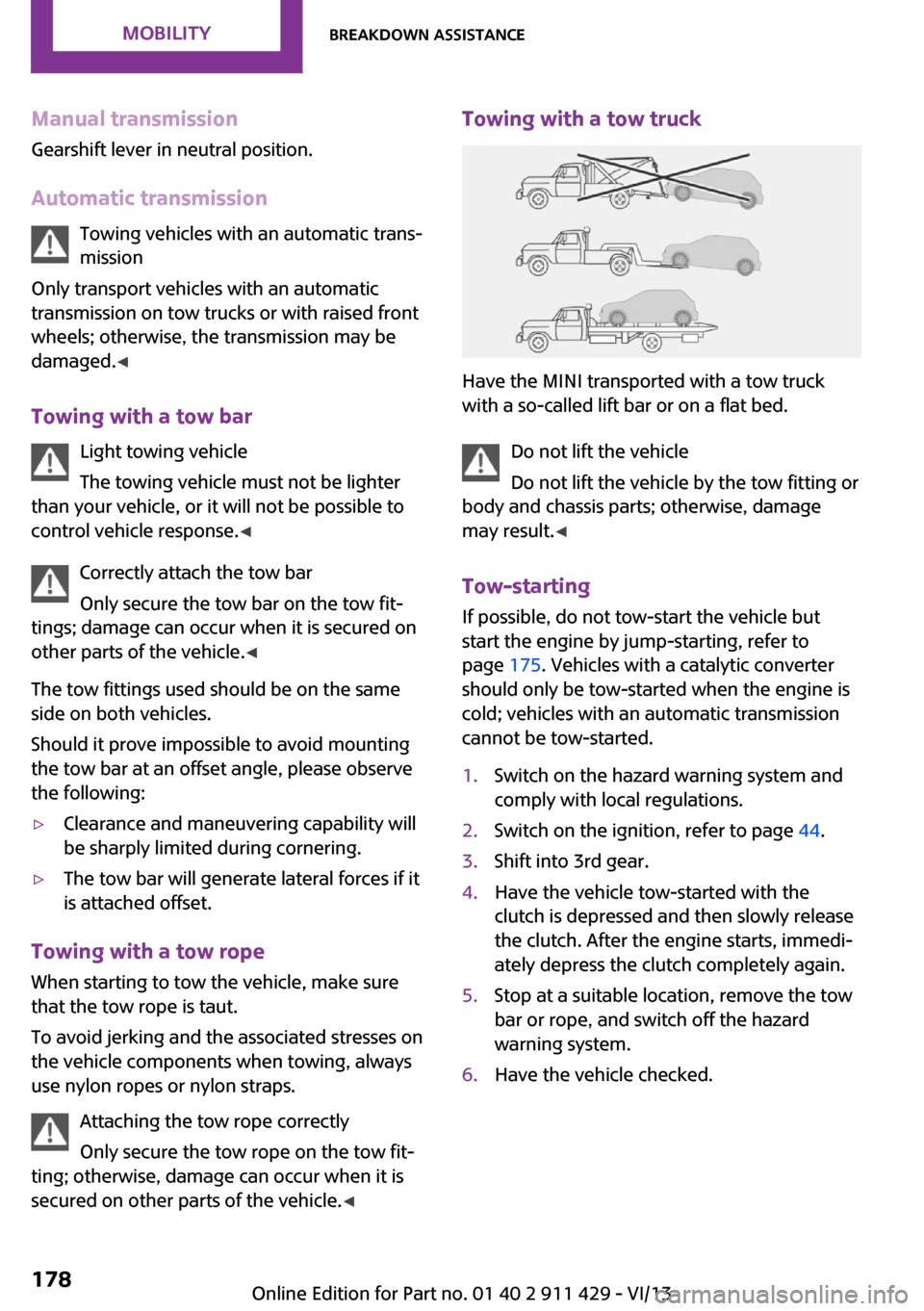
Towing with a tow truck
Have the MINI transported with a tow truck
with a so-called lift bar or on a flat bed.
Do not lift the vehicle
Do not lift the vehicle by the tow fitting or
body and chassis parts; otherwise, damage
may result. ◀
Tow-starting
If possible, do not tow-start the vehicle but
start the engine by jump-starting, refer to
page 175. Vehicles with a catalytic converter
should only be tow-started when the engine is
cold; vehicles with an automatic transmission
cannot be tow-started.
1.Switch on the hazard warning system and
comply with local regulations.2.Switch on the ignition, refer to page 44.3.Shift into 3rd gear.4.Have the vehicle tow-started with the
clutch is depressed and then slowly release
the clutch. After the engine starts, immedi‐
ately depress the clutch completely again.5.Stop at a suitable location, remove the tow
bar or rope, and switch off the hazard
warning system.6.Have the vehicle checked.Seite 178MobilityBreakdown assistance178
Online Edition for Part no. 01 40 2 911 429 - VI/13
Page 183 of 210

Indicator/warning lampsVehicle equipment
This chapter describes all series equipment as
well as country-specific and special equipment
offered for this model series.Therefore, it alsodescribes equipment that may not be found in
your vehicle, for instance due to the selected
special equipment or the country version. This
also applies to safety-related functions and sys‐
tems.
Overview
The indicator and warning lamps can light up in
a variety of combinations and colors in display
area 1 or 2. The table contains information on
causes and how to respond. Note whether a
lamp lights up alone or in combination with an‐
other. Some lamps can light up in different col‐
ors. Corresponding distinctions are made in the
text. 12CauseHow to respondTurn signalThe high beams/headlamp flasher are
switched on.The front fog lamps are switched on.The rear fog lamps are switched on.Fasten safety belts.Fasten safety belt, refer to
page 37.External temperature warningDrive conservatively, refer to
page 54.Lights up briefly:
Approx. 2.1 US gal/8 liters of fuel remain in
the tank.
Remains on:
The remaining range is no more than
30 miles/50 km, refer to page 55.Seite 183Indicator/warning lampsMobility183
Online Edition for Part no. 01 40 2 911 429 - VI/13
Page 184 of 210
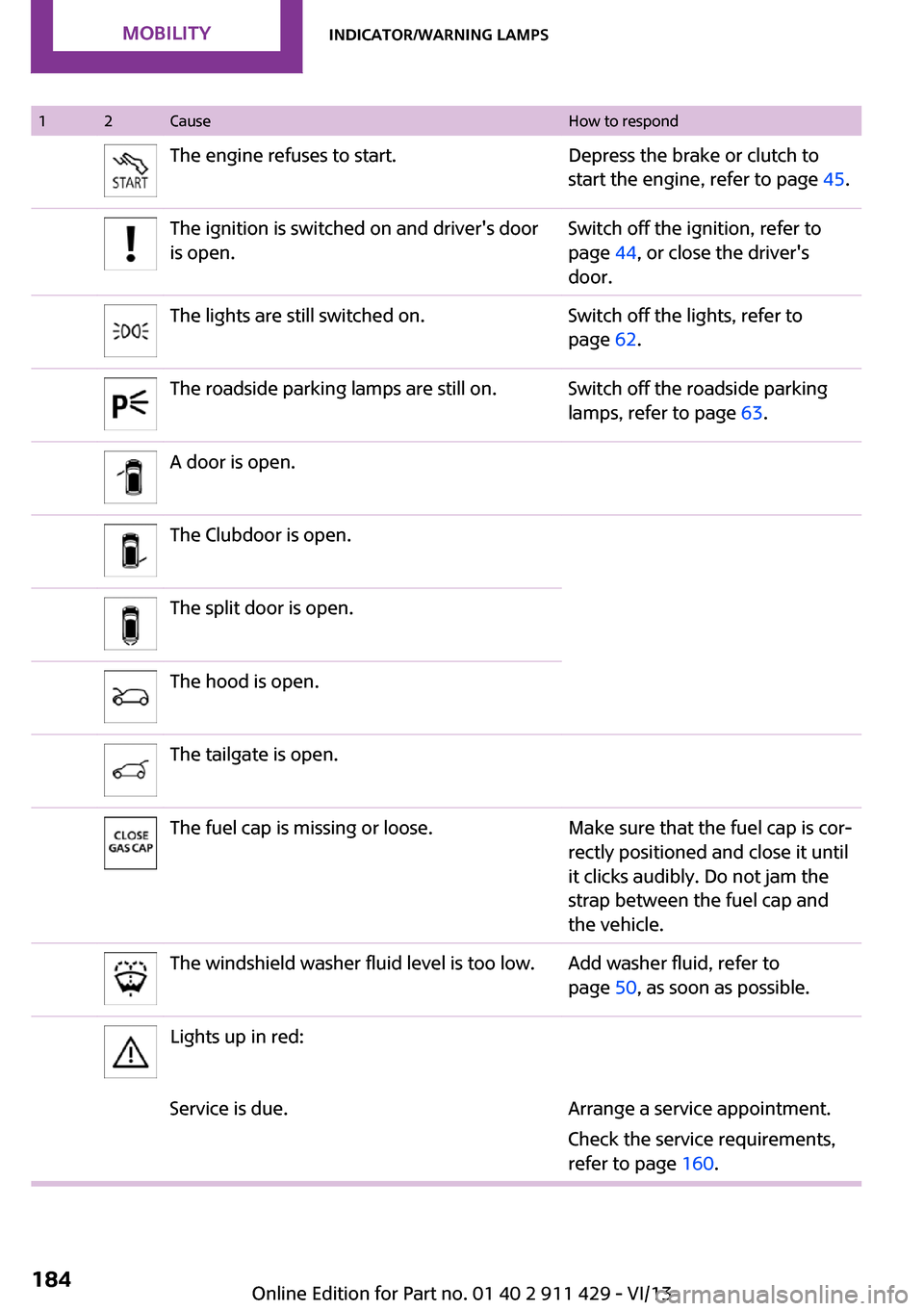
12CauseHow to respondThe engine refuses to start.Depress the brake or clutch to
start the engine, refer to page 45.The ignition is switched on and driver's door
is open.Switch off the ignition, refer to
page 44, or close the driver's
door.The lights are still switched on.Switch off the lights, refer to
page 62.The roadside parking lamps are still on.Switch off the roadside parking
lamps, refer to page 63.A door is open.The Clubdoor is open.The split door is open.The hood is open.The tailgate is open.The fuel cap is missing or loose.Make sure that the fuel cap is cor‐
rectly positioned and close it until
it clicks audibly. Do not jam the
strap between the fuel cap and
the vehicle.The windshield washer fluid level is too low.Add washer fluid, refer to
page 50, as soon as possible.Lights up in red:Service is due.Arrange a service appointment.
Check the service requirements,
refer to page 160.Seite 184MobilityIndicator/warning lamps184
Online Edition for Part no. 01 40 2 911 429 - VI/13
Page 185 of 210
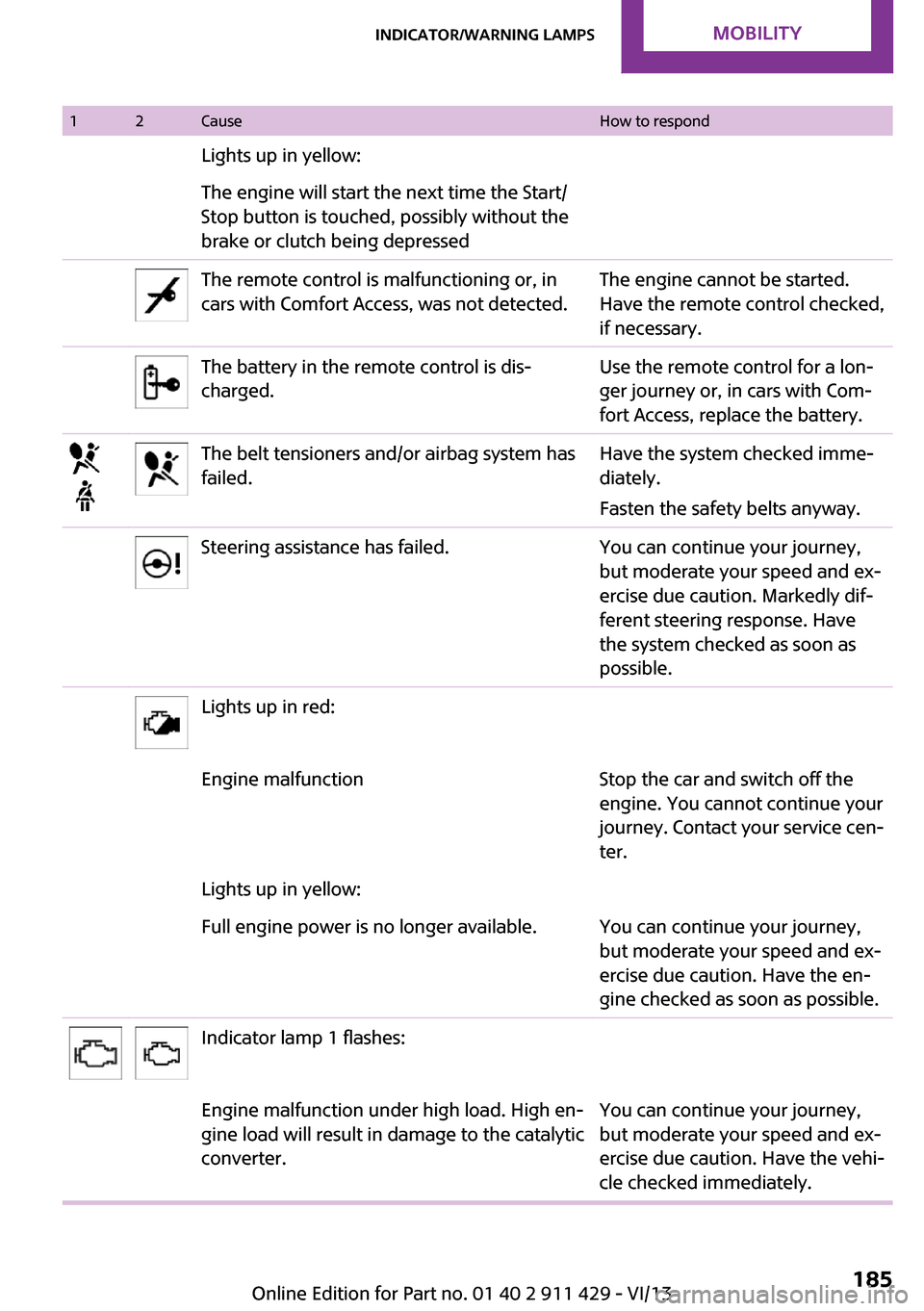
12CauseHow to respondLights up in yellow:The engine will start the next time the Start/
Stop button is touched, possibly without the
brake or clutch being depressedThe remote control is malfunctioning or, in
cars with Comfort Access, was not detected.The engine cannot be started.
Have the remote control checked,
if necessary.The battery in the remote control is dis‐
charged.Use the remote control for a lon‐
ger journey or, in cars with Com‐
fort Access, replace the battery.The belt tensioners and/or airbag system has
failed.Have the system checked imme‐
diately.
Fasten the safety belts anyway.Steering assistance has failed.You can continue your journey,
but moderate your speed and ex‐
ercise due caution. Markedly dif‐
ferent steering response. Have
the system checked as soon as
possible.Lights up in red:Engine malfunctionStop the car and switch off the
engine. You cannot continue your
journey. Contact your service cen‐
ter.Lights up in yellow:Full engine power is no longer available.You can continue your journey,
but moderate your speed and ex‐
ercise due caution. Have the en‐
gine checked as soon as possible.Indicator lamp 1 flashes:Engine malfunction under high load. High en‐
gine load will result in damage to the catalytic
converter.You can continue your journey,
but moderate your speed and ex‐
ercise due caution. Have the vehi‐
cle checked immediately.Seite 185Indicator/warning lampsMobility185
Online Edition for Part no. 01 40 2 911 429 - VI/13
Page 186 of 210
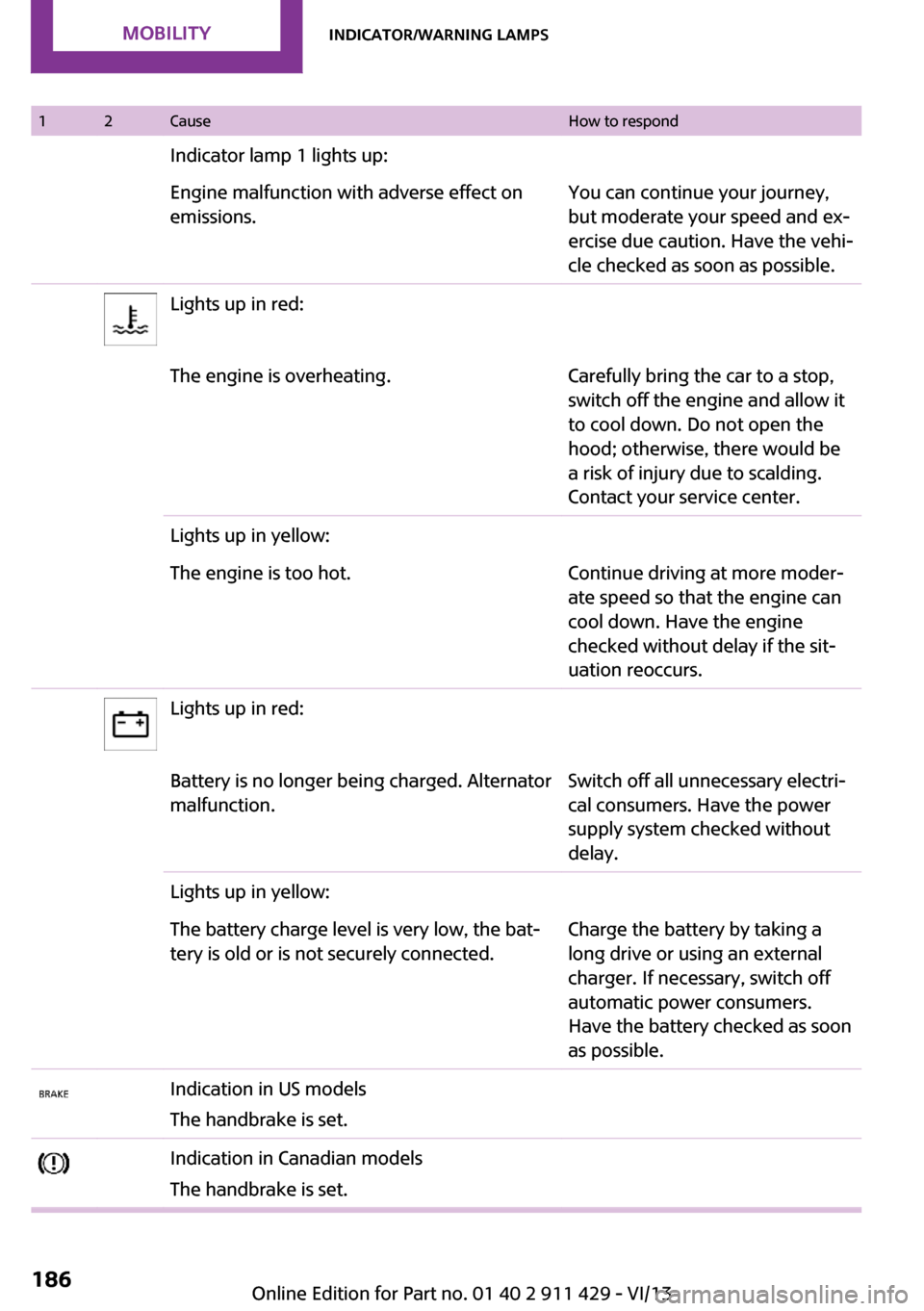
12CauseHow to respondIndicator lamp 1 lights up:Engine malfunction with adverse effect on
emissions.You can continue your journey,
but moderate your speed and ex‐
ercise due caution. Have the vehi‐
cle checked as soon as possible.Lights up in red:The engine is overheating.Carefully bring the car to a stop,
switch off the engine and allow it
to cool down. Do not open the
hood; otherwise, there would be
a risk of injury due to scalding.
Contact your service center.Lights up in yellow:The engine is too hot.Continue driving at more moder‐
ate speed so that the engine can
cool down. Have the engine
checked without delay if the sit‐
uation reoccurs.Lights up in red:Battery is no longer being charged. Alternator
malfunction.Switch off all unnecessary electri‐
cal consumers. Have the power
supply system checked without
delay.Lights up in yellow:The battery charge level is very low, the bat‐
tery is old or is not securely connected.Charge the battery by taking a
long drive or using an external
charger. If necessary, switch off
automatic power consumers.
Have the battery checked as soon
as possible.Indication in US models
The handbrake is set.Indication in Canadian models
The handbrake is set.Seite 186MobilityIndicator/warning lamps186
Online Edition for Part no. 01 40 2 911 429 - VI/13
Page 187 of 210

12CauseHow to respondIndication in US models
The handbrake is set while driving.Release the handbrake.Indication in Canadian models
The handbrake is set while driving.Release the handbrake.Indication in US modelsLights up in red:
The brake fluid level is too low.Reduced braking effect, stop the
car carefully. Contact the nearest
service center.Indication in Canadian modelsLights up in red:
The brake fluid level is too low.Reduced braking effect, stop the
car carefully. Contact the nearest
service center.Indication in US models.Brake pads worn.Have the condition of the brake
pads checked without delay.Indication in Canadian modelsBrake pads worn.Have the condition of the brake
pads checked without delay.Indication in US modelsThe vehicle electronics have failed.You cannot continue your jour‐
ney. Contact your service center.Seite 187Indicator/warning lampsMobility187
Online Edition for Part no. 01 40 2 911 429 - VI/13
Page 188 of 210
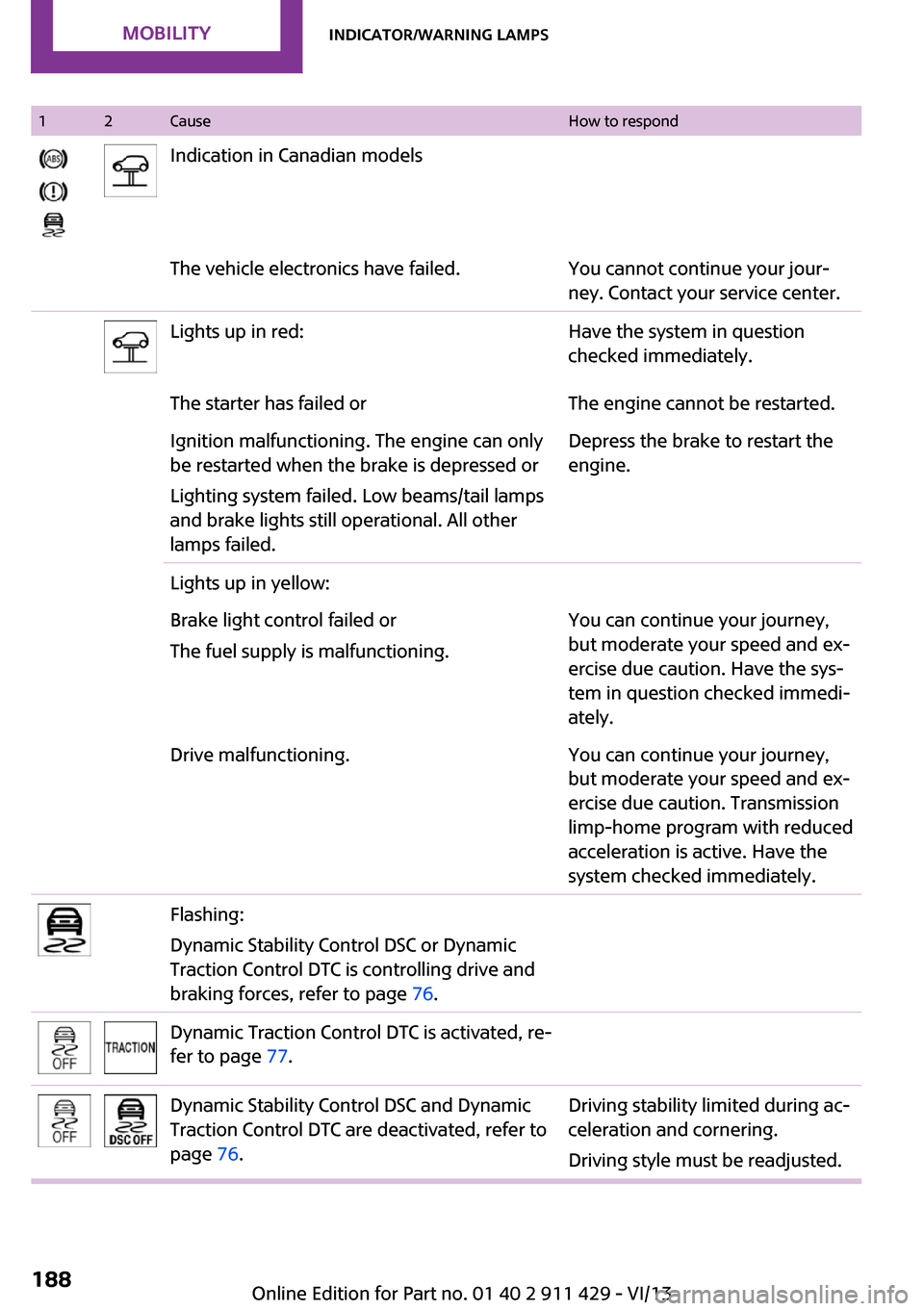
12CauseHow to respondIndication in Canadian modelsThe vehicle electronics have failed.You cannot continue your jour‐
ney. Contact your service center.Lights up in red:Have the system in question
checked immediately.The starter has failed orThe engine cannot be restarted.Ignition malfunctioning. The engine can only
be restarted when the brake is depressed or
Lighting system failed. Low beams/tail lamps
and brake lights still operational. All other
lamps failed.Depress the brake to restart the
engine.Lights up in yellow:Brake light control failed or
The fuel supply is malfunctioning.You can continue your journey,
but moderate your speed and ex‐
ercise due caution. Have the sys‐
tem in question checked immedi‐
ately.Drive malfunctioning.You can continue your journey,
but moderate your speed and ex‐
ercise due caution. Transmission
limp-home program with reduced
acceleration is active. Have the
system checked immediately.Flashing:
Dynamic Stability Control DSC or Dynamic
Traction Control DTC is controlling drive and
braking forces, refer to page 76.Dynamic Traction Control DTC is activated, re‐
fer to page 77.Dynamic Stability Control DSC and Dynamic
Traction Control DTC are deactivated, refer to
page 76.Driving stability limited during ac‐
celeration and cornering.
Driving style must be readjusted.Seite 188MobilityIndicator/warning lamps188
Online Edition for Part no. 01 40 2 911 429 - VI/13
Page 189 of 210

12CauseHow to respondDynamic Stability Control DSC and Dynamic
Traction Control DTC failed.Driving stability limited during ac‐
celeration and cornering.
You can continue your journey,
but moderate your speed and ex‐
ercise due caution. Have the sys‐
tem checked as soon as possible.Indication in US modelsThe driving stability control systems including
ABS and the Tire Pressure Monitor display
have failed, refer to page 76.Reduced braking and driving sta‐
bility. Drive cautiously and defen‐
sively. Avoid full brake applica‐
tion, operation on poor roads,
and use of the full throttle and
kickdown positions of the acceler‐
ator. Have the system checked
immediately.Indication in Canadian modelsThe driving stability control systems including
ABS and the Flat Tire Monitor or the Tire Pres‐
sure Monitor have failed, refer to page 76.Reduced braking and driving sta‐
bility. Drive cautiously and defen‐
sively. Avoid full brake applica‐
tion, operation on poor roads,
and use of full throttle and kick‐
down positions of the accelerator.
Have the system checked imme‐
diately.In vehicles with the Flat Tire MonitorLight up in yellow and red:A tire is deflated.Carefully bring the car to a stop.
Additional information, refer to
page 69.Seite 189Indicator/warning lampsMobility189
Online Edition for Part no. 01 40 2 911 429 - VI/13
Page 190 of 210

12CauseHow to respondThe Flat Tire Monitor was not initialized.Initialize the Flat Tire Monitor, re‐
fer to page 69.Light up in yellow:Flat Tire Monitor failed. Punctures are not in‐
dicated.Have the system checked.In vehicles with the Tire Pressure MonitorLight up in yellow and red:There is a flat tire or substantial loss of tire
pressure.Carefully bring the car to a stop.
Additional information, refer to
page 72.In vehicles with the Tire Pressure MonitorLight up in yellow:Tire Pressure Monitor not initialized.Check the inflation pressure and
reset the system, refer to
page 72.The small lamp flashes yellow and then stays
on, the large lamp lights up in yellow:Tire Pressure Monitor failed. Punctures are
not indicated.Have the system checked.A wheel without TPM electronics is mounted.Have the system checked.TPM is temporarily malfunctioning due to
other systems or devices using the same
radio frequency.In vehicles with the Tire Pressure MonitorThe small lamp flashes yellow and then stays
on, the large lamp lights up in yellow:Tire Pressure Monitor failed. Punctures are
not indicated.Have the system checked.A wheel without TPM electronics is mounted.Have the system checked.Lights up in red:Seite 190MobilityIndicator/warning lamps190
Online Edition for Part no. 01 40 2 911 429 - VI/13