lock MINI Clubman 2014 Service Manual
[x] Cancel search | Manufacturer: MINI, Model Year: 2014, Model line: Clubman, Model: MINI Clubman 2014Pages: 210, PDF Size: 5.12 MB
Page 169 of 210
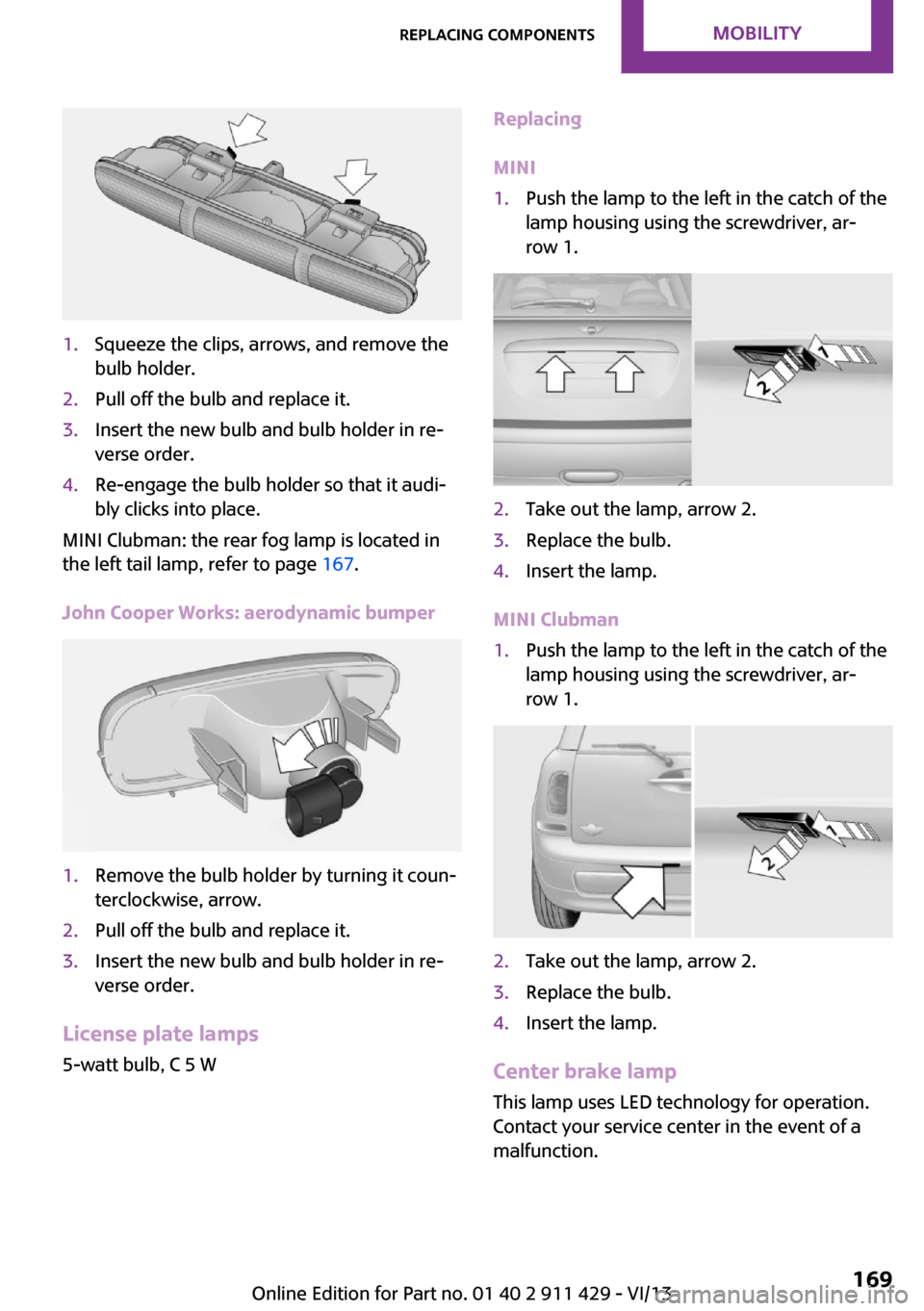
1.Squeeze the clips, arrows, and remove the
bulb holder.2.Pull off the bulb and replace it.3.Insert the new bulb and bulb holder in re‐
verse order.4.Re-engage the bulb holder so that it audi‐
bly clicks into place.
MINI Clubman: the rear fog lamp is located in
the left tail lamp, refer to page 167.
John Cooper Works: aerodynamic bumper
1.Remove the bulb holder by turning it coun‐
terclockwise, arrow.2.Pull off the bulb and replace it.3.Insert the new bulb and bulb holder in re‐
verse order.
License plate lamps
5-watt bulb, C 5 W
Replacing
MINI1.Push the lamp to the left in the catch of the
lamp housing using the screwdriver, ar‐
row 1.2.Take out the lamp, arrow 2.3.Replace the bulb.4.Insert the lamp.
MINI Clubman
1.Push the lamp to the left in the catch of the
lamp housing using the screwdriver, ar‐
row 1.2.Take out the lamp, arrow 2.3.Replace the bulb.4.Insert the lamp.
Center brake lamp
This lamp uses LED technology for operation.
Contact your service center in the event of a
malfunction.
Seite 169Replacing componentsMobility169
Online Edition for Part no. 01 40 2 911 429 - VI/13
Page 170 of 210
Changing wheelsNotes
Wheel change for run-flat tires:▷Prepare for the wheel change, refer to
page 171.▷Jack up the vehicle, refer to page 171.▷Tighten the lug bolts, refer to page 172.
Compact wheel
Wheel change with a compact wheel:
▷Remove the compact wheel, refer to
page 170.▷Prepare for the wheel change, refer to
page 171.▷Jack up the vehicle, refer to page 171.▷Mount the compact wheel, refer to
page 172.▷Tighten the lug bolts, refer to page 172.▷Drive with the compact wheel, refer to
page 171.
MINI: removing the compact wheel
The screw fitting of the compact wheel is lo‐
cated in the cargo area under the floor mat, on
the floor of the storage compartment holding
the wheel change set.
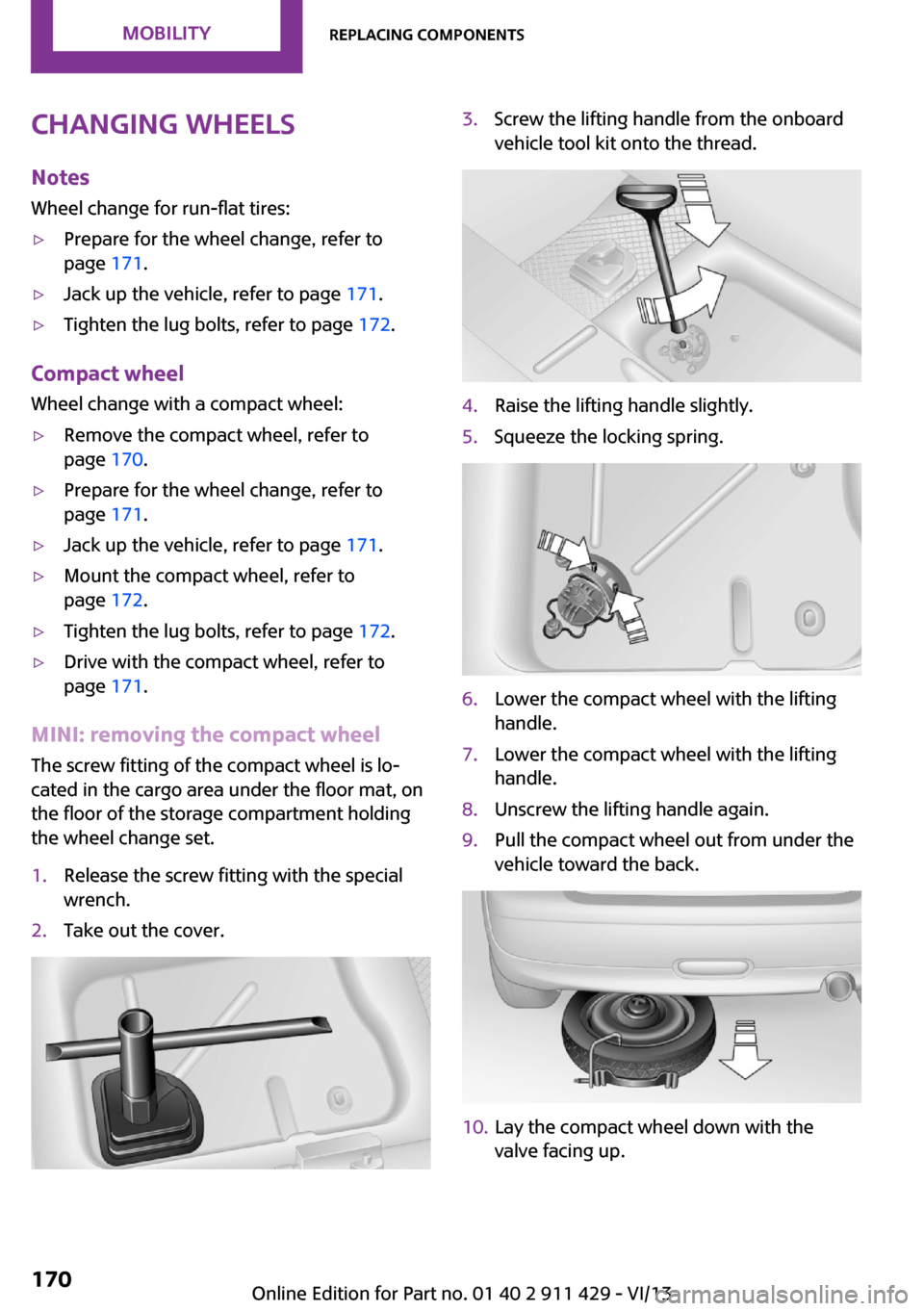
1.Release the screw fitting with the special
wrench.2.Take out the cover.3.Screw the lifting handle from the onboard
vehicle tool kit onto the thread.4.Raise the lifting handle slightly.5.Squeeze the locking spring.6.Lower the compact wheel with the lifting
handle.7.Lower the compact wheel with the lifting
handle.8.Unscrew the lifting handle again.9.Pull the compact wheel out from under the
vehicle toward the back.10.Lay the compact wheel down with the
valve facing up.Seite 170MobilityReplacing components170
Online Edition for Part no. 01 40 2 911 429 - VI/13
Page 171 of 210
11.Unscrew the valve extension from the valve
of the compact wheel.12.Unscrew the dust cap from the extension
and attach it to the valve of the compact
wheel.
The defective wheel cannot be stowed in the
compact wheel holder because it has a differ‐
ent size.
MINI Clubman: removing the compact
wheel
The compact wheel is located under the wheel
change set in the cargo area.
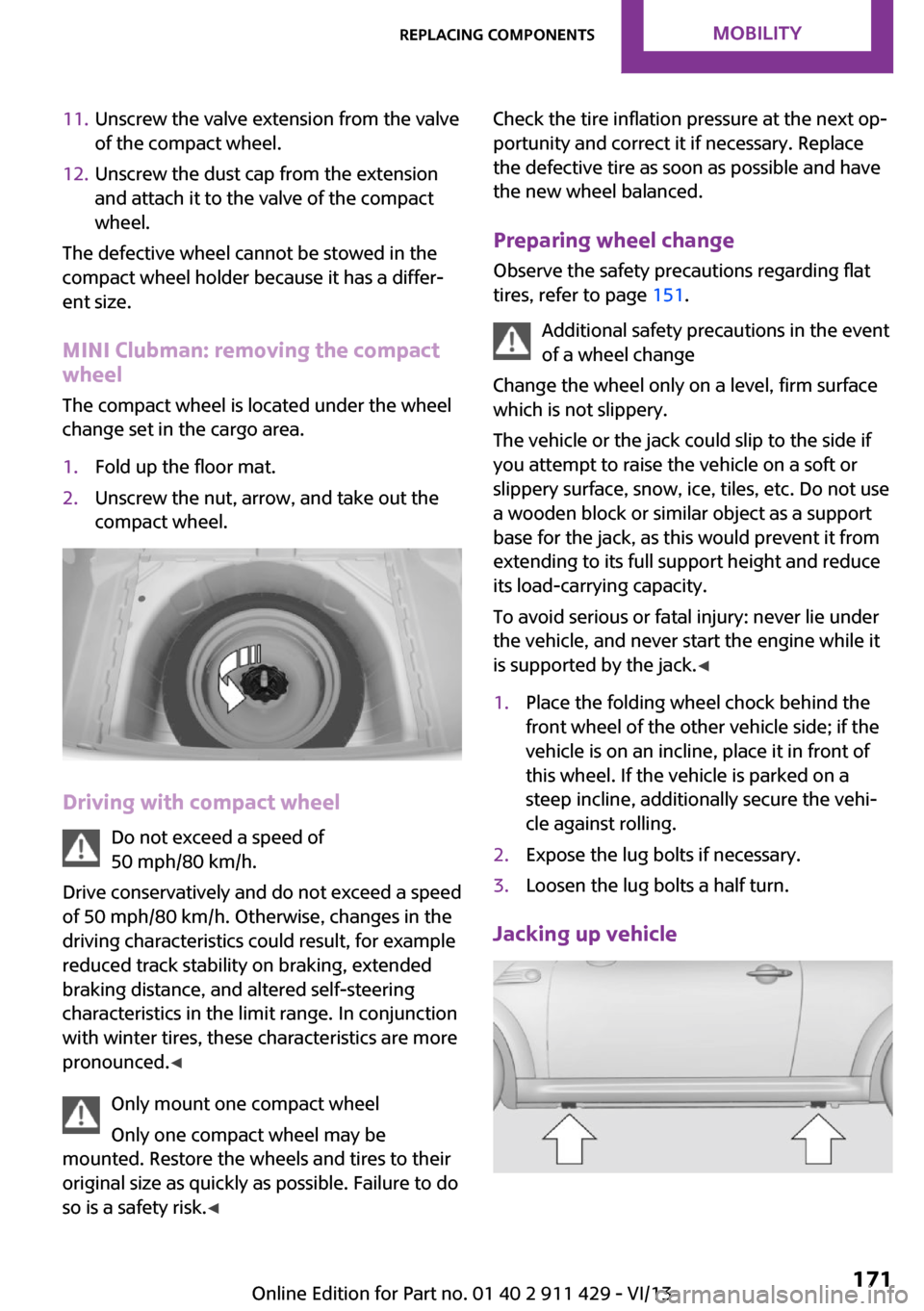
1.Fold up the floor mat.2.Unscrew the nut, arrow, and take out the
compact wheel.
Driving with compact wheel
Do not exceed a speed of
50 mph/80 km/h.
Drive conservatively and do not exceed a speed
of 50 mph/80 km/h. Otherwise, changes in the
driving characteristics could result, for example
reduced track stability on braking, extended
braking distance, and altered self-steering
characteristics in the limit range. In conjunction
with winter tires, these characteristics are more
pronounced. ◀
Only mount one compact wheel
Only one compact wheel may be
mounted. Restore the wheels and tires to their
original size as quickly as possible. Failure to do
so is a safety risk. ◀
Check the tire inflation pressure at the next op‐
portunity and correct it if necessary. Replace
the defective tire as soon as possible and have
the new wheel balanced.
Preparing wheel change
Observe the safety precautions regarding flat
tires, refer to page 151.
Additional safety precautions in the event
of a wheel change
Change the wheel only on a level, firm surface
which is not slippery.
The vehicle or the jack could slip to the side if
you attempt to raise the vehicle on a soft or
slippery surface, snow, ice, tiles, etc. Do not use
a wooden block or similar object as a support
base for the jack, as this would prevent it from
extending to its full support height and reduce
its load-carrying capacity.
To avoid serious or fatal injury: never lie under
the vehicle, and never start the engine while it
is supported by the jack. ◀1.Place the folding wheel chock behind the
front wheel of the other vehicle side; if the
vehicle is on an incline, place it in front of
this wheel. If the vehicle is parked on a
steep incline, additionally secure the vehi‐
cle against rolling.2.Expose the lug bolts if necessary.3.Loosen the lug bolts a half turn.
Jacking up vehicle
Seite 171Replacing componentsMobility171
Online Edition for Part no. 01 40 2 911 429 - VI/13
Page 173 of 210

Charging the battery
Note Do not connect the charger to the socket
Do not connect the battery charger to the
socket installed in the vehicle at the factory as this could damage the battery. ◀
Only charge the battery in the vehicle when the
engine is switched off. Connections, refer to
page 175.
General information
Ensure that the battery is sufficiently charged to
achieve the full battery life.
It may be necessary to charge the battery in
the following cases:▷When the vehicle is frequently used to
travel short distances.▷When the vehicle has not been driven for
more than one month.
Power failure
After a temporary power failure, some equip‐
ment will be restricted in its use and will need
to be reinitialized. In addition, certain individual
settings will be lost and must be updated:
▷Time and date: the values must be up‐
dated, refer to page 58.▷Radio: the stations need to be stored again,
refer to page 116.▷Glass sunroof, electrical: it may only be pos‐
sible to tilt the roof. The system needs to be
initialized. Contact the service center.
Disposing of old batteries
Have used batteries disposed of by the
service center after they are replaced or
take them to a recycling center.
Maintain the battery in an upright position for
transport and storage. Secure the battery so
that it does not tip over during transport.
Fuses
Replacing fuses
Never attempt to repair a blown fuse and
do not replace a defective fuse with a substi‐
tute of another color or amperage rating; this
could lead to a circuit overload, ultimately re‐
sulting in a fire in the vehicle. ◀
Fuses should be replaced by the service center.
Information on the fuses can be found on the
inside of the covers.
In the engine compartment
Opening the cover
Press the snap lock.
In interior
On the right side of the footwell.
Opening the cover
Push out at the recess.
Seite 173Replacing componentsMobility173
Online Edition for Part no. 01 40 2 911 429 - VI/13
Page 175 of 210

MINI Clubman
The first aid kit is located in the left side trim on
the cargo area floor or under the flat loading
floor.
Roadside Assistance
Service availability Roadside Assistance can be reached around the
clock in many countries. You can obtain assis‐
tance there in the event of a vehicle break‐
down.
Roadside Assistance A phone number for Roadside Assistance can
be displayed, refer to page 132, via the radio.
Jump-starting NotesIf the battery is discharged, the engine can be
started using the battery of another vehicle and
two jumper cables. In the same way, you can
help jump-start another vehicle. Only use
jumper cables with fully insulated clamp han‐
dles.
To prevent personal injury or damage to both
vehicles, adhere strictly to the following proce‐
dure.
Do not touch live parts
To avoid the risk of potentially fatal injury,
always avoid all contact with electrical compo‐
nents while the engine is running. ◀
Preparation1.Check whether the battery of the other ve‐
hicle has a voltage of 12 volts and approxi‐
mately the same capacitance in Ah. This in‐
formation can be found on the battery.2.Switch off the engine of the assisting vehi‐
cle.3.Switch off any electronic systems/power
consumers in both vehicles.
Bodywork contact between vehicles
There must not be any contact between
the bodies of the two vehicles, otherwise there
is a danger of shorting. ◀
Seite 175Breakdown assistanceMobility175
Online Edition for Part no. 01 40 2 911 429 - VI/13
Page 176 of 210

Connecting jumper cablesConnecting order
Connect the jumper cables in the correct
order; otherwise, there is the danger of injury
from sparking. ◀1.Open the battery cover in the engine com‐
partment to access the positive terminal.2.Unlock the tabs of the positive terminal
cover on the left and right, arrows 1, and
raise the cover, arrow 2.3.Attach one terminal clamp of the positive
jumper cable to the positive terminal of the
battery or to a starting aid terminal of the
vehicle providing assistance.4.Attach the second clamp of the positive
jumper cable to the positive terminal of the
battery of the vehicle to be started.5.Attach one terminal clamp of the negative
jumper cable to the negative terminal of
the battery, or to the corresponding engine
or body ground of the vehicle providing as‐
sistance.6.Attach the second clamp of the negative
jumper cable to the negative terminal ofthe battery, or to the engine or body
ground of the vehicle to be started.
Body ground:
Starting the engine
Never use spray fluids to start the engine.
1.Start the engine of the assisting vehicle and
let it run for several minutes at a slightly in‐
creased idle speed.2.Start the engine of the vehicle being started
in the usual way.
If the first starting attempt is not successful,
wait a few minutes before making another
attempt in order to allow the discharged
battery to recharge.3.Let both engines run for several minutes.4.Disconnect the jumper cables in the reverse
order.
Check the battery and recharge if necessary.
Tow-starting and towing
Notes Observe applicable laws and regulations
Observe applicable laws and regulations
for tow-starting and towing. ◀
No additional passengers
Do not transport any passengers other
than the driver in a vehicle that is being
towed. ◀
Seite 176MobilityBreakdown assistance176
Online Edition for Part no. 01 40 2 911 429 - VI/13
Page 180 of 210
▷Remove additional attachments, for in‐
stance a spoiler or telephone antenna, if
there is a risk that these may be damaged.▷Insert the remote control into the ignition
lock.
Automatic transmission
Before driving into the car wash, note the fol‐
lowing to ensure that the vehicle can roll:
1.Insert the remote control into the ignition
lock, even with Comfort Access.2.Move the selector lever to position N.3.Release the handbrake.4.Switch the engine off.5.Leave the remote control in the ignition
lock so that the vehicle can roll.
Hand car wash
If washing the vehicle by hand, use copious
quantities of water and car shampoo if neces‐
sary. Clean the vehicle with a sponge or a
washing brush by applying gentle pressure.
Before cleaning the windshield, deactivate the
rain sensor to avoid unintentional wiper activa‐
tion or switch off the ignition.
Adhere to the local regulations regarding
washing cars by hand.
Headlamps
Do not rub dry and do not use abrasive or caus‐
tic cleansers. Soak areas that have been soiled,
e.g., due to insects, with shampoo and rinse off
with copious quantities of water.
Thaw ice with a window deicer; do not use an
ice scraper.
Windows Clean the outside and inside surfaces of the
windows and the mirror glasses with window
cleaner.
Do not clean mirror glass with cleaners contain‐
ing quartz.
Wiper blades
Clean with soapy water and replace regularly to
avoid streaking.
Wax and preservative residue and soiling on
the windows cause streaking during window
wiping and lead to premature wear on the
wiper blades and malfunctions of the rain sen‐
sor.
Vehicle care Car care products
Regular cleaning and care contributes signifi‐
cantly to vehicle value retention.
The manufacturer recommends using cleaning
and care products from MINI, since these have
been tested and approved.
Original MINI CareProducts have been tested
on materials, in the laboratory, and in the field,
and offer optimum care and protection for MINI
vehicles.
Do not use cleansers that contain alcohol
or solvents
Do not use cleansers that contain alcohol or
solvents, such as lacquer thinners, heavy-duty
grease removers, fuel, or such; this could lead
to surface damage. ◀
Car care and cleaning products
Follow the instructions on the container.
When cleaning the interior, open the doors or
windows.
Only use products intended for cleaning vehi‐
cles.
Cleansers can contain substances that are dan‐
gerous and harmful to your health. ◀Seite 180MobilityCare180
Online Edition for Part no. 01 40 2 911 429 - VI/13
Page 191 of 210
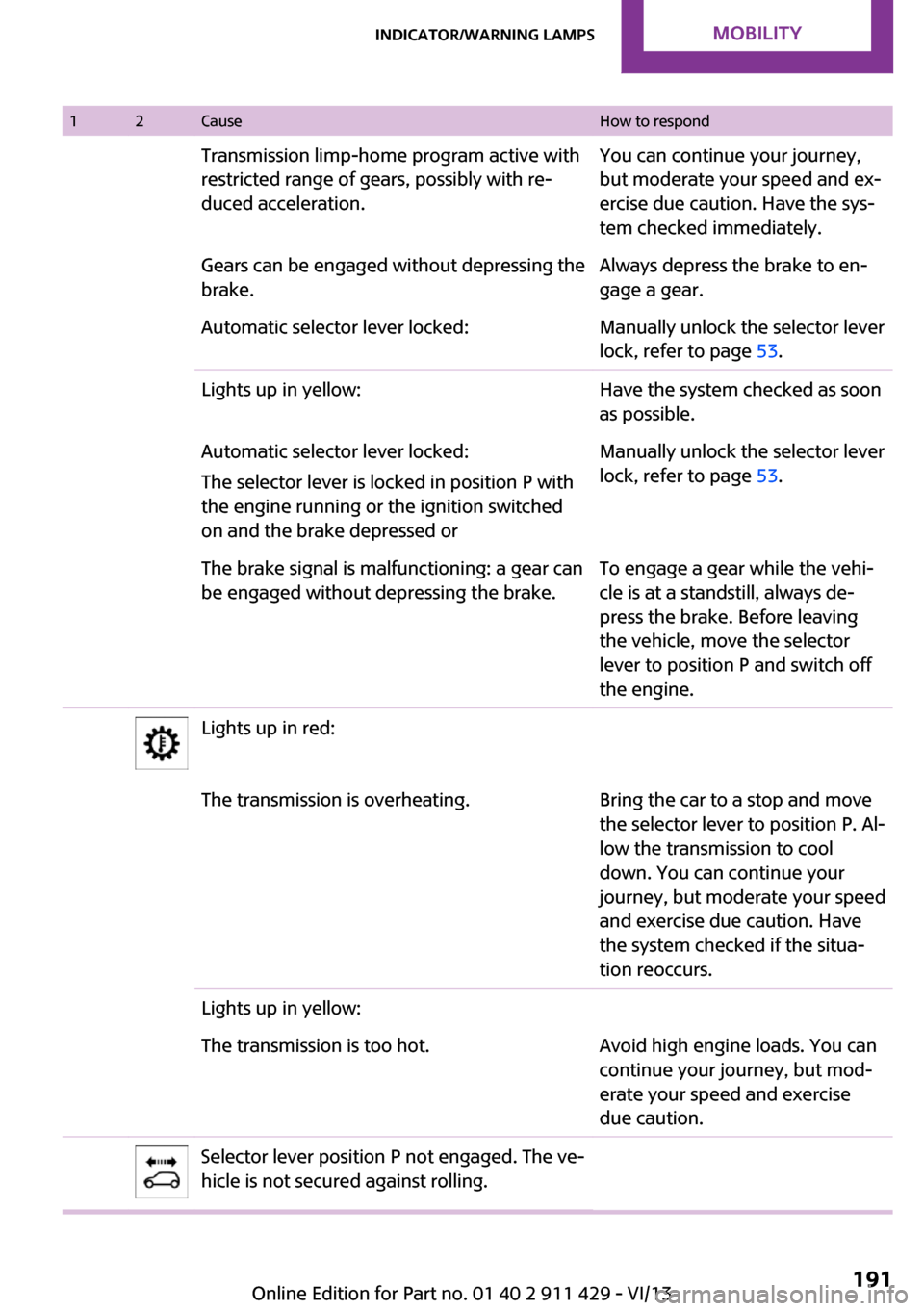
12CauseHow to respondTransmission limp-home program active with
restricted range of gears, possibly with re‐
duced acceleration.You can continue your journey,
but moderate your speed and ex‐
ercise due caution. Have the sys‐
tem checked immediately.Gears can be engaged without depressing the
brake.Always depress the brake to en‐
gage a gear.Automatic selector lever locked:Manually unlock the selector lever
lock, refer to page 53.Lights up in yellow:Have the system checked as soon
as possible.Automatic selector lever locked:
The selector lever is locked in position P with
the engine running or the ignition switched
on and the brake depressed orManually unlock the selector lever
lock, refer to page 53.The brake signal is malfunctioning: a gear can
be engaged without depressing the brake.To engage a gear while the vehi‐
cle is at a standstill, always de‐
press the brake. Before leaving
the vehicle, move the selector
lever to position P and switch off
the engine.Lights up in red:The transmission is overheating.Bring the car to a stop and move
the selector lever to position P. Al‐
low the transmission to cool
down. You can continue your
journey, but moderate your speed
and exercise due caution. Have
the system checked if the situa‐
tion reoccurs.Lights up in yellow:The transmission is too hot.Avoid high engine loads. You can
continue your journey, but mod‐
erate your speed and exercise
due caution.Selector lever position P not engaged. The ve‐
hicle is not secured against rolling.Seite 191Indicator/warning lampsMobility191
Online Edition for Part no. 01 40 2 911 429 - VI/13
Page 200 of 210
Everything from A to ZIndexA
ABS, Antilock Brake Sys‐ tem 76
Acoustic signal, refer to Check Control 60
Activated charcoal filter with automatic climate con‐
trol 86
Adaptive Light Control 64
Additives, engine oil 158
Airbags 67
Airbags, indicator/warning light 69
Air circulation, refer to Recir‐ culated air mode 83, 85
Air conditioner 82
Air conditioning 82
Air conditioning mode– Air conditioner 82– Automatic climate con‐
trol 84
Air distribution
– Automatic 85– Individual 83– Manual 83, 85
Air drying, refer to Cooling
function 86
Air flow rate 82, 85
Air pressure, refer to Tire infla‐ tion pressure 142
Air supply
– Air conditioner 82– Automatic climate con‐
trol 84
Alarm system 30
Alarm system
– Avoiding unintentional
alarms 30– Interior motion sensor 30– Tilt alarm sensor 30Alternating-code hand-held
transmitter 88
Ambient lighting 66
Antifreeze, washer fluid 50
Antilock Brake System, ABS 76
Anti-slip control, refer to Dy‐ namic Stability Control
DSC 76
Anti-theft protection 21
Approved engine oils 158
Ashtray 91
Assistance, roadside 175
Assistance when driving off, refer to Hill drive-off assis‐
tant 78
Assistance with starting en‐ gine, refer to Jump-start‐
ing 175
Automatic– Air distribution 85– Air flow rate 85
Automatic car wash 179
Automatic climate control
– Automatic air distribution 85
Automatic, cruise control 79
Automatic headlamp con‐ trol 62
Automatic transmission with
Steptronic
– Kickdown 52– Overriding selector lever
lock 53
AUTO program with auto‐
matic climate control 85
AUX-IN port 120
Average fuel consumption 56
Average fuel consumption
– Setting the units 57
Average speed 56
Average speed, refer to Com‐
puter 55
B Backrest curvature, refer to Lumbar support 35
Backrests, refer to Seats 34
Backup lamps, bulb replace‐ ment 167
Battery– Disposal 30– Remote control 20
Battery, refer to Vehicle bat‐
tery 172
Battery replacement
– Remote control 30
Belts, refer to Safety belts 36
Belt tensioners, refer to Safety belts 36
Bi-xenon headlamps 165
Blower, refer to Air flow rate 82, 85
Brake assistant 76
Brake discs, breaking in 100
Brake fluid, refer to Service re‐ quirements 59
Brake force distribution, elec‐ tronic 76
Brake pads, breaking in 100
Brakes
– Handbrake 46
Brakes, MINI maintenance
system 160
Brakes, service require‐ ments 59
Brake system, MINI mainte‐ nance system 160
Braking, notes 102
Breakdown assistance, Road‐ side Assistance 175
Seite 200ReferenceEverything from A to Z200
Online Edition for Part no. 01 40 2 911 429 - VI/13
Page 201 of 210
Breaking in 100
Button for starting the engine, refer to Start/Stop button 44
C
California Proposition 65 Warning 7
Car battery, refer to Vehicle battery 172
Car care products 180
Care, displays 182
Care, vehicle 180
Cargo area– Comfort Access 29– Doors, refer to Split door 27– Opening from the out‐
side 27– Tailgate, refer to Split
door 27
Cargo area doors, refer to Split
door 27
Cargo area lamp, refer to Inte‐ rior lamps 65
Cargo area tailgate, refer to Tailgate 27
Car horn, refer to Horn 12
Carpet, care 182
Car phone, refer to Tele‐ phone 126
Car wash 179
CBC, Cornering Brake Con‐ trol 76
CBS Condition Based Serv‐ ice 160
CD/DVD drives, care 182
Center console, refer to Around the center con‐
sole 15
Central locking
– Comfort Access 28– From the inside 25– From the outside 22
Central locking system
– Concept 21– From the outside 21Changes, technical, refer to
Safety 6
Changing wheels/tires 149
Check Control 60
Children, transporting 40
Child restraint fixing system LATCH 41
Child restraint fixing sys‐ tems 40
Child restraint fixing systems, mounting 40
Child seat, mounting 40
Child seats, refer to Transport‐ ing children safely 40
Chrome parts, care 182
Circulation of air, refer to Re‐ circulated air mode 83, 85
Cleaning, displays 182
Cleaning, refer to Care 179
Climate 82
Climate mode– Ventilation 86
Clock 54
Clock
– 12h/24h format 57
Closing
– From the inside 25– From the outside 22
Clubdoor 26
Clutch, breaking in 100
Cockpit 12
Cold start, refer to Starting the engine 45
Combination instrument, refer to Displays 14
Combination switch, refer to Turn signal/high beams/
headlamp flasher 47
Combination switch, refer to Washer/wiper system 48
Comfort Access
– In the car wash 29– Replacing the battery 30
Comfort area, refer to Around
the center console 15
Compact wheel, inflation pres‐ sure 143
Compartment for remote con‐
trol, refer to Ignition lock 44
Compass, digital 89
Computer 55
Computer, displaying informa‐ tion 55
Condition Based Service CBS 160
Confirmation signals for vehi‐ cle locking/unlocking 23
Consumption, refer to Aver‐ age fuel consumption 56
Control Display, care 182
Controls and displays 12
Control systems, driving stabil‐ ity 76
Convenient operation– Windows 23
Coolant temperature 55
Cooling function, switching on and off 86
Cooling, maximum 85
Cornering Brake Control,
CBC 76
Corrosion on brake discs 102
Cradle for telephone or mobile phone, refer to Snap-in
adapter 133
Cruise control 79
Cupholders 91
Current fuel consumption 56
Curve lights, refer to Adaptive Light Control 64
Cylinders, number of, refer to Engine data 196
D
Dashboard lighting, refer to Instrument lighting 65
Dashboard, refer to Cock‐ pit 12
Dashboard, refer to Dis‐ plays 14
Data, technical 196
Seite 201Everything from A to ZReference201
Online Edition for Part no. 01 40 2 911 429 - VI/13