roof MINI Clubman 2016 (Mini Connected) User Guide
[x] Cancel search | Manufacturer: MINI, Model Year: 2016, Model line: Clubman, Model: MINI Clubman 2016Pages: 246, PDF Size: 5.21 MB
Page 166 of 246

For example, if the YYY amount equals
1,000 lbs and there will be four 150 lbs pas‐
sengers in your vehicle, the amount of
available cargo and luggage load capacity
is 400 lbs: 1,000 lbs minus 600 lbs =
400 lbs.
5.Determine the combined weight of luggage
and cargo being loaded on the vehicle.
That weight may not safely exceed the
available cargo and luggage load capacity
calculated in Step 4.
Load
The maximum load is the sum of the weight of
the occupants and the cargo.
The greater the weight of the occupants, the
less cargo that can be transported.
Stowing cargo
▷Cover sharp edges and corners on the
cargo.
▷Heavy cargo: stow as far forward as possi‐
ble, directly behind and at the bottom of
the rear passenger seat backrests.
▷Very heavy cargo: when the rear seat is not
occupied, secure each of the outer safety
belts in the opposite buckle.
▷If necessary, fold down the rear backrests
to stow cargo.
▷Do not stack cargo above the top edge of
the backrests.
Securing cargo
Information
WARNING
Improperly stowed objects can shift and
be thrown into the car's interior, for example in
the event of an accident or during braking and
evasive maneuvers. Vehicle occupants can be
hit and injured. There is risk of injuries. Stow
and secure objects and cargo properly.◀
▷Small and light cargo: secure with retaining
straps or draw straps.
▷Larger and heavy cargo: secure with cargo
straps.
Attach the cargo straps, retaining straps or
draw straps to the lashing eyes in the cargo
area.
Lashing eyes in the cargo area
With storage package: to secure the cargo
there are four lashing eyes in the cargo area.
Roof-mounted luggage
rack
Information
Installation only possible with roof rack.
Seite 166DRIVING TIPSLoading166
Online Edition for Part no. 01 40 2 964 571 - X/15
Page 167 of 246
Roof racks are available as special accessories.
Securing
Follow the installation instructions of the roof
rack.
Loading
Because roof racks raise the vehicle's center of
gravity when loaded, they have a major effect
on vehicle handling and steering response.
Therefore, note the following when loading and
driving:
▷Do not exceed the approved roof/axle
loads and the approved gross vehicle
weight.
▷Be sure that adequate clearance is main‐
tained for tilting and opening the glass sun‐
roof.
▷Distribute the roof load uniformly.▷The roof load should not extend past the
loading area.
▷Always place the heaviest pieces on the
bottom.
▷Secure the roof luggage firmly, e.g., tie with
ratchet straps.
▷Drive cautiously and avoid sudden acceler‐
ation and braking maneuvers. Take corners
gently.
Seite 167LoadingDRIVING TIPS167
Online Edition for Part no. 01 40 2 964 571 - X/15
Page 168 of 246
Saving fuelVehicle features and op‐
tions
This chapter describes all standard, country-
specific and optional features offered with the
series. It also describes features that are not
necessarily available in your car, e. g., due to
the selected options or country versions. This
also applies to safety-related functions and sys‐
tems. The respectively applicable country provi‐
sions must be observed when using the respec‐
tive features and systems.
General information
Your vehicle contains advanced technology for
the reduction of fuel consumption and emis‐
sions.
Fuel consumption depends on a number of dif‐
ferent factors.
The implementation of certain measures, driv‐
ing style and regular maintenance can influ‐
ence fuel consumption and environmental im‐
pact.
Remove unnecessary
cargo
Additional weight increases fuel consumption.
Remove attached parts
following use
Remove auxiliary mirrors, roof-mounted or rear
luggage racks which are no longer required fol‐
lowing use.
Attached parts on the vehicle impair the aero‐
dynamics and increase the fuel consumption.
Close the windows and
glass sunroof
Driving with the glass sunroof and windows
open results in increased air resistance and
raises fuel consumption.
Tires
General information
Tires can affect fuel consumption in various
ways, for example, tire size may influence fuel
consumption.
Check the tire inflation pressure
regularly
Check and, if needed, correct the tire inflation
pressure at least twice a month and before
starting on a long trip.
Low tire inflation pressure increases rolling re‐
sistance and thus raises fuel consumption and
tire wear.
Drive away without de‐
lay
Do not wait for the engine to warm-up while
the vehicle remains stationary. Start driving
right away, but at moderate engine speeds.
This is the fastest way for the cold engine to
reach its operating temperature.
Look well ahead when
driving
Avoid unnecessary acceleration and braking.
Seite 168DRIVING TIPSSaving fuel168
Online Edition for Part no. 01 40 2 964 571 - X/15
Page 173 of 246
Display
Display in the instrument cluster
The mark in the bar display be‐
low the tachometer is high‐
lighted green and appears at the
zero point. The tachometer ap‐
proximately indicates idle speed.
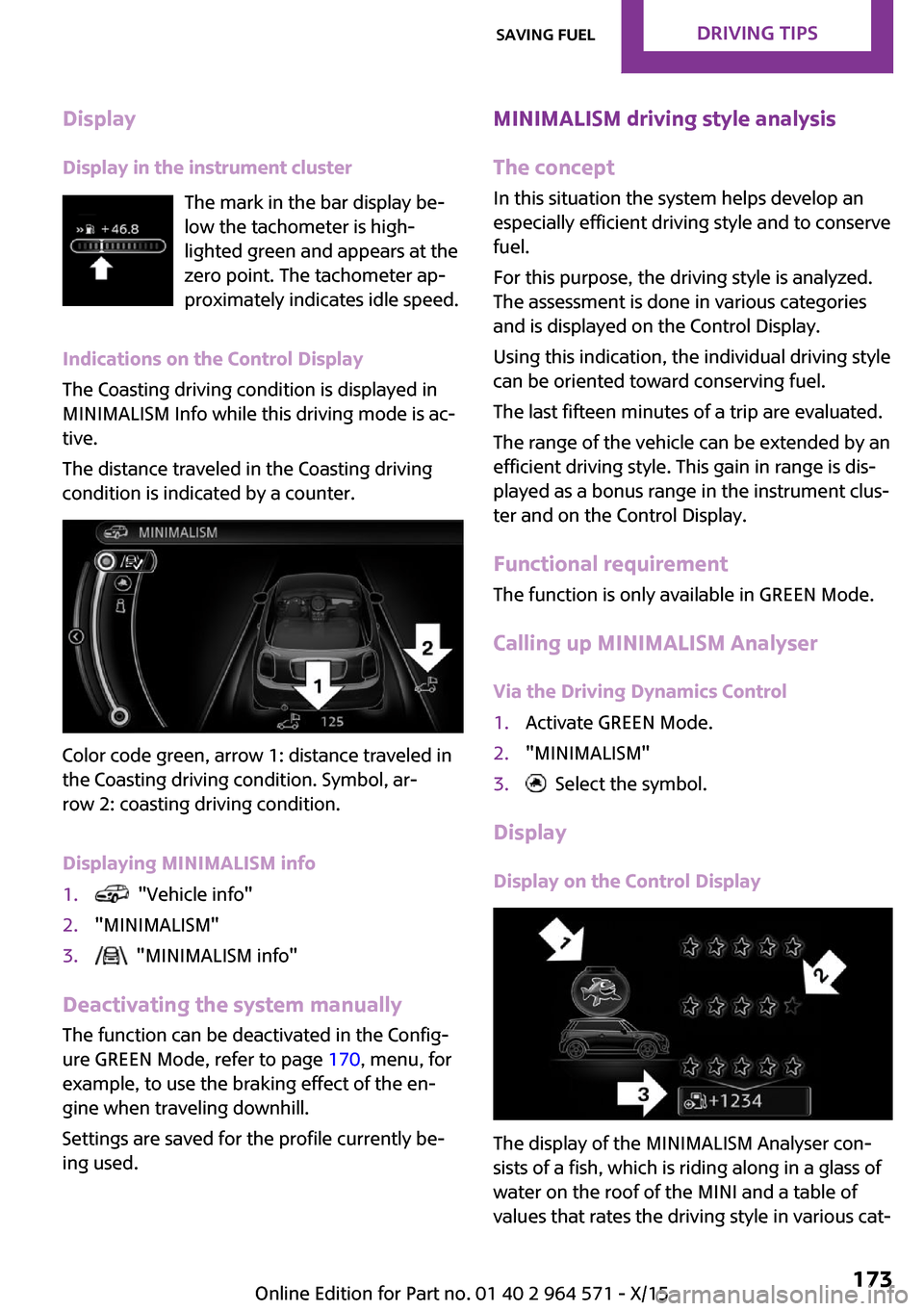
Indications on the Control Display
The Coasting driving condition is displayed in
MINIMALISM Info while this driving mode is ac‐
tive.
The distance traveled in the Coasting driving
condition is indicated by a counter.
Color code green, arrow 1: distance traveled in
the Coasting driving condition. Symbol, ar‐
row 2: coasting driving condition.
Displaying MINIMALISM info
1. "Vehicle info"2."MINIMALISM"3. "MINIMALISM info"
Deactivating the system manually
The function can be deactivated in the Config‐
ure GREEN Mode, refer to page 170, menu, for
example, to use the braking effect of the en‐
gine when traveling downhill.
Settings are saved for the profile currently be‐
ing used.
MINIMALISM driving style analysis
The concept
In this situation the system helps develop an
especially efficient driving style and to conserve
fuel.
For this purpose, the driving style is analyzed.
The assessment is done in various categories
and is displayed on the Control Display.
Using this indication, the individual driving style
can be oriented toward conserving fuel.
The last fifteen minutes of a trip are evaluated.
The range of the vehicle can be extended by an
efficient driving style. This gain in range is dis‐
played as a bonus range in the instrument clus‐
ter and on the Control Display.
Functional requirement
The function is only available in GREEN Mode.
Calling up MINIMALISM Analyser
Via the Driving Dynamics Control
1.Activate GREEN Mode.2."MINIMALISM"3. Select the symbol.
Display
Display on the Control Display
The display of the MINIMALISM Analyser con‐
sists of a fish, which is riding along in a glass of
water on the roof of the MINI and a table of
values that rates the driving style in various cat‐
Seite 173Saving fuelDRIVING TIPS173
Online Edition for Part no. 01 40 2 964 571 - X/15
Page 214 of 246
Battery replacement
CAUTION
Vehicle batteries that are not compatible
can damage vehicle systems and impair vehicle
functions. There is a risk of personal and prop‐
erty damage. Only vehicle batteries that are
compatible with your vehicle type should be in‐
stalled in your vehicle. Information on compati‐
ble vehicle batteries is available at your dealer’s
service center.◀
After a battery replacement, the manufacturer
of your vehicle recommends that the vehicle
battery be registered on the vehicle by a
dealer’s service center or another qualified
service center or repair shop to ensure that all
comfort features are fully available and that
any Check Control messages of these comfort
features are no longer displayed.
Charging the battery
General information
Make sure that the battery is always sufficiently
charged to guarantee that the battery remains
usable for its full service life.
The battery may need to be charged in the fol‐
lowing cases:
▷When making frequent short-distance
drives.
▷If the vehicle is not used for more than a
month.
▷Steptronic transmission: when parked for
long periods of time in selector lever posi‐
tion D, R or N.
Information
CAUTION
Battery chargers for the vehicle battery
can work with high voltages and currents,
which means that the 12 volt on-board net‐
work can be overloaded or damaged. There is
risk of property damage. Only connect battery
chargers for the vehicle battery to the starting
aid terminals in the engine compartment.◀
Starting aid terminals
In the vehicle, only charge the battery via the
starting aid terminals, refer to page 217, in the
engine compartment with the engine off.
Power failure
After a power loss, some equipment needs to
be newly initialized or individual settings up‐
dated, for example:
▷Time: update.▷Date: update.▷Navigation system: wait for the operability
of the navigation.
▷Seat and mirror memory: store the posi‐
tions again.
▷Glass sunroof: initialize the system, refer to
page 49.
Disposing of old batteries
Have old batteries disposed of by a
dealer’s service center or another quali‐
fied service center or repair shop or
take them to a collection point.
Maintain the battery in an upright position for
transport and storage. Secure the battery so
that it does not tip over during transport.
Fuses
Information
WARNING
Incorrect and repaired fuses can overload
electrical lines and components. There is risk of
fire. Never attempt to repair a blown fuse. Do
not replace a nonworking fuse with a substitute
of another color or amperage rating.◀
Seite 214MOBILITYReplacing components214
Online Edition for Part no. 01 40 2 964 571 - X/15
Page 221 of 246
CareVehicle features and op‐
tions
This chapter describes all standard, country-
specific and optional features offered with the
series. It also describes features that are not
necessarily available in your car, e. g., due to
the selected options or country versions. This
also applies to safety-related functions and sys‐
tems. The respectively applicable country provi‐
sions must be observed when using the respec‐
tive features and systems.
Car washes
General information
Regularly remove foreign objects such as leaves
in the area below the windshield when the
hood is raised.
Wash your vehicle frequently, particularly in
winter. Intense soiling and road salt can dam‐
age the vehicle.
Steam jets or high-pressure washers
Information
CAUTION
When cleaning with high-pressure wash‐
ers, components can be damaged due to the
pressure or temperatures being too high. There
is risk of property damage. Maintain sufficient
distance and do not spray too long continu‐
ously. Follow the Owner's Manual for the high-
pressure washer.◀
Distances and temperature
▷Maximum temperature: 140 ℉/60 ℃.▷Minimum distance from sensors, cameras,
seals: 12 inches/30 cm.
▷Minimum distance from glass sunroof:
31.5 inches/80 cm.
Automatic car washes
Information
CAUTION
Improper use of automatic car washes
can cause damage to the vehicle. There is risk
of property damage. Information the following
instructions:
▷Give preference to cloth car washes or
those that use soft brushes in order to
avoid paint damage.
▷Avoid car washes with guide rails higher
than 4 in/10 cm to avoid damage to the
chassis.
▷Observe the tire width of the guide rail to
avoid damage to tires and rims.
▷Fold in exterior mirrors to avoid damage to
the exterior mirrors.
▷Unscrew the rod antenna to avoid the rod
antenna breaking off.
▷Deactivate rain sensor if necessary to avoid
damage to the wiper system.◀
In some cases, an unintentional alarm can be
triggered by the interior motion sensor of the
alarm system. Follow the instructions on avoid‐
ing an unintentional alarm, refer to page 45.
With front PDC: to reduce PDC false alarms,
switch off automatic PDC activation on obstacle
detection, for example in car washes, refer to
page 129.
Before driving into a car wash
In order to ensure that the vehicle can roll in a
car wash, take the following steps:
Seite 221CareMOBILITY221
Online Edition for Part no. 01 40 2 964 571 - X/15
Page 223 of 246

wear and premature degradation of the leather
surface.
To guard against discoloration, such as from
clothing, clean leather and provide leather care
roughly every two months.
Clean light-colored leather more frequently be‐
cause soiling on such surfaces is substantially
more visible.
Use leather care products; otherwise, dirt and
grease will gradually break down the protective
layer of the leather surface.
Suitable care products are available from a
dealer’s service center or another qualified
service center or repair shop.
Upholstery material care
Vacuum regularly with a vacuum cleaner.
If upholstery is very dirty, for example, with
beverage stains, use a soft sponge or micro‐
fiber cloth with a suitable interior cleaner.
Clean the upholstery down to the seams using
large sweeping motions. Avoid rubbing the ma‐
terial vigorously.
CAUTION
Open Velcro® fasteners on articles of
clothing can damage the seat covers. There is
risk of property damage. Ensure that any Vel‐
cro® fasteners are closed.◀
Caring for special components
Light-alloy wheels
When cleaning the vehicle, use only neutral
wheel cleaners having a pH value from 5 to 9.
Do not use abrasive cleaning agents or steam
jets above 140 ℉/60 ℃. Follow the manufac‐
turer's instructions.
Aggressive, acidic or alkaline cleaning agents
can destroy the protective layer of adjacent
components, such as the brake disk.
Chrome surfaces
Carefully clean components such as the radia‐
tor grille or door handles with an ample supply
of water, possibly with shampoo added, partic‐
ularly when they have been exposed to road
salt.
Rubber components
Environmental influences can cause surface
soiling of rubber parts and a loss of gloss. For
cleaning, use only water and suitable care
products, the manufacturer of your vehicle rec‐
ommends original MINI care products.
Treat especially worn rubber parts with rubber
care agents at regular intervals. When cleaning
rubber seals, do not use any silicon-containing
car care products in order to avoid damage or
noises.
Fine wood parts
Clean fine wood facing and fine wood compo‐
nents only with a moist rag. Then dry with a
soft cloth.
Plastic components
These include:
▷Imitation leather surfaces.▷Roofliner.▷Lamp lenses.▷Instrument cluster cover.▷Matt black spray-coated components.▷Painted parts in the interior.
Clean with a microfiber cloth.
Dampen cloth lightly with water.
Do not soak the roofliner.
CAUTION
Cleansers that contain alcohol or solvents,
such as lacquer thinners, heavy-duty grease re‐
movers, fuel, or such, can damage plastic parts.
There is risk of property damage. Clean with a
Seite 223CareMOBILITY223
Online Edition for Part no. 01 40 2 964 571 - X/15
Page 228 of 246

Technical dataVehicle features and op‐
tions
This chapter describes all standard, country-
specific and optional features offered with the
series. It also describes features that are not
necessarily available in your car, e. g., due to
the selected options or country versions. This
also applies to safety-related functions and sys‐
tems. The respectively applicable country provi‐
sions must be observed when using the respec‐
tive features and systems.
Information
The technical data and specifications in this
Owner's Manual are used as guidance values.
The vehicle-specific data can deviate from this,
for example, due to the selected special equip‐
ment, country version or country-specific
measurement method. Detailed values can be
found in the approval documents, on labels on
the vehicle or can be obtained from a dealer’s
service center or another qualified service cen‐
ter or repair shop.
The information in the vehicle documents al‐
ways has priority over the information in this
Owner's Manual.
Dimensions
The dimensions can vary depending on the
model version, equipment or country-specific
measurement method.
The specified heights do not take into account
attached parts, for example, a roof antenna,
roof racks or spoiler. The heights can deviate,
for example, due to the selected special equip‐
ment, tires, load and chassis version.
MINI CLUBMANWidth with mirrorsinches/mm79.6/2,022Width without mirrorsinches/mm70.9/1,800Heightinches/mm56.7/1,441Lengthinches/mm168.3/4,275Wheelbaseinches/mm105.1/2,670Smallest turning radius diam.ft/m37.1/11.3Seite 228REFERENCETechnical data228
Online Edition for Part no. 01 40 2 964 571 - X/15
Page 229 of 246

WeightsMINI CLUBMANApproved gross vehicle weightManual transmissionlbs/kg4,230/1,919Steptronic transmissionlbs/kg4,275/1,939Loadlbs/kg980/445Approved front axle loadManual transmissionlbs/kg2,150/975Steptronic transmissionlbs/kg2,200/998Approved rear axle loadlbs/kg2,170/984Approved roof load capacitylbs/kg165/75Cargo area capacitycu ft17.5-47.9Canada: trunk capacitycu ft/l9.8-33.2/278-941
MINI Cooper S CLUBMANApproved gross vehicle weightManual transmissionlbs/kg4,260/1,932Steptronic transmissionlbs/kg4,330/1,964Loadlbs/kg925/420Approved front axle loadManual transmissionlbs/kg2,250/1,021Steptronic transmissionlbs/kg2,330/1,057Approved rear axle loadlbs/kg2,110/957Approved roof load capacitylbs/kg165/75Cargo area capacitycu ft17.5-47.9Canada: trunk capacitycu ft/l12.7-44.1/360-1,250Seite 229Technical dataREFERENCE229
Online Edition for Part no. 01 40 2 964 571 - X/15
Page 236 of 246
Everything from A to Z
Index
A
ABS, Antilock Brake Sys‐
tem 117
Acceleration Assistant, see
Launch Control 77
Accessories and parts 8
ACC, see camera-based cruise
control 121
Activated-charcoal filter 144
Active Cruise Control, see
camera-based cruise con‐
trol 121
Additives, oil 197
Adjustments, seats/head re‐
straints 50
Adjustments, steering
wheel 59
After washing vehicle 222
Airbags 101
Airbags, indicator/warning
light 102
Air circulation, see Recircu‐
lated-air mode 140, 143
Air conditioner 139
Air, dehumidifying, see Cool‐
ing function 140, 142
Air distribution,
manual 140, 143
Air flow, air conditioner 140
Air flow, automatic climate
control 143
Air pressure, tires 182
Air vents, see Ventilation 144
Alarm system 44
Alarm triggering 44
Alarm, unintentional 45
All around the center con‐
sole 16
All around the roofliner 17
All around the steering
wheel 14
All-season tires, see Winter
tires 188
Alternating-code hand-held
transmitter 147
Alternative oil types 197
Antifreeze, washer fluid 73
Antilock Brake System,
ABS 117
Anti-slip control, see DSC 117
App, MINI Motorer’s Guide 6
Approved axle load 229
Arrival time 89
Ash tray 150
Assistance when driving
off 120
Assist system, see Intelligent
Safety 110
AUTO intensity 143
Automatic car wash 221
Automatic climate con‐
trol 141
Automatic Curb Monitor 58
Automatic deactivation, Front-
seat passenger airbags 103
Automatic headlight con‐
trol 97
Automatic locking 44
Automatic recirculated-air
control 143
Automatic transmission with
Steptronic 75
AUTO program, automatic cli‐
mate control 142
AUTO program, intensity 143
Auto Start/Stop function 66
Average fuel consumption 89
Average speed 89
Axle loads, weights 229
B
Backrest curvature, see Lum‐
bar support 51, 52
Band-aids, see First-aid
kit 216
Battery replacement, vehicle
battery 214
Battery, vehicle 213
Being towed, see Tow-starting
and towing 217
Belts, safety belts 53
Beverage holder, cu‐
pholder 156
Bonus range, GREEN
Mode 171
Bottle holder, see Cu‐
pholder 156
Brake assistant 117
Brake discs, break-in 162
Brake pads, break-in 162
Braking, hints 163
Breakdown assistance 216
Break-in 162
Brightness of Control Dis‐
play 92
Bug light 205
Bulb replacement 204
Bulb replacement, front 205
Bulb replacement, rear 207
Bulb replacement, side 211
Bulbs and lights 204
Button, Start/Stop 64
Bypassing, see Jump-start‐
ing 216
C
California Proposition 65
Warning 8
Seite 236REFERENCEEverything from A to Z236
Online Edition for Part no. 01 40 2 964 571 - X/15