air condition MINI COOPER 2003 User Guide
[x] Cancel search | Manufacturer: MINI, Model Year: 2003, Model line: COOPER, Model: MINI COOPER 2003Pages: 148, PDF Size: 3.17 MB
Page 72 of 148

70
AUTOMATIC CLIMATE CONTROL
*
1Air onto the windshield and onto the
side windows
2Air for the upper body area72
3Air for the front and rear footwells
4Rear window defroster and windshield
heating715Interior temperature sensor – please
keep clear and unobstructed
6Recirculated air mode71
7Air conditioner68
8Automatic air distribution and supply71
9Switching the automatic climate control
on/off7110 Temperature71
11 Display for temperature and air
supply71
12 Blower for air supply71
13 Defrosting and demisting the wind-
shield and side windows69
14 Individual air distribution72
ba.book Seite 70 Montag, 5. August 2002 8:09 20
ProCarManuals.com
Page 73 of 148

71
OVERVIEW REPAIRS OPERATIONCONTROLS DATA INDEX
AUTOMATIC CLIMATE CONTROL
*
Automatic air distribution and supply
Automatic program (AUTO):
Indicator lamp lights up.
Automatic adjustment of the air distribution
and supply, and adaptation of the specified
temperatures to external influences, i.e. out-
side temperature and sunlight.
In the automatic program (AUTO), the air
conditioner is activated automatically.
Switching the automatic climate
control on/off
The blower, heating and air condi-
tioner are switched off.
To switch the automatic climate control on
again: Press any button of the automatic
climate control.
Air conditioning
Air conditioner switched on:
Indicator lamp lights up.
The air is cooled and dehumidified and –
depending on the temperature setting –
rewarmed.
In the automatic program (AUTO), the air
conditioner is activated automatically.
After the engine start, the windshield may
fog over briefly. Switching on the air condi-
tioner reduces condensation on the windows.
Condensation forms in the air condi-
tioner system during operation, and
then exits under the vehicle. Traces of con-
densed water on the ground are therefore
normal.<
Recirculated air mode
Supply of outside air into the vehi-
cle is blocked: Indicator lamp lights
up.
The air within the vehicle is recirculated.
In the automatic program (AUTO) in hot
weather conditions, the recirculated air
mode is activated temporarily to enable
faster cooling.
Do not run the recirculated air mode
for longer than approx. 30 minutes,
as otherwise the air quality in the interior
will deteriorate.<
If the windows fog up in the recircu-
lated air mode, turn the recirculated
air mode off and if necessary increase the
air supply.<
Rear window defroster and windshield
heating*
Rear window defroster and wind-
shield heating switched on:
Indicator lamp lights up.
As long as the indicator lamp is lit, the
heating operates at high power output –
rapid defrosting.
Indicator lamp goes out.
The heating continues to run with reduced
power output and then switches itself off
automatically.Temperature
Setting the temperature:
Move or turn the wheel in the
appropriate direction to increase
the temperature step by step.
The figures in the display provide a general
indication of interior temperature. When
you start the vehicle, the system ensures
that the selected temperature is achieved
as quickly as possible and then maintained.
Permanent heating with maximum
power output at temperature selec-
tion HI. Permanent cooling at LO.<
Air supply
Press the left or right half of the
button: the air supply varies.
ba.book Seite 71 Montag, 5. August 2002 8:09 20
ProCarManuals.com
Page 83 of 148

81
OVERVIEW REPAIRSOPERATIONCONTROLS DATA INDEX
GENERAL DRIVING NOTES Parking the vehicleCondensation forms in the air conditioner
system during operation, and then exits
under the vehicle. Traces of condensed
water on the ground are therefore normal.Brakes
Do not rest your foot on the brake
pedal while driving. Even light but
consistent pedal pressure can lead to high
temperatures, brake wear and possibly
even brake failure.<
Hydroplaning
When driving on wet or slushy roads,
reduce road speed. If you do not, a
wedge of water can form between tires and
road surface. This phenomenon is charac-
terized by a partial or complete loss of con-
tact between the tires and the road surface.
The ultimate results are loss of steering and
braking control.<
Driving through water
Do not drive through water on the
road if it is deeper than 1 ft / 30 cm,
and then only at walking speed at the
most. Otherwise, the vehicle's engine, the
electrical systems and the transmission
may be damaged.<
Clothes hooks
When suspending clothing from the
hooks, ensure that they will not
obstruct the driver's vision. Do not hang
heavy objects on the hooks. If you do so,
they could cause personal injury during
braking or evasive maneuvers.<
High temperatures
High temperatures occur in any vehi-
cle equipped with a catalytic con-
verter. Do not remove the heat protection
plates fitted in the area of the exhaust sys-
tem and do not apply body-cavity pro-
tectant to this area. When driving, standing
at idle or parking the vehicle, take care to
avoid contact between the hot exhaust sys-
tem and flammable materials – e.g. hay,
leaves, grass, etc. Such contact could lead
to a fire resulting in serious personal injury
and property damage.<
ba.book Seite 81 Montag, 5. August 2002 8:09 20
ProCarManuals.com
Page 85 of 148

83
OVERVIEW REPAIRSOPERATIONCONTROLS DATA INDEX
FUEL SPECIFICATIONS ANTILOCK BRAKE SYSTEM (ABS)The engine uses lead-free gasoline only.
Required fuel:
>Premium Unleaded Gasoline,
min. 91 AKI.
AKI = Anti Knock Index.
Do not use leaded fuels. The use of
leaded fuels will cause permanent
damage to the emissions-control system's
oxygen sensor and the catalytic con-
verter.<
The concept The ABS keeps the wheels from locking
while braking, thereby enhancing active
driving safety.
ABS also includes Electronic Brake Force
Distribution (EBD).Braking with ABSTo achieve optimal performance from ABS
when reacting to critical situations, you
should apply maximum pressure to the
brake pedal – panic stop.
Since the vehicle remains maneuverable,
you can still go around any obstacles with
the smallest possible steering movements.
Pulsation of the brake pedal in conjunction
with the sound of hydraulic regulation indi-
cates to you that you are driving at the limit
and reminds you to readapt your vehicle's
speed to road surface conditions.
Electronic Brake Force Distribution
(EBD)The system regulates the brake force distri-
bution between the front and rear axles. In
order to avoid an over-braking of the rear
wheels in certain situations, the EBD per-
manently monitors the slip values and reg-
ulates the slip on the rear axle depending
on that of the front axle.
ba.book Seite 83 Montag, 5. August 2002 8:09 20
ProCarManuals.com
Page 87 of 148
85
OVERVIEW REPAIRSOPERATIONCONTROLS DATA INDEX
TIRE INFLATION PRESSUREInformation for your safetyThe factory-approved radial tires are
matched to the vehicle and have been
selected to provide optimum safety and
driving comfort if used properly.
It is not merely the tire's service life, but
also driving comfort and – above all else –
driving safety that depend on the condition
of the tires and the maintenance of the
specified tire pressure.
Incorrect inflation pressure is a frequent
cause of tire damage. It also significantly
influences the roadholding ability of your
MINI.
Check tire inflation pressures regu-
larly – at least every two weeks and
before beginning a longer trip. Failure to
observe these precautions can result in
incorrect tire pressures, which cause unsta-
ble handling response as well as tire dam-
age, and can ultimately lead to an accident.
Also check the inflation pressure on the
space-saver spare tire.
turer of your MINI, which can be asked for
from your MINI Dealer.
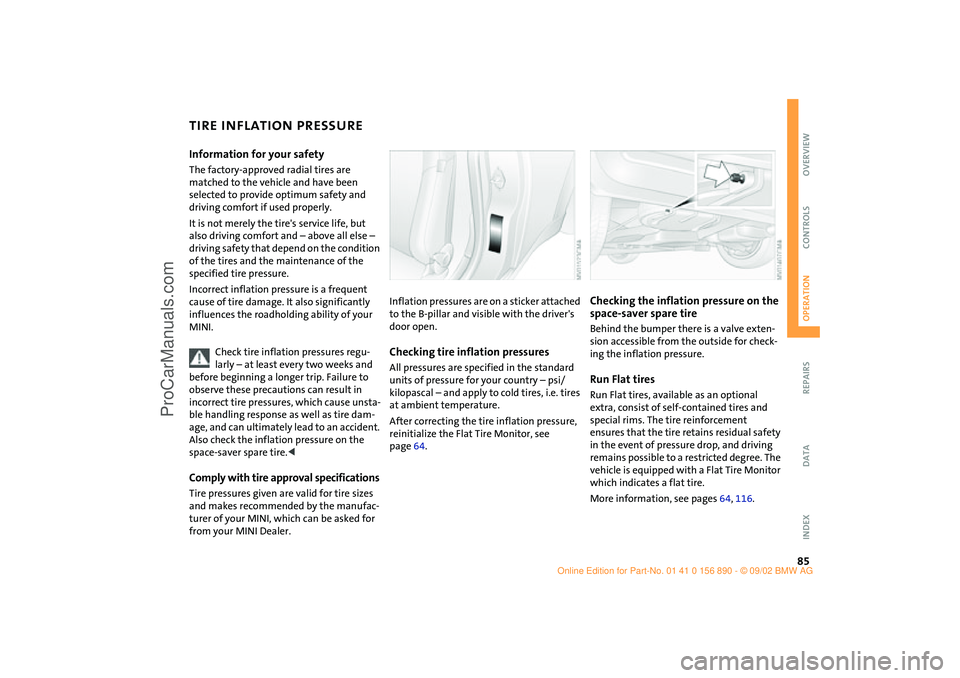
Inflation pressures are on a sticker attached
to the B-pillar and visible with the driver's
door open.Checking tire inflation pressuresAll pressures are specified in the standard
units of pressure for your country – psi/
kilopascal – and apply to cold tires, i.e. tires
at ambient temperature.
After correcting the tire inflation pressure,
reinitialize the Flat Tire Monitor, see
page 64.
Checking the inflation pressure on the
space-saver spare tireBehind the bumper there is a valve exten-
sion accessible from the outside for check-
ing the inflation pressure.Run Flat tiresRun Flat tires, available as an optional
extra, consist of self-contained tires and
special rims. The tire reinforcement
ensures that the tire retains residual safety
in the event of pressure drop, and driving
remains possible to a restricted degree. The
vehicle is equipped with a Flat Tire Monitor
which indicates a flat tire.
More information, see pages 64, 116.
ba.book Seite 85 Montag, 5. August 2002 8:09 20
ProCarManuals.com
Page 89 of 148

87
OVERVIEW REPAIRSOPERATIONCONTROLS DATA INDEX
TIRE CONDITION TIRE REPLACEMENTTire tread/tire damageInspect your tires frequently for tread wear,
signs of damage and for foreign objects
lodged in the tread. Check the tread depth.
The tread depth should not fall below1/8 in / 3 mm.
Below
1/8 in / 3 mm tread pattern depth,
there is an increased risk of hydroplaning,
even at relatively moderate speeds and
with only small amounts of water on the
road.
Wear indicators in the tread-groove base,
see arrow, are spread around the circum-
ference of the tire and are marked on the
side wall of the tire with TWI – Tread Wear
Indicator. The indicators in the tread indi-
cate at 1/16 in / 1.6 mm tread depth that
the legally permitted wear limit has been
reached.
Never continue to drive with a flat,
pressureless tire, except with Run Flat
tires. A pressureless, flat tire greatly
impairs steering and braking response, and
can lead to complete loss of control over
the vehicle. Avoid overloading the vehicle
so that the permitted load on the tires is
not exceeded. Overloading can lead to
overheating and increases the rate at
which damage develops inside the tires.
The ultimate result can assume the form of
a sudden air loss.
Unusual vibrations while driving, caused
for example by driving over a curb or simi-
lar, can indicate wheel or tire damage or
other damage to the vehicle. This is also
true for irregularities in the vehicle's han-
dling characteristics, such as a pronounced
tendency to pull to the left or right. Should
this occur, respond by immediately reduc-
ing your speed. Proceed carefully to the
nearest MINI Dealer or professional tire
center, or have the vehicle towed there to
have its wheels and/or tires inspected or
controlled. Tire damage – up to and includ-
ing blowouts – can endanger the lives of
both the vehicle occupants and other road
users.<
To maintain good handling and vehicle
response, use only tires of a single tread
configuration from a single manufacturer.
The manufacturer of your MINI tests and
approves wheel and tire combinations.
Do not use retreaded tires, since driv-
ing safety may be impaired. This is
due to the possible variations in casing
structures and, in some cases, to their
extreme age, which can lead to a decrease
in their durability.
Temperature A B C
All passenger car tires must conform
to Federal Safety Requirements in
addition to these grades.<
ba.book Seite 87 Montag, 5. August 2002 8:09 20
ProCarManuals.com
Page 91 of 148
89
OVERVIEW REPAIRSOPERATIONCONTROLS DATA INDEX
WHEEL AND TIRE COMBINATIONS WINTER TIRESThe right choiceThe factory-approved normal and Run Flat
tires are matched to your vehicle and have
been selected to provide optimum safety
and driving comfort if used properly.
The manufacturer of your MINI rec-
ommends never mounting wheels
and tires that have not been specifically
approved by the manufacturer for use on
your particular model. Although other
wheels and tires may theoretically have the
same dimensions, variations in factors such
as manufacturing tolerances can result in
contact between tire and bodywork, ulti-
mately leading to serious accidents. The
manufacturer of your MINI cannot evaluate
non-approved wheels and tires to deter-
mine if they are suited for use, and there-
fore cannot ensure the operating safety of
the vehicle if they are fitted.<
The manufacturer of your MINI has tested
certain tire brands in each size, categorized
them as safe for use on the road, and
approved them. Contact your MINI Dealer
for more details.
The correct wheel and tire combina-
tion affects various systems that
would otherwise be impaired, e.g. ABS,
ASC+T and DSC. For this reason, use only
tires of the same manufacture and tread
configuration. In the event of a flat tire, for
example, remount the approved wheel and
tire combination as soon as possible.<
StorageStore tires in a cool, dry place, protecting
them against light whenever possible.
Protect the tires against contact with oil,
grease and fuel.
Choosing the right tireThe manufacturer of your MINI recom-
mends winter tires – M+S radial tires – for
driving in adverse winter road conditions.
While so-called all-season tires with M+S
designation provide better winter traction
than summer tires with the load ratings S,
T, H, V, W, they do not achieve the perfor-
mance of winter tires.
In the interest of safe tracking and steering
response, install winter tires made by the
same manufacturer having the same tread
configuration on all four wheels.
Before purchasing winter tires, check
whether your MINI is fitted with Run Flat
tires. You will recognize Run Flat tires by a
circular symbol containing the letters RSC
on the side of the tire, see page 116. In this
case, use only Run Flat tires, as in the event
of a flat tire there is no space-saver spare
tire.
Any MINI Dealer will be glad to advise you
on the selection of the right winter tires for
the relevant operating conditions.
ba.book Seite 89 Montag, 5. August 2002 8:09 20
ProCarManuals.com
Page 92 of 148
90
WINTER TIRES SNOW CHAINS
*
Observing speeds
Never exceed the maximum speed
for which the tires are rated.
Unprofessional attempts by laymen to ser-
vice tires can lead to damage and accidents.
Have this work performed by skilled profes-
sionals only. Your MINI Dealer will be glad
to assist you with both their expertise and
the proper equipment for your vehicle.<
Tire condition, tire inflation pressure
Below a tread depth of
3/16 in /
4 mm, winter tires display a percepti-
ble decrease in their ability to cope with
winter driving conditions, and should be
replaced in the interest of safety.<
Comply with the specified tire inflation
pressures and be sure to have the wheel
and tire assemblies balanced every time
you change the tires.
Only certain types of snow chains have
been tested by the manufacturer of your
MINI, classified as road-safe and approved.
Contact your MINI Dealer for more details.
The manufacturer of your MINI recom-
mends that you use these fine-link snow
chains only. Their use is only permitted in
pairs on the front wheels on winter tires of
the following type:
175/65 R 15.
When fitting, comply with the manufac-
turer's instructions. With chains, do not
exceed a speed of 30 mph / 50 km/h.
After fitting the snow chains, do not
activate the Flat Tire Monitor.
When driving with snow chains, it can be
helpful to switch off the ASC+T or DSC for a
brief period, see pages 62, 63.<
ba.book Seite 90 Montag, 5. August 2002 8:09 20
ProCarManuals.com
Page 100 of 148
98
MINI MAINTENANCE SYSTEMThe MINI Maintenance System has been
designed as a reliable means of providing
maximum driving and operating safety –
and as cost-effective for you as possible.
Please bear in mind that regular mainte-
nance is not only necessary for the safety of
your vehicle, but also plays a significant
role in maintaining the resale value of the
vehicle.
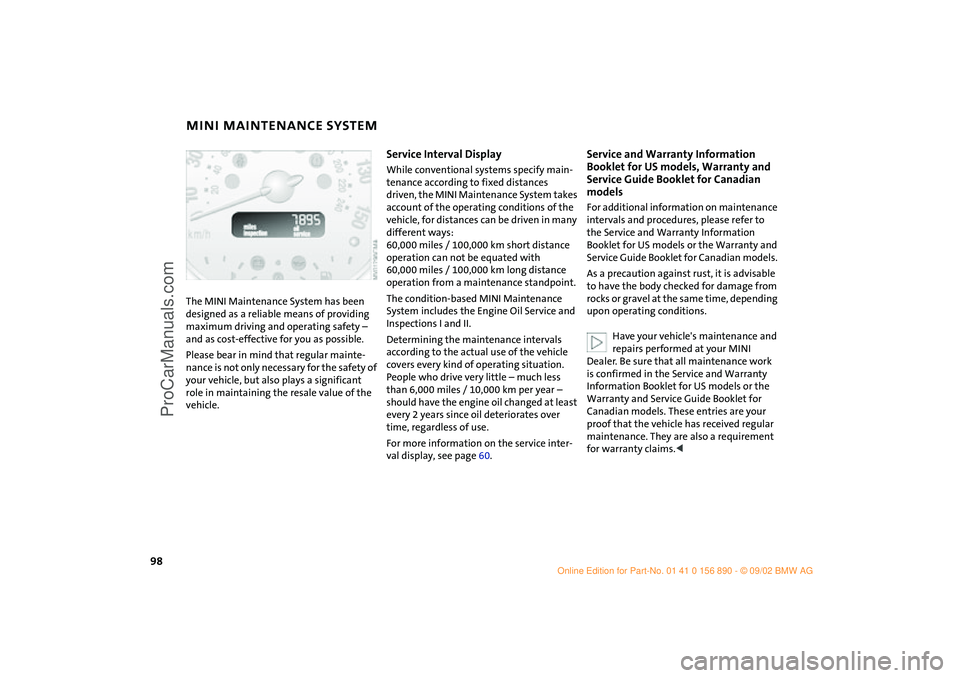
Service Interval DisplayWhile conventional systems specify main-
tenance according to fixed distances
driven, the MINI Maintenance System takes
account of the operating conditions of the
vehicle, for distances can be driven in many
different ways:
60,000 miles / 100,000 km short distance
operation can not be equated with
60,000 miles / 100,000 km long distance
operation from a maintenance standpoint.
The condition-based MINI Maintenance
System includes the Engine Oil Service and
Inspections I and II.
Determining the maintenance intervals
according to the actual use of the vehicle
covers every kind of operating situation.
People who drive very little – much less
than 6,000 miles / 10,000 km per year –
should have the engine oil changed at least
every 2 years since oil deteriorates over
time, regardless of use.
For more information on the service inter-
val display, see page 60.
Service and Warranty Information
Booklet for US models, Warranty and
Service Guide Booklet for Canadian
models For additional information on maintenance
intervals and procedures, please refer to
the Service and Warranty Information
Booklet for US models or the Warranty and
Service Guide Booklet for Canadian models.
As a precaution against rust, it is advisable
to have the body checked for damage from
rocks or gravel at the same time, depending
upon operating conditions.
Have your vehicle's maintenance and
repairs performed at your MINI
Dealer. Be sure that all maintenance work
is confirmed in the Service and Warranty
Information Booklet for US models or the
Warranty and Service Guide Booklet for
Canadian models. These entries are your
proof that the vehicle has received regular
maintenance. They are also a requirement
for warranty claims.<
ba.book Seite 98 Montag, 5. August 2002 8:09 20
ProCarManuals.com
Page 119 of 148
117
OVERVIEW REPAIRSOPERATION CONTROLS DATA INDEX
FLAT TIRE – RUN FLAT TIRES
*
Continuing driving with a damaged
tire
With Run Flat tires, you can continue driv-
ing under certain conditions, depending on
the vehicle load and the severity of the tire
damage, at a maximum speed of 50 mph /
80 km/h.
You can determine the possible mileage for
continued driving on the basis of the fol-
lowing general indications:
>Tire inflation pressure 0 psi / 0 kPa:
approx. 95 miles / 150 km
>Tire inflation pressure 7.2 – 14.5 psi /
50 – 100 kPa:
approx. 300 miles / 500 km
>Tire inflation pressure greater than
14.5 psi / 100 kPa:
approx. 600 miles / 1,000 km.
Tire change setYour MINI is additionally equipped with a
tire change set. This is located in the MINI
COOPER in the cargo area under the floor
mat.
In the MINI COOPER S the tire change set is
located in a separate bag which is attached
to the eyelets on the cargo area floor by
means of tie-down straps, see page 75.
When changing a tire, always observe the
safety measures on page 112, and follow
the procedure described on page 114 ff.
In case of a flat tire the tire change
set is not needed, since your MINI has
Run Flat tires.<
ba.book Seite 117 Montag, 5. August 2002 8:09 20
ProCarManuals.com