wheels MINI COOPER 2003 Owners Manual
[x] Cancel search | Manufacturer: MINI, Model Year: 2003, Model line: COOPER, Model: MINI COOPER 2003Pages: 148, PDF Size: 3.17 MB
Page 5 of 148
3
OVERVIEW REPAIRS OPERATION CONTROLS DATA INDEX
Driving:
Ignition lock45
Starting the engine46
Switching off the engine47
Parking brake47
Manual transmission48
Continuously Variable automatic Trans-
mission (CVT)49
Parking lamps/Low beams52
Turn signal indicator/Headlamp
flasher52
Instrument lighting53
Fog lamps53
Interior lamps53
Light-emitting diodes54
Washer/wiper system54
Cruise control56
Everything under control:
Odometer58
Tachometer58
Fuel gauge58
Coolant temperature gauge59
Service interval display60
Clock60
Computer60
Technology for safety and driving
convenience:
Automatic Stability Control plus Traction
(ASC+T)62
Dynamic Stability Control (DSC)63
Flat Tire Monitor64
Park Distance Control (PDC)66
Controlling the climate for pleasant
driving:
Air conditioning system67
Automatic climate control70
Interior conveniences:
Glove compartment73
Ashtray/Beverage holder73
Cigarette lighter/12 V power supply73
Loading and transporting cargo:
Cargo area cover74
Foldable rear backrest74
Loading cargo75
Roof-mounted luggage rack76
Operation, care, maintenance
Special operating instructions:
Break-in procedures80
General driving notes81
Refueling82
Fuel specifications83
Antilock Brake System (ABS)83
Brake system84
Wheels and tires:
Tire inflation pressure85
Tire condition87
Tire replacement87
Wheel and tire combinations89
Winter tires89
Snow chains90
ba.book Seite 3 Montag, 5. August 2002 8:09 20
ProCarManuals.com
Page 10 of 148
8
NOTES
Installation and operation of non-MINI
approved accessories such as alarms,
radios, amplifiers, radar detectors, wheels,
suspension components, brake dust
shields, telephones – including operation of
any portable cellular phone from within
the vehicle without using an externally
mounted antenna – or transceiver equip-
ment – e.g. CB, walkie-talkie, ham radio or
similar – may cause extensive damage to
the vehicle, compromise its safety, inter-
fere with the vehicle's electrical system or
affect the validity of the MINI Limited
Warranty. See your MINI Dealer for addi-
tional information.
<
Maintenance, replacement, or repair
of the emission control devices and
systems may be performed by any auto-
motive repair establishment or individual
using any certified automotive part.
<
Symbol on vehicle parts
Indicates that you should consult the
relevant section of this Owner's Man-
ual for information on a particular part or
assembly.
Service and warranty
This manual is supplemented by a Service
and Warranty Information Booklet for US
models or a Warranty and Service Guide
Booklet for Canadian models.
We recommend that you read this publica-
tion thoroughly.
Your MINI is covered by the following
warranties:
>
New Vehicle Limited Warranty
>
Rust Perforation Limited Warranty
>
Federal Emissions System Defect
Warranty
>
Federal Emissions Performance
Warranty
>
California Emission Control System Lim-
ited Warranty
Detailed information about these warran-
ties is listed in the Service and Warranty
Information Booklet for US models or in the
Warranty and Service Guide Booklet for
Canadian models.
Reporting safety defects
The following only applies to vehicles
owned and operated in the US.
If you believe that your vehicle has a defect
which could cause a crash or could cause
injury or death, you should immediately
inform the National Highway Traffic Safety
Administration NHTSA in addition to
notifying the MINI Division of BMW of
North America, LLC, P.O. Box 1227, West-
wood, New Jersey 07675-1227,
Telephone toll-free 1-866-275-6464.
If NHTSA receives similar complaints, it
may open an investigation, and if it finds
that a safety defect exists in a group of
vehicles, it may order a recall and remedy
campaign. However, NHTSA cannot
become involved in individual problems
between you, your dealer, or BMW of North
America, LLC.
To contact NHTSA, you may either
call the Auto Safety Hotline toll-free
at 1-800-424-9393 or 366-0123 in
Washington, D.C. area, or write to:
NHTSA, U.S. Department of Transportation,
Washington, D.C. 20590. You can also
obtain other information about motor
vehicle safety from the Hotline.
ba.book Seite 8 Montag, 5. August 2002 8:09 20
ProCarManuals.com
Page 33 of 148

31
OVERVIEW REPAIRS OPERATIONCONTROLS DATA INDEX
ALARM SYSTEM
*
The concept
The alarm system reacts if:
>A door, the bonnet or the tailgate is
opened
>There is any movement inside the vehicle
– interior motion sensor
>There is a change in the tilt angle of the
vehicle, e. g. during attempts to steal
wheels or tow away the vehicle
>There is interruption of the battery volt-
age.
Depending on the country-specific version,
the alarm system signals unauthorized
entry or tampering in different ways:
>Acoustic alarm for 30 seconds
>Turning on the hazard warning flashers
for approx. five minutes.
To arm and disarm the alarm systemWhen the vehicle is locked or unlocked via
the driver's door lock or with the remote
control, the alarm system is also simulta-
neously armed or disarmed.
The interior motion and tilt alarm sensors
are also activated with the closing action.
The alarm system cannot be armed if
the driver's door is not properly
closed.
In some country-specific versions the alarm
system can only be operated with the
remote control.
Unlocking these vehicles with the key trig-
gers the alarm.
To stop the alarm:
Press button 1 – unlock –
or
turn the ignition key to position 1.<
Indicator lampAlarm system:
>Indicator lamp in the wiper system lever
changes after 10 seconds from fast blink-
ing to constant flashing:
The system is activated
>Indicator lamp does not react:
Doors, bonnet or tailgate are not prop-
erly closed.
Even if these are not closed any more,
the alarm system is activated and
secures the remaining part of the vehi-
cle. If everything is closed, the indicator
lamp changes after 10 seconds from fast
blinking to constant flashing
ba.book Seite 31 Montag, 5. August 2002 8:09 20
ProCarManuals.com
Page 49 of 148

47
OVERVIEW REPAIRS OPERATIONCONTROLS DATA INDEX
SWITCHING OFF THE ENGINE PARKING BRAKE
You should never remove the ignition
key when the vehicle is in motion, as
the steering lock could engage.
When you leave the vehicle, always remove
the ignition key and engage the steering
lock.
When you park on downward slopes,
engage the parking brake.<
Manual transmissionTurn the ignition key to position 1 or 0.Continuously Variable automatic
Transmission (CVT)*Engage selector lever position P, turn the
ignition key to position 1 or 0.
The parking brake is designed primarily to
prevent the vehicle from rolling when it is
parked. It operates against the rear wheels.To engageLever automatically locks in position.
The warning lamp in the instrument cluster
comes on when the ignition key is in
position 2, see page 16.To release1. Pull up slightly
2. Press the button
3. Push the lever downwards.
If, in exceptional circumstances, it
should be necessary to engage the
parking brake while the vehicle is in
motion, do not pull the lever with excessive
pressure. Keep your thumb pressed against
the release button while carefully pulling
the lever up to apply moderate pressure.
Excessive pressure can lead to overbraking
and loss of traction, i.e. fishtailing, at the
rear axle.
The brake lamps do not come on when the
parking brake is engaged.
Vehicles with manual transmission:
Always engage the parking brake when
parking on hills and inclined surfaces, as
first gear or reverse may not provide ade-
quate resistance to rolling.
Vehicles with CVT:
Place the selector lever in P.<
ba.book Seite 47 Montag, 5. August 2002 8:09 20
ProCarManuals.com
Page 52 of 148

50
CONTINUOUSLY VARIABLE AUTOMATIC TRANSMISSION (CVT)
*
PPark
Select "P" only when the vehicle is com-
pletely stopped. The transmission locks to
prevent the rear wheels from turning.RReverseSelect "R" only when the vehicle is com-
pletely stopped.NNeutralSelect "N" only if your journey is inter-
rupted for a long period.DDrive – CVT driving positionThis position is designed for driving under
all normal operating conditions. KickdownIn "kickdown" mode, you achieve maxi-
mum acceleration and maximum speed in
position D.
Press the accelerator pedal past the
increased resistance point at the full-throt-
tle position.
M/S + – Manual mode and
Sport programSwitch from D into M/S + –:
Activates the Sport program and displays
SD in the gear indicator in the speedome-
ter.
>Press briefly:
CVT shifts from the Sport program to the
manual mode
>Press selector lever briefly towards +:
Transmission shifts upwards
>Press selector lever briefly towards – :
Transmission shifts back.
1 to 6 appear in the gear indicator.
The transmission will only execute upshifts
and downshifts that will result in a plausi-
ble combination of vehicle speed and
engine rpm. For instance, downshifts that
would result in excessive engine speed are
not executed.
Switching from M/S + – into the selector
lever positions P, R and N and switching
from manual mode back into the Sport pro-
gram is only possible via D.
ba.book Seite 50 Montag, 5. August 2002 8:09 20
ProCarManuals.com
Page 64 of 148

62
AUTOMATIC STABILITY CONTROL PLUS TRACTION (ASC+T)
*
The concept
This system optimizes vehicle stability and
traction, especially when just starting off,
when accelerating or when cornering.
ASC+T recognizes the danger present in
traction loss and will increase driving sta-
bility and traction by reducing the engine's
output and, if necessary, by applying the
brakes to the front wheels. ASC+T is opera-
tional each time you start the engine.
The laws of physics cannot be
repealed, even with ASC+T. An appro-
priate driving style always remains the
responsibility of the driver. Avoid using the
additional safety margin provided by the
system as an excuse for taking unnecessary
risks.
Do not make any modifications to the
ASC+T system. Allow only authorized tech-
nicians to perform service procedures on
the ASC+T.<
Indicator lamp
The indicator lamp on the instru-
ment cluster will go out shortly
after the ignition has been
switched on, see pages 16, 17.
If the indicator lamp flashes:
ASC+T controls the drive and braking
forces.
If the indicator lamp fails to go out
after the engine is started, or if it
comes on during normal driving and stays
on:
The system is defective or was turned off
using the button.
The described stabilizing operations are no
longer available.
You can, however, drive the vehicle nor-
mally without ASC+T.
In the event of a malfunction, please see
your MINI Dealer, see pages 16, 17.<
Switch off the ASC+TBriefly press the switch.
The indicator lamp stays lit.
When driving with snow chains or to "rock
free" in snow, it can be helpful to switch off
the ASC+T for a brief period.
To maintain vehicle stability, always
drive with the ASC+T switched on
whenever possible.
ba.book Seite 62 Montag, 5. August 2002 8:09 20
ProCarManuals.com
Page 65 of 148

63
OVERVIEW REPAIRS OPERATIONCONTROLS DATA INDEX
DYNAMIC STABILITY CONTROL (DSC)
*
The concept
This system maintains driving stability
even in critical driving situations.
The system optimizes vehicle stability dur-
ing acceleration and when starting from a
full stop, as well as optimizing traction. In
addition, it recognizes unstable vehicle
conditions, such as understeering or over-
steering, and, as far as is possible within
the laws of physics, helps keep the vehicle
on a steady course by reducing the rpms
and by brake applications to the individual
wheels.
The DSC is operational every time you start
the engine. DSC contains the functions
Antilock Brake System (ABS), Electronic
Brake Force Distribution (EBD), and ASC+T.
The laws of physics cannot be
repealed, even with DSC. An appro-
priate driving style always remains the
responsibility of the driver. We therefore
urge you to avoid using the additional
safety margin of the system as an excuse
for taking risks.
Do not make any modifications to the DSC
system. Allow only authorized technicians
to perform service procedures on the
DSC.<
Indicator lamp
The indicator lamp on the instru-
ment cluster will go out shortly
after the ignition has been
switched on, see pages 16, 17.
If the indicator lamp flashes:
DSC controls the drive and braking forces.
If the indicator lamp fails to go out
after the engine is started, or if it
comes on during normal driving and stays
on:
The system is defective or was turned off
using the button.
The described stabilizing operations are no
longer available.
The vehicle will remain completely opera-
tional, however, without DSC.
In the event of a malfunction, please see
your MINI Dealer, see pages 16, 17.<
To switch off the DSCBriefly press the switch.
The indicator lamp stays lit.
When driving with snow chains, it may be
effective to switch off the DSC for a brief
period.
To maintain stability, always drive
with the DSC switched on whenever
possible.
ba.book Seite 63 Montag, 5. August 2002 8:09 20
ProCarManuals.com
Page 67 of 148
65
OVERVIEW REPAIRS OPERATIONCONTROLS DATA INDEX
FLAT TIRE MONITORInitializing the systemOnly initialize the system if the inflation
pressure has been corrected or changed,
e.g. after a tire change.
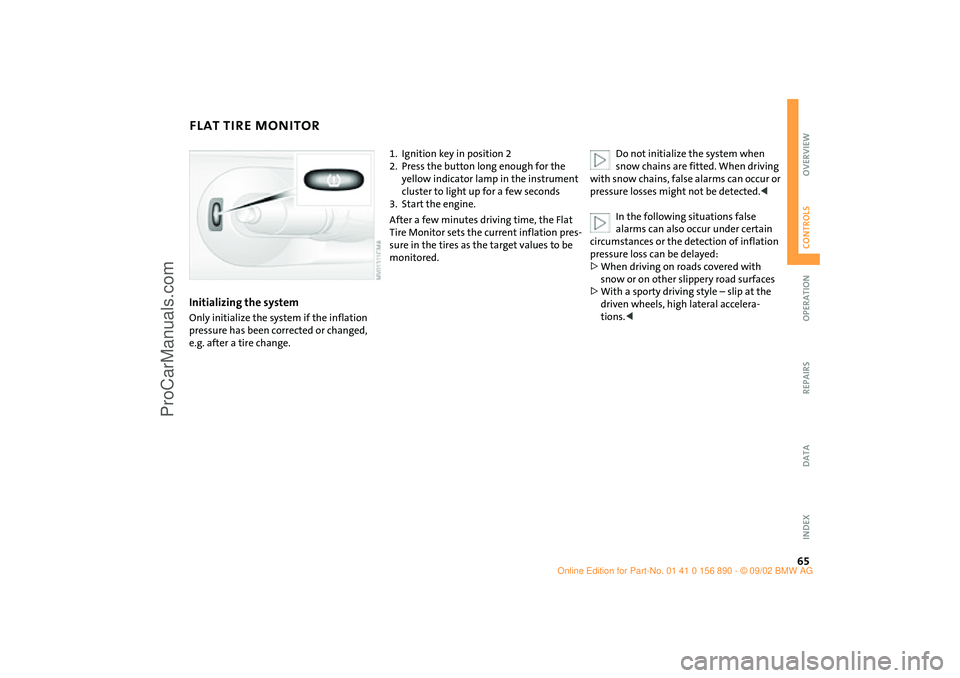
1. Ignition key in position 2
2. Press the button long enough for the
yellow indicator lamp in the instrument
cluster to light up for a few seconds
3. Start the engine.
After a few minutes driving time, the Flat
Tire Monitor sets the current inflation pres-
sure in the tires as the target values to be
monitored.Do not initialize the system when
snow chains are fitted. When driving
with snow chains, false alarms can occur or
pressure losses might not be detected.<
In the following situations false
alarms can also occur under certain
circumstances or the detection of inflation
pressure loss can be delayed:
>When driving on roads covered with
snow or on other slippery road surfaces
>With a sporty driving style – slip at the
driven wheels, high lateral accelera-
tions.<
ba.book Seite 65 Montag, 5. August 2002 8:09 20
ProCarManuals.com
Page 85 of 148

83
OVERVIEW REPAIRSOPERATIONCONTROLS DATA INDEX
FUEL SPECIFICATIONS ANTILOCK BRAKE SYSTEM (ABS)The engine uses lead-free gasoline only.
Required fuel:
>Premium Unleaded Gasoline,
min. 91 AKI.
AKI = Anti Knock Index.
Do not use leaded fuels. The use of
leaded fuels will cause permanent
damage to the emissions-control system's
oxygen sensor and the catalytic con-
verter.<
The concept The ABS keeps the wheels from locking
while braking, thereby enhancing active
driving safety.
ABS also includes Electronic Brake Force
Distribution (EBD).Braking with ABSTo achieve optimal performance from ABS
when reacting to critical situations, you
should apply maximum pressure to the
brake pedal – panic stop.
Since the vehicle remains maneuverable,
you can still go around any obstacles with
the smallest possible steering movements.
Pulsation of the brake pedal in conjunction
with the sound of hydraulic regulation indi-
cates to you that you are driving at the limit
and reminds you to readapt your vehicle's
speed to road surface conditions.
Electronic Brake Force Distribution
(EBD)The system regulates the brake force distri-
bution between the front and rear axles. In
order to avoid an over-braking of the rear
wheels in certain situations, the EBD per-
manently monitors the slip values and reg-
ulates the slip on the rear axle depending
on that of the front axle.
ba.book Seite 83 Montag, 5. August 2002 8:09 20
ProCarManuals.com
Page 89 of 148

87
OVERVIEW REPAIRSOPERATIONCONTROLS DATA INDEX
TIRE CONDITION TIRE REPLACEMENTTire tread/tire damageInspect your tires frequently for tread wear,
signs of damage and for foreign objects
lodged in the tread. Check the tread depth.
The tread depth should not fall below1/8 in / 3 mm.
Below
1/8 in / 3 mm tread pattern depth,
there is an increased risk of hydroplaning,
even at relatively moderate speeds and
with only small amounts of water on the
road.
Wear indicators in the tread-groove base,
see arrow, are spread around the circum-
ference of the tire and are marked on the
side wall of the tire with TWI – Tread Wear
Indicator. The indicators in the tread indi-
cate at 1/16 in / 1.6 mm tread depth that
the legally permitted wear limit has been
reached.
Never continue to drive with a flat,
pressureless tire, except with Run Flat
tires. A pressureless, flat tire greatly
impairs steering and braking response, and
can lead to complete loss of control over
the vehicle. Avoid overloading the vehicle
so that the permitted load on the tires is
not exceeded. Overloading can lead to
overheating and increases the rate at
which damage develops inside the tires.
The ultimate result can assume the form of
a sudden air loss.
Unusual vibrations while driving, caused
for example by driving over a curb or simi-
lar, can indicate wheel or tire damage or
other damage to the vehicle. This is also
true for irregularities in the vehicle's han-
dling characteristics, such as a pronounced
tendency to pull to the left or right. Should
this occur, respond by immediately reduc-
ing your speed. Proceed carefully to the
nearest MINI Dealer or professional tire
center, or have the vehicle towed there to
have its wheels and/or tires inspected or
controlled. Tire damage – up to and includ-
ing blowouts – can endanger the lives of
both the vehicle occupants and other road
users.<
To maintain good handling and vehicle
response, use only tires of a single tread
configuration from a single manufacturer.
The manufacturer of your MINI tests and
approves wheel and tire combinations.
Do not use retreaded tires, since driv-
ing safety may be impaired. This is
due to the possible variations in casing
structures and, in some cases, to their
extreme age, which can lead to a decrease
in their durability.
Temperature A B C
All passenger car tires must conform
to Federal Safety Requirements in
addition to these grades.<
ba.book Seite 87 Montag, 5. August 2002 8:09 20
ProCarManuals.com