inflation MINI COOPER 2012 User Guide
[x] Cancel search | Manufacturer: MINI, Model Year: 2012, Model line: COOPER, Model: MINI COOPER 2012Pages: 207, PDF Size: 3.18 MB
Page 135 of 207
MOBILITYWheels and tires
134
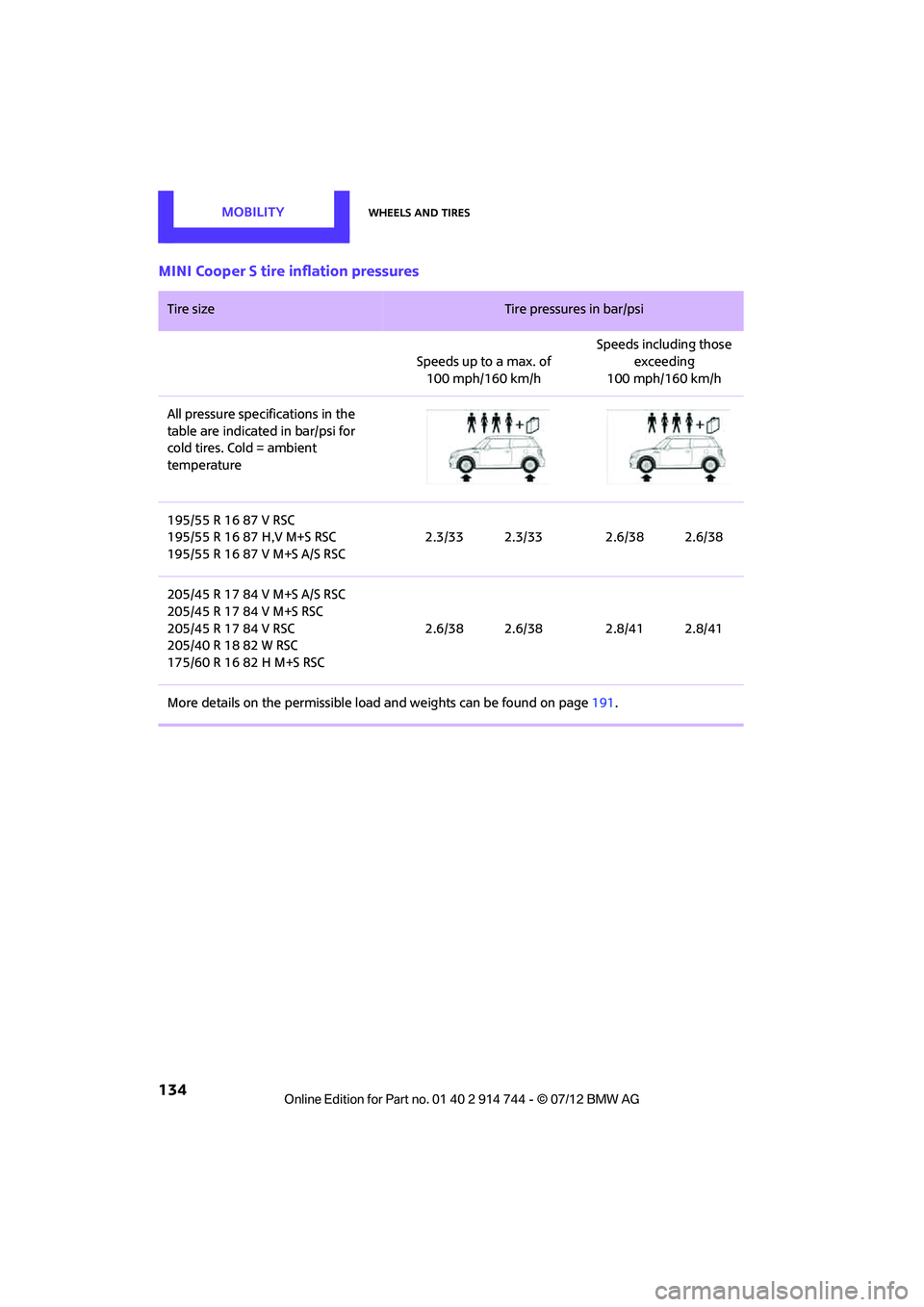
MINI Cooper S tire inflation pressures
Tire size Tire pressures in bar/psi
Speeds up to a max. of 100 mph/160 km/h Speeds including those
exceeding
100 mph/160 km/h
All pressure specifications in the
table are indicated in bar/psi for
cold tires. Cold = ambient
temperature
195/55 R 16 87 V RSC
195/55 R 16 87 H,V M+S RSC
195/55 R 16 87 V M+S A/S RSC 2.3/33 2.3/33 2.6/38 2.6/38
205/45 R 17 84 V M+S A/S RSC
205/45 R 17 84 V M+S RSC
205/45 R 17 84 V RSC
205/40 R 18 82 W RSC
175/60 R 16 82 H M+S RSC 2.6/38 2.6/38 2.8/41 2.8/41
More details on the permissible load and weights can be found on page191.
Online Edition for Part no. 01 40 2 914 744 - \251 07/12 BMW AG
Page 136 of 207
Wheels and tiresMOBILITY
135
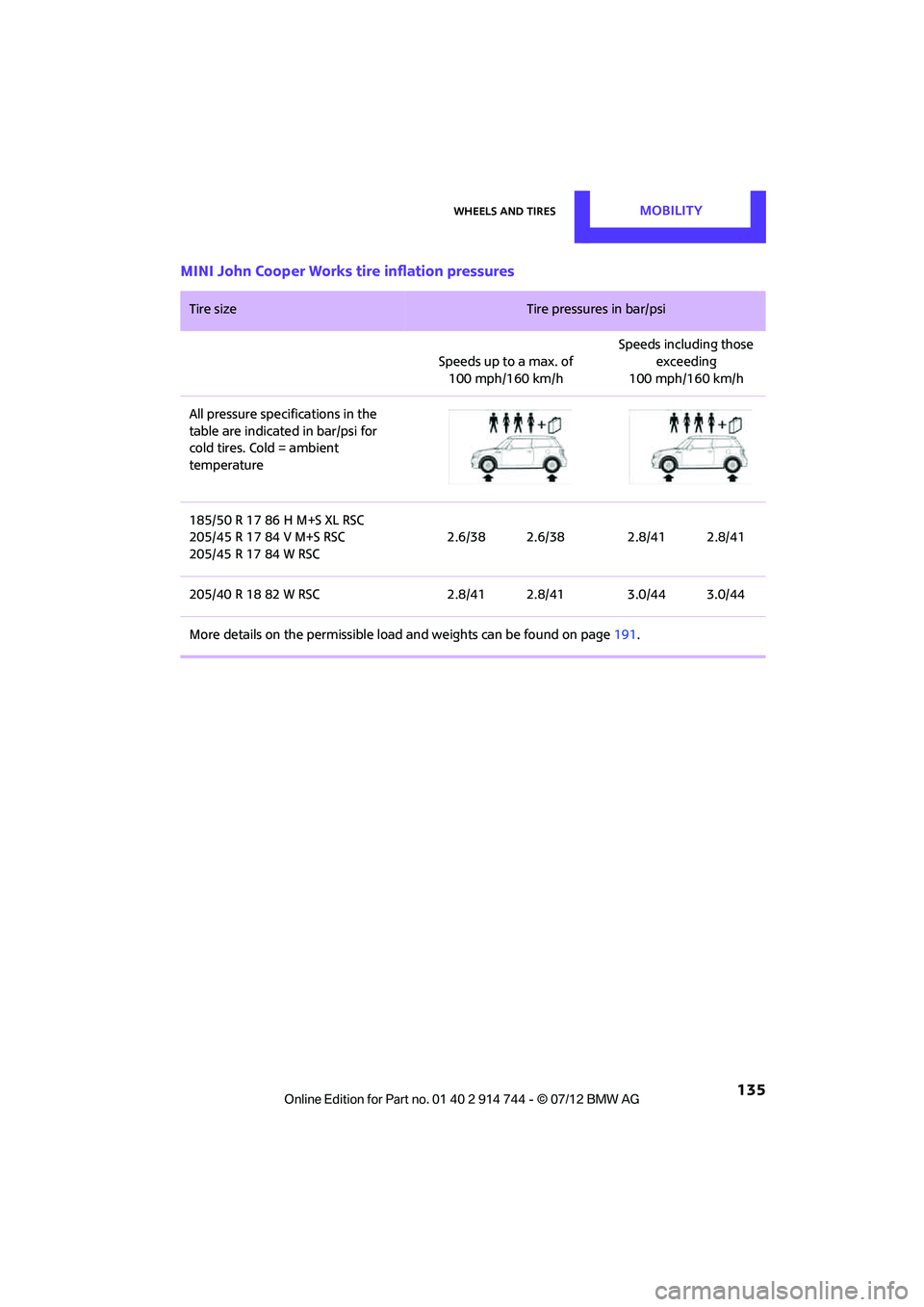
MINI John Cooper Works tire inflation pressures
Tire size Tire pressures in bar/psi
Speeds up to a max. of 100 mph/160 km/h Speeds including those
exceeding
100 mph/160 km/h
All pressure specifications in the
table are indicated in bar/psi for
cold tires. Cold = ambient
temperature
185/50 R 17 86 H M+S XL RSC
205/45 R 17 84 V M+S RSC
205/45 R 17 84 W RSC 2.6/38 2.6/38 2.8/41 2.8/41
205/40 R 18 82 W RSC 2.8/41 2.8/41 3.0/44 3.0/44
More details on the perm issible load and weights can be found on page 191.
Online Edition for Part no. 01 40 2 914 744 - \251 07/12 BMW AG
Page 137 of 207
MOBILITYWheels and tires
136
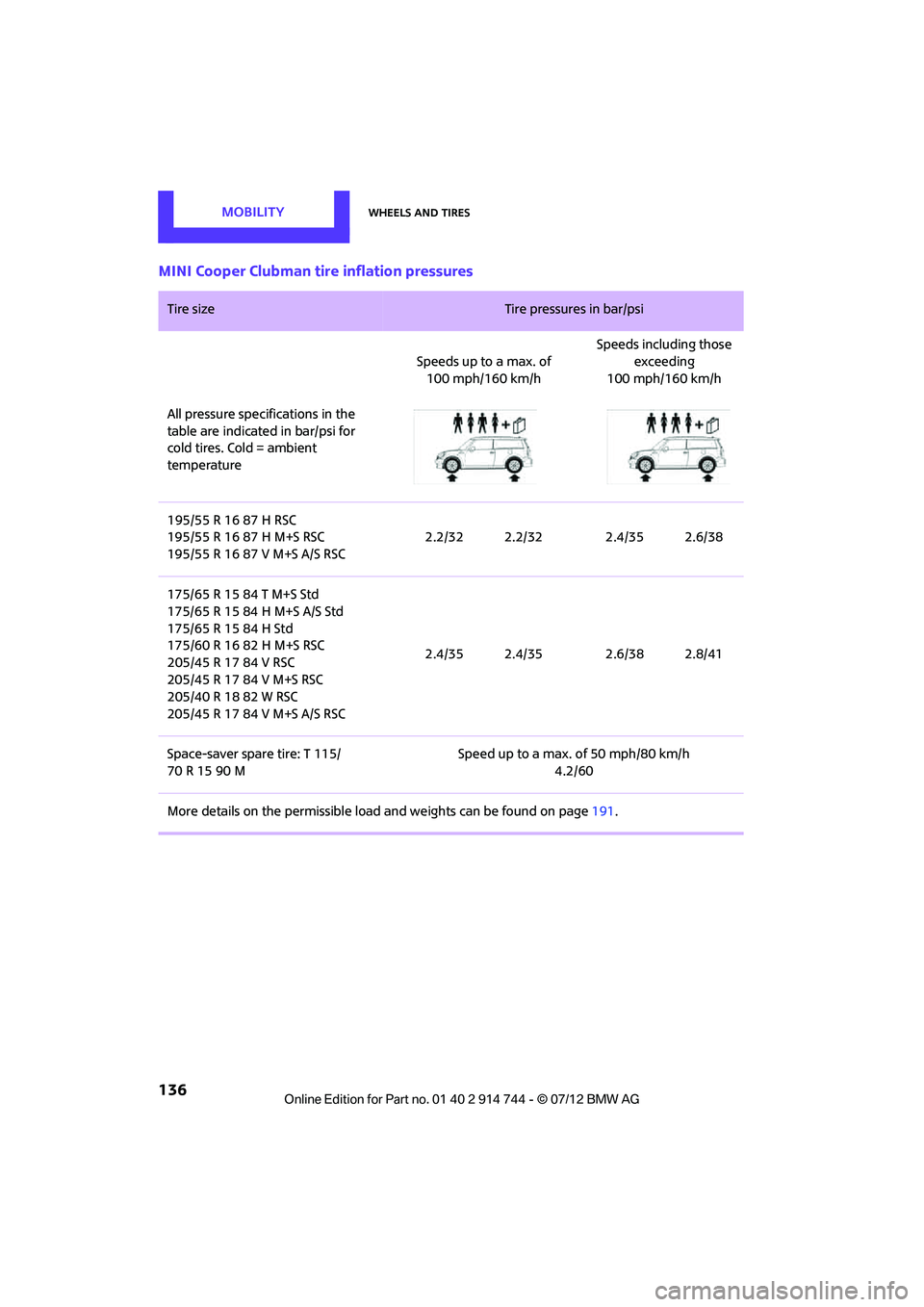
MINI Cooper Clubman tire inflation pressures
Tire size Tire pressures in bar/psi
Speeds up to a max. of 100 mph/160 km/h Speeds including those
exceeding
100 mph/160 km/h
All pressure specifications in the
table are indicated in bar/psi for
cold tires. Cold = ambient
temperature
195/55 R 16 87 H RSC
195/55 R 16 87 H M+S RSC
195/55 R 16 87 V M+S A/S RSC 2.2/32 2.2/32 2.4/35 2.6/38
175/65 R 15 84 T M+S Std
175/65 R 15 84 H M+S A/S Std
175/65 R 15 84 H Std
175/60 R 16 82 H M+S RSC
205/45 R 17 84 V RSC
205/45 R 17 84 V M+S RSC
205/40 R 18 82 W RSC
205/45 R 17 84 V M+S A/S RSC 2.4/35 2.4/35 2.6/38 2.8/41
Space-saver spare tire: T 115/
70 R 15 90 M Speed up to a max. of 50 mph/80 km/h
4.2/60
More details on the permissible load and weights can be found on page191.
Online Edition for Part no. 01 40 2 914 744 - \251 07/12 BMW AG
Page 138 of 207
Wheels and tiresMOBILITY
137
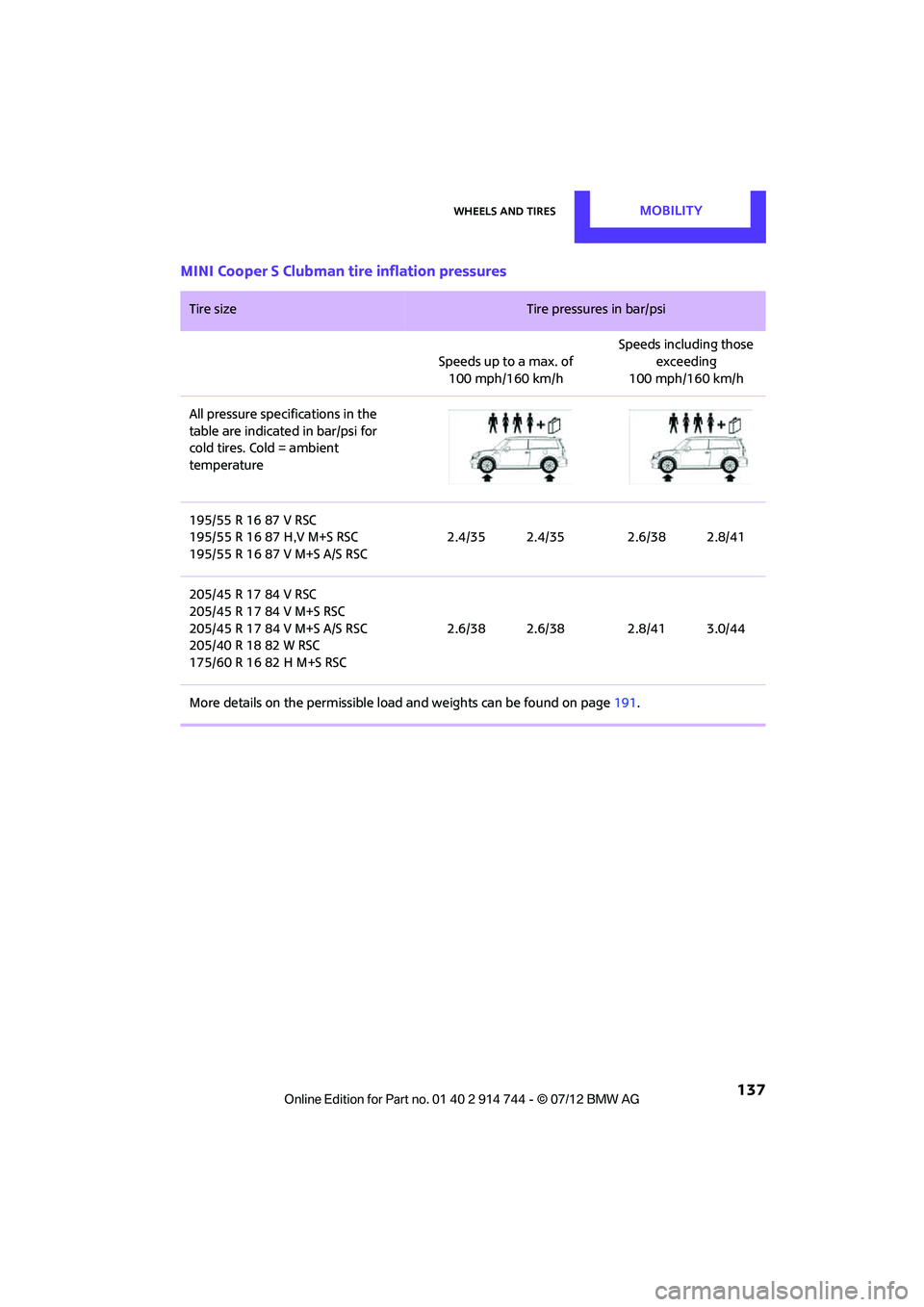
MINI Cooper S Clubman tire inflation pressures
Tire size Tire pressures in bar/psi
Speeds up to a max. of 100 mph/160 km/h Speeds including those
exceeding
100 mph/160 km/h
All pressure specifications in the
table are indicated in bar/psi for
cold tires. Cold = ambient
temperature
195/55 R 16 87 V RSC
195/55 R 16 87 H,V M+S RSC
195/55 R 16 87 V M+S A/S RSC 2.4/35 2.4/35 2.6/38 2.8/41
205/45 R 17 84 V RSC
205/45 R 17 84 V M+S RSC
205/45 R 17 84 V M+S A/S RSC
205/40 R 18 82 W RSC
175/60 R 16 82 H M+S RSC 2.6/38 2.6/38 2.8/41 3.0/44
More details on the perm issible load and weights can be found on page 191.
Online Edition for Part no. 01 40 2 914 744 - \251 07/12 BMW AG
Page 139 of 207

MOBILITYWheels and tires
138
MINI John Cooper Works Clubman tire inflation pressures
Tire coding
Knowledge of the labeling on the side of the tire
makes it easier to identify and choose the right
tires.
Tire size
Speed letter
Q = up to 100 mph/160 km/h
T = up to 118 mph/190 km/h H = up to 131 mph/210 km/h
V = up to 150 mph/240 km/h
W = up to 167 mph/270 km/h
Y = up to 186 mph/300 km/h
Tire Identification Number
Tires with DOT codes meet the guidelines of the
US Department of Transportation.
DOT code:
Uniform Tire Quality Grading
Quality grades can be found where applicable
on the tire sidewall between tread shoulder and
maximum section width. For example:
Tire size Tire pressures in bar/psi
Speeds up to a max. of 100 mph/160 km/h Speeds including those
exceeding
100 mph/160 km/h
All pressure specifications in the
table are indicated in bar/psi for
cold tires. Cold = ambient
temperature
185/50 R 17 86 H M+S XL RSC
205/45 R 17 84 V M+S RSC
205/45 R 17 84 W RSC 2.6/38 2.6/38 2.7/39 3.1/45
205/40 R 18 82 W RSC 2.8/41 2.8/41 2.9/42 3.3/48
More details on the permissible load and weights can be found on page191.
e.g.
Nominal width in mm
Aspect
ratio in Ξ
Radial belt construction
Rim diameter in inches
Load rating,
(not on ZR tires)
Speed code letter,
(before the R on ZR tires)225/45 R 17 91 V
For instance:
Manufacturer's code
for tire make
tire size and
tire design
Tire ageDOT xxxx xxx 1012
Online Edition for Part no. 01 40 2 914 744 - \251 07/12 BMW AG
Page 140 of 207

Wheels and tiresMOBILITY
139
Tread wear 200 Traction AA
Temperature A
DOT Quality Grades
Tread wear
Traction AA A B C
Temperature A B CAll passenger car tires must conform to
Federal Safety Requirements in addition
to these grades. <
Tread wear
The tread wear grade is a comparative rating
based on the wear rate of the tire when tested
under controlled conditions on a specified
government test course. For example, a tire
graded 150 would wear one and one-half (1 γ)
times as well on the government course as a tire
graded 100. The relative performance of tires
depends upon the actual conditions of their use,
however, and may depart significantly from the
norm due to variations in driving habits, service
practices and differences in road characteristics
and climate.
Traction
The traction grades, from highest to lowest, are
AA, A, B, and C.
Those grades represent the tire's ability to stop
on wet pavement, as measured under con-
trolled conditions on specified government test
surfaces of asphalt and concrete. A tire marked C
may have poor traction performance.
The traction grade assigned to this tire is
based on straight-ahead braking traction
tests, and does not incl ude acceleration, corner-
ing, hydroplaning, or peak traction characteris-
tics. <
Temperature
The temperature grades are A, the highest, B,
and C, representing the tire's resistance to the
generation of heat and its ability to dissipate
heat when tested under controlled conditions
on a specified indoor laboratory test wheel. Sustained high temperature can cause the
material of the tire to
degenerate and reduce
tire life, and excessive temperature can lead to
sudden tire failure. The grade C corresponds to a
level of performance which all passenger car
tires must meet under the Federal Motor Vehicle
Safety Standard No. 109. Grades B and A repre-
sent levels of performance on the laboratory test
wheel that exceed the minimum required by
law.
The temperature grade for this tire is
established for a tire that is properly
inflated and not overloaded. Excessive speed,
underinflation, or excessive loading, either
separately or in combin ation, can cause heat
buildup and possible tire failure.<
RSC - run-flat tires
You will recognize run-flat tires by a circular
symbol containing the letters RSC on the side of
the tire, page 140.
M+S
Winter and all-season tires.
These have better winter properties than
summer tires.
XL
Designation for specia lly reinforced tires.
Tire condition
Inspect your tires regularly for tread wear, signs
of damage and for foreig n objects lodged in the
tread. Check the tread depth.
Tread depth
The tread depth should not drop below 0.12 in/
3 mm, although, for exam ple, European legisla-
tion only specifies a minimum tread depth of
0.063 in/1.6 mm. At tread depths below
0.12 in/3 mm there is an increased risk of high-
speed hydroplaning, even when only small
amounts of water are present on the road
surface.
Online Edition for Part no. 01 40 2 914 744 - \251 07/12 BMW AG
Page 143 of 207

MOBILITYWheels and tires
142
Pay attention to speed
Always comply with the speed limit for the
winter tires mounted on your car; failure
to do so could result in tire damage and acci-
dents. <
If the car is capable of speeds higher than that
permitted for the winter tires, a label stating the
maximum permitted speed for the mounted
tires must be displayed in your field of view. This
label is available at your tire dealer or MINI
dealer.
Storage
Always store wheels and tires in a cool, dry place
with as little exposure to light as possible.
Always protect tires agains t all contact with oil,
grease and fuels.
Do not exceed the maximum tire inflation
pressure indicated on the sidewall of the tire.
Swapping wheels among the axles
Depending on the individual use, front and rear
tires may exhibit different wear and tear.
In order to maintain an even wear and tear, the
wheels may be rotated between the axles. Your
MINI dealer will be glad to advise you.
Always check the inflation pressure after the tire
rotation, if necessary change the pressure.
Snow chains
Only certain types of fine-link snow chains have
been tested by the manufacturer of your MINI,
classified as road-safe and recommended.
Contact your MINI deal er for more details.
Only attach snow chains in pairs to the front
wheels with the following tires.
> 175/65 R 15 M+S
> 175/60 R 16 M+S
John Cooper Works:
> 185/50 R 17 86 H M+S XL RSC
Observe the manufacturer's instructions when
mounting snow chains. Do not exceed a speed
of 30 mph or 50 km/h. Do not initialize the Flat Tire Monitor if
snow chains are mounted; otherwise, the
instrument might issue an incorrect reading.
When driving with snow ch ains, it can be useful
to briefly deactivate DSC or activate DTC, refer to
page 65.<
Online Edition for Part no. 01 40 2 914 744 - \251 07/12 BMW AG
Page 162 of 207
Replacing componentsMOBILITY
161
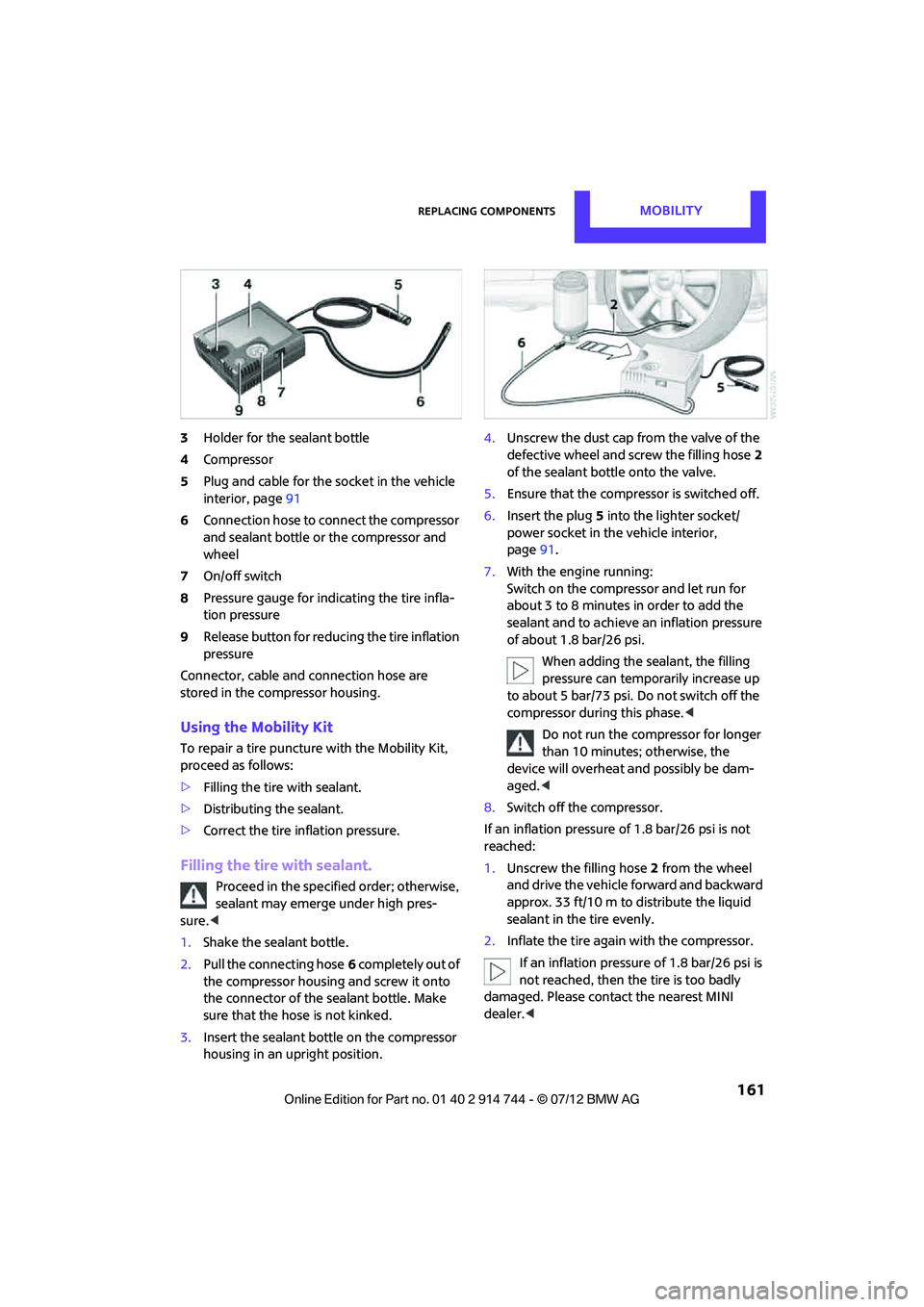
3Holder for the sealant bottle
4 Compressor
5 Plug and cable for the socket in the vehicle
interior, page 91
6 Connection hose to connect the compressor
and sealant bottle or the compressor and
wheel
7 On/off switch
8 Pressure gauge for indi cating the tire infla-
tion pressure
9 Release button for reduci ng the tire inflation
pressure
Connector, cable and connection hose are
stored in the compressor housing.
Using the Mobility Kit
To repair a tire puncture with the Mobility Kit,
proceed as follows:
> Filling the tire with sealant.
> Distributing the sealant.
> Correct the tire inflation pressure.
Filling the tire with sealant.
Proceed in the specifie d order; otherwise,
sealant may emerge under high pres-
sure. <
1. Shake the sealant bottle.
2. Pull the connecting hose 6 completely out of
the compressor housing and screw it onto
the connector of the sealant bottle. Make
sure that the hose is not kinked.
3. Insert the sealant bottle on the compressor
housing in an upright position. 4.
Unscrew the dust cap from the valve of the
defective wheel and screw the filling hose 2
of the sealant bottle onto the valve.
5. Ensure that the compressor is switched off.
6. Insert the plug 5 into the lighter socket/
power socket in the vehicle interior,
page 91.
7. With the engine running:
Switch on the compre ssor and let run for
about 3 to 8 minutes in order to add the
sealant and to achieve an inflation pressure
of about 1.8 bar/26 psi.
When adding the sealant, the filling
pressure can temporarily increase up
to about 5 bar/73 psi. Do not switch off the
compressor during this phase. <
Do not run the compressor for longer
than 10 minutes; otherwise, the
device will overheat and possibly be dam-
aged. <
8. Switch off the compressor.
If an inflation pressure of 1.8 bar/26 psi is not
reached:
1. Unscrew the filling hose 2 from the wheel
and drive the vehicle forward and backward
approx. 33 ft/10 m to distribute the liquid
sealant in the tire evenly.
2. Inflate the tire again with the compressor.
If an inflation pressure of 1.8 bar/26 psi is
not reached, then the tire is too badly
damaged. Please contact the nearest MINI
dealer.<
Online Edition for Part no. 01 40 2 914 744 - \251 07/12 BMW AG
Page 163 of 207

MOBILITYReplacing components
162
Stowing Mobility Kit
1.Unscrew filler hose 2 of the sealant bottle
from the wheel.
2. Unscrew connecting hose of the
compressor 6 from the sealant bottle.
3. Connect the filler hose 2 of the sealant
bottle to the unoccupied connection on the
sealant bottle.
This prevents the rest of the sealant from
escaping from the bottle.
4. Wrap the empty sealant bottle in suitable
material to avoid dirt ying the cargo area.
5. Stow Mobility Kit back in the vehicle.
Distributing the sealant.
Immediately drive approx. 3.1 miles/5 km so
that the sealant evenly distributes itself.
Do not exceed speeds of 50 mph/
80 km/h.
If possible, do not drop below 10 mph/
20 km/h. <
Adjusting the tire pressure
1.After driving approx. 3.1 miles/5 km or
10 minutes, stop at a suitable location.
2. Screw the connection hose 6 of the com-
pressor directly onto the tire valve.
3. Insert the plug 5 into the power socket in
the vehicle interior.
4. Adjust tire pressure to 1.8 bar/26 psi. With
the engine running:
> To increase the inflatio n pressure: switch on
the compressor. To ch eck the current infla-
tion pressure, switch off the compressor.
Do not run the comp ressor for longer
than 10 minutes; otherwise, the
device will overheat and possibly be
damaged.<
> To decrease the inflation pressure: press the
release button 9. If the tire cannot m
aintain the inflation
pressure, drive the vehicle again, refer to
Distributing the sealan t. Then repeat steps
1to4.
If an inflation pressure of 1.8 bar/26 psi still can-
not be reached, then the tire is too heavily dam-
aged. Contact your ne arest MINI dealer.<
Driving on
Do not exceed the permitted maximum
speed of 50 mph/80 km/h; doing so may
result in an accident. <
Replace the defective tire as soon as possible
and have the new wheel/tire assembly
balanced.
Have the Mobility Kit refilled.
Changing wheels
Run-flat tires
Tire change for run-flat tires:
> Prepare for tire change, page 164
> Jack up vehicle, page 164
> Tighten lug bolts, page 165
Space-saver spare tire
Tire change with space-saver spare tire:
>Remove the space-saver spare tire,
page 163
> Prepare for tire change, page 164
> Jack up vehicle, page 164
> Mount space-saver spare tire, page 164
> Tighten lug bolts, page 165
> Drive with space-saver spare tire, page 163
MINI: removing the space-saver spare
tire
The screw connection of the space-saver spare
tire is under the floor mat in the cargo area, on
the base of the storage compartment for the tire
change set.
Online Edition for Part no. 01 40 2 914 744 - \251 07/12 BMW AG
Page 181 of 207
MOBILITYIndicator and warning lamps
180
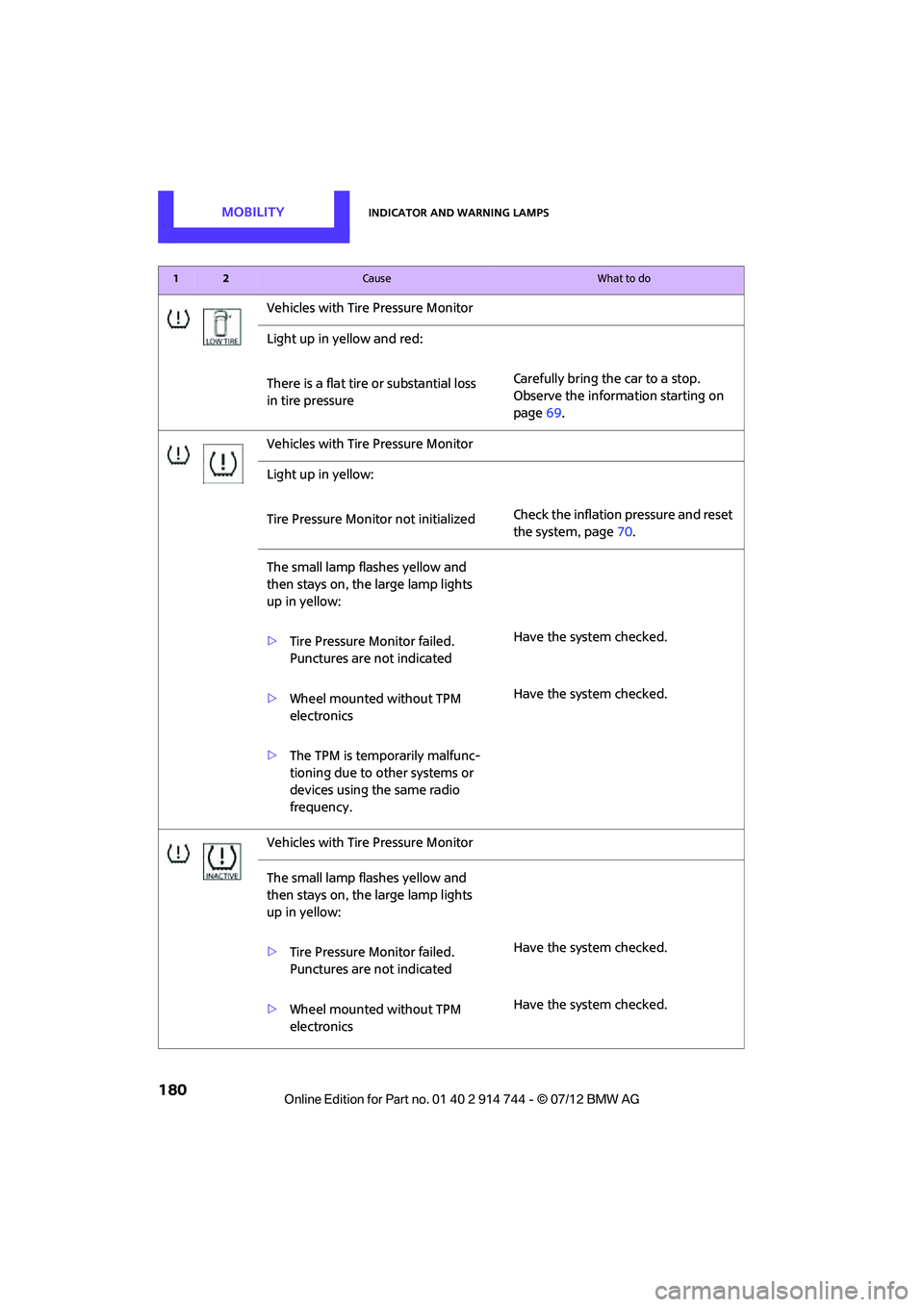
Vehicles with Tire Pressure Monitor
Light up in yellow and red:
There is a flat tire or substantial loss
in tire pressure Carefully bring the car to a stop.
Observe the information starting on
page
69.
Vehicles with Tire Pressure Monitor
Light up in yellow:
Tire Pressure Monitor not initialized Check the inflation pressure and reset
the system, page
70.
The small lamp flashes yellow and
then stays on, the large lamp lights
up in yellow:
> Tire Pressure Monitor failed.
Punctures are not indicated Have the system checked.
> Wheel mounted without TPM
electronics Have the system checked.
> The TPM is temporarily malfunc-
tioning due to other systems or
devices using the same radio
frequency.
Vehicles with Tire Pressure Monitor
The small lamp flashes yellow and
then stays on, the large lamp lights
up in yellow:
> Tire Pressure Monitor failed.
Punctures are not indicated Have the system checked.
> Wheel mounted without TPM
electronics Have the system checked.
12Cause What to do
Online Edition for Part no. 01 40 2 914 744 - \251 07/12 BMW AG