ignition MINI COOPER CONVERTIBLE 2007 Owners Manual
[x] Cancel search | Manufacturer: MINI, Model Year: 2007, Model line: COOPER CONVERTIBLE, Model: MINI COOPER CONVERTIBLE 2007Pages: 172, PDF Size: 1.9 MB
Page 5 of 172
3OVERVIEW REPAIRS OPERATION CONTROLS DATA INDEX
Driving:
Ignition lock53
Starting the engine53
Switching off the engine54
Parking brake54
Manual transmission55
Automatic transmission with
Steptronic56
Parking lamps/Low beams60
Turn signal indicator/Headlamp
flasher61
Instrument lighting62
Fog lamps62
Interior lamps62
Washer/wiper system63
Washer fluid64
Cruise control65
Everything under control:
Odometer67
Clock67
Fuel gauge67
Coolant temperature gauge68
Tachometer69
Service interval display69
Onboard computer70Technology for safety and driving
convenience:
Driving stability control systems72
Flat Tire Monitor74
Airbags76
Park Distance Control (PDC)78
Controlling the climate for pleasant
driving:
Air conditioning system79
Automatic climate control82
Interior conveniences:
Glove compartment85
Center armrest85
Drinks holders, ashtray86
Cigarette lighter, 12 V power supply87
Integrated universal remote control88
Loading and transporting cargo:
Luggage compartment in the MINI90
Luggage compartment in the MINI
Convertible91
Loading cargo92
Roof-mounted luggage rack95
OPERATION, CARE, MAINTENANCESpecial operating instructions:
Break-in procedures98
General driving notes98
Refueling101
Wheels and tires:
Tire inflation pressure104
Tire coding108
Tire condition109
Run-Flat Tires111
New wheels and tires112
Snow chains113
Page 18 of 172

16
INDICATOR AND WARNING LAMPSTechnology that monitors itselfThe system runs a check on the indicator
and warning lamps marked by
+ when you
turn the key in the ignition lock. They each
light up once for different periods of time.
If a malfunction should occur in one of
these systems, the corresponding lamp
does not go out after the engine is started
or it lights up while the vehicle is moving.
You will see below the correct way to react
to this.
Red: stop immediately
Battery charge current
+
The battery is no longer being
charged. Indicates a defective alter-
nator drive belt or a problem with the
charge circuit. Please contact your MINI
Dealer.
If the drive belt is defective, do not
continue driving. The engine could be
damaged due to overheating. When the
power-assist is deactivated, increased
steering effort is required.<
Engine oil pressure
+
The engine oil pressure is too low.
Pull over immediately and switch
off the engine. Please contact your MINI
Dealer.
Do not continue driving; otherwise,
the engine could be damaged
because of inadequate lubrication.<
Brake warning lamp
+
Lights up although the parking
brake is released. The brake fluid
level is too low. Before driving further, be
sure to comply with the information on
page120. Have the system checked imme-
diately.
Canadian models display this
warning lamp.
If equipped with a navigation system or
Cockpit Chrono Pack:
Coolant temperature warning
lamp in the navigation system or
Cockpit Chrono Pack+
Lights up while driving:
engine is too hot. Pull over to the side of
the road immediately, switch off the
engine and allow it to cool down, refer also
to page68. Have the system checked
immediately.
Page 19 of 172
17
OVERVIEW REPAIRS OPERATION CONTROLS DATA INDEX
INDICATOR AND WARNING LAMPSYellow: stop immediately
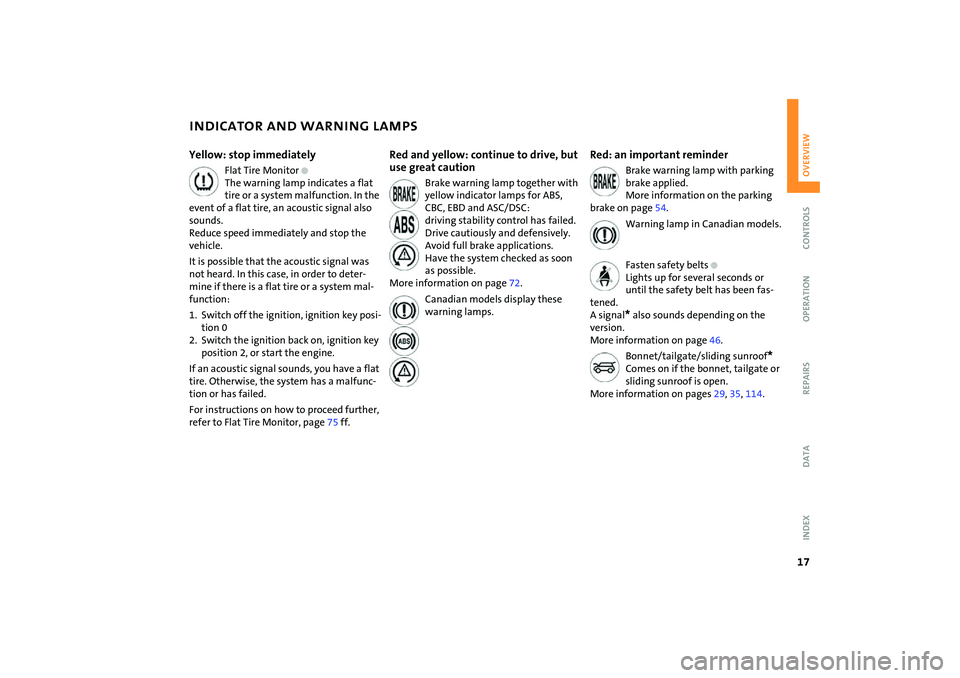
Flat Tire Monitor
+
The warning lamp indicates a flat
tire or a system malfunction. In the
event of a flat tire, an acoustic signal also
sounds.
Reduce speed immediately and stop the
vehicle.
It is possible that the acoustic signal was
not heard. In this case, in order to deter-
mine if there is a flat tire or a system mal-
function:
1. Switch off the ignition, ignition key posi-
tion 0
2. Switch the ignition back on, ignition key
position 2, or start the engine.
If an acoustic signal sounds, you have a flat
tire. Otherwise, the system has a malfunc-
tion or has failed.
For instructions on how to proceed further,
refer to Flat Tire Monitor, page75 ff.
Red and yellow: continue to drive, but
use great caution
Brake warning lamp together with
yellow indicator lamps for ABS,
CBC, EBD and ASC/DSC:
driving stability control has failed.
Drive cautiously and defensively.
Avoid full brake applications.
Have the system checked as soon
as possible.
More information on page72.
Canadian models display these
warning lamps.
Red: an important reminder
Brake warning lamp with parking
brake applied.
More information on the parking
brake on page54.
Warning lamp in Canadian models.
Fasten safety belts
+
Lights up for several seconds or
until the safety belt has been fas-
tened.
A signal* also sounds depending on the
version.
More information on page46.
Bonnet/tailgate/sliding sunroof
*
Comes on if the bonnet, tailgate or
sliding sunroof is open.
More information on pages29, 35, 114.
Page 26 of 172

24
KEYS CENTRAL LOCKING SYSTEMDepending on your vehicle's equipment
vesion, you will have received the following
keys:
1 Master keys with remote control
2Spare keyMaster keys with remote controlIn every master key with remote control,
there is an extended-life battery as a power
supply that is charged automatically in the
ignition lock as you drive.
You should therefore use each master key
at least twice a year to maintain the charge
status.
Depending on which master key the vehicle
detects when it is unlocked, different set-
tings will be called up and executed inside
the vehicle, refer to Vehicle Memory on
page49.Spare keyFor keeping in a safe place, e.g. in your wal-
let. This key is not intended for constant
use.
The conceptThe central locking system is ready for
operation whenever the driver's door is
closed. The doors, the tailgate and the fuel
filler door are unlocked or locked.
The central locking system locks or unlocks
your vehicle:
>When operated from the outside via the
remote control as well as via the door
lock
>When operated from the inside via a
switch
>The vehicle is unlocked automatically
when the ignition key is pulled out of the
ignition switch.
If operated from outside, the anti-theft sys-
tem is activated at the same time. This pre-
vents the doors from being unlocked via
safety lock buttons or door handles.
In the event of a sufficiently severe acci-
dent, the central locking system unlocks
automatically. The hazard warning flashers
and interior lamps are also switched on.
Page 32 of 172

30
TAILGATEManual release in the MINI In the event of an electrical malfunction,
you can also unlock the tailgate manually.
1. Fold the rear seat bench upward
2. Pull the ring.
The tailgate is released.
Manual release in the MINI
ConvertibleIn the event of an electrical malfunction,
you can also unlock the tailgate manually.
1. Use a master key or ignition key to
release the catches of the rear backrests,
refer to Through-loading system on
page91
2. Fold the rear bench seat upward and
remove the hook attached to it
3. Using the hook, reach backward
between the convertible top and the
rear backrest to pull one of the levers for
releasing the folding rear backrests,
refer to page92
4. Fold rear backrests forward
Page 33 of 172

31
OVERVIEW REPAIRS OPERATIONCONTROLS DATA INDEX
TAILGATE ELECTRIC POWER WINDOWS5. Pull the handle, see arrow.
The tailgate is released.
To open the windows >Press the switch downwards.
The window opens until you release the
switch or
>Tap the switch downwards.
The window opens automatically.
Tapping the switch again stops the oper-
ation.To close the windows
Make sure that the closing range of
the windows is unobstructed, other-
wise personal injury could result when the
windows close.<
From ignition key position 1:
Press the switch upwards.
The window closes until you release the
switch.
Watch the closing process to ensure
that no one is injured.<
After the ignition has been switched off:
You can continue using the electric power
windows for a limited period as long as no
one opens either of the doors.
When leaving the vehicle, always
take the ignition key with you. Other-
wise children could operate the power win-
dows and injure themselves.<
Page 35 of 172

33
OVERVIEW REPAIRS OPERATIONCONTROLS DATA INDEX
GLASS SUNROOF, ELECTRIC
*
To raise
Press the switch.
>The closed glass sunroof is raised.
>The closed glass sunroof automatically
moves into the raised position.
Do not use force to close the glass
sunroof from its raised position, oth-
erwise the mechanism will be damaged.<
To open and close
Be sure that adequate clearance is
maintained for the opening path of
the glass sunroof; otherwise damage can
occur. Observe the glass sunroof while it is
closing, to make sure that no one is
injured.<
>Push the switch backwards to the resis-
tance point.
The glass sunroof opens for as long as
the switch is held in this position.
>Push the switch backwards past the
resistance point. The glass sunroof opens
automatically. Tapping the switch again
stops the operation.
The glass sunroof is closed in the same
manner by pushing the switch forward.
After the ignition has been switched
offYou can continue using the glass sunroof
for a limited period as long as no one opens
either of the doors.
If a door is opened during operation, the
opening/closing process stops immedi-
ately.
When leaving the vehicle, remove the
ignition key from the lock and close
the doors. Otherwise children could oper-
ate the sunroof and injure themselves.<
Page 37 of 172

35
OVERVIEW REPAIRS OPERATIONCONTROLS DATA INDEX
CONVERTIBLE TOP WITH INTEGRATED SLIDING SUNROOFOpening and closing the sliding
sunroofTo open:
Press button 2 until the desired sunroof
position is reached.
To close:
Press button 1.
The sliding sunroof can be operated up to a
road speed of 75 mph / 120 km/h.Sliding sunroof not completely closedIf the ignition key is in position 0 or
removed and the driver's door is opened,
the following warnings are issued:
>bonnet/tailgate/convertible top indica-
tor lamp
*, refer to page17, comes on
>a signal sounds
>LED in button 1 flashes for a certain time
and then goes out.
Power convertible top So that you can get the most enjoyment
out of your MINI Convertible, please
observe the following tips:
>It is recommended that you close the
convertible top whenever the vehicle is
parked.
The closed convertible top not only pro-
tects the vehicle interior from damage
due to unforeseen bad weather, but also
provides a certain degree of protection
against theft
>Even when the convertible top is closed,
keep valuable items in the locked lug-
gage compartment or in the lockable
glove compartment
>Do not mount any roof rack systems on
the convertible top
>To avoid damage, do not operate the
convertible top at temperatures below
147/–106.
Do not leave the convertible top
folded for more than one day if it is
wet, to prevent permanent damage from
moisture. Do not place any objects on the
convertible top, as they could otherwise fall
off while the convertible top is being oper-
ated and result in damage or personal
injury.<
Page 39 of 172

37
OVERVIEW REPAIRS OPERATIONCONTROLS DATA INDEX
CONVERTIBLE TOP WITH INTEGRATED SLIDING SUNROOFChecking>The LED lights up during convertible top
operation until the opening or closing
procedure is completely finished
>The LED flashes for approx. 60 seconds
after the button is released. The opening
or closing procedure has not yet been
completed. The procedure can be contin-
ued in the desired direction by pressing
the appropriate button
>The LED flashes rapidly. The convertible
top cannot be operated.
The luggage compartment cover is not in
its lower position, refer to page91, or the
loading aid is not correctly locked, refer
to page91.
InterruptionThe automatic movement is immediately
interrupted when the buttons for convert-
ible top operation are released. The proce-
dure can be continued in the desired direc-
tion by pressing the appropriate buttons.
If the opening or closing procedure is inter-
rupted by releasing the respective button,
the convertible top stays in its current posi-
tion for several seconds before it slowly
moves into a more stable position. The pro-
cedure can be continued by pressing the
appropriate button.
Movement is also interrupted when there
is a mechanical blockage. In this case, in
order to operate the convertible top again:
1. Turn off the ignition and then switch it
on again
2. Press the button to continue the proce-
dure in the desired direction.Opening and closing procedure
Do not interrupt and restart the clos-
ing procedure several times one after
another, or the convertible top mechanism
could be damaged.<
If the convertible top can be moved in
only one direction after several con-
secutive attempts to operate it, the con-
vertible top system has overheated. Allow
the system to cool down for approx.
20 minutes.<
If the battery is disconnected, e.g. for
changing batteries or vehicle storage,
reinitialize the power windows, refer to
page32. Otherwise the windows will not
be lowered when the convertible top is
opened.
tion via the door lock refer to page27.
Page 44 of 172
42
SAFE SEATING POSITIONThe ideal seating position can make a vital
contribution to relaxed, relatively fatigue-
free driving. Together with the safety belts
and airbags, the seating position also plays
an important role in providing occupants
with maximum levels of passive safety in
an accident. To ensure that the safety sys-
tems operate with optimal efficiency, we
strongly urge you to observe the instruc-
tions contained in the following section.
For additional information about trans-
porting children safely, refer to page50.Airbags
Always maintain an adequate dis-
tance between yourself and all of the
airbags. Always hold the steering wheel by
the rim with the hands at the 9 and
3 o'clock positions to keep any chance of
injury to hands or arms to an absolute min-
imum, should the airbag be deployed.
No one and nothing is to come between
the airbags and the seat occupant. Do not
use the front passenger airbag cover as a
storage surface for objects of any kind.
Ensure that the front passenger is correctly
seated, e.g. that no feet or legs are propped
against the dashboard. Otherwise, leg
injury could result if the front passenger
airbag suddenly deployed.
Make sure that passengers do not lean
their heads against the side or head airbag,
as injuries could result if the side airbags
were triggered.<
Even if all these instructions are followed, it
cannot entirely be ruled out that in some
circumstances injury may result from con-
tact with the airbags. In sensitive individu-
als, the ignition and inflation noise may
induce a mild hearing loss that is usually
temporary.
For airbag locations and additional infor-
mation on airbags, refer to page76.Head restraintA correctly adjusted head restraint reduces
the risk of injury to the cervical spine in the
event of an accident.
Adjust the head restraint in such a
way that it is centered roughly at ear
level. Otherwise, there is an increased risk
of injury in the event of an accident.
work in conjunction with the safety belts,
but do not replace them. Your vehicle is
equipped with four seats, each of which is
provided with a safety belt.
Never allow more than one person to
wear a single safety belt. Never allow
infants or small children to ride in a passen-
ger's lap. Make sure that the belt in the lap
area sits low across the hips and does not
press against the abdomen. The safety belt
must not rest against the throat, run across
sharp edges, pass over hard or fragile
objects or be pinched. Fasten the safety
belt so that it is not twisted and sits as
snugly as possible against the lap and
shoulder. Otherwise the belt could slide
over the hips and injure the abdomen in
the event of a frontal collision. Avoid wear-
ing bulky clothing and pull the belt in the
upper-body area upward periodically to
retension it. Otherwise, the restraining
effect of the safety belt could be dimin-
ished.<
For information on using the safety belts,
refer to page46.