parking brake MINI COOPER CONVERTIBLE 2007 Owners Manual
[x] Cancel search | Manufacturer: MINI, Model Year: 2007, Model line: COOPER CONVERTIBLE, Model: MINI COOPER CONVERTIBLE 2007Pages: 172, PDF Size: 1.9 MB
Page 5 of 172
3OVERVIEW REPAIRS OPERATION CONTROLS DATA INDEX
Driving:
Ignition lock53
Starting the engine53
Switching off the engine54
Parking brake54
Manual transmission55
Automatic transmission with
Steptronic56
Parking lamps/Low beams60
Turn signal indicator/Headlamp
flasher61
Instrument lighting62
Fog lamps62
Interior lamps62
Washer/wiper system63
Washer fluid64
Cruise control65
Everything under control:
Odometer67
Clock67
Fuel gauge67
Coolant temperature gauge68
Tachometer69
Service interval display69
Onboard computer70Technology for safety and driving
convenience:
Driving stability control systems72
Flat Tire Monitor74
Airbags76
Park Distance Control (PDC)78
Controlling the climate for pleasant
driving:
Air conditioning system79
Automatic climate control82
Interior conveniences:
Glove compartment85
Center armrest85
Drinks holders, ashtray86
Cigarette lighter, 12 V power supply87
Integrated universal remote control88
Loading and transporting cargo:
Luggage compartment in the MINI90
Luggage compartment in the MINI
Convertible91
Loading cargo92
Roof-mounted luggage rack95
OPERATION, CARE, MAINTENANCESpecial operating instructions:
Break-in procedures98
General driving notes98
Refueling101
Wheels and tires:
Tire inflation pressure104
Tire coding108
Tire condition109
Run-Flat Tires111
New wheels and tires112
Snow chains113
Page 18 of 172

16
INDICATOR AND WARNING LAMPSTechnology that monitors itselfThe system runs a check on the indicator
and warning lamps marked by
+ when you
turn the key in the ignition lock. They each
light up once for different periods of time.
If a malfunction should occur in one of
these systems, the corresponding lamp
does not go out after the engine is started
or it lights up while the vehicle is moving.
You will see below the correct way to react
to this.
Red: stop immediately
Battery charge current
+
The battery is no longer being
charged. Indicates a defective alter-
nator drive belt or a problem with the
charge circuit. Please contact your MINI
Dealer.
If the drive belt is defective, do not
continue driving. The engine could be
damaged due to overheating. When the
power-assist is deactivated, increased
steering effort is required.<
Engine oil pressure
+
The engine oil pressure is too low.
Pull over immediately and switch
off the engine. Please contact your MINI
Dealer.
Do not continue driving; otherwise,
the engine could be damaged
because of inadequate lubrication.<
Brake warning lamp
+
Lights up although the parking
brake is released. The brake fluid
level is too low. Before driving further, be
sure to comply with the information on
page120. Have the system checked imme-
diately.
Canadian models display this
warning lamp.
If equipped with a navigation system or
Cockpit Chrono Pack:
Coolant temperature warning
lamp in the navigation system or
Cockpit Chrono Pack+
Lights up while driving:
engine is too hot. Pull over to the side of
the road immediately, switch off the
engine and allow it to cool down, refer also
to page68. Have the system checked
immediately.
Page 19 of 172
17
OVERVIEW REPAIRS OPERATION CONTROLS DATA INDEX
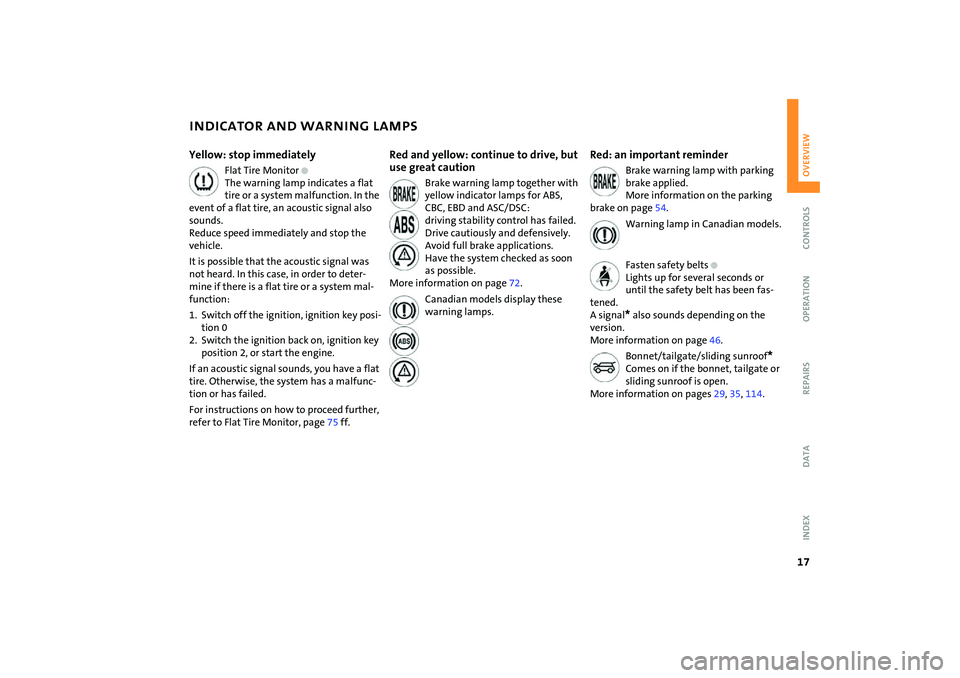
INDICATOR AND WARNING LAMPSYellow: stop immediately
Flat Tire Monitor
+
The warning lamp indicates a flat
tire or a system malfunction. In the
event of a flat tire, an acoustic signal also
sounds.
Reduce speed immediately and stop the
vehicle.
It is possible that the acoustic signal was
not heard. In this case, in order to deter-
mine if there is a flat tire or a system mal-
function:
1. Switch off the ignition, ignition key posi-
tion 0
2. Switch the ignition back on, ignition key
position 2, or start the engine.
If an acoustic signal sounds, you have a flat
tire. Otherwise, the system has a malfunc-
tion or has failed.
For instructions on how to proceed further,
refer to Flat Tire Monitor, page75 ff.
Red and yellow: continue to drive, but
use great caution
Brake warning lamp together with
yellow indicator lamps for ABS,
CBC, EBD and ASC/DSC:
driving stability control has failed.
Drive cautiously and defensively.
Avoid full brake applications.
Have the system checked as soon
as possible.
More information on page72.
Canadian models display these
warning lamps.
Red: an important reminder
Brake warning lamp with parking
brake applied.
More information on the parking
brake on page54.
Warning lamp in Canadian models.
Fasten safety belts
+
Lights up for several seconds or
until the safety belt has been fas-
tened.
A signal* also sounds depending on the
version.
More information on page46.
Bonnet/tailgate/sliding sunroof
*
Comes on if the bonnet, tailgate or
sliding sunroof is open.
More information on pages29, 35, 114.
Page 55 of 172

53
OVERVIEW REPAIRS OPERATIONCONTROLS DATA INDEX
IGNITION LOCK STARTING THE ENGINE0 Steering locked
1 Steering unlocked
2 Ignition switched on
3 Starting the engineSteering lockedThe key can be inserted or removed in this
position only.
To lock the steering:
1. Remove the key
2. Turn the steering wheel slightly to the
left or right until the lock engages.
An alarm goes off if the key remains in the
ignition after opening the driver's door.
Interlock for automatic transmission with
Steptronic:
To turn the key back to the 0 position or to
remove it, first move the selector lever to
position P.Steering unlockedIndividual electrical accessories are ready
for operation.
You will find that it is often easier to turn
the ignition key from position 0 to
position 1 when you move the steering
wheel slightly to help disengage the lock.Ignition switched onAll electrical accessories are ready for oper-
ation.Starting the engine
Vehicles with manual transmission:
step on the clutch when starting the
vehicle. A lockout prevents the engine from
starting if the clutch is not depressed.<
Do not allow the engine to run in
enclosed spaces. Breathing the nox-
ious exhaust gases can lead to uncon-
sciousness and death. The exhaust gases
contain carbon monoxide, an odorless and
colorless, but highly toxic gas.
Do not leave the vehicle unattended with
the engine running. This is a safety hazard.
Before getting out of the vehicle with the
engine running, put the transmission in
idle or position P, and apply the parking
brake. If you fail to do this, the vehicle
could move.<
Do not let the engine warm up with the
vehicle at a standstill. Move off immedi-
ately at a moderate engine speed.
Do not stop the starting procedure
too early, and do not continue it for
more than approx. 20 seconds. Release the
ignition key immediately when the engine
starts.
Extended starting attempts, characterized
by excessively frequent or long periods
with the starter engaged, can lead to dam-
age in the catalytic converter.<
Page 56 of 172

54
STARTING THE ENGINE SWITCHING OFF THE ENGINE PARKING BRAKEManual transmission1. Engage the parking brake
2. Gearshift lever in idle position
3. Depress the clutch
4. Start the engine.Automatic transmission with
Steptronic1. Press the footbrake
2. Put the selector lever in position P or N
3. Start the engine.Special starting conditionsIn the following situations, depress the
accelerator pedal halfway and continue
starting the engine for up to approx.
10 seconds:
>If the engine does not start on the first
attempt, for instance if the engine is very
hot or cold.
>The engine is started at very low temper-
atures, below approx. +57/–156, at
high altitudes above 3,300 ft/1000 m.You should never remove the ignition
key when the vehicle is in motion, as
the steering lock could engage.
When you leave the vehicle, always remove
the ignition key and engage the steering
lock.
When parking on inclines, engage the park-
ing brake, or the vehicle could roll.<
Manual transmissionTurn the ignition key to position 1 or 0.Automatic transmission with
SteptronicEngage selector lever position P, turn the
ignition key to position 1 or 0.
The parking brake is designed primarily to
prevent the vehicle from rolling when it is
parked. It operates against the rear wheels.To engageLever automatically locks in position.
The indicator lamp in the instrument clus-
ter lights up from ignition key position 2,
refer to page17.To release1. Pull up slightly
2. Press the button
3. Push the lever downwards.
If, in exceptional circumstances, it
should be necessary to engage the
parking brake while the vehicle is in
motion, do not pull the lever with excessive
Page 57 of 172

55
OVERVIEW REPAIRS OPERATIONCONTROLS DATA INDEX
PARKING BRAKE MANUAL TRANSMISSIONforce. Keep your thumb pressed against the
release button while pulling the lever up
carefully.
Otherwise, excessive force could lead to
overbraking and loss of traction, i.e. fish-
tailing, at the rear axle.<
To avoid corrosion and one-sided
braking, apply the parking brake
lightly from time to time when coasting to
a standstill, for instance at a traffic light,
provided that it is safe to do so. The brake
lamps do not come on when the parking
brake is engaged.<
6-speed transmission*
When shifting into 5th or 6th gear,
press the gearshift lever to the right.
Otherwise, the engine could be damaged
by accidentally engaging 3rd or 4th gear.<
Reverse gearBefore selecting reverse gear, ensure the
vehicle is stationary; then, fully depress the
clutch and pause briefly before moving the
gearshift lever into position.
5-speed transmission:
Press the gearshift lever to the right and to
the back.
6-speed transmission:
Press the gearshift lever towards the left.
Thereby overcome the slight resistance and
press forward.
Page 102 of 172

100
GENERAL DRIVING NOTESMobile communications in the vehicle
The manufacturer of your MINI rec-
ommends that you do not use mobile
devices, e.g. mobile phones, inside the vehi-
cle without directly connecting them to an
outside antenna. Otherwise, interference
between the vehicle electronics and the
mobile device cannot be ruled out. In addi-
tion, it is not ensured that the radiation
emitted during mobile transmission will be
directed outside of the vehicle.<
Driving through water
Do not drive through water on the
road if it is deeper than 1 ft/30 cm,
and then only at walking speed at the
most. Otherwise, the vehicle's engine, the
electrical systems and the transmission
may be damaged.<
Use the parking brake on inclines
Do not hold the vehicle in place on
slopes by slipping or 'riding' the
clutch. Use the parking brake instead. Oth-
erwise, a high degree of clutch wear could
result.<
Clothes hooks
When suspending clothing from the
hooks, ensure that they will not
obstruct the driver's vision. Do not hang
heavy objects on the hooks. If you do, they
could injure the occupants during braking
or evasive maneuvers.<
Hot exhaust system
High temperatures occur in every
vehicle's exhaust system. Do not
remove the heat protection plates fitted in
the area of the exhaust system and do not
apply body-cavity protectant to this area.
When driving, standing at idle, and parking
the vehicle, take care to avoid contact
between the hot exhaust system and flam-
mable materials, e.g. hay, grass, leaves, etc.
Such contact could lead to a fire resulting in
serious personal injury and property dam-
age. Do not touch hot exhaust pipes. Other-
wise there is a risk of burns.<
Parking the vehicleCondensation forms in the air conditioning
system during operation, and then exits
under the vehicle. Traces of condensed
water on the ground are therefore normal.
Close the tailgate
Drive the vehicle only when the tail-
gate is completely closed. Otherwise,
exhaust fumes could penetrate the interior
of the vehicle.<
Should it be absolutely necessary to drive
with the tailgate open:
1. Close all windows as well as the glass
sunroof or the sliding sunroof of the
MINI Convertible
2. Sharply increase the air supply for the
heater, the air conditioning or the auto-
matic climate control, refer to page79
or82.
Page 122 of 172

120
BRAKE SYSTEMBrake fluid level
The warning lamp comes on
although the parking brake is not
engaged:
The brake fluid level in the reservoir is too
low, refer to page16. At the same time,
brake pedal travel may become signifi-
cantly longer.
Have the system checked immediately.
If the brake fluid level is too low and brake
pedal travel has become longer, there may
be a defect in one of the brake system's
hydraulic circuits.
Canadian models display this
warning lamp.
If you continue driving, higher brake
application pressure may be neces-
sary, and there may be a slight pull to one
side. Brake pedal travel may also be longer.
Adapt your driving style accordingly.<
Page 135 of 172
133
OVERVIEW REPAIRSOPERATION CONTROLS DATA INDEX
REPAIRING A FLAT TIRE SPACE-SAVER SPARE TIRE
*
Safety measures in the event of a
flat:
Park the vehicle as far away from flowing
traffic as possible, and switch on the haz-
ard warning flashers.
Turn the steering wheel to the straight-
ahead wheel position and engage the
steering lock. Engage the parking brake and
shift into 1st or reverse gear – selector lever
in P.
All passengers should be outside the vehi-
cle and well away from your immediate
working area – behind a guardrail, for
instance.
If a portable hazard warning lamp is avail-
able, set it up on the roadside at an appro-
priate distance from the rear of the vehicle.
Comply with all safety guidelines and regu-
lations.<
In the event of a flat tire, different proce-
dures should be followed depending on the
equipment included in your vehicle:
>Vehicles with Run-Flat Tires, refer to
page111
>Vehicles with a space-saver spare tire,
refer to the following section
>Vehicles with MINI Mobility System,
refer to page137.
To change a space-saver spare tire, proceed
as follows:
>Remove space-saver spare tire, refer to
the section after the next one
>Prepare for tire change, refer to page135
>Jack up the vehicle, refer to page136
>Mount the space-saver spare tire, refer
to page136
>Tighten the lug bolts, refer to page136
>Drive with space-saver spare tire, refer to
page135.
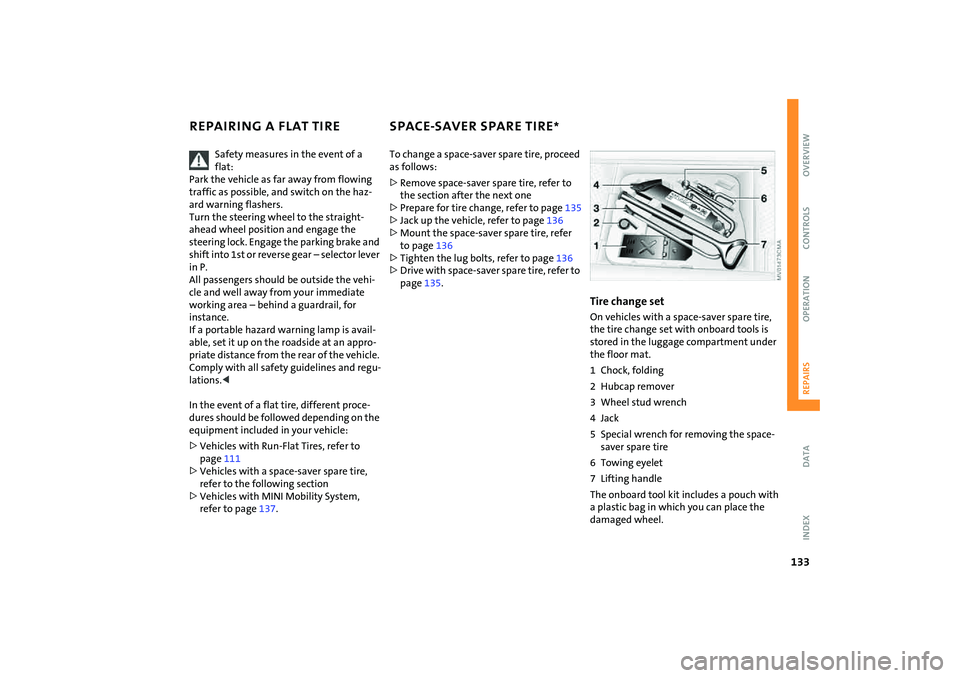
Tire change setOn vehicles with a space-saver spare tire,
the tire change set with onboard tools is
stored in the luggage compartment under
the floor mat.
1 Chock, folding
2 Hubcap remover
3 Wheel stud wrench
4Jack
5 Special wrench for removing the space-
saver spare tire
6 Towing eyelet
7 Lifting handle
The onboard tool kit includes a pouch with
a plastic bag in which you can place the
damaged wheel.
Page 159 of 172

EVERYTHING FROM A TO Z
157
OVERVIEW REPAIRS OPERATION CONTROLS DATA INDEX
Brake pads99
break-in procedures98
warning lamp18
Brake system120
brake fluid120
brake pads99
break-in procedures98
disc brakes99
warning lamp17
Brake wear warning
brake pads99
warning lamp18
Brakes120
ABS72
brake fluid120
brake pads99
break-in procedures98
CBC72
indicator/warning
lamps16,17,18
parking brake54
Breaking in98
Bulb replacement, refer to
Lamps and bulbs129
Buttons on multifunction
steering wheel20
automatic transmission with
Steptronic58 C
California Proposition 65
warning7
Capacities153
Car care, refer to Caring for your
vehicle122
Car keys, refer to Keys24
Car radio, refer to separate
Owner's Manual
Car telephone, refer to separate
Owner's Manual
Car vacuum cleaner,
connecting, refer to Cigarette
lighter socket
87
Car wash122
Car wash, refer to Washing
your vehicle122
Car-care products122
Care of plastics123
Care of synthetic leather123
Care, vehicle122
Cargo area
opening from the outside29
opening with the remote
control26
volume151,152
Cargo area cover, refer to
Luggage compartment
cover90
Cargo area, refer to Luggage
compartment in the MINI90 Carpet care124
Cassette operation, refer to
Owner's Manual for Radio
Catalytic converter, refer to
Hot exhaust system100
CBC Cornering Brake Control72
CD changer, refer to Owner's
Manual for Radio
CD operation, refer to
Owner's Manual for Radio
Center armrest86
Central locking system24
interior28
Changing bulbs129
Changing the wiper
blades128,129
Changing tires135
space-saver spare tire133
Charge-current indicator
light16
Child seat, refer to Installing
child-restraint systems50
Children, transporting50
Child-restraint fixing system,
LATCH52
Child-restraint systems50
Chock, folding
space-saver spare tire133
Chrome parts, refer to Caring
for your vehicle123
Chrome-plated parts, care123 Cigarette lighter87
Cigarette lighter socket87
Cigarette tray, refer to
Ashtray86
Circulation of air, refer to
Recirculated air mode80,83
Cleaning the rear window64
Cleaning the vehicle, refer to
Caring for your vehicle122
Clock67
12-hour/24-hour mode67
changing the time67
Closing
from inside28
from outside25
Clothes hooks100
Clutch53
break-in procedures98
Cockpit12
Coding, tires108
Cold start, refer to Starting the
engine53
Compact disk operation, refer
to Owner's Manual for Radio
Compartments, refer to
Storage compartments85
Computer, refer to Onboard
computer70
Condensed water, refer to Air
conditioning80,83