tire pressure MINI COOPER CONVERTIBLE 2015 User Guide
[x] Cancel search | Manufacturer: MINI, Model Year: 2015, Model line: COOPER CONVERTIBLE, Model: MINI COOPER CONVERTIBLE 2015Pages: 231, PDF Size: 5.56 MB
Page 120 of 231
LoadingVehicle equipment
This chapter describes all series equipment as
well as country-specific and special equipment
offered for this model series. Therefore, it also
describes equipment that may not be found in
your vehicle, for instance due to the selected
special equipment or the country version. This
also applies to safety-related functions and sys‐
tems.
When using the features and systems described
here, adhere to local regulations.
General information Overloading the vehicle
To avoid exceeding the approved carry‐
ing capacity of the tires, never overload the ve‐
hicle. Overloading can lead to overheating and
increases the rate at which damage develops
inside the tires. This could result in a sudden
loss of tire inflation pressure. ◀
No fluids in the cargo area
Make sure that fluids do not leak into the
cargo area; otherwise, the vehicle may be dam‐ aged. ◀Determining the load
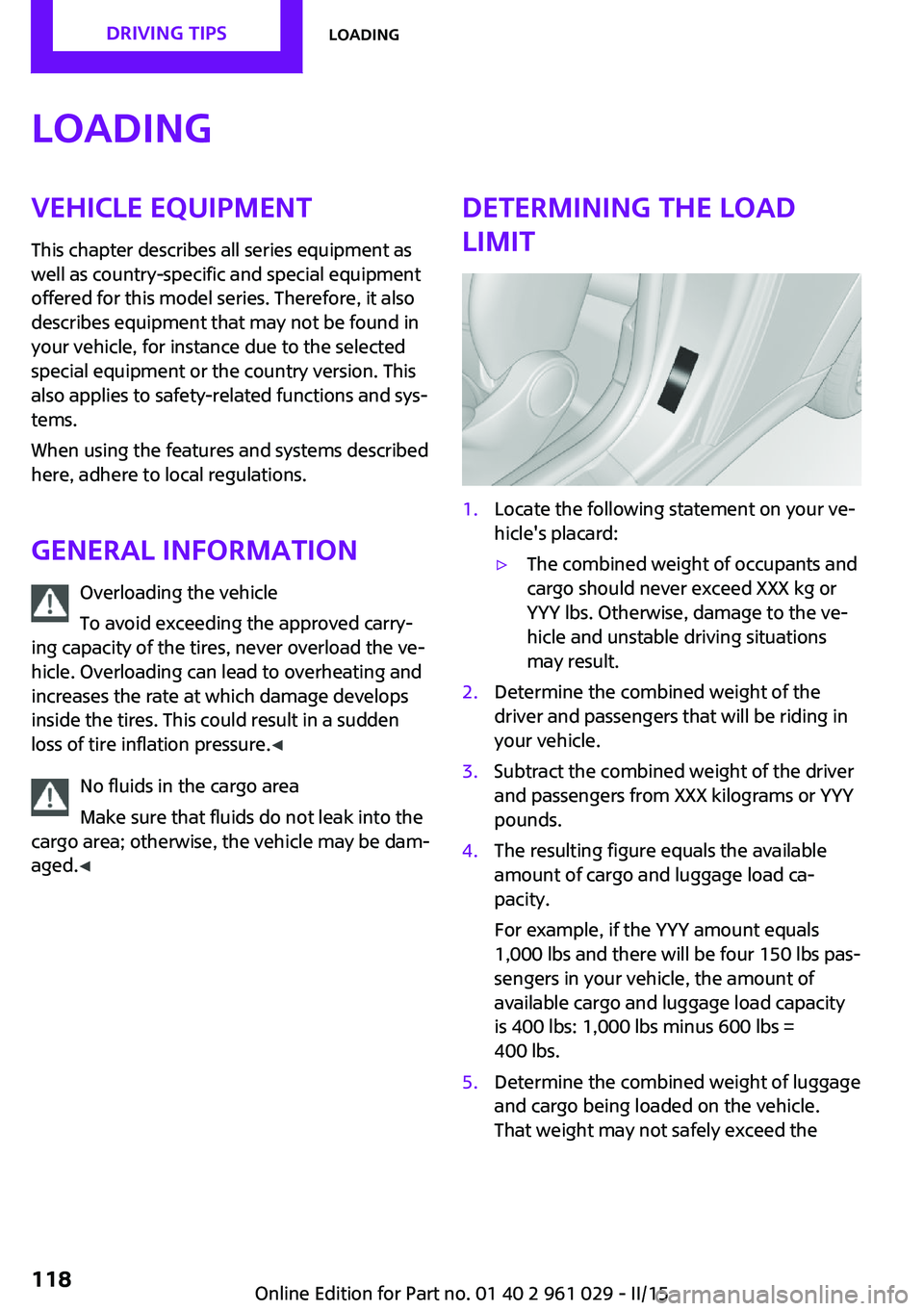
limit1.Locate the following statement on your ve‐
hicle's placard:▷The combined weight of occupants and
cargo should never exceed XXX kg or
YYY lbs. Otherwise, damage to the ve‐
hicle and unstable driving situations
may result.2.Determine the combined weight of the
driver and passengers that will be riding in
your vehicle.3.Subtract the combined weight of the driver
and passengers from XXX kilograms or YYY
pounds.4.The resulting figure equals the available
amount of cargo and luggage load ca‐
pacity.
For example, if the YYY amount equals
1,000 lbs and there will be four 150 lbs pas‐
sengers in your vehicle, the amount of
available cargo and luggage load capacity
is 400 lbs: 1,000 lbs minus 600 lbs =
400 lbs.5.Determine the combined weight of luggage
and cargo being loaded on the vehicle.
That weight may not safely exceed theSeite 118DRIVING TIPSLoading118
Online Edition for Part no. 01 40 2 961 029 - II/15
Page 123 of 231

Saving fuelVehicle equipment
This chapter describes all series equipment as
well as country-specific and special equipment
offered for this model series. Therefore, it also
describes equipment that may not be found in
your vehicle, for instance due to the selected
special equipment or the country version. This
also applies to safety-related functions and sys‐
tems.
When using the features and systems described
here, adhere to local regulations.
General information
Your vehicle contains advanced technology for
the reduction of fuel consumption and emis‐
sions.
Fuel consumption depends on a number of dif‐
ferent factors. The implementation of certain measures, driving style and regular mainte‐nance can have an influence on fuel consump‐
tion and on the environmental impact.
Remove unnecessary cargo Additional weight increases fuel consumption.
Remove attached parts following use Remove rear-mounted luggage racks after use.
Attached parts on the vehicle impair the aero‐
dynamics and increase the fuel consumption.
Close both windows Open windows causes higher air resistance and
thus increases fuel consumption.Check the tire inflation pressure
regularly
Check and, if necessary, correct the tire infla‐
tion pressure, refer to page 156, at least twice
a month and before starting on a long trip.
Low tire inflation pressure increases rolling re‐
sistance and thus raises fuel consumption and
tire wear.
Drive away without delay
Do not wait for the engine to warm-up while
the vehicle remains stationary. Start driving
right away, but at moderate engine speeds.
This is the fastest way for the cold engine to
reach its operating temperature.
Look well ahead when drivingAvoid unnecessary acceleration and braking. To
achieve this, maintain a suitable distance to the
vehicle driving ahead of you.
Driving smoothly and looking ahead reduces
fuel consumption.
Avoid high engine speeds Use 1st gear to get the vehicle in motion. Be‐
ginning with 2nd gear, accelerate rapidly. When
accelerating, shift up before reaching high en‐
gine speeds.
When you reach the desired speed, shift into
the highest applicable gear and drive with the
engine speed as low as possible and at a con‐
stant speed.
As a rule: driving at low engine speeds lowers
fuel consumption and reduces wear.
Use coasting conditions
When approaching a red light, take your foot
off the accelerator and coast to a halt in the
highest applicable gear.Seite 121Saving fuelDRIVING TIPS121
Online Edition for Part no. 01 40 2 961 029 - II/15
Page 158 of 231
Wheels and tiresVehicle equipment
This chapter describes all series equipment as
well as country-specific and special equipment
offered for this model series. Therefore, it also
describes equipment that may not be found in
your vehicle, for instance due to the selected
special equipment or the country version. This
also applies to safety-related functions and sys‐
tems.
When using the features and systems described
here, adhere to local regulations.
Tire inflation pressure
Safety information It is not merely the tires' service life, but also
driving comfort and, to a great extent, driving
safety that depend on the condition of the tires
and the maintenance of the specified tire pres‐
sure.
Checking the pressure Tires naturally lose pressure uniformly across all
four tires.
Check the tire inflation pressure regularly
Regularly check the tire inflation pressure
and correct it as needed: at least twice a month
and before a long trip. If you fail to observe this
precaution, you may be driving on tires with in‐
correct tire pressures, a condition that may not
only compromise your vehicle's driving stabil‐
ity, but also lead to tire damage and the risk of
an accident.
Do not drive with depressurized or flat tires, ex‐
cept for run-flat tires. A flat tire will seriously
impair your vehicle's handling and braking re‐
sponse. Attempts to drive on a flat tire can lead
to a loss of control over the vehicle. ◀Tires warm up during driving and the tire infla‐
tion pressure increases as the temperature
rises. The tire inflation pressure specifications
apply to cold tires or tires at ambient tempera‐
ture.
Only check the tire inflation pressure when the
tires are cold. This means after a maximum of
1.25 miles/2 km driving or when the vehicle
has been parked for at least 2 hours. When the
tires are warm, the tire inflation pressure is
higher.
After correcting the tire inflation pressure, reset
the Tire Pressure Monitor, refer to page 87
or reinitialize the Flat Tire Monitor, refer to
page 84.
Checking the inflation pressure of the compact wheel
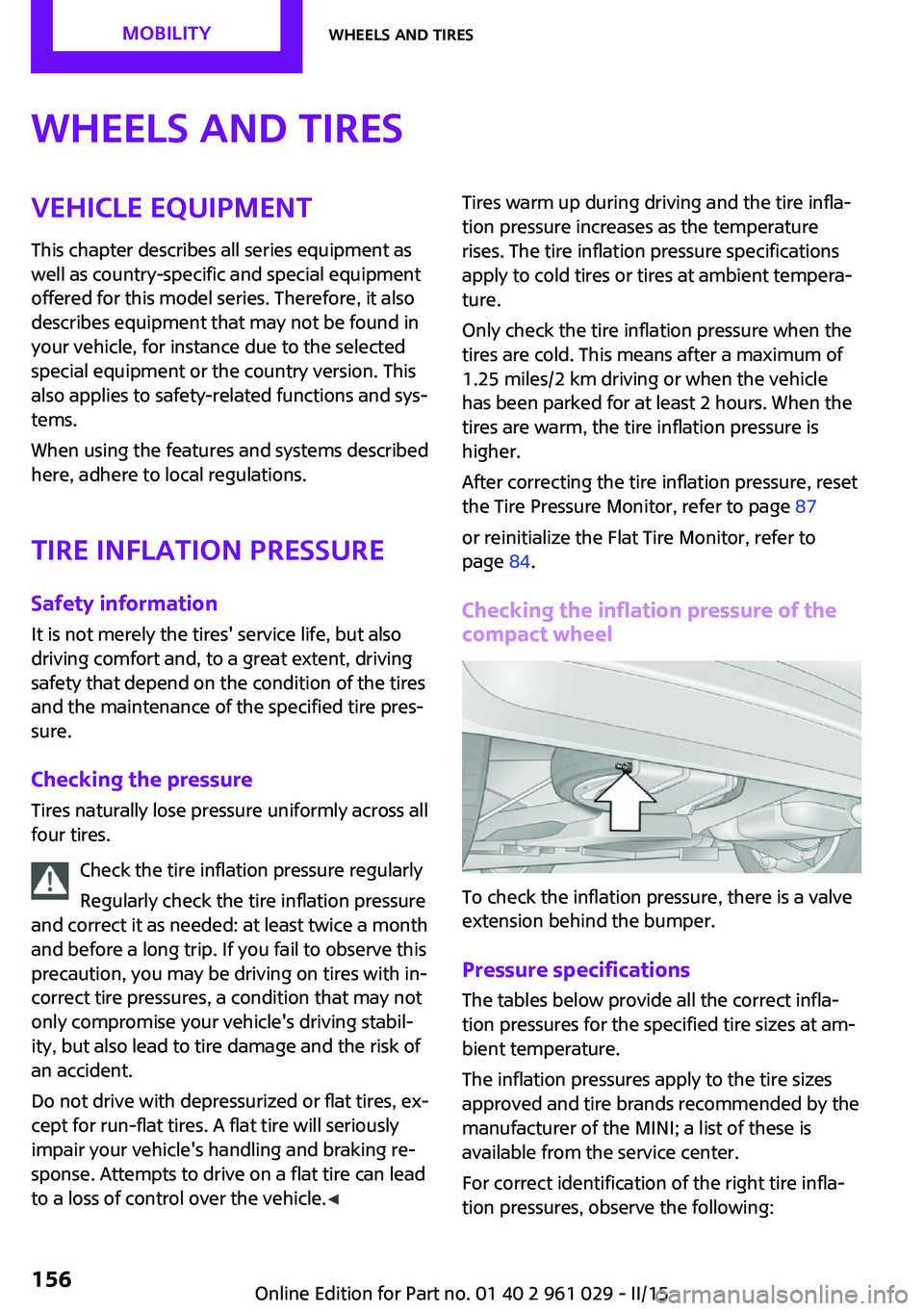
To check the inflation pressure, there is a valve
extension behind the bumper.
Pressure specifications
The tables below provide all the correct infla‐
tion pressures for the specified tire sizes at am‐
bient temperature.
The inflation pressures apply to the tire sizes
approved and tire brands recommended by the
manufacturer of the MINI; a list of these is
available from the service center.
For correct identification of the right tire infla‐
tion pressures, observe the following:
Seite 156MOBILITYWheels and tires156
Online Edition for Part no. 01 40 2 961 029 - II/15
Page 159 of 231

▷Tire sizes of your vehicle▷Maximum allowable driving speed
Tire inflation pressures for driving up to
100 mph or 160 km/h
For normal driving up to 100 mph/160 km/h,
adjust pressures to the respective tire inflation
pressures listed on the following pages in the
column for traveling speeds up to 100 mph/
160 km/h to achieve optimum driving comfort.
These tire inflation pressures can also be found
on the driver's side door pillar when the driver's
door is open.
Do not exceed the maximum permissible
speed
The permissible maximum speed for these tire
inflation pressures is 100 mph/160 km/h. Do
not exceed this speed or else there is a risk of
tire damage and accidents. ◀
Tire inflation pressures for driving
above 100 mph or 160 km/h
Adjust the tire inflation pressures
To drive at maximum speeds in excess of
100 mph/160 km/h, adjust pressures to the re‐
spective tire inflation pressures listed on the
following pages in the column for traveling
speeds including those exceeding 100 mph or
160 km/h. Otherwise, tire damage and acci‐
dents could occur. ◀
Observe all national and local maximum speed
limits; otherwise, violations of the laws could
occur.
Tire inflation pressures for MINI Cooper Coupe
Tire sizePressure specifications in bar/PSIAll pressure specifications in the table
are indicated in bar/PSI with cold
tires.
Cold = ambient temperature175/65 R 15 84 T M+S Std
175/65 R 15 84 H Std
175/65 R 15 84 H M+S A/S Std
195/55 R 16 87 H RSC
195/55 R 16 87 H M+S RSC
195/55 R 16 87 V M+S A/S RSC
205/45 R 17 84 V RSC
205/45 R 17 84 V M+S RSC
205/45 R 17 84 V M+S A/S RSC
205/40 R 18 82 W RSC2.4/352.4/35Seite 157Wheels and tiresMOBILITY157
Online Edition for Part no. 01 40 2 961 029 - II/15
Page 160 of 231
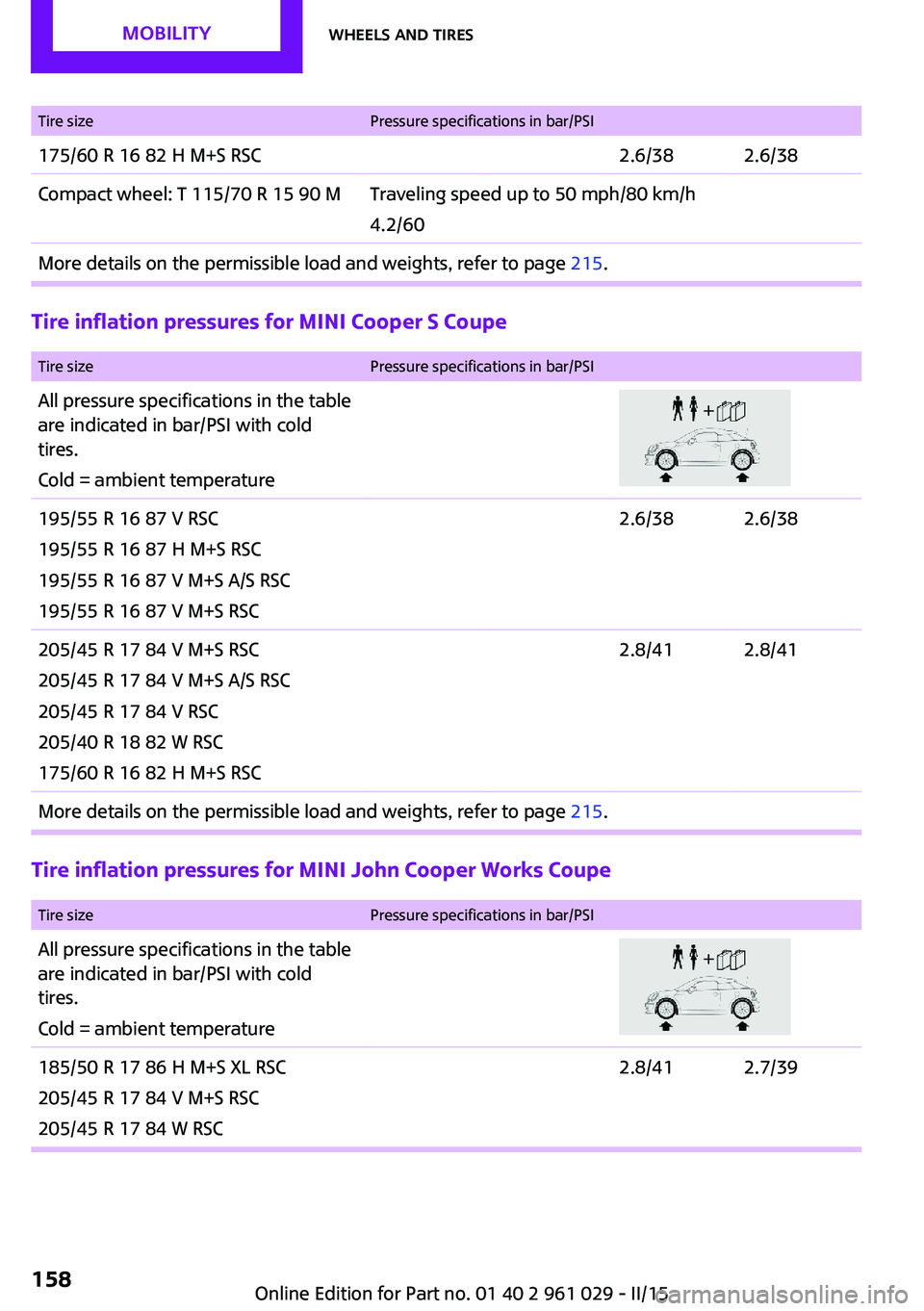
Tire sizePressure specifications in bar/PSI175/60 R 16 82 H M+S RSC2.6/382.6/38Compact wheel: T 115/70 R 15 90 MTraveling speed up to 50 mph/80 km/h
4.2/60More details on the permissible load and weights, refer to page 215.
Tire inflation pressures for MINI Cooper S Coupe
Tire sizePressure specifications in bar/PSIAll pressure specifications in the table
are indicated in bar/PSI with cold
tires.
Cold = ambient temperature195/55 R 16 87 V RSC
195/55 R 16 87 H M+S RSC
195/55 R 16 87 V M+S A/S RSC
195/55 R 16 87 V M+S RSC2.6/382.6/38205/45 R 17 84 V M+S RSC
205/45 R 17 84 V M+S A/S RSC
205/45 R 17 84 V RSC
205/40 R 18 82 W RSC
175/60 R 16 82 H M+S RSC2.8/412.8/41More details on the permissible load and weights, refer to page 215.
Tire inflation pressures for MINI John Cooper Works Coupe
Tire sizePressure specifications in bar/PSIAll pressure specifications in the table
are indicated in bar/PSI with cold
tires.
Cold = ambient temperature185/50 R 17 86 H M+S XL RSC
205/45 R 17 84 V M+S RSC
205/45 R 17 84 W RSC2.8/412.7/39Seite 158MOBILITYWheels and tires158
Online Edition for Part no. 01 40 2 961 029 - II/15
Page 161 of 231
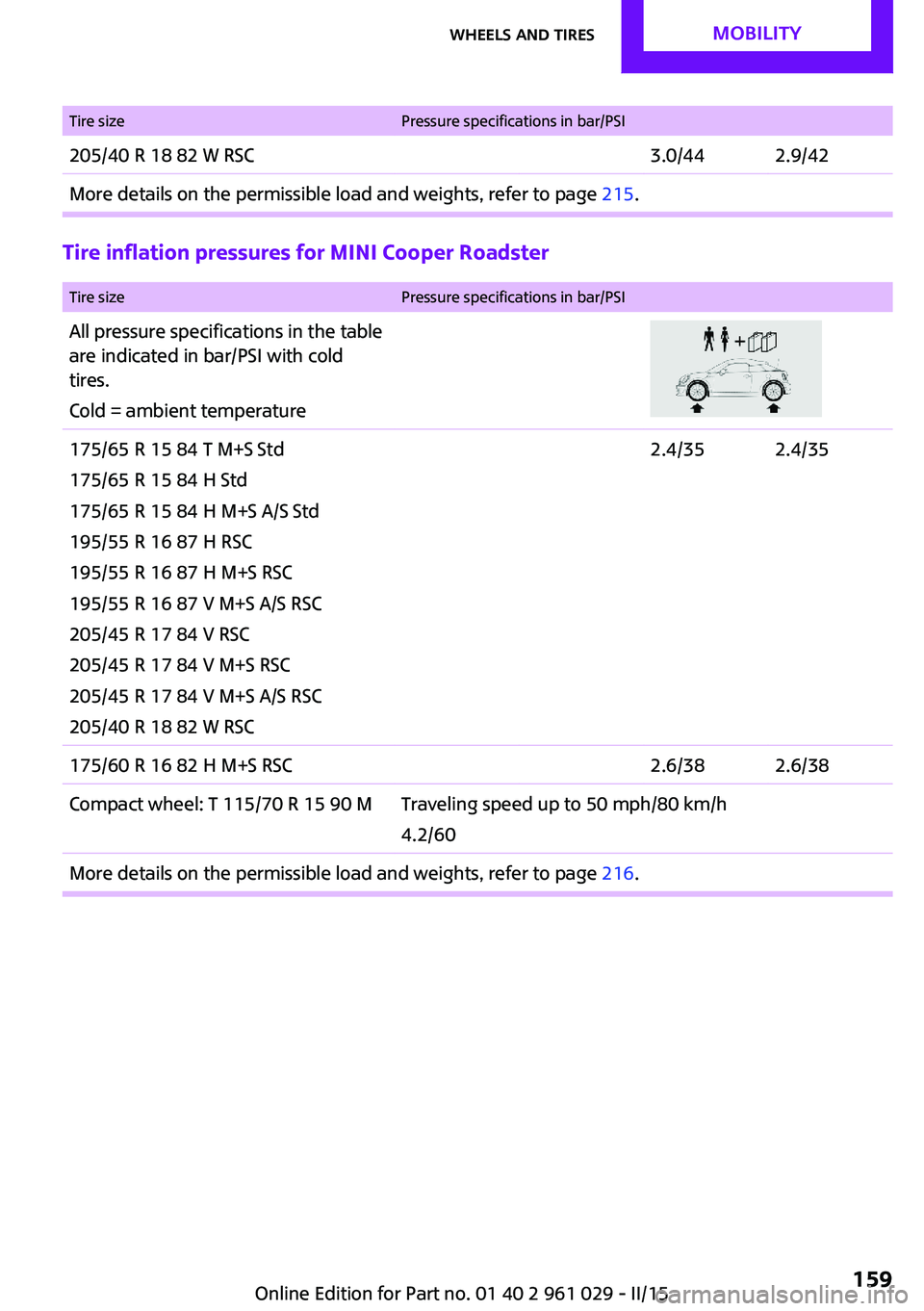
Tire sizePressure specifications in bar/PSI205/40 R 18 82 W RSC3.0/442.9/42More details on the permissible load and weights, refer to page 215.
Tire inflation pressures for MINI Cooper Roadster
Tire sizePressure specifications in bar/PSIAll pressure specifications in the table
are indicated in bar/PSI with cold
tires.
Cold = ambient temperature175/65 R 15 84 T M+S Std
175/65 R 15 84 H Std
175/65 R 15 84 H M+S A/S Std
195/55 R 16 87 H RSC
195/55 R 16 87 H M+S RSC
195/55 R 16 87 V M+S A/S RSC
205/45 R 17 84 V RSC
205/45 R 17 84 V M+S RSC
205/45 R 17 84 V M+S A/S RSC
205/40 R 18 82 W RSC2.4/352.4/35175/60 R 16 82 H M+S RSC2.6/382.6/38Compact wheel: T 115/70 R 15 90 MTraveling speed up to 50 mph/80 km/h
4.2/60More details on the permissible load and weights, refer to page 216.Seite 159Wheels and tiresMOBILITY159
Online Edition for Part no. 01 40 2 961 029 - II/15
Page 162 of 231
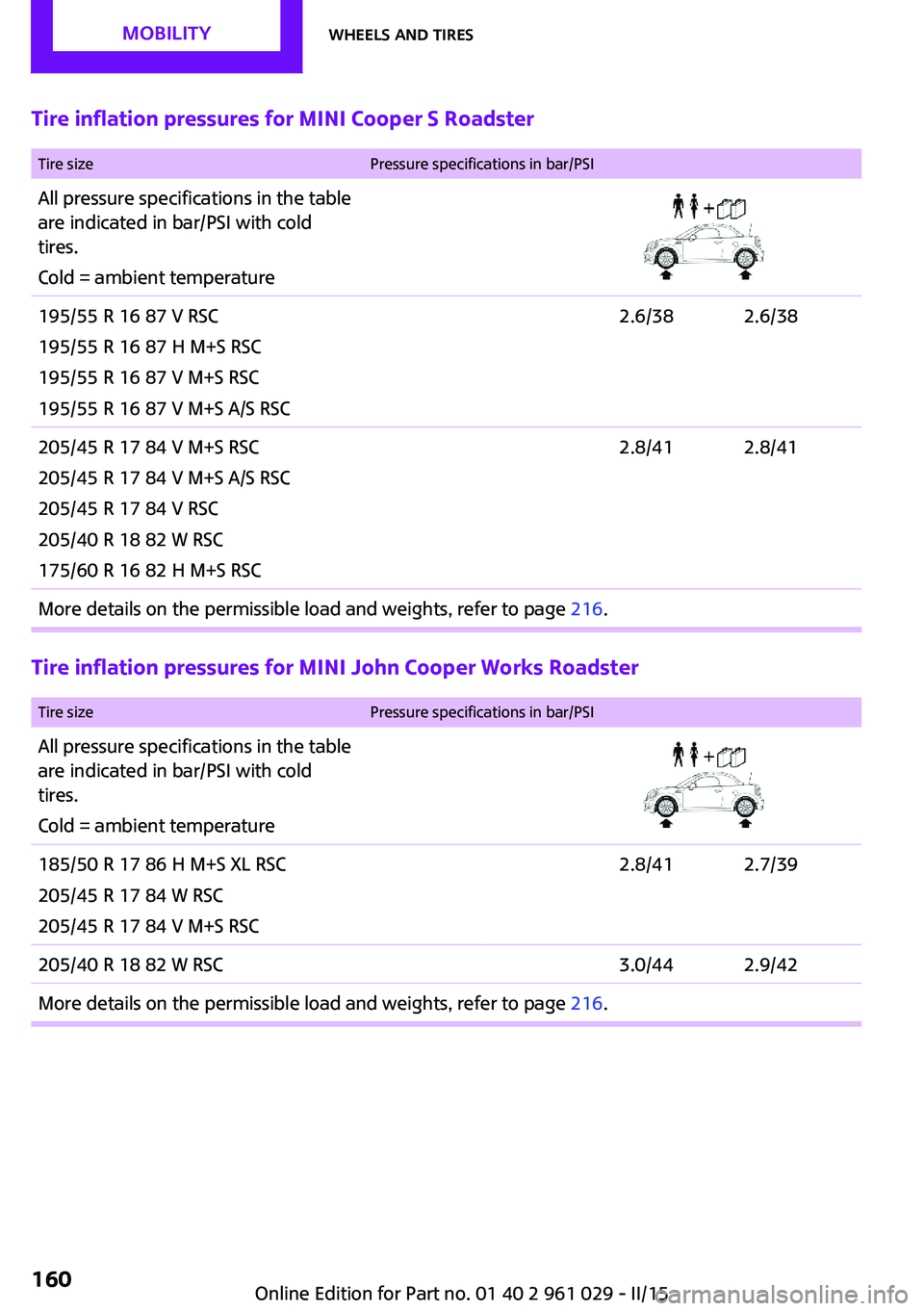
Tire inflation pressures for MINI Cooper S Roadster Tire sizePressure specifications in bar/PSIAll pressure specifications in the table
are indicated in bar/PSI with cold
tires.
Cold = ambient temperature195/55 R 16 87 V RSC
195/55 R 16 87 H M+S RSC
195/55 R 16 87 V M+S RSC
195/55 R 16 87 V M+S A/S RSC2.6/382.6/38205/45 R 17 84 V M+S RSC
205/45 R 17 84 V M+S A/S RSC
205/45 R 17 84 V RSC
205/40 R 18 82 W RSC
175/60 R 16 82 H M+S RSC2.8/412.8/41More details on the permissible load and weights, refer to page 216.
Tire inflation pressures for MINI John Cooper Works Roadster
Tire sizePressure specifications in bar/PSIAll pressure specifications in the table
are indicated in bar/PSI with cold
tires.
Cold = ambient temperature185/50 R 17 86 H M+S XL RSC
205/45 R 17 84 W RSC
205/45 R 17 84 V M+S RSC2.8/412.7/39205/40 R 18 82 W RSC3.0/442.9/42More details on the permissible load and weights, refer to page 216.Seite 160MOBILITYWheels and tires160
Online Edition for Part no. 01 40 2 961 029 - II/15
Page 163 of 231
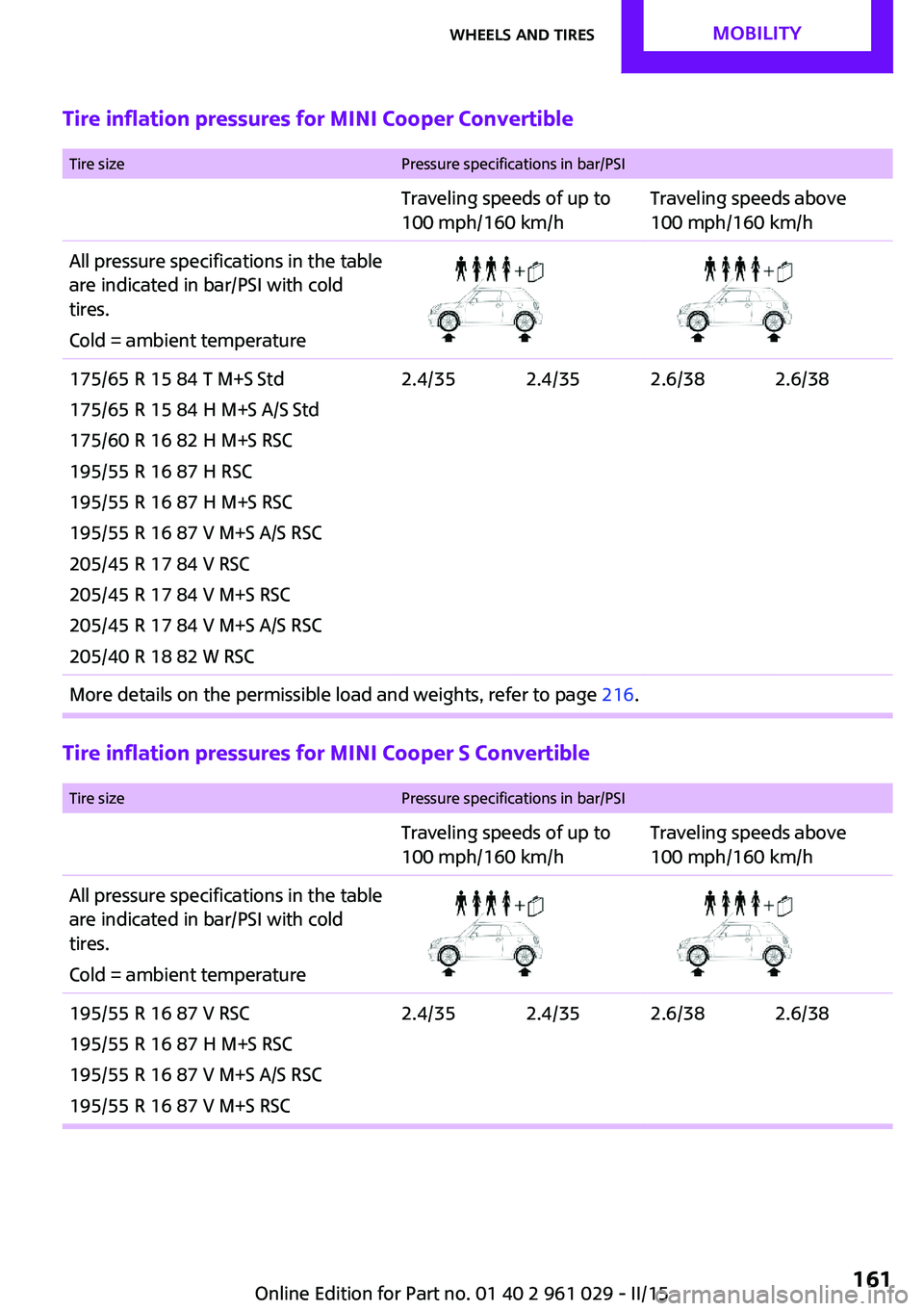
Tire inflation pressures for MINI Cooper Convertible Tire sizePressure specifications in bar/PSITraveling speeds of up to
100 mph/160 km/hTraveling speeds above
100 mph/160 km/hAll pressure specifications in the table
are indicated in bar/PSI with cold
tires.
Cold = ambient temperature175/65 R 15 84 T M+S Std
175/65 R 15 84 H M+S A/S Std
175/60 R 16 82 H M+S RSC
195/55 R 16 87 H RSC
195/55 R 16 87 H M+S RSC
195/55 R 16 87 V M+S A/S RSC
205/45 R 17 84 V RSC
205/45 R 17 84 V M+S RSC
205/45 R 17 84 V M+S A/S RSC
205/40 R 18 82 W RSC2.4/352.4/352.6/382.6/38More details on the permissible load and weights, refer to page 216.
Tire inflation pressures for MINI Cooper S Convertible
Tire sizePressure specifications in bar/PSITraveling speeds of up to
100 mph/160 km/hTraveling speeds above
100 mph/160 km/hAll pressure specifications in the table
are indicated in bar/PSI with cold
tires.
Cold = ambient temperature195/55 R 16 87 V RSC
195/55 R 16 87 H M+S RSC
195/55 R 16 87 V M+S A/S RSC
195/55 R 16 87 V M+S RSC2.4/352.4/352.6/382.6/38Seite 161Wheels and tiresMOBILITY161
Online Edition for Part no. 01 40 2 961 029 - II/15
Page 164 of 231

Tire sizePressure specifications in bar/PSI205/45 R 17 84 V M+S RSC
205/45 R 17 84 V M+S A/S RSC
205/45 R 17 84 V RSC
205/40 R 18 82 W RSC
175/60 R 16 82 H M+S RSC2.7/392.7/392.9/422.9/42More details on the permissible load and weights, refer to page 216.
Tire inflation pressures for MINI John Cooper Works Convertible
Tire sizePressure specifications in bar/PSITraveling speeds of up to
100 mph/160 km/hTraveling speeds above
100 mph/160 km/hAll pressure specifications in the table
are indicated in bar/PSI with cold
tires.
Cold = ambient temperature185/50 R 17 86 H M+S XL RSC
205/45 R 17 84 W RSC2.7/392.7/392.9/422.9/42205/40 R 18 86 W XLRSC2.9/422.9/423.1/453.1/45More details on the permissible load and weights, refer to page 216.Tire identification marks
Knowledge of the labeling on the side of the tire makes it easier to identify and choose the
right tires.
Tire size Example: 225/45 R 17 91 V
225: nominal width in mm
45: aspect ratio in %
R: radial tire code
17: rim diameter in inches
91: load rating, not for ZR tires
Speed letter Q = up to 100 mph/160 km/hT = up to 118 mph/190 km/h
H = up to 131 mph/210 km/h
V = up to 150 mph/240 km/h
W = up to 167 mph/270 km/h
Y = up to 186 mph/300 km/h
Tire Identification Number Tires with DOT codes meet the guidelines of
the U.S. Department of Transportation.
DOT code:
DOT xxxx xxx 2214
xxxx: manufacturer code for the tire brand
xxx: tire size and tire design
2214: tire ageSeite 162MOBILITYWheels and tires162
Online Edition for Part no. 01 40 2 961 029 - II/15
Page 167 of 231

DOT … 0315: the tire was manufactured in the
3rd week of 2015.
Changing wheels and
tires
Mounting Information on mounting tires
Have mounting and balancing performed
only by a service center or tire specialist.
If this work is not carried out properly, there is
the danger of subsequent damage and related
safety hazards. ◀
Wheel and tire combination
Information on the right wheel and tire combi‐
nation and rim version for your vehicle can be
obtained from the service center.
Incorrect wheel and tire combinations impair
the function of a variety of systems such as ABS
or DSC.
To maintain good handling and vehicle re‐
sponse, use only tires with a single tread con‐
figuration from a single manufacturer.
Following tire damage, have the original wheel
and tire combination remounted on the vehicle
as soon as possible.
Approved wheels and tires
The manufacturer of your vehicle recom‐
mends that you use only wheels and tires that
have been approved for your particular vehicle
model.
For example, despite having the same official
size ratings, variations can lead to body contact
and with it, the risk of severe accidents.
The manufacturer of your vehicle cannot evalu‐
ate non-approved wheels and tires to deter‐
mine if they are suited for use, and therefore
cannot ensure the operating safety of the vehi‐
cle if they are mounted. ◀Wheels with electronics for TPM Tire
Pressure Monitor
When mounting new tires or changing from
summer to winter tires or vice versa, only use
wheels with TPM electronics; otherwise, the
Tire Pressure Monitor will not be able to detect
a flat tire, refer to page 86. Your service center
will be glad to advise you.
Recommended tire brands
For each tire size, the manufacturer of your ve‐
hicle recommends certain tire brands. These
are indicated by the clearly visible marking on
the tire sidewall.
With proper use, these tires meet the highest
standards for safety and handling.
Retreaded tires
The manufacturer of your vehicle does not rec‐
ommend the use of retreaded tires.
Retreaded tires
Possibly substantial variations in the de‐
sign and age of the tire casing structures can
limit service life and have a negative impact on
road safety. ◀
Winter tires The manufacturer of your vehicle recommends
winter tires for winter roads or at temperatures
below +45 ℉/+7 ℃.
Although so-called all-season M+S tires do pro‐
vide better winter traction than summer tires,
they do not provide the same level of perform‐
ance as winter tires.
Seite 165Wheels and tiresMOBILITY165
Online Edition for Part no. 01 40 2 961 029 - II/15