steering wheel MINI COOPER CONVERTIBLE 2016 Owner's Guide
[x] Cancel search | Manufacturer: MINI, Model Year: 2016, Model line: COOPER CONVERTIBLE, Model: MINI COOPER CONVERTIBLE 2016Pages: 252, PDF Size: 5.41 MB
Page 186 of 252
Wheels and tiresVehicle features and op‐
tions
This chapter describes all standard, country-
specific and optional features offered with the
series. It also describes features that are not
necessarily available in your car, e. g., due to
the selected options or country versions. This
also applies to safety-related functions and sys‐
tems. The respectively applicable country provi‐
sions must be observed when using the respec‐
tive features and systems.
Tire inflation pressure Safety informationThe tire characteristics and tire inflation pres‐
sure influence the following:▷The service life of the tires.▷Road safety.▷Driving comfort.
Checking the tire inflation pressure
WARNING
A tire with low or missing tire inflation
pressure impacts handling, such as steering
and braking response. There is risk of an acci‐
dent. Regularly check the tire inflation pressure,
and correct it as needed, e.g., twice a month and before a long trip. ◀
Tires have a natural, consistent loss of tire infla‐ tion pressure.
Tires heat up while driving, and the tire inflation
pressure increases along with the tire's temper‐
ature. The tire inflation pressure specifications
relate to cold tires or tires with the ambient
temperature.
Only check the tire inflation pressure when the
tires are cold. This means after driving no more
than 1.25 miles/2 km or when the vehicle has
been parked for at least 2 hours.
The displays of inflation devices may under-
read by up to 0.1 bar.
For Flat Tire Monitor: after correcting the tire
inflation pressure, reinitialize the Flat Tire Moni‐
tor.
For Tire Pressure Monitor: after correcting the
tire inflation pressure, reset the Tire Pressure
Monitor.▷Reinitialize the Flat Tire Monitor.▷Reinitialize the Tire Pressure Monitor.
Pressure specifications
The tire inflation pressure table, refer to
page 187, contains all tire inflation pressure
specifications for the specified tire sizes at the
ambient temperature. The tire inflation pres‐
sure values apply to tire sizes approved by the
manufacturer of the vehicle for the vehicle
type.
To identify the correct tire inflation pressure,
please note the following:
▷Tire sizes of your vehicle.▷Maximum permitted driving speed.
Tire inflation pressures up to 100 mph/
160 km/h
For speeds of up to 100 mph/160 km/h and for
optimum driving comfort, note the pressure
values in the tire inflation pressure table, refer
to page 187, and adjust as necessary.
Seite 186MOBILITYWheels and tires186
Online Edition for Part no. 01 40 2 969 276 - II/16
Page 194 of 252
Changing run-flat tires
For your own safety, only use run-flat tires. No
spare tire is available in the case of a flat tire.
A dealer’s service center will be glad to answer
additional questions at any time.
Repairing a flat tireSafety measures▷Park the vehicle as far away as possible
from passing traffic and on solid ground.▷Switch on the hazard warning system.▷Secure the vehicle against rolling away by
setting the parking brake.▷Turn the steering wheel until the front
wheels are in the straight-ahead position
and engage the steering wheel lock.▷Have all vehicle occupants get out of the
vehicle and ensure that they remain out‐
side the immediate area in a safe place,
such as behind a guardrail.▷If necessary, set up a warning triangle at an
appropriate distance.
Mobility System
The concept
With the Mobility System, minor tire damage
can be sealed temporarily to enable continued
travel. To accomplish this, sealant is pumped
into the tires, which seals the damage from the
inside.
The compressor can be used to check the tire
inflation pressure.
Information
▷Follow the instructions on using the Mobi‐
lity System found on the compressor and
sealant container.▷Use of the Mobility System may be ineffec‐
tive if the tire puncture measures approx.
1/8 in/4 mm or more.▷Contact a dealer’s service center or another
qualified service center or repair shop if the
tire cannot be made drivable.▷If possible, do not remove foreign bodies
that have penetrated the tire.▷Pull the speed limit sticker off the sealant
container and apply it to the steering
wheel.▷The use of a sealant can damage the TPM
wheel electronics. In this case, have the
electronics checked at the next opportunity
and have them replaced if needed.
DANGER
If the exhaust pipe is blocked or ventila‐
tion is insufficient, harmful exhaust gases can
enter into the vehicle. The exhaust gases con‐
tain carbon monoxide, an odorless and color‐
less but highly toxic gas. In enclosed areas, ex‐
haust gases can also accumulate outside of the
vehicle. There is danger to life. Keep the ex‐
haust pipe free and ensure sufficient ventila‐
tion. ◀
Storage
The Mobility System is located under the cargo
floor panel.
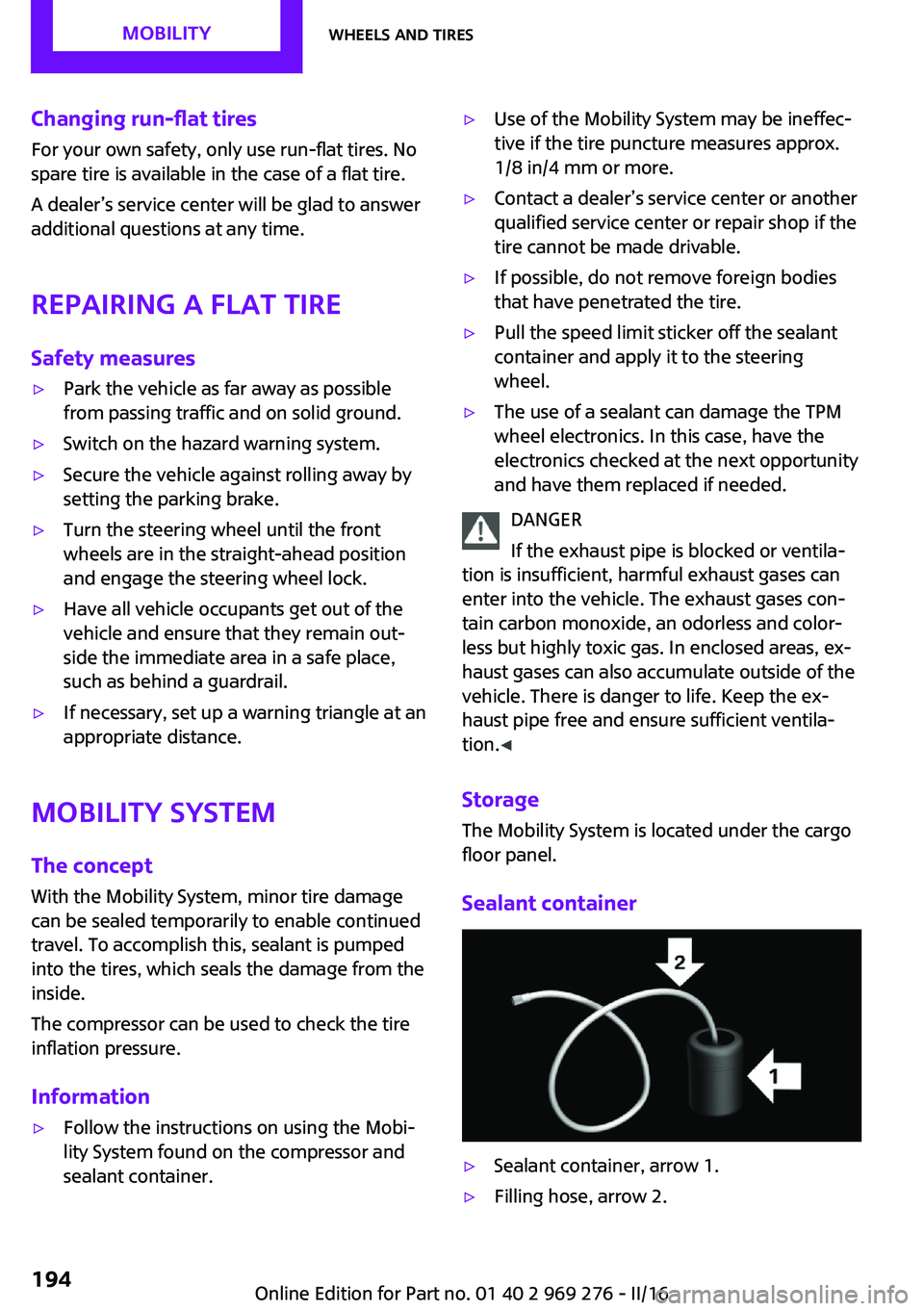
Sealant container
▷Sealant container, arrow 1.▷Filling hose, arrow 2.Seite 194MOBILITYWheels and tires194
Online Edition for Part no. 01 40 2 969 276 - II/16
Page 211 of 252
Turn signalFollow the general instructions on lights and
bulbs, refer to page 209.
Bulbs: PW24W
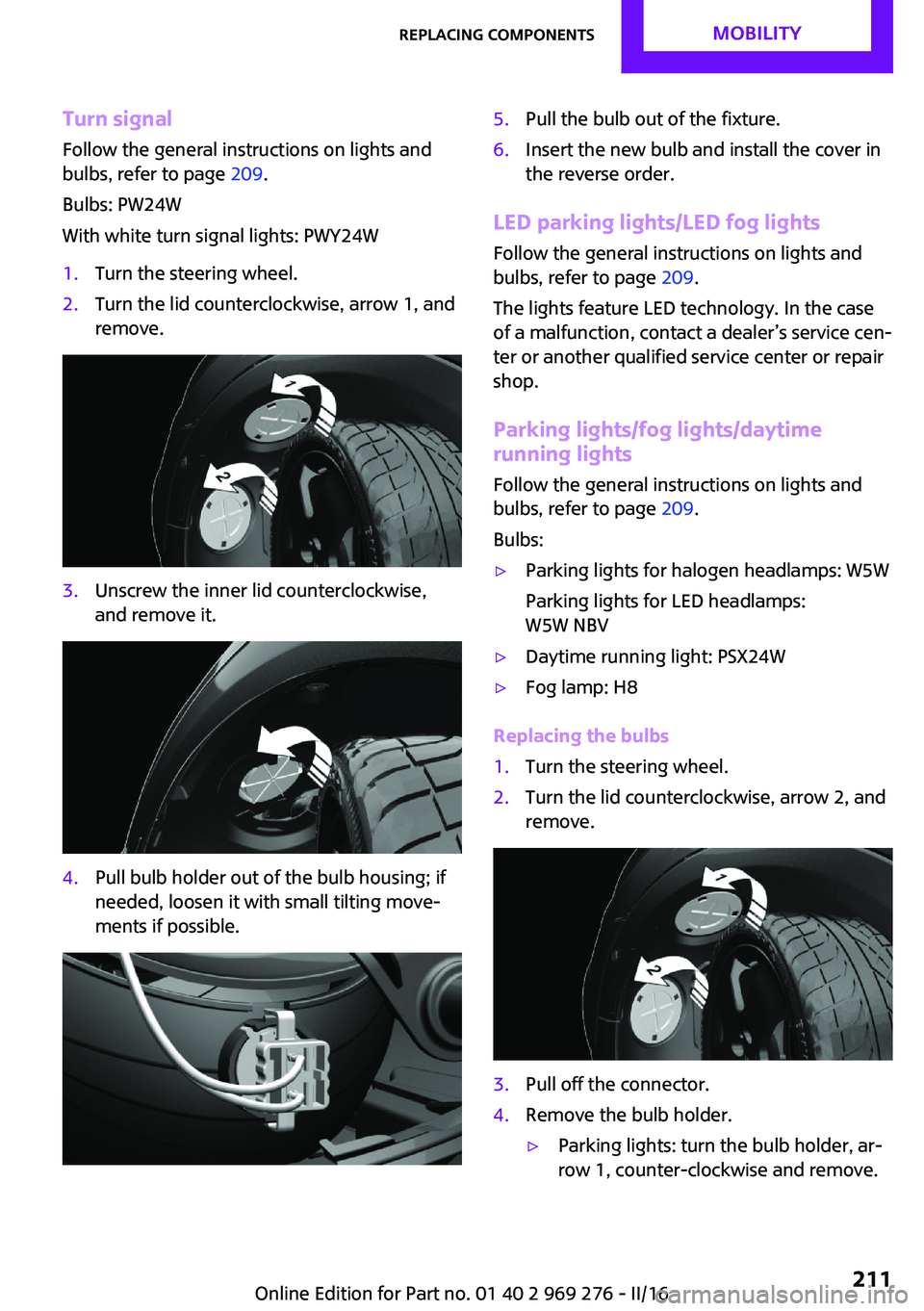
With white turn signal lights: PWY24W1.Turn the steering wheel.2.Turn the lid counterclockwise, arrow 1, and
remove.3.Unscrew the inner lid counterclockwise,
and remove it.4.Pull bulb holder out of the bulb housing; if
needed, loosen it with small tilting move‐
ments if possible.5.Pull the bulb out of the fixture.6.Insert the new bulb and install the cover in
the reverse order.
LED parking lights/LED fog lights
Follow the general instructions on lights and
bulbs, refer to page 209.
The lights feature LED technology. In the case
of a malfunction, contact a dealer’s service cen‐
ter or another qualified service center or repair
shop.
Parking lights/fog lights/daytime
running lights
Follow the general instructions on lights and
bulbs, refer to page 209.
Bulbs:
▷Parking lights for halogen headlamps: W5W
Parking lights for LED headlamps:
W5W NBV▷Daytime running light: PSX24W▷Fog lamp: H8
Replacing the bulbs
1.Turn the steering wheel.2.Turn the lid counterclockwise, arrow 2, and
remove.3.Pull off the connector.4.Remove the bulb holder.▷Parking lights: turn the bulb holder, ar‐
row 1, counter-clockwise and remove.Seite 211Replacing componentsMOBILITY211
Online Edition for Part no. 01 40 2 969 276 - II/16
Page 217 of 252
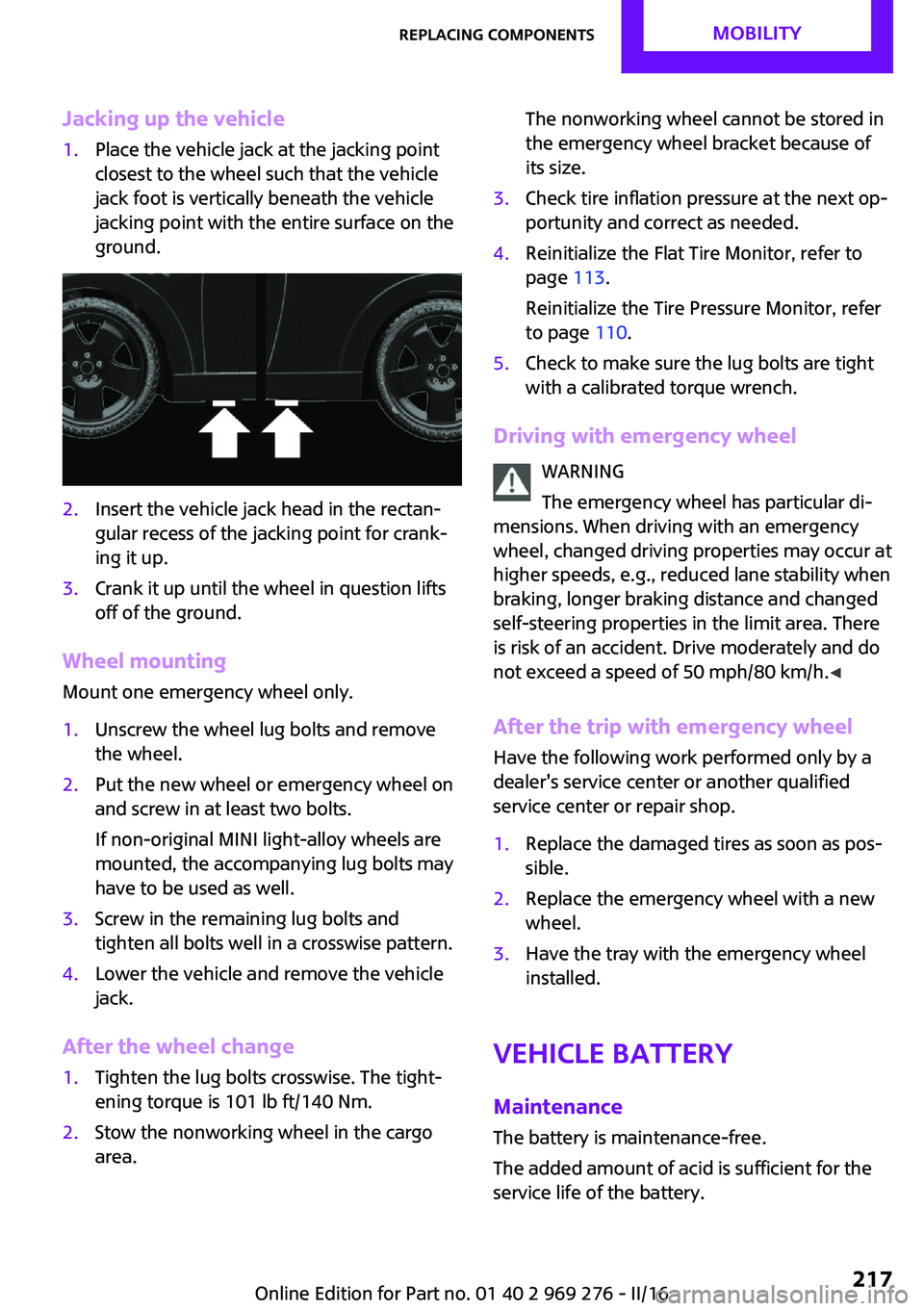
Jacking up the vehicle1.Place the vehicle jack at the jacking point
closest to the wheel such that the vehicle
jack foot is vertically beneath the vehicle
jacking point with the entire surface on the
ground.2.Insert the vehicle jack head in the rectan‐
gular recess of the jacking point for crank‐
ing it up.3.Crank it up until the wheel in question lifts
off of the ground.
Wheel mounting
Mount one emergency wheel only.
1.Unscrew the wheel lug bolts and remove
the wheel.2.Put the new wheel or emergency wheel on
and screw in at least two bolts.
If non-original MINI light-alloy wheels are
mounted, the accompanying lug bolts may
have to be used as well.3.Screw in the remaining lug bolts and
tighten all bolts well in a crosswise pattern.4.Lower the vehicle and remove the vehicle
jack.
After the wheel change
1.Tighten the lug bolts crosswise. The tight‐
ening torque is 101 lb ft/140 Nm.2.Stow the nonworking wheel in the cargo
area.The nonworking wheel cannot be stored in
the emergency wheel bracket because of
its size.3.Check tire inflation pressure at the next op‐
portunity and correct as needed.4.Reinitialize the Flat Tire Monitor, refer to
page 113.
Reinitialize the Tire Pressure Monitor, refer
to page 110.5.Check to make sure the lug bolts are tight
with a calibrated torque wrench.
Driving with emergency wheel
WARNING
The emergency wheel has particular di‐
mensions. When driving with an emergency wheel, changed driving properties may occur at
higher speeds, e.g., reduced lane stability when
braking, longer braking distance and changed
self-steering properties in the limit area. There
is risk of an accident. Drive moderately and do
not exceed a speed of 50 mph/80 km/h. ◀
After the trip with emergency wheel
Have the following work performed only by a
dealer's service center or another qualified
service center or repair shop.
1.Replace the damaged tires as soon as pos‐
sible.2.Replace the emergency wheel with a new
wheel.3.Have the tray with the emergency wheel
installed.
Vehicle battery
Maintenance
The battery is maintenance-free.
The added amount of acid is sufficient for the
service life of the battery.
Seite 217Replacing componentsMOBILITY217
Online Edition for Part no. 01 40 2 969 276 - II/16
Page 223 of 252
▷Make sure that the ignition is switched on;
otherwise, the low beams, tail lamps, turn
signals, and wipers may be unavailable.▷Do not tow the vehicle with the rear axle
tilted, as the front wheels could turn.▷When the engine is stopped, there is no
power assist. Consequently, more force
needs to be applied when braking and
steering.▷Larger steering wheel movements are re‐
quired.▷The towing vehicle must not be lighter than
the vehicle being towed; otherwise, it will
not be possible to control the vehicle's re‐
sponse.▷Do not exceed a towing speed of
30 mph/50 km/h.▷Do not exceed a towing distance of
30 miles/50 km.
Tow truck
With driven front axle
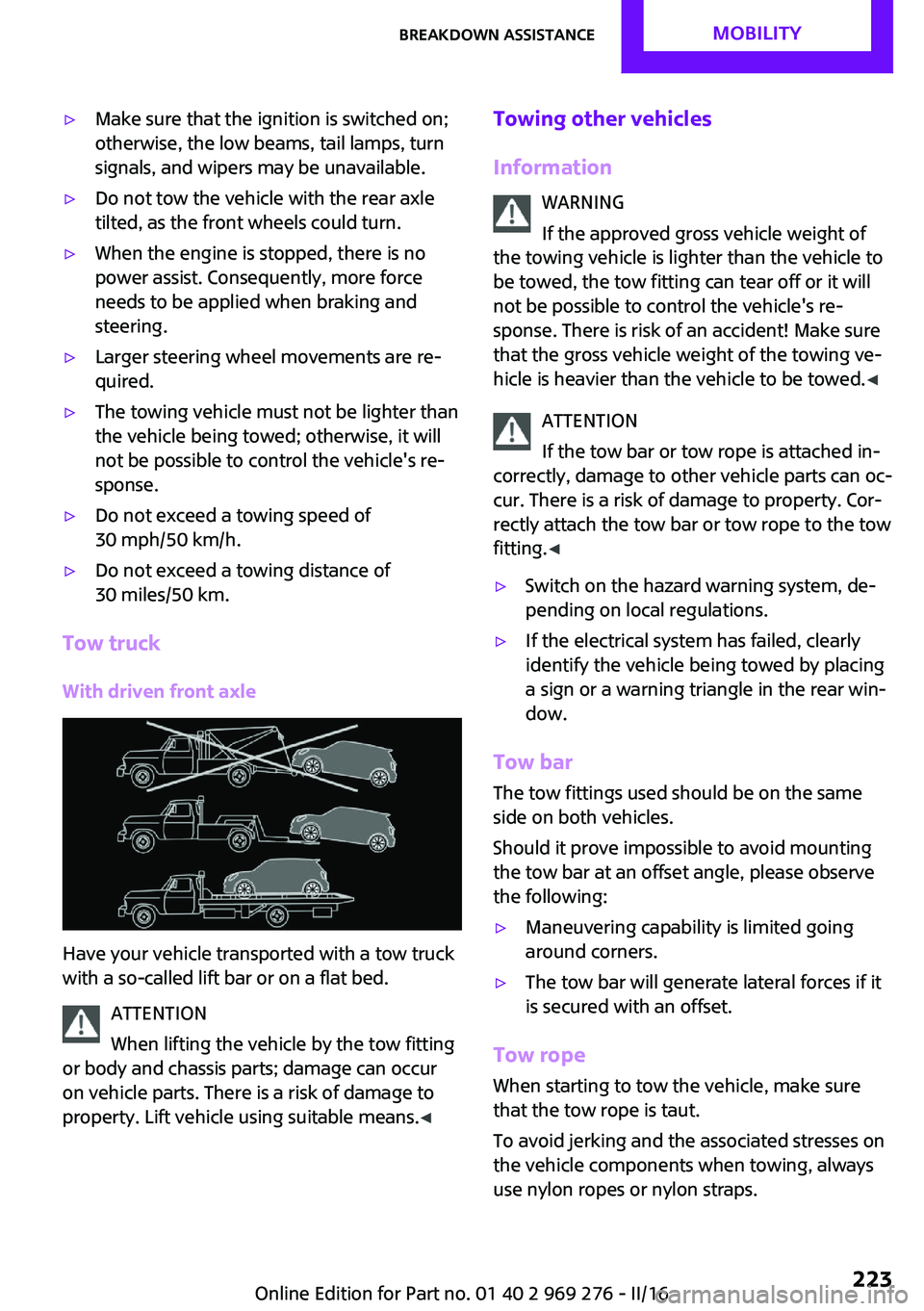
Have your vehicle transported with a tow truck
with a so-called lift bar or on a flat bed.
ATTENTION
When lifting the vehicle by the tow fitting
or body and chassis parts; damage can occur
on vehicle parts. There is a risk of damage to
property. Lift vehicle using suitable means. ◀
Towing other vehicles
Information WARNING
If the approved gross vehicle weight of
the towing vehicle is lighter than the vehicle to
be towed, the tow fitting can tear off or it will
not be possible to control the vehicle's re‐ sponse. There is risk of an accident! Make sure
that the gross vehicle weight of the towing ve‐
hicle is heavier than the vehicle to be towed. ◀
ATTENTION
If the tow bar or tow rope is attached in‐
correctly, damage to other vehicle parts can oc‐ cur. There is a risk of damage to property. Cor‐
rectly attach the tow bar or tow rope to the tow
fitting. ◀▷Switch on the hazard warning system, de‐
pending on local regulations.▷If the electrical system has failed, clearly
identify the vehicle being towed by placing
a sign or a warning triangle in the rear win‐
dow.
Tow bar
The tow fittings used should be on the same
side on both vehicles.
Should it prove impossible to avoid mounting
the tow bar at an offset angle, please observe
the following:
▷Maneuvering capability is limited going
around corners.▷The tow bar will generate lateral forces if it
is secured with an offset.
Tow rope
When starting to tow the vehicle, make sure
that the tow rope is taut.
To avoid jerking and the associated stresses on
the vehicle components when towing, always
use nylon ropes or nylon straps.
Seite 223Breakdown assistanceMOBILITY223
Online Edition for Part no. 01 40 2 969 276 - II/16
Page 242 of 252
Everything from A to ZIndexA
ABS, Antilock Brake Sys‐ tem 122
Acceleration Assistant, see Launch Control 78
Accessories and parts 8
ACC, see camera-based cruise control 126
Activated-charcoal filter 149
Active Cruise Control, see camera-based cruise con‐
trol 126
Additional information, on‐ board monitor 23
Additives, oil 202
Adjustments, seats/head re‐ straints 54
Adjustments, steering wheel 62
After washing vehicle 227
Airbags 105
Airbags, indicator/warning light 106
Air circulation, see Recircu‐ lated-air mode 145, 148
Air conditioner 144
Air, dehumidifying, see Cool‐ ing function 145, 147
Air distribution, man‐ ual 145 , 148
Air flow, air conditioner 145
Air flow, automatic climate control 148
Air pressure, tires 186
Air vents, see Ventilation 149
Alarm system 44
Alarm triggering 44
Alarm, unintentional 45
All around the center con‐ sole 16 All around the interior mir‐
ror 17
All around the steering wheel 14
All-season tires, see Winter tires 193
Alternating-code hand-held transmitter 152
Alternative oil types 202
Always Open Timer, Control Display 97
Always Open Timer, onboard computer 90
Antifreeze, washer fluid 74
Antilock Brake System, ABS 122
Anti-slip control, see DSC 122
App, MINI Motorer’s Guide 6
Approved axle load 235
Arrival time 91
Ash tray 155
Assistance, Roadside Assis‐ tance 220
Assistance when driving off 125
Assist system, refer to Intelli‐ gent Safety 115
AUTO intensity 148
Automatic car wash 226
Automatic climate con‐ trol 146
Automatic Curb Monitor 60
Automatic deactivation, Front- seat passenger airbags 107
Automatic headlamp con‐ trol 101
Automatic locking 43
Automatic recirculated-air control 148
Automatic transmission with Steptronic 75 AUTO program, automatic cli‐
mate control 147
AUTO program, intensity 148
Auto Start/Stop function 68
AUX-IN port, position in vehi‐ cle 156
Average fuel consumption 90
Average speed 90
Axle loads, weights 235
B
Backrest curvature, see Lum‐ bar support 55
Band-aids, see First-aid kit 220
Battery replacement, vehicle battery 218
Battery, vehicle 217
Being towed, see Tow-starting and towing 222
Belts, safety belts 56
Beverage holder, cup holder 161
Bonus range, GREEN Mode 176
Bottle holder, see Cup holder 161
Brake assistant 122
Brake discs, break-in 166
Brake pads, break-in 166
Braking, information 167
Breakdown assistance 220
Break-in 166
Brightness of Control Dis‐ play 93
Bug light 210
Bulb replacement 209
Bulb replacement, front 209
Bulb replacement, rear 212
Bulb replacement, side 214 Seite 242REFERENCEEverything from A to Z242
Online Edition for Part no. 01 40 2 969 276 - II/16
Page 247 of 252
Manual mode, transmis‐sion 76
Manual operation, door lock 40
Manual operation, exterior mirrors 60
Manual operation, Park Dis‐ tance Control PDC 135
Manual operation, rearview camera 137
Manual transmission 75
Manufacturer of the MINI 7
Marking, run-flat tires 193
Master key, see Remote con‐ trol 34
Maximum cooling 147
Maximum speed, display 87
Maximum speed, winter tires 193
Measurement, units of 93
Medical kit 220
Menu in instrument cluster 89
Menus, refer to onboard mon‐ itor operating concept 20
Messages, see Check Con‐ trol 81
Microfilter 146, 149
MID - program, driving dy‐ namics 124
MINI Connected, refer to Inte‐ grated Owner's Manual
MINI driving modes 124
MINI logo projection during unlocking 38
MINI maintenance sys‐ tem 206
MINIMALISM Analyser 178
MINIMALISM info 177
MINI Motorer’s Guide app 6
Minimum tread, tires 191
Mirrors 60
Mobile communication devi‐ ces in the vehicle 167
Mobility System 194
Mode, GREEN Mode 174 Modifications, technical, refer
to Own Safety 7
Moisture in headlight 209
Monitor, refer to Control Dis‐ play 18
Mounting of child restraint systems 64
Multifunction steering wheel, buttons 14
Multimedia, refer to Inte‐ grated Owner's Manual
N
Navigation, refer to Integrated Owner's Manual
Neck restraints, front, see Head restraints 58
Neck restraints, rear, see Head restraints 59
New wheels and tires 192
O
OBD Onboard Diagnos‐ tics 207
Obstacle marking, rearview camera 138
Octane rating, see Recom‐ mended fuel grade 185
Odometer 85
Office, refer to Integrated Owner's Manual
Oil 200
Oil, adding 201
Oil additives 202
Oil change 202
Oil change interval, service re‐ quirements 86
Oil filler neck 201
Oil types, alternative 202
Oil types, suitable 202
Old batteries, disposal 218
On-board computer 89
On-board computer, refer to On-board computer 89 Onboard Diagnostics
OBD 207
Onboard monitor 18
Onboard monitor operating concept 18
Onboard vehicle tool kit 208
Opening/closing via door lock 40
Opening/closing with remote control 38
Operating menus, onboard monitor 18
Optional equipment 7
Outside air, see Automatic re‐ circulated-air control 148
Own safety 7
P Paint, vehicle 227
Parallel parking assistant 139
Park Distance Control PDC 134
Parked-car ventilation 149
Parked vehicle, condensa‐ tion 168
Parking aid, see PDC 134
Parking assistant 139
Parking brake 71
Parking lights 100
Parts and accessories 8
Passenger side mirror, tilting downward 60
Pathway lines, rearview cam‐ era 138
PDC Park Distance Con‐ trol 134
Performance Control 123
Personal Profile 36
Person warning with City light braking function 119
Phone, refer to Integrated Owner's Manual
Pinch protection system, win‐ dows 46
Plastic, care 229 Seite 247Everything from A to ZREFERENCE247
Online Edition for Part no. 01 40 2 969 276 - II/16
Page 248 of 252
Post Crash — iBrake 121
Power failure 218
Power windows 45
Prescribed engine oil types 202
Pressure, tire air pressure 186
Pressure warning, tires 113
Profile, see Personal Pro‐ file 36
Protective function, win‐ dows 46
Push-and-turn switch, see Controller 19
R
Racetrack operation 169
Radiator fluid 204
Radio-operated key, see Re‐ mote control 34
Radio ready state 66
Radio, refer to Integrated Owner's Manual
Rain sensor 73
Ratchet straps, securing cargo 171
Rear fog lights 103
Rear lights 212
Rear luggage rack 171
Rearview camera 137
Rearview mirror 60
Rear window de‐ froster 146, 149
Recirculated-air filter 149
Recirculated-air mode 145, 148
Recommended fuel grade 185
Recommended tire brands 192
Refueling 182
Remaining range 86
Remote control/key 34
Remote control, blocking 35
Remote control, malfunc‐ tion 39 Remote control, replacing the
battery 35
Remote control, univer‐ sal 151
Replacement fuse 219
Replacing parts 208
Replacing the battery, remote control 35
Replacing wheels/tires 192
Reporting safety malfunc‐ tions 10
RES CNCL button, see camera- based cruise control 126
RES CNCL button, see Cruise control 131
Reserve warning, see Range 86
Reset, Tire Pressure Monitor TPM 110
Retreaded tires 193
Roadside parking lights 101
Rollover protection sys‐ tem 108
RON recommended fuel grade 185
Roof load capacity 235
Roof, see convertible top 47
RSC Run Flat System Compo‐ nent, see Run-flat tires 193
Rubber components, care 229
Run-flat tires 193
S Safe braking 167
Safety belt reminder for driv‐ er's seat and front passenger
seat 57
Safety belts 56
Safety belts, care 229
Safety belts, rear 57
Safety systems, airbags 105
Saving fuel 173
Screen, refer to Control Dis‐ play 18 Screwdriver 208
Sealant 194
Seat belts, see Safety belts 56
Seat heating, front 56
Seating position for chil‐ dren 63
Seats 54
Securing cargo 171
Selection list in instrument cluster 89
Selector lever, Steptronic transmission 76
Sensors, care 230
Service and warranty 8
Service requirements, Condi‐ tion Based Service CBS 206
Service requirements, dis‐ play 86
Service, Roadside Assis‐ tance 220
SET button, see camera-based cruise control 126
SET button, see Cruise con‐ trol 131
Settings, locking/unlocking 43
Settings, mirrors 60
Settings on Control Display 92
Shift paddles on the steering wheel 77
Shift point indicator, Head-Up Display 96
Side airbag 105
Signaling, horn 14
Signals when unlocking 44
Sitting safely 54
Size 234
Snow chains 197
Socket 155
Socket, OBD Onboard Diag‐ nostics 207
Spare fuse 219
Spare tire, see Emergency wheel 215
Speed, average 90
Speed limit detection 87 Seite 248REFERENCEEverything from A to Z248
Online Edition for Part no. 01 40 2 969 276 - II/16
Page 249 of 252
Speed limit detection, com‐puter 91
Speed limits, display 87
Speed warning 92
Split screen 23
Sport displays 91
Sport displays, Head-up Dis‐ play 96
Sport instruments, cockpit 97
SPORT program, Dynamic Driving Control 124
Sport program, transmis‐ sion 76
Stability control systems 122
Standard equipment 7
Standard view, Head-up Dis‐ play 95
Start/stop, automatic func‐ tion 68
Start/Stop button 66
Start function during malfunc‐ tion 35
Starting the engine 67
Status control display, tires 109
Status of Owner's Manual 7
Steering wheel, adjusting 62
Steptronic Sport transmission, see Steptronic transmis‐
sion 75
Steptronic transmission 75
Stopping the engine 68
Storage compartments 160
Storage, tires 193
Storing the vehicle 230
Suitable engine oil types 202
Summer tires, tread 191
Sun visor 155
Supplementary text mes‐ sages 84
Switch for driving dynam‐ ics 124
Switch-on times, parked-car ventilation 150
Switch, see Cockpit 14
Symbols 6 Symbols in the status field 23
T Tachometer 85
Tailgate, emergency unlock‐ ing 41
Tail lamps 212
Technical changes, refer to Own Safety 7
Technical data 234, 236
Temperature, air condi‐ tioner 145
Temperature, automatic cli‐ mate control 147
Temperature display for exter‐ nal temperature 85
Temperature, engine 90
Terminal, starting aid 221
Text messages, supplemen‐ tary 84
Theft alarm system, see Alarm system 44
Thigh support 55
Tilt alarm sensor 45
Time of arrival 91
Tire damage 191
Tire identification marks 190
Tire inflation pressure 186
Tire inflation pressure moni‐ tor, refer to FTM 113
Tire Pressure Monitor TPM 109
Tire repair kit, see Mobility System 194
Tires, changing 192
Tire sealant, see Mobility Sys‐ tem 194
Tires, everything on wheels and tires 186
Tires, run-flat tires 193
Tire tread 191
Tone, refer to Integrated Owner's Manual
Tools 208
Total vehicle weight 235 Touchpad 21
Towing 222
Tow-starting 222
TPM Tire Pressure Moni‐ tor 109
Traction control 123
TRACTION drive mode, driving dynamics 123
Transmission lock, releasing manually 78
Transmission, manual trans‐ mission 75
Transmission, see Steptronic transmission 75
Transporting children safely 63
Tread, tires 191
Triple turn signal activa‐ tion 71
Trip odometer 85
Trip onboard computer 91
Trip recorder, see Trip odome‐ ter 85
Trunk, cargo area parti‐ tion 158
Trunk lid 41
Trunk lid via remote con‐ trol 39
Turning circle lines, rearview camera 138
Turn signal, front 209
Turn signal, side 214
Turn signals, operation 71
Turn signals, rear, bulb re‐ placement 212
U
Unintentional alarm 45
Units of measurement 93
Universal remote control 151
Unlock button, Steptronic transmission 76
Unlocking/locking via door lock 40 Seite 249Everything from A to ZREFERENCE249
Online Edition for Part no. 01 40 2 969 276 - II/16