roof MINI COOPER CONVERTIBLE 2016 Owners Manual
[x] Cancel search | Manufacturer: MINI, Model Year: 2016, Model line: COOPER CONVERTIBLE, Model: MINI COOPER CONVERTIBLE 2016Pages: 252, PDF Size: 5.41 MB
Page 38 of 252
Using the remote con‐
trol
Information WARNING
People or animals in the vehicle can lock
the doors from the inside and lock themselves
in. The vehicle can then not be opened from
the outside. There is a risk of injury. Take the
remote control along so that the vehicle can be
opened from the outside. ◀
Unlocking Press button on the remote control.▷The vehicle is unlocked.▷The interior lights are switched on, when it
is dark outside, the courtesy lamps and the
MINI logo projection are also switched on.
These functions are not available if the inte‐
rior lamps were switched off manually.▷The welcome lamps are switched on, if this
function was activated.
For 3-door models:
Press button on the remote control
twice in direct succession to activate comfort
entry.
When the door is opened, the window is low‐
ered more to make it easier to enter the vehi‐
cle.
You can set how the vehicle is to be unlocked.
Create the settings, refer to page 43.
The alarm system, refer to page 44, is
switched off.
Convenient opening WARNING
Body parts can be jammed on opening
and closing the hardtop. There is a risk of inju‐
ries. When opening and closing the hardtop,
observe the opening procedure and keep the
area of movement free. ◀
Press and hold this button on the re‐
mote control after unlocking.
The windows and the sliding sun roof inte‐
grated into the convertible top are opened, as
long as the button on the remote control is
pressed.
With Comfort Access, the remote control can be
used to open the convertible top when in the
vicinity of the vehicle.
Press the remote control button againafter the sliding sun roof integrated
into the convertible top is fully opened. Press
and hold the button until the convertible top is
fully opened and locked.
Leaving the vicinity of the vehicle stops the mo‐
tion.
Locking WARNING
Unlocking from the inside is only possible
with special knowledge.
If people must spend a longer time in the vehi‐
cle while it is very hot or cold outside, there is a
risk of injuries or danger to life. Do not lock the
vehicle from the outside when there are people
in it. ◀
The driver's door must be closed. Press button on the remote control.
The alarm system, refer to page 44, is
switched on.
If the vehicle horn honks twice when you lock
the car, this means that the engine or ignition is
still switched on. In this case, the engine or ig‐
nition must be switched off by means of the
Start/Stop button.Seite 38CONTROLSOpening and closing38
Online Edition for Part no. 01 40 2 969 276 - II/16
Page 47 of 252
In case of danger from the outside or if ice
might prevent normal closing, proceed as fol‐
lows:1.Pull the switch past the resistance point and
hold it there.
The pinch protection is limited and the win‐
dow opens slightly if the closing force ex‐
ceeds a certain threshold.2.Pull the switch past the resistance point
again within approx. 4 seconds and hold it
there.
The window closes without jam protection.
Malfunction
General information
In certain situations a window can only be op‐
erated to a limited extent.
▷After a power failure during the opening or
closing process, the a window can only be
operated to a limited extent. The system
must be initialized in this case.▷The power window motors are equipped
with overheating protection. If a window is
opened and closed several times within a
short period of time, the overheating pro‐
tection switches the motor off for approx.
five minutes. During this period, the win‐
dow can only be closed.
Initializing the system
The system can be initialized when the vehicle
is stationary and the engine is running.
During the initialization, the affected window
closes without jam protection.
WARNING
When operating the windows, body parts
and objects can be jammed. There is a risk of
injury or risk of property damage. Make sure
that the area of movement of the windows is
clear during opening and closing. ◀1.Open the affected window completely.2. Pull the switch to the resistance point
and hold.
The window closes.3. Continue holding the switch pulled to
the resistance point.
Depending on the equipment, the window
opens and closes one or twice after approx.
15 seconds.4.Release switch.
Convertible top with in‐
tegrated sliding sun
roof
Overview
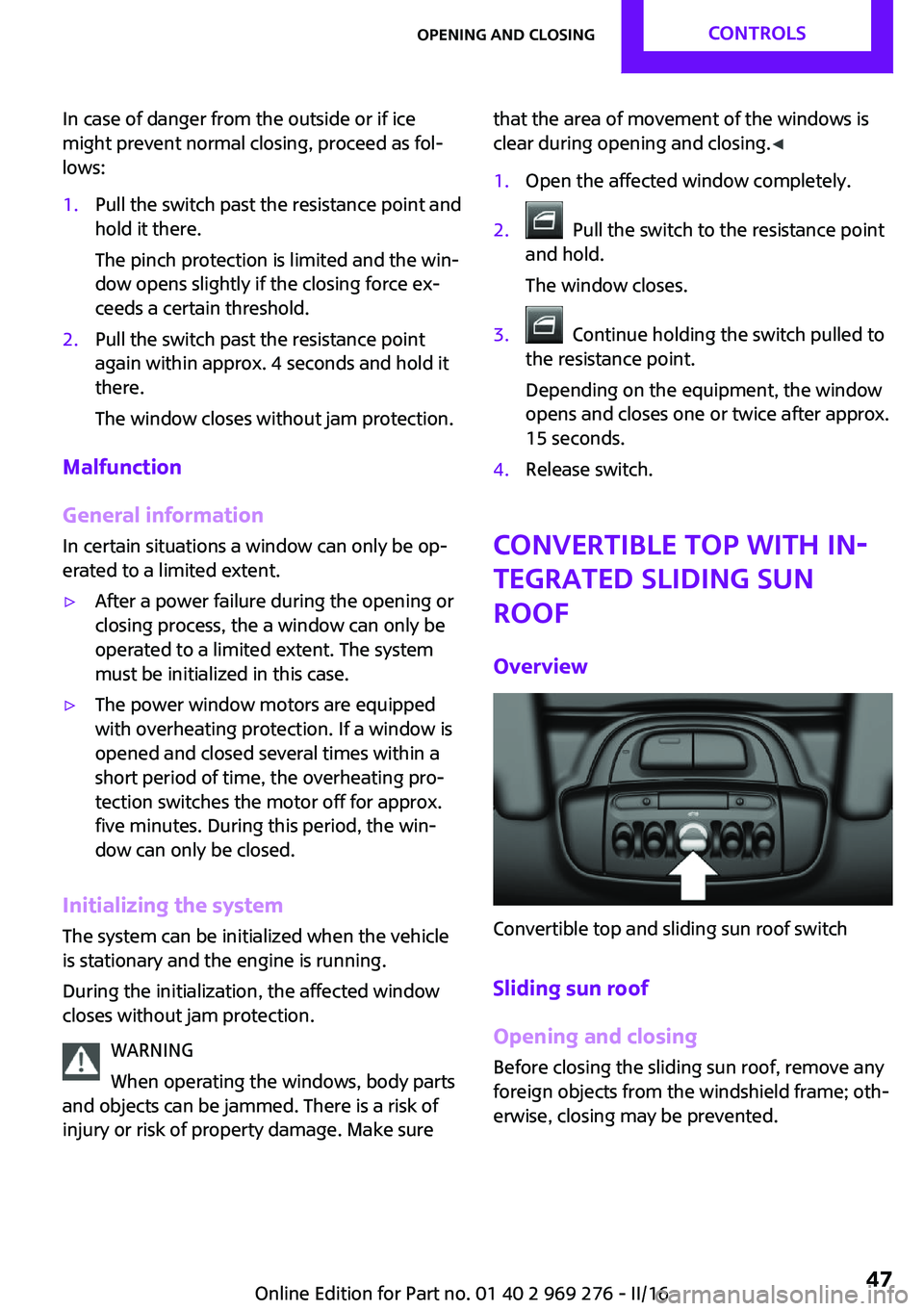
Convertible top and sliding sun roof switch
Sliding sun roof
Opening and closing Before closing the sliding sun roof, remove any
foreign objects from the windshield frame; oth‐
erwise, closing may be prevented.
Seite 47Opening and closingCONTROLS47
Online Edition for Part no. 01 40 2 969 276 - II/16
Page 48 of 252

Press the switch backward, until
the desired position is reached
or the sliding sun roof is fully open.
Press the switch forward, until
the desired position is reached or the sliding
sun roof is closed.
Convertible top
General information
The convertible top can be opened or closed at
speeds up to approx. 18 mph/30 km/h.
If the vehicle is accelerated above a speed of
approx. 18 mph/30 km/h while the convertible top is being moved, the convertible top move‐
ment stops.
Observe the following information:▷While the convertible top is moving, it is not
possible to open the tailgate.▷If possible, close the convertible top when
the vehicle is parked. A closed convertible
top protects it from weather-related dam‐
age and to some extent from theft.▷Even when the convertible top is closed,
only store valuables in the locked cargo
area.▷At higher speeds, vacuum produced in the
vehicle interior causes the convertible top
to begin to flutter. Increase the amount of
air via the automatic climate control so that
no vacuum is produced in the vehicle.▷It is not possible to start the engine and op‐
erate the convertible top simultaneously.
When the engine is started using the Start/
Stop button or using the Auto Start/Stop
function, the convertible top movement is
briefly interrupted.▷Opening a door interrupts closure of the
convertible top.▷When loading the cargo area, make sure
that the cargo does not push against thecargo area partition, refer to page 50,
from below.▷In order to protect the battery, move the
convertible top only when the engine is
running if possible.▷Before closing the convertible top, remove
any foreign objects from the windshield
frame; otherwise, closing may be pre‐
vented.
Information
▷The tailgate can normally not be opened if
the convertible top is not fully opened or
closed. Always open and close the converti‐
ble top completely.▷If possible, close the convertible top when
the vehicle is parked. A closed convertible
top protects it from weather-related dam‐
age and to some extent from theft.▷Even when the convertible top is closed,
only store valuables in the locked cargo
area.▷At higher speeds, vacuum produced in the
vehicle interior causes the convertible top
to begin to flutter. Increase the amount of
air via the automatic climate control so that
no vacuum is produced in the vehicle.▷It is not possible to start the engine and op‐
erate the convertible top simultaneously.
When the engine is started using the Start/
Stop button or using the Auto Start/Stop
function, the convertible top movement is
briefly interrupted.▷At temperatures below +14 ℉/-10 ℃, the
convertible top cannot be opened.▷Opening or closing a door interrupts closing
the convertible top.
CAUTION
Incorrect operation can damage the con‐
vertible top and other parts of the vehicle.
There is a risk of property damage. During op‐
eration, heed the following points:
Seite 48CONTROLSOpening and closing48
Online Edition for Part no. 01 40 2 969 276 - II/16
Page 49 of 252
▷Keep the area of movement of the conver‐
tible top clear because the convertible top
swivels out upward. Maximum area of
movement: 98.5 inches/2.5 meters.▷Do not leave the convertible top open for
more than a day while it is wet.▷Do not open the convertible top, if it is wet,
covered in snow, iced up, or dirty.▷Do not place objects on the convertible top.▷The rollover protection system may not be
triggered.▷Do not operate convertible top on uneven
sections of road.▷Always open or close the convertible top
completely. The convertible top is only
locked in the final positions.▷Make sure that no objects are on the cargo
cover when opening the convertible top. ◀
WARNING
When opening and closing the converti‐
ble top, body parts can be jammed, for exam‐
ple by the mechanism. There is a risk of injuries.
Make sure that the area of movement of the
convertible top is clear during operation. ◀
WARNING
When operating the convertible top while
driving, the view to the rear may be limited. At
speeds above 20 mph/30 km/h the convertible
top remains in its current position. There is a
danger of accidents and property damage.
When operating the convertible top while driv‐
ing, observe traffic attentively and if necessary,
reduce speed. Do not operate while backing up
or with wind. ◀
WARNING
The convertible top is not suitable for the
mounting of roof carrier systems. The roof car‐
rier could come loose. There is a risk of an acci‐
dent. Do not attach any roof carrier systems to
the convertible top. ◀
Functional requirements
The ignition or radio-ready state must be
switched on.
The following requirements must be fulfilled in
order to be able to move the convertible top.▷The cargo area partition is stored and
latched in the bottom position.▷The tailgate is closed.▷The external temperature is above
14 ℉/-10 ℃.▷The voltage of the vehicle electrical system
is sufficient.▷The convertible top drive is not overheat‐
ing.▷The vehicle speed is not too high.▷The windows can be lowered.
If this requirement is not met, a check control
message is displayed.
Opening and closing from the inside In order to protect the battery, move the con‐
vertible top only when the engine is running if
possible.
Before closing the convertible top, remove any
foreign objects from the windshield frame; oth‐
erwise, closing may be prevented.
Press the switch backward, until
the sliding sun roof is open.
Press the switch backward again.
The windows are rolled down,
and the convertible top opens as
longs as the switch is pressed. After the conver‐
tible top is completely open, the switch can be
held or pressed again briefly in order to raise
the windows.
Press and hold switch forward.
The windows are lowered, the
convertible top closes and the windows are raised again as long
as the switch is pressed.
Seite 49Opening and closingCONTROLS49
Online Edition for Part no. 01 40 2 969 276 - II/16
Page 51 of 252
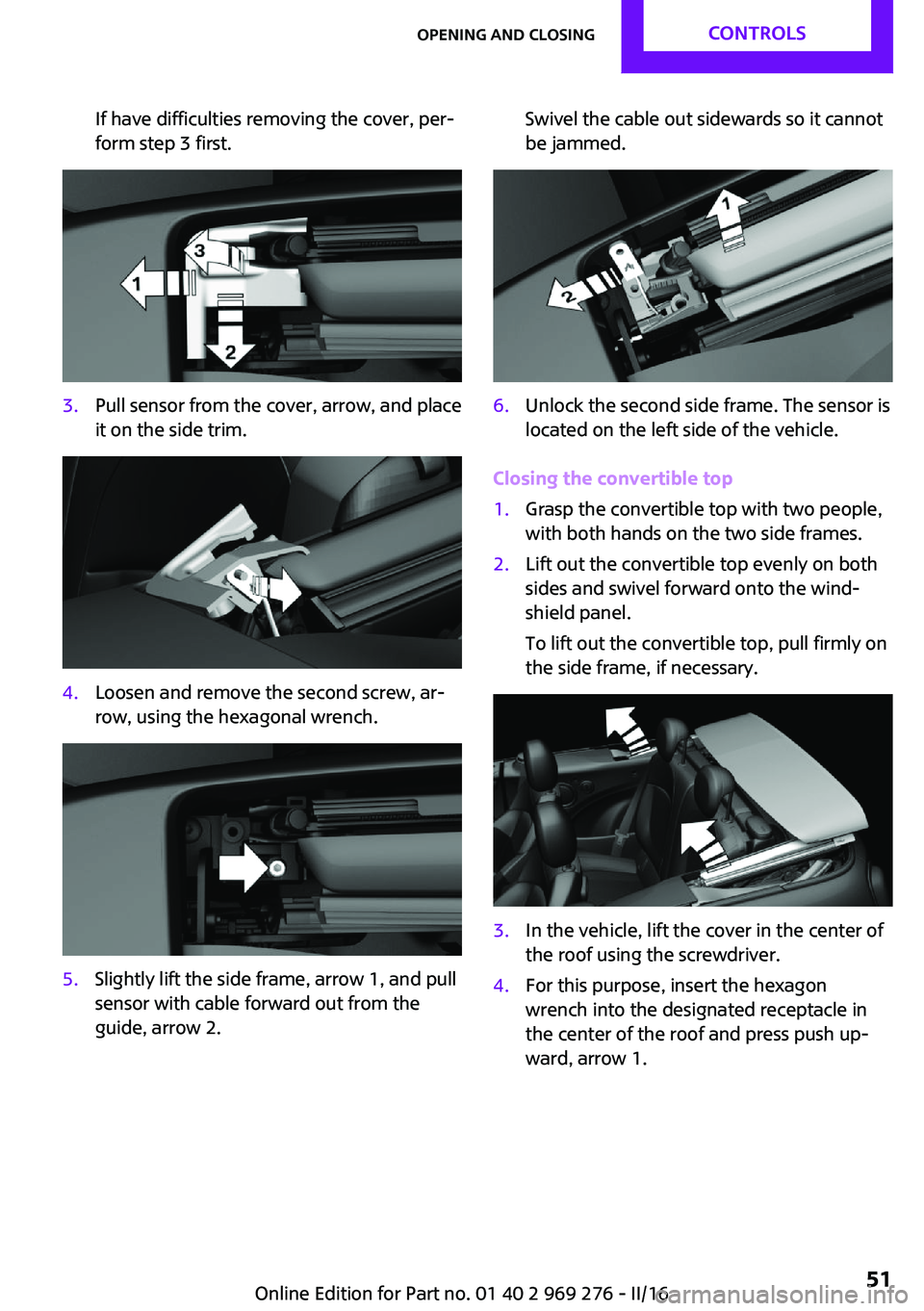
If have difficulties removing the cover, per‐
form step 3 first.3.Pull sensor from the cover, arrow, and place
it on the side trim.4.Loosen and remove the second screw, ar‐
row, using the hexagonal wrench.5.Slightly lift the side frame, arrow 1, and pull
sensor with cable forward out from the
guide, arrow 2.Swivel the cable out sidewards so it cannot
be jammed.6.Unlock the second side frame. The sensor is
located on the left side of the vehicle.
Closing the convertible top
1.Grasp the convertible top with two people,
with both hands on the two side frames.2.Lift out the convertible top evenly on both
sides and swivel forward onto the wind‐
shield panel.
To lift out the convertible top, pull firmly on
the side frame, if necessary.3.In the vehicle, lift the cover in the center of
the roof using the screwdriver.4.For this purpose, insert the hexagon
wrench into the designated receptacle in
the center of the roof and press push up‐
ward, arrow 1.Seite 51Opening and closingCONTROLS51
Online Edition for Part no. 01 40 2 969 276 - II/16
Page 52 of 252
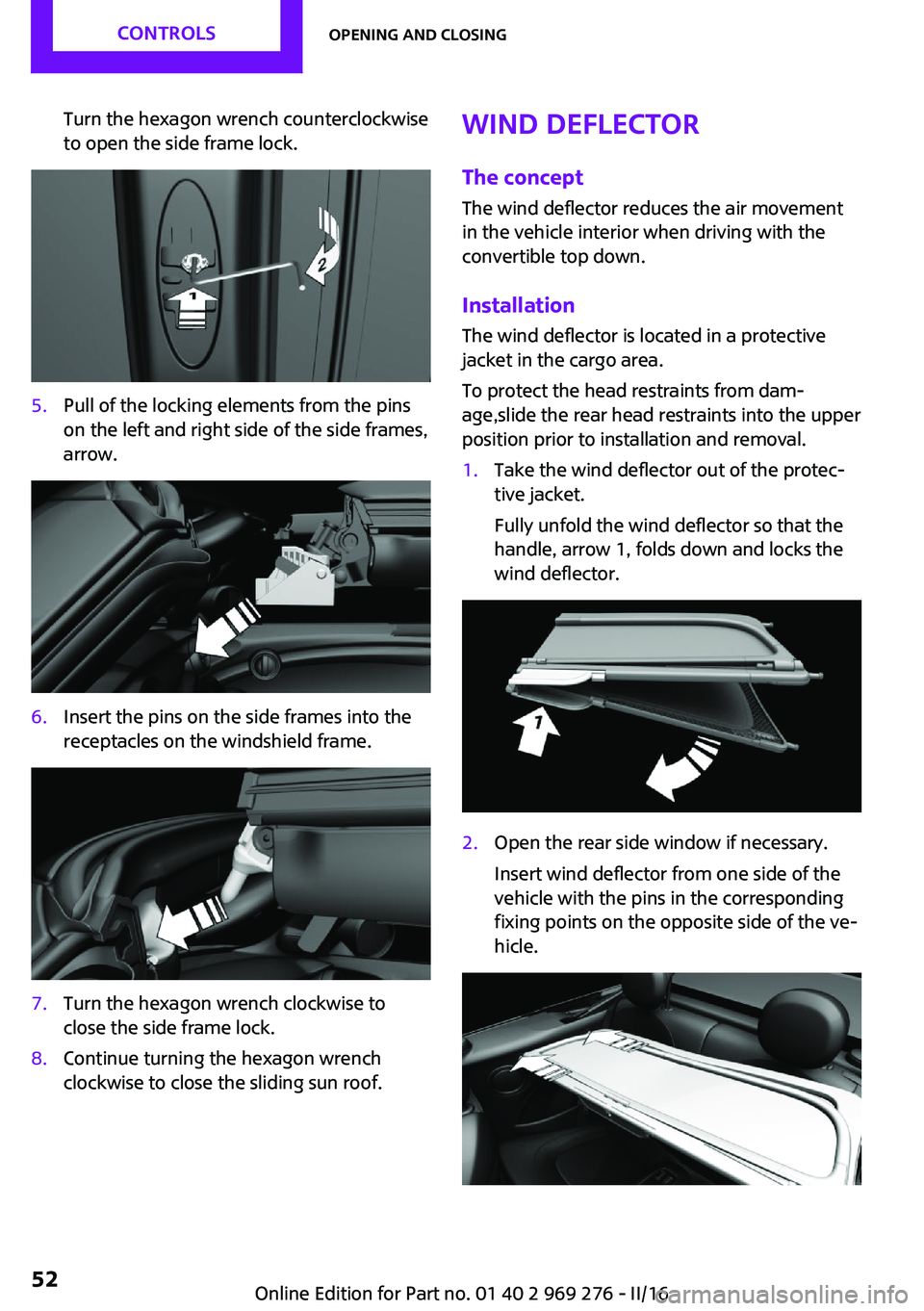
Turn the hexagon wrench counterclockwise
to open the side frame lock.5.Pull of the locking elements from the pins
on the left and right side of the side frames,
arrow.6.Insert the pins on the side frames into the
receptacles on the windshield frame.7.Turn the hexagon wrench clockwise to
close the side frame lock.8.Continue turning the hexagon wrench
clockwise to close the sliding sun roof.Wind deflector
The concept The wind deflector reduces the air movement
in the vehicle interior when driving with the
convertible top down.
Installation The wind deflector is located in a protective
jacket in the cargo area.
To protect the head restraints from dam‐
age,slide the rear head restraints into the upper
position prior to installation and removal.1.Take the wind deflector out of the protec‐
tive jacket.
Fully unfold the wind deflector so that the
handle, arrow 1, folds down and locks the
wind deflector.2.Open the rear side window if necessary.
Insert wind deflector from one side of the
vehicle with the pins in the corresponding
fixing points on the opposite side of the ve‐
hicle.Seite 52CONTROLSOpening and closing52
Online Edition for Part no. 01 40 2 969 276 - II/16
Page 167 of 252
General driving notes
Closing the tailgate WARNING
An open tailgate protrudes from the vehi‐
cle and can endanger occupants and other traf‐
fic participants or damage the vehicle in the
event of an accident, braking or evasive ma‐
neuvers. In addition, exhaust fumes may enter
the vehicle interior. There is a risk of injury or
risk of property damage. Do not drive with the
tailgate open. ◀
If driving with the tailgate open cannot be
avoided:▷If the convertible top is closed, close all
windows and the sliding sun roof.▷Greatly increase the air flow from the vents.▷Drive moderately.
Hot exhaust system
WARNING
During driving operation, high tempera‐
tures can occur underneath the vehicle body,
e.g., caused by the exhaust gas system. If com‐
bustible materials, such as leaves or grass,
come in contact with hot parts of the exhaust
gas system, these materials can ignite. There is
a risk of injury or risk of property damage.
Do not remove the heat shields installed and
never apply undercoating to them. Make sure
that no combustible materials can come in con‐
tact with hot vehicle parts in driving operation,
idle or during parking. Do not touch the hot ex‐
haust system. ◀
Mobile communication devices in the vehicle
WARNING
Vehicle electronics and mobile phones
can influence one another. There is radiation
due to the transmission operations of mobile
phones. There is a risk of injury or risk of prop‐
erty damage. If possible, in the vehicle's interior
use only mobile phones with direct connections
to an exterior antenna in order to exclude mu‐
tual disturbance and deflect the radiation from
the vehicle's interior. ◀
Hydroplaning On wet or slushy roads, a wedge of water can
form between the tires and road surface.
This phenomenon is referred to as hydroplan‐
ing. It is characterized by a partial or complete
loss of contact between the tires and the road
surface, ultimately undermining your ability to
steer and brake the vehicle.
Driving through water ATTENTION
When driving too quickly through too
deep water, water can enter into the engine compartment, the electrical system or the
transmission. There is a risk of damage to prop‐
erty. When driving through water, do not ex‐
ceed the maximum indicated water level and
the maximum speed for driving through wa‐
ter. ◀
When driving through water, observe the fol‐
lowing:▷Drive through calm water only.▷Drive through water only if it is not deeper
than maximum 9.8 inches/25 cm.▷Drive through water no faster than walking
speed, up to 3 mph/5 km/h.
Braking safely
Your vehicle is equipped with ABS as a standard
feature.
Perform an emergency stop in situations that require such.
Steering is still responsive. You can still avoid
any obstacles with a minimum of steering ef‐
fort.
Seite 167Things to remember when drivingDRIVING TIPS167
Online Edition for Part no. 01 40 2 969 276 - II/16
Page 178 of 252
Display
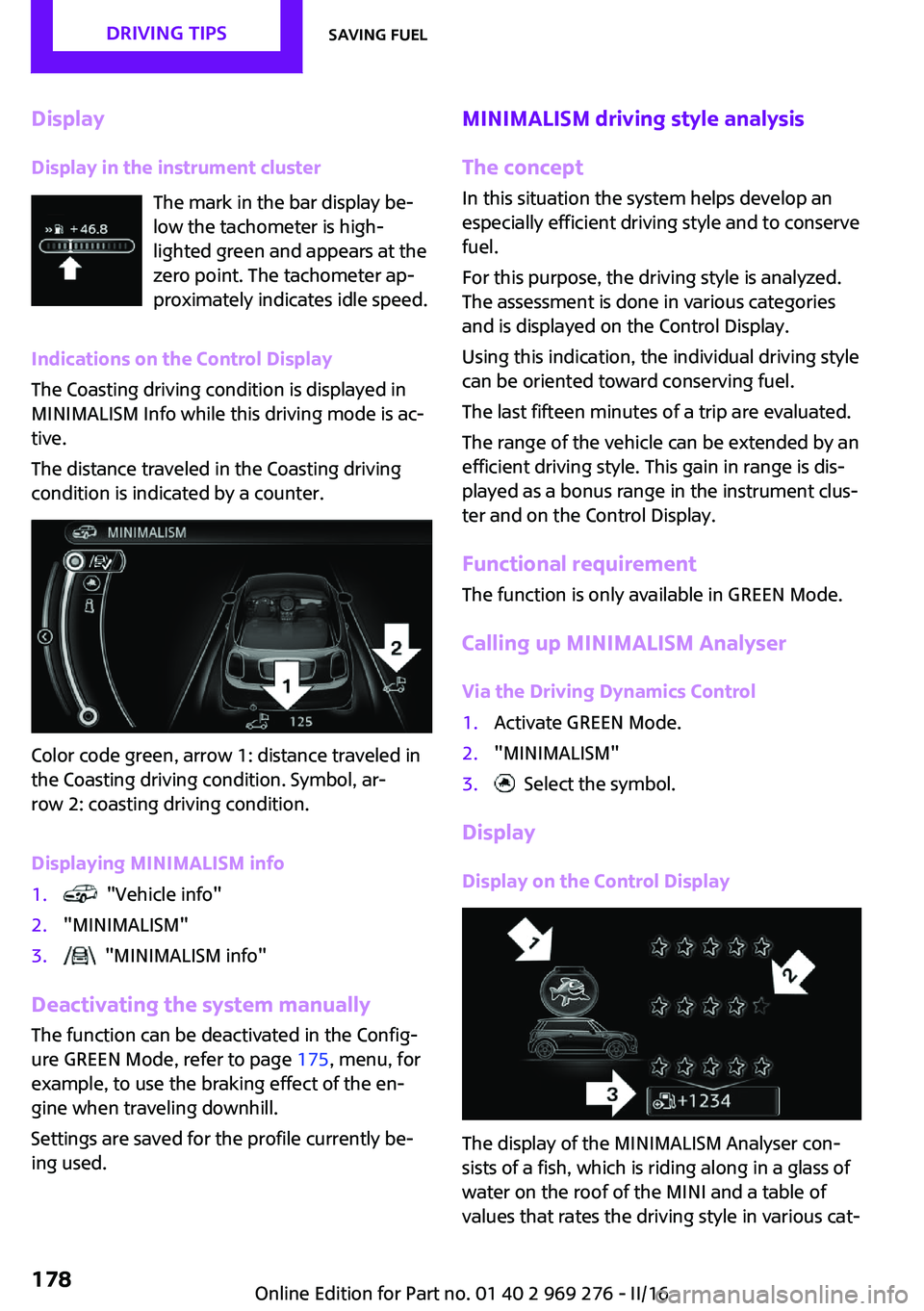
Display in the instrument cluster The mark in the bar display be‐
low the tachometer is high‐
lighted green and appears at the
zero point. The tachometer ap‐
proximately indicates idle speed.
Indications on the Control Display
The Coasting driving condition is displayed in
MINIMALISM Info while this driving mode is ac‐
tive.
The distance traveled in the Coasting driving
condition is indicated by a counter.
Color code green, arrow 1: distance traveled in
the Coasting driving condition. Symbol, ar‐
row 2: coasting driving condition.
Displaying MINIMALISM info
1. "Vehicle info"2."MINIMALISM"3. "MINIMALISM info"
Deactivating the system manually The function can be deactivated in the Config‐
ure GREEN Mode, refer to page 175, menu, for
example, to use the braking effect of the en‐
gine when traveling downhill.
Settings are saved for the profile currently be‐
ing used.
MINIMALISM driving style analysis
The concept
In this situation the system helps develop an
especially efficient driving style and to conserve
fuel.
For this purpose, the driving style is analyzed.
The assessment is done in various categories
and is displayed on the Control Display.
Using this indication, the individual driving style
can be oriented toward conserving fuel.
The last fifteen minutes of a trip are evaluated.
The range of the vehicle can be extended by an
efficient driving style. This gain in range is dis‐
played as a bonus range in the instrument clus‐
ter and on the Control Display.
Functional requirement
The function is only available in GREEN Mode.
Calling up MINIMALISM Analyser Via the Driving Dynamics Control1.Activate GREEN Mode.2."MINIMALISM"3. Select the symbol.
Display
Display on the Control Display
The display of the MINIMALISM Analyser con‐
sists of a fish, which is riding along in a glass of
water on the roof of the MINI and a table of
values that rates the driving style in various cat‐
Seite 178DRIVING TIPSSaving fuel178
Online Edition for Part no. 01 40 2 969 276 - II/16
Page 228 of 252
Follow the following instructions:▷Clean roofliner with a microfiber cloth.
Dampen cloth lightly with water.▷Do not soak the roofliner.▷To prevent water stains, mildew spots, and
chafe marks, do not enclose the convertible
top in the convertible top well for a long
period and do not fold and stow the con‐
vertible top in the convertible top well
while the top is wet or frozen.▷Remove water stains that may nevertheless
have appeared on the roofliner using a mi‐
crofiber cloth and an interior cleaner.▷When the vehicle is parked in enclosed
areas for lengthy periods, ensure that the
area is well ventilated.▷If possible, park the vehicle in the shade to
protect it from intensive solar radiation so
that color, rubber and fabric are not af‐
fected.▷Remove bird droppings immediately as
their corrosive effect will otherwise attack
the convertible top and damage the rubber
seals.▷Hard to remove tree sap or bird droppings
can be removed from the convertible top
with special tree sap remover and a soft
brush.
CAUTION
Spot remover, paint thinner, solvents,
gasoline or similar can damage the convertible
top or the rubber coating. There is a risk of
property damage. To remove spots on the con‐
vertible top, use only suitable cleaning agents,
for example special convertible top cleaning
agent. ◀
To remove heavy soiling, especially for light col‐
ored convertible tops, use a special convertible
top cleaner.
Proceed as follows:
1.Spray the convertible top with the converti‐
ble top cleaner.2.Make the convertible top cleaner foam up
using a well saturated sponge, moving it in
circular motions.3.Finish washing the vehicle in the car wash
or rinse with ample amounts of water.
Otherwise, follow the instructions for use from
the manufacturer.
Treat the convertible top with an impregnating
agent after it has been washed three to five
times.
Suitable cleaners and car products can be ob‐
tained from the service department.
Leather care Remove dust from the leather often, using a
cloth or vacuum cleaner.
Otherwise, particles of dust and road grime
chafe in pores and folds, and lead to increased
wear and premature degradation of the leather
surface.
To guard against discoloration, such as from
clothing, clean leather and provide leather care
roughly every two months.
Clean light-colored leather more frequently be‐
cause soiling on such surfaces is substantially
more visible.
Use leather care products; otherwise, dirt and
grease will gradually break down the protective
layer of the leather surface.
Suitable care products are available from a
dealer’s service center or another qualified
service center or repair shop.
Upholstery material care
Vacuum regularly with a vacuum cleaner.
If upholstery is very dirty, for example, with
beverage stains, use a soft sponge or micro‐
fiber cloth with a suitable interior cleaner.
Clean the upholstery down to the seams using
large sweeping motions. Avoid rubbing the ma‐
terial vigorously.
Seite 228MOBILITYCare228
Online Edition for Part no. 01 40 2 969 276 - II/16
Page 229 of 252
ATTENTION
Open Velcro® fasteners on articles of
clothing can damage the seat covers. There is a
risk of damage to property. Ensure that any
Velcro® fasteners are closed. ◀
Caring for special components Light-alloy wheels
When cleaning the vehicle, use only neutral
wheel cleaners having a pH value from 5 to 9.
Do not use abrasive cleaning agents or steam
jets above 140 ℉/60 ℃. Follow the manufac‐
turer's instructions.
Aggressive, acidic or alkaline cleaning agents
can destroy the protective layer of adjacent
components, such as the brake disk.
Chrome surfaces
Carefully clean components such as the radia‐
tor grille or door handles with an ample supply
of water, possibly with shampoo added, partic‐
ularly when they have been exposed to road
salt.
Rubber components Environmental influences can cause surface
soiling of rubber parts and a loss of gloss. For
cleaning, use only water and suitable care
products, the manufacturer of your vehicle rec‐
ommends original MINI care products.
Treat especially worn rubber parts with rubber
care agents at regular intervals. When cleaning
rubber seals, do not use any silicon-containing
car care products in order to avoid damage or
noises.
Fine wood parts Clean fine wood facing and fine wood compo‐
nents only with a moist rag. Then dry with a
soft cloth.
Plastic components
These include:▷Imitation leather surfaces.▷Roofliner.▷Lamp lenses.▷Instrument cluster cover.▷Matt black spray-coated components.▷Painted parts in the interior.
Clean with a microfiber cloth.
Dampen cloth lightly with water.
Do not soak the roofliner.
ATTENTION
Cleansers that contain alcohol or solvents,
such as lacquer thinners, heavy-duty grease re‐
movers, fuel, or such, can damage plastic parts.
There is a risk of damage to property. Clean
with a microfiber cloth. Dampen cloth lightly
with water. ◀
Safety belts Dirty belt straps impede the reeling action and
thus have a negative impact on safety.
WARNING
Chemical cleansers can destroy the safety
belt webbing. Missing protective effect of the
safety belts. There is a risk of injury or danger to
life. Use only a mild soapy solution for cleaning
the safety belts. ◀
Use only a mild soapy solution, with the safety
belts clipped into their buckles.
Do not allow the switchs to retract the safety
belts until they are dry.
Carpets and floor mats WARNING
Objects in the driver's floor area can limit
the pedal distance or block a depressed pedal.
There is risk of an accident. Stow objects in the
vehicle such that they are secured and cannot
enter into the driver's floor area. Use floor mats
that are suitable for the vehicle and can be
safely attached to the floor. Do not use loose
Seite 229CareMOBILITY229
Online Edition for Part no. 01 40 2 969 276 - II/16